

As pharmacies close and queues grow, Dorset’s official assessment says provision is ‘sufficient’ – a conclusion many rural patients would dispute

Community pharmacies are a lifeline in towns and villages across the nation – many do significantly more than dispense prescription drugs. Pharmacists give advice on minor health problems, administer flu jabs, and sell health-related items. However, when Jhoots recently closed its doors in Dorset (and other parts of the South West), the gap in service was evident. So why are there issues with the pharmacy service? Are there enough community pharmacies in rural Dorset?
Dorset Council has recently published its Community Pharmaceutical Needs Assessment – the document that decides where pharmacy services are considered viable, and where they are not. Those people who have spent time queuing in their local chemist, especially with the recent issues with Jhoots, are probably curious about provision for their area.
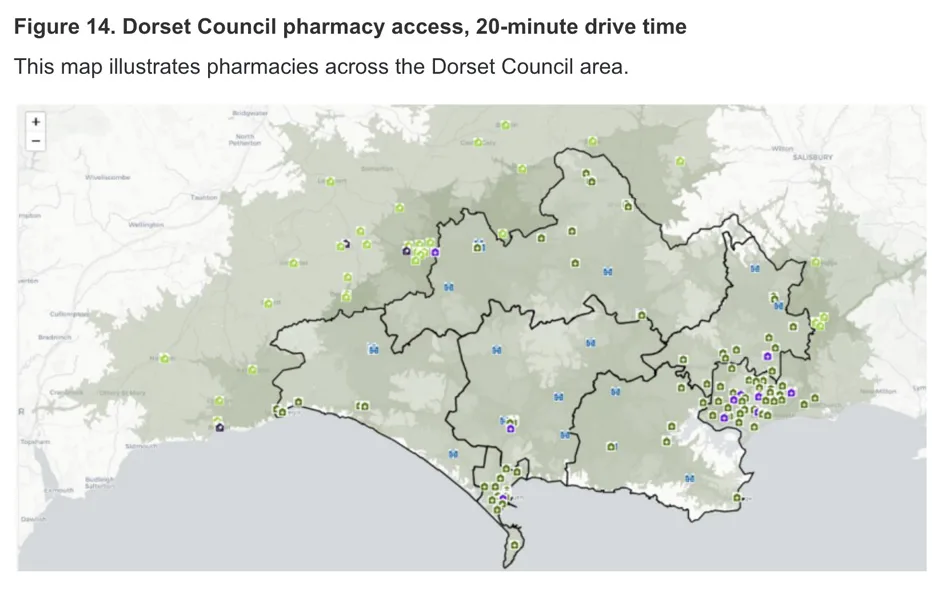
One of the key measures used is travel time. Nationally, the benchmark is that 99 per cent of residents should be able to reach a community pharmacy within 20 minutes by car – a standard Dorset Council has adopted for this assessment.
The report assumes that high levels of car ownership – and the council’s view that areas with lower car ownership are located near pharmacies – mean access is ‘practical and achievable’ for most residents. That assumption would seem laughable to those without transport, or reliant on sporadic rural public transport.
Are there enough pharmacies in the county?
The needs assessment identified 132 pharmacies across Dorset (66 in Bournemouth, Christchurch and Poole, and 66 in the Dorset Council area), with the majority clustered in urban centres alongside GP surgeries.
In North Dorset, seven community pharmacies were mapped, alongside GP dispensing practices which are included in the access calculation. On that basis – using a 20-minute car journey as the defining measure – the council’s steering group concluded that Dorset has ‘sufficient’ pharmacy provision, a finding that is likely to surprise many residents who have recently queued, travelled long distances or gone without their prescription.
A complex business
Richard Brown is the Chief Officer at Community Pharmacy Dorset, the group that works on behalf of pharmacies in the county, negotiating contracts and giving advice on pharmaceutical services.
‘By its very nature, rural areas don’t have many people. So who would pay for more pharmacies? There has to be a level of business thinking in these decisions because a pharmacy is a business, and needs to be viable,’ says Richard Brown.
‘Everyone in a village would love a pharmacy, but that doesn’t mean they would use it regularly. It’s always interesting how they get grocery items – they get them from somewhere, and it isn’t always the village shop.
’Jhoots was a successful business in the Midlands for several years. The owners are not amateurs, and bought their pharmacies in good faith.
‘There is chronic underfunding in the pharmacy service. If two pharmacies in Shaftesbury were struggling, think about what that would be like in a rural village. It costs a minimum of £250k a year to run a pharmacy because of the overheads, alongside staff wages, having secure IT systems … although the Government says there has been an increase in pharmacy funding, most of that has been absorbed in National Insurance increases.’
While it seems a simple process for people to go to pharmacies with their prescriptions, what goes on behind the scenes is revealing. Opening a pharmacy is tightly regulated. A provider must prove there is an unmet ‘need’ – even in communities already struggling to access services. Medication is sourced from suppliers and there is a variable price which can affect profit margins, especially where there are shortages of drugs. Richard gave an example: ‘During the winter of 2024, the price of a single box of penicillin rose to £20 because it was in short supply – that cost had to be absorbed by the pharmacy. For each prescription item dealt with, the NHS pays the pharmacy £1.46. The whole funding structure is chronically insufficient and has not been changed to address rising costs. To get pharmacies funded correctly would probably require an increase of 1% in National Insurance costs from each adult in the country. But if a pharmacy stopped giving out medications where they are making a loss, there would be deaths.’
Heading online
Local Gillingham social media groups have for months been awash with long threads of complaints as the Barn Surgery Pharmacy closed and the town’s remaining chemists have struggled to keep up with the demand. Many residents say they have simply given up and switched to online services – not by choice, but through exhaustion. Derek Day from Okeford Fitzpaine uses Pharmacy2U to help him manage a chronic health condition.
‘My GP automatically sent the prescription to Boots, and I assumed they were dealing with it. But when I went to collect it two or three days later it hadn’t been processed. They said it would be ready in an hour or two, but when I went back they hadn’t got the tablets I needed. I need to keep my blood pressure under control, and need to take tablets on time so I started using Pharmacy2U. I haven’t had an issue since, and the medication is delivered to my door.’
Other pharmacies are providing services, such as free delivery at the NHS pharmacy at Blandford, to support local people who may not drive. Allied Pharmacy will be taking over most of the pharmacies previously owned by Jhoots, including those in Lyme Regis, Bridport, and Shaftesbury, but will the inherited issues be resolved, given the chronic underfunding in the sector?
MP for West Dorset, Edward Morello, comments in The BV this month: ‘I received the fantastic news that Allied Pharmacy had agreed to take over and re-open the pharmacy in Lyme Regis, bringing to an end the long-running Jhoots saga and meaning residents would once again have a local service. The resilience and strength shown by the staff, who have gone months without pay, was a sight to behold.’
Pharmacy services are complex small businesses. One of the key issues to emerge from the recent Jhoots problems in Dorset was the plight of the staff, who worked unpaid for months but continued to support the patients. The recent chaos has exposed a system held together not by funding or policy, but by staff who continued to show up – unpaid, overstretched and deeply committed – because they knew patients were relying on them.
Dorset residents can read the Pharmaceutical Needs Assessment in full here