

Bovine TB dominates farm life, George Hosford says, as flawed testing and policy inertia persist (and January rain only adds to the pressure)
The total rainfall on the farm for January is 313mm – 12 and a half inches in old money. The previous monthly record was 304mm in January 2014, and all other months since 1985 pale into insignificance. It’s no wonder springs have broken all over the place, and many people are spending a lot of time filling sandbags, hiring pumps and nervously checking their insurance policies. The Blandford area seems to have been hit quite hard: the town centre has been closed off by flooded roads for several days, and the Stour rose to a level this week that we’ve not seen in many years.
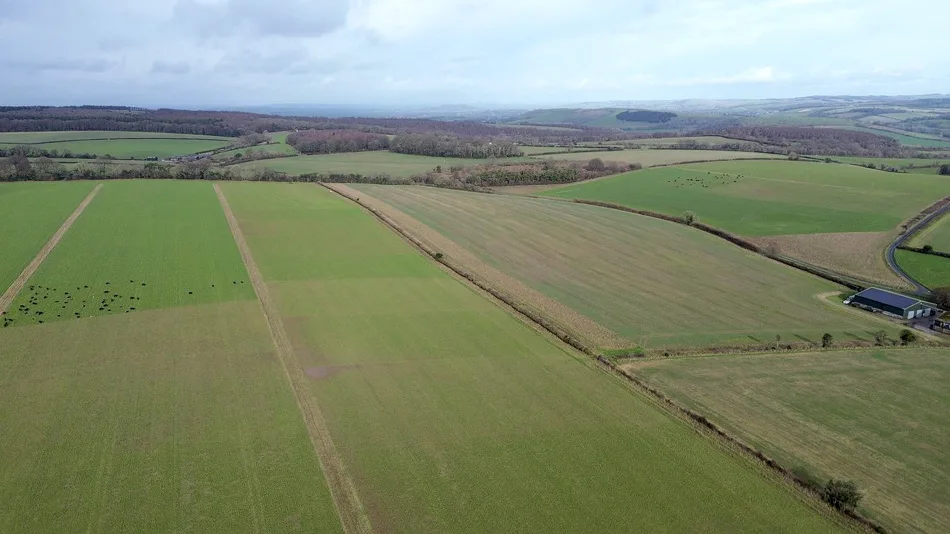
In the image above, two groups of youngstock are marching across the broad acres of cover crops in fields destined for spring cropping this year (the black dots are the cattle). They spend a day on the plot, approximately a hectare, and then very happily move on when the fence is opened for them. The fresh grazing every day, where the animals can choose what to eat from a multi-species mixture, does them very well – they are not fed anything else such as silage, hay or straw.
This approach last year led to all animals gaining weight over winter, which was not the case before we began this regime. Previously they would have been on a maintenance ration of hay or silage, plus a thin strip of turnips every day. Not so good for the land, which would get badly poached, or for the animals, who spent months standing in mud. There is an awful lot of electric fencing needed to graze the cattle like this, but Brendan takes it on with great gusto come rain or shine (if he counted the miles perhaps there should be an award in it!).
On our particular patch of Dorset the ungrazed land on our chalk-based soils drains well, even after the recent heavy rainfall, so moving the animals onwards daily minimises poaching. Farmers on heavy clay may weep to read this: they have no alternative but to house their livestock over winter, and feed them with stored forage.
The unrepentant group at the bottom clearly got fed up with the miserable cold rain this afternoon though (Sunday 1st) – they broke out through the electric fence, and were only noticed when they arrived in the yard at Shepherds Corner, clearly keen to get indoors with their mothers. Sorry chums, it’s back to the field for you!
TB time
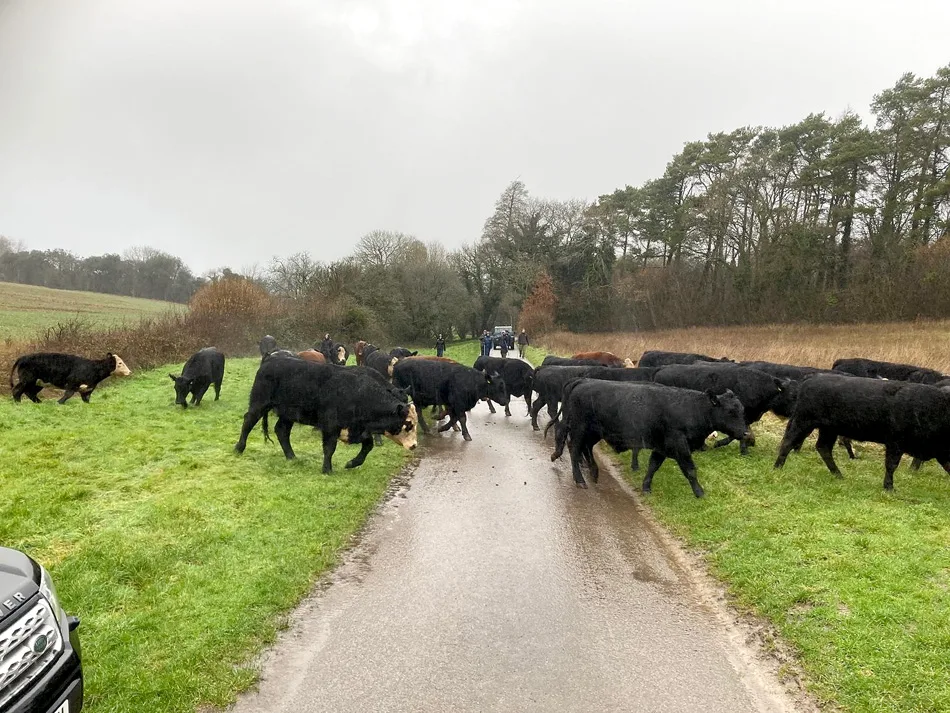
Theo and Mr Red, our bulls, make do with hay, some light grazing when it’s not too wet, and a pound of grass nuts every day to keep them sweet – particularly important come TB testing day, which we had to face once again a fortnight ago. The ‘Inconclusive’ animal from the previous test 60 days ago was once again declared an IR – so now becomes a full Reactor – which is, to be frank, a death sentence.
The same was pronounced out of the blue for another animal, in a different group, and he obviously took a pretty dim view of the decision. On the day the death wagon rolled up, he couldn’t be seen for dust (well, mud), and led the team on a 4½ mile steeplechase around the farm, ending up back with his original group. After ten days away with a stranger – the other inconclusive reactor – he still knew exactly where his herd was.
Cattle psychology is rightly being studied more closely, as these poor animals are forced to endure the blunt tools of the response to a disease which the dim humans seem so utterly incapable of getting rid of.
We can put men on the moon, we can ‘undress’ pictures of people on grossly unpleasant social media platforms, but when it comes to TB in cattle, we are still using a test invented in the 1890s as the first line of defence in rooting out infected animals from our herds.
The SICCT skin test is very good at telling you if you have TB in your herd, but is hopeless at telling you which animals are infected, leaving on average 20 to 25% of infected animals undetected. This is the same test which is used pre-movement to tell you whether animals you plan to buy from other farms are clear of TB prior to bringing them into your own herd …
What could possibly go wrong?
Looking for a way forward
The NFU has helped to set up a new TB management group in Dorset, and other counties, in the aftermath of the badger cull, to take advantage of the (temporarily) lower badger numbers, and to encourage farmers to take advantage of the things that they can control, rather than agonise over the things that they can’t. There are other tests available, though they come at private cost and with no government compensation for any TB reactors they detect that weren’t picked up by official testing. Biosecurity measures can also help – protecting cattle from infection by badgers or by other livestock, such as neighbouring animals over a fence or escapees from nearby farms.
One promising approach is to closely study the lump sizes recorded during previous TB tests. These can be used to rank animals by risk, allowing farmers to manage higher-risk cattle in separate groups – or cull them earlier than they otherwise might. The size of the lump in response to the TB test is a good indicator of the animal’s immune reaction, indicating prior exposure to the TB organism.
There’s also the IBTB online service, which lets farmers check the TB status of holdings they might be buying replacements from. That cow farmers do not all operate closed herds in the TB era completely stumps me: buying in cattle for your herd is like Russian roulette, you have no idea which barrel is loaded.
As the vet leading last week’s meeting pointed out however, those of us who THINK we operate a closed herd, probably aren’t.
Even if you use AI (artificial insemination, not intelligence!) on all of your cows, and breed all your own replacements, can you really call yourself a closed herd if you have neighbours with cows, or badgers on your farm, or even deer, which also carry TB?
A different route
Our motivation, as a Dorset group, is simple: to ease the burden of this disease in any way we can, and to bring together everyone with a stake in it – in the hope of finding a realistic way forward.
Right now, we’re heading backwards again, despite the earlier drop in outbreaks that followed the badger cull. What that cull showed was that reducing badger numbers can cut the number of new TB infections – but only by around 50%. That makes it just one part of any long-term strategy. And let’s be honest: it’s highly unlikely to happen again. So we need a different route.
Top of the list is getting DEFRA to reassess its approach. The current 25-year TB ‘eradication’ plan is clearly a bad joke – for all the reasons already mentioned. The department must be willing to continually review new tests, new science, and the changing shape of the cattle industry itself.
Frankly, I don’t understand why we still have a category called ‘inconclusive reactor’, or why we persist with both standard and severe interpretations of lump sizes.
The severe version is used where TB is strongly suspected or already confirmed – but if an animal reacts to the test and produces a lump, that means it has been exposed to TB, and poses an ongoing risk to the rest of the herd.
The problem, of course, is that TB is now so deeply embedded in so many herds that removing every animal with a lump – however small – would cause chaos. And it would cost a fortune. So the can keeps getting kicked further down the road.
If we really want to see an end to TB we need to take the disease seriously and prescribe some very painful and expensive medicine. And by this I don’t mean a vaccine – the nature of the disease makes this very difficult and a long way in the future.
If you’re then naturally asking me why we’re vaccinating badgers against TB, my answer is that it is simply a very cynical, expensive and dishonest political gesture.
This is a condensed version of George’s farm diary. See the unabridged version on his blog viewfromthehill.org.uk