

Pussy willow catkins are among late winter’s most generous and quietly important natural wonders, says Jane Adams
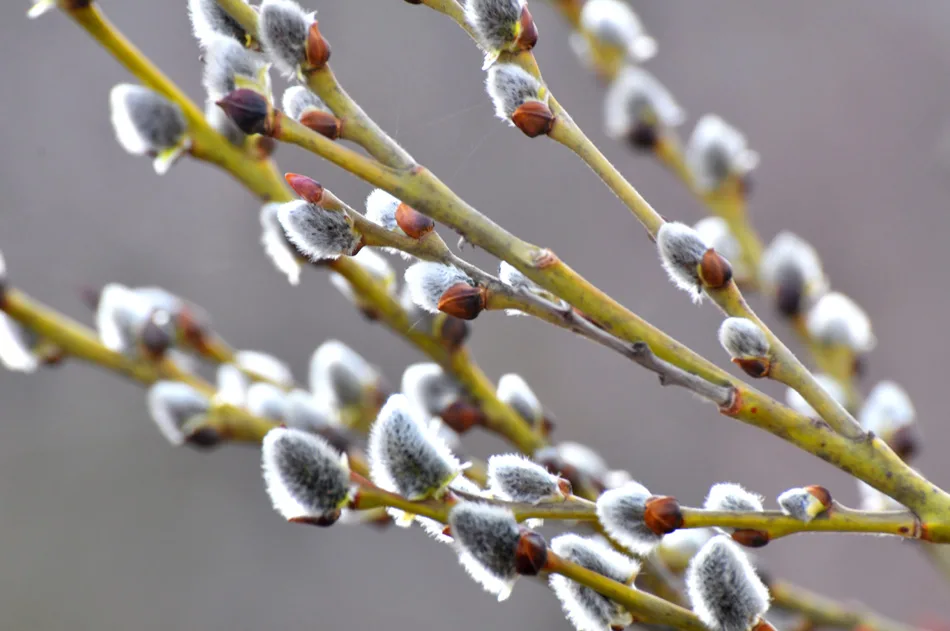
When did you last stop to look closely at a catkin? We usually think of the strange blooms as the dangly swaying yellow threads which hang from several species of shrub and tree at this time of year … but pussy willow is by far my favourite catkin. The soft, furry buds grow on goat willow (Salix caprea), and they look and feel just like the paws of a tiny kitten – hence their pussy willow nickname.
As a child, I adored the book Pussy Willow, written by the American author Margaret Wise Brown. It told the story of a small, fluffy kitten exploring the changing seasons in search of her namesake. A frog eventually tells her she will find the pussy willow when the small birds sing, the sun shines warm, and the frogs ‘peep’.
A wise frog – though, for the record, Dorset frogs definitely ‘croak’ rather than ‘peep’!
Sadly, willows are woefully overlooked, despite there being around 20 species in the UK. Perhaps it’s because they aren’t as long-lived as oaks, or as showy as horse chestnuts. Yet goat willow can reach ten metres in height, and the oldest specimens may live for up to 300 years. Straggly, but still beautiful.
The humming tree
It’s not as if humans haven’t found willow useful across the millenia. Its branches have been woven into wattle for house building for more than 6,000 years, while its bark’s pain-relieving properties were known long before Felix Hoffmann isolated the active compound in 1897 and it was marketed as Aspirin.
But it’s insects that really go wild for this understated tree. Willows have been found to support more than 450 species of insect, from 162 butterflies and moths to 104 bees and wasps. Add over 150 species of lichen, and it’s easy to see just how vital these trees are to the natural world.
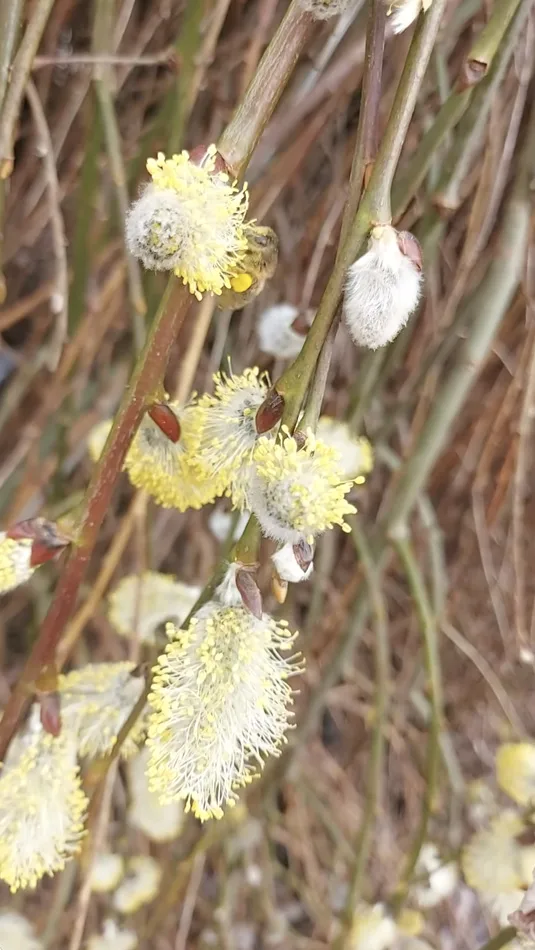
Goat willow is dioecious, meaning male and female catkins appear on separate trees. By mid-to-late February, male catkins are at their fluffiest, weighed down with pollen and nectar. Female catkins are less kitten-like, but still offer essential nectar. Unlike the dangly yellow hazel catkins, which rely on the wind for pollination, goat willow depends on insects, especially bees. On a sunny, calm day, a flowering willow will literally hum with bumblebees, solitary bees, honeybees and hoverflies. Later, when its rounded, curly-tipped leaves appear, they are food for many moth and butterfly caterpillars, with the purple emperor perhaps its most regal and rare diner.
In medieval times, people brought branches of pussy willow indoors to ward off evil spirits – a tradition that feels worth reviving in our troubled times. For now, though, I’ll listen for the frogs and follow in the footsteps of that childhood kitten, stopping every so often to feel the softness of pussy willow’s paws.