

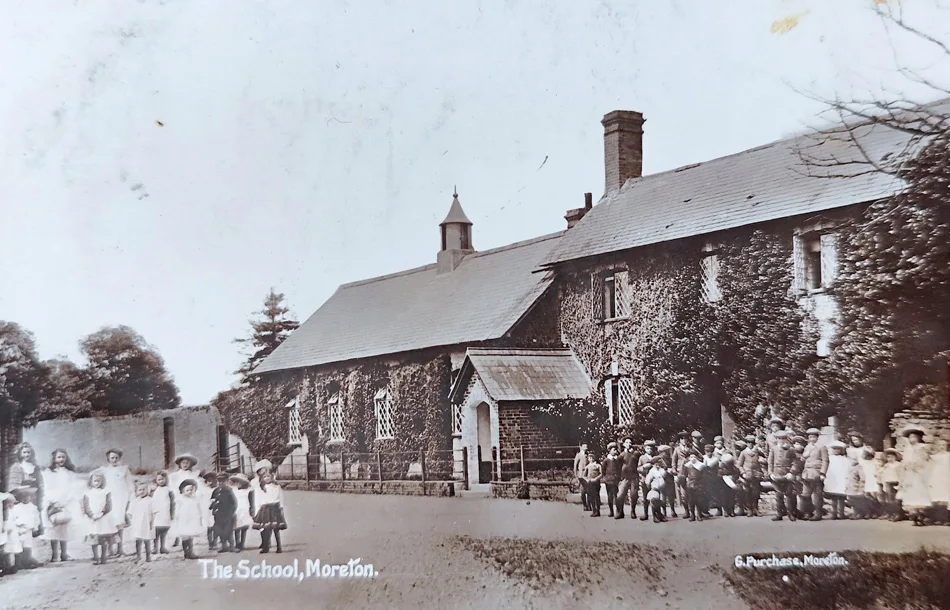
This month Barry has selected a postcard of Moreton School, sent in 1911 (right). The letter that follows was written by Hermann Lea, one of the village’s most notable early 20th century residents. A close friend of Thomas Hardy, Lea was both a writer and an accomplished photographer, working with Hardy to document the real landscapes behind Wessex. He published A Handbook to the Wessex Country of Thomas Hardy’s Novels and Poems in 1905 and later Thomas Hardy’s Wessex. Born in Bristol in 1860, Lea later moved to Dorset and built his house in Moreton, naming it Var Trees – later Vartrees – at Hardy’s suggestion. He seems to have become a regular contributor to local newspapers: a search of the archives shows him to have been an active correspondent, and the following letter, concerning the state of his local roads, appeared in the Western Gazette in July 1912, just a year after the above postcard was sent. It makes strikingly familiar reading in Dorset today …
THE SCANDALOUS WASTE OF PUBLIC MONEY.
To the Editor of the
Western Gazette,
Sir, —My attention has just been called to a notice in your issue of the 2lst, in which it is stated that I made a complaint regarding the condition of the roads near Moreton,
That is correct. I am further credited with a withdrawal of this complaint since “the recent rains.”
Here, however, there enters a slight inaccuracy, or at least a misunderstanding. The tracks in this neighbourhood – tracks which are by courtesy only termed roads – are always less impassable after heavy rain, but it must be borne in mind that this improvement is of a temporary nature only, and that, after a few hours of wind and sunshine, they quickly relapse into their normal condition.
My letter of complaint was addressed to the County Council, and one of their surveyors came here very promptly to inspect the tracks in question. After seeing him I discovered that there were at least four bodies responsible for the upkeep of these tracks,
their responsibilities being divided in a somewhat complicated manner.
Thus, a few yards came under the guardianship of A. Then B took over the responsibility for a short distance. A entered once more. C had a look in here and there, and D appeared to superintend such portions as the others ignored or repudiated.
In my letter of complaint I stated that some portions of these roads were absolutely dangerous, and this fact I am prepared to maintain today – in spite of “the recent rains”. No one who has the least respect for their tyres would venture to drive over these tracts of road: and I can name a dozen people who have told me they invariably walk and push their cycles rather than risk the punctures which would almost inevitably follow if they rode.
If I want to drive a car to Puddletown (a distance of four and a-half miles), I go via Affpuddle (a distance of nearly 10 miles). If I want to drive to Dorchester – now, to-day, since “the recent rains” – I am constrained to avoid the direct road (six miles), also the road through Woodsford (seven and a-half miles), and am forced to go via Broadmayne (a distance of nine miles).
This is somewhat annoying, certainly: but the most irritating factor is the scandalous waste of money due to the inadequate way in which it is expended on what is facetiously termed *the upkeep of the roads!”
I do not wish to pose as an expert on road-making, but 1 do claim to possess a slight amount of common-sense, a possession shared in the main by the labourers who draw the gravel. Let us glance for a moment at the methods chiefly in vogue. The gravel appears to be selected mainly from pits which produce clean stone eminently suitable for concrete work. It is carted and spread on the road. It is then either rolled with a heavy roller designed for rolling in granite, or else it is left to work its own way in by the help of passing wagons, carriages, motor-cars, and bicycles.
Where it is rolled the stone is quickly and efficiently reduced to a fine sandy powder. The sun shines, the wind blows, and away goes the road in clouds of dust. Or it rains, and this same dust is washed into the ditches. In the case of such sections as are not rolled, the same process is repeated, but more gradually. The wheels gradually wear two comparatively smooth hollows.
Then a man is detailed to rake the unpulverized stones into these grooves, and they are in time reduced to impalpable dust and borne away by wind and rain.
The ratepayers’ money is thus spent in a perfectly reckless manner. It would be far cheaper in the long run if a larger initial sum were spent and the road made properly in a workmanlike manner. I make this statement emphatically, and I defy any practical man to prove my contention wrong. Meanwhile we muddle on and grumble, and grumble and muddle on.
I am not attempting to place the blame on any individual member of the various Councils, nor on any individual of their staff. I merely state that the methods employed are unscientific, antiquated, provedly inadequate, and disgracefully expensive.
Should there be any sceptical readers either amongst the Council or the men in the street, I should be pleased to act as showman and to point out the sections of road referred to.
I am, Sir, yours faithfully.
HERMANN LEA.
Var Trees, Moreton, Dorchester, 9th July, 1912
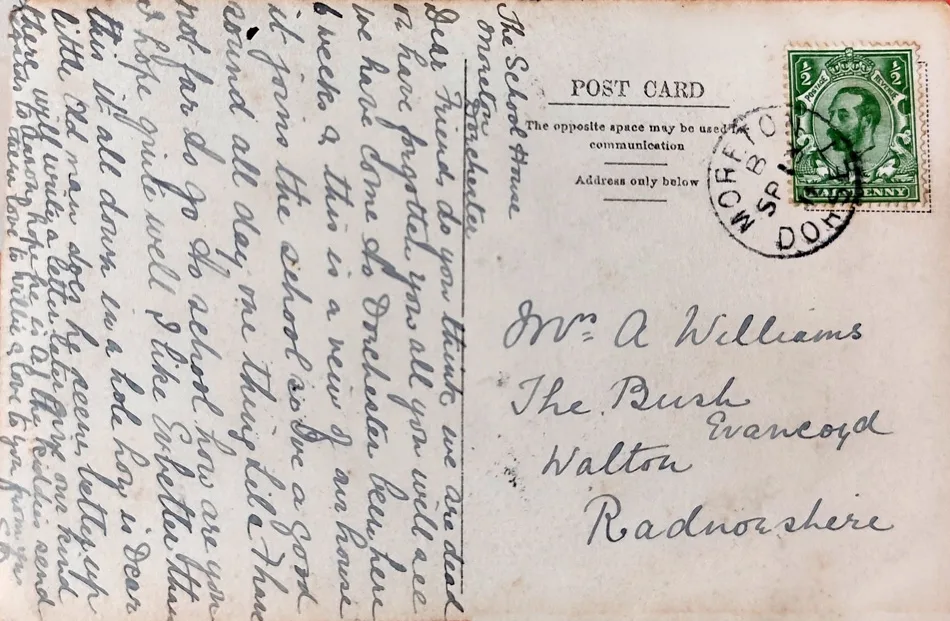
*** The postcard was sent to Evancoyd, in the village of Walton, Radnorshire – presumably the ‘Ev’ mentioned – in September 1911. The back of the postcard reads as follows (the editor has taken the liberty of adding punctuation, as the writer felt no need to do so!):
The School House, Moreton. Dear Friends, do you think we are dead, or have forgotten you all? You will see we have come to Dorchester: been here 6 weeks & this is a view of our house. It joins the school, so I’ve a good sound all day! One thing, Lil & I have not far to go to school. How are you? I hope quite well. I like Ev better than this, it all down in a hole. How is Dear little old man, does he seem better up there? Will write a letter later. Give our kind regards to Aaron, hope he is Ok. The kiddies send their love to Willie & love to you from
Yrs, CB ***


