

Fanny Charles tells the story of one of the world’s most famous – notorious – pets, who died 100 years ago this year, and was buried in the garden of his owners, Thomas Hardy and his wife Florence.
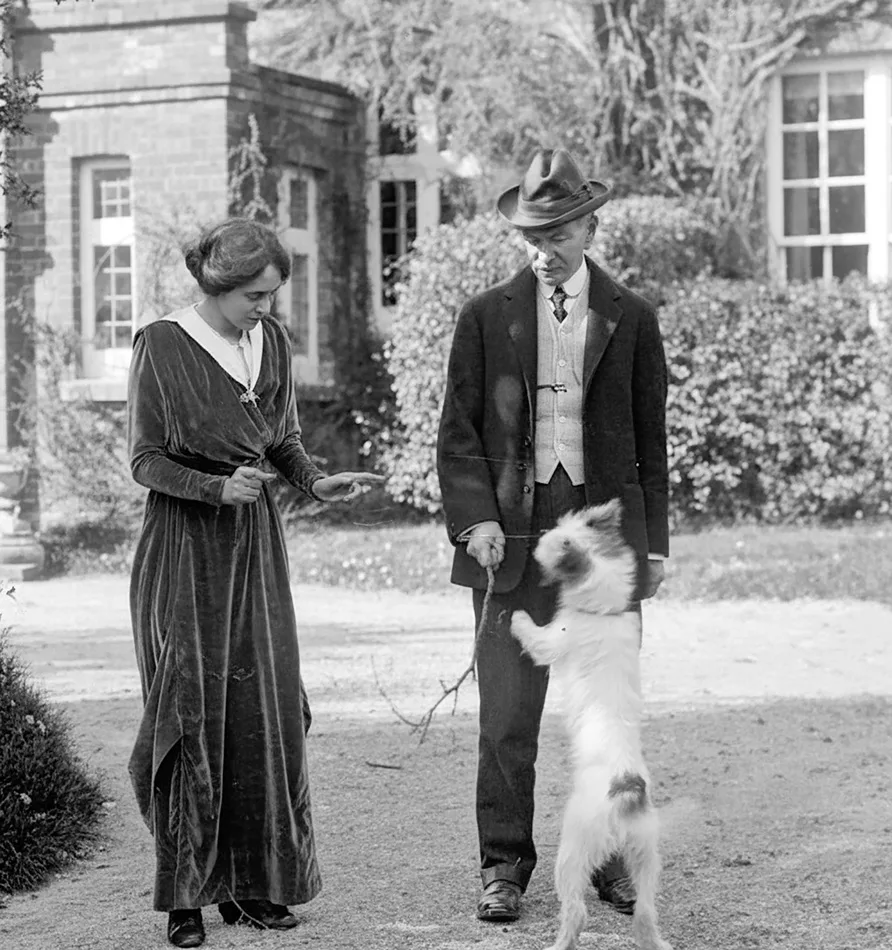
If you know anything about wire-haired fox terriers, you probably remember one you had on wheels as a child, or perhaps you enjoyed the Tintin stories and liked his dog Snowy.
We have a wire-haired fox terrier who has all the appealing character of the breed, bouncy, curious, loyal and eccentric – he is friendly, safe with children, utterly uninterested in sheep and a delightful walking companion.
Thomas Hardy had a wire-haired fox terrier who was as different from ours as two dogs of the same breed could be.
Wessex, one of the most famous of the so-called “literary pets,” was a very naughty terrier. He had a nasty temper and most visitors suffered – his bite was a good deal worse than his bark.
Wessex wasn’t choosy – he would sink his sharp little teeth into the ankles of servants and famous visitors alike. He bit George Bernard Shaw, Rudyard Kipling and John Galsworthy, reportedly taking a chunk out of the Forsyte Saga author’s leg. He was allowed up on the table during meals, and tried to snatch food from the fork of JM Barrie (of Peter Pan fame). And he regularly nipped the postman. The Hardy household servants would close themselves into rooms when they were working to avoid him.
The only visitors whose legs escaped unscathed were those of TE Lawrence (Lawrence of Arabia), whom Wessex liked, and Prince Edward, the heir to the throne – because the dog was locked away for the duration of the royal visit.
Companion to May
Florence, Thomas Hardy’s second wife, bought the terrier in 1913, apparently because she wanted a dog for security. Hardy was initially not keen but Wessex, whose pedigree showed he was related to Caesar, King Edward VII’s dog, soon became a cherished – and indulged – pet at Max Gate.
He loved the radio, and would wake Hardy up so that it could be turned on for him.
Apart from Hardy, Florence and TE Lawrence, there was one other person whom Wessex liked – May O’Rourke, the author’s secretary. In her little memoir, published by the Toucan Press in 1965**,
May writes: ‘Wessex was my kind companion, lying on the floor beside me, and those muted conversations by touch and glance, known to all dog-lovers, interrupted the click-clack of my typewriter.’
Wessex became May’s inseparable ally: ‘So it was to my side of the table he would come, stand up and place his paws delicately on the table rim, and indicate with a sparkling glance towards me, and pointing of his nose, which cake I was to choose and pass on to him. This I unfailingly did.’
May did not see Wessex’s widely reported aggression, but she read the dog’s behaviour quite acutely: ‘I know that if he found a visitor tedious or unlikeable, when the time came for them to leave, he would follow close behind them, nudging them onwards gently with his nose, to hasten their going.’
Dogs (and cats) can have a special sense when someone is ill – and perhaps of their own imminent demise: May experienced both with Wessex. On the one occasion at Max Gate that she was not well enough to walk with the Hardys, the dog insisted on staying by her side. And in the winter of 1926, as she prepared to leave after a morning’s typing, he effectively barred the door to stop her going: ‘I assured him that we were not parting, but I would be with him again very shortly. But he knew better. Some days later, Florence Hardy wrote to me that he was dead; he had become very ill and they had decided he must suffer no longer.’
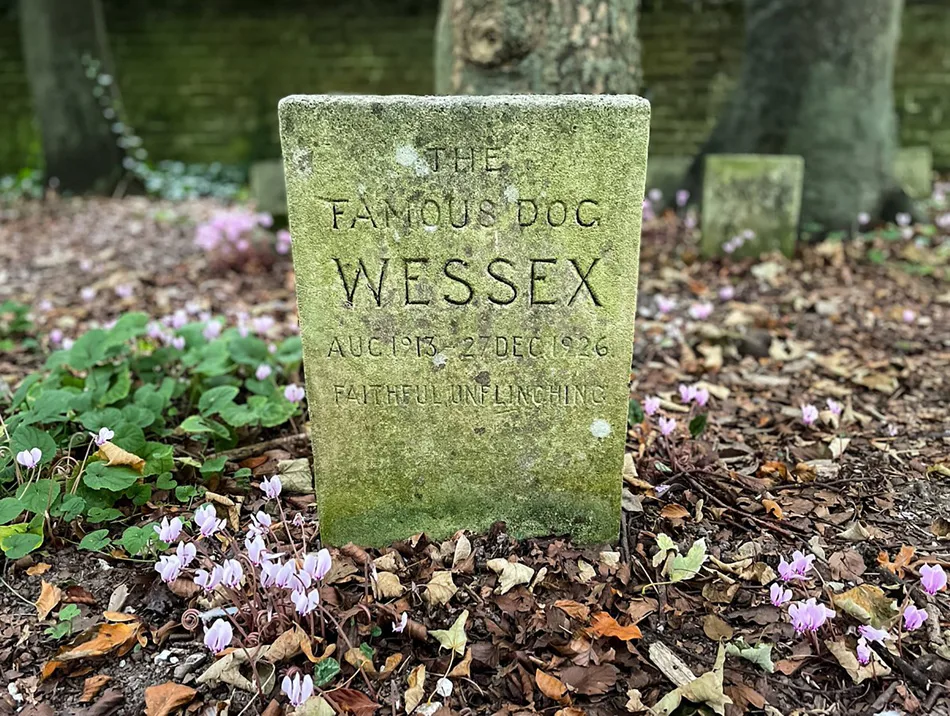
The famous dog
Wessex
Aug 1913 – 27 Dec 1926
Faithful, unflinching.
© National Trust Images Chris Lacey
Wessex was deeply mourned by Thomas and Florence. He was buried in a corner of the garden and visitors to Max Gate, now owned by the National Trust, can see his grave (above), with its inscription which May O’Rourke echoed ‘with all my heart.’
Doing his damnedest
In one of James Stevens Cox’s more entertaining and unusual Hardy monographs, Wessex writes his own little memoir.**
Wessex’s reasons for venturing into print were not only to remember his life with Hardy but to restore his own reputation.
‘Though I did get a couple of lines in the Daily Telegraph on my death, that’s not very much for the celebrated terrier of a writer of international fame, seeing that I did my damnedest to keep folk from worrying him too much for all those years,’ he says. He dismisses other dogs that lived at Max Gate. He doesn’t remember their ‘snivelling little names’ and indeed most people think that Wessex – named, as he says, after a whole region of England – was the only dog.
‘Why? Just because I had character and they hadn’t. And character is the thing that a famous writer’s famous dog needs to keep up his tail. Just look what I did for Hardy to enable him to keep his nose on the scent by preventing him being worried by too many people.’
Sometimes he didn’t like their smell, at other times he thought visitors were preventing the Master from working, but whichever it was, Wessex had a simple solution: ‘Whether they belonged to the quality or were just nobodies, I treated them all alike, for really you couldn’t expect me to distinguish between the classes.’
Wessex is loyal, but he doesn’t have many illusions about the great Thomas Hardy, describing some of his poetry as sentimental, and commenting on the psychological problems and repressed complexes at Max Gate ‘the Master’s mind always brooding about the life he would have lived if things hadn’t got muddled up by his early love affairs … The whole set-up reminded me of trails of animals and aniseed crossing the way unexpectedly. Then as he worked back from trail to trail in his mind, he’d start off on a new story or alter direction in an old one. His mind was eternally dwelling on what he and she might have done in the fresh conditions he had invented …’
Wessex ends with memories of an autumn night when he and Hardy went out to the gate, awaiting a possible message, perhaps, muses the dog, from ‘one or more of his people out of a book.’ After a while, Hardy gave up and said: ‘Come Wessex, old man, let’s go in now. It doesn’t seem as if anyone is coming to see us now tonight.’
They go back inside … ‘My mind was set on the little fire by which I hoped to stretch myself and doze … we went inside and shut the door of our house.’
Wessex the dog, clever, instinctive, loyal … the great Charles Schulz, creator of the immortal Snoopy, really had it right: ‘All his life he tried to be a good person. Many times, however, he failed. For after all, he was only human. He wasn’t a dog.’

© Tilman2007 Wikimedia Commons is used under license.
- James Stevens Cox (1910-1997) produced a series of monographs about Thomas Hardy and life in Dorset in the late 19th and early 20th century; they were published by his Toucan Press, and extracts are published with permission of his son, Gregory Stevens Cox © Toucan Press
** The Return of Wessex, by Wessex Redivivus (reborn). Long-standing readers of the original BVM may recall that Potter, our then wire-haired fox terrier, used occasionally to contribute wry reflections on his and our lives, at the start of the Village and Vale section. Indeed, Potter wrote the final piece before I left the magazine, understanding that he could be both poignant and honest. Never underestimate the intelligence and observational powers of your pet.




I truly enjoyed Wessex’s life story 🐾♥️ Appreciated 🙂