

A local expert from Citizen’s Advice provides timely tips on consumer issues.

Q: My landlord tells me that my rights as a tenant are changing later this year.
Do I need to do anything? What should I expect?
A : Your landlord is right and you are wise to be looking for more information.
The change to tenancy rights and obligations dates back to 2019 when then-Prime Minister Theresa May committed to abolition of s.21 (no fault evictions) in the Queen’s Speech. The government introduced a Renters’ (Reform) Bill in 2023 but, at the time of the general election in 2024, this had not progressed beyond the House of Lords, and so fell away at the end of the parliamentary session. The new Labour Government introduced a Renters’ Rights Bill in September 2024. The Bill received royal assent on 27 October 2025 so is now the Renters’ Rights Act.
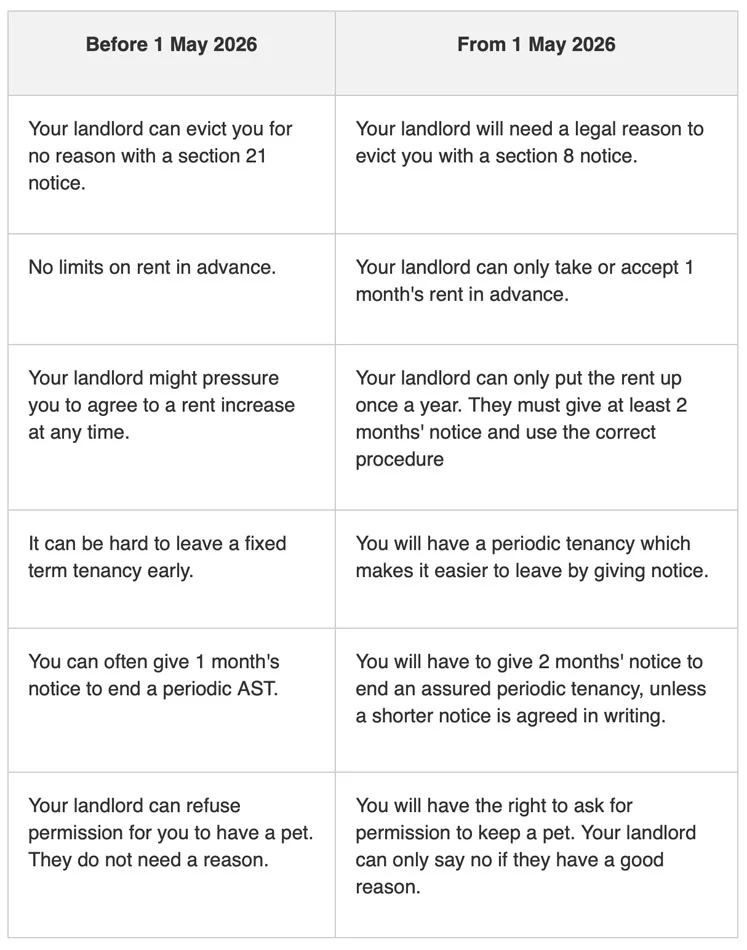
Lots of changes will come into force on 1 May 2026. These will apply to the Private Rented Sector only, and the main changes for tenants are detailed in the above table.
From late 2026 there will also be a new private rented sector database and a new private rented sector ombudsman to deal with complaints.
Landlords are obliged to provide written information to tenants about these changes. For new tenancies, landlords will need to provide information about the tenancy to their tenants in writing before the tenancy starts – this could be through a written tenancy agreement. For existing tenancies, if there is already a written tenancy agreement, landlords will have to provide a government-published information sheet by 31 May. If there is no current written agreement, a written summary of the main terms (as for new tenancies) must be provided by the same date. Landlords who do not comply may be fined by the Local Authority.
There is lots more information and a good explainer video about
these changes on the
Shelter website
The BV community news section is sponsored by Wessex Internet