This is an exciting opportunity to join our Estate Team in this newly created role working 37.5 hours per week, all year round.
The successful candidate will work alongside the Head of Estates to ensure the smooth operation of the department which encompasses maintenance, grounds and gardens and support across the site. Responsibilities will include developing and progressing maintenance schedules, coordination of day-to-day reactive maintenance and occasional project support. The post holder may be expected to participate in ‘hands on’ maintenance tasks themselves when required and they will form part of the department rota to provide weekend support and call out duties.
We are looking for someone with relevant experience within the building, maintenance or grounds & gardens industry, and a good understanding of multiple trades. It is essential for the successful candidate to have good leadership and managerial skills and experience.
In addition to a competitive salary, we can offer a non-contributory pension scheme, 30 days annual leave and membership of our Sports Centre.
For further information and an application form, please go to:
Clayesmore is committed to the safeguarding and promotion of children’s and young people’s welfare and expects all staff and volunteers to share this commitment.
From petty customer theft to competing with the mega dairies, small farms arefighting against the tide to run a successful business, says Andrew Livingston.
If lockdown taught us one thing, it’s to buy local. in rural areas, milk vending machines became all the rage during 2020 as farmers learnt that they could cut out the middleman and sell straight to the suppliers.
An important by-product of farmers gaining more of their profit means that food has a much smaller carbon footprint. My final look at what farmers are doing to reach carbon neutral targets by 2040, puts the onus on the public to buy local!
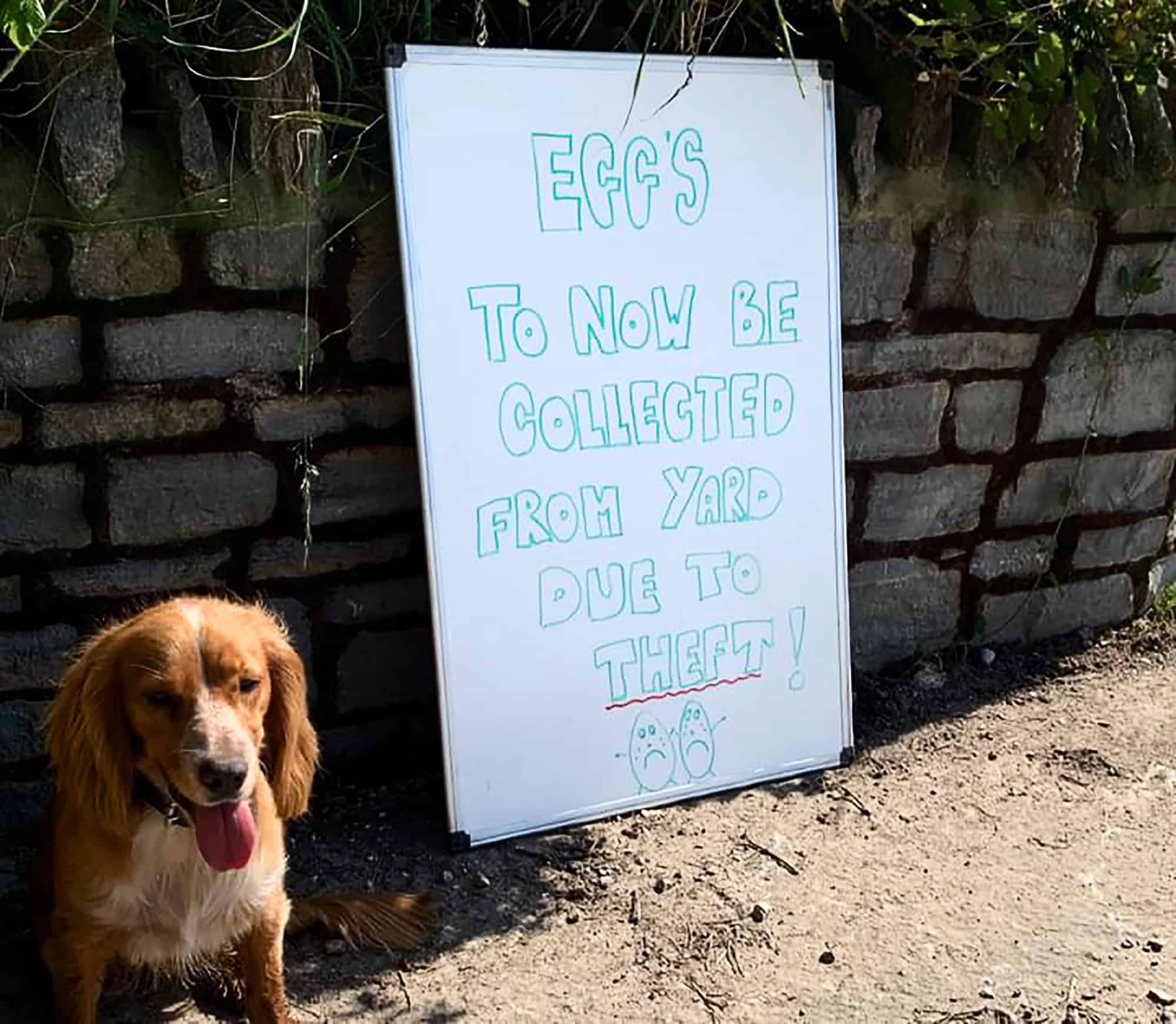
Security dog Wilf considers egg guard duty a necessary chore
The egg trade
Last year we decided to stop selling our eggs to St Ewe (a Cornwall-based packer) and instead became a producer for Foots, who are based just outside of Sherborne. Previously, with St Ewe, our eggs would be picked up in Dorset, driven for grading
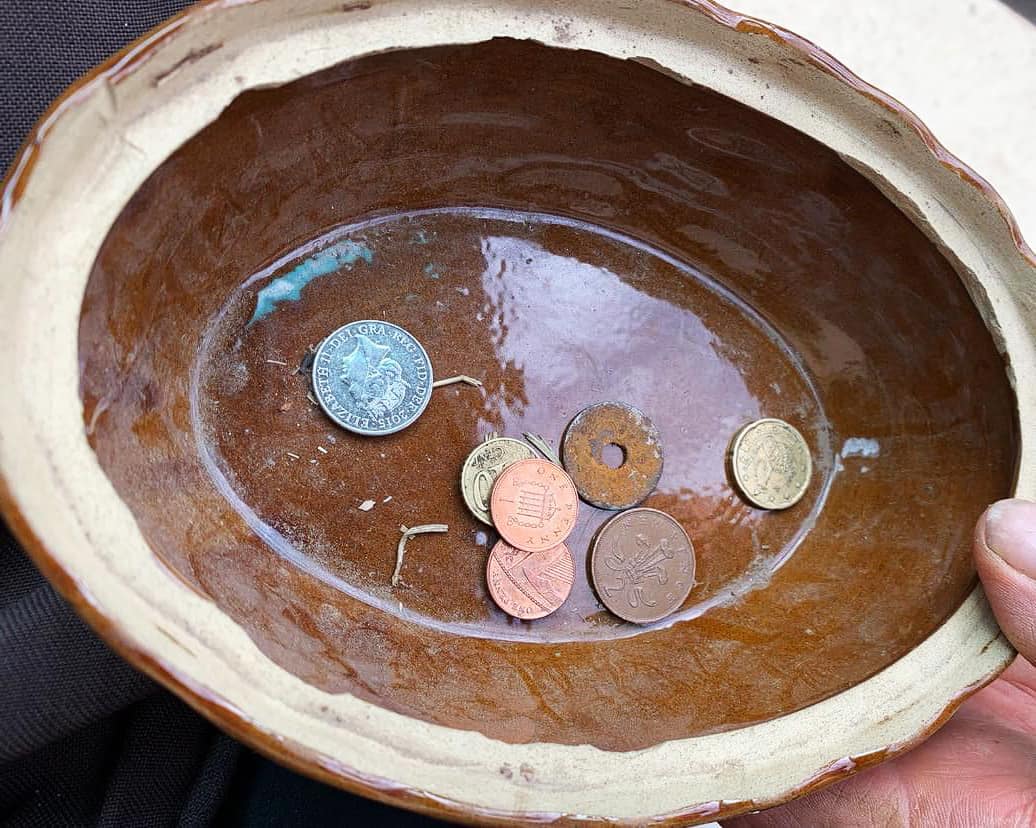
in Cornwall and then taken to London to be sold. Madness, I know! However, since our first flock of chickens, we have also sold our eggs on our gate to the passing trade. This has admittedly come with its issues; stolen eggs and money, with some ‘customers’ apparently believing that washers and lint are legal tender. What it does ensure though, is that our customers get the freshest produce possible, whilst seeing where their food comes from – that is the real joy of buying straight from the farm.
Take one avocado
Security dog Wilf considers egg guard duty a necessary chore I love avocado – but when you pick them up in the supermarket shelves can you envisage the land that it has grown on? Do you know the impact of the water consumption of an avocado farm (two thousand litres of water are needed to produce just one kilo of avocados – four times the amount needed to produce a kilo of oranges, and 10 times what is needed to produce a kilo of tomatoes)? Do you know how many miles that fruit has travelled by sea and air to be smashed up and spread on your toast? For years agricultural marketing campaigns have pleaded with the public to ‘Buy British’ in the supermarkets. But now it’s time to buy local. Being fortunate enough to be living in a rural county you will be amazed at what local produce you could buy – even without going to a (often overpriced) farm ‘shop’.
Most popular farm milk vending machines will be accompanied by a vending machine selling eggs, cheese, butter, maybe meat, condiments, soup or pies. You can buy all your staple foods in a way that not only supports your local farmer but helps to keep fuel and greenhouse gas emissions down.
20 euro cents, a rusty washer and a few coppers – all received as ‘payment’ for eggs at the farm gate.
The struggle of the small farm
Unfortunately, with the cost of animal feed and electricity as it is, small family-run farms are turning to selling direct to customers simply to be able to turn a profit. Especially daity farmers – larger and larger commercial dairies with in excess of 1,000 cows are keeping the cost of the milk low; meaning the small farm next door can’t get a decent price per litre to be able to make a living. In a simpler time, farmers would devote their time to pampering their animals to perfection. Now, farmers seem to need to spend their lives squeezing every last potential penny out of their farms just to stay afloat.
We are excited and delighted to invite applications from hardworking, customer focused and friendly people for a Supervisor and Assistants roles for the new Clayesmore coffee shop which will be opening in the Summer term.
Your day will be hands on and customer facing, working in a small team creating an environment that is warm and welcoming for all who visit the coffee shop. You will have an eye for detail and be interested in serving good coffee, good food and making people happy.
This is a great opportunity to work in hospitality with daytime shifts only, the majority of which will be worked during term time.
Closing date for applications: Monday, 11 April 2022 at 8.00am Please contact Emma Grigg on 01747 813213 if you have any further questions.
Clayesmore is committed to the safeguarding and promotion of children’s and young people’s welfare and expects all staff and volunteers to share this commitment.
Lifeguards – Full time/Part time vacancies available.
We are looking for energetic and engaging applicants to be part of a friendly team looking to refocus on the provision of providing a fun, safe and quality experience for all our customers. The successful candidates will have a passion to work in a sports environment, possess good communication skills and a commitment to providing great customer service.
In addition to lifeguard duties, you will be required to assist in various other Sports Centre duties and sporting activities. NPLQ training will be provided if necessary.
There are flexible working hours available alongside more fixed working hours ranging from early starts, middle of the day shifts to weekends and evenings.
We offer excellent facilities, resources and a warm, friendly and supportive workplace. We are committed to the wellbeing of all our staff, and promote continuous professional development in a creative and innovative environment. In addition to a generous non- contributory pension scheme and annual leave entitlement, you have use of the Sports Centre facilities free of charge in order to maintain your professional fitness when available for staff use.
For further information and to apply please go to:
Clayesmore is committed to the safeguarding and promotion of children’s and young people’s welfare and expects all staff and volunteers to share in the commitment.
The community impact of Eunice, that Panorama documentary, and the government’s drive for rewilding – James Cossins muses on a busy few weeks.
Here at Rawston Farm we have managed to come through the week of three named storms relatively unharmed. We did lose our electricity supply for 24 hours, but with our generators at each dairy on standby we managed to continue milking our cows without too much disruption.
We lost a number of trees to the gales but fortunately they didn’t cause damage to our buildings. Our surrounding villages didn’t fare quite so well, with a loss of power for up to five days and nights with power lines being brought down by trees, and wooden power line poles breaking. It has been a challenging time for all but it has brought out the community spirit, with everyone helping neighbours out. I am sure when the wind has calmed down there will be lessons to be learnt as to the best way to cope in these situations.
March means drilling crops at Rawston – pictured here in the 1960’s image – James Cossins
A cow’s life
I am sure that many of the readers may have watched the Panorama programme portraying the life a dairy cow. As a dairy producer I was shocked at what I saw. I could not believe that humans could treat animals in this way. As was stated in the programme, most animal keepers would never treat their animals like this. We have various assurance schemes such as Red Tractor and in our personal case an Arla assurance scheme which goes into great detail on animal welfare and how to best treat animals. We have protocols on how to handle animals and how to deal with emergencies. We all occasionally have a sick animal, and by following compassionate methods you are far more likely to nurse the patient back to a full recovery than if the anlmal was maltreated.
I hope readers understand that the actions taken on the farm featured in the documentary is very much an isolated occurance. I understand that following the programme, the farm was visited by various inspectors to question their welfare practices.
Rewilding or food security?
Recently the NFU held their annual conference which this year took place in-person. One of the key speakers was George Eustace, the Minister for the Environment, and it became clear that the Government is determined to go down the road of promoting rewilding of land, and growing crops for wildlife. Whilst I agree in certain circumstances it is appropriate on less favoured land to do this, the Government seem to have forgotten about food production and this country’s food security. With what is going on in the world at the time of writing, I would have thought the government would have put more emphasis on producing our own food for this country rather than relying on imports.
Spring begins
As we move through March we will be concentrating on sowing our barley and bean crops, and applying some fertiliser to kick start the autumn crops into their spring growth.
The dairy cows are already looking over the gate, waiting patiently to be let out to graze once more. And so yet another year’s cycle begins again.
Occasionally it’s great to leave the stud so that the whole team can share in the ultimate racing dream, says Lucy Procter.
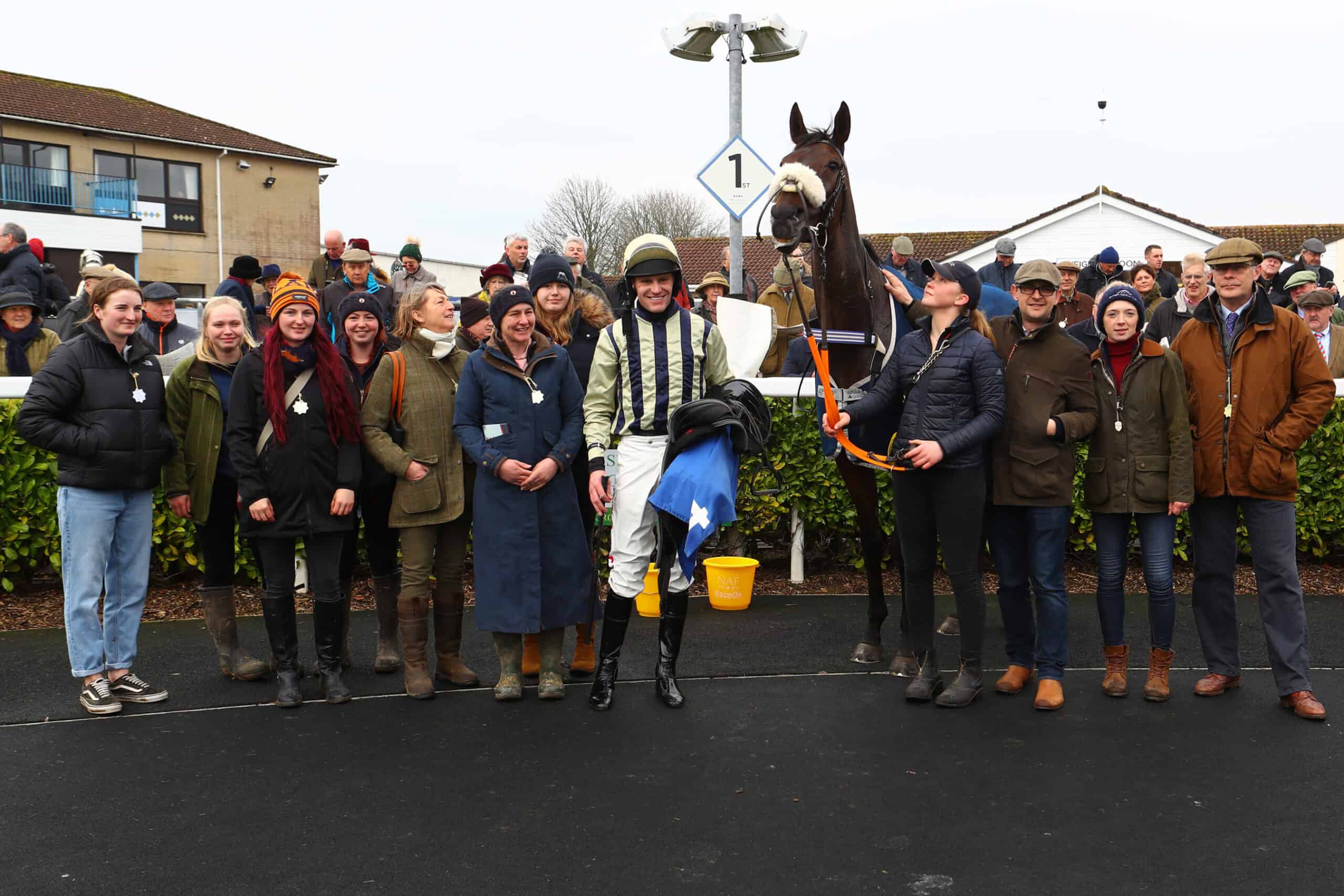
This week Last Royal, a year younger full brother to superstar racehorse Honeysuckle – and also bred by The Glanvilles Stud (TGS) – was running in a Novice Hurdle at Wincanton, so we took the staff to watch. The girls raced through morning stables, got changed and drove to the racecourse in time to join the trainer in the parade ring. Everyone was delighted to watch Last Royal dominate the field and win by a frankly astonishing 42 lengths!
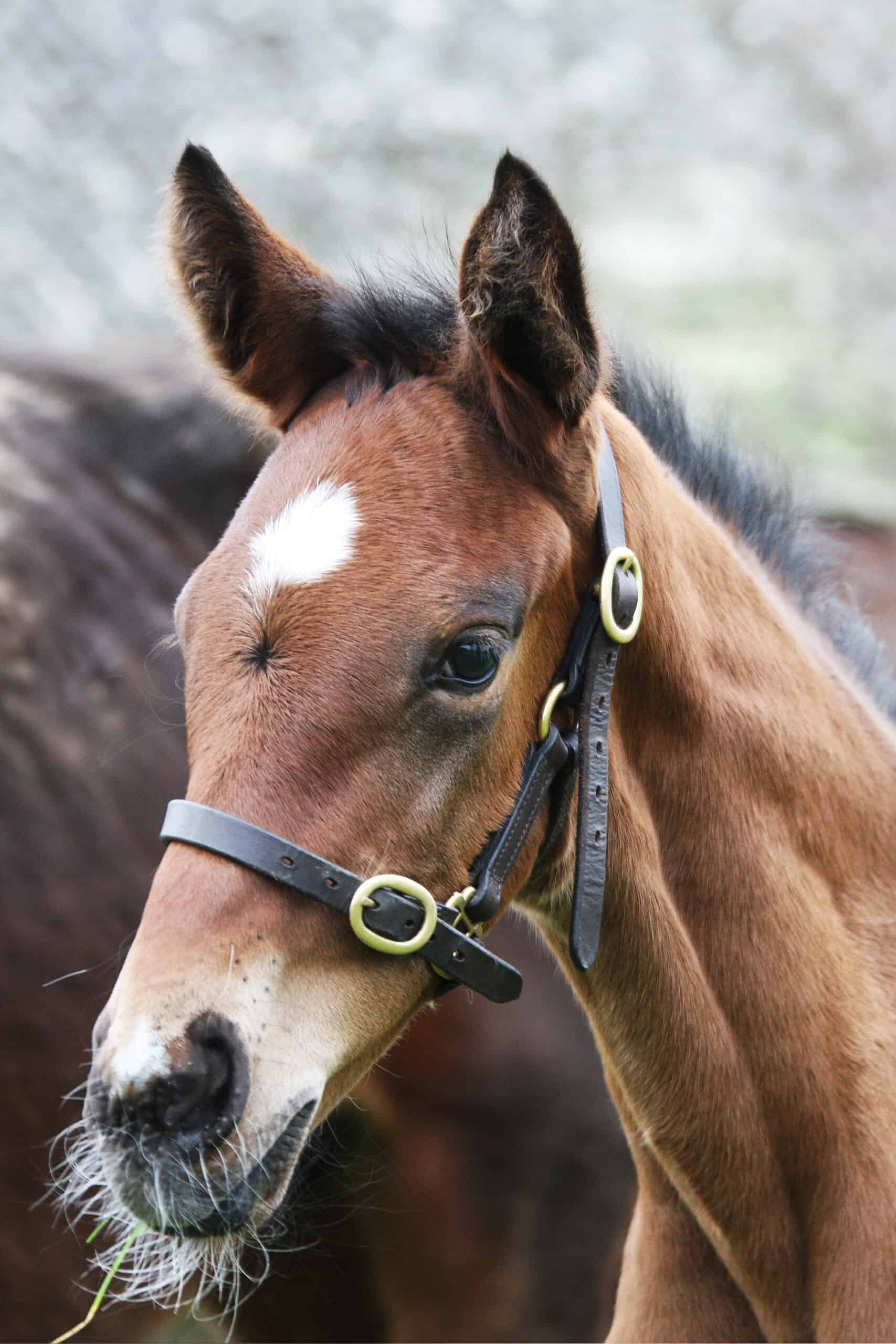
The first TGS foal of 2022. Will this one be the next 42-length winner? Image by Courtenay Hitchcock
Go Romeo
Last Royal was named because his dam, First Royal, died when he was just three months old – hence he was ‘last of the Royals’. Luckily, when he was orphaned, he was just old enough to thrive without supplementary milk as he had already been eating grass, hay and hard feed so was able to join some older weaned foals without needing a foster mother. Being an orphan, he was always much loved by the girls and has always been known as Romeo at home.
Where it begins
At Wincanton, our entire team got to see the ultimate goal of what we do; winning races. Meanwhile, in Worcestershire, I was at the start of the cycle, with homebred mare, Glanvilles Guest, visiting Planteur, her chosen stallion this year. Our vet, Paul Legerton, had been scanning the mare over the previous week and had determined from her follicle size and oedema (blood thickened womb) pattern, that she was well ‘in season’, meaning that she should be receptive to the stallion, and would most likely ovulate in the next 48 hours.
The whole TGS team got to join Last Royal (‘Romeo’) in the winner’s enclosure at Wincanton this week
A hot date in the diary
With the cover (mating) booked for midday, we loaded Glanvilles Guest with her 4-week-old Scalo colt into the lorry at 9am to travel to the stallion. Mares and foals generally travel very well together, on a thick bed of straw and without a partition so they have the full double space – a stable on wheels. The mare travels tied up with a haynet to munch, and the foal is left loose, free to happily drink, wander around or lie down and sleep. The covering usually takes around 30 minutes and then we are loaded again and on the way home. The next stage is to scan for pregnancy and to make sure the mare hasn’t conceived twins and this we do at 14 days after covering. So, it’s fingers crossed that she scans in foal first time. Raising young Thoroughbreds is so dependent on the hard work of our staff and it was great to be able to share with them, Last Royal’s win at Wincanton today. At this time of year, the excitement is, that every new foal being born or conceived could be the next 42 length winner.