Home Blog

Roundup and the road ahead

0

As glyphosate faces renewed scrutiny, George Hosford argues that routine pre-harvest use risks threatening its future altogether
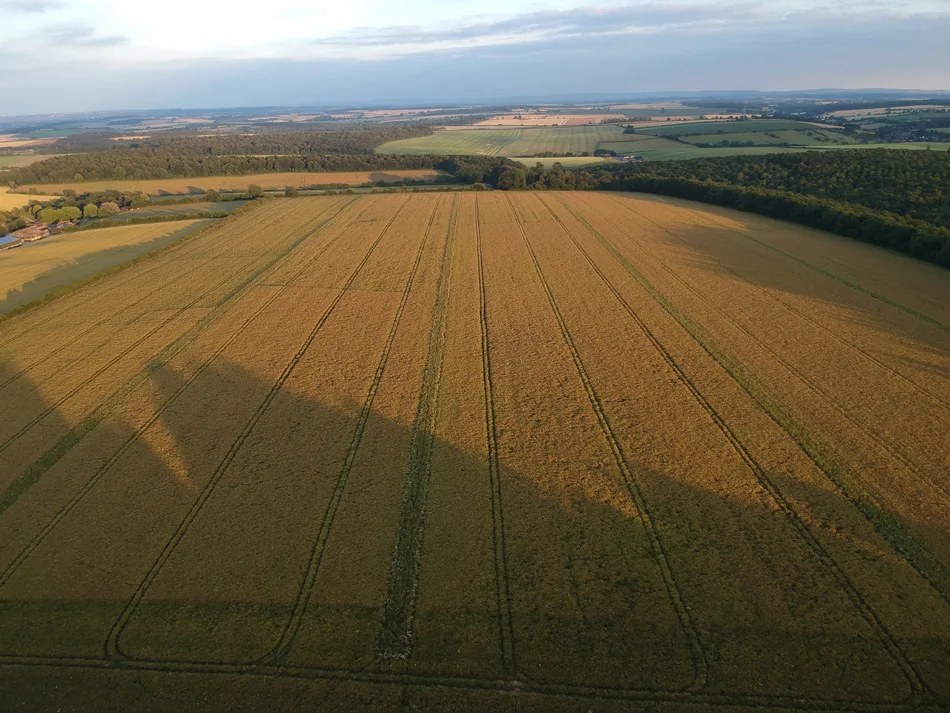
‘Left rear of the field is a greener area that ripened later than the bulk of the field. We cut the first part of the field, then left the rest to come back 10 days later.
No legally applied glyphosate would have evened up this field.
All images © George Hosford

There is a row brewing over the future of glyphosate – the very widely used weedkiller more commonly known as Roundup – and there is great concern among many in the UK oilseed growing fraternity that the sky may be about to fall in.
United Oilseeds, the farmer-owned co-operative through which we have sold our rapeseed for the last 40 years, reports as follows:
In November 2023, the European Commission renewed glyphosate’s approval for another ten years, until December 2033. Reviews by the European Food Safety Authority (EFSA) and the European Chemicals Agency (ECHA) concluded there were no critical safety concerns overall.
In short, the EU has renewed approval, but tightened how it can be used. However, the key restriction is a ban on its use as a pre-harvest desiccant, with countries such as Italy banning that particular use in 2016.
But what works in Milan or Verona certainly doesn’t translate to Aberdeen or Perth, where crops like oilseed rape face a far shorter, cooler growing season and a much greater need for pre-harvest management.
Further to this, United Oilseeds continues:
If the UK dynamically aligns with EU plant protection product legislation again, whether through new trade agreements or alignment mechanisms, our growers could face the same restrictions without the same level of subsidy support that EU farmers receive.
Since leaving the EU, the UK has followed its own regulatory path. In 2023, the Health and Safety Executive (HSE) and Chemicals Regulation Directorate (CRD) extended the approval of glyphosate until 15 December 2026.
This period allows for an independent UK assessment of glyphosate’s safety and environmental impact, using the latest data.
The possible outcomes range from
Full renewal (potentially up to 15 years)
Renewal with restrictions
Or, in the worst case, non-renewal of pre-harvest use altogether
To this I would add, as a very very worst scenario, the complete banning of glyphosate for any agricultural use at all.
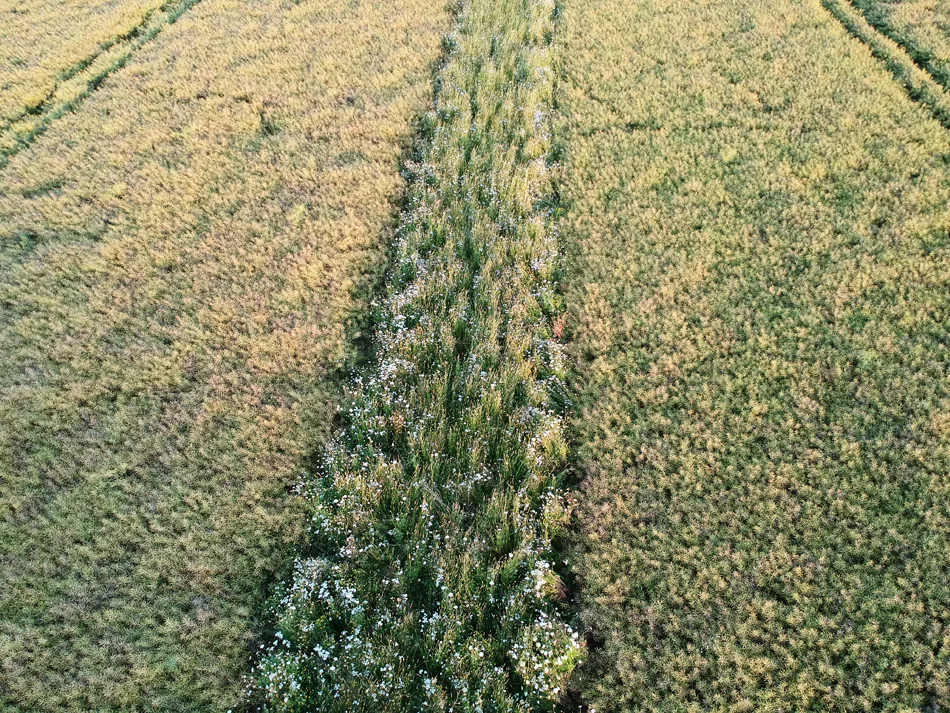
The potential for collateral damage: in-field flower strips, headland margins and hedges risk being wiped out by wind-assisted spray drift from pre-harvest spraying

The 30 per cent rule
Currently, it is legal in the UK to apply glyphosate to most agricultural crops within a carefully stipulated period, when the crop is in its ripening phase. This has been legal for very many years. The trouble is that in much of the industry, it has now become routine to treat crops in this way when farmers get impatient: they think they can hasten harvest by using glyphosate on the ripening crop.
However, this doesn’t really work if you follow the instructions on the label correctly. The crop grains must be below 30 per cent moisture before application: below this moisture, approval data suggests that translocation of the chemical into the grain cannot occur.
The label on a can of agricultural spray is a legal document, explaining how the chemical must be used. It is a requirement in order to both gain approval and for the granting of a licence for sale and use.

Oilseed rape (OSR) is combined when the yellow flowers have faded and the pods are leathery/brown, seeds are dark brown/black

Not in my beer
There are two main reasons for use of a pre-harvest glyphosate application.
Firstly, for the control of weeds that would make the combining process difficult or impossible, and secondly, to even up a crop that is maturing unevenly – maybe due to pigeon grazing or waterlogging earlier in the season.
The first is understandable, but usually indicates some kind of failure in the decision-making process during the growing season.
I have more of an issue with the second reason. If you spray any part of a crop containing grains which are above 30 per cent moisture, following the logic of the label moisture rule, there is at least a risk that some chemical could be translocated into the grain. I, for one, do not relish the idea of the presence of any kind of weedkiller in my cooking oil, my bread or even in my beer (made from barley). I cannot support the use of pre-harvest glyphosate, wherever it is grown.
It is worth noting that many brewers and maltsters do not allow their growers to use pre-harvest glyphosate on crops destined for their maltings and breweries. The naked grains of barley differ from wheat and rapeseed, covered as they are by chaff or pods. Oats, however, like barley, have no such protection (which of course is no protection at all if we believe that the chemical can be translocated into the grain anyway), should it be applied above 30 per cent moisture, whether by accident or by design.
Indeed, it also says on the label that crop destined for use as seed to grow the next season’s crop should not be treated with glyphosate pre-harvest. Does that not at least suggest that its interaction with seed needs to be treated with caution?
The pictures show various rape crops from recent years, largely even and weed free. Look closely at the one at the top, opposite, however, and you can see to the left rear of the field a greener area that ripened later than the bulk of the field.
We cut the first part of the field, then left the rest to come back 10 days later. No legally applied glyphosate would have evened up this field. If we farmers insist on the need to continue using glyphosate pre-harvest, I believe we can expect it to be banned for all uses sooner rather than later.


Family forger who faced the noose found in the ‘R’ box

0

It was a cardboard archive box in a London library that stopped Rachael Rowe in her tracks.
‘I pulled out this packet of papers labelled “Rowe”,’ she says. ‘And what I found next just stopped me. It was a letter addressed to Mr Richard Rowe, schoolmaster, dated 1838. I knew exactly who that was. It was my great-great-great grandfather.’

The Rowe family photograph that started it all. Image courtesy of Rachael Rowe


Rachael is now a long time Dorset resident and writer, but at this time was working as a nurse in London. She had gone home for the weekend, and her grandfather joined them for Sunday dinner. ‘He was what we’d now call decluttering,’ she says. ‘He brought a pile of certificates and photos relating to my great grandmother – birth and marriage certificates, a photograph of them working in a fruit and veg shop (above) – and asked what we wanted to do with them. I just thought, “Who are these people?” I wanted to see how far back I could take our family tree.’
So Rachael began tracing her Cornish family history the hard way: it was the 1980s, before Google, before Ancestry.com, before digitised records. Back then, you had to plod through parish registers. Learn to use microfiche. Trawl census books and spend hours at St Catherine’s House.
Then came the revelation.
One afternoon, bored by card indexes at the Society of Genealogists’, she glanced around the room and noticed the stacks of box files – folders of donated material, arranged alphabetically.
‘I thought, I’ll pull down the ‘R’ box for Rowe and see what happens,’ she says. ‘It is such a common Cornish name, it could have been anybody.’
Inside was a packet of papers labelled simply ‘Rowe’. ‘I opened it, and the first thing I saw was the letter to my four-times-great grandfather,’ she says. ‘I just thought “I know who this person is!”. The hairs on the back of my neck stood up. It was like touching time – you’re there, holding something an ancestor has handled.
‘Among the papers in the packet there was a newspaper cutting about an execution,’ she says. ‘My Richard Rowe’s father, also called Richard Rowe, had been hanged.’
Or had he? The archive box held more than one story. What began as family curiosity would become years of research and, 30 years later, Rachael’s new book The History of Forgery, published by Pen & Sword.

Schoolmaster to condemned man
The packet of documents had been collated by Arthur Francis Rowe, another ancestor who, in the late 1890s, had himself discovered the story of the doomed Richard Rowe. He had donated his research to the archive in the hopes someone else might continue the story – it was sheer chance that Rachael discovered the papers he had left almost 100 years before.
She discovered that Richard Rowe senior had worked as a schoolteacher in Cornwall. He had set up a school for poor boys, he signed off apprentice indentures and he had been press-ganged into the Royal Navy in the 1790s – seized and forced into service at a time when Britain was at war with France. As a schoolteacher, he was used on board to teach the youngest sailors to read and write. But when he fell ill, he was simply left behind in Plymouth as the fleet sailed on.
‘There was no safety net,’ she says. ‘If you couldn’t work, there was no pay, no benefits, nothing.’
Out of work and desperate, he forged a bill of exchange for £26 6s 9d – but he got the name of the Cornish bank wrong. Instead of writing Williams Gould of Truro, Richard wrote ‘Gould William’. And that small mistake led to his arrest.
When Rachael finally accessed the restored court records at The National Archives – documents so fragile they had to be specially recovered for her – she uncovered the full tale.
‘At that time, only the male landed gentry could sit on juries. It transpired that his employer sat on the jury at his trial, and a relative of the bank owner he had tried to defraud chaired it. Would you honestly believe that today?’ she says.
She also discovered a second charge: bigamy. While stranded in Plymouth, Richard had married – despite having a wife and six children still living in Cornwall. With the second charge, any hope of reprieve vanished. He was hanged at Bodmin.

The history of forgery by Rachael Rowe

The Bloody Code
Forgery at that time was not treated as a minor financial offence. It was treason. Between the late 18th and early 19th centuries, more than 200 crimes carried the death penalty – it was a period known as the Bloody Code.
‘Until 1779, women were burned at the stake for coining [making counterfeit coins],’ Rachael says. ‘It was considered treason. It was horrific.’
In 1797, the British government began issuing low-value paper banknotes to fund the war effort. A population unfamiliar with paper currency suddenly had to trust scraps of printed paper instead of metal coins.
‘They hadn’t even thought about the consequences,’ she says. ‘People couldn’t read. They didn’t understand the notes, and the change opened the door to forgery.
Between 1797 and 1812, more than 300 people were sent to the gallows. Some were skilled engravers bribed by gangs. Some were architects or artisans whose talents were redirected into criminal enterprise. Some were simply desperate.
‘There were greedy people,’ she says. ‘But there were also people living right on the edge of a society which didn’t look after them.’

The person behind the crime
Initially, Rachael admits, she viewed her ancestor as ‘a bit of a rogue’. It took a writing workshop to shift her perspective. ‘Someone said to me, “This isn’t just a crime story. It’s about social inequality.” And that changed everything.’
When it suited society, Richard had been useful – he was a founder of a poor school for disadvantaged children, he was a press-ganged sailor and a schoolmaster aboard ship. But when he needed support, there was none.
‘The newspaper report of the forgery case said nothing about his teaching career,’ she says. ‘Nothing about the school he’d set up. Nothing about the apprenticeships he’d signed off.’
As she delved further into forgery cases, her curiosity and research widened. She discovered the committed excise officer in Scotland who had spent years tracking down smugglers – who then lost his job when whisky production was regulated and turned to forging notes to pay his debts. There was an architect transported to Australia for forgery whose face would later appear – legally – on a banknote. There were stories of engravers who both designed legitimate currency and copied it. ‘It really made me look at the person behind the crime,’ she says.
Today, fraud is largely digital, often invisible and is usually measured in statistics and headlines. In the late 18th century. It was public, brutal … and deeply tied to class.
The History of Forgery is available via Pen & Sword and major retailers. Locally, there are copies in 1855 in Sturminster Newton.

What if this is a fake?

0

A local expert from Citizen’s Advice provides timely tips on consumer issues.

Q: I bought a doll for my child recently. I thought it was manufactured by a well-known brand, but I suspect it might be counterfeit. How can I be sure and what are my rights?

Shutterstock

A : You’re right to seek advice about this iissue, because counterfeit goods aren’t only illegal, they can be dangerous.
Counterfeit goods are fake products designed to mimic authentic ones and it’s not always easy to spot a knock-off. Fake children’s toys often don’t meet safety standards and can pose choking hazards – poor manufacturing can mean small parts are easily detachable.
It’s not just toys and games – things like clothing, footwear, e-cigarettes, perfumes and media devices can also be counterfeit. Watch out for strangely low prices from well-known brands and signs of poor quality like missing security seals, bad or non-existent packaging, blurry logos and poor stitching.
You may also spot spelling mistakes in the advert or on the packaging. Looking at photos from official sellers can help when making comparisons, and it’s important to only buy products from reputable sellers.
If you have purchased a counterfeit item, there are steps you can take to try and get your money back. You’re legally entitled to a full refund on fake goods within 30 days of your purchase. If it’s between 30 days and six months since you paid, the seller can provide you with a real version of the item first. If they can’t, they’re legally required to give you a full refund. If you paid more than six months ago, you’re only entitled to a part-refund based on how much you’ve used the item and how long you’ve had it.
Sometimes sellers might refuse to refund you, and argue the items were obviously fake because they were very cheap, but they’re breaking the law by selling them and your legal rights still apply. If you paid by debit card, contact your bank and ask to use the ‘chargeback scheme’. If you paid by credit card and the item cost less than £100, you can ask to use the same scheme. If you paid by credit card and the item cost between £100 and £30,000, tell your credit card company you want to make a ‘section 75’ claim to get your money back.
To report counterfeit goods – or get help getting your money back – contact
Citizens Advice Consumer Service
on 0808 223 1133.

The BV community news section is sponsored by Wessex Internet

Are we wasting our time?

0

What do you call a gathering of parish councillors? A tribe? A murmuration?
(A wrangle? A mutter? A grievance? – Ed)
Whatever we are called, I always welcome the opportunity to meet up with fellow councillors – it’s a great way to share ideas and to swap experiences (usually of dealing with the scourge of developers and a multitude of potholes). It was at one of these recent gatherings that Dorset Council shared its latest thoughts on planning.
The big news was, of course. that the Planning and Infrastructure Act received Royal Assent in December. This is the wildly ambitious plan to Get Britain Building – to create 1.5 million new homes. As a consequence, most towns and villages are now being bombarded with planning applications – and the character of some places is being changed forever.

The Dorset Insider


While it’s important that the housing crisis is addressed, I have to wonder whether the homes we need – as opposed to the luxury homes beloved by developers that no local person can afford – are actually being built.
Naturally, with Dorset currently unable to meet the five-year housing supply target, planning application numbers have increased. Now, and each year, 3,246 homes must be built in the county. That does not include the Bournemouth, Poole and Christchurch area, where there are additional targets.
In practical terms, that means many existing Neighbourhood Plans – drawn up by town and parish councils to shape where and how development happens in their areas – will now be out of date. The mood in the room was interesting at this stage, almost like a mad pass-the-hot-potato game with no one wanting a large development on their own patch. Some council chairmen are clearly under siege from major developers. The usually smug ones from the AONB villages were not looking so smug as they swiftly realised that nothing in Dorset is sacred any longer. Will we see houses on Hambledon Hill or Bulbarrow? I think not … but it increasingly feels as though no meadow is safe. And as for North Dorchester and its abundance of water, the recent flooding should have sent a very clear message to planners – but it won’t have.
And if it’s not housing on that meadow everyone loves, it may yet become a field of solar panels.

You will be overridden
Many parishes and towns have spent hours drawing up their Neighbourhood Plans. Designed to allow a certain amount of development and have a settlement boundary, they have always taken hours of unpaid work and, in many cases, high consultancy fees. It’s always good to have a strategic way forward and some of these plans have been agreed by local referendum. However, as the good people of Pimperne know, a Neighbourhood Plan is not worth much when it comes to the council’s decision-making process. I’m currently wondering if we should even bother to spend money on our own parish Neighbourhood Plan if it is simply going to be overridden when housing targets loom.
The answer to this dilemma came with the decision-making processes for agreeing developments. As the Neighbourhood Plans are out of date, the policies in the Dorset Local Plan will take precedence.
This also means that if a local Neighbourhood Plan says something that does not accord with the Dorset Local Plan, the latter takes precedence. In other words, all that local knowledge will be disregarded – you need to say the right things, speak the mantra and align with the planners, or risk being overridden.
Hopefully some Neighbourhood Plan thinking can be included in the Dorset Local Plan (LP). While another iteration of the Dorset LP is expected in August, at this stage it feels less like a consultation and more like a done deal at this stage. Developers are actively submitting plans regardless of any public consultation.

Why bother?
All of this is very difficult.
As a parish councillor, I’m left having to explain to people why our opinions count for nothing.
And why productive fields are being lost when national food security is a live concern.
People are asking why some new homes that are said to be ‘desperately needed’ remain unsold locally. Why build more?
They are asking why promised social housing has not been prioritised by developers, when that is the exact housing needed to stem the accommodation crisis.
And local people are demanding answers about drainage and flood protection – none of which is solved by developers as if they were a silver bullet.
However, what frustrates people the most is that so many have contributed productive ideas to these Neighbourhood Plans: plans which do include more housing as there is a recognition that additional homes are needed.
To see these careful plans overridden, hours of unpaid work brushed aside and hard-won local knowledge dismissed is not only deeply disappointing, it sends a clear message to volunteers: why bother?
This is not a NIMBY moan. It is a serious question. Does any parish or town council truly have a voice any more? Or are we expected to sit down, shut up and allow developers to concrete over whichever part of the countryside is next? The voters deserve better.

***The Dorset Insider is a no-holds-barred column pulling back the curtain on local affairs with insight, honesty and the occasional raised eyebrow. Written by a seasoned parish councillor who prefers to remain anonymous (for obvious reasons), it cuts through the noise to expose the frustrations of grassroots politics, and say what others won’t. Rest assured, their identity is known – and trusted – by the editorial team. Expect opinion, candour … and a healthy dose of exasperation:***

When you don’t know

0

In a county awash with acronyms and restructures, Help and Kindness offers calm clarity and connection, writes Jon Sloper

When you don’t know – shutterstock

When my wife and I first had the idea for Help and Kindness ten years ago, it was in response to conversations with people working in the midst of the local government reorganisation that created Dorset’s two unitary authorities. Council colleagues were restructuring and redefining roles. Staff changed jobs, some were made redundant, and almost everyone’s responsibilities shifted. Community organisations who had worked closely with councils pre-unification were anxious – they didn’t know how contracts would work, how they would be paid, or how what they did would link into the new structures.
Many people found themselves building new connections with colleagues, and often didn’t know who to approach within the wider voluntary and community sector (VCS).
The changes were hugely challenging.
Within this turmoil, we soon identified ways in which we felt we could strengthen the VCS, and make it easier for people to stay connected during times of change. Through extensive relationship building and research, our Help and Kindness directory was created. We designed it to showcase the breadth and scale of support across Dorset and to provide a clear point of connection for people looking for help.
It went on to support the community response to COVID. Today it is helping navigate the major changes under way in the NHS and local authorities. Public sector services are continually adapting to meet both community needs and new national directives – this cycle of planned and urgent change is part of life, and reducing the frequency of an “I don’t know” during these transitions is a huge help.
Not knowing who to talk to, or how things work, doesn’t just impact services – it affects us all. Sometimes there is too much choice and it becomes overwhelming, making it hard to know where to start. Other times it feels like being in a vacuum without any signs or guides. We often don’t know what we don’t know.
Unknown great things
The challenge of finding answers is further complicated by the continual redevelopment of services. Even when the changes are for good reasons, they can simply add to the confusion if they come with a new name, a rebrand, a new set of acronyms or a largely different team.
Great things are happening right across Dorset that people simply don’t know about. Resource shortages limit promotion and advertising that could help to increase their visibility. Services can be narrow, or siloed, and don’t always have a connection to related services, within organisations as well as between different ones.
The ‘work together’ element of our strapline reflects our response to this. Every week we link people who share common interests but don’t realise it, perhaps planning a new service that they didn’t realise was already in place. We connect new services with existing ones. We help people share challenges with others who truly understand the situation.
Residents feel these uncertainties too. People contact us because they don’t know how to describe their difficulties in ways that align with available help. They don’t know whether to speak to health, social care, children’s services, housing or trading standards or the police. Not knowing can paralyse us. It creates further worry and frustration, and can quickly turn to anger, fear or despair.
Across Dorset there are skilled and compassionate people and organisations who can release that sticking point. When people call or email us, we can help point them in the right direction.
There is so much good happening in Dorset – we now have almost 14,000 listings in our directory – and real commitment behind the changes sweeping the county. But change inevitably brings new ‘I don’t knows’. We continue to strengthen connection and shared knowledge, offering a compassionate introduction to support when people feel all at sea and simply don’t know where to turn.
helpandkindness.co.uk

The BV community news section is sponsored by Wessex Internet

Let itbee spring

0

As spring gathers pace, Dorset’s gardens begin to fill with tawny mining bees, hairy footed flower bees and colourful nomads emerging from winter

The common carder bee, one of the commonest of our native bumblees

Bees are a welcome sign that spring has arrived – or, at least, is just around the corner. Most people are familiar with bumblebees and honeybees, but these are only a small fraction of the 270 or so species of bee that can be found in Britain. Some bees live in social colonies, while others lead solitary lives. A surprising number of bees are parasitic – laying their eggs in the nests of other bees.
Spring is a good time to study bees and there are several excellent online resources available. The Field Guide to the Bees of Great Britain and Ireland (Falk and Lewington) is an indispensable book for anyone wanting to extend their knowledge of these fascinating insects. Find out more online at the Bumblebee Conservation Trust website: Bumblebeeconservation.org
Dorset Wildlife Trust Conservation Officer,
Hamish Murray, is sharing his guide on which bees will be buzzing around between March and May …

Tawny mining bee

Tawny mining bee
One of our most distinctive bees, the female is particularly striking, with dense reddish-brown hair covering most of her body while the head and legs are black. Like all mining bees, these are solitary insects with each female digging its own nesting burrow, typically in light soils. The distinctive burrow entrances (looking a bit like worm casts) are a good clue that mining bees are present in an area. Tawny mining bees are found over much of England, and are frequently seen in gardens, even in urban areas.

Ashy mining bee
With 68 species recorded in Britain, Andrena (mining bees) is our largest genus of
bees. Many species are difficult to identify but from mid-March, the grey and black ashy
mining bee is easy to spot as it collects pollen from a variety of wildflowers. As with many
spring bees, dandelions are a favourite foodplant: if you want to encourage bees (and other insects), it’s certainly worth leaving some of the showy yellow flowers to grow in your garden.

Grey-patched mining bee
Another large and attractive mining bee, this one has foxy-brown hair on the thorax and a shiny black abdomen. Closer inspection might reveal the small patch of grey hairs on the side of the body which give this bee its English name. This is a late spring species, found in Dorset gardens during April and May. A carefully cultivated patch of lesser celandine in my front garden attracts many spring insects, including this mining bee.

Garden bumblebee


Garden bumblebee
In a recent poll to find Britain’s favourite insect, bumblebees came top. Early spring is a
good time to see bumblebees as this is when the queens emerge from hibernation to look for a suitable site to build a nest and lay their eggs. Of the seven widespread and abundant species of bumblebee found in Dorset, the garden bumblebee can be distinguished by the yellow lines at the front and back of its black thorax. This species also has a noticeably long tongue which it uses to feed on primroses and other early spring flowers.

Gooden’s nomad bee

Gooden’s nomad bee
There are around 30 different species of nomad bees in Britain. As their name suggests, they do not build their own nests, but lay their eggs in the well-stocked burrows of various mining bees. The wasp-like Gooden’s nomad bee is one of the most colourful and widespread of this genus, often occurring in large numbers around the nests of their unwitting hosts. Look out for the bold yellow-and-black striped body, orange legs and yellow spots at the base of the wings.

Red mason bee

Red mason bee
Unlike their mining relatives, mason bees build their nests wherever they can find a suitable ready-made hole, whether it’s in the mortar of an old wall or in a specially made ‘bee hotel’. Having found a suitable hole, mason bees collect wet mud from which they construct their nest cells. Once completed, the nest entrance is capped with a mud plug, allowing their young to develop in safety over the winter.

Common carder bee
One of the commonest of our 20 or so native bumblebees, the common carder can be found in a wide range of Dorset habitats from suburban gardens to sea cliffs. Unlike the familiar striped bumblebees, carder bees are a uniform gingery colour. Although common, carder bees are one of the earliest bees to emerge in the spring, they can be seen right through the summer and well into the autumn.

Hairy-footed flower bee

Hairy-footed flower bee
The name of this distinctive bee arises from the long, feathery hairs on the legs of the male. The dark females look quite different to the buff-coloured males, but both sexes are very active fliers and have a characteristic high-pitched buzz.
In my garden, hairy-footed flower bees are particularly attracted to comfrey and lungwort.

Visit dorsetwildlifetrust.org.uk

Take on the Jurassic Coast Ultra Challenge

0

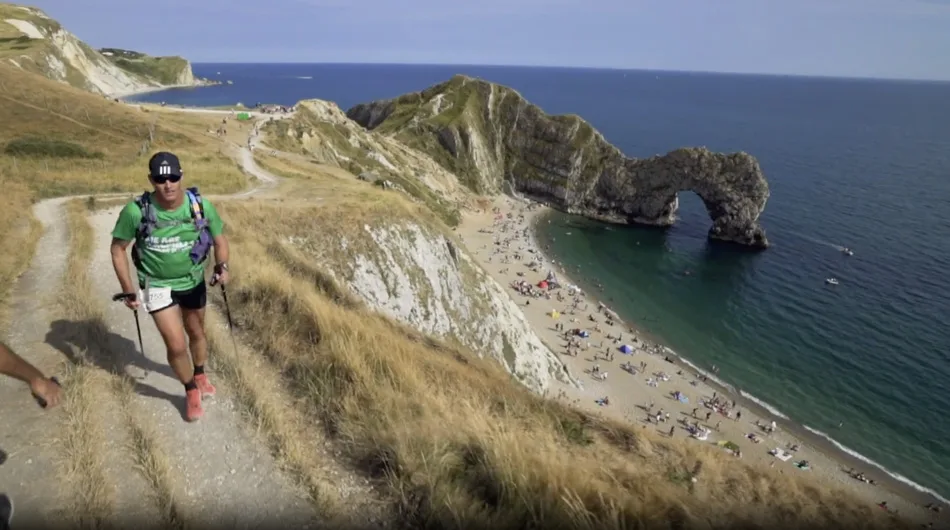
Walkers, joggers and runners are being invited to take on one of the South West’s biggest endurance events when the Jurassic Coast Ultra Challenge returns on 16th–17th May 2026.
The event follows a spectacular route along Dorset’s World Heritage coastline, beginning at Corfe Castle and passing through Swanage, Lulworth Cove and Durdle Door before reaching Weymouth. Those tackling the full distance continue past Portland Bill and Chesil Beach before finishing in Bridport.


Participants can choose from several distances depending on experience and ambition, including the full 100km challenge, as well as 76km, 58km, marathon, 25km and 10km options.
The route includes major rest stops every 10–15km with food, drink, medical support and marshals along the way. While some participants take part for personal achievement, many use the event to raise money for charity. Up to 700 charities are supported through the challenge each year, ranging from national organisations with local branches – such as Mind and Cats Protection – to Dorset-based charities including Weldmar Hospicecare and Diverse Abilities.
With its dramatic scenery, demanding climbs and celebratory finish line in Bridport, the Jurassic Coast Ultra Challenge has become one of the UK’s most popular endurance events – and a major fundraiser for charities of all sizes.
More information and entry details are available at ultrachallenge.com.

The BV community news section is sponsored by Wessex Internet

Steele Raymond expands with new brand

0

South Coast law firm Steele Raymond has unveiled a new brand and website as it continues a period of expansion across the region, alongside the growth of its partnership and specialist legal teams. The firm says it has nearly doubled the size of its partner group in recent years, strengthening expertise across key practice areas as demand has grown from businesses, developers and private clients across the central south.

Managing Partner Jennifer Rogerson


A new office in Poundbury brings the firm closer to clients across Dorset, alongside its long-established base in Bournemouth, while maintaining what it describes as a single-firm approach across its locations. The expansion reflects wider demand for legal advice as the region continues to see growth in housing development, business investment and commercial property. For regional firms like Steele Raymond, that means handling everything from land deals and planning agreements to business sales, restructures and employment disputes.Managing Partner Jennifer Rogerson said the growth reflected the role regional firms play in supporting local economic activity:
‘When a regional firm grows in this way, it creates more capacity for projects that shape our communities. You can see it in real outcomes resulting in growth that is intentional and grounded in the relationships we have built over many years.’
Alongside the expansion, Steele Raymond has maintained its long-standing position in The Legal 500 guide, where it has held Top Tier status for more than 20 years.
The latest rankings recognise eight practice areas, including Top Tier positions for Commercial Litigation, Commercial Property, Residential Development and Corporate & Commercial. Other specialist teams, including Contentious Trusts & Probate, Employment and Family, are also strongly recommended.
Chairman and Head of Corporate Tim Stone said the firm’s focus remained on providing clear commercial advice to clients: ‘Whether it is a sale, funding round or group restructure, clients choose us because of our extensive market experience and ability to bring clear commercial direction at the right time.’

British Under 18 Taekwon-Do champion returns to teach

0

‘I loved it, and it was my life. It was absolute life.’
As a teenager in the late 1990s and early 2000s, Taekwon-Do wasn’t a hobby for Chris Ryu – it was everything. Training daily, competing nationally and internationally, he became British Under 18 Taekwon-Do Champion in 2005. By 17 he was already a qualified instructor.
Then he walked away.

Chris Ryu


An injury, a new relationship and a fallout with a club meant the sport that had shaped his youth slipped into the background. He kept a connection to it, but it was more than two decades before he returned fully to the mat.‘I had a long break,’ he says. ‘But I always missed it.’
Today, he is back. At the end of 2025 Chris launched Unity Taekwon-Do, a new North Dorset-based club that has attracted 62 students already.
Unity now runs classes in Sturminster Newton, Shaftesbury and Gillingham, as well as sessions within Sandroyd School.
‘Our youngest student is three and our oldest is 64,’ says Chris. ‘We’ve built a bit of a family unit at the club – there’s lots of actual families that train together, too.’ He has even finally managed to convince his wife to try Taekwon-Do herself. ‘Just a few weeks ago I got the pleasure of presenting her with her first belt, after 23 years of being together,’ says Chris. ‘There was a moment in the grading where I gave an order and she replied, “Yes, sir.” That was a little bit strange. I don’t get that at home!’
The intergenerational mix is deliberate. While martial arts are often seen as something primarily for children, Chris is keen to challenge that assumption. ‘A few weeks ago during class I saw someone who was 12 years old teaching someone who was 64. It felt like a really special moment.’
The benefits for older bodies go beyond strength, he says: ‘Keeping fit, keeping active, keeping joint mobility – that’s the obvious bit. But there’s also the social aspect. Belonging to something. Being welcomed into a club. It’s nice. And we try to encourage that.’
He is currently training to deliver Choi Kwang-Do, a version of Taekwon-Do adapted for older bodies, removing harsher movements and focusing more on circular motion, balance and mobility. An over-50s class is planned.
The club’s early growth has surprised him.
‘We’re five months in and we have 62 students. I’m blown away, actually.’
Chris is well known locally for his IT and web development work, and he previously opened a STEM education centre. That background is evident in the running of Unity, down to the digital lesson planning tool he has built. ‘We have a formal lesson plan for every single lesson. Everything’s structured. Students can even see that in advance if they want to prepare their minds for what they might have to do later on,’ he says, explaining that this can be particularly helpful for those with autism spectrum disorder.

Chris in sparring gear

Everyone’s different
Chris holds multiple safeguarding and autism-related qualifications, and says lessons are adapted around individual needs.
‘We’ve got boisterous confident kids, but also shy students, those who struggle with attention, we have students who don’t speak,’ he says. ‘Our lessons look different to different students, but we work with them on that individual level. Sometimes that might mean a one-to-one with a senior student, or simply getting them to hold a pad for someone – it’s a very easy way of building some social contact.’
That individualisation extends to physical ability. Standards are fixed, but execution is judged technically rather than athletically.
‘Everyone’s different shapes and sizes,’ he says. ‘We have a set criteria they need to pass at grading and there are no exceptions. But one person’s side kick might be waist height, someone else might be head height. It doesn’t matter. Did they side kick correctly? Did they chamber? Did they pivot? That’s the important bit.’

One of Unity’s junior Taekwon-Do classes at Sturfit in Sturminster Newton

A modern club with big plans
Although Unity is not formally tied to a single governing body, Chris has trained across multiple major Taekwon-Do styles. He holds black belts in two systems and is working towards a third: ‘I wanted not only to get a black belt in all three, but also unify them into one syllabus.’
His aim has been to combine those different schools and approaches under one roof – though for most students that complexity sits quietly in the background. What they experience is a traditional martial arts club that competes regularly and invests heavily in equipment. The group is entering several competitions over the coming months, and a minibus has already replaced the original van as numbers have grown.
Unity uses reaction-testing equipment and kick paddles that measure striking power and feed data into an app. Chris has also published a children’s book, and is currently developing a mobile game aimed at reinforcing the life skills taught in class. Perhaps it’s no surprise that he reflects his software and systems background with an unusually digital approach for a local martial arts school. Affordability has also been a priority. Membership starts from £25 per month, with no sign-up fee, and licence and personal accident insurance included. Even the dobok – the formal Taekwon-Do uniform – is embroidered in-house to keep costs down.
Looking ahead, Chris is determined to secure a permanent, fully matted martial arts centre in Sturminster Newton. The aim is not a single-club Unity headquarters, but rather a shared space hosting multiple martial arts disciplines, alongside daytime sessions for older adults and other exercise classes. ‘I think we might then start to see the creativity,’ he says, recalling the more dynamic, acrobatic elements of Korean training he experienced in his youth.
For now, though, his message is simpler.
‘Just give it a try,’ he says. ‘Even if you tried it before and didn’t like it, just try it again. Maybe you just didn’t enjoy that club, or you didn’t enjoy that teaching style, or that style of Taekwon-Do. We’ve had lots of students return after a long break – and they’re really loving it.’
And after more than 20 years away from the mat, he understands that feeling.

For more information or to contact Chris direct, please see Unity’s website unityma.co.uk