

Two old bikes, two older riders and one dog-eaten pair of bifocals – Giles and Annie Henschel return to the road after 30 years
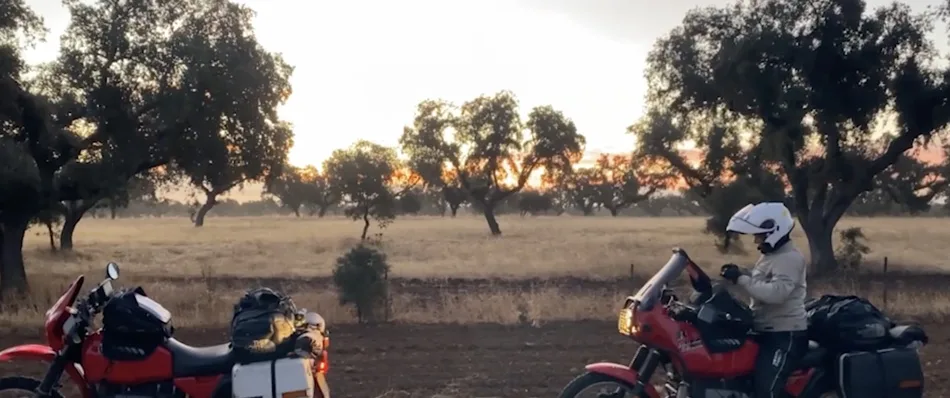
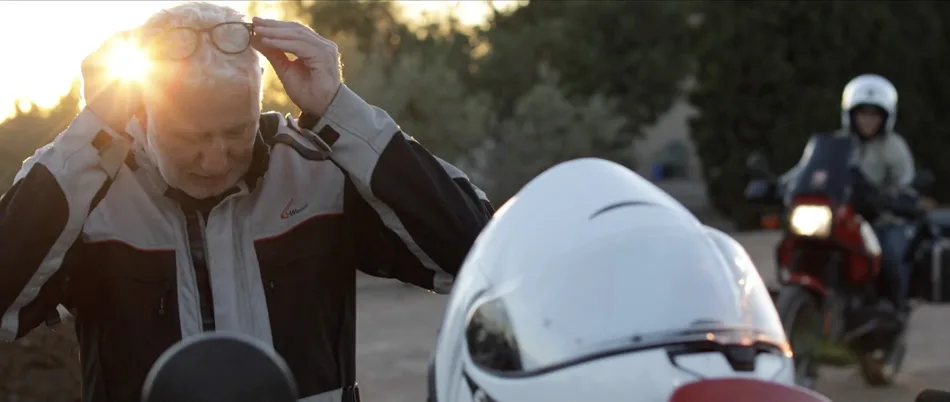
Giles Henschel is explaining, with the wry amusement of a man who’s seen some things, how a dog ate his bifocals somewhere in the hills of Chianti. ‘We got up the next morning,’ he says, ‘and there was this gentle crunching noise … the dog had my glasses.’ Annie is already laughing beside him. ‘For the last month of the trip he was basically blind,’ she says.
Giles shrugs. ‘I could see the road perfectly. I just couldn’t see the satnav at all…’
For anyone who knows their history, it’s the perfect illustration of how much has changed since their first great motorcycle journey more than 30 years ago. Back then, Giles navigated by a paper map tucked into a clear pouch on the bike tank. ‘Back then I could ride along, glance at the map, then up at the road…’ he says.
This time, Giles had to get special bifocals made – the lenses set so he could glance down at the satnav on his handlebars and still look up at the road in perfect focus. The dog, of course, had other plans.
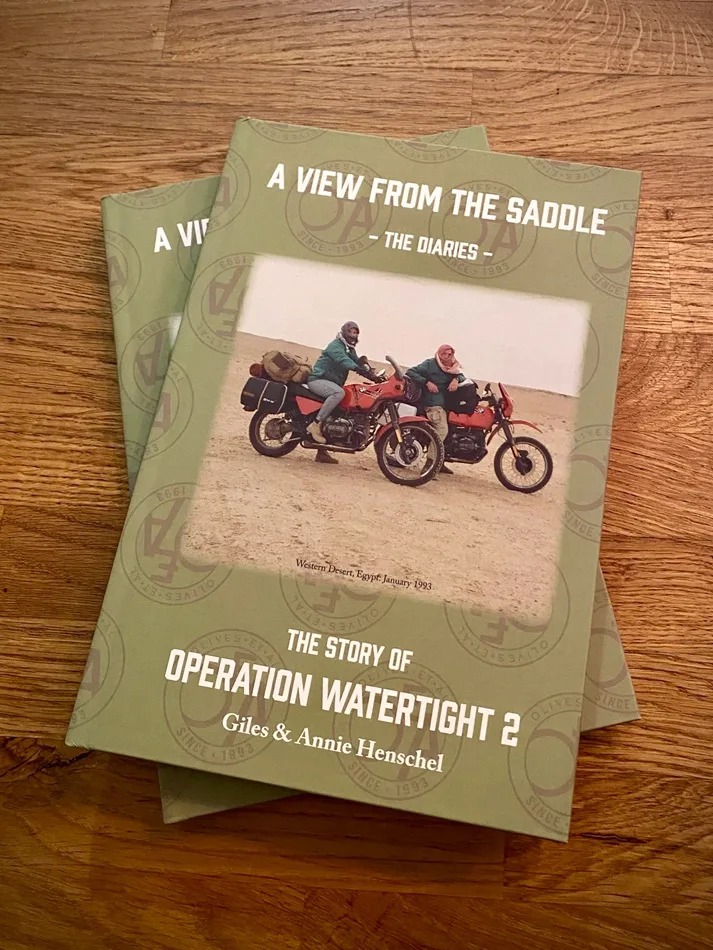
It’s the kind of story that fills a book.. which of course they’ve written about their journey: a raw, unedited collection of daily travel notes from their hundred-day olive odyssey. Warm, wry and occasionally ridiculous, it reads just like Giles and Annie sound when they sit side by side – a couple who’ve lived, worked and travelled together for decades.
The rhythm of the road
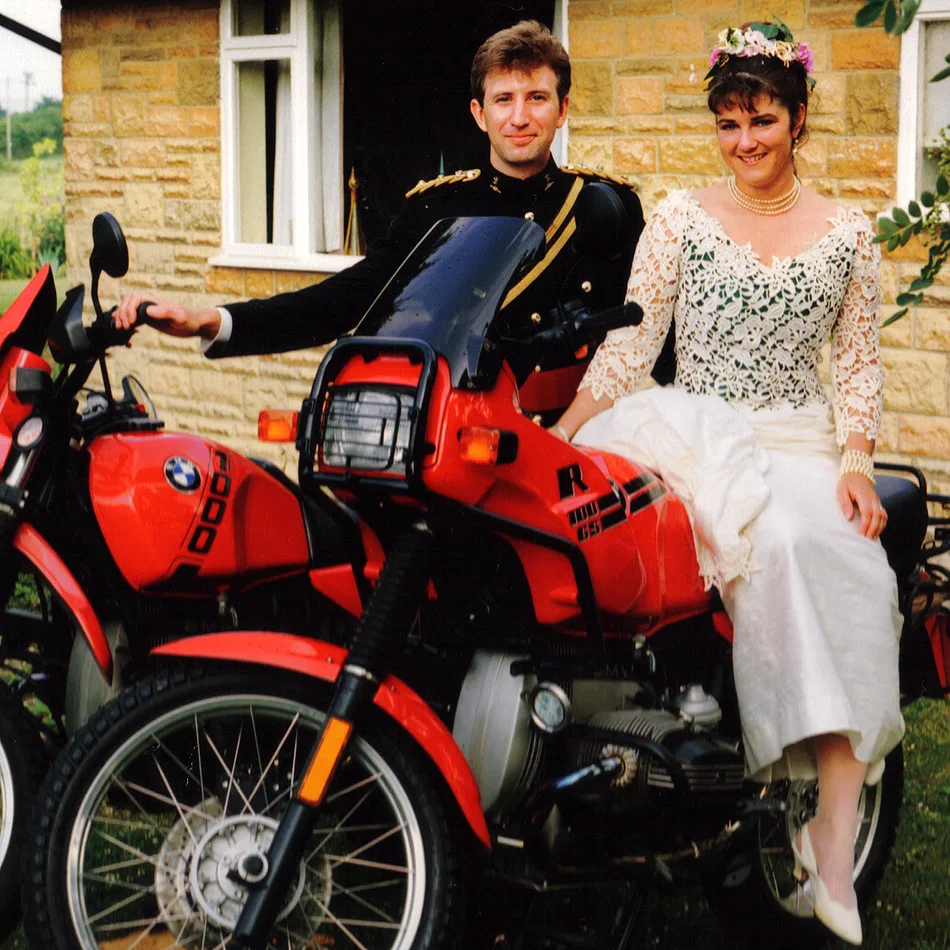
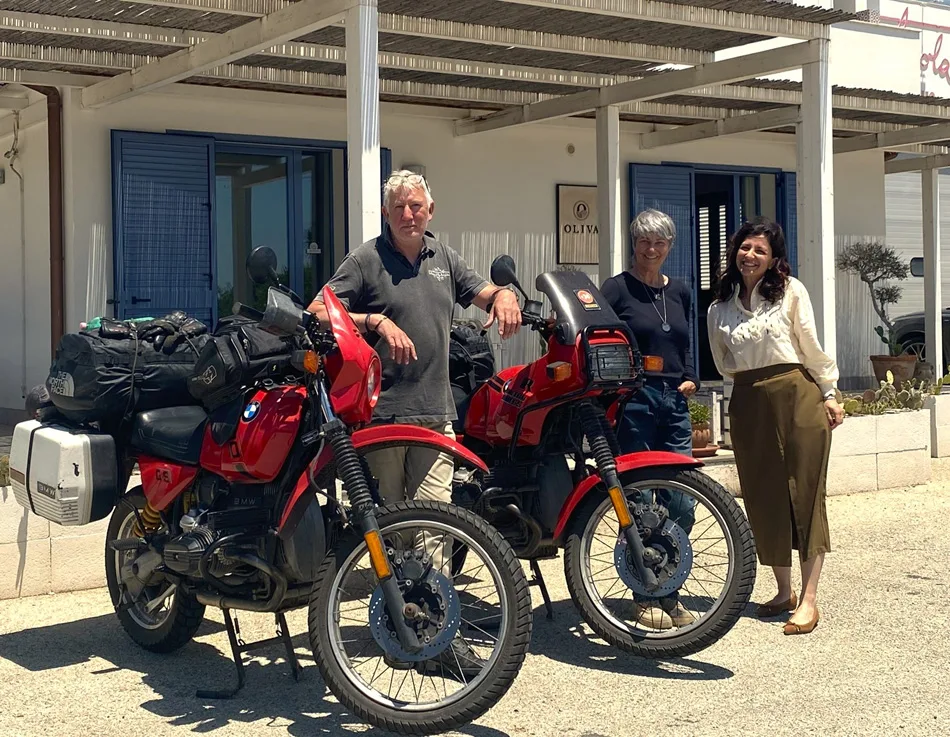
On 32-year-old bikes – the same they used for their first trip – their new book takes the reader with Giles and Annie across 10,000 miles and countless borders. From Spain’s parched reservoirs to Italy’s absent harvests, it isn’t just a travel log. It’s real lives, hard land and a centuries-old tradition under threat. Amid the stories of sliding down a mountain in a random ice storm, dribbling cats and a helmet which makes random phone calls, there are the growers and farmers with stories of drought, flood and resilience whose livelihoods depend on groves passed down through generations.
I wondered how the travelling had compared to their first journey three decades before. ‘After two or three days of getting into the rhythm – getting off, unpacking, packing, getting on – it felt natural to be back on the bikes,’ Annie says.
The rhythm of motorcycle travel has barely changed. Every stop still requires a small ceremony: panniers off, room colonised, socks washed in the sink, a piece of washing line strung across the shower. ‘Everything has a place,’ Giles says. ‘And everything goes back into that place, or you get explosions. True.’
The biggest difference, this time, was that they weren’t camping. The first trip was done with no money, cooking over stoves and pitching tents wherever they landed. Now, with phones and Booking.com, they never planned ahead and just filtered by price (‘30 euros – that’s it, no more’) to find the cheapest rooms available – which they admit led them to some eccentric places.
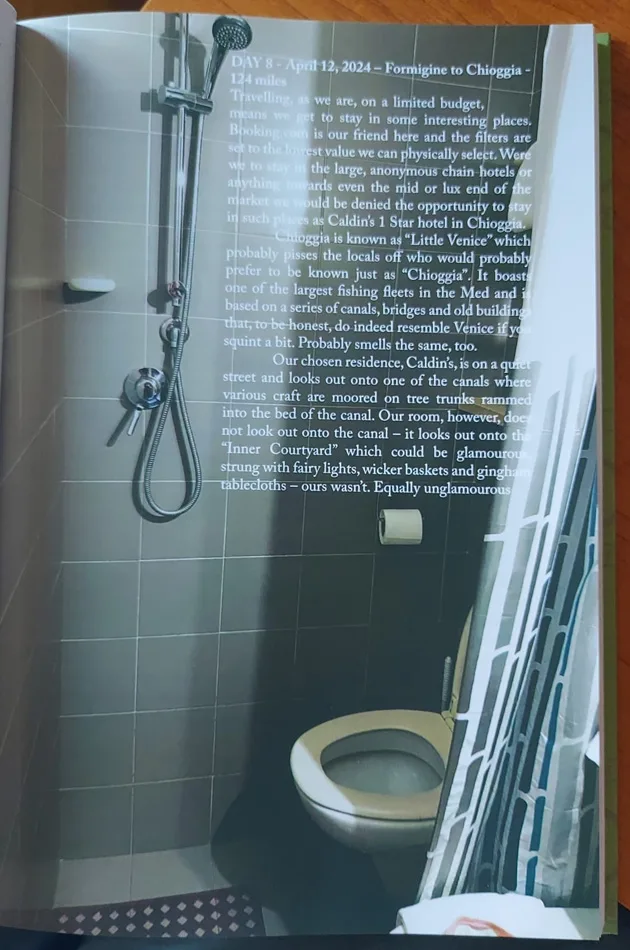
One in particular has become legendary in their retelling: a one-star hotel in the middle of Chioggia. ‘The toilet was in the shower cubicle,’ Giles says. ‘Directly underneath the shower head. The mark of a gentleman is someone who gets out of the shower to take a pee. The ladies and gentlemen at Calvin’s can stay in the shower with no fear for their reputation. Genius. What a time saver.’
Annie laughs. ‘Even the toilet paper was hung in the cubicle: disastrous if you forgot to remove it before turning the shower on!’.’
Riding itself was harder now. The old bikes required real work. ‘They have to be ridden,’ Giles says. ‘You can’t just sit on them, twist and go, like a modern bike.’ And the elements were harsher than memory suggested. Annie recalls watching Giles being blown sideways by a sudden gust in France. ‘It just picked him up and moved him right across the road,’ she says. ‘Thankfully there wasn’t anything coming the other way … if it were me, I would have been off.
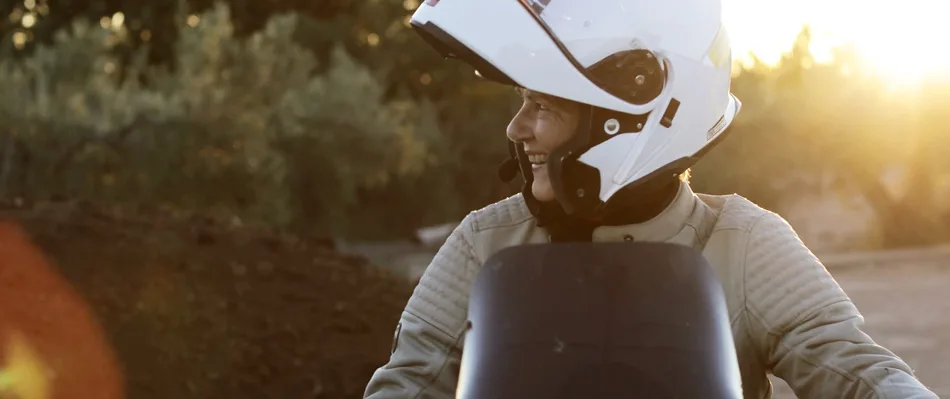
Giles chips in: ‘All I heard was “I can’t stop! I-can’t-stop-I-can’t-stop! I CAN’T STOP!” as she shot past me.’
‘We also had to be sure to stop on flat ground. Giles can put both feet down and support his bike, but I can only properly reach the ground on one side at a time: on a hill, I would topple straight over.
‘There was one occasion where Giles had booked a room in Croatia without realising it sat halfway up an alarmingly steep hill…’ Giles seamlessly picks up the story: ‘I was riding up the road towards it, thinking, oh, this is actually really quite steep,’ he says. ‘Finally, it came into view, and I pulled into the drive and stopped.’
Annie did not.
‘I just sailed straight past him,’ she says. ‘It was so steep that if I put a foot down I’d have gone over. But the road just kept going up and up.’
Giles chips in: ‘All I heard was “I can’t stop! I-can’t-stop-I-can’t-stop! I CAN’T STOP!” as she shot past me at a hefty speed.’
‘I ended up on a bit of waste ground right at the top of the hill,’ Annie says. ‘Giggling helplessly out of fear.’
Giles had to park his own bike, run up the hill and help her peel herself off the seat. They walked the bike back down together. It’s typical of the second trip, they say: absurd in places, unforgettable in others, the kind of moment that would have been disastrous if they hadn’t found it deeply funny.
Abandoned groves
Their journey wasn’t all comedy, however. The whole purpose of the trip was to see how the olive-growing culture is changing. What they found was complex.
Everywhere they went, people told the same story. ‘Everyone said the weather patterns were changing – there’s no such thing as seasons anymore,’ Giles says. In Sicily they met farmers who only get water in the groves for an hour a week. ‘And they never know when it’s coming,’ says Annie. ‘So the manager sits in the grove waiting for the phone call.’
While some centuries-old groves are being abandoned, others are finding new life as community orchards. In Spain they visited the World Olive Bank in Córdoba, where scientists are working with more than a thousand olive varieties to breed trees that can survive harsher conditions. ‘It was a really good piece of work,’ Giles says. ‘A huge positive in what was a rather bleak scene. Thank God for those people.’
The book – self-published ‘because Giles was impatient’ – collects the day-by-day accounts they wrote on the road. ‘They’re completely unedited,’ Giles says. ‘Completely unfiltered. Completely raw. We shoved it all in, warts and all, and just added explanations where necessary.’
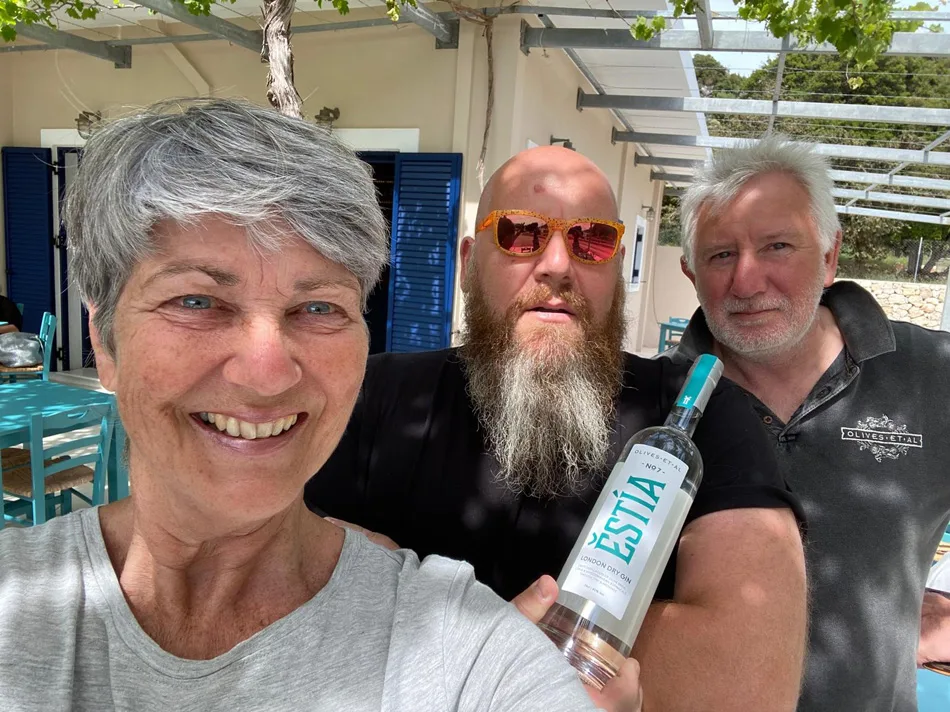
‘If ever you’re passing Ody’s Taverna on Jerusalem Beach, pop in and ask him for a Gin and Tonic with Estía Gin – made from olive brine. All the way from Dorset. By motorcycle courier. Ask him how it got there. It’s almost an interesting tale.
There’s a short prologue about their first trip, the one that birthed Olives Et Al in the early 1990s. Then an introduction explaining why, 30 years later, they decided to do it all again – older, achier, marginally wiser. The rest is pure chronology: where they went, who they met, the roads they followed, the conversations with farmers, millers, hoteliers, and the occasional bemused supermarket cashier.
They filmed it, too – hours of GoPro footage stitched together by a professional videographer in Valencia. Giles remembers sitting in a rain-lashed hotel room in Santander, recording final pieces to camera before sending the clips off to be edited. It was a far cry from their first attempt, when they tried to persuade TV production companies to work with them. ‘We suggested sticking a “helmet-mounted camera” on our heads, and they all laughed in our faces back then at the very idea. A camera just couldn’t be that small, there was no way. Now, the cameras are the size of a matchbox.
The book contains all of it — the hard days, the small revelations, the places you only find by accident. There are glimpses of their younger selves too: the same couple who once got hopelessly lost in Istanbul; the chance encounter with Danish cyclists that somehow repeated itself months later when they met again in the Sinai desert.
What they’ve produced isn’t a polished travelogue. It isn’t curated. It isn’t even gentle. It is, exactly as Giles says, ‘our tale of daily life, seen from the saddles… fruity real-time language and completely unedited writing.’
But it is affectionate, curious, rude, sharp-eyed occasionally sweary and often very funny.
‘It’s just honest,’ Giles says. ‘Probably a great Christmas present for someone you’re not that fond of.
‘Brilliant Christmas present for someone you are fond of, too,’ Annie’s swift to add, vainly attempting to wrestle Giles back on message.
Potholes and donkeys
One of the questions the couple often get is whether it’s wise to travel long-distance with your spouse once – let alone twice, after 33 years of marriage and 32 years of running a business together. Annie admits she wondered. ‘I did think about that. I did worry. Can we do this again? We work together, live together… but it was just so easy. It was the easiest thing about the whole trip – sharing the whole journey and just talking.’
Giles agrees. ‘The laughter and humour … base, base humour. That’s the best thing about travelling with Annie.’ Then, after a pause: ‘And the comms in our helmets. On the first trip they didn’t exist. This time we could chat as we rode – sometimes warning each other about potholes or donkeys, but mainly just ludicrous conversations.’
‘Giles would narrate what we saw. A couple of times I was actually crying with laughter,’ says Annie. ‘Couldn’t see the road.’
They grin at each other in a way that tells you the decision to do it again was never really in doubt.
And they’d like to do more – more travel, more writing, more exploring the culture of the olive tree. ‘When people think about Olives Et Al, they assume we’re all about the Mediterranean,’ Giles says. ‘We’re not. We’re about food from wherever the olive tree grows – and that’s Africa, Australia …all over the world.’
For now, though, they’re letting the book speak for the journey: two old bikes, two older riders, 30 years between trips, and a hundred days on the road – full of mishaps, hard miles, and the kind of laughter you only share with the person who’s been in the saddle next to you for half a lifetime.
A View From the Saddle is available from the Olives Et Al shop and website olivesetal.co.uk