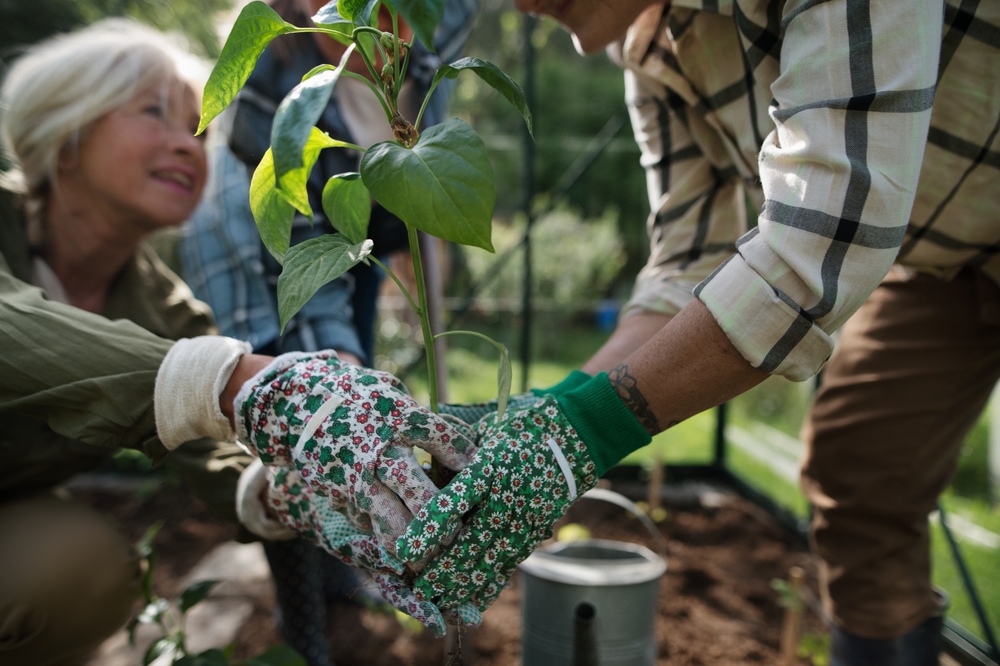
This May, Dorset Mind is encouraging people to connect with nature as part of the proven Five Ways to Wellbeing
Spending time in nature can be beneficial for supporting your wellbeing. It can help improve your mood, reducing anger or stress, and taking part in activities outside, such as gardening, allows your mind to focus and relax. In addition, gentle exercise can help support your physical health – reducing the risk of high blood pressure, heart disease, diabetes and other chronic medical conditions. Community allotments are spaces which enable users to connect with others, helping reduce isolation. Feedback from Dorset Mind’s ‘Eco in Mind’ support programme, delivered at several sites across the county, shows the amazing impact of gardening and ecotherapy in providing support for participants: ‘I am really struggling to leave the house at the moment but when I get to sessions they really help, and I feel it is a safe place to come’ – February 2023 ‘I was in tears before attending and left feeling happy. Focusing on nature-based art has helped lift my mood’ – November 2022 ‘Since attending sessions, I feel a greater sense of being able to cope with my week. After the sessions, I feel uplifted and grounded. I’m learning and it is really helping me each week’ –March 2022
Community allotments Dorset Mind is expanding its ‘Eco in Mind’ ecotherapy programme to reach even more people who need their mental health support. Local allotments will host charity groups to support Dorset residents. People are encouraged to self-refer, but can also be referred by a health professional.
Dorchester On Mondays, Dorchester continues to host sessions for young people from a local secondary school, with a mixed adult group later in the morning. On a Thursday, Dorchester sessions include a mixed adults art and plant session and a session supporting more young people. There is a new third session for paramedics, NHS, and blue lights staff.
Shillingstone ‘Eco in Mind’ is offering a new session in Shillingstone, at the Yellow Bus Project, supporting adults with their mental wellbeing by growing fruit and vegetables to give to the local food bank. These sessions will run on a Friday morning.
Shaftesbury Dorset Mind has announced new sites in Shaftesbury to support patients at a local medical centre, in conjunction with Blackmore Vale Partnership and Shaftesbury in Bloom, with sessions to also run on Fridays.
Stay seasonal If you don’t have access to a garden or allotment space, you can still enjoy the season’s produce. Baking and cooking are also mindful activities that support your wellbeing. Rhubarb is still going strong – why not bake a heart-warming crumble? You could also connect with nature simply by going to a local Pick Your Own farm. We are lucky in Dorset to have easy access to enjoy such a rich variety of environments, from our thickly-hedged farmland to our ancient woodland, the precious chalk downlands and of course the beaches in south Dorset.
Find out more about the Eco in Mind programme on dorsetmind.uk or email [email protected] for questions relating to volunteering or accessing this service.
AWAKEN YOUr BODY & MIND WITH STURMINSTER WELLNESS Experienced instructors who are passionate about sharing knowledge, skills, techniques and promoting wellness of the body and mind to the community Sessions start Saturday 27th May 2023 at The Recreation Ground, Ricketts Lane, Sturminster Newton, DT10 1BY
Supportive continued professional development (CPD) programme
Extensive training
About Us:
The Marchant-Holliday School is an independent special school that caters for boys aged 5-12, all of whom have an Education, Health & Care Plan (EHCP) for social, emotional and mental health (SEMH) needs. Our vision is that all children can thrive in a caring, tolerant, understanding and supportive environment.
The school has day pupils and weekly boarders and we believe that every child has the right to feel safe to enable them to thrive and build their self-esteem whilst developing a lifelong love of learning. We provide a nurturing environment for children who have experienced difficulties accessing mainstream education. In order to achieve these aims, we have a fantastic team of staff and a wonderful site with amazing facilities.
The role:
We require a resourceful, enthusiastic, and self-motivated teaching assistant to support pupils within the classroom. Our class groups have a maximum of eight. The staffing structure at the school is a teacher and two teaching assistants per class. With this high pupil to adult ratio, teaching assistants have the opportunity to be flexible in their approach and to provide individualised and adaptive support.
Supporting teachers in the classroom
Delivering sessions with small groups of pupils
Supporting pupil’s emotional regulation
Managing dysregulated behaviours through a range of de-escalation strategies
Being playful and having fun
Supporting pupils 1:1 with curriculum tasks or social skills activities
Organising resources to support learning
Lunch and play time duties
Club time duties
Accompanying classes on trips
A passion and enthusiasm for working with SEN children is essential as is the ability to work co-operatively within a team setting.
A tolerant, compassionate nature and sense of humour would also be an asset.
Our school is committed to safeguarding and promoting the welfare of children and young people and expects all staff to share this commitment. An enhanced level Disclosure and Barring Service check will be required.
Prospective candidates are strongly encouraged to visit the school ahead of submitting an application.
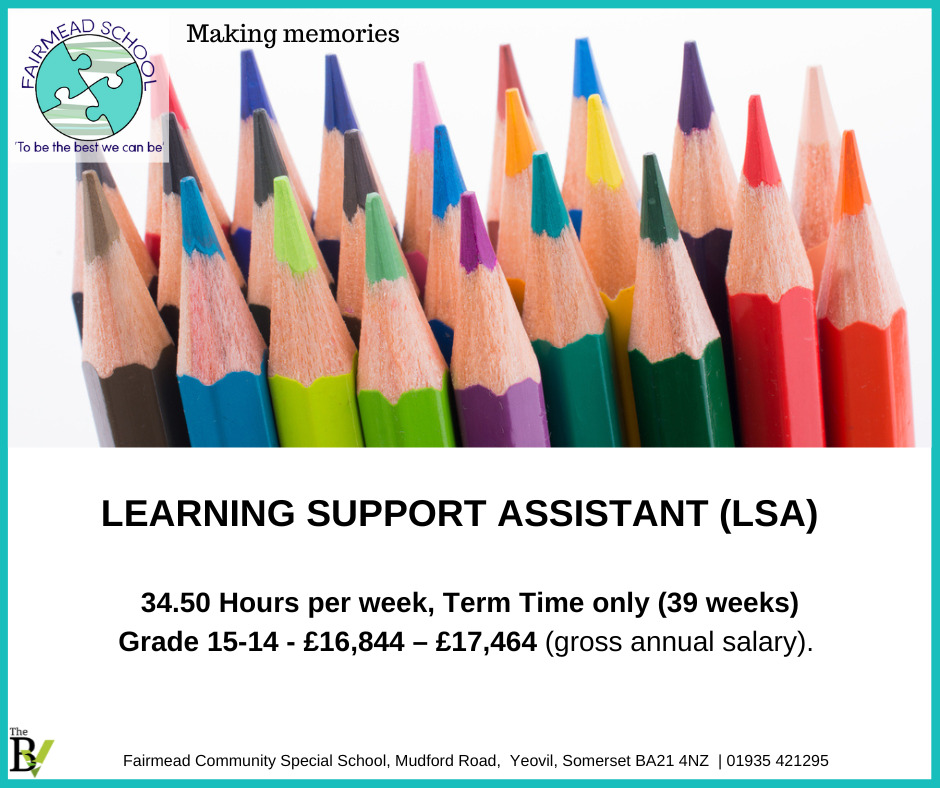
Grade 15-14 – £16,919 – £17,540 (gross annual salary). Subject to increase from April 2023
Working hours Mon, Wed, Thurs, and Fri 8.30am-3.45pm and Tues 8.30pm-4.30pm – 34.50 working hours
We are seeking to appoint outstanding Learning Support practitioners who are compassionate, dynamic and resourceful individuals to join our dedicated and hardworking team of skilful support staff to work across the whole school. A desired element to this role would be experience of supporting young people with Autism and moderate learning needs.
Prospective candidates are warmly invited to visit our school; this can be arranged by contacting [email protected]
Closing/Shortlisting Date: Monday 5th June Interviews: Thursday 8th June
About the school
Fairmead Community Special School transforms the lives of pupils aged between
4-19 years with additional learning needs (MLD and ASD). The school works in partnership with parents/carers and other stakeholders to develop our pupils in becoming positive individuals who make a valuable contribution to their community.
Fairmead Community Special School
Mudford Road, Yeovil, Somerset. BA21 4NZ
‘This is a Good School’ – Ofsted February 2018’
Fairmead School is committed to safeguarding the school community. All job applications must contain the disclosure of any spent convictions and cautions. The school will carry out pre-employment vetting procedures, which include the successful outcome of an enhanced DBS.
You can’t interview Charlie without a steady stream of name-dropping – his long and winding career is a musical tour through 40 years of popular culture
Charlie North-Lewis
Charlie North-Lewis was working at BAFTA when he decided it was time to go back to his roots and look for a theatre job. ‘I just happened to see the advert for the Tivoli. It said “Tivoli Theatre in Wimborne, Dorset, is looking for a general manager.” I’m sure it said something along the lines of knowledge of the area useful or helpful or something. And I just thought, well, I went to school in Dorset so that’ll do.’ I came for the interview, but genuinely didn’t expect to hear back from them. I got a phone call, though, and the first thing that was said was: “We don’t think we can afford you. How much do you want to be paid?’ It was higher than they were hoping (but it wasn’t all that high!), so I wished them well and told them to let me know how they got on. Why I said that I’ve no idea. Six weeks later the Tivoli called me back … There’s incredible community support for the Tivoli. From the box office staff, the people who you buy the tickets from, the front of house staff, the bartenders, the ushers … they are all volunteers. I’ve never thought about my career as being particularly exciting. It’s just what I do. But then I talk to other people, they moan about only ever working in an office for however long, and I think … you know, I’ve actually been pretty lucky.
A life in music And so to Charlie’s eight music choices, in no particular order, along with how and why they have stuck in his life:
Ramblin’ Rose Nat King Cole Unbelievably, this is a memory from 40 years ago this year. I was living in Toronto (my first wife was Canadian), and my son James was born in the city’s North York General Hospital. Funnily enough we had an English doctor. Dr. Peridot was his name. I remember going into the delivery room with all the gear on, you know, and he just strode in, eating a sandwich! He put the radio on, and there was Nat King Cole singing Ramblin’ Rose. It was playing when my son James was born. It was a close call on my Nat King Cole choice, though. In the late 80s I was in Toronto and saw The Profumo Affair. One of the songs in the film was Lazy, Hazy, Crazy Days of Summer. Watching the 60s movie, hearing that song, I was taken straight back to my childhood. For some reason, it always makes me think of my parents’ front garden, I have no idea why. Hearing it brings me the scent of an early summer day and the waft of gin and tonic and freshly lit cigarettes because they were having one of their drinks parties or something.
Our Town Iris Dement My first marriage broke down and I came back to England in 1997. A job at BAFTA came up and I just applied for it. I got a letter almost by return asking me to come in for an interview (on the way to which I wrote my car off, which is a whole other story). Anyway, I got the job! One of the first things I was asked to do was to revamp BAFTA’s banqueting area in honour of Sir David Lean, the film director. I was hunting for the right production stills from Dr Zhivago, and someone told me to call a place in Camden called the Cabal Collection. I ended up speaking to a lovely voice on the end of the phone. I’ve no idea quite why I said it, but I alluded to the fact that she must be quite glamorous. I discovered she was Australian (she didn’t sound Australian at all) when I met her the next day – I was so enchanted by her. She came and saw a film at BAFTA with me and we got married exactly a year later! I was actually half an hour late to my own wedding because I misjudged how long it would take me to get there. Fiona had been playing me this song, saying it was one of her favourites and that she wanted it at her funeral. It’s a special song – sad, but the lyrics are beautiful. It’s about the end of the small, rural communities and small towns, how they’ve been gobbled up. It’s a really lovely song.
For A Dancer Venice To be honest, I just think this is one of the best songs ever written. That’s it. I just absolutely love it. There are several versions of it, but for me the best is on a double CD called Looking Into You, a Tribute to Jackson Browne. It’s his song, but it’s sung by a group called Venice. Of all the versions I’ve heard, this is it. It’s a song about death. Or rather, some people have interpreted it as being a song about death. I just think the lyrics are amazing.
Stormy Monday Chris Farlowe Best singer ever. Bar none. He’s been my favourite for decades. In my opinion, Chris Farlowe and Steve Marriott are two of the greatest vocalists this country’s ever produced for British R&B and British soul. Paul Rogers is another one, actually. And Rod Stewart – if you listen to early Rod Stewart with the Jeff Beck Group he’s phenomenal. And with the Faces. Him and Farlowe and Marriott – you can’t touch them. Chris Farlowe was the first act I ever booked for the Tivoli, beginning a long association which still continues. He’s back with Colosseum later in May and hopefully in his own right later this year.
Stray Cat Strut Stray Cats I worked for a concert merchandise company in London after I’d been the in-house sound engineer at Blazes Club in Windsor. Through that job I knew the man who was Andy Williams’ sound engineer (whose wife is Elkie Brooks). On the second time that Andy Williams played at Blazers, in 1981, I asked Trevor to let me know if he heard of any jobs going – I’d seen my future as a sound engineer. About two weeks later I got a phone call from the production manager: “Do you want to go to Europe with Nils Lofgren?” I said yes, and he said “Good, you’ll be doing the merchandising”. I protested that I was a sound engineer. He said: “Take the job. You’ll get paid more than you earn now, you get all your expenses, you’ll travel and you’ll meet people that can be very useful to you.” He was so right. It became a Rick Wakeman tour instead. Then I went straight on a Steve Harley tour, which had two London dates, during which my boss abruptly said ‘I’m taking you off this tour’. I thought I’d done something wrong! But no, turned out I was going to Bristol with the Stray Cats. In 1981 we had the worst winter we’d had for 20 years. The snow was appalling and we were ordered out of our vehicles on the M4 because of the snow. We never even got to Chippenham (it wasn’t Bristol after all). So the first gig I actually did with them was in Brighton and I just loved them. It’s the type of music I really like, rockabilly. Apart from the Rolling Stones, the Stray Cats are my favorite band. It’s strange, touring. You get ten days into a tour and think ‘Oh God, there’s another month to go.’ Because, you know, you don’t get many days off, it’s constant. But then as soon as you come home, you can’t wait to go out again. I did enjoy it … there was only one I really didn’t enjoy. That was my second tour with Kid Creole, but I loved the first. I was doing a tour with Rose Royce at the time, and worked out with my manager that the two tours didn’t clash, so I could manage them both. I loved it. It was like a family on tour. I had a short break in Canada while my first wife and I got married, and then I was put on this second three-month tour with Kid Creole. It was relentless – just too many dates, no time off, my grandmother died when I was in Germany … I just didn’t enjoy it. I came back and did a tour of France with Murray Head. Then I was taken off that to do a Pat Benatar tour, joined up with my mate Derek and we did a load of tours together. And then I toured with Tears for Fears. And then I moved to Canada!
Gimme Shelter The Stones I just think this is one of their best songs, actually. It was that or a song called Dead Flowers, which I absolutely love, a country song, really, and Mick Jagger sort of does a Johnny Cash voice. But Gimme Shelter – I just think it’s a powerful song. The Stones in concert will have a guest vocalist who will come on and sing it with them; I’ve seen them do it with their former backing singer Lisa Fisher, who has one of the best voices. She was the greatest companion vocalist on the song with Mick Jagger. It’s not a terribly nice song, in terms of what it’s about. But it’s just fantastic.
Tin Soldier The Small Faces I think this is one of The Small Faces’ greatest songs. And it just showcases Steve Marriott’s voice brilliantly. I was a fan of his, through The Small Faces and then in Humble Pie – I saw Humble Pie at Oxford Poly. I was just completely blown away by them. But then The Small Faces reformed in about 1976, and I went and saw them at the New Theatre in Oxford. I expected it to be packed – it wasn’t and I couldn’t understand it! I was just really glad I saw them. Sadly, Ronnie Lane had left them at that point, but all the others were part of it. Marriott’s just one of the greatest vocalists ever.
Hymn for My Soul Andy Fairweather Low Andy Fairweather Low is one of the nicest people you could ever meet. He’s got no side to him at all. You can sit and have long chats with him about all sorts of things, he’s great company. I think he’s one of the most unsung heroes – a lot of people don’t realise exactly what he’s done in his life. I mean, he was a pop star in the 60s with Amen Corner. And then he had quite a bit of solo success. And then he ended up becoming a sideman. He was with Eric Clapton for years, he was with Roger Waters for years. And he’s played with all sorts of other people on their records and as a sideman. In about 2008 that he, Dave Bronze who was Eric Clapton’s bass player, and Chris Stainton, who was Clapton’s keyboard player, would just go out on tour. They played the Tivoli, and I was just blown away by it. What a nice man. He’s been a regular visitor to us almost every year since, until COVID messed things up. I’m hoping he’ll be back soon. I chose his Hymn For My Soul just because of the lyrics.
A book for a castaway It would be a John Mortimer, but I’m cheating. I cannot decide between Paradise Postponed or the complete Rumpole stories. In Toronto I went to An Evening With John Mortimer. I took my copy of Paradise Postponed and some of my Rumpole books, and he signed them. It was almost as good as seeing the Stones in concert. Not quite, because nothing’s that good. But it was amazing. I love Rumpole. In terms of heroes, if one can have a fictional hero, mine would be Horace Rumpole. I want to say he’s the Lenny Bruce of the legal system, but he wasn’t a heroin addict. And he didn’t swear in court. But he just wanted the truth. Rumpole’s thing is the truth. There’s a great documentary about Lenny Bruce called Swear To Tell The Truth (I actually have it tattooed on my arm). Truth is Rumpole’s whole thing. Plus he’s totally irreverent. Another reason why I think he’s really cool.
A luxury item? My guitar. Well. One of my guitars. I have too many. I won’t say how many in case my wife sees it. The thing is I keep saying ‘right, I haven’t played that one for ages. I’m just gonna sell it’. And then I pick it up to put it in its case. And then I think ‘oh, actually, maybe I won’t sell it’. I need to be very strict with myself. So yeah, I would take an acoustic guitar, obviously, because there’d be no electricity.
One to keep? And if a giant wave was coming, and there was only time to snatch one record, which would Charlie save from the water? ‘It would probably have to be Gimme Shelter. I think … maybe … that or Our Town. It’s so difficult to choose!
Jim Bettle of Dorset Charcoal makes his living from an ancient craft, fuelling his passion for a more sustainable country. Tracie Beardsley reports
One of Jim Bettle’s Dorset charcoal kilns. All images: Courtenay Hitchcock
Jim Bettle’s lively eyes focus on the smoke winding its way skywards. He’s reading it, looking for a deeper colour. Above the chatter of woodland birds, he listens for the sound of fire. A sudden thunderous roar and he springs into action, peering up the port-holes of a huge, circular steel kiln to see how far the fire has spread. He expertly manoeuvres a massive circular lid – I can’t help but think of a giant’s paella dish – over the wood-filled kiln, propping it so the fire spreads before he dexterously drops the lid. Then he slots four tall chimney pipes into bases around the kiln. Now he’s cooking – and will be doing so for the next 16 hours. It’s this year’s first burn in the woods for The Dorset Charcoal Company. Jim’s ‘in tray’ is a neat stack of 300 cubits* of ash, sycamore and oak, cut from the private Dewlish woodland that will be his ‘office’ until the end of August. In that time, he’ll produce more than 35 tonnes of sustainable British charcoal. One of very few British charcoal producers, he’s the biggest in Dorset. ‘I’ve got seven kilns, based on models dating back more than 200 years. ‘As we hit the busy season, I’ll constantly have two kilns going, producing about half a tonne daily,’ explains Jim.
It’s not just for the barbecue – Dorset Charcoal Co. create cattle and pet feed supplements, as well as gardener’s biochar.
Nothing is wasted, every size having a use. Bigger pieces are bagged up on site to sell as barbecue fuel, while finer grades go to the cosmetic industry as an environmentally-friendly replacement to the now thankfully banned microbeads. Jim’s charcoal even features in blockbuster movies – his powder was used for special effects in the latest Star Wars film! The Dorset Charcoal Company is accredited as a sustainable supplier to the TV and film industry by the BAFTA scheme We Are Albert. His charcoal enhances equestrian and cattle feed (adding biochar to feed reduces cows’ methane emissions by up to 18.4 per cent) and is also a diet supplement for dogs. His biochar horticultural additives, an ancient way of conditioning soil, help to retain both nutrients and moisture, improve drainage and soil microbes.
Jim Bettle, owner of Dorset Charcoal Co. will make half a tonne of charcoal daily over the summer
An ancient sustainability ‘Finally, after shouting from the treetops, the penny is dropping and we’re finding sustainable alternatives,’ says Jim. ‘Charcoal is natural. We’ve used it for thousands of years. The symbiotic relationship makes such sense. We can create a sustainable wood fuel with carbon dioxide emissions 95 per cent lower than gas or oil. It’s absorbed back into the soil and nourishes trees.’ He gestures to the woodland around him. ‘Managing this coppice allows flora and fauna to thrive. I hear more birds and insects as we open the wood and let light in. I’m completely driven by producing a sustainable product that has positive effects in the environmental chain.’
Once a kiln is lit, Jim Bettle lets it ‘cook’ for 16 hours. He has seven kilns, and during the season there will constantly be two working
Wearing the charcoal hat The call to a career in charcoal came more than 25 years ago. ‘I got my degree but quickly realised a suit, tie and a job in the city was not for me.’ After some time spent backpacking, Jim took a variety of rural jobs. ‘A throwaway comment from a master thatcher I was working for – “there’s a future in charcoal” – was the first seed sown. I went to Glastonbury Festival (now one of his clients) and rather than take photos of the stars on the Pyramid stage, I took snaps of kilns!’
image Courtenay Hitchcock
Living and working on the Drax Estate, the ‘charcoal call’ came again when the estate forester looked for a charcoal burner. Over a bottle of wine, a plan was hatched and in 1996 Jim began contracting. He went to the Greenwood Trust in Telford for training in woodland skills. ‘I also travelled around the country learning this ancient craft from the “old boys”. I started making my own charcoal at weekends and in 1997 gave up my day job and launched The Dorset Charcoal Company.’ Now, 25 years on, he’s proud to have four employees and seasonal summer workers (‘my ‘woodland pirates’). And it’s not just his own business in Dorset: ‘I wears the charcoal hat for the National Coppice Federation and lobby government to regulate charcoal imports. The scale of waste is madness! The UK imports over 100,000 tonnes of substandard charcoal annually, made by ravaging tropical rainforests. And don’t get me started on the shipping pollution to get it here!’
Jim’s team expertly manoeuvre the massive circular lid – Tracie thinks of a giant’s paella dish – from the wood-filled kiln
Quick fire questions:
A-list barbecue guests? My wife Nancy, the UK’s environment minister (it would good to have her ear!), ex-US presidential candidate Al Gore and scientist James Lovelock. Oh, and Shane Warne (I’m a keen amateur cricketer!).
Book by your bedside? American Dirt by Jeanine Cummins. It’s a brilliant novel about a Mexican migrant family building a life in the USA
*cubits – an ancient unit of length based on the length of the forearm, from the elbow to the tip of the middle finger. Usually equal to about 18” / 46cm
Jim’s ‘in tray’ – a neat stack of 300 cubits of ash, sycamore and oak, cut from the private Dewlish woodland that will be his office until the end of August.
Formerly of Bruton, passed away peacefully on 30th April 2023 aged 96 years.
A dearly loved father, grandad and uncle who will be sadly missed by his family and friends. Now reunited with his beloved wife Mary.
Funeral service to take place at St. Leonards Church, Pitcombe, on Tuesday 16th May 2023 at 12pm.
Family flowers only. Donations (in lieu) made payable to The Friends of Wincanton Community Hospital, can be made via funeral-notices.co.uk or forwarded to Trotman Funeral Directors, Ashdene, Cranmore, Shepton Mallet, BA4 4QQ.
Wildlife writer Jane Adams grew up in the suburbs, and vividly recalls the first time she shared her morning tea with the waking birds
The wren, whose song ‘packs a mighty machine-gun punch’
In the past, I didn’t understand why people got so excited about the dawn chorus. Wasn’t it just a bunch of birds singing ridiculously early in the morning? I grew up in a London suburb where the chirp of a house sparrow was as good as it got. Then we moved to the edge of a Dorset village. That first spring, I woke up every morning at 5am to close the window, half asleep. Not due to noisy builders, or dustmen, or someone digging up the road. It was birds. Just singing. One morning I had to get up at 4am for work, and I took my cuppa into the garden. And that’s when I experienced my first dawn chorus.
‘… the unexpectedly beautiful song of a little brown dunnock’
Confident and melodic, he belted his tune out into the darkness, followed soon after by the softly repeated lullaby of a wood pigeon. In the distance, a tawny owl hoo-hoo’d goodnight to his mate, followed a few seconds later by his partner’s kee-wick. The urgent song of a wren split the first rays of sunlight. As one of our smallest birds, its song packs a mighty machine-gun punch and it seemed to buoy other birds to join in. There was a robin, blue tits, great tits and a chaffinch I think. Then the repeated chant of a song thrush, and the unexpectedly beautiful song of a little brown dunnock (see video below left if, like me, you’re not sure – Ed). There were other tunes I didn’t recognise, and it didn’t matter. The sound rose and fell in waves, and, as it did, I shivered with pure pleasure and felt the hairs raise on the back of my neck.
That’s when I understood. These small feathered creatures weren’t singing for me, and they certainly weren’t trying to interrupt my sleep at 5am. They were singing for the chance to attract a mate, to establish their territories. They were singing for their futures, for their offspring, for their very lives. That’s why the dawn chorus is special. Why it matters. Just try to imagine a world without birds. Within fifteen minutes, it was nearly over, and I was left with just the intermittent chirp of a house sparrow.
Dawn Chorus events in Dorset:
Dorchester Dawn Chorus Walk 13th May 5 to 7am Dorchester walking festival Shillingstone, Blandford. Dawn Chorus Walk with Breakfast 13th May 4.30 to 6.30am The CRT Radipole Lake Nearly the Dawn Chorus with Breakfast Pastry 14th May 7 to 9am The RSPB Arne Not Quite the Dawn Chorus with Breakfast 7th, 13th and 21st May 7 to 9am The RSPB