Second episode of May’s podcast is out now – just click the play button to listen
In May episode two:
Buying two horses unseen was a risk, but the results are absolutely wonderful, and the season has started well, says Toots Bartlett, our national three day event rider diarist.
In Tales from the Vale, Andy Palmer shares tales of rationing and his mum’s war
The fascinating history of compassion, bravery and the largest pitched battle in Dorset during the Civil War is told by Rupert Hardy, chair of North Dorset CPRE
Pubs in previous centuries staged a wild variety of events to draw in customers – but they weren’t quite the same as today’s quiz nights and ‘open mic’ sessions, explains Roger Guttridge as he talks about Shroton’s village pub
The tale of an innocent Dorset boy who quickly became a man in the horrors of the Napoleonic war is vividly described by Roger Guttridge
Birds living and breeding on the UK’s farmland saw numbers decline by almost a tenth in just five years, says Dorset Wildlife Trust
Blue tits are on a surprisingly precarious tightrope each spring. Nature writer Jane Adams shares the task ahead of ‘her’ Bonnie and Clyde
With his gardening jobs for May, Pete Harcom suggests now’s the time to look for optimum siting for plants to bloom
Crating the tulips image – Melanie Ward
Originally a wildflower from Asia, Europe’s love for tulips meant that some bulbs were worth more than a house during the height of the Dutch craze for the plant, as Charlotte Tombs relates
Life or death foals, DIY one-sided milking, windswept legs, film stardom and “Go Honeysuckle, go!” – it’s another average month at The Glanvilles Stud with Lucy Procter
When Jemima Green was paralysed from the waist down after a car crash, she thought she’d never be able to ride again. She was wrong – she shares her story
Events at a Dorset council meeting made national headlines, but ultimately overshadowed the importance of the vote, says Labour’s Pat Osborne
The Government is punishing the victims of cross-channel trafficking, not the perpetrators, says north Dorset Lib Dems’ Mike Chapman.
The tale of an innocent Dorset boy who quickly became a man in the horrors of the Napoleonic war is vividly described by Roger Guttridge.
J T Willmore’s engraving of the Storming of the Centre Pass at Roliça, one of the battles that Harris describes
When Benjamin Harris of Stalbridge exchanged the gentle pace of life as a shepherd boy for military service, he had no idea what he was letting himself in for. After tending sheep since infancy, the 22-year-old met an army recruiting team in Blandford in 1803, and was seduced into ‘taking the King’s shilling’. Army records reveal that Harris was paid £11 (approximately £900 today) for signing up, which must have seemed a fortune to someone whose weekly wage would have been a few shillings. He spent the next 11 years as a private, mostly in the 95th Rifles, surviving battles and other tribulations that claimed the lives of many comrades. Although illiterate, Harris later dictated a vivid account of the Peninsular War, which was first published in 1848 and reprinted in 1995, with notes and additions, by Dorset writer Eileen Hathaway (see image below). Benjamin, son of shepherd Robert Harris and his wife Elizabeth, was a ‘sheep-boy’ from an early age. ‘As soon almost as I could run, I began helping to look after the sheep on the downs of Blandford in Dorsetshire where I was born,’ he says. ‘Tending the flocks and herds under my charge and occasionally, in the long winter nights, learning the art of making shoes, I grew a hardy little chap.’ His hardiness would come in handy in later years. ‘One fine day, in 1803, I was drawn as a soldier for the Army of Reserve. ‘Without troubling myself much about the change which was to take place in the hitherto quiet routine of my days, I was drafted into the 66th Regiment of Foot and bid goodbye to my shepherd companions.’ Benjamin’s decision meant leaving his ageing father ‘without an assistant to collect his flocks just as he was beginning more than ever to require one’. A shocked Robert Harris did his best to remedy his son’s impulsiveness. ‘He tried hard to buy me off, and to persuade the sergeant that I was of no use as a soldier, having maimed my right hand by breaking a forefinger when a child,’ says Benjamin. ‘But the sergeant said I was just the sort of little chap he wanted, and off he went, carrying me, and a batch of other recruits, away with him.’
Front cover of the 1995 edition of Benjamin Harris’ book
Witnessing an execution One of Benjamin’s first military experiences was to witness the execution of a soldier who had joined up 16 times to claim the bounty and deserted every time. In 1808 Harris was involved in the first skirmishes of the Peninsular campaign against Napoleon in Portugal. ‘I often look back with wonder at the light-hearted style, the jollity and reckless indifference with which men, destined in so short a time to fall, hurried onwards to the field of strife,’ he says. Among those whose deaths he witnessed was Joseph Cockayne, shot in the head while swigging water. In those days many women followed their men to the battlefields. ‘After the battle, when the roll was called, some of the females came along the line to inquire of the survivors whether they knew anything about their husbands,’ Harris recalled. Mrs Cockayne refused to believe Joseph was dead and insisted on being taken to the spot. ‘I made my way over the ground we had fought on. She followed, sobbing,’ says Harris in a particularly moving section. When they reached her husband’s body, Mrs Cockayne ‘embraced a stiffened corpse, then rose and contemplated his disfigured face for some minutes’. ‘She took a prayer book from her pocket, and with hands clasped and tears streaming down her cheeks, she knelt down and repeated the service for the dead over the body.’
‘Widow refused my offer!’ Harris later offered to marry the ‘handsome woman’ but she said she’d never think of marrying another soldier. Some horrors described by Harris are almost too awful to contemplate. After the Battle of Vimeiro, a churchyard became an open-air hospital where surgeons, ‘their hands and arms covered with blood, looked like butchers in the shambles’. ‘As I passed, I saw at least 20 legs lying on the ground, many clothed in the long black gaiters then worn by the infantry of the line,’ Harris adds. During a winter retreat to Corunna and Vigo, a heavily pregnant Irishwoman and her husband fell by the wayside in the snow and were not expected to be seen again. But a little later the couple were hurrying to catch up, complete with their newborn baby. Between them they carried the baby to the end of the retreat and sailed for England.
Pubs in previous centuries staged a wild variety of events to draw in customers – but they weren’t quite the same as today’s quiz nights and ‘open mic’ sessions, explains Roger Guttridge.
The White Hart, Shroton, in the early 1900s. Picture from David Burnett’s book Lost Dorset: The Villages & Countryside, based on Barry Cuff ’s postcard collection
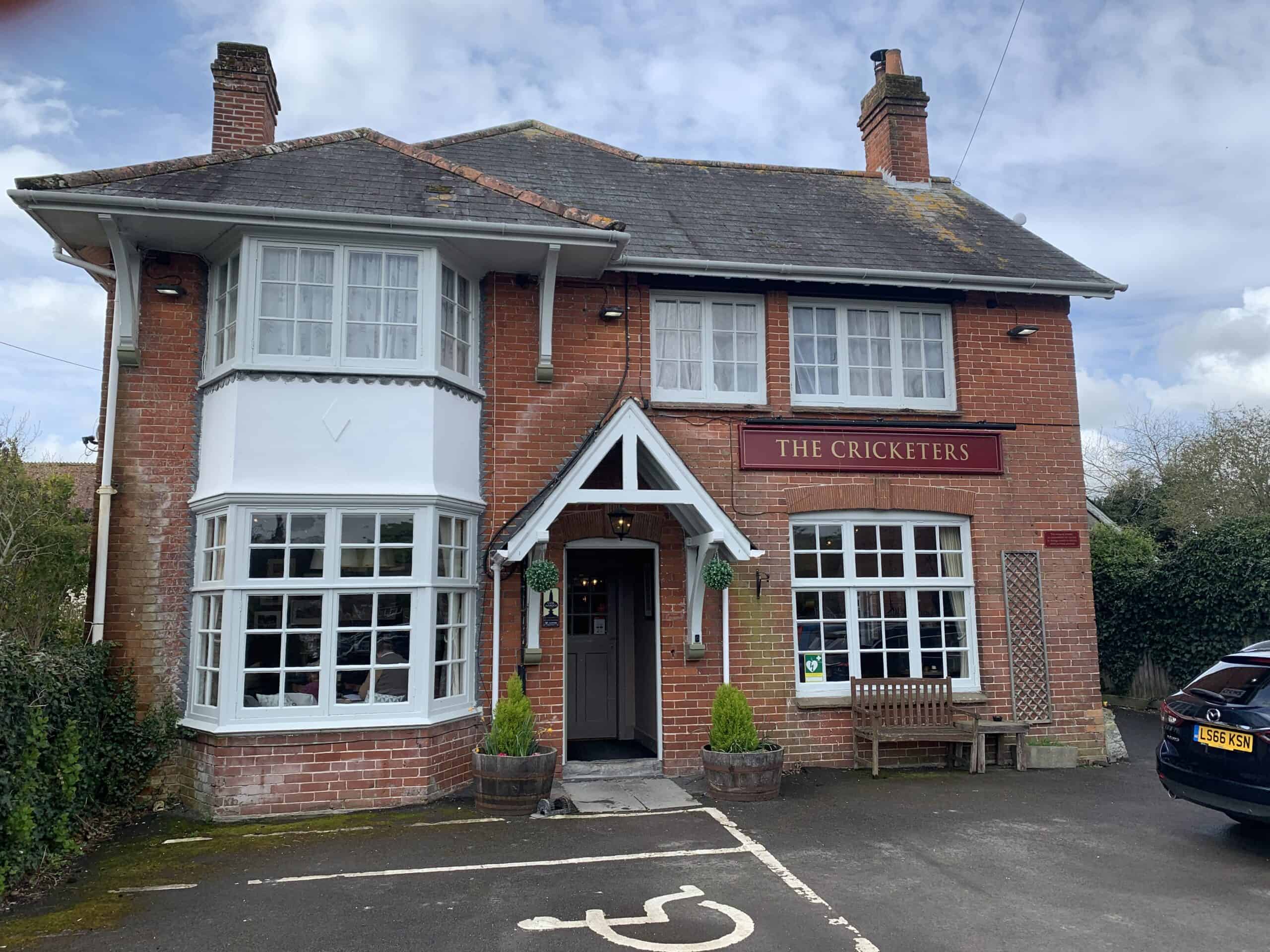
If you think Shroton’s village pub looks markedly different from its forebear, you’d be right – and there’s a good reason for that. The Cricketers of today was built a century ago after the thatched White Hart that stood on the same site was burnt down. The fire was in 1920 but the White Hart name survived until the 1990s when it was changed to celebrate the pub’s long association with Shroton Cricket Club, founded in 1857. The pub’s own origins are lost in the mists of time. Village historian Judith Hewitt tells me the earliest record of a pub in Shroton dates from before 1715, when victualler Edward New paid £10 for his liquor licence. It’s not clear where Mr New’s premises were. In 1759 victualler John Goddard kept a pub at ‘the sign of a Bush’. The Bush was renamed the White Hart the following year. Goddard’s name appears again in 1807, when the White Hart hosted a major auction of timber comprising ‘100 prime maiden oaks, with lops and bark’ and ‘21 ashes’, all standing at Shroton Farm.
Gory list of attractions The White Hart also hosted cock- fighting in 1799, with the Salisbury and Winchester Journal advertising ‘a main of cocks to be fought, 15 on each side’. The prizes were ‘10 guineas a battle’ and ‘50 guineas the odd battle’. On Boxing Day 1889, a pigeon shooting competition was held at the White Hart with a sweepstake for ‘valuable prizes’. Tickets cost five shillings and ‘conveyances’ were organised to meet trains at Shillingstone station with a fare of one shilling. For much of the 19th century the pub was associated with the Andrews family and Shroton Brewery, who rented it from the Pitt Rivers Estate. In 1918 the Estate, anticipating death duties, offered the pub for sale and it was bought by Blandford brewers Hall & Woodhouse for £750.
The familiar post- 1920 building, now called the Cricketers
The sale was held at the Swan in Sturminster Newton and the catalogue describes the building as ‘brick-built with a thatched roof and fronted by a small lawn and open green beyond, extending to the main highway’. The green is now the car park. Facilities in 1918 included a bar, smoking room, taproom, large living room, large cellars, three bedrooms, lobby, attic bedroom, long clubroom and a long room that doubled as a skittle alley and trap house. The outbuildings included a two- room former brewhouse and a four-stall stable. The landlord at the time was Joseph Crew, who paid an annual rent of £45 and whose wife or sister appear in the early 1900s picture above. During the 19th century the clubroom and long room hosted coroner’s inquests, the cricket club AGM, political meetings and Christmas dinners for village organisations.
The fascinating history of compassion, bravery and pitched battle in Dorset during the Civil War is told by Rupert Hardy, chair of North Dorset CPRE.
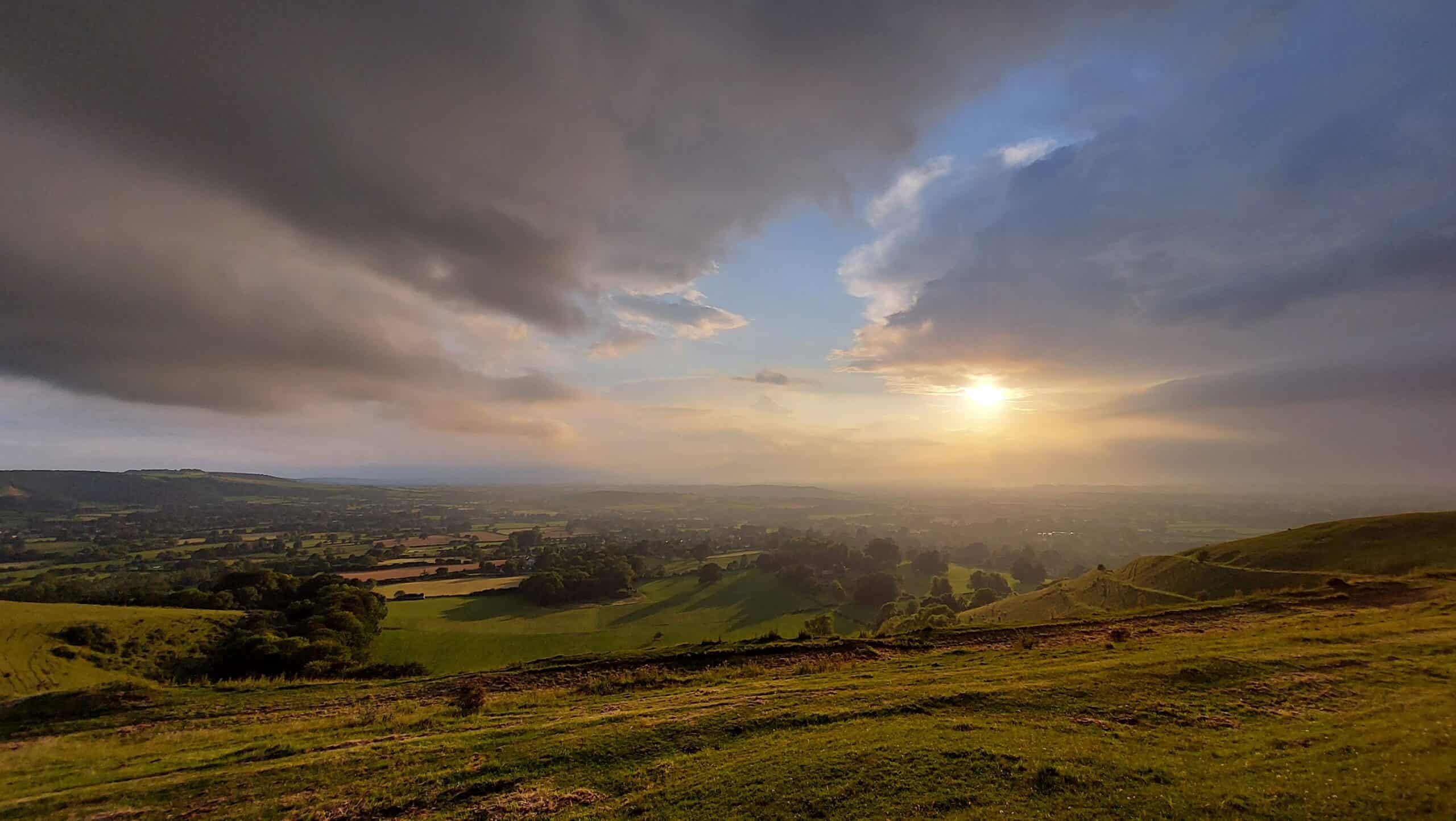
Hambledon Hill, an Iron Age hill fort known for its spectacular views across the Blackmore Vale. Few people walking the ramparts today are aware that 3-4,000 local men, led by Richard Newman of Fifehead Magdalen and the Rev. Thomas Bravel of Compton Abbas, fought Cromwell and his Roundhead Dragoons, with up to 60 men killed as they eventually fled
People often forget how severely Dorset was impacted by the Civil War which started in earnest in 1642. The county lay between the Royalist strongholds in the West Country and those of the Roundheads in South East. Dorset was very divided with Sherborne and Blandford Royalist while Dorchester and Lyme Regis were strong supporters of Parliament. There were repeated clashes and sieges, such as at Corfe Castle, where the brave Lady Bankes held out for years. However ,the largest pitched battle was at Hambledon Hill in 1645, and was fought between an army of Roundheads and a motley band of local farmers, called Clubmen, driven to defend their land and homes from the ravages of both Roundhead and Cavalier soldiers. Indiscriminate plundering and looting by these troops in Dorset and other counties had gone on for several years badly affecting rural communities, especially in the Vale. Soldiers were for the most part ill-paid and poorly disciplined, living off the land, although the formation of the New Model Army in 1645 improved things to some degree.
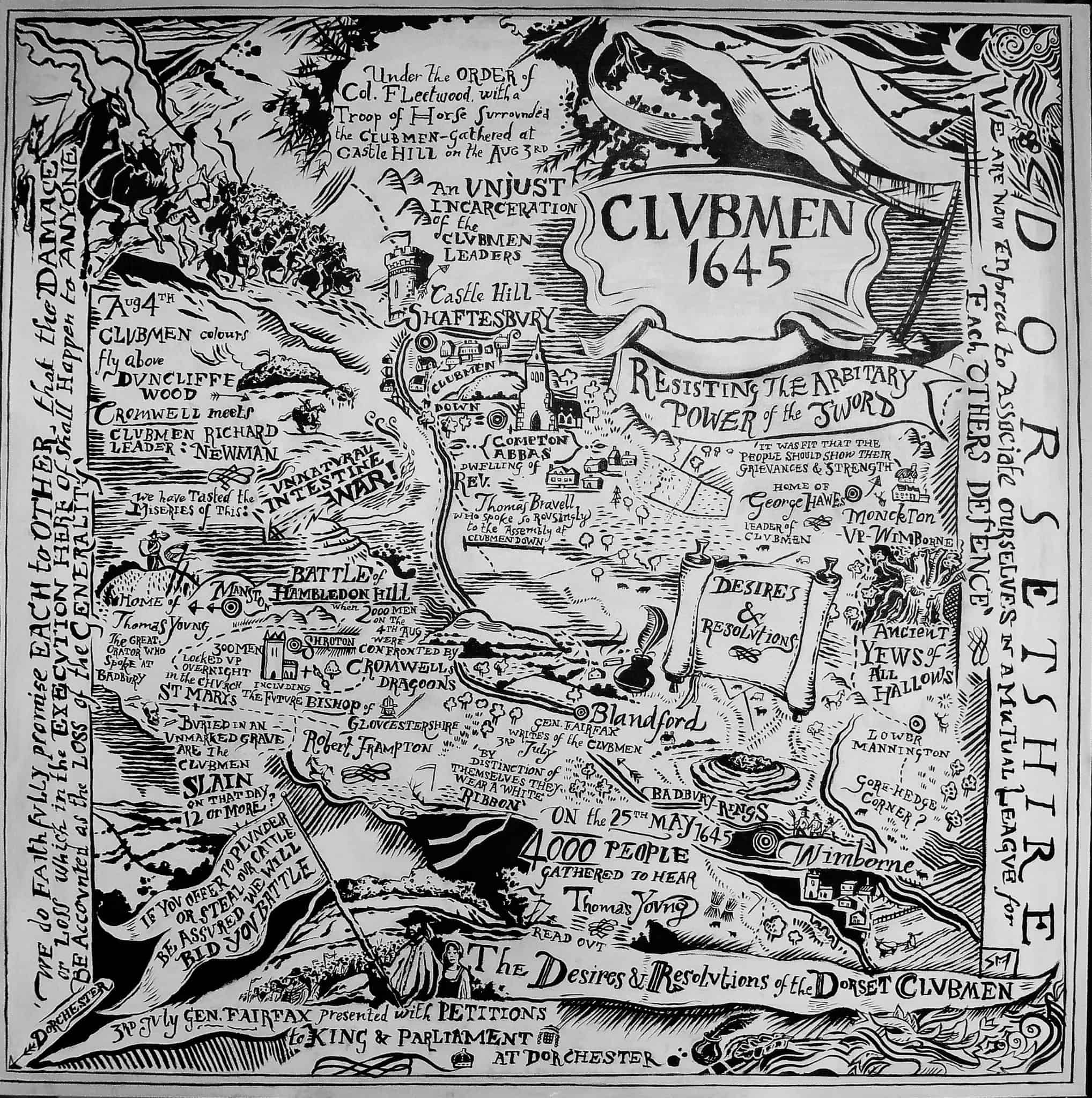
A white ribbon on their hats In exasperation farmers formed local militias to defend themselves and their families. They were known as Clubman, due to the rudimentary nature of their arms, including clubs and pitchforks. They were often led by the local clergy, as well as gentry, while their ‘uniform’ was no more than a white ribbon on their hats as a sign that they were a neutral third party. They did carry banners saying: “If you offer to plunder or take our cattel, be assured we will bid you battel!”. The first notable sign of them in Dorset was in February 1645 when 1,000 gathered at Godmanstone, outside Dorchester, and killed a few Royalist soldiers. By May, Clubmen were organising themselves throughout the west of England, and 4,000 gathered on Clubmen’s Down near Fontmell Down to create articles of covenant and organise groups of watchmen to guard against the soldiers who stole and plundered. In June a similar large gathering took place at Badbury Rings calling for “an end to this civil and unnatural war within the Kingdom”. The next month a deputation of clerics and gentry presented parliamentarian General Sir Thomas Fairfax with a petition in Dorchester, which prompted him to promise them good discipline. However, in August Fairfax started to besiege Sherborne Castle, but found his supply lines threatened by Clubmen. He therefore sent troops, commanded by no less a figure than Oliver Cromwell, to Shaftesbury to arrest their leaders as they presented a real threat to his Parliamentary forces. Cromwell did this, but then nearly faced a battle with Clubmen at nearby Duncliffe Hill. However, he managed to pacify them after an arduous climb to the top of the hill to meet their leaders, including Richard Newman of Fifehead Magdalen.
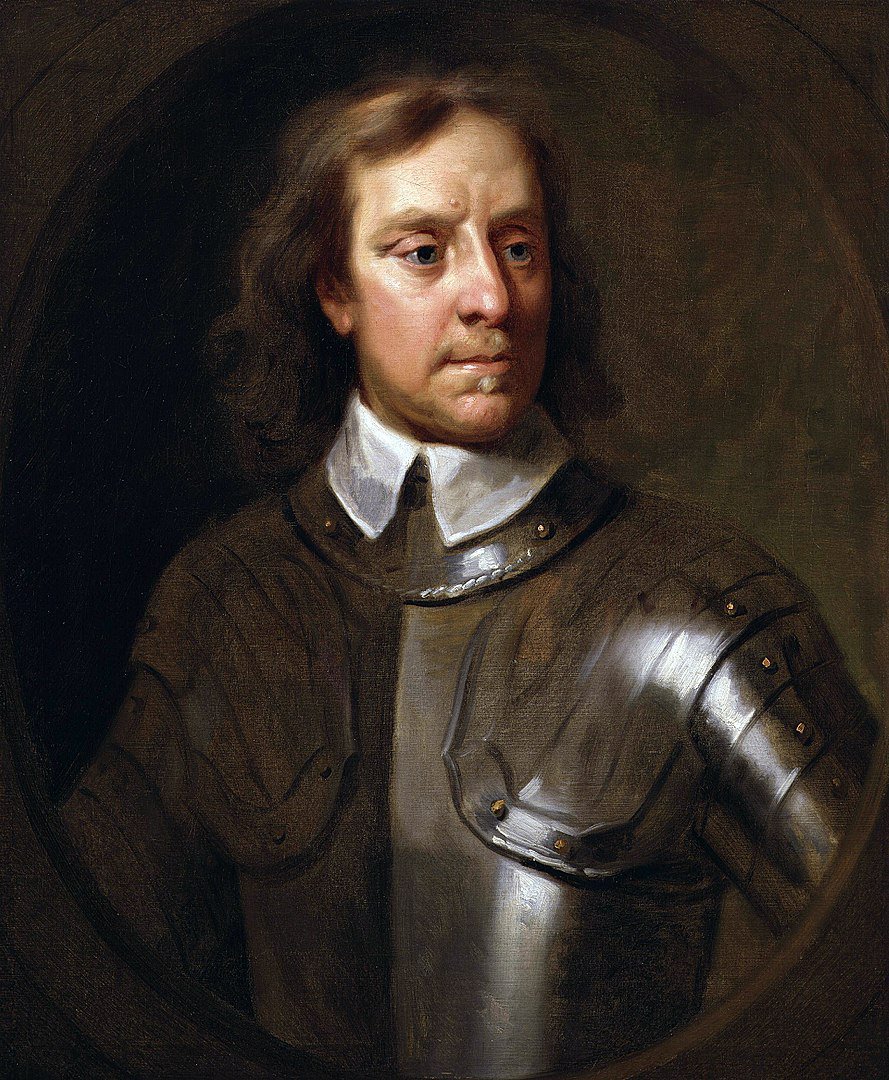
Oliver Cromwell by master miniaturist Samuel Cooper in 1656 – the portrait which coined the phrase ‘warts and all’. Cooper’s original, in watercolour on vellum, is the size of a 50p piece but miraculously detailed – from the bald patch, creased forehead and roughened cheeks to the jowly five o’clock shadow. When Cromwell came to Cooper’s studio, he gave the famous order for less flattery and more accuracy
Battle of Hambledon Hill A few days later the Clubman had regrouped on Hambledon Hill. They numbered 3-4,000 and were led by Newman and the Rev. Thomas Bravel of Compton Abbas. They were determined to make a stand against the Roundhead dragoons, while Cromwell thought it was time put an end to the threat they posed to his supply lines. He attempted to negotiate but was met with a hail of bullets which killed two of his men. The Clubmen had dug trenches and used the existing Iron Age banks and ditches. They were expecting a frontal attack, but Cromwell outwitted them by sending 50 dragoons to charge their rear as he attacked the front. The Clubmen took one look at the dragoons bearing down on them and most fled down the hill in panic, with up to 60 killed. Three hundred were locked up overnight at Shroton, including four “malignant priests”. Cromwell gave them a lecture and then dismissed them calling them “poor silly creatures”. A Roundhead helmet hung from the church there until quite recently as a reminder. The Clubmen might have had greater success had they been more united. Part of this was related to the army of occupation they feared more. Langport Clubmen only experienced the ravages of Royalists, so they actually helped the Roundhead army in 1645 while those in Dorset and Wiltshire feared both armies.
Rebellion by the ‘common man’ There were more Clubmen risings later in the year but The Battle of Hambledon Hill was the last time they presented a real threat to either army. It would be wrong to underestimate them though. The failure of either the King or Parliament to agree a peace treaty only served to increase tension as plundering continued, and gave further motivation to the Clubmen. After Hambledon these were demonstrated largely through physical demonstrations and print culture, particularly in pamphlets. Joshua Sprigg, chaplain to General Fairfax, summed it up well, if the Clubmen rising “had not been crushed in the egg, it had on an instant run all over the kingdom”. Some historians have sought to attribute revolutionary tendencies to them, but this is simply not true. They mostly wanted a return to the status quo before the war, but they are remembered as early instigators of rebellion by the ‘common man’ and their example of community self-defence was inspirational.
If you’re keen to learn more, the book ‘CLUBMEN 1645, Neutralism in a Revolution’ by local author Haydn Wheeler is available here.
The English Civil War 1642-9 The conflict started when King Charles 1, believing he had the divine right to rule, was confronted by ‘commoners’ in Parliament who demanded a more democratic (by the then standards) rule of law. The impasse led to open conflict with the Royalist army, supporters of the king, opposing the ‘Roundheads’, supporters of Parliament The conflict ended with the trial of the monarch ‘for treason’ after ‘the will of the common man’ triumphed. Found ‘guilty’, Charles was beheaded outside The Banqueting Hall, Westminster, on January 30th 1649 – almost exactly 144 years before the French revolutionaries beheaded Louis XV1.
It is September 1939 and a young girl, around 12 years old, is hushed while the family gathers in the kitchen: ‘there’s an important announcement on the wireless.’ The Prime Minister is announcing to the nation ‘we are at war with Germany’. I’ll break in at this sombre moment to recall the memory of Spike Milligan, a teenager, later called-up to fight. He was in his London home at exactly the same time as our young Blackmore Vale girl, his family also hushed around the wireless, as Chamberlain made his announcement, ‘we are at war…’. Spike’s dad indignantly said of the deluded, failed premier, “I like the ‘we’!”. And how life changed for the little girl. The families were issued with gas masks, ID cards and ration books. The gas masks had to be carried at all times. What a coming of age for the poor children. Now too old for Mappowder’s infant school our young girl and others were bused to Buckland Newton primary, a rather bare three roomed building. The children were told to bring a hessian sack into school the next day, where the girls slit the edges so they resembled small blankets. The hessian squares – one for each child – were dyed green and they were told to listen for the whistles.
SW London on VE Day – top left you can spot Andy’s mum Audrey Philipson, aged 15, with her hand on her hip, apparently rather annoyed that the war was over
One pheep on the whistle meant the children had to put on the gas masks. Two shrill calls on the whistle instructed the children to lie down flat on the ground and cover themselves with their green hessian blanket in order to minimise being machine gunned by passing German planes. Three whistle calls meant ‘run to the trenches’, which were at the top of the school garden and under a hedge. And there they had to stay, presumably alternating between being scared rigid and giggling until they heard the ‘all-clear’. You may think it a bit far-fetched, the thought of highly intelligent German pilots, from an allegedly super-cultured nation that gave us Schiller, Goethe, Beethoven (we’ll omit Kraftwerk) modern psychiatry et al, machine gunning English civilians, including women and children. Not at all: it is well-documented. I used to play chess in East Sussex with some elderly gentlemen (and yes, they always won, but they did checkmate me with a charming air of regret). They all remembered their boyhood in Kent spent excitedly watching the German formations drone over and running for cover when a low- level fighter came over searching for ‘a bit of fun’. Indeed, secretly recorded conversations from captured pilots in British-run POW camps caught some pilots boasting about the fun of such heroic war work and of their prowess. Obviously, such a thing couldn’t happen in Europe today. Oh, hang on …
Now, onto food I’ve mentioned before that one of my first jobs was to establish and run an education department in a military museum (Fort Newhaven in East Sussex – see my column in Feb’s BV) . The job was easy as we had no end of original artefacts to display and for school age children to handle. But it was all pretty much geared for boys, and I wanted it to be attractive to girls. So not only did we display authentic uniforms for women called up – the WRENS uniforms were most admired – I thought it interesting if children could appreciate the weekly food allowance which, I’ll admit, rather astounded me.
The nation’s new diet Rationing was introduced on January 8th, 1940 and a typical person’s weekly ration – the amounts fluctuated throughout the conflict – roughly allowed per person: • 1 egg, • 2oz of tea • 2 oz of butter • 1 oz of cheese • 8 oz of sugar • 4 oz of bacon • 4 oz of margarine Just a quick note: fifty modern teabags weighs 4.8 oz (they re-used tea bags). A modern pack of butter is 9 oz. Two tablespoons of sugar is 1.7 oz – no wonder people sweetened cake mixture with root vegetables, mainly carrots. It may be interesting for children to weigh out two ounces of butter and see how much they get to last a week. As for bananas, oranges, lemons and other imported fruit and nuts, forget it. In 1946 my mum, aged 16, was given an orange, and she’d forgotten what they were. When told it was to eat she took a bite and grimaced – she didn’t know you had to peel it. The last time she’d seen an orange, she was nine. So, at the museum I got the art department to knock up a display of a typical week’s food allowance. Our female visitors were astonished – but the boys were even more horrified.
National Loaf No, this wasn’t a massive country-wide lie-in: rationing made people inventive. We had an example during the 70th VE Day anniversary in the village hall in Mappowder. The villagers went to great efforts to reproduce authentic war time festive meals. By and large it was all inedible, including the ‘National Loaf’, which my wife researched and baked. The National Loaf was a Government-inspired horror which urged bakers not to use wasteful white purified flour, but the grain husks, too. I’m all for wholemeal and roughage but there are limits, as the Government must have thought as they tried to sell the concept with the ditty: Pat-a-loaf, pat-a-loaf Baker’s man Bake me a loaf as fast as you can It builds up my health And its taste is good I find that I like eating Just what I should. I think it fairly clear that the author at the propaganda ministry either hadn’t tried the National Loaf – or had one hell of an imagination. Not sure if the ditty worked but that didn’t matter. There was little other choice for most people. And there was the notorious Woolton Pie, named after the Food Ministry boss. Of this monstrosity, I can only say that if you tried a modern ‘Homity Pie’ in what seems to be the regulation bullet-proof pastry from a particularly austere vegetarian café, then that would be sumptuous by comparison.
Mrs Lillie Taylor of Oldham, Lancashire at work in the Ministry of Food kitchen. She was “one of 25 housewives chosen to show cookery experts of the Ministry of Food how they vary their rations”.
A sheltered upbringing Bit more about my mum, which I have gently touched on in an earlier article: mum, based in SW London, rather liked the war and thoroughly enjoyed the air raids in 1940. Even now I wonder at the morality of adult males thinking it OK to kill a 10 year old girl and her mum. Mum had little thought for that. “It was so cosy in the shelter. Dad made up beds, we had hot milk in a thermos and I was allowed to read by candlelight.” Typical of my mum: it’s just ‘me, me, me!’
…rationing wasn’t rationed! And did rationing end right after the war in May 1945? No. My mum was nine when rationing started, and she was a 24 year old qualified teacher when it ended on July 4th, 1954. Blast! No, that wasn’t a bomb, I’ve been distracted (bloody Germans!). I meant to write about life in the Blackmore Vale based on our young north Dorset girl’s memoirs, but got carried away. We’ll see if the Editor wants more next issue. (NO, write something cheerful, for the love of macaroni. Ed)
Hannah Wilkins of Vineyards in Sherborne is championing change in the wine industry, creating a ‘blanc slate’ with an exciting wine competition.
‘We’ll be tasting wine from female vinters, particularly the smaller under- represented growers,’ says Sadie Wilkins
Like many industries, being a wino can be tough when you’re sipping your way through the archaic stigmas attached to a privileged, white, male- dominated arena. Yes, we’ve come a long way, but there’s still a distance to go. Proud as we are to be awarded Best in the South West and fifth in the UK (out of over 800 independent wine shops), we were the only gals featured in this year’s top 10 indie wine merchants by Harpers Wine – and in 2022, it just doesn’t feel right.
Under-represented makers So, we’re introducing our very own and very shiny indie wine tasting: Vine of the Times. An annual wine tasting where a group of industry winos sit together and raise a glass to inclusivity by hosting a blind tasting competition. Our new event will unearth little drinking gems from underrepresented makers – this year belongs to women in wine. Our vision is to highlight a different group of ‘minority makers’ each year, not just women, and try to level out the diversity – one bottle at a time. But back to now, and it’s all about the Sip-sterhood!
Made by women For the inaugural awards we’re gathering wine from female winemakers across the globe for the tasting, and have recruited an eclectic, independent panel of female judges, each bringing a real mix of experience from the wine industry. On the day, the judges will be provided with the grape variety, region, and RRP only for each bottle we try, in a bid to remove any misconceptions. All wines will be celebrated in an awards brochure after the event and shared within the wino community, and the winning wines from each grape category will receive a special feature. We’re not giving out glittery trophies, we’re creating a noise instead, which is what Vine of the Times is about. Real change doesn’t happen from silence.
Time to drink equal The response we have received from winemakers and prospective judges has been nothing short of overwhelming, including some heavy weights, who are well-respected in our trade, giving up their time and expertise to be part of our event – in Sherborne, here in rural Dorset. It’s incredible. If you want to follow our journey and gain a behind the scenes scoop on our exciting event, please do sign up to our mailing list and check out our social media accounts. Vine of the Times takes place on 23rd May – it’s time to drink equal.
Your monthly wine tip For those who look forward to a recommendation each month, here’s a wine from one of our favourite winemakers – who just so happens to be young and female (which coincidentally is how we hope she gets introduced in the future: simply as a winemaker, without the female adjective). From the heart of Burgundy, making waves with her delicious winemaking, let us introduce you to Marinette Garnier of Maison Jaffelin. Her Côte de Beaune Villages is a true gem – it’s voluptuous, soft, approachable and completely over-delivers for a £25 bottle of wine
Buying two horses unseen was a risk, but the results are absolutely wonderful, and the season has started well, says Toots Bartlett.
Equador, Toots’ favourite ever FedEx delivery, is settling in to life in the UK – and slowly acclimatising to the British weather!
April has been a very exciting month here at Toots Bartlett Eventing, with lots of eventing and a few new members joining the team. The lovely Extasy SR Z (Gatsby) has been out twice this season, returning from a year off. He started with a 24 dressage and clear show jumping but withdrew cross country as it was only unaffiliated and we felt he wouldn’t have gained any education from the course. He then went on to do a lovely double clear at Portman BE100, with a few time penalties cross country for a finishing place of 9th. He will now step back up to BE Novice level. Portman also marked the first event for my fantastic groom, Joel Hart and his horse The Rag Lad, also competing in the BE100 section, just adding four faults from the show jumping to his dressage score of 34.
Cor Y Taran’s debut My very exciting young horse Cor Y Taran (I introduced him last month – he’s the horse I bought unseen off Facebook) had his eventing debut with me. Throwing him into the deep end at one unaffiliated 100 at Aston-Le-Walls and then a BE100 at Bicton. He passed all my expectations with double clear at both! I am feeling just a little pleased with myself to have found this special boy. Freestyle R was the last horse to have been out competing in April. He had two great runs at Intermediate level, and is feeling absolutely amazing. We took on our first Advanced as a combination on the 1st May, before turning our attention to Houghton for the CCI3*L.
Toots and Cor Y Taran, the horse she bought unseen from Facebook, at his first event. He passed all Toots’ expectations with double clear.
A very special FedEx parcel Finally, whilst pretty much every weekend has been full of eventing throughout April, we have also had the arrival of two very special horses. My 4* horse C Why came back to me from Ivy Lodge Rehab Centre in Glos, where they have done a fabulous job and have given him the chance to return to his former glory!! It’s fantastic to have him home and I am excited about bringing him back to fitness. On April the 21st a very special FedEx parcel arrived from the other side of the world. Back in March whilst on the search for a new horse we found an incredible ‘Black Beauty’ that my family and I fell in love with. The only small problem was that he was in New Zealand! We had no opportunity to be able to go try him because of Covid restrictions, so there were long conversations with my trainers and a lot of research before we decided to take an enormous risk and a deal was done! A long wait till the earliest plane from New Zealand to England, and a 38 hour plane journey for him, but Equador has finally safely arrived. I have had many sleepless nights wondering if we made the right decision, but he is here, safe, sound and more beautiful than I can ever had imagined. I can’t wait to start getting to know him and am so grateful, appreciative and still in a little bit of shock to have been giving this once in a lifetime opportunity. Apparently it will take him six months to adjust to our British weather (my heart goes out to Equador on that one – Ed), so I will thoroughly enjoy sharing our journey with you. It has also been a very special month watching all the preparation for William Fox- Pitt’s two horses getting ready for Badminton. It has been wonderfully insightful, and has made me even more determined to follow in his footsteps. He is a legend and what a privileged young rider I am to have access to all his expertise and knowledge. Anyway such an exciting month, time to take a breath, catch up on a tiny bit more sleep and get ready to go and attack May!
Freestyle R had two great runs at Intermediate level in April
Three Day Eventing 101 Eventing is best described as an equestrian triathlon. Each horse and rider pair must complete three tests: dressage, cross-country and show jumping. The horse and rider pair with the fewest penalty points after all three tests is the winner. The tests developed from training horses used in military combat; war horses were required to be fit, agile, obedient and brave. As their usefulness in combat diminished, these highly trained horses became repurposed for competitions between nations during peaceful times, which became known as Horse Trials, and the sport known as Eventing.
How it works Horse trials have varying degrees of difficulty, ranging from Beginner Novice through to Advanced in nationally recognized events, and CCI1* through CCI5* in internationally recognised competitions. A simple guide to all levels can be seen here.
The three disciplines Dressage – The first phase of a Horse Trial is always dressage, a series of suppling and strengthening exercises performed in a flat, enclosed arena.
Show jumping – The second phase in Eventing. Agility and precision at speed are the critical requirements of Stadium Jumping. A ‘clear’ round means no penalties.
Cross-country – The final phase tests the speed, endurance, boldness and jumping ability of the horse over varied terrain and solid obstacles; large fences, water, banks, ditches and drops. Cross-Country is ridden at a gallop with speed requirements dependent upon the level of difficulty of the division.
Great Taste is the world’s largest, most trusted food and drink accreditation scheme – and its home is right here in Gillingham. Long time judge Fanny Charles takes us behind the scenes on testing for this year’s Great Taste Awards.
If you were lately walking near the Kingsmead Business Park at Gillingham, you might have heard peels of laughter. Go a little closer and the scene looked positively Mediterranean – a group of people sitting on benches around a wooden table, enjoying lunch in the unseasonable sunshine. It probably didn’t look like work! But the 10 people around the table were having a short break from tasting and testing for this year’s Great Taste Awards. As a long-standing judge and co- ordinator at the Great Taste Awards, I am used to the amused head- shaking if I comment that we work hard. Eating interesting food all day – how hard can that be? The truth, of course, is that it is hard work, because it is a very responsible job and one which is carried out with real rigour.
Becoming a judge I have been a Great Taste judge for many years, since the Guild of Fine Food, now based in Gillingham, was in Wincanton near where I live. At that time, I was editing the Blackmore Vale Magazine, and regularly writing about the activities of the Guild, including the Great Taste and World Cheese Awards. Bob Farrand, who founded the Guild and both award schemes – his son, John, is now managing director – repeatedly invited me to come and spend a day judging. I always pleaded the demands of work until one day I didn’t … So I walked down the road, met some of the judges, listened to Bob’s introduction, spent the day tasting dozens of products – and was hooked. I have been a judge ever since, and for some years also a co ordinator (one of the people who record the comments and stars, where agreed, on the products). Bob, a writer, cheese expert and author of the excellent Cheese Handbook (2000), always put new judges at their ease by explaining that we “all have the same number of taste buds.” Some people may have more knowledge of specific products – olive oil or espresso coffee, for example – but that doesn‘t mean that your opinion on the taste isn’t just as valid.
Judges Val Stones, aka “the Cake Whisperer,” and award-winning Indian cook Bini Ludlow.
You’ve definitely seen them If you are still with me, but wondering what the Great Taste Awards are, the best advice is to look around the next time you are in a supermarket, deli or farm shop. You will soon spot products with small black and gold Great Taste Award labels, with one, two or three stars. They might be preserves or cider, artisan cheese or handmade biscuits, sausages or ice-cream, sea salt or Greek mountain honey. It’s a simple idea – establish a benchmark for quality and encourage producers and retailers to work together to promote great tasting food, prepared by dedicated makers using fresh, honest and where possible local ingredients. Launched in 1994, when fewer than 100 food and drink entries were blind-tasted by 12 experts across five classes, Great Taste is now arguably the world’s leading food awards scheme, attracting around 14,000 entries in 2021. Since 1994, more than 150,000 products have gone through the judging process. Each food or drink item is blind-tasted by judges from a wide range of food- related backgrounds, including chefs, cooks, buyers, retailers, restaurateurs, food critics and writers.
Antipasto squid tyres The judges look for truly great taste, regardless of branding or packaging. They take into account texture, appearance, aroma and of course the quality of the ingredients – but above all, doesthe product taste truly great? On any given judging day, you may have some glorious experiences – a three star hazelnut gelato, mouth-watering venison salami, oysters fresh from the pristine sea waters off the Irish coast – or some that are anything but … My worst experience, bar none, still remembered with a shudder, was a dish of seafood, intended as antipasto. It included pieces of squid that could have patched shredded bike tyres, floating in a sea of rough vinegar. It was hard to imagine how this made it out of a test kitchen – let alone why anyone would put it forward for a Great Taste star! But the horrors are rare – the majority of the products we taste and discuss, thoughtfully, professionally and constructively, are created and made with care, and many will qualify as Great Tastes. In 2021, a total of 5,383 products were awarded one, two or three stars, of which 497 were from the West Country. This year’s Great Taste judging is now well under way. My most recent experience, typical of the cross-section of people you meet, was a fun and interesting morning with Val Stones, the “Cake Whisperer” and former Great British Bake-Off contestant, and Bini Ludlow, who makes Indian ready meals in Somerset. The combined taste- buds of a great baker, an award-winning Indian cook and me produced some strong opinions – the pros and cons of a vegan chocolate cake, the level of spicing of a biryani – and stars for several products. When people ask me why I love Great Taste judging, I have four reasons: I believe that what we do helps to support and promote the work of great artisan and small food and drink producers (and some bigger companies too); I believe we help consumers to discover fine foods they might not otherwise try; I always meet interesting people; and I always learn something new.