The Blackmore Vale logo
Home Blog Page 242

Where have all the dentists gone?

0

It’s now a common cry: ‘Does anyone know of an NHS dentist?’ But why is the lack of NHS dental care such an issue? Rachael Rowe investigates the problem in Dorset

shutterstock

When was the last time you saw a dentist? Are you even able to access an NHS dentist?
With NHS dentistry becoming harder to find – but across the entire country – what is happening to the provision of dental health care?
‘After many many months of searching and calling and emailing different dentists, I am yet to find one taking on NHS patients. I have a severe need to see an NHS dentist as I’m really unable to eat because of the pain which has led to weight loss and other health complications. I am a young adult who doesn’t work currently due to disability and illness and am unable to pay for private dentistry treatment which I have explored too.’
Patient comment, in the Healthwatch Dorset report.
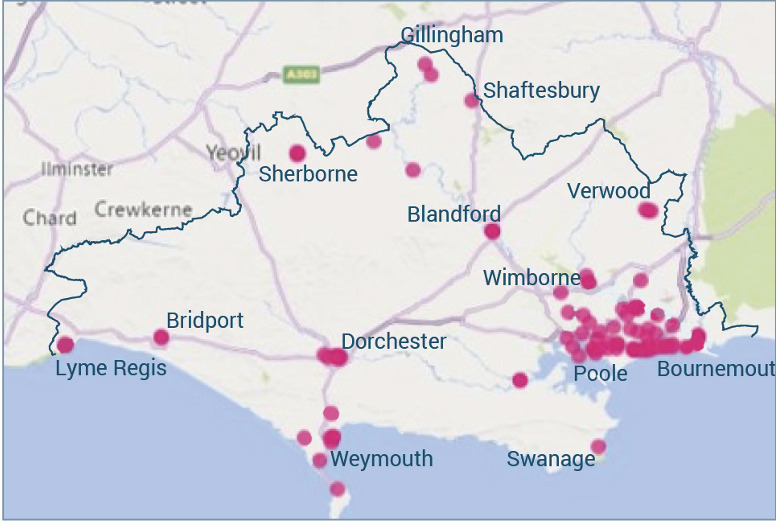
The pink dots show the 93 Dorset dentists registered on the NHS website, highlighting the gap in provision in Purbeck, and the north west, mid and north east of the county.

How many see an NHS dentist?
Data from NHS England shows that fewer than half the adults in the South West have seen a dentist in the last two years. If they end up with a problem, chances are they will not be able to access NHS dental care. Healthwatch Dorset has recently published a report on the state of dental access in the county. The recent survey of Dorset’s 93 dental practices found that, at the end of 2022, none was taking new NHS patients.
So what is happening and how is care being prioritised?
Healthwatch Dorset manager Louise Bate explained what had caused her most concern about the report: ‘Last year when we did this questionnaire there were three dentists taking patients. This year, there are none. It’s getting worse. Even if the contracts are changed, there are no dentists.’
Of the 78 dental practices that responded to the Healthwatch survey, none was taking new NHS adult patients, 17 now only treat private patients and only 18 were accepting new NHS patients if they are children. Seven practices said they were accepting patients with additional needs, and 23 practices had waiting lists, half of which were more than 12 months long.

Dorset’s below average
Maps indicate that there are dentists in North Dorset, but they are not taking any NHS patients right now.
The South West Dental Reform Group is a network which sets the strategy for NHS dentistry in the west country, including Dorset. Membership includes regional and local staff. Their assessment of future needs in Dorset identified several significant issues for the future of dentistry. For example, by 2028, Dorset’s population will have increased by three per cent – or an additional 23,708 people. While the child population will have decreased by six per cent, older adults (65+) will have increased by 18 per cent, or 35,504 additional people.
So, in addition to finding dentists to serve more residents, there will also be a need to provide extra services to manage the complex dental needs of older people.
Louise identified a further issue. ‘Because of the way the dental contract is currently set up, dentists see the easiest people to manage – those needing basic check ups. That means it is much harder for people with complex needs to get an appointment.’
How many people can actually get to see a dentist? The SW Dental Reform Group reviewed the data and found that access to children’s dental services in the last year was 48.9% in below the average for England (53%) average. Access to adult NHS dentistry in Dorset is also below the national average at 45.6% (England average 47.1%). That’s a significant gap between those who should be able to see a dentist and those who don’t or cannot.

Testimonial from Healthwatch Dorset report

How is dental care funded?
Until April this year, NHS dentistry was commissioned by NHS England. From April, dentistry is under the control of the local Integrated Care System (ICS). Louise is encouraged by this: ‘I’m more positive now the ICS is taking over responsibility. There’s an opportunity to use local incentives. I’d like to see children prioritised; if we don’t, we are setting ourselves up for a generation of dental problems. I’d also like to see better access for vulnerable people.’
With local commissioning of dental services, there are also opportunities to design services to meet the needs of the population. Louise already has thoughts. ‘I’d like to see more joint working with the voluntary sector. For example, people access mental health services because their teeth are problematic. People are unable to eat properly, they become malnourished, and voluntary groups contact us for advice.’
Chief commissioning officer of the NHS Dorset Integrated Care Board, David Freeman says: ‘From 1st April we will have a much greater opportunity to work with local people, dentists and other specialists in our area to develop new and different ways of working. We’ve already started this work – from helping children and families with good dental hygiene to designing extra services to meet more complex dental needs, we are developing plans for improvements this year.’
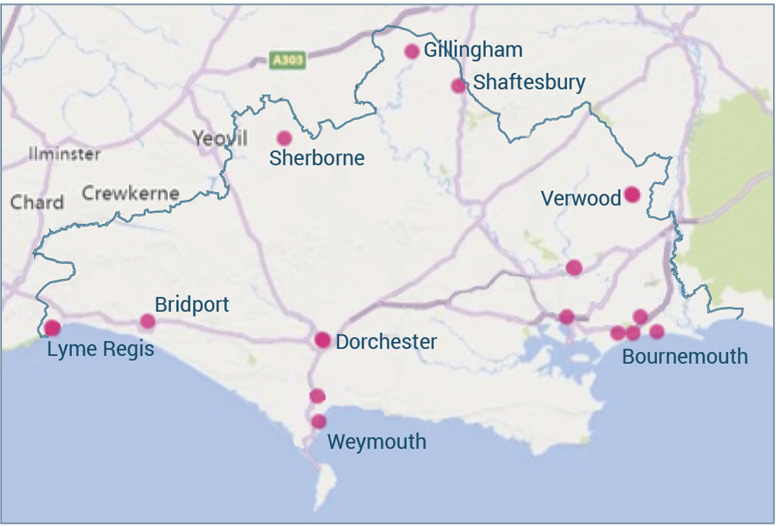
Map shows dental clinics in Dorset that accept children as new NHS patients.
None said they were accepting adult patients, unless very elderly or had additional needs.

What can you do now?
If you have toothache and don’t have access to a dentist, Louise Bate advises the best course of action is to dial NHS 111 to discuss your needs. ‘And keep looking for appointments, because some NHS slots do come up.’
Clearly, the NHS will be busy working to improve access to dentistry this year. However, there has never been a better time to ensure we all practise good dental hygiene, stop smoking and reduce sugar intake to avoid tooth decay as much as possible.

Sources:
South West Dental Reform Group Report 2022-Dorset.
Healthwatch Dorset 2023: NHS Dental care in Dorset.

Time to get started in the garden

0

April is here, and it’s finally time to start getting busy, says gardener Pete Harcom. Warmer temperatures come with lots of garden jobs!

Now’s the time to plant your hollyhocks, foxgloves and other cottage garden favourites for some summer colour

The soil will slowly be warming up, so there is lots to do now! Having said that, watch out for frosts at night, and resist the temptation to sow and plant out too early. Keep an eye on the weather forecast and wait a few days if necessary.

Jobs for April

  • Sweet Peas can be sown outdoors this month, or you can plant out any autumn-sown ones.
  • Remember to protect early outdoor sowings with fleece if a frost is warned.
  • The lawn will need attention from now on, including sowing some fresh grass seed on any bare spots. Aerate the lawn by spiking with a lawn aerator or a garden fork – this can be done a few times per year.
  • You can purchase lawn aerator spiked shoes that fit over your boots, to do the job (NB you may have to join the Ministry of Funny Walks!).
  • There is still time to move, divide and plant herbaceous perennials – geranium, Astrantia coronaria, hostas and delphiniums. Don’t forget to check for any couch grass or other weeds within the crown of the plant.
  • Hydrangea macrophylla can be pruned back by approximately a third now. TIP – plant the cuttings in the ground in a sheltered spot and they will have rooted within the year.
  • Watch out for aphids, even at this time of year.
  • Don’t spray with nasty insecticide, just squeeze them between your fingertips. This way, there’ll be a few left for the birds!
  • Turn over the compost heap using a fork – but be careful, there may be some overwintering hedgehogs or grass snakes in there! Grass snakes sometimes like the warmth and use a compost heap to lay their eggs.
  • There is still time to prune roses back to hard stems and open up the centre of the bush if possible; this lets air and sun in. Also give them a mulch of well-rotted manure.
  • Deadhead all the tulips and daffodils to help them put energy into root growth and flowers for next year.
  • A cold greenhouse will be sufficiently warm this month to start sowing annual and biennial seeds for favourites like foxgloves, hollyhocks, nemesia, rudbeckia and French marigolds.
  • Order your summer-flowering seeds and bulbs!
  • Check your outdoor pots aren’t drying out – they can, even at this time of year. Also, now’s the time to start increasing the watering of your house plants.

Sponsored by Thorngrove Garden Centre

The enduring appeal of Brief Encounter

0

WHEN the former Kneehigh Theatre director Emma Rice – whose own Wise Children theatre is now based in Frome – took on the challenge of a stage adaptation of one of the best-loved films of all time, there were many who held their breath.

Hanora Kamen as Laura Jesson and Jammy Kasongo as Dr Alec Harvey. Image: Marc Brenner

What would the iconoclastic Rice do with this poignant wartime Noel Coward black-and-white classic, with its famous story of two married people who meet by chance and fall in love. In the event (and unsurprisingly to anyone who knew that first and foremost Rice is a story-teller), the stage version was a triumph, combining the poignancy of the love story with Kneehigh’s trademark anarchic musical fun. It enjoyed a sell-out run in the West End in 2008 and was revived in 2018.
Now, a new production is at Salisbury Playhouse, directed by Douglas Rintoul and starring Hanora Kamen as Laura Jesson and Jammy Kasongo as Dr Alec Harvey, with a stunningly multi-talented ensemble of actor-singer-musicians who play all the other parts.
Beautifully lit by designer Jessie Addinall, the versatile set is a railway station, Laura’s home, a restaurant, Alec’s friend Steve’s flat and, most importantly, the station tearoom where Laura, with painful grit in one eye, first meets Alec, the doctor who carefully removes the fragment. The chemistry between these two is palpable, and the development of the relationship is convincing.
Fanny Charles

Brief Encounter is at Salisbury Playhouse until 22nd April, and then goes on a short tour, including the New Wolsey Theatre in Ipswich and the Yvonne Armaud at Guildford.

AKC provided wide farming knowledge and a huge amount of expertise and experience’

0

ADVERTORIAL

AKC, an agricultural consultancy firm based near Devizes in Wiltshire, offer independent strategic and financial advice and consultancy for agricultural businesses – as well as bookkeeping and payroll services for all business types. AKC are engaged with the farming community and know first-hand the impact the current industry changes are having on farmers.

Stewardship application
AKC’s farm consultant, James Berry, provides technical and financial advice to farming clients. Farmer Simon Barrett engaged AKC for a farm business review with James, and found the process very simple: ‘AKC provided wide industry knowledge and a huge amount of expertise and experience.’
Simon also noted that James was very patient and personable: ‘he was happy to explain to me again and again, and helped me understand [the different schemes on offer]. It was more than comprehensive, and a very positive experience’, says Simon. It led him to ask James for help with his Countryside Stewardship application this year.
‘Last year I submitted the application for myself,’ he says, ‘but I felt anxious I wasn’t making the most of the scheme.’
After walking the farm with James and identifying how best to apply different stewardship options, Simon felt he attained a far higher level of revenue than if he had completed the application himself.
‘The stewardship application has been of most value to me’ says Simon. ‘Others should compare the price of professional fees with the income brought long term. I encourage other farmers to be brave on fees; be prepared to pay for professional advice, and it will pay dividends.
‘AKC were excellent. There was a mix of skills and a good marriage of financial awareness and breadth of agricultural knowledge. In my experience accountants generally don’t have the depth and technical knowledge of farming, so it was a revelation to have someone bring a better understanding that allowed me to feel more up to the numbers

Free advice
As part of the Future Farming Resilience Fund, AKC are working with NIAB and Savills to bring free tailored business advice to farmers in receipt of Basic Payments. This is an important opportunity for farmers to learn about the changes in policy, the impact it will have on their own business and how they can adapt to these challenges.
Simon Barrett was left feeling very encouraged by the advice he was given; ‘I learnt a huge amount about the ELMS schemes I could access,’ he says. ‘Also, James shared what is making other farms across the country more profitable.’
Another AKC client agreed the process of the farm business review worked very smoothly. Mark Vaughan Lee, from Dorset, describes his experience in receiving guidance on the replacement of BPS, learning about how they can do things differently, in addition to what they are currently doing.
‘I have been using AKC for ten years.’ He says. ‘They provide an excellent on-farm service and have held my hand throughout the process, especially with the transition and the loss of BPS payments.’

As environmental land management continually develops, AKC are helping clients with:
Sustainable Farming Incentive rollout/Animal health & welfare/Productivity opportunities
CSS Plus Applications planned in 2023
Slurry Infrastructure Grants
Opportunities for landscape recovery (developing working clusters)
What makes AKC unique is the array of commercial farm business experience backed up by a professional accountancy, bookkeeping & payroll team –providing clients with an
all-encompassed service.

Get in touch to see how we can help you – 01380 724687 akcagric.co.uk

Dorset one of worst counties for raptor persecution, says RSPB,after poisoned birds are found

0

Following the successful prosecution of a Dorset gamekeeper for rural crimes, Andrew Livingston spoke to the RSPB about the scale of the issue

The poisoned red kite which started the investigation in 2020.
Image: Johanna Dollerson

At the start of the 19th century firearms technology had developed sufficiently to create an opportunity for commercial shooting of game birds in the countryside. Many of the large estates that you walk and visit today were originally designed with the intention of shooting pheasant, partridge, duck, geese, grouse or snipe.
Landowners began planting woodlands around picturesque settings from where the birds would be ‘driven’ towards a row of guns, to be shot for sport.
Whatever your view on it, shooting is undeniably big business across the whole country – including in Dorset. With the amounts of money invested in commercial shoots, gamekeepers are under increased pressure to ensure as many of the game birds survive to adulthood as possible and make it to flight on shoot days.
These birds, which are bred for shooting, are not at the top of the food chain in the wild and are frequently hunted by our native birds of prey such as buzzards, harriers, eagles and kites. These birds, known as raptors, have been protected from persecution since the Wildlife and Countryside Act of 1981, meaning gamekeepers have no powers within the law to protect their game birds against their predators.
Data collated in 2021 by the RSPB (Royal Society for the Protection of Birds) showed that 71 per cent of all raptor persecution in the UK occurred at the hands of gamekeepers on private or commercial shoots. The same data showed that Dorset was one of the worst counties for the persecution of raptors.
Earlier this year, Paul Allen, the gamekeeper for the Shaftesbury Estate Shoot pleaded guilty to seven offences relating to rural crimes, two of which resulted from the discovery of six dead buzzards after a search of his site.
‘It began in 2020, actually,’ Jennie Shelton, media liaison officer for the RSPB Investigations Team, told The BV: ‘It began in 2020, when a walker found a dead kite and was concerned that the rat had been poisoned and used as bait.’
Dorset Police’s forensics team found that the kite and the rat were both poisoned with Brodifacoum, said to be one of the strongest rodenticides on the market. With this evidence, the police had suspicions that the kite was poisoned deliberately.
‘We got involved [at] that stage.’ says Jenny. ‘We give advice and so, when the search of the land took place, our RSPB Investigations Team was included, along with Natural England, the National Wildlife Crime Unit and Dorset Police.
‘On that search, they discovered dead buzzards – six of which had been shot and the remains of three more in a fire. There was also an array of poisons, many of which were banned substances, stashed away.’
The search also revealed a loaded shotgun which was left behind a kitchen door, in breach of Allen’s firearms licence.

Dorset Police and Natural England with two containers of sodium cyanide. Image: RSPB

Condemned by his community
Post-mortems on the buzzards found that they were shot rather than poisoned and Allen was never charged with causing their deaths, only for storing their bodies. For his crimes, Allen was sentenced to 15 weeks in prison, suspended for 12 months, and fined more than £2,000. There were mitigating factors in the sentencing. Allen had lost his wife to cancer around the time of the investigation, and the court deemed that a custodial sentence would have had a significant detrimental impact on his two daughters.
Jenny Shelton believes that the sentencing was typical for crimes of this nature.
She says: ‘I think only one person has ever been jailed for a raptor crime. What we find generally is that it might be a first offence, or they might have good character.
‘Our concern is that this might not be much of a deterrent for other people committing these crimes. [The fine] is not a huge amount if you consider the scale of some of these shoots.’

A red kite in flight. Native birds of prey such as buzzards, harriers, eagles and kites are seen as predators to the game birds on commercial estate shoots. Of all raptor persecution in the UK, 71 per cent occurred at the hands of gamekeepers on private or commercial shoots.

She is concerned that the UK’s sentencing guidelines do not allow magistrates to impose stronger penalties.
Even within his own community, Paul Allen was condemned. The National Gamekeepers Organisation suspended Allen’s membership and later expelled him from the organisation.
The organisation declined an opportunity to speak with The BV, but states on its website: ‘We have a no-tolerance approach to any kind of wildlife crime and we expect our members to adhere to the Code of Good Shooting Practice.’
Since the COVID outbreak, there has been a spike in cases of raptor persecution, which mainly include shooting, trapping or poisoning.
Jenny fears that these reported cases are the tip of the iceberg: ‘It’s hard to say whether it’s getting worse or better because what we’re detecting is probably just a fraction of what’s happening.
‘I think what is really needed is an overhaul of the system. Instead of targeting the gamekeepers, who are usually the guys committing the crimes, it is important to impose a greater deterrent on the employers or the estates.’

Four of the dead buzzards found on the Shaftesbury Estate. Image: RSPB

White-tailed eagle death
Natural England, which assisted in the search of Paul Allen’s property, commented after the sentencing: ‘We are extremely pleased that he has been held to account for his appalling offences against wildlife.
‘This case, and the death in Dorset of one of the stunning white-tailed eagles reintroduced to the Isle of Wight, are clear examples of a bigger problem: the widespread misuse and abuse of poisons in the countryside, which are killing birds of prey and pose ongoing risks to the public.’
According to the RSPB, the white-tailed eagle was found dead on the same Shaftesbury Estate, after the investigation had started, and had also been poisoned by Brodifacoum.
As a result of habitat change and unchecked hunting, by 1918 there was just one single lonely white-tailed eagle male flying in the UK. He was shot and killed and the birds were officially extinct on our shores until a re-introduction programme began in the 1980s. The satellite-tracked eagle, which had been released on the Isle of Wight, was found dead in 2022.
‘We don’t know where it picked up the poison,’ says Jenny. ‘It had spent time on several pheasant estates in the days leading up to his death and it hasn’t been possible to identify a suspect.’
A scheduled police search of the estate was cancelled.
‘Basically that was the end of the investigation.’ says Jenny. ‘There’s clearly an issue with rodenticides being used. They may or may not be used to target birds of prey, but they’re certainly getting into their food chain and they are killing these birds.
And that’s a crime.’

Andy’s Moroccan vegetable tagine

0
shutterstock

If the sun comes out in the next few weeks, the British barbecues will no doubt be dusted off for the new season. Andy, the Traeger Grills chef, has provided BV readers with an alternative to the standard burgers and sausages – stretch your grilling skills with a Moroccan vegetable tagine! Tagine is a traditional North African stew, usually made with meat and vegetables, but in this recipe, they use an assortment of vegetables, aromatic spices and herbs to create a flavour-packed and satisfying meal. Perfect for vegetarians, vegans, as a vegetable side or anyone looking for a healthy and flavourful meal. So fire up the grill and get started on this mouth-watering vegetable tagine!

Ingredients

  • 150g Butternut Squash
  • 150g Onion
  • 1 Small Red Pepper
  • 125g Courgettes
  • 3 Cloves Garlic
  • 50g Dried Apricots
  • 125ml Vegetable Stock with a few strands of saffron added
  • ¾ Tsp Coarse Sea Salt
  • 1 Tsp Dried Mint
  • ½ Tsp Ground Cumin
  • ½ Tsp Ground Coriander
  • 1 Tbsp Rose Harissa Paste
  • 2 Tbsp Olive Oil
  • ½-1 Tsp Sumac
  • Handful of Freshly Chopped Parsley
  • Two chopped preserved lemons

Method

  1. Peel the butternut squash and cut into a 1.5cm dice
  2. Peel, top and tail the onion and then cut into eight wedges
  3. Cut the red pepper into a dice
  4. Cut the courgette into 2cm dice
  5. Peel and slice the garlic cloves as finely as you can.
  6. Cut the dried apricots in half.
  7. Add the onions to the tagine, followed by the pepper, then garlic, courgette, butternut squash, apricots and preserved lemons. Try to arrange the veggies in layers so that they all cook evenly .
  8. Mix the vegetable stock with the harissa paste, saffron, ground cumin, ground coriander and dried mint, then pour it over the vegetables.
  9. Pour over the olive oil and pout on the tagine lid. place the tagine onto your barbecue grill (or and oven) at 160º for 40-45 minutes.
  10. Garnish with sumac and fresh parsley.

Serving Tip: Serve with some simply cooked couscous. Boil some veg stock and pour it over 150g of couscous. Cover with cling film and leave for 5-6 minutes to absorb the liquid. Season with salt and pepper and a couple of knobs of butter.

Small shoots and old stores – The Voice of the Allotment

0

The importance of storing your harvest shows in late winter, says Barry Cuff – with few new crops he continues to eat from his larder

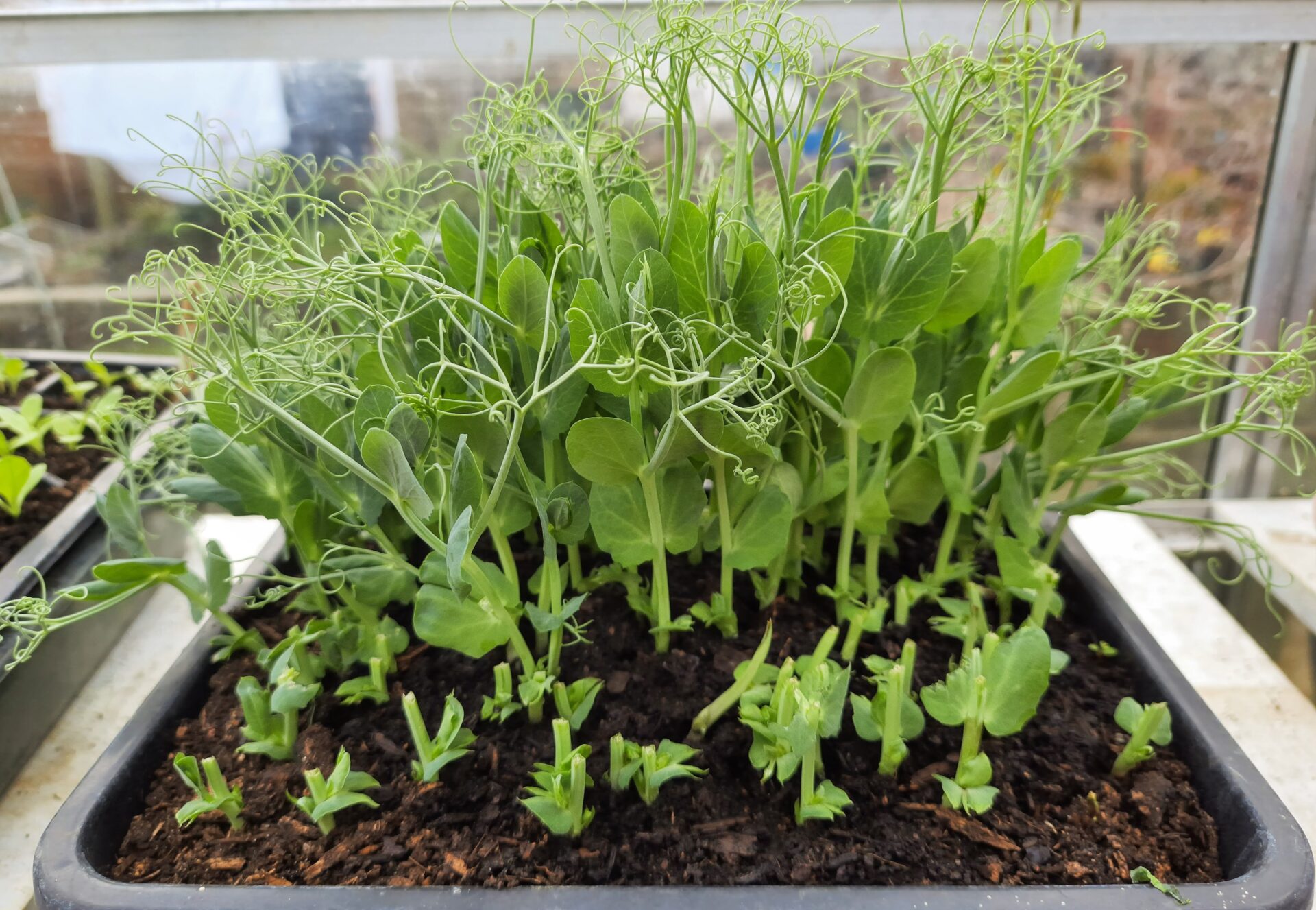
Peas are planted monthly – seedlings make a delicious salad supplement.
Images: Barry Cuff

By the end of March we were harvesting the last of our 2022 crops. Musselburgh leeks, mostly for soup, and Palace parsnips for roasts and chips. The few brassicas left after the winter frosts are the last of the Brendan sprouts and two plants of Cardinal purple sprouting broccoli. The broccoli was netted against pigeons and gave some nice spears. Hopefully these two plants should crop until the middle of April.
Three self-sown wintercress (Barbara Sp, a cut-and-come-again plant) are providing fresh growth for our salads. To supplement them, we grow an agricultural pea in the greenhouse – the young seedlings are delicious in salads. We sow a tray each month as they can only be cut once, and we are lucky enough to obtain these from a local farm.
At this time of year we mostly rely on vegetables harvested the previous summer and autumn. Stored in the cool garage we have Golden Bear onions, a good supply of potatoes with four varieties to choose from – Rooster, Picasso, Sagitta and Charlotte. Rooster and Sagitta roast well, Charlotte is perfect for salads and Picasso is a good all-rounder.
In the freezer we still have packs of French beans, broad beans, peas and sweetcorn.
We are now down to our last two winter squashes – one each of a Crown Prince and a Honeyboat.
In the kitchen cupboard are jars of pickled beetroot, green tomato chutney and runner bean relish.

The new season’s crop has begun well in the greenhouse

Back to work
Work has been slow on the plot due to the wet conditions, with more than four inches of rain. The soil is also quite cold. A good indicator of soil temperature is the emergence of weed seedlings; there are very few to see at the moment!
We did manage to plant a row of first early potatoes (Maris Bard) into quite wet soil on the 27th. As this was the first row, we were able to plant from the path without standing on the plot.
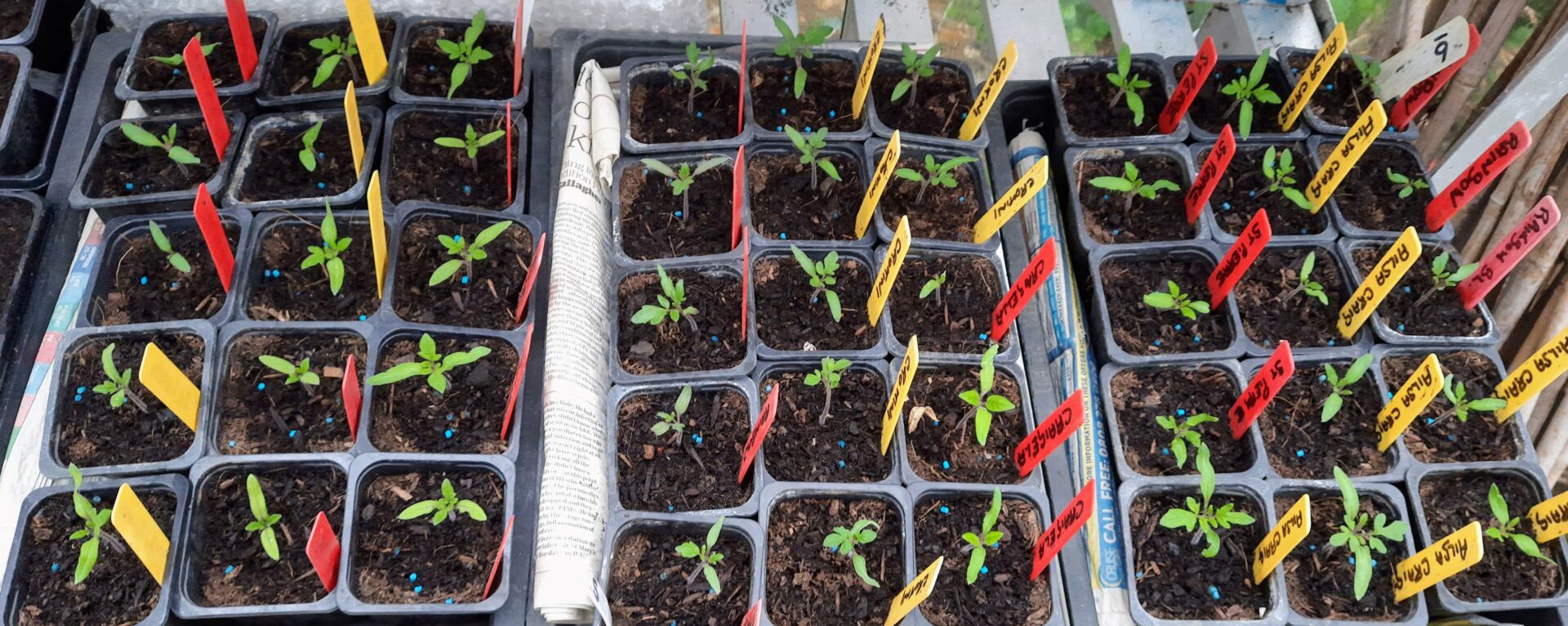
In the greenhouse the first of this year’s vegetables are doing well, however (all our vegetables are raised from seed). Our new strawberry bed, planted in February is showing some growth from all three varieties, Marshmello, Malwina and Honeoye. Hopefully April will bring some warm weather at last, with no night frosts.

sponsored by Thorngrove Garden Centre

Traegar Grills – raising the bar for outdoor living

0

ADVERTORIAL FEATURE

As thoughts turn to warmer weather and cooking outdoors, Traeger – the BBQ brand that is passionate about grilling, is looking forward to bringing people together to create wonderfully flavourful moments this Spring. As the inventor of the wood pellet grill, Traeger uses sustainable 100% natural hardwood pellets to fuel your cooking and infuse every dish you make with deliciously flavourful smoke.
Because cooking on a Traeger is so easy, anyone can master the art of great BBQ-ing, and the easy-to-use controls will give you a confidence-boosting cooking experience at the touch of a button. You can even control your cooking from your smartphone, using WIFI, so you can set the temperature and forget it for a while, while you concentrate on having fun with your friends and family.
Brand new to the Traeger range are two premium grills – the Timberline and Ironwood, creating the ultimate combination of consistency, convenience, and versatility. Traeger redefines what a grill can do, bringing friends and family together to make cooking outdoors an absolute fuss-free joy.

The new Timberline and Timberline XL retail at £3,699.99 and £3,399.99.
The new Ironwood and Ironwood XL retail at £1,299.99 and £1,999.99.
To find your nearest platinum dealer, visit traeger.com/uk/en/dealers

Letters to the Editor April 2023

0

LETTER FROM THE EDITOR

Is it just me, or does March seem to have been just one step too far? We weathered the winter with its relentless rolling onslaught of bad news. March started with optimism, and we all turned our faces to the sun, feeling that perhaps things were finally brightening. But no, silly.
That was just a lull.
The punches keep on rolling.
On the national and international stage the news is perennially worrying, unsolvable and uncomprehendingly BIG.
Here at BV Towers we’ve been forced into a new car purchase, and our son in America has had a traumatic couple of weeks (parenting from across the world is HARD when what he needs most is someone to just pop in, put the kettle on and share the load for a bit). And like every other household there are other personal bubbles that insist on suddenly popping.
And yet – as always, I look for the silver lining. The sun is shining! We have been shortlisted for a major national award as Regional Publication of the Year!
Spring is finally upon us, and with it comes a new sense of energy and hope. I try to count the small daily wins. I watch the imperceptible greening of the hedgerows and the bright scattering of yellow primroses and celandines as Dorset wakes up. On a walk this month we both stopped and gaped at countless skylarks overhead – all simply shouting lark-swears at us, no doubt, but we were thrilled nonetheless (and then it hammered down with rain, but I’m keeping it positive here) (did I mention that we’ve been shortlisted for a national award?!).
I’ll leave you with my son’s cat.

Mochi

Two weeks ago Mochi fell four floors from the apartment window. Miraculously, she suffered just a cracked pelvis, one snapped tooth and a fractured elbow – for which she has one leg in full plaster cast shoulder-to-toes and is confined to a box. Yesterday, in the few nanoseconds they took their eyes off her, she wriggled her broken leg OUT of her cast.
Yet another emergency vet dash, and now she sports a new up-to-her-chin chunky,
un-escapable cast.
Mochi is not happy …


On farming
Thank you for covering Minette Batters speech at the annual NFU conference, and also for providing the link to the full speech. I was impressed by her passion, knowledge, and commitment to supporting our industry, but what impressed me most was her ability to connect with the audience and to speak directly to the concerns of farmers. She was engaging, thoughtful, and genuinely passionate about the future of our industry.
Diane Creed, by email


The European Union is by no means perfect, but in leaving it the UK really did cut off its own nose to spite its face. A promise by those behind this Brexit Government that EU funds would be matched if we left has been broken. There’s only so much repetition of the empty “levelling up” slogan that ministers in Rishi Sunak’s administration can do to obscure that truth. Anyone in a rural community can see that farmers continue to bear the brunt of the empty promises and the shambles that is the current (non-existent) ELMS replacement.
It was good to read George Hosford’s column last month, sharing some positivity around the fact that at least some departments within DEFRA are keeping themselves up to date with soil health and environmental issues.
John Napier, Mere


What good sense we can read in Minette Batters statement to the NFU conference. She painted a stark picture, reminding the hall that input costs had jumped 50 per cent, posing a threat to domestic food security and supply. We have the lowest egg production in nine years, salad production is down to levels we haven’t seen since the 80s and many beef and sheep farmers are planning to reduce numbers.
Let’s hope the government were listening when she demanded they ‘start putting meaningful, tangible and effective meat on the bones of the commitments it had made.’
What a shame that Therese Coffey couldn’t show her the respect and professionalism she deserved. How embarrassing that a Wiltshire tenant farmer puts the Secretary of State to shame just in the simple matter of good old fashioned manners.
Angela Carrows, by email


Walkers be aware
I have read this week that the Tick-borne encephalitis virus (TBEV) has been detected in Dorset. It’s a very small risk, but better safe than sorry as the consequences can be extremely serious. Most people are aware of tick bites causing Lyme disease, which is a treatable bacteria infection, but are seemingly not so aware that though the chances of contracting TBEV are very low, the subsequent viral infection can be life threatening.
Obviously it’s a small risk, but worth covering up if spending time in long grasses, using insect repellant (or the SAS’ allegedly preferred repellent, AVON’s Skin So Soft moisturiser!) and just keeping an eye out on your legs after a walk.
Mary James, Shaftesbury


Dogs behaving badly
I am writing to express my frustration and concern regarding the behaviour of some dog owners on the trailway in Sturminster Newton. While I enjoy taking walks on the trailway and appreciate the ease of access to the beauty of the area, I have recently encountered several incidents involving poorly behaved dogs and their owners.
On numerous occasions, I have encountered dogs running off-leash and causing a nuisance to other walkers and their dogs. Some dogs have even chased after cyclists, putting themselves and the cyclists in danger. In addition, I have seen owners not cleaning up after their dogs, which is both unsightly and unhygienic.
As a dog owner myself, I understand the importance of exercise and time spent outdoors for our furry friends. However, it is the responsibility of the owner to ensure that their dog is under control and not causing disruption or danger to others.
I urge all dog owners to please keep their dog on a lead and to clean up after them. It is important that we all respect the trailway and each other, and ensure that it remains a safe and enjoyable place for everyone to visit.
Annie G, by email


CONGRATULATIONS, Laura and Courtenay! It’s great that you’re on the shortlist with two other top regional publications.
(for the NMA2023’s Regional Publication of the Year – Ed) I wish you both all the very best on your great achievement so far and hope you win.
Sheila L, by email


I thought your readers might be interested in the above photo. It was taken by my father, Geoff Mallett, who was the headmaster at St Mary’s Junior School (as it was then) in Stalbridge, from the 60s through to the early 80s. On the transparency slide is written:
“Lower juniors trip to Portland 1966“
Chris Mallett, by email


This laughing donkey was submitted to our Reader’s Photography this month. It didn’t make the pages, but it was just too good not to share! Thanks for submitting Debs Baker.