Rare breed pigs have been enlisted for conservation duties at Bere Marsh Farm as volunteers vie to be a part of Operation Pig Watch
Conservation efforts at Bere Marsh Farm have taken on an unusual twist with the arrival of three rare breed Oxford Sandy & Black pigs. The trio of female pigs will be allowed to freely roam a nine acre field for the next few months, and they will naturally root up the ground. The idea was suggested by ecologist Derek Gow and is part of the Countryside Regeneration Trust’s (CRT) plan to increase natural biodiversity. The pigs have come from nearby breeder Lillie Smith, one of only 136 registered breeders of Oxford Sandy and Blacks in the country. See our feature on Lillie and her OSB’s on page 25. The sows will be left to their natural foraging behaviour that will encourage a less uniform area filled with scrub and tussocks, and will create small patches of bare ground to allow grey willow and other wild plants to establish. The wild field landscape will provide a better habitat for insects and field voles – and consequently more food for the farm’s barn owls.
Operation Pig Watch Volunteers from the Bere Marsh Farm community will be on duty every day to feed and monitor the pigs as part of Operation Pig Watch. According to Elaine Spencer-White, the farm manager, the response to the call for volunteers was overwhelming; within 24 hours of the call being sent out, she had 14 pig-sitters volunteered to help, with two more on standby. The volunteers will monitor the pig’s daily welfare and scatter their food across the field to encourage their natural rootling activities. Feeding times will also be flexible to stop them relying on a regular meal. Pig-promoted conservation has not been used at Bere Marsh Farm before, and the innovative scheme is being closely monitored by the CRT, which hopes to see results quickly. They plan to take a photo from the same spot overlooking the field for a detailed record of the habitat’s development over future years. The hope is that the pigs’ assistance will result in the establishment of a variety of plants and create a sustainable ecosystem for future years. Across its 19 farms and properties the CRT works on the principal that nature is integral to good farming, and that philosophy is the practice on more than 2,000 acres of working farms, small-holdings and woodland across the country, where they are demonstrating how regenerative farming increases biodiversity and maintains sustainable food production for every one of us.
We are sad to announce the passing of Brian Hutcheson Dearly loved Husband, father, stepdad, uncle, Grandad and great Grandad. A true friend to many. Passed away on the 28th March 23 in Salisbury Hospital.
May he now rest in peace.
Funeral service is on Thursday 20th April at 3.30pm at The West wilts crematorium Semington. And afterwards at the Coronation club Gillingham Dorset.
Therese Coffey lost her audience at the NFU conference in February – but does her attitude raise a bigger red flag, asks Andrew Livingston
Dr Therese Coffey, Secretary of State for Environment, Food and Rural Affairs
The UK government must not be allowed to blame its lack of action on the climate crisis on things like rotating cabinet members, Prime Ministers and every business’s favourite scapegoat – COVID. Back in 2019, with Theresa May at the helm – however many PMs ago that was – reaching carbon neutral by 2050 was made a legal requirement, with the passing of the Climate Change Act. By 2050, any carbon we release into the atmosphere from the UK must be balanced with carbon-capture, through things like tree planting and the use of new carbon-cutting technologies. This was a good plan. The UK was at the forefront of action on climate change and looked proactive. Well done government. Last July, however, the High Court ruled that the action the government had taken toward net zero was insufficient and that the government was in breach of its own law. Greg Hands, the then Minister of State for Business, Energy and Clean Growth, approved the government’s actions, despite them not actually meeting the legal requirement. For failing at the first hurdle, the High Court imposed harsher, wider and more frequent hurdles for the government to leap to ensure that efficient action is being taken and that the plans are more than simply rhetoric. Just over seven months later, The Observer acquired a leaked document showing that the government was falling far short of its target. Best (worst) of all for the constantly downtrodden farmers is that the Department for Environment, Food and Rural Affairs (DEFRA) is furthest from the hurdle, with its Secretary of State Therese Coffey looking likely to knock herself out on the approach. The leaked documents, which were sent from DEFRA officials to senior Whitehall staff, show that Coffey’s department is 24 per cent short of its official target. Therese Coffey has managed the unthinkable; to look more incompetent than her predecessors.
Grumpy and rude At the NFU Conference last month, Coffey was booed during her speech. She continued to project the air of someone who couldn’t care less. As George Hosford – who was at the conference – commented in his BV column last month (Red Twins, ELMS and beavers, BV Mar 23), Coffey spent the majority of her time during a Q&A with the NFU members yawning, looking at her watch and reminding them that she had a train to catch. Coffey spent the majority of her time during a Q&A with the NFU members yawning, looking at her watch and reminding them that she had a train to catch. In fact, George described her as grumpy and rude. Bridges are being burned. You can be sure that NFU members took careful note of her attitude. If by some miracle she does set a plan for net zero by the deadline, she would do well to remember who will be out in the fields, carrying out her plan. I can personally dislike Coffey, but I can’t blame her solely for her department’s inaction on climate change. Since May’s Climate Change Act in 2019, DEFRA has been playing pass-the-parcel from one minister to the next. Only there are no hidden presents in this game. The music has stopped and Coffey is left holding the box. This will blow up in her face, but unfortunately it’s the environment that will feel the lasting damage.
The weekend event is taking place at Turnpike Showground between Gillingham and Shaftesbury on the 22nd and 23rd April
The Spring Countryside Show is BACK! Get ready for an exciting and unforgettable experience – the first show of the year in Dorset’s rural events calendar is just around the corner! A line up of over 50 exhibits, demonstrations and attractions are set to deliver a weekend jam-packed with fun for the whole family. Taking place over two days, the Spring Countryside Show is the perfect way to spend a day with family and friends. Nick Hill, show secretary, says: ‘With just over two weeks to go until the Spring Countryside Show we are ready to welcome everyone, and what a treat is in store! We are very excited to start off the 2023 show season with an amazing weekend of entertainment for all.’
Rural Living Countryside pursuits and rural activities will of course be on display, including a dedicated ‘Rural’ ring sponsored by Gritchie Brewing Co. See heavy horse logging, terrier racing, gun dog demonstrations and the spectacular horseback falconry display by Jonathan Marshall. The famous Dorset Axemen will be battling it out against the clock, and back by popular demand is the hilarious ‘Sheep Show’ – yes, sheep really do love to dance. The rural skills of farrier, wood carving, blacksmith, stickmaker and coppicer will also be on show, and for those who love a bit of vintage there’s vehicles, farm machinery and steam engine demonstrations.
In other news … Food lovers can indulge their passion in a dedicated cookery area. The best local produce is on offer, as well as new recipe ideas in the Cookery Theatre. Green-fingered visitors will enjoy the stunning show gardens and floral displays. Perhaps try your hand at willow weaving, in one of the various have-a-go activities that are scheduled. For those who love animals, there will be a variety to meet and greet – whether you’re a fan of horses, sheep, goats or pigs, you’re sure to be happy. There will also be a range of talks and demonstrations throughout the event, providing an insight into the workings of the countryside and the people who make it so special.
Entertainment To increase the celebratory atmosphere there’s a festival area with live music, food and – of course – a bar with local ales, gin and cider. This will all be open until 10pm on the Saturday evening, so visitors can dance beneath the stars and enjoy a true festival vibe.
You can join in If all that’s not enough to ‘bring in the spring’, there’s a fun fair with bouncy castles, and tractor and trailer rides. Tickets are currently £14 for adults (gate price will be £16) – children go FREE! . And if you have a country craft or skill you can demonstrate, or want to try your luck at a Show Garden or floral display – there’s still time to get involved. For tickets and more information, visit springcountrysideshow or call 01747 823955
Dorset Wildlife Trust have plenty of activities for you to get involved with this April. Join them at their visitor centres at Chesil beach, Brownsea Island, Kimmeridge Bay and Kingcombe or at Lorton Meadows nature reserve to experience the best of Dorset’s wildlife. Easter has never been so ‘eggciting’, with something for everyone to enjoy – you’ll be spoilt for choice! Highlights include Pond Dipping days on Brownsea (Sun 9 Apr), Stream Dipping at Kingcombe Visitor Centre (Tues 11 Apr), a children’s treasure trail looking for clues to solve puzzles in the Chesil Challenge (Thurs 13 Apr) and a Willow Owl Workshop at Kingcombe (Sat 15 Apr). See the DWT website for full details of all events.
In 2021, Brad Jones had a nightmare motorbike crash at Brands Hatch, followed by three weeks in a coma. Now he’s back on two wheels – Steve Keenan reports
Brad Jones at home in Stalbridge with his new cycling passion. All images Steve Keenan
‘I had a highside accident – where the rear end slides then suddenly regains grip and violently flips. I rolled through the gravel, and knew I had broken my collarbone but then I was knocked out, which it turns out was great. ‘The bike had flown through the air and came down on my head and chest: that’s where the bad injuries happened. Luckily, I crashed right outside the medical centre: British Superbikes employ the best medics. They had my visor up after 12 seconds – there was blood pouring out of my head. ‘I was airlifted to Kings College Hospital in London. I had broken the base of my skull, shoulder blade, pelvis, collarbone and five ribs, which punctured my lungs. I was put into an induced coma for three and a half weeks…’
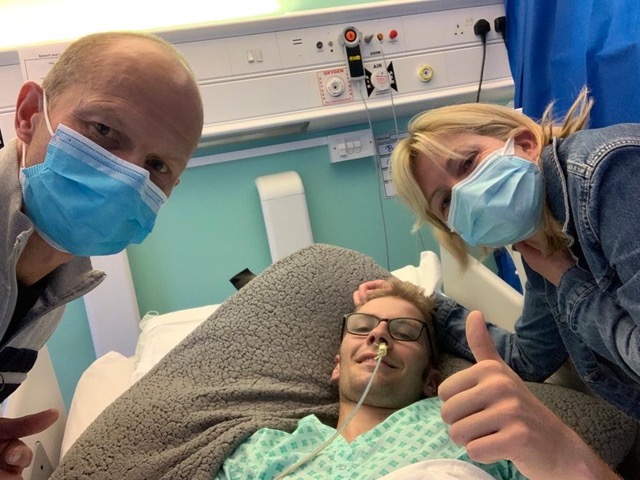
Brad recovering in hospital, with dad Tim and mum Maxine.
Brands Hatch, July 2021 Brad Jones was 23. It was his debut season in the Superbikes Championship riding 1,000cc machines competitively for the first time. He was more used to 600cc bikes. It was, as he says ‘a lot more power, a lot more for me to learn.’ The third race of the season was at Brands Hatch, the closest race circuit to his home in Stalbridge. ‘It was the first race of the weekend, on the Saturday,’ he says. ‘I kept having mechanical issues. Maybe I went into that bend on the first lap a bit too fast. Perhaps it was the cold tyres. I don’t know. It was just one of those things. I do remember vague little bits. I’ve seen the footage. But talking to you now, it’s like I am talking about someone else …’ Brad is now back living with his parents and working as a heating engineer in his grandfather’s business. He’s talking about that crash 21 months ago: ‘I was in hospital for seven and a half weeks. When I came out of the coma, I was asking the same questions all the time, I was all over the place,’ he says. ‘I’ve still got two screws in my pelvis and a plate in my collarbone but physically, I’m 100 per cent recovered. Psychologically, I’m not 100 per cent. I struggle with short-term memory: the doctors said it could take four years.’ Brad is polite, warm and quietly spoken, and is well liked in the local community and racing world. His dad Tim is a mechanic: he raced competitively himself, and Brad caught the bug. He started in motocross aged six, following his older cousin Ollie, and over 15 years worked his way up to the 600cc British Supersports circuit and the fringe of the World Championships.
Pre-crash Brad on his bike
Turning to Superbikes In 2019, Brad came ninth in a field of 25 at Donington Park and received a wild card for a World Championship race in Qatar. But, he says, the reality of getting a place in a World Championship team meant having to secure £150,000 sponsorship each season. ‘The thing that stopped me going on the world stage was money. It was demoralising – but I could see that it just wasn’t going to happen.’ Brad turned to British Superbikes, then the highest level of racing in the UK, with a season of 11 rounds (this year it begins in April at Silverstone and ends at Brands Hatch in October). The pandemic delayed his first competitive season until 2021. Then came two races – and then the crash. Brad’s parents Tim and Maxine were at the hospital daily, as was his girlfriend Courtney. The family was allowed in for an hour a day but only one at a time, so they were allowed 20 minutes each. At times he was partially conscious. ‘One time, he squeezed his mum’s hand and was able to focus but then he was back into a coma,’ said grandad Bob Jones.
Community strength At one stage, doctors told the family that the next 24-48 hours was down to Brad. Only his inner strength would pull him through. Added Bob: ‘I was watching that race live on television. I didn’t think Brad was going to make it when I saw the screens go up around him on the track.’ It was a dark period for the whole family. ‘At the start, there was lots of talk about maybe having to adapt my parents’ home for me,’ says Brad. But the community rallied to help. Cousin Lucy Calvert set up a crowdfunding page with a £20,000 target, helped by selling T-shirts, caps and stickers with the hashtag #KeepFightingBrad. The page eventually raised £40,979 from nearly 1,000 people. The money proved invaluable: instead of having to travel to Poole for NHS physio, Brad could have intensive physio and rehab work at home. He had his teeth repaired, lost seven kilos and was advised to get a therapy dog (he now has a cavapoo called Rufus). By September he was able to walk without crutches. Over the winter of 2021-22, Brad worked hard to regain strength. He struggled to breathe properly and had to go cold turkey on medication – ‘I worked to remain positive but that was the time I struggled mentally.’ He was barred from driving – but he did have an exercise bike at home. And it got him thinking about the possibility of racing on two wheels again … In April 2022, he began riding his pushbike out locally, to Marnhull or Sturminster Newton, as part of the rehab and because it was ‘good for my head.’ Brad had the all-clear from hospital, stepped up the intensity of riding – and entered a race. It was at Thruxton, one of the familiar Superbike tracks. But this time it was all down to pedal power – a one hour Category 3 simple circuit race; first over the line wins, entry fee was £20 and the winner gets a pat on the back. Brad hasn’t stopped cycling since. He’s now risen to Category 2 where the racing is much harder. With his best friend Scott Ridding, an established name in World Superbikes, he cycles all over the country.
Brad with Rufus, his therapy dog
No more engines I met Brad on a Monday, fresh back from two weekend races in Lancaster and Oxford. Oxford was eight laps – 62 miles in total – and Brad did 40 before calling it a day. Could it be that perhaps it’s no longer about winning but being out there, with a friend? ‘Scott and I will talk about Superbikes for 15 minutes, maybe, and that’s it – we just talk about cycling all the time!’ Brad is clear that cycling is a hobby, that he’s not going to make money out of it and that it’s a game. But there’s a light in his eye. ‘I’ve always been competitive. I don’t like being beaten – which helped me in my recovery. This year, I want to win some cycle races. I want to buy a house. And I will go and watch some motorbike racing: I have so many friends that I won’t see unless I go to the track.’ And how would he feel about that? Would he be thinking of a return to the motorbikes? Reflecting on his life before the crash, and where he is now, Brad’s response is thoughtful. ‘I was living the dream. I was working three days a week and racing motorbikes at weekends. My dad was my mechanic and my grandad and nan were coming to watch. ‘Motorbike racing has changed financially even just in the last two years. It used to be £20,000 sponsorship was needed for a good team in Supersports – now it’s £60,000. The way I look at it, things happen for a reason. I had a great time doing it – and I was very lucky to get away with it. I would say I had my bell rung. ‘Now I can still go to work, earn some money, see my mates and ride a pushbike. ‘I’m enjoying doing my own thing. I can even have a few drinks – I never used to drink when I was racing. It’s all new to me. It’s what you’re supposed to do when you are 18! ‘Even now, I see local cars driving around with the #KeepFightingBrad sticker on. The support from everyone has just been unbelievable. I reached the pinnacle of where I thought I could get to and now I am simply grateful to be here. I thought it was the worst day of my life – but it was the best day, as I pulled through.’
Although initial fears around the Poole Harbour oil spill have been calmed, eventual long-lasting effects are still unknown. Andrew Livingston reports
Shutterstock
As I write, it has been 12 days since a ruptured pipeline at Wytch Farm expelled more than 30,000 litres of reservoir oil into Poole Harbour. By all reports the clean-up, overseen by the Poole Harbour Commission (PHC), has been successful. The public are back on the beaches and in the water and no serious harm seems to have occurred to the rare birds of the area. While most of the surrounding population heaves a great sigh of a relief, there is a small community of boats moored, with no purpose till further notice. ‘Let’s hope they clear it up fairly soon. I think we are fairly optimistic.’ Pete Miles, owner of Dorset Oysters, told The BV. ‘We are on stop until further notice really.’ Soon after the news broke of the oil spill from Perenco’s site into Ower Bay, the PHC announced that, with immediate effect, any shellfish harvest could not be retailed, transported or marketed – effectively locking down the local shellfish industry. Testing of the shellfish has been ongoing, but as Pete understands it, no results have yet been announced. ‘The last I heard, a couple of days ago, [they] should be back within seven to ten days … As all these things are when it comes to food – oysters particularly – it’s always precautionary.’
Whole season impact Dorset Oysters is normally 100 per cent self-sufficient in Poole Harbour, but to keep the business going, Pete has been buying oysters in from Jersey. The oysters Pete usually sells aren’t actually wild, they are grown at a sister company, Othniel Oysters, a farm in the harbour. Like all farmer’s crops, there’s a limited window when they can be harvested. ‘It will be worrisome if we can’t get into this year’s stock. What will happen is [they] will keep growing. If we can’t harvest them, then they grow to a certain size and they’re just not marketable. They simply get too big. ‘Once the water warms up and the plankton and the algae bloom then the oysters will grow quite quick … It’ll be a couple of weeks and [then] once they start we need a good, fast turnaround.’ In the short term, all the shellfish fisherman want is to get out to the oysters, cockles and clams to keep their businesses trading.
Long term impact There is, however, a long term danger – not only to the molluscs of Poole Harbour, but the ecology as a whole. Emma Rance has 20 years experience of marine biology and conservation and believes that the monitoring of the shellfish in the harbour will have to continue for years to come. When she heard the news of the oil spill she felt ‘utterly saddened and disappointed’. She says: ‘This should not occur. Oil farms are regulated to operate using the strictest of control measures. We would not expect this to happen. ‘Poole Harbour is the second largest natural harbour in the world and is home to some rare and protected species ranging from seabed-stabilising eelgrass, beautiful peacock worm beds, a sea bass nursery area, both species of seahorse and many other habitats and species of conservation importance.’ Before setting up her own marine consultancy business, Noctiluca Marine, Emma worked with the Dorset Wildlife Trust and contributed to Dorset Council’s emergency Oil Spill Contingency Plan, with other government agencies and NGOs. ‘There is no full understanding on the long-term impact of petroleum hydrocarbons on the marine environment. Research has shown that this kind of pollution is known to affect species survival, reproduction and ability to function normally plus many other concerns. ‘‘Oil spills can impact habitats, locking the pollution deep into sediments, allowing for slow release over a long period of time.’ Perenco, the owners of Wytch Farm, have set up a claims line for anyone affected by the spill. In a statement, Frank Dy, the general manager at Wytch Farm, says: ‘Any spill is an extremely serious matter and a full investigation will be launched to ascertain what happened in Poole Harbour. It is important to stress that the situation is under control, with the discharge of fluids stopped and the spill is being contained.’
Oil Spill Timeline
26th March Pipeline at Wytch Farm fractures, spilling oil into Ower Bay PHC activates its emergency oil spill plan A major incident is declared and agencies including Dorset Police, Dorset Council, Bournemouth, Christchurch and Poole Council, NHS, Environment Agency and Natural England are involved. Fishing, swimming and other leisure activities in the harbour are prohibited.
27th March 7am – More than 100 people were out assessing the shoreline and harbour, undertaking shoreline cleanup. 60-70% reduction in oil sightings in the water from drone footage.
28th March 3pm – 30 slightly oiled birds found in the harbour, reported by RSPB
29th March Clean-up teams recovered 14,000 litres of oil/water mix and approximately 1,500kg of oil sediment. Key stakeholders in the shellfish industry are advised not to market shellfish harvested from Poole Harbour since the oil spill.
30th March A further 31,000 litres of liquid recovered overnight. Oil found washing up on the beaches of Brownsea Island
31st March An estimated 100,000 litres of oil/water mix and two tones of sediment recovered. Excavation of broken pipe begins Oil found washing up on Arne Nature Reserve
2nd April Perenco set up a claims line for those affected by the oil spill 140,000 litres of oil/water mix and more than five tonnes of contaminated beach/soil material have been recovered
4th April Estimated 160,000 litres of oil/water mix and more than six tonnes of contaminated beach/soil material have been recovered People are once again allowed to swim and fish in Poole Harbour
The Thorngrove team are feeling the rush of spring, says Kelsi-Dean Buck, caused by a bit of sunshine and a rush of colour in the courtyard
shutterstock
Well Spring is finally here! It’s taken its time, though. It felt like we had a stunning Mother’s Day weekend (I actually sat on the lounger in my garden and felt warm!), but slipped swiftly back into a wintery feel in the air… However, as I write this the sun has finally shown up. And I’m happy to report that garden-mode is now fully activated! I’ve not had a garden space to call my own for very long, so I’m actually excited for the arrival of warmer weather and to get out and make use of it again!
Lupin month Thorngrove’s plant of the month for April is lupins. Native to North and South America, there’s over 200 species of these flowering plants which are from the legume family. Often used in garden design due to their showy structural flowers, they come in a variety of colours including pink, purple, blue, yellow, and white. Some can grow up to 5 feet tall, and they do require well-drained soil and full sun to thrive. Don’t forget that lupins are a great source of nectar for bees, butterflies, and other pollinators. Planting lupins in your garden will help attract these beneficial insects and promote a healthy ecosystem in your own garden. Secret Garden Our new menu in the café should be launching soon after this month’s BV goes ‘to print’, so please keep an eye out for that. We’ve been welcoming lots of new faces at The Secret Garden Café and it feels like word has really been spreading about the amazing food we have available. A huge credit goes to Ben and his team in the café for making it one of Gillingham’s highest reviewed cafés on Google. Indoor seating is available of course, but we’ve also revamped our outdoor patio in anticipation for the warmer weather, so please do stop by this spring with friends!
Lunch inside the Secret Garden Cafe
Coming up At Thorngrove this month we’re hosting Children’s Crafts (at time of writing spaces are already filling up so please book to avoid disappointment!). We’ve also announced open days for Employ My Ability, happening May 16th and 17th – book your guided tour today! At EMA we offer vocational qualifications and work experience to young people with Special Educational Needs and Disabilities, and Thorngrove functions as a campus for our students. Find out more on our website! employmyability.org.uk/
Like all astrophotographers, the March skies meant that Rob Nolan had an impossible month – but he did capture a stunning nebula in February
Well, its official, it was the wettest March we’ve seen since 1981. Which means it’s the wettest March I’ve ever seen! I don’t think myself or any of my fellow Astrophotographers managed to collect any images last month, and we were all extremely grumpy because of it! We live in hope of some cloudless and moonless nights in April to reinvigorate us and to try and capture some data as the days grow longer and the nights grow shorter. The worst thing about the bad weather, is we all tend to get bored and go and buy more equipment to make ourselves feel better! Never a good thing! My image this month is one I shot back in February, and turned out to be my last nebula shot of winter as we are now giving way to galaxy season again.
The California Nebula A large emission nebula stretching across almost 2.5 degrees of the night sky, the California Nebula (NGC1499) is in the constellation Perseus. It is so named because its shape is reminiscent of the outline of the US state of California on a map. The Nebula stretches about 100 light years across. Despite its huge size and visual magnitude of 6.0, the nebula is still very difficult to observe visually because it has a low surface brightness. However, when photographed using Narrowband filters which pick up hydrogen, sulphur II and oxygen lll emission bands, details come alive on this massive structure. I’m always in awe when zooming in around the high resolution version of this image to see all the different shapes that create this truly stellar nebula. It was discovered by American astronomer Edward Emerson Barnard – renowned for his catalogue of dark nebulae and his pioneering work in astrophotography – in 1884. This image was captured with my 1000mm Maksutov Newtonian Telescope and the ZWO ASI2600MM Pro Astro camera with Narrowband filters and is about 8 hours of data.
The night sky, April 2023 – Rob’s guide for your stargazing this month:
Now that the spring equinox has come and gone, we start to see the nights get shorter; always a sombre time for astronomers! Thankfully though, there’s still plenty of astronomical darkness in April to keep us entertained, clouds permitting! Since the clocks went forward, there’s more chance that we’ll be back home from work and settled as night falls, so now is a really good time to take a look at our three nearest neighbours ton view in the evening sky; Mercury, Venus and Mars. It’s a really good time to try to observe Mercury, which never strays far from our sun and follows a very tight oval-shaped orbit, completing one year in just 88 Earth days. Imagine having to go through Christmas dinner and all the trimmings every 88 days! The fight for the title of brightest object in the night sky this month includes stars from several constellations. Regulus in the constellation Leo, Spica in Virgo and the unmistakable orange glow of Arcturus in Boötes. One of the prominent constellations this month is Virgo, with its Y-shaped appearance, it’s the second largest constellation in the night sky. The glory of Virgo , so named because the pattern traditionally represents a victorious maiden holding an ear corn, lies in the ‘bowl’ of the Y shape. If you scan the upper region with a small telescope at a low magnification, you’ll find this part of the constellation packed with faint, fuzzy blobs. These are just a few of the 2,000 galaxies that make up the gigantic Virgo cluster.
Dates to remember Events to make a note of this month include observing our local neighbourhood, starting on the 11th as brilliant Venus is positioned left of the Pleiades. Wake up early on the 16th to catch Saturn above the crescent Moon before dawn. We’ve got an excellent chance of observing the Lyrid Meteor shower this year on the night of the 22nd to 23rd of April. This is because the Moon isn’t in the way to obscure the display, so it’s definitely one to watch if the clouds oblige! The Lyrids appear to emanate from Lyra – a small constellation named to represent the lyre of Orpheus in the northern sky –as we pass through debris from Comet Thatcher. On the 23rd, look towards the crescent moon at twilight and you’ll see Venus, hanging like a pendulum below the clock face of the Moon. Finally, on the 25th, you’ll be able to observe Mars close to the Moon, next to stars Castor and Pollux. Until next time, clear skies!