The Dorset Doddlers’ next – very popular – Couch to 5k course starts this month. These courses have helped many want-to-be runners ease themselves into the sport through excellent coaching, friendly club members and by making it a bit of fun! No previous running experience is required: just a desire to get a bit fitter, to meet some new people and to bring a positive, can-do attitude – especially as they train in all weathers! You will be supported and coached every step of the way – “No one is left behind, and no one is too unfit”. The sessions start at Sturfit in Sturminster Newton at 6.45pm every Monday, and the course lasts for 10 weeks. It is not too late to sign up, even though the course officially started on 6th January*. The Dorset Doddlers was formed in 1983 by a small group of friends and now has more than 150 members. There are weekly hills sessions in Shaftesbury on Tuesday evenings through the winter – fancy running (walking!) up the iconic Gold Hill? – which switch to summer runs around the county when the clocks change (mysteriously starting and finishing at pubs, usually…). Thursday evening fitness sessions are from Sturfit in Sturminster Newton, making use of the local small roads and trailway. All sessions are taken by qualified club coaches and are tailored for runners of all abilities.
*More information can be found on the Doddlers’ website dorsetdoddlers.org
Pessimism, promises and poultry: Andrew Livingston asks if 2025’s lofty food and farming goals may already be slipping through our fingers
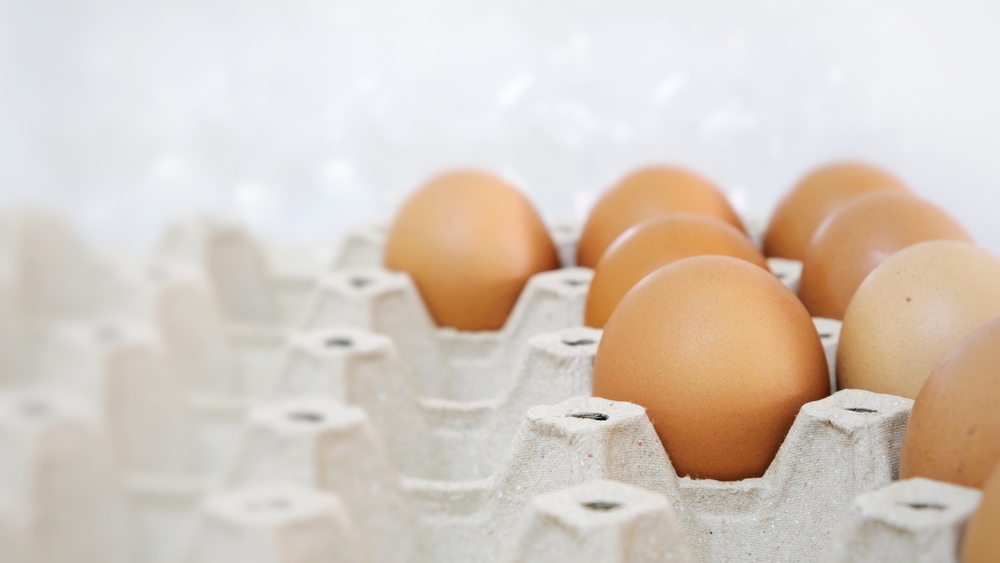
When you return to work in January – not that farmers ever really stop… – you can soon forget that it is a shiny, fresh new year. The festivities get left behind, New Years’ resolutions begin to get dusty and forgotten and we all slowly return to just getting on with our lives. My own healthy eating plan has already gone out of the window, but I’m still (mostly) dry for January! For the poultry industry, 2025 is supposed to be a big year. Many of the major retailers made a promise in 2016 – the question is, will they keep it? Nine years ago, Aldi, ASDA, Iceland, Lidl, Morrisons and Tesco all stated that at the end of 2025, all the whole eggs sold in their stores would be from cage-free birds. It’s a promise which is looking very unlikely to be kept … it’s all gone a bit too quiet. Hats off to M&S who have only sold free-range eggs since 2002, and Waitrose hasn’t sold any caged eggs since 2001. The promise was made in what was frankly a completely different world: pre-pandemic, pre-inflation, pre-war in Ukraine and pre-bird flu. Each of these have put great strain on the industry. While the volume of free-range eggs sold in the UK went up another 7.8 per cent last year, 22 per cent of all the eggs sold in the second quarter of last year were raised in colony cages: that’s around 220 million dozen a year. Colony cages replaced the old battery cage system in 2012, and on average a colony cage holds 80 hens. It has a screened-off area for laying, a scratch mat and low perches. Hens don’t leave the cage until they go to slaughter. I will be interested to see the public’s reaction if the 2016 promise isn’t kept … though I doubt that the public really cares. Most of the public wouldn’t know the difference between caged or barn-kept birds, or even what organic really means. The reaction will be interesting nonetheless, as there are bigger promises to be broken in the near future. The NFU pledged five years ago that UK farms would be carbon neutral by 2040. A quarter of the time has gone and little progress has been made. I hate to be nihilistic, and I know it’s important, but … Donald Trump is back in America and far-right movements are gaining power across Europe. Are we wasting our time on the climate change debate? Please don’t think that I am a climate change denier (don’t come for me, I wash my plastics). I just worry that we are going to be one of the only countries banging the Net Zero drum while everyone else prioritises other matters. I’ve done it again. I’ve gone all pessimistic. All I’ll say is, looking at the current global situation and the history of the last five years, should we concentrate on our food security rather than climate change? Or should we be concentrating on animal welfare rather than food security? It’s a moral dilemma and I don’t have an answer. It’s a Venn diagram of a multitude of factors and we need to find the sweet spot in the middle. I don’t know where that sweet spot is, but I do know we aren’t there yet. Planning officers need to start granting permission for chicken sheds to grow the nation’s free-range flock … without them, we’ll never stop selling caged eggs on our supermarket shelves. Sorry. Nihilistic, pessimistic, depressing… Happy 2025! I need a stiff drink after all that. I suspect my Dry January is about to get a little wet.
Fanny Charles looks ahead to what’s coming this year
January is an odd time in the art world – some galleries carry their December/Christmas exhibitions over into the New Year. Others – such as Bournemouth’s Russell Cotes Museum and Gallery – are closed, for necessary maintenance work or other reasons. And it’s not a time when you necessarily want to venture far from the warmth of your home or the demands of the job, so here is a brief look at some of the interesting exhibitions in the first half of 2025, from big London shows to local galleries.
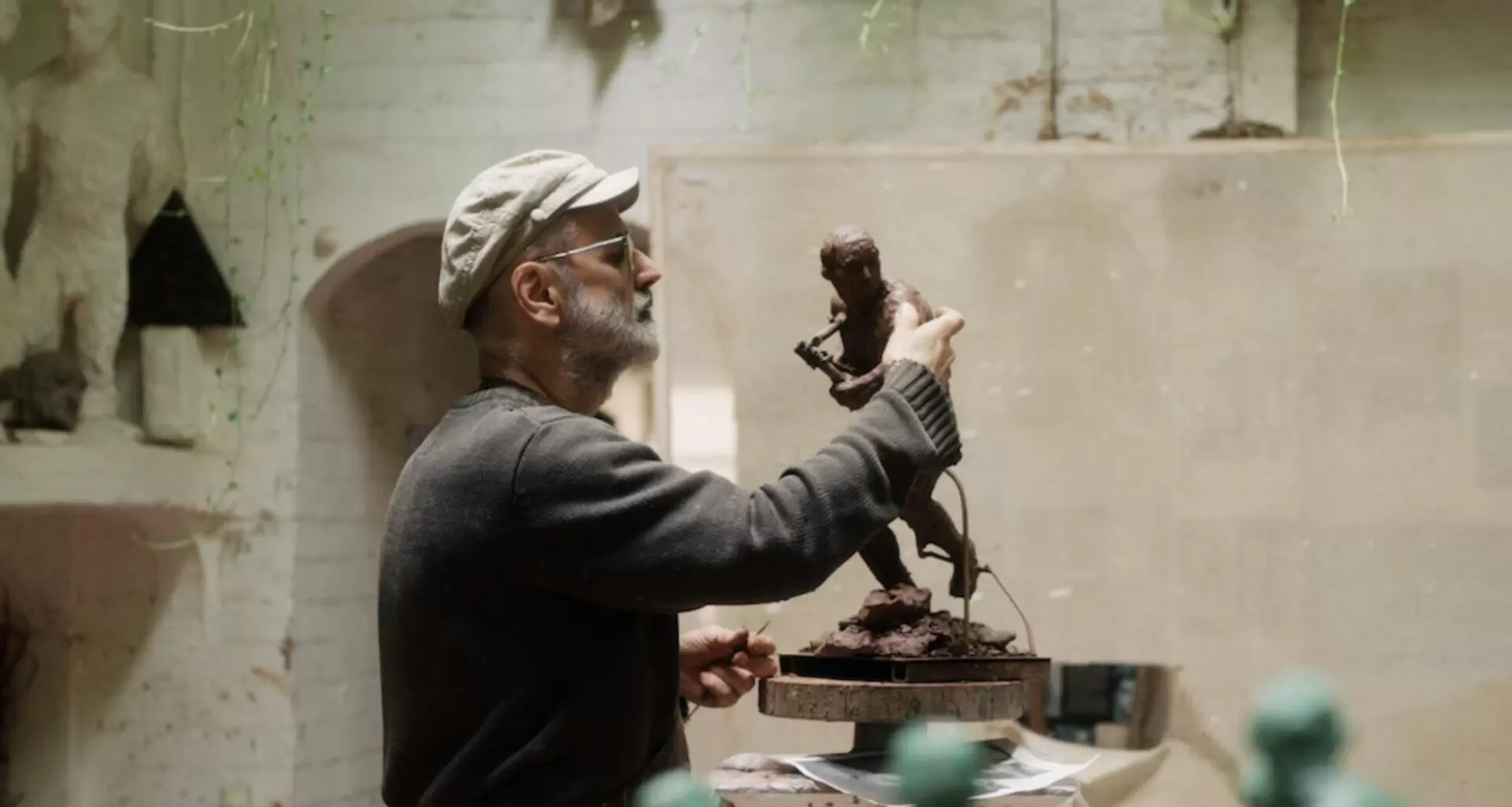
Laurence Edwards at work in his studio
For fans of the great early Italian Renaissance artists, the National Gallery has the exhibition of the year – Siena: The Rise of Painting 1300-1350, This milestone exhibition marks the gallery’s 200th anniversary with a rare reunion of 14th-century Italian paintings. The 100 or so works on show will showcase the pivotal role of Sienese artists in Europe’s artistic landscape. Highlights include Duccio di Buoninsegna’s Maestà panels and Simone Martini’s Orsini Polyptychi. – 8th March to 22nd June. Staying at the National Gallery, we find there is more to Mexican art than Frida Kahlo, wonderful though she was of course. The UK’s first exhibition of work by Mexico’s leading 19th century artist – Jose Maria Velasco: A View of Mexico – celebrates his paintings of Mexico’s landscapes and industrialisation and the 200th anniversary of UK-Mexico diplomatic relations. You may recognise his painting called (in translation) Pyramids of the Sun and the Moon, an iconic view of two of the massive ancient structures which dot the Mexican landscape. – 29th March to 17th August. The Royal Academy at Burlington House in Piccadilly has an exhibition of Victor Hugo’s drawings. Best known for his massive novels, including Les Miserables and The Hunchback of Notre Dame, Hugo was also a poet, politician and artist. His drawings, many made while he lived on Guernsey, include imaginary castles, monsters and seascapes. – 21st March to 29th June.
The Royal West of England Academy in Bristol has its biennial open 2025, with the theme of Paper Works, and an important exhibition of work by Paule Vezelay, a pioneering modernist, born in Bristol, with an international reputation. – 25th January to 27th April
Paule Vezelay’s Living Lines at the Royal West of England Academy at Bristol
The Russell-Cotes on Bournemouth’s East Cliff is one of the most beautiful museum buildings in the country, with a fascinating display of the many collections of Sir Merton and Lady Russell-Cotes as well as a changing programme of exhibitions. The current show is Artists in Purbeck: Spirit of Place, a revelatory survey of the artistic heritage of this spectacular part of Dorset, with its dramatic coast and landscape and its history of quarrying and stone-carving. The artists, painters and sculptors featured include Mary Spencer Watson, Brian Graham, Mark Gertler, Augustus John and Paul Nash. – Returning from 21st January to 16th March, after the New Year closure period.
Southampton City Art Gallery has an exhibition from its important permanent collection that tells the story of western art from the Renaissance to the present day. Featured items include works from the 17th century Dutch, French and Italian baroque, French Impressionists, 20th century British art, Surrealism and the St Ives-based abstract artists. – From 23rd February
Sladers Yard at West Bay follows the Christmas-New Year mixed show, Radiance, with Restless Earth – paintings, prints and ceramics by leading gallery artists, including Anthony Garratt, ceramicist Adela Powell and resident furniture designer-maker Petter Southall. The spring show is a solo exhibition by the Poole-born and West Dorset-based Philip Sutton RA. Now in his 90s, this remarkable artist has a career spanning seven decades including paintings and drawings from his years living on Fiji. The new show is Portrait of the Artist, 70 years of self-portraits and the places where they were painted. – 15th March to 11th May
Messums West, based in the magnificent medieval Tithe Barn at Tisbury, has a wide range of exhibitions and events, including Landscape Painting Today, from 11th January to 24th February, Contemporary Danish Ceramics from 1st March to 4th May and Dressed for the Woods, a retrospective to mark Nicola Hicks’ 65th birthday, celebrating one of the most significant sculptors of our time, from 8th March to 4th May. Further ahead, there is an exhibition by another outstanding contemporary sculptor, Laurence West, from 26th July to 29th September.
Gladiators, a panel from the exhibition coming to Dorchester
If you have been captivated by the blood and glamour of the amphitheatre in Gladiator II, you will be fascinated by Gladiators of Britain at Dorset County Museum. The exhibition explores the history of gladiatorial contests in Roman Britain, and will include finds from Maumbury Rings in Dorchester, originally a Neolithic henge which was transformed into an amphitheatre by the Romans. This is followed by Jane Austen: Down to the Sea, celebrating the 250th anniversary of her birth and exploring the influence of the sea in her novels. – Gladiators of Britain, 25th January to 11th May Jane Austen: Down to the Sea, 14th June to 14th September
Shaftesbury Arts Centre’s gallery has a regularly changing programme of exhibitions, mostly on for a fortnight, but the 2025 opening show – Welcome 25 – is on until 1st February. It is followed by the Spring Open, from 5th to 22nd February, and the arts centre art group’s annual exhibition from 26th February to 4th March. The gallery is open most days and is always worth a visit. The standard of work on show – paintings, prints, ceramics, photography and more – is consistently high.
Hauser & Wirth at Durslade Farm, Bruton, is the Somerset outpost of a global contemporary art group, bringing world-class art to our area. Past exhibitions have included Elisabeth Frink, Henry Moore and Phyllida Barlow, in a beautiful rural setting, with a garden designed by Piet Oudolf. This year’s shows include An Uncommon Thread, featuring 10 contemporary artists living and working in the UK, highlighting the transformative power of unconventional media, using unexpected painting surfaces, adapting formal craft traditions and repurposing discarded products into compelling works. – 8th February to 27th April.
December is a notoriously lean month for new releases, and this year was no exception. Thankfully, I was saved by Lancashire duo Aquilo, who have provided an ‘album of the month-worthy’ offering: their second LP release in the space of just four months. You Should Get Some Sleep can be viewed as a companion piece to August’s A Quiet Invitation To A Hard Conversation – the two albums are available together as a double vinyl LP – but it also stands by itself as their best work to date. The band’s production on this can essentially be split into two camps. One is the pop, indie-lite presentation of songs such as the title track You Should Get Some Sleep and Coldplay-esque I Smile When You’re Not Even There. But this album really shines when duo Tom Higham and Ben Fletcher prioritise restraint in creating their soundscapes. Opening track Feel Alive (“Close your eyes, you’re only 23, but you still know how to dream”) sets the tone suggested by the album title with simple piano arpeggios and washes of strings combining to create a dreamscape which invites the listener to delve deeper.
This style returns throughout, providing necessary respite from the more pop-oriented offerings. No Means No (“Can’t let go, I’m tired and in a mess, and we keep on pushing on dead discussion”) manages to spin 90s slow-jam touchpoints into a truly moving reflection on incompatibility in a relationship. The eight tracks here get their work done quickly (the album is wrapped up in under 23 minutes), but impressively it never feels rushed. A lovely piece of English pop which demands you hit play again and again. 3.5/5 stars.
Matthew Ambrose, DJ at Abbey104
Matthew Ambrose presents Under The Radar on Tuesday evening at 7pm on Abbey104. Broadcasting on 104.7FM and online at abbey104.com.
A prolific photographer from the 1880s to the 1920s, Job Pottle captured local life from children to Churchill, the royal family to railways workers.
Job Pottle in casual stance, possibly in his photographic studio. Date unknown.
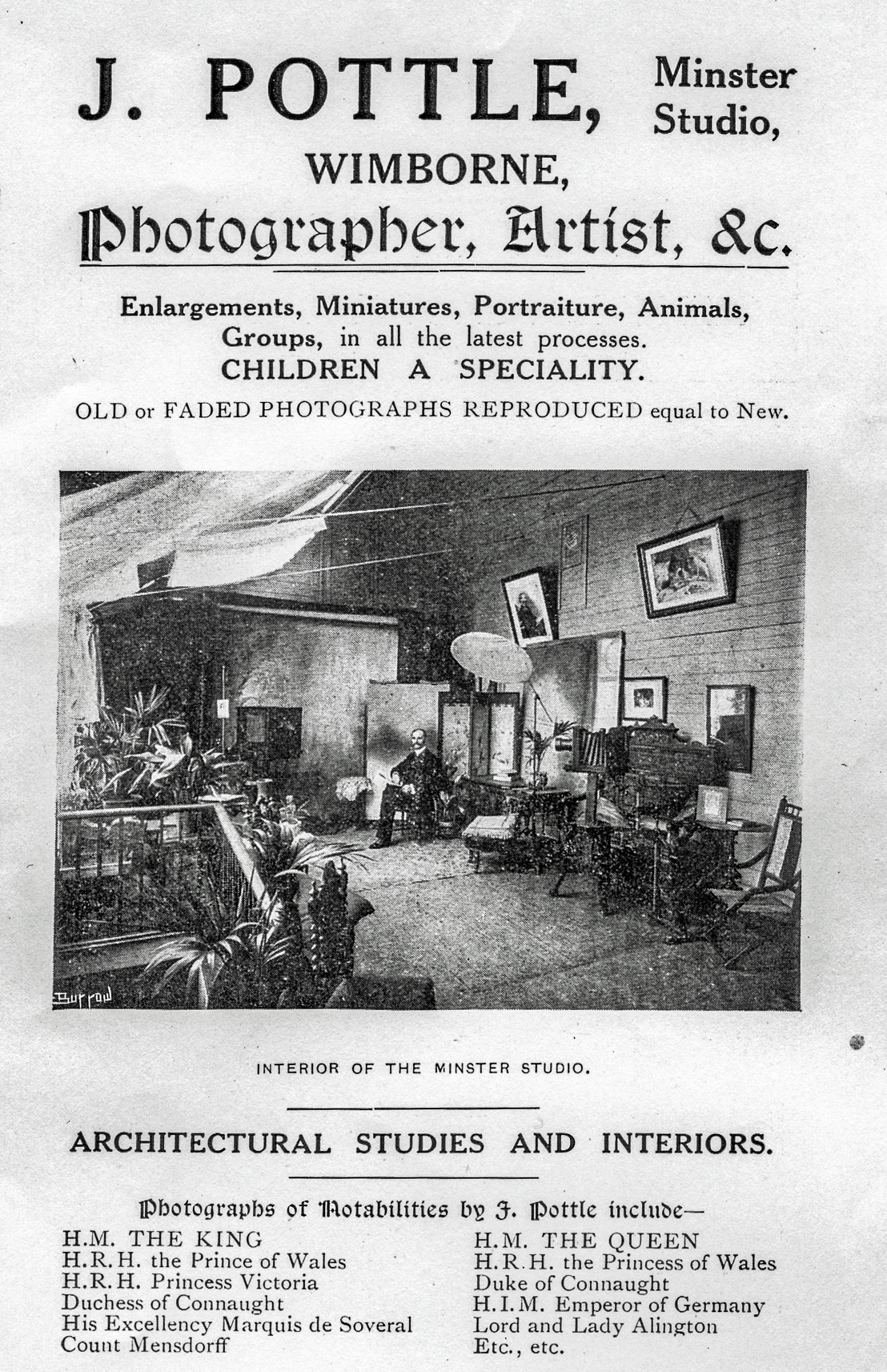
Job Pottle was born in 1856 in Poole to Henry and Fanny Pottle. He grew up in a busy household with three sisters and six brothers. One of his brothers was a part-time postman and photographic assistant: the snow scene above was produced as a Christmas card image from the Pottle family, and was possibly taken by his brother, as Job himself is the man in the boat. Job started his working life as an apprentice cordwainer (shoemaker) to his father, but by December 1889 was calling himself a photographer. He enjoyed the new technology of photography, starting a photographic studio in Wimborne at the back of his father’s property, 34 East Street, and calling it Minster Studio.
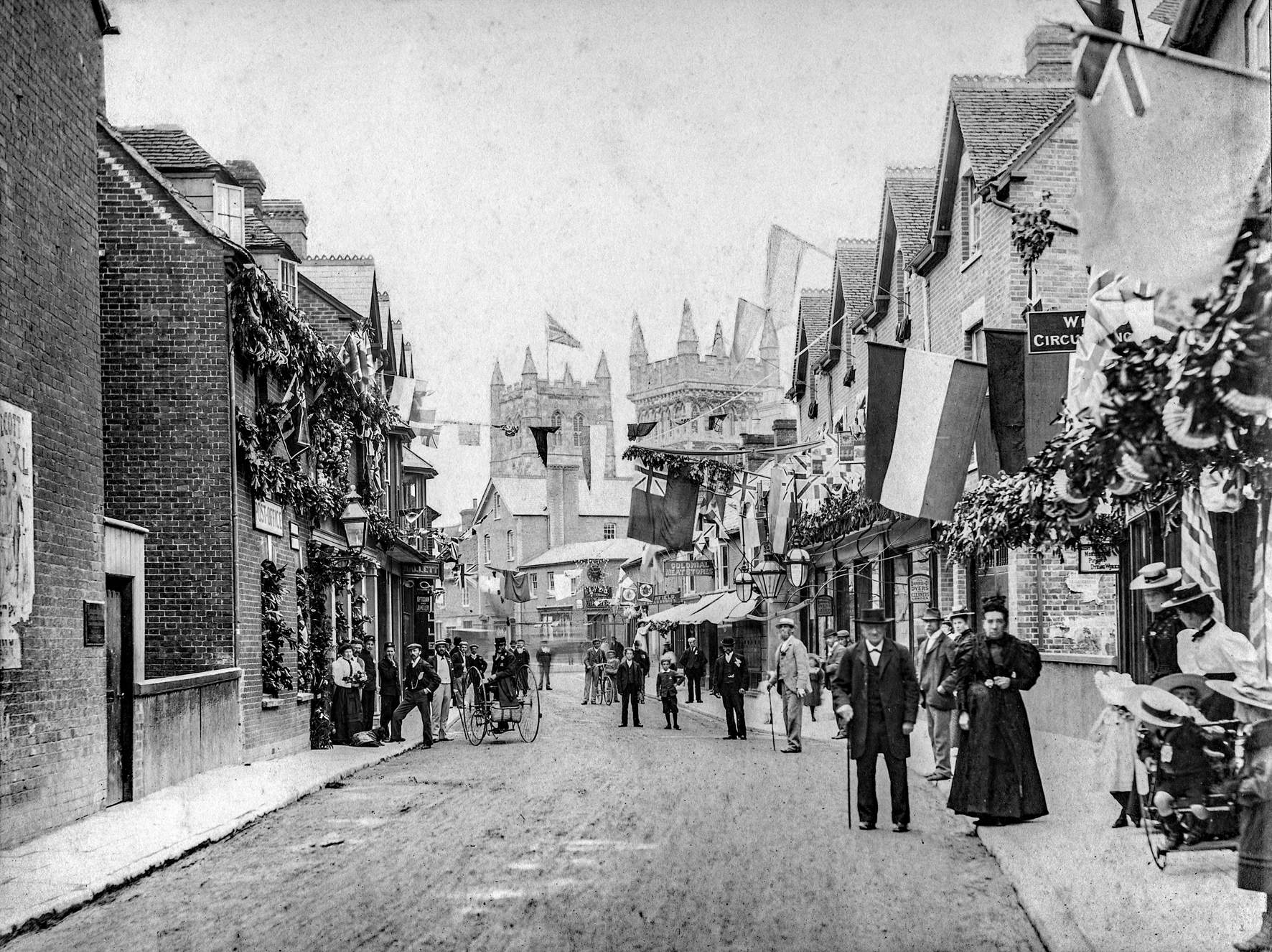
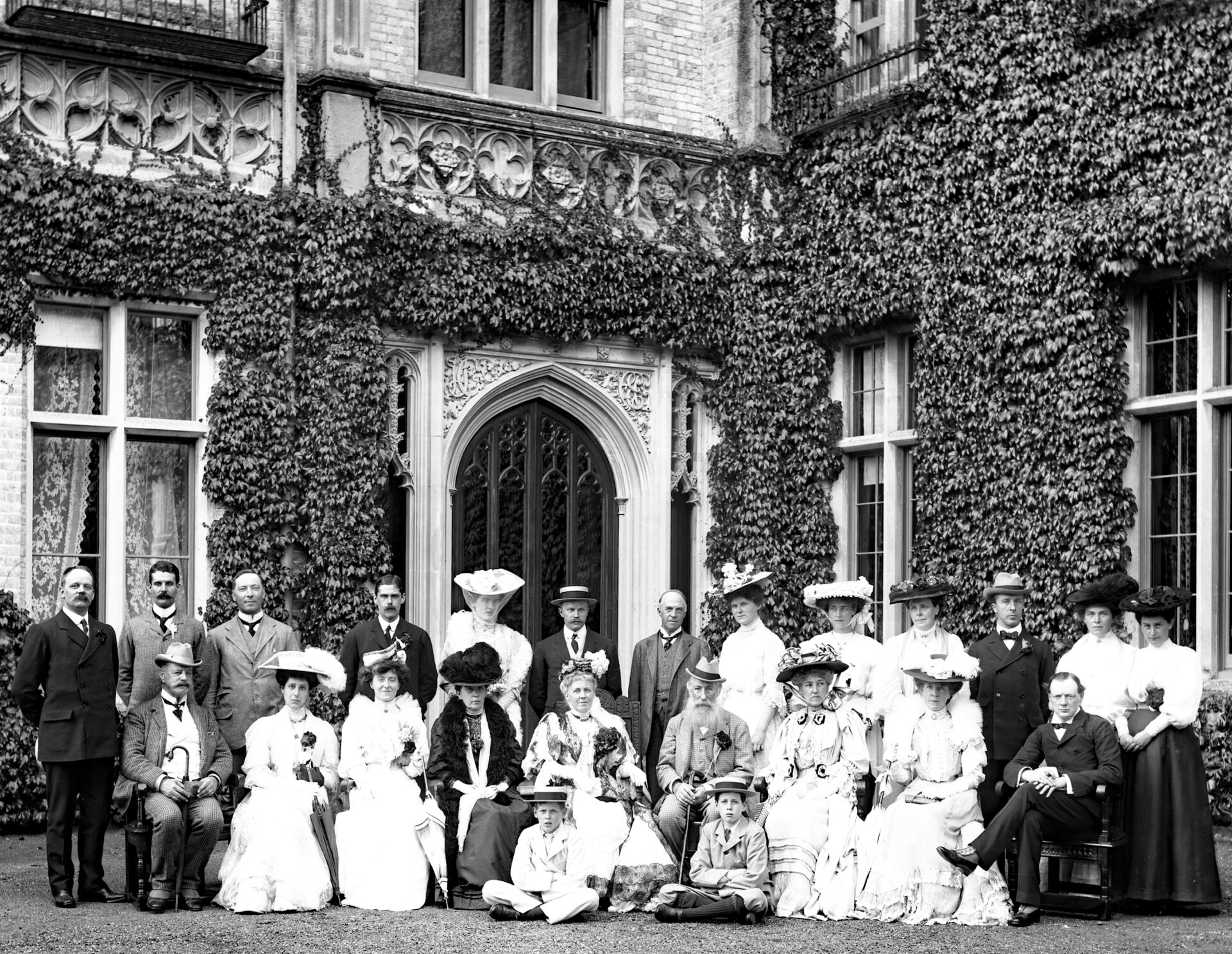
Snow scene on the River Allen at rear of Royal Studio in East Street, Wimborne. It looks like Job Pottle in the boat, so the photo was probably taken by his assistant. Dated 25th April 1908Celebrations in East Street, Wimborne, for Queen Victoria’s Diamond Jubilee in 1897. The postmistress, Miss Housden, is on the left in front of the Post Office with Mr Ward, postman, on the tricycle which has a pannier for letters at the rear. In the foreground is Mr John Low with his wifeA group photograph outside Canford Manor taken in 1907. Group includes Lord and Lady Wimborne with Winston Churchill (without hat) seated on the far right. Lady Wimborne was one of Winston’s aunts
He recorded the floods of 1894 and also suffered an injury helping to catch two women who leapt from a blazing building in East Street but he still photographed the charred remains of the shop. He documented Wimborne’s celebration of Queen Victoria’s diamond jubilee in 1897 and photographed King Edward VII’s visit to Crichel in 1909. Later, having photographed many important Royal visitors to nearby Crichel House – you can see the impressive list on his advert – he renamed his business Royal Studio. An enterprising photographer, Job produced popular Royal portrait postcards from his photos to sell, and also re-photographed older pictures to sell as postcards and magic lantern slides.
To Canada and back Job’s advertising poster of 1910 (right) indicates children and animals were a speciality, and he kept pet rabbits in his studio to keep children calm and still. Job married Mary Ann (née Wyatt) in Wimborne Minster on 5th December 1887, and the couple had two children, Reg and Ella. Reg wasn’t interested in the photographic business, but Ella was frequently seen in Job’s photographs (see above). Ella became ill from the toxic chemicals used in the developing process. The advice to improve her health was to go to Canada – where her brother Reg had already emigrated. In 1921 Job and Mary spent six months in Canada, returning as Ella was homesick. Returning home, Job set himself up as a grocer in Southampton, where he lived until his death in 1947, at the age of 90.
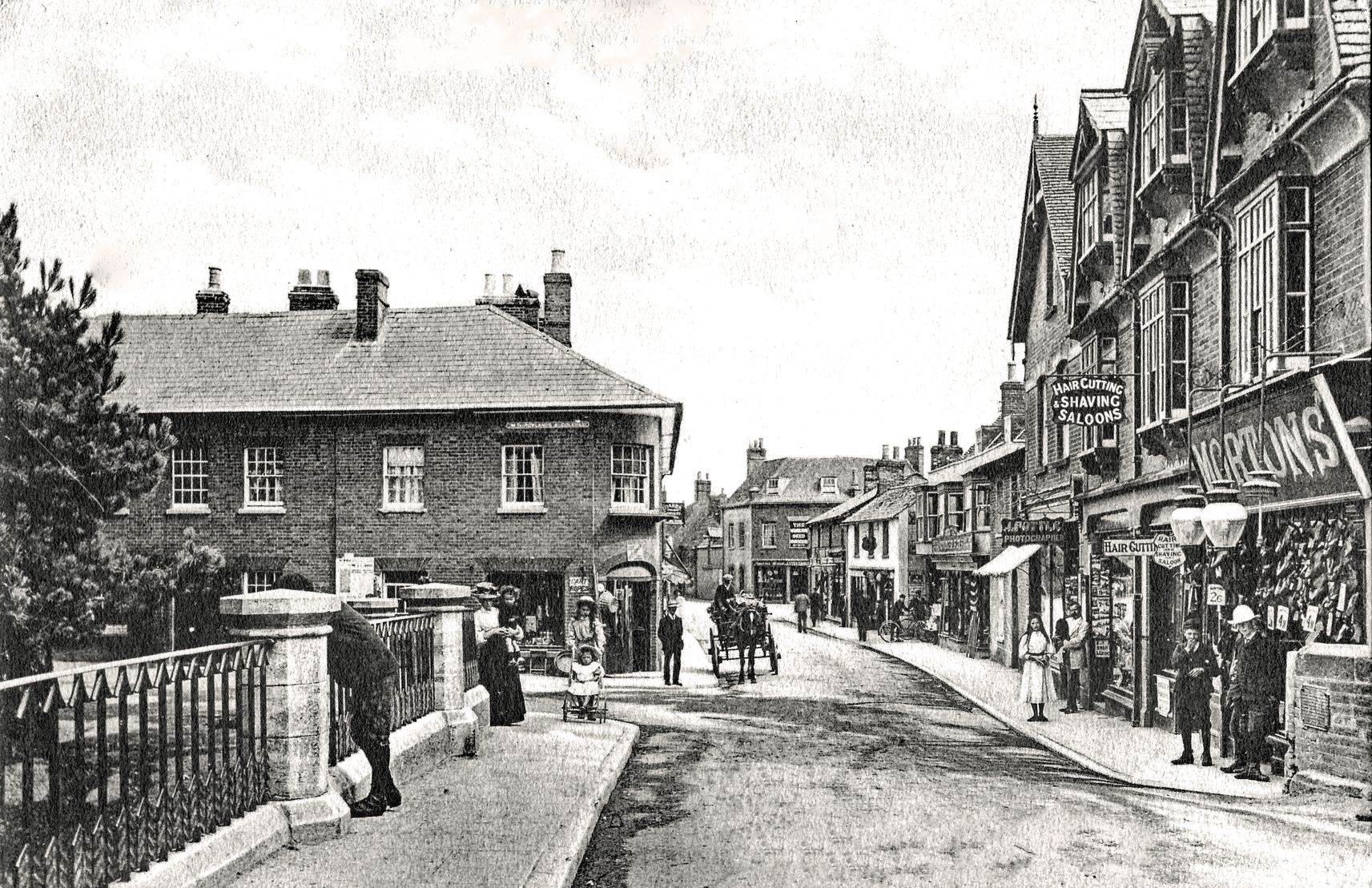
Wimborne railway station staff on the platform, circa 19001908 view of East Street, Wimborne, from Eastbrook Bridge to Poole Corner. On the right is Morton’s shoe shop, King’s hairdresser and Pottle’s photographic studio. Further along is Seward and Co’s ironmongers shop with its three bay windows, which came down for the new Post Office. Job’s daughter Ella is the girl on the right in the white dress.
This portrait of King Edward VII and Queen Alexandra with their favourite dog Caesar comes from a larger group photograph taken by Job Pottle in 1908 at Crichel House. The enterprising photographer published a series of royal portrait postcards from this single visit.
Photographs supplied by Museum of East Dorset. Copies of photos from the museum’s extensive library are available to buy.
If you have any bygone photos, slides, negatives or film relating to East Dorset that you would like to loan for copying, or to donate to the museum archives, they would be delighted to receive them.
Small, consistent habits and a supportive community beat unrealistic resolutions for health and wellbeing every time, says expert Karen Geary
At the end of last year, I joined a challenge at my local gym. The run-up to the festive season can be stressful, as we all know, and the aim was to provide some collaborative support. ‘Buddy benefits’ or ‘buddy systems’ have been widely researched – and it has been clearly demonstrated that working with others can make a material difference to weight and fitness goals. I didn’t know these women before I started, but the inspiration, encouragement and camaraderie from the group (we used an online app) were incredible. Halfway through, I suddenly found myself dealing with some serious family health stress and was unable to do everything I had set myself originally (more on that in a moment), but the team kept me going, with things I was able to do when I could. I soon learned how small things done consistently can make massive differences, rather than aiming for lofty goals – and failing. Which brings us to the New Year. The media world is once again full of the ‘new year, new you’ messages which make me instantly rebel against the very idea of it. Besides, it’s mid-winter, and the body does not wish to be put under undue pressure. This time of year is all about nourishment and self-care.
Small things add up But there are a number of small things that, done consistently, will really have an impact on your health. Let’s start with staying hydrated. One of the things I committed to during the challenge was taking in enough water: my rule-of-thumb calculator was 35ml per kg of body weight, and when I tracked it I was honestly shocked to find I wasn’t drinking enough. Staying hydrated was a game-changer: my skin, health, weight, energy and sleep all improved. I was also less hungry. It’s a boring tip, I know, but – are you sure you’re drinking enough? Next – we don’t need to eat all the time! The UK has a strong snacking culture, but our bodies are not meant to snack. Unless you have a medical condition or are an athlete with very demanding goals, a steady three meals a day is more than enough for most people. Creating consistency with three meals a day and not eating on the run is something most of us can do. I couldn’t always manage it when I was dashing back and forth to the hospital, but I stuck to it when I could, thanks to the team support. Protein and fibre with every meal. Protein and fibre create satiety (feeling ‘full’) – if you have these covered, it’s so much easier not to snack and to stick to your plans.
Here’s a quick starter for ten to get you thinking along the right lines:
Breakfast Ideas:
High-Protein Omelette 2 eggs + 2 egg whites Spinach, tomatoes and a sprinkle of feta cheese Serve with a slice of wholegrain toast
Vegan Overnight Oats: 50g rolled oats soaked in plant milk 1 tbsp chia seeds, 1 scoop plant-based protein powder and a handful of berries Topped with crushed nuts for fibre
Greek Yogurt Bowl: 200g Greek yogurt 1 tbs flaxseeds, a handful of mixed berries or stewed apple (skin on) and 1 tsp honey (optional) Sprinkle with a small handful of oats, sugar-free granola or nuts Lunch Ideas
Chicken and Bean Salad: Grilled chicken breast on a bed of mixed greens Add chickpeas, cherry tomatoes, cucumber and ½ avocado Drizzle with olive oil and lemon
Vegan Lentil and Quinoa Bowl: 100g cooked quinoa mixed with 150g cooked lentils Add roasted vegetables like courgette, peppers and carrots Top with a tahini dressing
Salmon and Broccoli Stir-Fry: 1 salmon fillet stir-fried with broccoli, edamame and mixed peppers Served with brown rice
Home made vegetable soup is always good Remember to add some protein. Try chicken, egg, prawns, tofu or beans Dinner Ideas
Chicken/turkey and Sweet Potato Tray Bake: Lean chicken or turkey breast, roasted with sweet potatoes, Brussels sprouts and red onion Season with herbs, olive oil and garlic
Vegan Chickpea Curry: Chickpeas, tomatoes, spinach, onion, garlic and coconut milk simmered with turmeric, chilli powder and cumin Served with cauliflower rice
Fish & Mixed Vegetable Bake: Baked fish fillet on a bed of asparagus, cherry tomatoes and green beans Drizzle with lemon juice and olive oil
Walking I missed quite a few gym sessions, but I walked around the hospital quite a lot, got outside for some fresh air when it wasn’t raining, and always used the stairs. Walking doesn’t always get the recognition it deserves, but it’s a powerful tool for both physical and mental health.
Be kind to yourself When setting your New Year goals, be kind to yourself. Start with small, sustainable habits and remember that consistency is key. Best of all, try and find a ‘buddy’ so you can cheer each other on. What small change will you focus on this January? Share it with a friend or your own ‘buddy’ to make it stick!
My thanks to the ladies at Lukins Fitness and especially to Rachel Howard for creating such an incredible group.
Peacefully at his home on 31st December 2024, aged 93.
Beloved husband of the late Rachael, much loved Dad, Grandpa, Great Grandpa, Uncle and friend.
Sadly missed by all who knew and loved him.
Private cremation on 28th January. Thanksgiving service on 19th February 12:00 at St Mary the Virgin church, Marston Magna, followed by a reception at the village hall. Family flowers only. Donations in Norman’s memory are being invited either to Asthma & Lung UK or towards a picnic table for the playground at the village hall. Can be sent to Harold F Miles, Funeral Director, Winton Cottage, South Cadbury, Yeovil BA22 7ES – 01963 440367
Sadie Wilkins from Sherborne’s award-winning indie wine merchant has some things to clear up regarding the new duty taxes
As we pop the cork on 2025, we want to take a moment to thank everyone who supported us through a wonderfully merry 2024. We couldn’t have done it without you, and we wish you all a very Happy New Year! As January rolls in, let’s chat about what this month means for us in the wine trade – and for you as consumers. (Dry) January is always a tricky time for the drinks business, but this year brings fresh challenges with the UK government’s tax on duty changes. These changes have been looming, but now they’re here, and they’re going to have an impact on what you pay at the till. The new rules mean wine will now be taxed in different bands depending on its alcohol by volume (ABV). The higher the ABV, the higher the tax. For you, that means you’ll see prices going up on bottles with a higher ABV. It’s important to note that this extra cost isn’t going to the winemaker or to us as retailers – it’s tax. We genuinely feel for wines like ports and sherries, which naturally have higher ABVs and will be penalised.
Sweet enough for you? As alcohol and sugar often balance each other in winemaking, we could also see a rapid trend towards sweeter wines, as producers will inevitably look to avoid those new tax hikes. This won’t help mass-produced supermarket brands like Jam Shed, though, since they’re already sweetened to the max (there’s 57g per litre residual sugar in their Shiraz…). But here’s where we can all make a difference. We’re lucky in the South West – and particularly right here in Sherborne – as the community has always been fantastic at supporting local, independent businesses. This is more important now than ever before. Small, local wine merchants like us have full control over our wine buying, which means we can adapt, flex our range and work closely with winemakers to bring you wines of true quality at an honest price. We source every bottle with care, from grape to glass – much like your local butcher or greengrocer does. We’re all championing quality over quantity. So, while these tax changes may seem like a challenge, with your continued support, we’ll keep bringing you the best wines in 2025 – ones that are worth every penny.
A final toast We’re delighted to be heading into 2025 as Harper’s Wine & Spirits ‘Best Indie Wine Retailer in the Southwest’ and Number 4 nationally (out of over 1,200-ish wine retailers). We love what we do, and we care about finding great wine for all people. If you’re already a fan, thank you. If you’ve never visited, please make 2025 the year you discover your new favourite wine merchant! We’re based in Old Yarn Mills in Sherborne, a buzzy (and boozy…) little artisan quarter of Sherborne, we always have something open to try, and we pride ourselves on quality, price and service. vineyardsofsherborne.co.uk
‘What I picked on the allotment today’ – Barry Cuff is still harvesting through the winter All images: Barry Cuff
At the end of December, Val and I had had our allotment for 36 years. We originally took on 90 square meters back in 1989, increasing this to 270 square meters in 1990 plus a further 60 a few years later – enabling us to be more or less self-sufficient in vegetables and some fruit. In 1989, many of the plots on the site were unused and in a bad condition, with weeds, grass and brambles – and there was no water on the site. As we enter 2025, it thankfully looks very different: there is a waiting list for plots, two sources of water, a discounted seed buying scheme, a yearly manure delivery and also an annual inspection managed by the Allotment Association. December is a quiet month on the plot, so I thought it would be good to look back and review the whole of 2024. It was probably one of our best years for yields and crop quality – with one or two exceptions. There were very few frosts of a damaging nature last year, and we had below average sunshine with well above average rainfall – more than 40 inches.
On the allotment in Sturminster Newton
Beetroot – Successional sowings ensured roots for six months. Broad beans – Good yields from both Masterpiece Green Longpod and Witkiem Manita. Less blackfly than usual. Brussels sprouts (Brendan) – we started harvesting at the end of November, and the nine plants will supply us until the end of February. Cabbage – The last head of the Red Drumhead was cut at the end of November: it stood well, with no caterpillar damage. The Savoy is filling out well for the spring. Calabrese – We have had excellent yields of both Ironman and Atlantis, with good heads followed by side shoots. Cauliflower – We had average curds of both Cheesy and White Step, and we are cutting good heads of Cendis now. Medallion and Snow March should be ready in February and March. No damage this year from Swede Midge.
How d’you like them onions?
Carrot – Once again we only grew Early Nantes and we made about ten sowings over a long period. We’re digging excellent roots now, and we have enough in the ground to last until the beginning of March. Celeriac – This was grown next to the celery and also developed Septoria – the roots were smaller than usual. Celery – Not a good year for our celery – leaves were attacked by Septoria leaf spot, probably helped by high rainfall. Chicory (Witloof) – We had a good yield of roots, which were lifted in November. First chicons harvested on 20th December. Courgette – We had good yields of both Defender and Astia Dwarf French bean – Good yields of Safari and Nautica over a long period. Leek – We are currently lifting as required. This year’s crop are slightly smaller than usual, but we have many left in the ground for 2025. No Leek Moth damage this year! Lettuce – (Little Gem) We’ve had good tight heads from monthly sowings.
Barry started harvesting the Brussels sprouts at the end of November, and the plants will continue to be harvested through to the end of February
Mangetout – We had average yields from both Carouby De Massaune and Purple Magnolia.Onion – Our yields were down compared with the previous year due to White Rot. Those harvested have stored well, however, and they should keep in good condition until March. Parsnip – These are yielding well and we have plenty left in the ground for 2025. Pea – We had very poor establishment down to either seed weevils, mice or birds … but we have ideas for 2025! Potatoes – Probably our best year ever for yields! We lifted before the blight set in, and they are all stored in paper sacks and keeping well. Runner beans – Good yields of both red and white flowered over a long period. Salad crops (autumn/winter) – All looking well on the allotment. During January we will make our first sowing of sweet peppers, and also buy our seed potatoes. Squash – Both Butterfly and Crown Prince gave us good yields and are still keeping well in store. Sweetcorn – (Swift) This is a variety we have grown for many years: we grew about 70 plants this time, and they did well despite the weather.