EB Marsh & Son have very generously offered one lucky BV reader the chance to win a fantastic £400 LG 55″ 4K Ultra HD Smart TV – delivered in time to settle in for all your favourite Christmas films.
The LG 55UA74006LB.AEK is a cracking all-rounder: a big, bright 55-inch screen with true 4K Ultra HD clarity, bringing sharper detail, richer colour and a noticeably more immersive picture. Whether you’re binge-watching a new series or sticking on a family film, the upgraded sharpness and depth make everything look that bit better (you can see it on Marsh’s website here)
It also features LG’s 4K Upscaling, meaning even older or lower-resolution content is intelligently enhanced to look closer to true 4K. The TV runs on LG’s webOS platform – simple, intuitive and packed with the streaming apps most households use daily. From Netflix to iPlayer, everything sits neatly together for quick, easy browsing. You’ll also find FILMMAKER Mode for a more cinematic picture and HDR for improved contrast and realism.
In short: it’s easy to use, great to watch and a serious upgrade to anyone’s living room.
To enter, simply answer the questions in the widget below. It takes moments – and someone will be getting a rather excellent early Christmas present.
Important details:
– Delivery area: The winner’s delivery address must be within 25 miles of either EB Marsh’s Sturminster Newton or Sherborne stores. – Closing date: Midnight on 19th December. – Winner drawn:Saturday 20th December, with details passed straight to EB Marsh & Son to arrange pre-Christmas delivery.
Good luck – and a huge thank you to EB Marsh for such a generous Christmas treat!
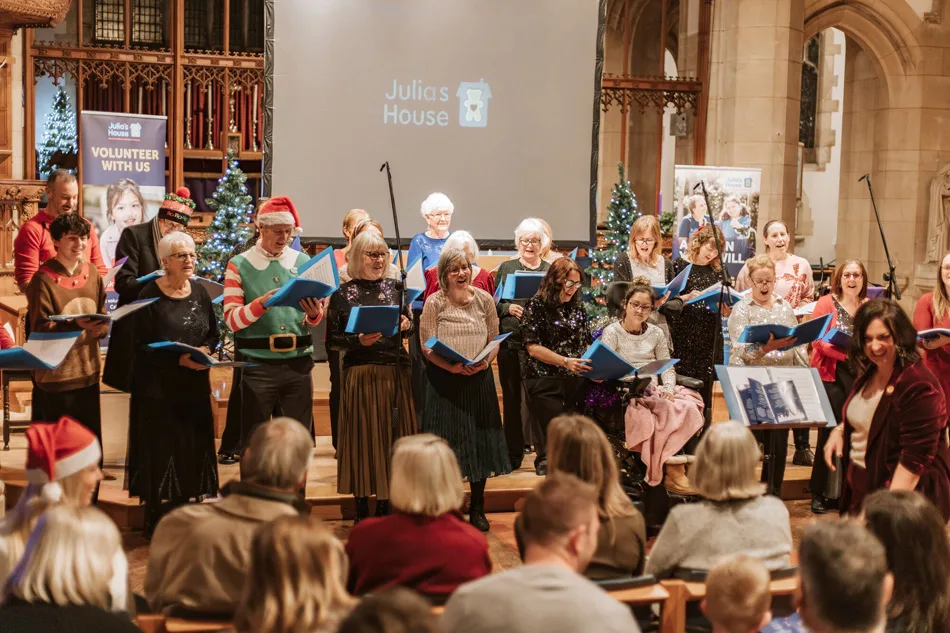
Start your festive season with a heart-warming evening of music and community spirit at the Julia’s House Christmas Carols, held for the first time at All Saints Church, Branksome Park on Tuesday 16th December. The evening promises traditional carols, seasonal readings from Julia’s House families and staff, and a performance by local acoustic singer Shelley Edwards, who will be joined by the Julia’s House Choir.
.Julia’s House provides essential, specialist care for local children with life-limiting and complex conditions, bringing support, compassion and respite to families when they need it most. Care is delivered both in family homes and at their hospices in Corfe Mullen and Devizes – entirely free to families, made possible only through fundraising and donations. ‘We’re so excited to hold our carol concert at All Saints Church for the first time,’ says fundraiser Sarah Agnew. ‘It’s a lovely way to come together with the community, share festive joy, and raise vital funds to support seriously ill children and their families.’ Julia’s House Christmas Carols takes place on Tuesday 16th December, with doors opening at 6.15pm and the concert starting at 7pm. Tickets include mince pies and mulled wine, with all proceeds supporting Julia’s House. Tickets: £10 adults, £5 children, under 5s free. Book now at juliashouse.org/Carols2025
November’s podcast has hidden poverty, climate ambition, a teenage cadet scaling caves – and a parish power shift no one voted for. It’s a deep dive into rural Dorset’s quiet realities – and the people trying to change them. Just hit the play button below.
“It’s not always visible – but that doesn’t mean it isn’t there.”
This month’s podcast starts with Dorset’s hidden poverty – the kind no one likes to talk about, but far too many are living with. Help & Kindness CEO John Sloper explains why it’s everywhere and invisible – and how small, local action makes the biggest difference.
Then it’s on to the climate. Don’t switch off – this isn’t doom and gloom. Dorset COP organiser Giles Watts explains how we make climate ambition actually work in a rural county, and why language matters more than you think.
And if you’ve been wondering what “devolution” really means for Dorset’s towns and villages? The Dorset Insider has some strong views, a few sharp one-liners, and one big question: is this local empowerment, or just shifting blame?
Finally, we meet Wimborne cadet Charlotte Bedford – caver, climber, award-winner, and proud recipient of the UK’s top cadet honour. She’s brilliant. Don’t miss her.
Pop it on. It’s full of courage, climate, community and a healthy dose of quiet outrage.
This episode is based on stories from November’s BV. Read the issue here: https://bvmag.co.uk/Nov25 News, people, politics and rural Dorset life – every month, always free.
The BV – named Best Regional Publication in the UK (ACE Awards) and Regional News Site of the Year (Press Gazette). Always worth your ears.
Set within one of Dorset’s most breathtaking school environments, Holroyd Howe is looking for enthusiastic and talented individuals to join our dedicated catering team at Milton Abbey School. We are now hiring for Chefs of all levels, Front of House Supervisors, and General Assistants to support our vibrant, welcoming dining experience for pupils, staff, and visiting guests.
As part of the Holroyd Howe family — one of the UK’s leading independent foodservice providers, you’ll be working in a kitchen that champions fresh, seasonal ingredients, creativity, and genuine hospitality. This is a fantastic opportunity for anyone wanting to build their career in a supportive, food-led environment.
What We Can Offer You:
• A great work–life balance
• 5 over 7 working pattern
• Daytime shifts
• Free meals while on duty
• A friendly, forward-thinking team culture
• The chance to be part of something truly special in an inspiring school setting
If you’re passionate about food, people, and delivering an exceptional service, we’d love to hear from you. To apply, please send your CV to: Tim Flageul – [email protected] If you don’t have a CV that’s not a problem, you are welcome to send Tim an introductory email. He’d love to hear from you!
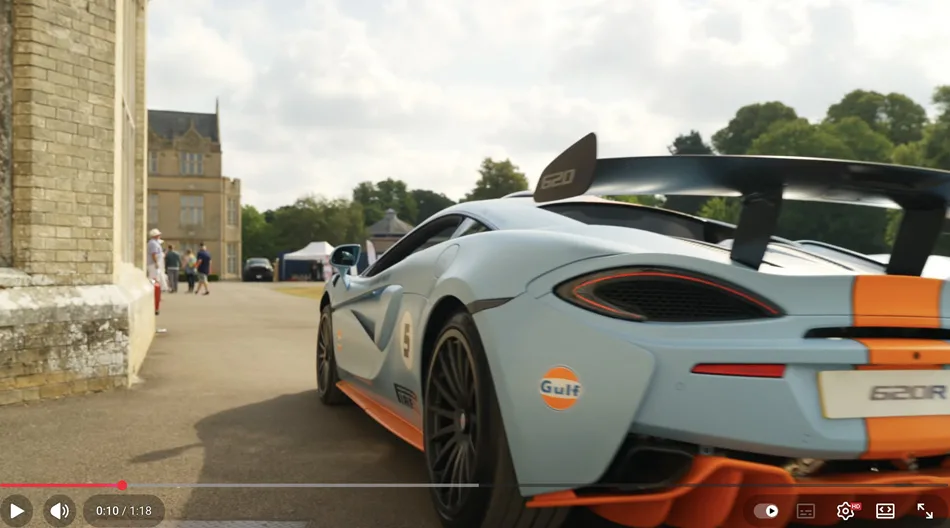
he organisers of Canford Classic & Supercar Sunday are already gearing up for 2026 – still buoyed by the overwhelming success of this year’s move to Canford School. The event, which has rapidly become Dorset’s fastest-growing automotive showcase, drew more than 5,000 visitors and featured over 700 cars in August – from rare classics to cutting-edge hypercars. The school’s sweeping parkland provided a suitably dramatic backdrop for what many are already calling the county’s most exciting motoring day out.
Screenshot
Among the standout stars were two Ferrari F40s – one earning the People’s Choice Award after its generous owner allowed children (and a few parents) to climb inside the £2 million icon. The Aston Martin Valour and Valhalla made memorable appearances, alongside the ultra-rare Koenigsegg CCX, which proved a crowd magnet from start to finish. Bonhams Cars added extra glamour, displaying models worthy of any concours lawn, including the exquisite Aston Martin DB4 GT Zagato. Event director Zander Miller, of Aperta Events, said: ‘The success of this year’s event at Canford was beyond anything we expected. To see so many incredible cars and passionate people come together in such a setting was a proud moment. We can’t wait to build on it for 2026.’ The next Canford Classic & Supercar Sunday returns on 23rd August 2026, with early-bird tickets and updates coming soon at apertaevents.com Whether you’re a petrolhead, a photographer, or simply love the spectacle of beautiful engineering, this is one date already revving loudly on Dorset’s event calendar.
With meticulous patience and a deep love of nature, Pauleen Trim’s delicate work has twice won the RHS’s highest honour for botanical art
Pauleen Trim
Pauleen Trim grew up surrounded by wildflowers, plants and trees in Winterborne Whitechurch, one of the villages that follow the meandering winter bourne (stream) south from Blandford. She still lives in the village, with her husband Jim, surrounded by friends, family – and that beautiful landscape of fields, hedges, trees and gentle hills. She always loved painting and drawing, but it was only when she retired, after many years teaching a wide range of art courses, that she really fell in love with nature. That love, and her remarkable talent as an artist, which earned her membership of the exclusive Society of Botanical Artists, have together brought her not one but two coveted RHS (Royal Horticultural Society) gold medals at the prestigious RHS botanical art exhibition. In 2021, one of her suite of gold-medal-winning illustrations of six trees was chosen as Best in Show. This year, she again won gold with another tree series, in the RHS show at the Saatchi gallery.
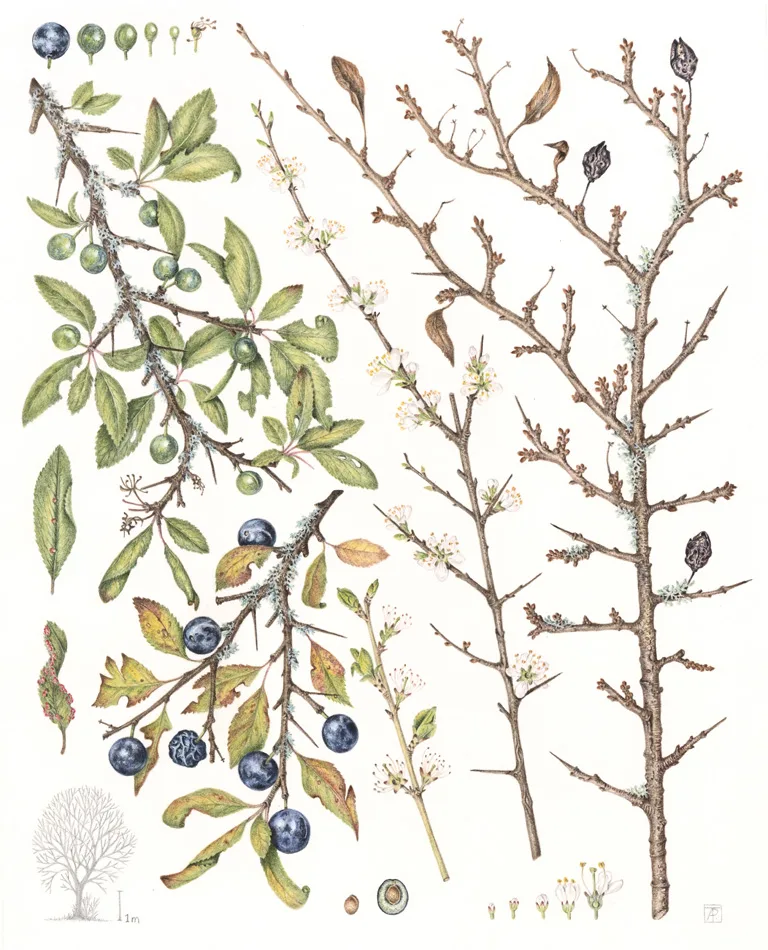
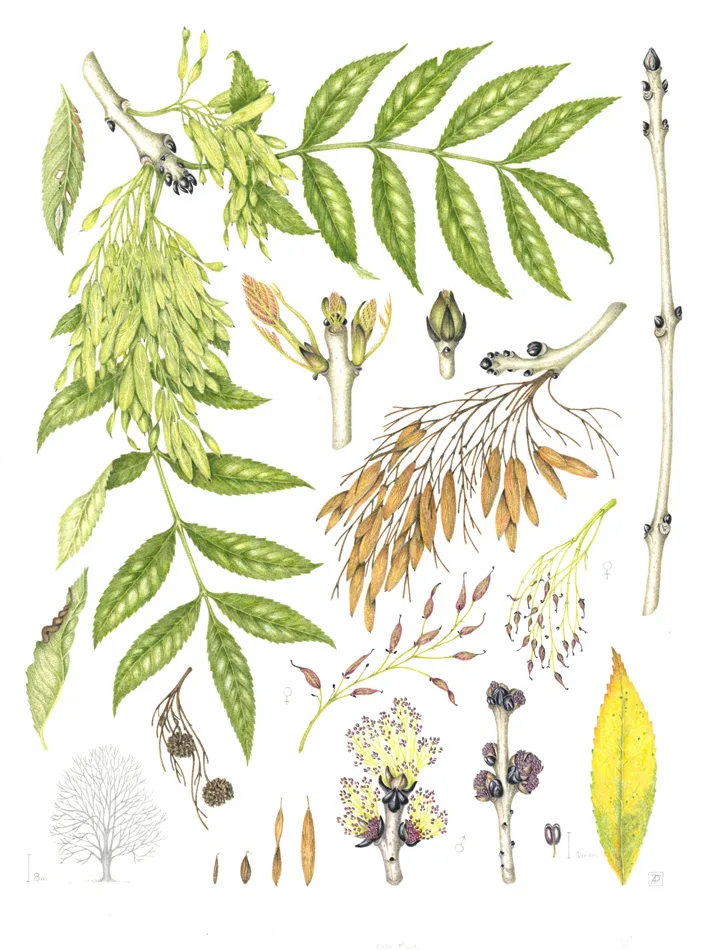
Prunus spinosa – one of Pauleen Trim’s Six Native Deciduous Trees and Their Galls series, which was awarded gold at the prestigious RHS botanical art exhibition
From childhood, Pauleen (the unusual spelling was a mistake when her birth was registered!) knew she was keen on art – at one point she imagined a career in fashion design. She was offered a place at a leading London art school but didn’t take it up and instead went to work for the then Dorset County Council. She took an ONC in public administration, and went on to marry Jim and have two children. Her father, Robert Maidment, was a well-known local builder who built his own home, and Pauleen and Jim’s. She carried on painting and joined the Blandford Art Society, where she was one of a small group taking a diploma in fine art. Towards the end of this course she was asked if she would consider teaching, and after taking an Adult Education course at Ferndown she stepped in to run a leisure painters’ course at Bovington. She moved on to a temporary post at Bournemouth and Poole college at the Lansdowne, where she taught art to students on other courses (including floristry and hairdressing). It became a permanent job, and for 25 years she taught art, eventually specialising in theatre make-up and costume design. Throughout her life, Pauleen has continued to learn – while working at the college, she took a City & Guilds course in textiles and is one of a small group who have just visited Transylvania to learn about and paint the uniquely unspoiled plants, flowers and trees of this region, where farming follows a pre-chemical agricultural cycle. She is also an accomplished miniaturist, and has been a member of the Hilliard Society of Miniature Art for about 30 years.
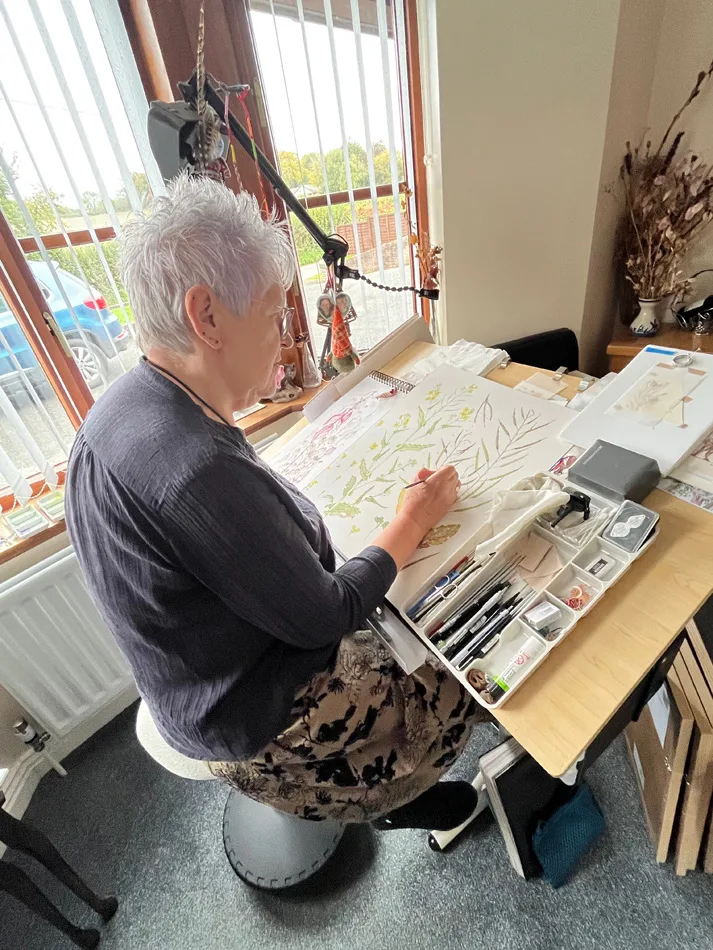
A rigorous process The art of botanical illustration demands exceptional precision and attention to detail. Every element, from the shape of a petal to the texture of the bark, must be captured with lifelike accuracy. Botanical artists must be skilled in traditional painting techniques and have a deep understanding of the plant’s structure and growth. The process is time-consuming and meticulous, with work usually created at life size to showcase the true characteristics of the subject. For artists like Pauleen, the journey from sketch to finished piece involves not only artistic talent but also a thorough knowledge of botany and the natural world. After she retired 12 years ago she found some paintings of flowers and plants that she had done in the 1970s and 80s and they reignited her interest. She took a course in botanical illustration at Kingston Maurward College. ‘I just thought “Wow!” I fell in love with looking at nature,’ she says. She joined the South West Society of Botanical Artists, went on to do a diploma in the medium, and was advised by a teacher to start exhibiting. She submitted some work to the Society of Botanical Artists and was accepted as a member in 2018 after having five works accepted in two consecutive years. It has now changed a bit, but is still a complicated and demanding procedure – the current system is to submit a set number of paintings which go before a panel, whose members decide if the artist is to be offered SBA Fellowship status. There is a similarly rigorous process for the annual RHS exhibition. The artist must submit four paintings (professional quality life-size prints) which go before a selection panel.
If the work is deemed to be silver standard (or above) you have five years to develop an exhibit comprising six pieces of botanical illustration on a coherent plant theme. Once they are completed, you apply for space to exhibit in the RHS annual art show. The paintings are taken to the Saatchi Gallery and framed. When hung, they are judged by an RHS panel and the awards are given. The level of award is based on all six paintings, so to attain a gold medal, all six have to be of gold standard. If one is not, the whole exhibit award is based on the lowest standard painting. In 2021, Pauleen submitted six tree paintings including the ash illustration – all six were awarded gold, and the ash was chosen as Best in Show. This year’s six, exhibited at the Saatchi Gallery, were also trees, and once again all won gold. For future SBA/RHS exhibitions Pauleen aims to show other botanical paintings.
Fraxinus excelsior – ASH. In 2021, all six of Pauleen’s paintings were awarded gold, and ASH was chosen as Best in Show
Pauleen is on Instagram @pauleentrim8 – where she shares much of her work.
“If I should die, think only this of me: That there’s some corner of a foreign field That is for ever England.” More than 4,500 men from Dorset never came back home to our county after WWI: more than 16,000 came home, but with life-changing injuries. From the Dorsetshire Regiment, 350 men died in one day during the Battle of the Somme. Private Harold Mead from the Dorsetshire Regiment was just 16 years old when he was killed in Belgium on 13th November 1914, having enlisted underage. Those men left the rural idyll of our county to be met with the horrors of trench warfare, the devastating effects of modern heavy artillery and the widespread use of chemical weapons. It is hard to comprehend what impact that must have had on them, both during and after the conflict. The toll placed on their families, not knowing from day to day if their sons, fathers and husbands were still alive or not, must also have been unbearable. In total, Dorset lost more than 5,000 men and many hundreds of civilians during the two great wars. The county experienced significant damage to the towns of Bournemouth, Poole, Weymouth and the Isle of Portland, which were heavily targeted in bombing raids by the Luftwaffe. The men who left our county were, in the main, not experienced, trained soldiers: they were ordinary civilians, young men at the start of their lives, many still only teenagers. They left our county and country without hesitation, in the belief they were fighting for something larger than themselves – a nation, a home. The brutal contrast that these men would have experienced between our then-quiet rural county and the harrowing realities of modern war, particularly that of the Western Front during WWI, is all but impossible to imagine. We must never forget what that generation gave, and I believe we have a deep obligation to continually question how we have honoured the sacrifice of so many. Have we earned what they gave us? Have we preserved the country for which those men and women were prepared to give their lives? Have we honoured the lives of young men like Private Harold Mead, by ensuring the country we pass to our children is better than the one we inherited? Our forebearers quite literally gave their today for our tomorrow. We owe it to them to fix broken Britain and create a better country for future generations – as they did, with great consequence, for us. To all those who have served our country, we owe you a debt that can never be repaid. Thomas Gargrave Reform UK Dorset
There’s a strong movement happening across the country right now – people are coming together to fight back and protect our food and farming industry. Our farmers aren’t the bad guys. In fact, it’s been really encouraging to see more supermarkets here in Britain finally recognising the importance of supporting British food and getting more of it onto their shelves. 2025 has been a full-on year for us – supporting our Love Local, Trust Local members and continuing our fight for better food labelling. One of the highlights has to be Open Farm Sunday. It was such a brilliant day and I still feel incredibly proud thinking about how many people came out to visit us at the farm. It really means a lot.
Another special moment this year was being invited to sit on the panel at the Bridport Food Festival, and working alongside Claire King from The NAT (National Advisory Team). It made me realise more than ever how important it is for farmers to have a voice – to speak up and tell our side of the story. So many people don’t realise how tough it is to produce food in a way that’s both economical and sustainable. We’re at the mercy of global markets, and unlike most countries, we’re one of the few where the prices we get are governed so heavily by supermarkets and world trade. That’s not fair. Farmers don’t waste food – far from it. But a lot of what happens is out of our control. We need more understanding, more support and better systems in place. Education is a big part of this too. We’ve got to make sure our children are getting the nourishment they need – and that starts with food education and proper meals at home. Looking ahead to 2026, we’re really excited to be launching our new awards. Entries will open early in 2026 – so keep an eye out for that! Most of all, we need to reconnect: with our food, with our farmers and with the beautiful rural landscapes that surround us. They’re not just nice to look at – they’re essential to how we live, eat and thrive. By Barbara Cossins, Love Local Trust Local
Autumn’s been kind at Rawston Farm, says James Cossins, who’s balancing good crops, community harvests and climate conversations
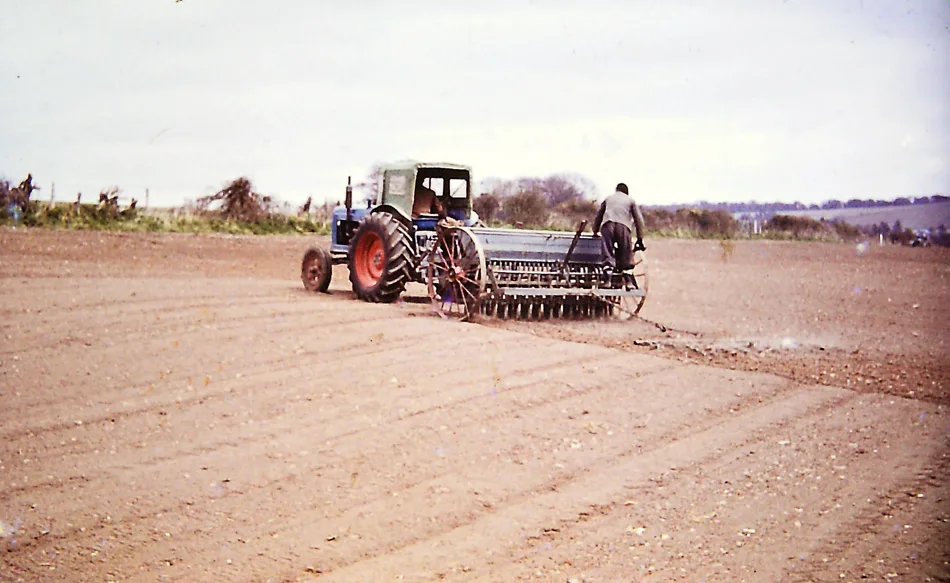
Sowing wheat on Rawston Farm in 1968 All images: James Cossins
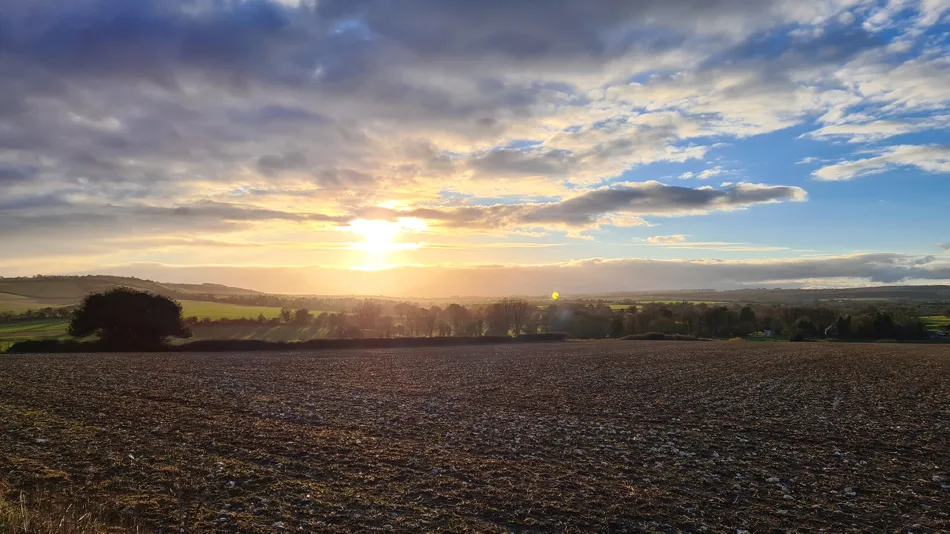
The autumn has been relatively kind to us at Rawston Farm, with autumn sowing of crops such as wheat, barley, oil seed rape and grass all now completed in record time. Thanks to the mild weather and warm soils they have all germinated very quickly too, and are now a lush green. We have had few slug issues so far this autumn, but aphids are now the main concern. These tiny insects can transmit barley yellow dwarf virus, which can cause significant crop losses if infected aphids pass the virus to young plants. Later drilling can help reduce the risk, as it narrows the window in which crops are vulnerable – though in some cases, an insecticide may be necessary as a last resort. We’re keeping a close eye on our cereal crops and monitoring carefully for any signs of aphid activity. Our milking cows are now housed at night and just go out for a few hours in the day, depending on the weather. Thankfully we have had a good autumn for grass growth, after the long drought of the spring and summer. That has allowed us to keep cattle out for longer than usual, letting them graze off the surplus grass. In turn, this is helping us preserve valuable forage stocks for the winter.
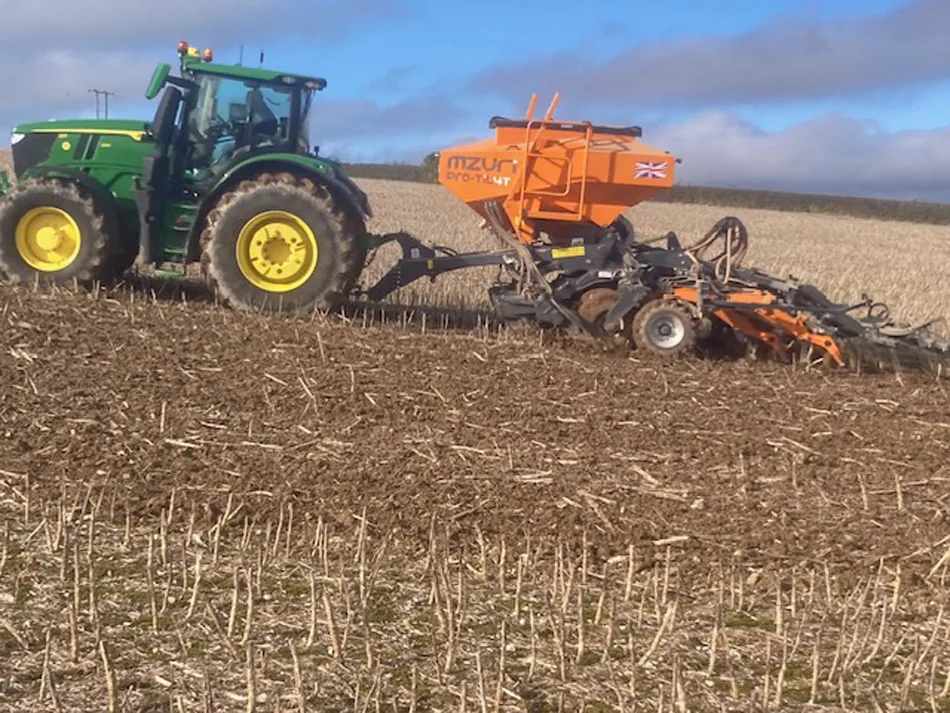
The same job in 2025, 57 years later
That time of year It is harvest festival season once again, and it has been great to see good turnouts for both harvest suppers and church services. I was asked at a recent village harvest supper what the church could do to support farmers. I replied that continuing the harvest thanksgiving services in villages, towns and cities was a great way of reminding everyone where their food comes from – and that, in spite of the dry summer, crops such as apples seem to be in abundance. I was invited to the Blandford Young Farmers’ harvest supper, where the club took time to thank everyone who had supported them over the past year. It was a fantastic evening, with the young members working together to provide our supper. During the event, the group presented a cheque to this year’s chosen charity – Teddy Rocks – from their fundraising efforts. Young Farmers Clubs are always on the lookout for new members. Anyone under 26 is welcome to join – you don’t need to be from a farming background, just keen to meet like-minded young people. There are six clubs across Dorset – you can find your nearest on dorsetyfc.org.uk.
Autumn drilling at Rawston Farm in the 1960s
Dorset COP On 1st November I attended the Dorset COP25 conference at the Exchange in Sturminster Newton. COP – the Conference Of the Parties – is essentially focused on climate change and the many debates that surround it. More than 300 delegates attended, and it was encouraging to see so many like-minded people gathered to hear from a range of speakers covering different aspects and effects of climate change. My own particular interest lay in the discussions around sustainable food production, and in the work happening here in Dorset to restore our harbours and rivers. There was considerable debate about food. One of the key conclusions was the need for better education – we all need a clearer understanding of how to feed ourselves a healthy, nutritious diet, using locally-grown food where possible. Schools would be a good place to start, teaching children about where food comes from and how to eat well. The expansion of allotments, giving more people the chance to grow their own food and encouraging communities to come together to support one another, was also discussed. Where food is short, help can be offered; where food is abundant, it can be shared. We were shown an excellent example of this in practice at the Vale Family Hub. Rivers are an important part of the Dorset landscape, and there were encouraging updates on restoration projects already underway. These involve volunteers working alongside organisations and landowners to improve and protect our watercourses (see the DWT’s article this month) We also heard about active steps being taken to improve the condition of our harbours. I’m sure there’ll be more on the Dorset COP elsewhere in this month’s BV, but these are just my own reflections on what was a really interesting day. Plenty of questions remain, but one thing is clear – it’s vital we keep the conversation going. Back to reality this month – we are TB testing again. Please keep your fingers crossed!