The Music & Drama Group’s Youth Theatre has rounded off a highly successful run of Annie Jr. at Shaftesbury Arts Centre, drawing almost full houses across four performances and showcasing the strength of young local talent. Staged from 21st–23rd November, the production sold 97 percent of available tickets and drew warm praise from audiences throughout the weekend.
A cast of 45 performers aged seven to 17 led the show, presenting a lively, modern interpretation of the much-loved musical. The creative team incorporated street dance elements and Stomp-inspired percussion alongside the traditional score, giving the production a contemporary edge while retaining the spirit of the original. Audience members commented on the cast’s confidence and precision, as well as the choreography and musical delivery that underpinned the performance. Several musical numbers proved particular highlights. ‘It’s a Hard-Knock Life’ opened with strong ensemble energy, while ‘Tomorrow’ provided a memorable centrepiece and featured a real-life Sandy on stage. The combination of vocal strength and disciplined movement brought repeated applause, including standing ovations across the run.
Quite an experience The atmosphere at the Arts Centre over the three days reflected strong community interest in youth theatre. Families and regular theatre-goers filled the auditorium, with the weekend matinees especially well attended. For many younger children in the audience, it was their first experience of live performance, adding to the sense of occasion around the production. Director Daniel Cullen said: ‘We couldn’t be prouder of this cast. They’ve worked incredibly hard, supported each other every step of the way, and delivered a show that truly exceeded expectations. To perform to such full, enthusiastic audiences has been a wonderful experience for them all. This was my first time directing a show and it has been a joyous and fulfilling experience.’ The production continues the Youth Theatre’s commitment to offering structured, high-quality performance opportunities for young people, while providing the wider community with accessible, family-friendly theatre. Many of the cast will now turn their attention to the Arts Centre’s forthcoming pantomime, Alice in Wonderland, which opens on Thursday 22nd January for a two-week run.
Sturminster Newton Community Leisure Centre, better known as Sturfit, is excited to unveil the latest addition to its community wellbeing offering – a brand new infrared sauna, now available. Until now, local people have struggled to find any sauna availability without travelling 40 minutes or so. But after listening to feedback from both regular users and the wider community, Sturfit is proud to bring this much-requested facility right to the heart of Sturminster Newton.
Relax, recover and reconnect Sturfit Sauna
What is an infrared sauna? Unlike traditional saunas that heat the air around you, infrared saunas use radiant heat that warms the body directly. This makes them more energy-efficient, more environmentally friendly, and easier to maintain, while still delivering all the classic benefits of a sauna.
Why try it? Infrared saunas are known to support a range of health and wellness benefits, including: Easing joint pain and stiffness Reducing stress and fatigue Supporting cardiovascular health Improving circulation and skin health Aiding muscle recovery Promoting better sleep It’s also a great social option – book with friends and catch up while you relax.
Take your seats The sauna seats up to four people and can be booked at £5 per person for a 30-minute session. Want the space to yourself or to share privately? Simply book the full session for £20 and divide it between your group. It’s recommended to begin with shorter sessions (10–15 minutes) and build up as you get used to it. As with all Sturfit facilities, there’s no need for gym membership, just register your details on the booking system. Contact [email protected] or 01258 471774 to book a sauna session
The Countryside Regeneration Trust (CRT) has launched its 2025 Christmas Appeal – and this year, it’s all about helping one of Britain’s most vulnerable – and adorable – native mammals: the hazel dormouse. The Shelter Belts for Hazel Dormice appeal aims to raise £6,000 to fund vital habitat restoration and install dormouse footprint monitoring tunnels across six CRT farms, including two in Dorset. Once widespread across England and Wales, hazel dormice have seen a steep decline. According to the National Dormouse Monitoring Programme, populations have dropped by 70% since 2000, and the species is now extinct in 14 counties where it once thrived. Officially classed as ‘vulnerable’ to extinction, recent research suggests dormice should be upgraded to ‘endangered’. ‘Hazel dormice are a powerful bioindicator,’ explains Ruth Moss, the CRT’s conservation and mapping officer. ‘They are sensitive to habitat fragmentation, so when they’re present, it means the surrounding area is supporting a wide range of other sensitive species too – bats, butterflies, amphibians and birds. Protecting dormice helps protect them all.’
Hazel dormice are the only small British mammal with a furry tail. They are active from late spring to early autumn in the trees and shrubs canopy, hibernating in nests on the ground over winter
Where funds will go Across the six farms, 250 footprint tunnels will be installed to monitor dormouse presence without disturbing their habitat. Footprint tunnels are a non-invasive way to detect dormouse activity. As they pass through the tunnel, they leave behind their tiny, distinctive prints, which can then be monitored. How will they know the footprints are dormice? Hazel dormouse footprints are unique: small, about 1cm wide, with a rounded shape and distinctive triangular pads on their feet. The toe pads look similar to the pieces of pie in the Trivial Pursuit game. Footprints of wood mice and yellow-necked mice are made up of little spots rather than triangles. Crucially, these surveys don’t require a dormouse licence and can be conducted at scale. ‘We need to raise £1,250 to do this. The rest of the money from our £6,000 appeal will go towards creating a shelter belt at Turnastone Court Farm in Herefordshire to form a woodland corridor habitat for dormice to move between woodland patches. We know they are present in some areas of the farm and want to help them connect to other areas. ‘This is a wonderful opportunity to give something meaningful this Christmas,’ says Ruth. ‘A £5 donation buys a footprint tunnel. Larger donations help create connected habitats, which benefit not only dormice, but also birds, hedgehogs, bats – even the farm’s livestock.’ The farms benefiting from the appeal include Babers Farm and Bere Marsh Farm in Dorset. There are several ways to support the appeal: Donate directly online Buy the CRT’s 2026 wall calendar Gift a CRT Friendship to someone special Every donation helps reconnect woodlands, restore wildlife habitats, and protect the hazel dormouse – along with the many other species that rely on the same precious countryside. thecrt.co.uk
As the nights draw in and we all hunker down, one charity quietly carries on. Read Easy – one of Britain’s leading adult literacy charities – never stops. Jonathan Douglas, CEO of the National Literacy Trust, recently said: ‘Never have charities like Read Easy been needed more.’ He’s not wrong. For decades, successive governments have known that poor literacy carries a high price. The Adult Literacy Trust now estimates it costs the UK economy more than £40 billion every year. A third of businesses say school-leavers’ literacy is not up to scratch – and poor reading skills are affecting productivity. The numbers speak for themselves. According to the National Literacy Trust (2024), one in six adults in England – that’s 18 per cent – struggle to read. And it’s not just about confidence. Pro Bono Economics research shows that 4 million adults could earn up to £1,500 more each year if they improved their reading skills.
Poor literacy means fewer opportunities. Adults who struggle to read are five times more likely to be unemployed, and four times more likely to remain long-term unemployed. If they are in work, it’s often in low-paid, low-skill jobs. That impacts not just the individual, but society – with higher welfare costs, reduced spending power, and fewer people able to respond to change or innovation at work. Employers report more errors, difficulty interpreting written instructions, and costly in-house training. Yet many still don’t know that Read Easy exists.
Help us find them Read Easy has been providing free, confidential, one-to-one reading coaching for more than 15 years. There are nearly 90 groups across England, including four in Dorset: Blackmore Vale North, South Dorset, Bridport and Poole & Bournemouth. They welcome any adult who wants to learn – no matter their background, no matter how long ago school was. The team knows how daunting that first step is, and they do everything they possibly can to make it easy. ‘Please help us find these folk,’ asks Lydia Everitt of the Blackmore Vale North group. ‘Give them our phone number or refer them to us with a phone call. Tell them we’ll call them if they prefer. ‘The bravery of that first step is always remarkable, and we commend them all. If you know someone who finds reading really hard, someone who never quite ’got it’ at school, help them to come to us and we can help. Our number is 07748 981935.’ And she says if you want to help, now’s the time. All four Dorset groups need volunteers – especially to help with publicity and social media.
A critically acclaimed young pianist, Reed Tetzloff, will give an afternoon recital, The Romantic Piano, at St John’s Church, Tisbury, on Saturday 13th December at 3.30pm. The concert is raising funds for the church. Tetzloff came to international attention ten years ago at the XV Tchaikovsky Competition, where he was dubbed ‘the lyric hero of the competition.’ He is a regular performer at large venues around the world – the Tisbury concert will be a rather more intimate affair, and an opportunity for local music-lovers to enjoy South Bank quality piano playing and to meet and chat with the soloist.
Star pianist Reed Tetzloff coming to Tisbury
Reed Tetzloff, described by fellow pianist Richard Goode as ‘a musician of great authority,’ was praised by one reviewer for his ‘richly communicative’ performances, and has been delighting audiences worldwide since making his Lincoln Center (New York) concerto debut in 2012. He has appeared in major European venues, including the Berlin Philharmonie, the Allerheiligen Hofkirche at the Munich Residenz, Prague’s Rudolfinum, the Great Hall of the Moscow Conservatory, Place Flagey in Brussels, the Théâtre d’Angoulême, and De Singel in Antwerp. His solo recitals in the United States have been heard from coast to coast. He has performed at many music festivals and in major venues in China and South Korea, and has collaborated as a chamber musician with many ensembles. His list of recordings is already impressive, including the start of a complete Beethoven concerto cycle, which is due to be issued as a box set before the Beethoven anniversary in 2027. In December 2025, his recording of the Schumann and Grieg piano concertos with the Luxembourg Philharmonic Orchestra, conducted by Sir John Eliot Gardiner, will be released. Born in Minneapolis, Reed Tetzloff studied there with Dr Paul Wirth and went on to take bachelor’s and master’s degrees in New York. He has won prizes in several international piano competitions. There is no advance booking for the Tisbury concert – tickets £15 on the door.
With a third of Dorset residents now over 65, Jon Sloper argues ageing well is about connection, confidence and everyday kindnesses
There is an increasing focus on age in Dorset. Manchester’s average age is 31: Dorset’s is 51. Almost a third (30%) of our county’s residents are older than 65. I think it gives Dorset a unique opportunity to to lead the way in showing how communities can age well – together As we age, our needs change: the balance of our dependence on each other shifts. The years pass, and some things take more effort and we lean on others a little more. Instead of being the provider of support for others, we are increasingly in need of their support. Sometimes these are transitory changes, others are long-term.
One blunt and rather tired old story is that we become increasingly dependent as we age. Words like ‘frail’ and ‘elderly’ carry cultural connotations of weakness, deficit and incapacity. I don’t think this helps – and I don’t think it is true. At Help and Kindness, I work with people of all ages, including those in their 80s and 90s, and words like weakness and deficit are the last I would use to describe them. They are as bold, fearless, compassionate, self-reliant, kind, engaged and energetic as anyone I’ve met – of any age. They live an interdependence that is as vibrant and fulfilling as anyone could imagine. I ask them about it often: ‘What has made you who you are now?’ The answers are very human and ordinary: ‘I came from a large family, we had to learn to look after one another from a very young age.’ People often say that their values came from a grandparent or other significant adult who inspired them to look outwards, to serve others, when they were younger, and these values have lasted a lifetime. They are honest about how life changes, and the need to be happy to receive, as well as give, support while not giving up on things. Stoicism and gratitude feature highly. They are adults – grounded, wise and quietly practical. Being involved with other people is always mentioned: people from other walks of life and age groups. In their stories they also talk about little (and larger) things that make a difference. Some talk about the importance of their family, others talk about healthcare they’ve received, some reflect on their faith, others mention the home or community they live in. There are also things that help – from apps that make things easier to gadgets that help with hearing or mobility.
A stitch in time The people that I’ve spoken to don’t need to be wrapped in cotton wool, ‘put out to pasture’, or shut away from society. There is often a list of small things that they need in their lives that make a big difference – a bench half-way to the shops where you can stop to catch your breath. Accessible, clean and safe public toilets. Being able to pick up a neighbour to go into town together. Having large print instructions for things. Someone to sit with the person you care for so you can get to an appointment. Someone stopping to say hello. A phone line to call, or person to speak to, for advice, rather than being expected to find things online. They talk about needing things for a little while, not forever, and things that are a ‘stitch in time’ to help them get back on their feet. These relatively little things benefit us all and make a huge difference to everyone who finds things difficult from time to time. Whether our needs are associated with age, illness, mental health difficulties, disabilities or other challenges in life, it is the little things which can powerfully change our lives for the better. When we think about ageing, I think we uncover so many issues that affect us all – along with opportunities that can help us all. That park bench is a great place to socialise. That large print leaflet helps any of us with sight issues. Those ‘good toilets’ are essential to help many people feel confident about visiting places away from home. That phone line or the local library can be used by anyone who isn’t either confident or able to get online. We can see that interdependence is key. Need and support are not one-way streets. The older people I speak to are also providing support themselves, and are much needed by others – as much, if not more, than the support they receive. We recognised this when we set up Help and Kindness. Our strapline ‘Find help – give help – work together’ expresses this approach. With so many of us living longer, Dorset has a chance to show what ageing well really looks like – communities that look out for one another, small acts of kindness that keep us connected … and a shared understanding that we all need a little help sometimes. helpandkindness.co.uk
Everyone knows booksellers make the BEST book suggestions – so we asked our local indies what they thought was gift-worthy this year
Who better to help you pick a brilliant book than someone who lives and breathes them? Dorset’s independent bookshops are treasure troves, run by people who love nothing more than matching the right story to the right reader. We’re lucky to have a clutch of excellent indie bookshops in the county, each one full of passion, personality and proper recommendations – no algorithms required.
We asked five of them – from Shaftesbury to Sherborne to Wimborne – to choose a title they’d personally recommend for a gift this Christmas. Whether you’re shopping for a curious child, a history buff, a fiction fiend or just a really hard-to-buy-for uncle, there’s something in here for everyone.
And it’s a truth universally acknowledged that a person in possession of a free hour must be in want of a bookshop … but if you really can’t get there in person, many of these shops have websites, and are also part of Bookshop.org – the online store that supports local bookshops with every order.
It’s an easy way to shop online but remain secure in the knowledge that your money’s in the hands of real local booksellers, not billionaires.
Suggested by Amber: A special edition of this book has been released for indie bookshops, and has been one of the most talked about books this year. Raising Hare charts Chloe as she finds and cares for a leveret. Along the way she discovers more about hares, their role in folklore, and what special animals they are.
What We Can Know by Ian McEwan
Suggested by Karen: Described as A literary thriller and a love story, What We Can Know spans the past, present and future to ask some profound questions. It tells of a time where rising tides have reduced England to a series of archipelagos, while historians search for a poem created and read 100 years prior, and thought lost to history. (FOLDE has some signed indie edition copies)
Suggested by Wayne: Britain is lurching towards WW1 and the Prime Minister is distracted by an affair with a 26-year-old aristocrat with whom he shares national intelligence. Based on historical fact and the Prime Minister’s letters this is an immaculately researched novel about an event that changed political history.
The Hazelbourne Ladies Motorcycle and Flying Club by Helen Simonson
Suggested by Hazel: This is a lovely novel that takes you by surprise as characters develop and the history kicks in. With a real Sunday night drama feel about it we get into the difficulties of life after the First World War ends: life isn’t necessarily automatically better for everyone. It’s witty, moving … and you may feel the need to get on a vintage motorbike!
Suggested by Claire: This is a not-so-well-known children’s classic – Kathleen Hale started writing the series of Orlando the Marmalade Cat stories in 1938. Apart from the charming storylines, her books are renowned for her bright and colourful lithographs. A great gift for all ages!
Suggested by Victoria: I’m in exalted company – in 1977 the TLS asked celebrated writers to name their most under-rated author, and both Philip Larkin and Lord David Cecil chose a 63-year-old spinster living in an Oxford village, leading to Barnara Pym’s rediscovery more than 20 years after her first published novel. Each of her nine books is a perfect blend of wit, gentle humour and bittersweet insight.
Pym does resonate more readily with women readers, so to redress the balance: Dear Lupin, Letters to a Wayward Son, by Roger and Charlie Mortimer. Sharing with Pym an affectionate portrait of a time gone by, it’s a hilarious but moving delight.
Suggested by Sarah: This has been my absolute standout favourite in the culinary memoir category this year: if you know someone who loves to read about food as much as they like to cook it, then this is the perfect stocking filler. Tiff grew up in the 70s and 80s at iconic recording studio Rockfield, where her mum was the chef. On any given day she might meet Freddie Mercury at the breakfast table, or Ozzy Osbourne in the garden. Buy this for anyone who grew up in that era – it’s a joyous, funny and touching tale of a very different childhood, surrounded by rockstars and culinary crises.
Suggested by Beth: A classic enemies to lovers read by one of the best authors of this genre: one of my 2025 favourites!
When the Cranes Fly South by Lisa Ridzen
Suggested by Jane: A word-of-mouth bestseller that still isn’t as huge as I think it deserves to be. It will rip your heart out and gently put it back again. One of the most moving books I’ve ever read.
A Christmas Carol by Charles Dickens
Suggested by Malcolm: I read it every year, without fail. Who wouldn’t love to receive it?
Winter by Val McDermid
Suggested by Anne: An evocative cosy read – it made me nostalgic for Christmases of the past. Can I also make a special mention for The Jolly Christmas Postman? It needs to be on the shelf of every child.
As winter rain returns, Andrew Livingston looks to Dorset’s real flood defences – the fields and hedges doing the work concrete can’t
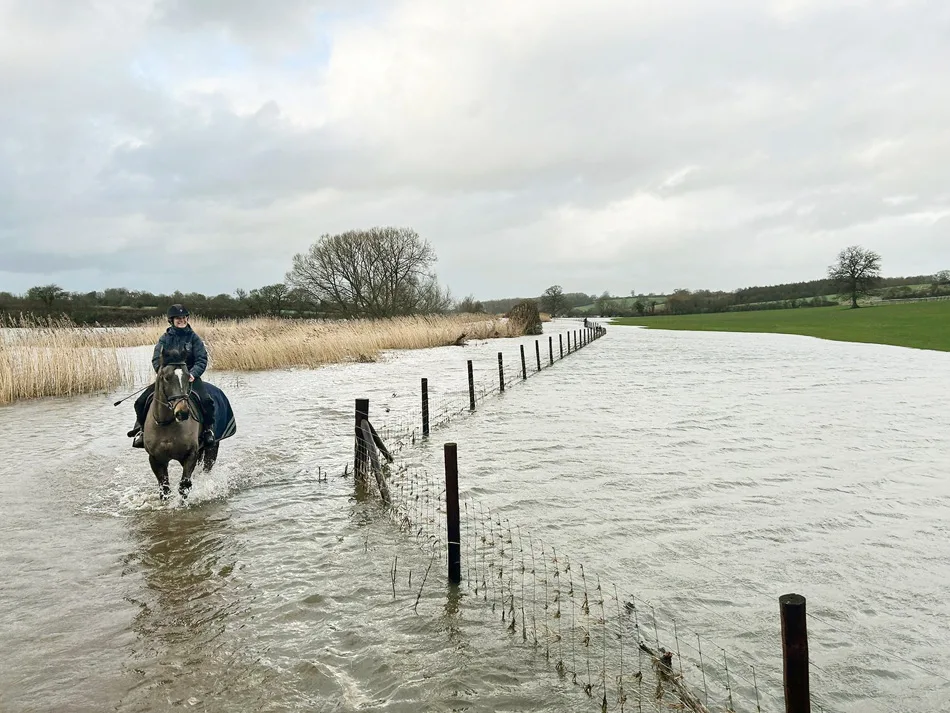
Stick your hand out the window and you’ll probably notice it’s started raining. Those hot dry summer days are a distant memory, and all we’re left with is the constant reminder to take a coat with us. Wet winters aren’t a new phenomenon (in fact, in the south west they’re quite the norm!), but the day this publishes, 5th December, is the ten-year anniversary of Storm Dennis, which drenched the north of England and flooded more than 5,200 homes, wracking up a whopping bill of more than a billion pounds for the storm damage. It’s almost become a yearly tradition: somewhere across the country, that one local yokel kayaking to the shop for a pint of milk. Funny when it’s not your community – heartbreaking when it’s your own cherished belongings floating around on the television news.
Flooding of the Stour valley. Image: George Hosford
Nature’s reservoir Yet every time it happens, we act surprised. Out roll the sandbags, up go the emergency alerts, and down goes morale. The weather seemingly worsens each year: maybe the real question isn’t how to mop up the mess, but how to stop it ever getting that far. And here’s the funny thing: the best flood defence strategy isn’t a multimillion-pound wall or a concrete-lined river channel. It’s something far simpler, far older, and far more Dorset: it’s slowing the water down before it even reaches the towns. Farmers have been whispering this for years. Nature has been shouting it. And now, finally, policymakers are catching on that the landscape itself can do half the work – if we let it. Across the county, you can already see the beginnings of a quiet revolution. Fallen timber is being turned into leaky dams that hold water back just enough to calm a river’s temper. Wetlands that were drained decades ago are being welcomed back, allowed to store winter rain (almost like they’re nature’s own reservoir …). Big chunky hedges are being replanted to slow runoff from sloping fields. And farmers are focusing more on improving soil structure so fields can stop acting like tiled bathrooms and start behaving like the giant sponges they are, again.
chocolate brown of stour in flood at sturminster newton
It’s already out there Our constant battle with flooding can no longer be seen as a rural headache or a ‘farmers’ problem.’ In reality, upstream fields and downstream shopfronts share the same raincloud. What happens on the hills decides what happens on the high street. I’m not suggesting that farmers set up a Godfather-style racketeering scheme (“Give us money or we’ll flood your business …” shakes fist threateningly). But maybe it’s time we invested in solving flooding rather than diverting it. Dorset’s best flood defence won’t be found behind a council desk or in a contractor’s warehouse. It’s already out there, upstream, waiting patiently in fields, hedges, wetlands, and those famously meandering rivers. It’s often said that farmers are simply custodians of the land – but we are also tarnished as abusers of the environment, and that couldn’t be further from the truth. The land under farmers’ wellies is their livelihood – they must protect it so it remains viable for the next generation trying to scrape a living from it. In other words, if we look after the land, the land will look after us. And with storms getting punchier and puddles getting bigger, that might just be Dorset’s most important business investment of the next decade.
With Christmas almost upon us, we’re all thinking about gifts for friends and family – and some of the most practical and thoughtful options come straight from our local farming community. As many farmers diversify with creative new income streams to offset the soaring cost of animal feed (which has more than trebled), there’s never been a better time to support them. From homegrown produce to handmade goods, check out our tips for wonderful Dorset-made gifts that give back to the land they came from.
Meet the Hairy Coos in the Piddle valley. Images: Rachael Rowe
Meet the Hairy Coos Give an encounter with a hairy coo – who could resist? The hair, the horns, those doleful eyes … Cameron Farquarson’s Highland cattle in Piddletrenthide are a joy to meet (and the breed is generally very docile). Your recipient will not only get to spend time with the highly photogenic coos, but stroke them, cuddle the smaller ones and even brush them. However, you’ll also learn about this heritage breed, why they are known as a fold and not a herd, and their connections to Robert the Bruce. Cameron also talks about why cows behave in the way they do – and like most people, once you have met the coos you won’t want to leave. All visits must be booked. Details for gift vouchers for the Highland Cow Experience (£30) are on the website. redlandscoppice.co.uk
Never say no to cheese Cheese is always welcome during the festive season, and unusual varieties are in demand on cheese boards. It’s easy to stock up in person on Dorset Blue Vinny from their vending machine on Woodbridge Farm near Sturminster Newton, but head to the website to find some very tempting cheese boxes and hampers too. Book and Bucket Cheese, from Cranborne Chase, has cheese hampers which make perfect gifts – we can personally recommend ‘The Present’ selection! Dorset Blue Vinny Book and Bucket Cheese Company
The Beanie kit from Gutchpool Farm
Get knitting with Dorset Down Wool Winter nights are perfect for a bit of knitting beside the fire. Gutchpool Farm near Gillingham makes the most of the 70-strong flock of Dorset Down sheep, offering a range of knitting kits and wool. Choose from a handwarmer, beanie or child’s gansey (fisherman’s sweater) kit as a gift, or simply select some of the balls of wool for a knitter’s dream gift. You can buy online or pop into the farm shop, where you’ll also find sheepskins. There are also gift vouchers. Balls of wool are £9.50 and a beanie kit is £39. gutchpool.com
The Dorset Luxury Steak Box from the Dorset Meat Co
Send a meat box Many people are concerned about the price of food, so a meat box can be a real treat or simply practical help. A meat gift voucher is also a great gift that will enable a student or relative to choose what they want to fill a space in the freezer. Buy from the Dorset Meat Company and you’ll be supporting local farmers and growers. The online company also carries a range of appetising deli items so the recipient will have fun choosing treats. thedorsetmeatcompany.co.uk
How about a shot of … milk vodka Dorset-based Black Cow is the world’s first pure milk vodka. The famous alcoholic drink is made in West Dorset with what’s left over from grass-grazed cows’ milk after the curds are used for cheesemaking. A bottle of vodka is a great gift for a friend or relative, and an interesting addition to the drinks cabinet. Stick with the smooth classic Black Cow, try the English strawberry version or, for something seasonal, a bottle of Black Cow Christmas Spirit. All are delicious neat, and all work beautifully in a cocktail. Prices starts at £26.50. blackcow.co.uk
Send a little love for British bees We all know that bees are critical for life – and currently in desperate need of all the help they can get. Filberts, based in West Dorset, has grown from three generations of farmers and promotes the protection of British bees. On their website, you will find a range of gifts and stocking fillers from balms (£5.30) and hand cream to beeswax candles and craft kits (from £12.50). There’s also a beekeeping course – and of course they also sell honey. filbertsofdorset.co.uk
You can never have enough socks Socks are always welcome, especially at Christmas. Keep your loved ones’ feet toasty warm with some alpaca socks (from £22.50 – we highly recommend the best-selling cushioned sole walking socks) from South Paddocks Farm in Winterborne Houghton. Or try the alpaca sock range at Bride Valley Alpaca Farm in Kingston Russell (from £20 – ‘as strong as silk, as soft as cashmere’). A little further afield is Corrymoor in the Cotswolds with a gorgeous range of mohair and angora socks. southpaddocks.co.uk bridevalleyalpacas.com
Filberts of Dorset gift tin
Give a farm shop voucher Farm shops are always jam-packed with local crafts, cakes, food specialities and treats, so a gift voucher will always be welcome. Good farm shops offering gift vouchers and treats include Washingpool Farm Shop near Bridport and Home Farm Shop at Tarrant Gunville. Many also offer cream teas, a perfect excuse for a day out. Otterton Mill on the Dorset-Devon border is perhaps worth a day trip. It mills grain from farmers all along the Jurassic Coast. Despite a devastating fire in June, they are still working, full of inspiring gift ideas – and they do a great cream tea in the new restaurant. There are good farm shops all over rural Dorset – they don’t all have a cafe and serve delicious cream teas, but a simple Google search for ‘Farm shop near me’ will show you your nearest.
Go on a Sheep Walk Many of us enjoy walking the dog and alpaca treks have been popular for years, but now you can take a sheep for a walk around a beautiful Somerselt farm – and learn about the breed at the same time.On this 90 minute experience you’ll meet the flock, pick your personal sheep companion and head out for a trek. Lambing experiences are also available at specific times of the year. Based near Taunton, the farm offers gift vouchers, the perfect gift for animal lovers. somersetsheeptrekking.co.uk