Cyclamen, Wreath Making workshops, Gifts for loved ones, and of course, the trees… yes, it’s all on our minds.
Cohle said that ‘Time is a flat circle’ (it’s actually Nietzsche’s doctrine of eternal recurrence – that everything repeats itself and that what happened before is bound to happen again), and the festive season approaches at speeds which feel like they’re faster than ever each year. Last month we talked about the joys that Autumn brings and it hardly feels like we’ve had much time to savour it!
image by Throngrove
A festive normality
It’s important to savour those good moments, and we also previously touched upon a sense of ‘normal’ really feeling like it had returned. The news on tv may imply some possibly difficult times ahead this winter, but our determination to press on safely, and with prosperity, has not waned. We know how important the festive season is to so many people, and how even a humble fir tree in the corner of the living room can bring a sense of togetherness and warmth at the coldest time of year. To some, of course, the end of the year doesn’t mean a great deal – it’s just another month on the calendar, and it’s other times of the year where they celebrate their own traditions. The diversity in our culture is something which makes a community so valuable. We can all gain knowledge and perspective from each other that enriches our own personal lives. If you’re not getting festive soon, we still remain a community garden centre, and we welcome everyone through our gates with experts on hand to provide you inspiration for your seasonal gardening.
image by Throngrove
‘Bah Humbug’ is a phrase that even many of our staff may utter, but we promise you, it’s all in good spirits! There’s an authenticity you’ll find at Thorngrove all year round. We’ll of course be on hand for many of your festive essentials this November and December, so please consider adding Thorngrove on your shopping destination to find something special this Christmas. There will be plenty of treats in the café too, so bring a friend, and savour that moment.
Let’s enjoy the togetherness we have right now, because as far as we’re concerned, it’s never felt more appreciated. Ho Ho Ho!
Animal boarding has been operating on the current site in Stour Row, just outside Shaftesbury, for almost half a century
Branscombe Kennels and Cattery consistently offers high levels of care for the four-legged members of the family. We offer a year-round boarding service for dogs and cats for when you are not able to be there yourself. From single days and weekends to longer stays, we strive to accommodate all requests, and pride ourselves on the level of care we offer. Our facilities are maintained to a high standard, and all dogs are walked around our beautiful field twice a day, weather permitting. We employ well- qualified and experienced staff, and all of them are working towards additional higher-level qualifications.
image by Branscombe Kennels
Grooming
We are also able to offer a highly competitive dog grooming service in our newly refurbished grooming salon. Dogs can be groomed while they stay with us to save you another journey, or can be booked in independently to be pampered whenever they need it. We also offer wash and dry and nail clipping services.
Agility for hire
Our secure exercise and agility arena is now available for hire. The arena is fenced on all sides, has a selection of dog agility equipment and can be hired for 1/2 hour, 1 hour or longer times by arrangement. Currently it is available for bookings starting at 10am in the morning, and, as we have installed floodlights, is also now available into the evening with the last booking at 7pm. We are now also able to offer supervised sessions in the arena as part of your dog’s stay.
image by Branscombe Kennels
All the extras
We also have an area where we sell the food brands that we use on a daily basis for our guests, as well as a good selection of great value raw meats and toys.
We are constantly striving to improve our service. This year we are making significant upgrade; our cattery is undergoing a major refurbishment that will see much of the building upgraded, as well as new heating and lighting systems. We are also installing new heating and lighting in the kennels ready for the winter.
If you would like to book a visit or need any additional information, please do not hesitate to contact us on 01747 838323. You can also visit our website at www.branscombekennels.co.uk, or contact us using Facebook.
You are invited to The Farndale Avenue Housing Estate Townswomen’s Guild Dramatic Society Murder Mystery. This play-within-a-play creates some amazing comic moments that provides brilliant entertainment for a cold winters evening.
Every drama group has experienced the horrors of what can go wrong opening night and the ladies of the F.A.H.E.T.G Dramatic Society are no different, with the possible exception that almost everything that could happen,does.The scenery collapses, cues are missed, lines forgotten, and the sound effects take on a strange note at times, as the ladies present their ambitious evening’s entertainment.
Thursday 25th November 2021 – Saturday 27th November 2021
With landmark global announcements protecting forests, acceleration of green technologies and methane pledges this UN Climate Change conference is focusing on the shift from ambition to action.
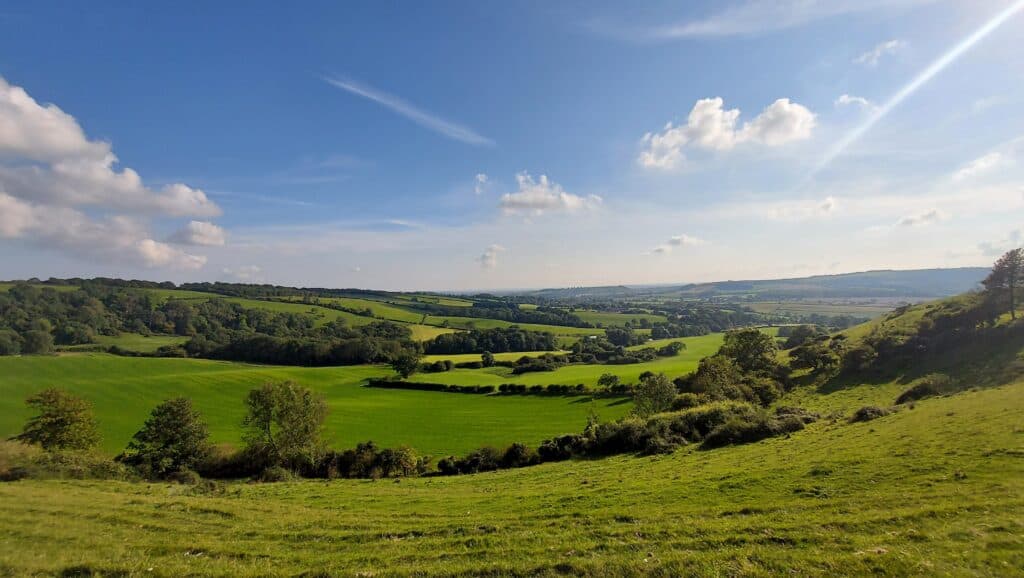
The view across Hilton Bottom towards Lower Ansty image: Laura Hitchcock
COP26 is rightly dominating the headlines at this moment. Pre-COP26 70% of the world’s economy was covered by a net zero target and with Australis and India laying out their targets in Glasgow, it is a vital step in limiting global warming.
So how about our industry?
There is plenty in the press about agriculture’s impact but let’s look a bit closer. NFU President Minette Batters set a target for the British farming industry to become net zero by 2040, this is our contribution towards the UK’s ambition of net zero for 2050. Agriculture is uniquely placed to be part of the solution, as both an emissions source and sink. As farmers, we can protect and enhance the carbon reserves already in our soils and vegetation, by modifying some farm practices and better managing out hedgerows and trees.
“…at the same time as reducing our impact on the climate, we must not reduce our ability to feed the UK with high quality, affordable British food”
In addition to these ‘nature- based’ climate solutions, we can help to capture more carbon by growing the raw materials for bioenergy alongside our food production. That food production element mustn’t be forgotten: because at the same time as reducing our impact on the climate, we should not reduce our capacity to feed UK consumers with high quality, affordable British food. Nor should we achieve our climate change ambitions by exporting UK production – or our greenhouse gas emissions – to other countries. So, there is no single answer to this climate problem; agriculture has to manage a real balancing act.
How much of an impact is our food production having on the climate anyway? There is much talk about reducing your red meat intake to help climate change. But British cattle and sheep only account for 5.7% of the UK’s greenhouse gas emissions, and greenhouse gas emissions from UK beef are less than half the global average. We also mustn’t forget the role that our livestock play in maintaining wildlife habitats, soil quality and the beautiful landscapes we treasure, both here in North Dorset and further afield. There are several activities that would make more of an impact than reducing meat and dairy – green energy, or driving a more efficient car for example, especially as 27% of UK greenhouse gas emissions comes from transport.
Regenerative farming
We have always known this would not be an easy task but as I work across the County it has been incredible to see the innovative and diverse range of measures farmers have employed to make their businesses more sustainable. Regenerative farming has been in the headlines within our industry for some time; the over-arching principle is working hand in hand with the environment and that starts with the soil, all whilst producing high quality food.
I see many farmers embracing this approach, but it is important to remember that a farmer can make just one change within their farming system and still make a huge difference. For example, when arable farmers grow cover crops after harvest, or chop their straw rather than bale it, these actions capture carbon, draw it down and lock it into the soil at the same time as improving soil nutrients and biodiversity – a simple and easy win! Grassland management is at the heart of any livestock farmer’s plans. Allowing species of deeper rooting rye grass and clover to flourish helps improve soil health and increases nutrient cycling, fixing nitrogen in the soil and reducing the need for artificial fertiliser use. This will also help improve the health and productivity of a herd by reducing the worm burden.
Dorset’s iconic rolling farmland is already the scene of a considered indistry move towards tackling climate change image: Laura Hitchcock
With rotational grazing regimes, the cattle graze a small area for a short period of time and then move on, allowing the grass a chance to replenish and put sufficient energy back into the roots. This can improve the soil organic matter and biodiversity. But with every farm being different, even to their neighbours, its important each farmer choose options and farming practices that suit their own system. Herbal leys for example do need planting every few years so there is a cost implication. Making changes to a farming system takes time; soil biology takes time to make up any difference from removing chemical inputs.
Making changes to get to net zero is a journey. Finally, with the COP26 methane pledge in mind, there is a seaweed food supplement to reduce methane emissions from dairy herds being trialled through the University of Nottingham; watch this space to see what our iconic Blackmore Vale dairy herds will be munching on in the future!
As you walk the footpaths across Dorset farmland, there is often more happening around you tackling climate change than you might first realise. Farmers are showing how they are adapting their businesses to reduce agricultural emissions and capture and store more carbon on farmland, all while providing climate-friendly, nutritious and affordable food for people at home and abroad.
Lucy Procter, co-owner of the Glanvilles Stud, shares a diary of life on a Thoroughbred stud. This month – double breeding and almost a hat trick.
October was quite the month for the Glanvilles Stud; storms submerged the fields, but out of the yard there were successes at the track and a new French arrival, as Lucy shares.
Despite the October storms briefly submerging some of our fields – much to the enjoyment of the foals (see image above!), the worst of the water has now drained off our land and the mares and foals are all still living out 24/7. They are protected from the excesses of the weather by our thick hedges, though a few of the mares with skin sensitive to prolonged drenching, are rugged at night.
Out on the racecourse
It’s just as well that the majority are living out and the stud is still relatively quiet, as things have been pretty busy on the racecourse recently and we have managed to get away and enjoy a few days out racing.
Since the end of September, our homebred flat filly, Beryl Burton, has run three times. She has achieved a win, a third and a fourth place. Her overall performance has improved with every run, and she has now been sold to her trainer, John Berry in Newmarket, for another owner in his yard. Not to be outdone, our homebred gelding, Soul Icon, made his handicap debut at Huntingdon on 5th October; a winning one.
He followed this up two weeks later with a win at Exeter and then again, a week later, he just missed out on getting his hat trick by a neck at Taunton.
Soul Icon has gone up over a stone in the handicap in just three weeks. This means his mark, which is used by the handicapper to allot weight to horses in handicap races, has gone up.
If a horse is deemed to have run its most recent race better than previous runs, its mark increases. A horse with a higher mark, say 110, would carry 12lb more than a horse of 98, the object being to give every horse an equal chance of winning. If a horse runs badly in a race, then the handicap mark can be reduced with the same aim of levelling out the racing field.
A family win
Particularly exciting for Doug and I was the fact that our eldest son Freddie rode Soul Icon in all three races, with the Huntingdon triumph being his first winner ‘under rules’ (professional racing as opposed to amateur Point-to-Point racing). As if that wasn’t pleasing enough, our daughter Alice had backed Soul Icon, pretrained him and taught him to jump at home. And a cherry on top, Soul Icon is the first horse we have bred out of a mare that raced in the stud colours.
Back at the stud
A well-bred filly purchased online from France, eventually made it across the water at the beginning of the month to be prepped and sold on at the December Mare Sale at Tattersalls in Newmarket.
Straight out of a flat racing yard, she was a slight little thing when she arrived, but is already, twoweeks on, beginning to put weight on nicely and has settled down to long days out at grass with a steady, elderly broodmare as her companion.
With two homebred winners this month, one of them ridden by a homebred jockey, everyone at The Glanvilles Stud has been given a little boost. and a timely reminder of why we pour our heart and soul into breeding and raising racehorses.
This month we’ve been chatting to Doune, who runs the Queen’s Arms in the village of Corton Denham, just three miles north of Sherborne, with a focus is on good food and a comfortable night’s sleep in one of their ten refurbished rooms.
The Queen’s Arms
How did you end up at
The Queen’s Arms?
We have lived in Corton Denham for 14 years, and the Queen’s Arms was always our local. We always dreamed of owning it one day but never imagined we actually would do. When it came up for sale it was too good an opportunity to miss. We finbally signed the contract in July 2020, just as the first lockdown lifted. Thankfully the previous owners stayed on to help show us the ropes until December, and then in January we shut and carried out a refurbishment ready to open early July 2021.
It’s been a rollercoaster year!
How big is your team?
We have a new manager, as I knew I’d be unable to do it with 3 small children. He prefers to be low key, but he’s in charge of the day-to-day running and comes with a wealth of experience. He is ably assisted by Danny who is in charge of front of house, and who has a welcome smile for everyone. Kyle the former owner’s son has stayed on to help with the transition, and we also have Cathy who is a former air hostess and is utterly charming and wonderful. We have lovely Fred who is a tree-surgeon by day and glamorous bar man by night (his parents have been regulars of the pub for years). The rest of the team are sparky, bright young adults who are eager to learn.
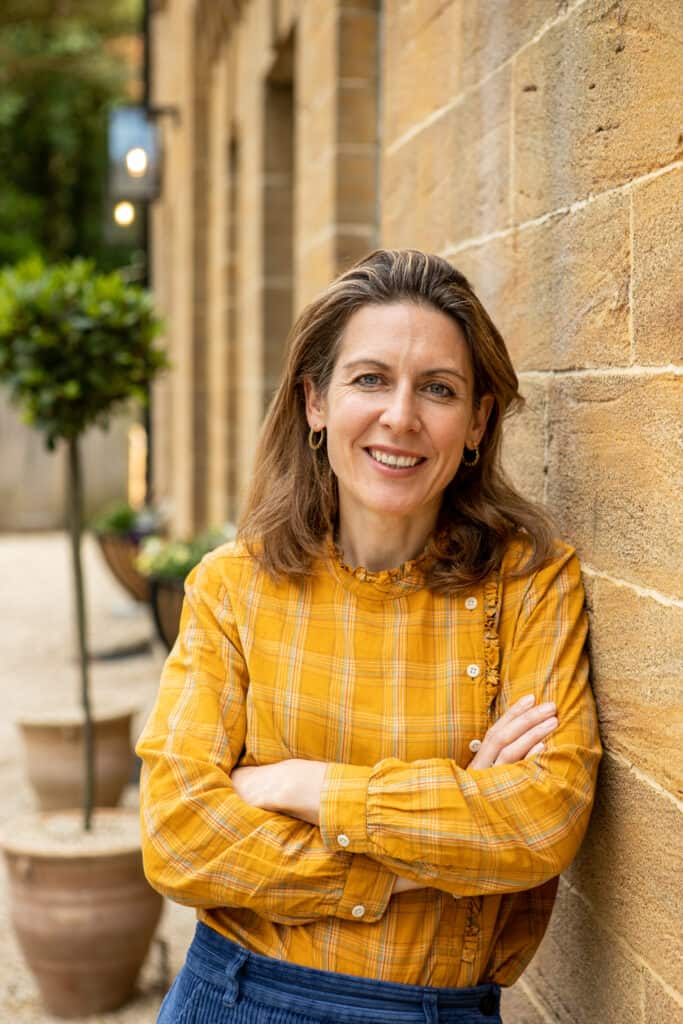
Doune Mackenzie-Francis with her husband and three children. Doune trained at Ballymaloe Cookery School in Ireland and worked as a private chef before becoming Marketing and PR manager at Leiths School of Food and Wine.
Is there a pub pet?
Yes – our dog Aggie (see Aggie with the family below). She has roamed the pub for years begging for scraps! She’s getting on a bit now so likes to lie by the fire.
The previous owners bought Aggie’s puppy, so her daughter was a real pub dog too.
What’s your favouritelocal place to visit onan afternoon off?
We love the walk along Corton Denham ridge, looking out over the Somerset levels. We can walk along the ridge from our house straight to the pub, so it’s a great commute to work. My favourite hill is Parrok hill, with the 7 trees on the top, which can be seen from miles around, I love it so much I’ve put in our logo. I also love going to Sherbone and looking at antiques that may work for the pub, which we are adding to all the time.
There is also so much creative talent in the area, I love Circus, and Caroline Nicholls, and I’m excited to see that the former masterchef winner, Matt Follas has moved to Sherborne; he’s on my list to sample his lovely food!
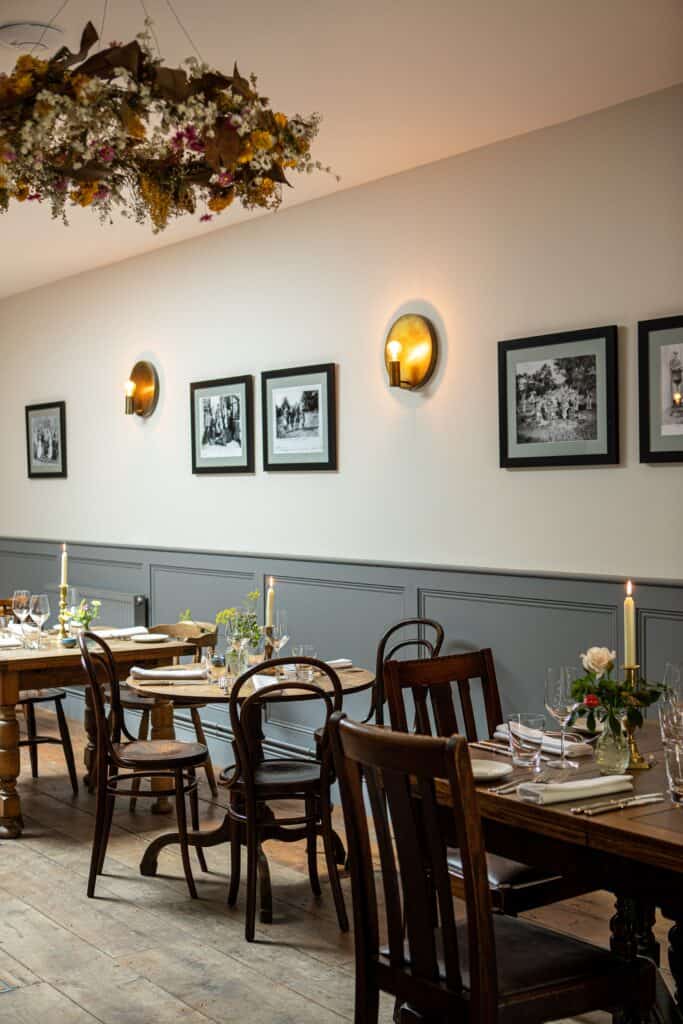
The Queen’s Arms has three inside dining areas. Dining is a relaxed and informal affair in the main pub space (pictured here) and the Long Dining Room (next page). For those looking to celebrate an occasion, the private dining room can accommodate up to fourteen guests.
What’s been yourbiggest challenge sincetaking over?
It’s hard to not include covid as it has defined the whole purchasing and opening of the pub. We faced a second and third lockdown after purchasing, and the impact on getting supplies to build, decorate and furnish the pub and the delays with planning permission because there was no one in the office had their effect. The challenges haven’t stopped now we’ve opened; the knock-on effects from fuel and suppliers, to staffing post furlough/covid on hospitality have been huge, and something we didn’t anticipate or appreciate fully.
What are you mostproud of so far?
The overall look of the pub. It’s been a labour of love, and the bit I was most involved in. We’ve still got lots of bits to add, but I love that the vision has materialised in to a reality. We have added a ‘Pub-hub’ – the building to the right of the piub – where there is a coffee bar and I hope to build this up so that we will have bread, newspapers and a few items for sale which will be useful for the village, as there is no village shop.
The are five en-suite bedrooms in the main part of the pub, and three in the Coach House situated across the terrace. The Queens Arms also offers 4 Queen’s Court, a two-bedroomed private cottage.
What part of thebuilding is yourabsolute favourite?
There are lots of parts of the pub I love; I dreamt of having the flower wreaths and now they are hung they are just as I imagined them – they are beautiful and make a real impact when you walk in. They were made by the skillful hands of Deborah Bain of Lunaria in Bruton.
I also love the arched windows in the coach house – they let in so much light.
Which meal is your most popular? What do people drive from afar to come specifically toyou for?
Our most popular dish is our Jalapeno chicken. The chicken is crispy and light with a real kick from the jalapeno sauce, chilis and spring onions on top, it works for children too (when we take the sauce off – then it’s a bit like KFC but a 100 times better!). Our pork belly on the Sunday lunch menu is a huge hit, and we had some amazing sirloin steaks from the butcher Walter Rose in Wincanton, everyone who tried one said how good they were.
The Long Dining Room features some of the beautiful ceiling wreaths Doune had designed by Lunaria in Bruton.
Tell us about anyof your really localsuppliers?
Our favourite and most local suppliers are The Story Pig at Sandford Orcas, the next village on from us. They have lovely Tamworth pigs and we use their produce as much as possible, from their sausages to their chops.
What’s next?
We do have big plans for the horizon – my background is cookery and I hope to build a cookery school that is linked to the pub. The idea would be people could stay in the rooms and do a class in the morning then have the afternoon to relax. I also want to develop the back garden so we can grow more of our own produce.
We are planning a big New Year celebration, tickets are almost sold out but there are a few left. We’ll also be doing amazing brunches over the festive period, on Christmas Eve, Boxing Day, and New Year’s Day: think Bloody Mary’s, pub classics, bacon rolls and much more after a hearty walk across Corton Denham ridge.
Doune Mackenzie-Francis
The Queen’s Arms are open Wednesday to Sunday 8am – 11pm. Food is served 12 – 3.00 pm and 6.00 – 9.30pm (9pm on a Sunday). For the month of November they are closed for lunch Wednesday to Friday, but are offering bar snacks.
To book a table or room at The Queens Arms call 01963 220317 or click here: www.thequeensarms.com/
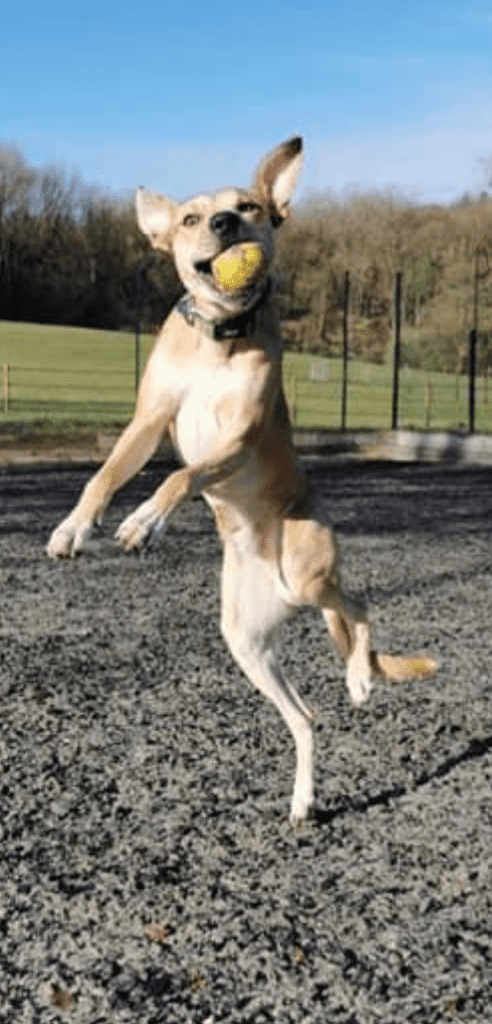
For many of us, Bonfire Night is a high point of the year, with lots of socialising, weird hot picnics in the dark and of course. But the noise, excitement and beauty of the fireworks can be traumatic for pets. Is there anything you can you do to help? Mandy Walters, Small Animal Practice Manager & Head Nurse at Damory Vets has a few suggestions…
image shutterstock
Animals of course have very acute hearing – loud bangs from fireworks can genuinely scare your pets, even cause pain in their ears. Here’s our best tips to reduce and relieve their anxiety:
Keep your dogs and cats inside
If you are a dog owner, make sure your dog is walked earlier in the day so you don’t have to take them out when fireworks are being let off. Make sure that they have a safe space they can hide in and feel comfortable. Closing windows and doors will block out some of the noise, and if you have a cat flap, make sure you lock it or block it off to make sure a cat
can’t make a dashing escape.
Ambient noise
You can also block out some of the noise from the fireworks by turning on the TV or radio (not too loudly). Classical music has been found to have a relaxing effect on animals, with many kennels and rehoming centres using the power of classical music to help keep animals calm. For the last three years, ClassicFM has played a ‘PetSounds’ programme for Bonfire Night.
Rabbits, guinea pigs and other small pets Smaller animals are easilyfrightened – we suggest that hutches/cages and enclosures are bought into a quiet room indoors if possible, or inside a garage or shed. If you aren’t able to do this, you should turn the hutch/cage or enclosure around so it is facing a wall or fence. Putting in extra bedding can help your pet to feel a bit safer.
Extra help
You can also get some aids from your local veterinary practice to help calm pets, such as sprays and diffusers which can be purchased over the counter. Prescription drugs can also be used, although these would need to be dispensed by a vet.