This is the perfect comfort food for January – it’s so simple to make, really good for you and deliciously thick and moreish for those cold January days. The amount this recipe makes depends on the size of your butternut squash, but will feed at least three hungry people.
Ingredients
1 butternut squash
Some good quality olive oil
1 small onion
1 generously heaped tbs of butter
1 tbs maple syrup
300ml to 500ml of vegetable stock
Some crushed chilli flakes
A bit of cream or natural yoghurt to finish
Heather Brown is a special officer for the Guild of Food Writers, and has worked in the food industry for 20 years. She is a food writer and photographer, offering one-to-one help to local businesses for content and websites.
Method
Heat your oven to gas 5/160º fan. Line a baking tray with baking paper.
Cut the butternut squash in half from top to bottom and scoop out the seeds.
Drizzle the inside of the squash liberally with olive oil and place it flat face down on the baking tray.
Roast in the oven for 40 to 50 minutes (depending on how large the squash is), until the inside is soft.The skin will crinkle slightly and start to brown.
Remove from the oven and leave until cool enough to handle – at least ten minutes.
While the squash is cooling, chop the onion.
Add the butter to a small frying pan over a medium heat, and when melted add the onion. Drizzle in the maple syrup and cook gently together until the onion has softened and the buttery mixture starts to brown. Remove from the heat.
Take the butternut squash halves and scoop the lovely soft insides into a bowl (throw the tough skins away). Add the softened onions in their sweet buttery mixture into the squash.
Blend using a stick blender until it is a smooth, glorious, thick and tasty mixture.
Loosen the mixture with the stock – just add until you have reached the consistency of soup you like (I used about 300ml of stock but I like a lovely thick soup and my butternut squash was quite small).
This soup will keep quite happily in the fridge for a couple of days. Just reheat in a small saucepan and finish with a drizzle of cream or natural yoghurt and some crushed chilli flakes.
Spring 2024 is set to bloom with the inaugural Dorset Spring Show, promising a vibrant celebration of spring flowers, food, farming, and more. Scheduled for Saturday 27th and Sunday 28th April 2024, it’s a brand new event from the team behind the Dorset County Show. The Dorset Spring Show is a celebration of the arrival of warmer days after the chill of winter. Jason Bowerman, Chairman of the Show, says the event may be new, but it has old bones; ‘The roots of this event trace back to the Society’s annual Spring Horticulture and Homecraft Competitions Show. In 2024, we are taking this to a whole new level with the introduction of the Dorset Spring Show, set against the stunning backdrop of Kingston Maurward.’ Visitors can expect a range of experiences, from savoring local delicacies and discovering the art of food production to enjoying live demonstrations and engaging talks by local speakers. Entertainment will be plentiful, with local acts, hands-on rural skills workshops, and of course there’ll be lots of shopping opportunities. The highlight for many will undoubtedly be the chance to meet newborn lambs – a true sign of spring. A special focus of the Show will be the farm-to-fork journey, illustrating the agriculture sector’s vital role in feeding the nation. It will feature a variety of speakers and rural crafters, showcasing the essence of Dorset. James Cox, the Show Organiser, shares his enthusiasm: ‘Speakers Corner, Floral Demonstrations, Agri Education Hub, Crafters Corner … there is so much happening in this new event, and you can be a part of it. For more than 170 years, the Dorset County Show has bid summer farewell in style. In 2024, we are also starting summer with a blooming bang through the Dorset Spring Show. We will have so much to announce over the coming months.’ Tickets are available now, with an Early Bird offer for adults at just £8, and free entry for children.
This month Barry Cuff has chosen a couple of postcards of the village in which he grew up.
This is the school that grandfather, father and I attended. The sender, Mary Jones, was the infant teacher and wife of Thomas Jones, headmaster. Note the separate playgrounds in their time – bottom for the boys and top for the girls!). It was sent on 23rd December 1904 to the postmistress, Miss F Collis, at Iwerne Minster: ‘My dear Fan, A line to wish you a very jolly Christmas. I thought you would like a view of our house & school. It was taken from the church tower. Much love from Mary Jones’
A William Snook sent this card on 4th November 1904 to a relative, Miss E Snook, in Longfleet. The Snook family ran the Post Office, Telegraph Office, the bakery and Temperance Hotel in the village – and, as can be seen from the message, they produced postcards too! The thatched cottages were pulled down in the late 1970s. ‘Do you remember this spot – we are doing this at one penny each. I will send Jon another soon. Kind love to all’
He’s ‘cried’ on Glastonbury’s pyramid stage … Robbie Wiliams is a fan … Tracie Beardsley talks to Chris Brown, the voice of Wimborne
Chris Brown, Wimborne Minster’s town crier All images: Courtenay Hitchcock
When moving to a new area, advice tends to be “join a sports or social club” to make friends. Not for Chris Brown, a newcomer who soon made himself the most recognised person in town by becoming town crier the same year he moved to Wimborne Minster. That was in 1998 – Now, 25 years later, Chris still opens businesses and attends civic engagements with flourish and flair. He’s been crowned The Ancient and Honourable Guild of Town Criers Champion and is the current Dorset County Champion Crier – a title he has held five times. He’s appeared on postcards and even the back of buses promoting Wimborne Town.
Chris Brown, Wimborne Minster’s town crier
Also hailed the ‘Rock and Roll Town Crier’ because of his love of music and DJ-ing (as DJ Dapper Dan), he hosts the Town Centre Stage at Boomtown Festival in Winchester, sitting on a throne to introduce acts, and he has even appeared on the Pyramid Stage at Glastonbury. ‘That was definitely the craziest thing I’ve done,’ says Chris. ‘In town, I’m lucky if there’s 50 people listening to me. There were about 70,000 that day – I’d been adopted as mascot for Texan indie-pop band The Polyphonic Spree. I’ve opened loads of their tours around the UK, but Glastonbury was definitely my biggest gig!’
Chris’s costume is based on a 17th century Serjant, whose job it was to raise the local militia, to keep order in the town
He even impressed singing star Robbie Williams, who was captivated by his booming voice and flamboyant costume. ‘He told me he loved what I do as he shook me by the hand!’ recalls Chris. Being Town Crier is voluntary and Chris gives it his all, writing amusing poems or personalising messages, whether it’s opening a telephone box converted into a library in Sturminster Marshall or surprising an elderly couple celebrating their 70th anniversary. The former social worker says: ‘It’s about engaging with people, making announcements, attention-grabbing.’ However, this can lead to the occasional faux pas. ‘A few years before the Queen died, I was showing Prince Edward around the Physic Garden in Wimborne. I announced the garden was dedicated to the memory of his mother. He looked at me in alarm. “She was alright this morning,” he said. “Is there something I should know?” ‘
Chris is proud of his first ever eBay purchase – a First World War trench gas attack warning bell
Chris has spent time researching the origins of town criers. ‘They were the newsreaders of their time, communicating information and collecting taxes. Greek runners would run from town to town telling the news. Romans had town criers. I visited a remote village in Africa and they had someone to tell the news. We exist all over the world in slightly different forms.’ As well as herding people, the town crier was paid to be keeper of cattle pens. He would impound strays and be paid a penny for each turn of the key that released them. In Wimborne, the crier also used to collect market pitch fees, deal with disputes, check quality and the price of goods. Beer adulterated by molasses? Veg too cheap? Even today all criers have royal protection and it’s illegal to lay hands on them or hinder their work.
The search for hose Such bygone concepts of policing captivated Chris, who is keen on 17th century history. ‘I’ve been re-enacting civil wars longer than they actually took to fight! I investigated the role of the Town Mayor’s Serjant, whose job it was to raise the local militia, to keep order in the town – he was the forerunner of the modern police force.’ Chris took the idea of ‘men with muskets’ to Wimborne Town Council and, thanks to him, the famous Wimborne Militia now celebrates 25 years, with Chris as its Serjant figurehead. They recreate historical events such as the 1685 Monmouth Rebellion, and Chris’ resplendent red and gold uniform with jaunty tricorn hat reflects these military roots. It was designed by two Arts University Bournemouth students studying Costume for Stage and Screen. ‘My only problem in this day and age is finding woollen hose,’ laughs Chris ‘but I’ve got a costumier in Blandford on the case for me.’ His most important accessory is his bell. ‘It was my first ever purchase on eBay. By accident I forgot the decimal point and offered $5,000! Luckily, the American buyer checked the amount with me, and I got it for £50. It’s a British first world war trench gas attack warning bell – it had found its way back to the USA as a GI’s stolen souvenir!’ Chris’s greatest plaudit is being made honorary freeman of the town. ‘I can now drive my sheep through the town free of charge! To celebrate, I walked one sheep through the town – Wimborne Model Town!’ Chris is now 67, but do town criers ever retire? ‘Until I disgrace myself or fall over, no! I had polio when I was a baby which left me with deformed feet – hence my need to use crutches or a mobility scooter at times. The doctors told my mother I would never walk but she was a determined lady. ‘I love this role, though it takes me two hours popping to the shops. I know so many people.’
image Courtenay Hitchcock BV Magazine January 2024
Quick fire questions:
Top dinner party guests? Sven Berlin – an amazing artist and sculptor who lived in Wimborne Frank Zappa. Tony Benn – my dad worked with him and weirdly, both died on the same morning within minutes of each other. Glenda Jackson. My mum – it would be nice to see her again. She died in 1983.
Book by your bedside? ‘I am Lazarus’ by Sven Berlin. I met him a couple of times and bought his artwork in auctions. He’s painted beautiful pictures of Wimborne.
Sherborne’s housing dilemma: Ted Howells examines the proposed West Sherborne development and its implications for the town’s future
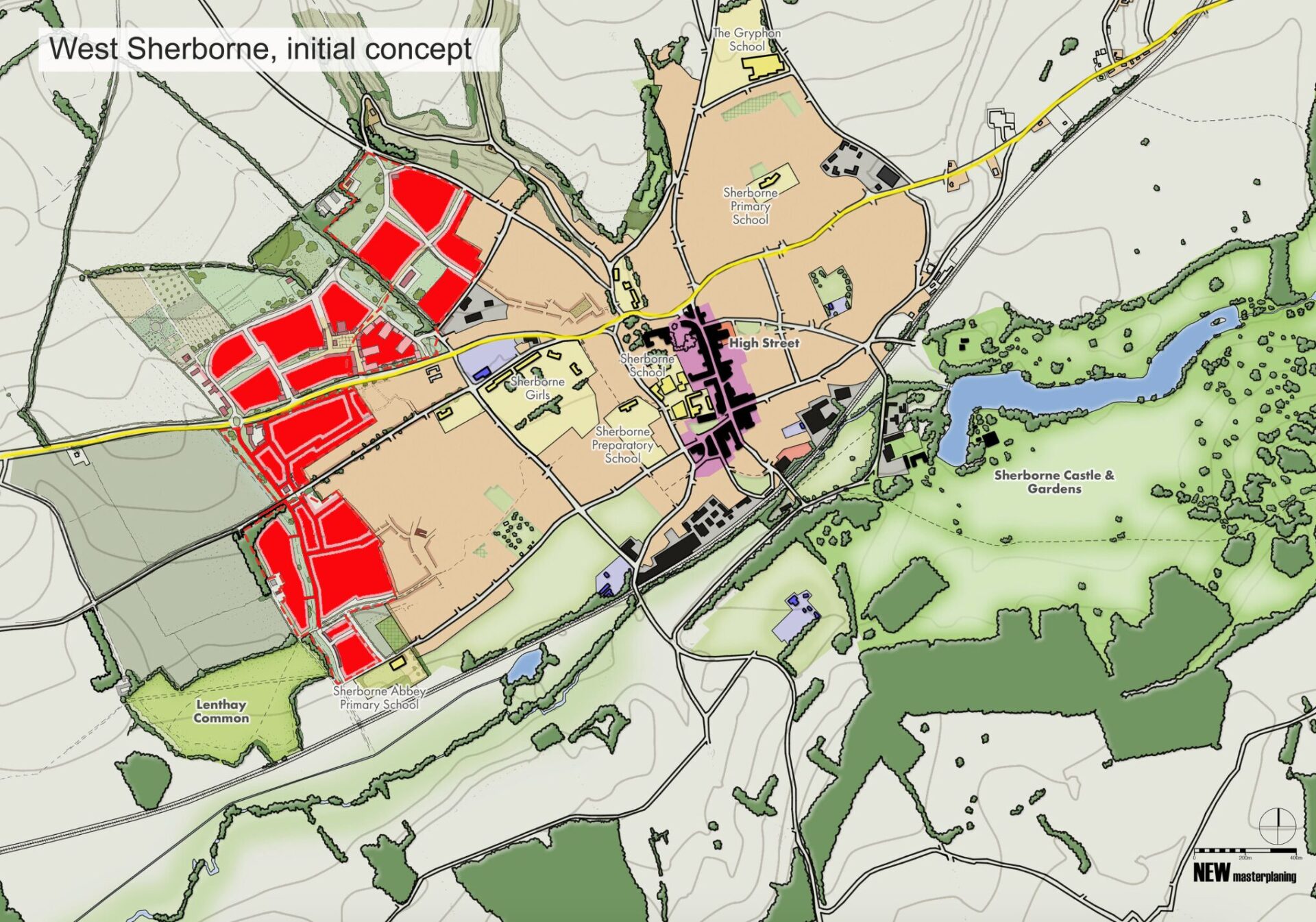
The red blocks show the proposed development land
In recent months, there’s been a lot of debate about the issue of housing in Sherborne. During the last decade, the affordability, demographics and supply of housing in the town has evolved. Since 2010, property prices have increased by 46 per cent, with an average price tag today of more than £360,000. In this same period, the town’s population has risen to over 10,300 people, and in 2021 the proportion of socially rented households had increased, while home ownership through mortgages or shared ownership had decreased. These societal shifts raise a fundamental question about Sherborne’s housing situation: but what’s the solution?
West Sherborne For Sherborne Town Council, the proposed West Sherborne development provides the answer. In April 2021, the town council agreed a collective response to the Dorset Local Plan consultation and ‘supported’ the West Sherborne development. It was widely expected that the Local Plan – which outlines the need for 30,000 new homes in Dorset by 2038 – would be adopted by late 2023, but it has since been delayed until 2026. The concept of West Sherborne was devised by Sherborne Castles Estate, which encompasses some 15,000 acres of land, in-hand and tenanted farms, and a range of agricultural, residential and commercial properties. It includes Sherborne Castle, the 1,200 acre ancestral home of the Wingfield Digby family, which has owned the property and gardens for over 400 years. It also includes the land to the north-west and western edges of Sherborne, earmarked for the proposed Sherborne West development. Working with Chesters Harcourt, NEW Masterplanning, and Andrew Cameron & Associates, the Estate has put forward a vision for the creation ‘of a new masterplanned neighbourhood in the west of Sherborne’ on this land. It’s envisaged that the development would extend from Marston Road, across the A30 and down to Lenthay Road. So what exactly is being proposed?
Looking north east across the planned development site towards Bradford Road
According to the town council’s response, any development – such as West Sherborne – should entail ‘new housing units comprising a mixture of small and larger homes rather than 1,200 homes of equal sizes’. It is proposed that the construction of 1,200 homes would be delivered in instalments, similar to the process of the Barton Farm development. The town council’s members also expressed their desire for 500 affordable homes to be introduced, which they claim ‘would mean the overall introduction of at least 1,500 homes’. Any such development would need to be delivered in co-ordination with Dorset Council to ensure ‘adequate local provision’.
Looking east from Lenthay Common
Location The western side of Sherborne is an area which the town council acknowledges is situated away from the town centre and which lacks adequate infrastructure, as ‘the services are to the middle and to the East’. In addition, the location of the proposed development – especially extending south from Bradford Road to Lenthay Common – is known for its ‘high-water table and likelihood of flooding’.
Infrastructure To accommodate such a proposal on this scale would need adequate infrastructure. It would require additional educational facilities, as the state-run Gryphon school and Sherborne Abbey Primary School ‘are nearing capacity and may need to be expanded’. It would also require the sufficient provision of healthcare and retail facilities to accommodate the increase in homes, along with a drainage system and good broadband.
Looking south from the A30, in the middle of the outlined development site, towards Lenthay Common
Transportation In their response, town council members conceded that such a development would be ‘creating stress on the already busy [road] junctions within the town.’; this is particularly so when it is estimated that 1,200 homes would result in around 2,400 extra cars. To this extent, council members ‘support the proposals for the ‘civilising’ of the A30, with the potential to bring it down to a single carriageway as it approaches Sherborne to slow it down and reduce the potential for speeding.’ Members also endorsed proposals to electrify the local train network and consider new bus routes. Sherborne Town Council has stated their support for ‘holistic development that ensures the future economic, social and environmental health of our community’.
‘I’m surprised I’m still here!’ The Dorset woman’s year-long journey walking Britain’s entire coastline is raising money for the homeless
North Dorset’s Claire Allen is walking round the coast of Britain
On a bitterly cold winter day, Claire Allen is striding out across Studland Beach towards Old Harry Rocks. It is one small stage in a massive challenge – to walk the entire length of Britain’s coastline in a year. However, right now there’s only one thought on her mind, especially with the biting cold. Where is she going to sleep tonight?
A mighty undertaking Claire lives in Bristol now, but her family are from Okeford Fitzpaine in Dorset. She set out from John o’ Groats in Northern Scotland on 8th August 2023 – she has completed about a third of her total distance so far. She’s walking for charity, aiming to raise £25,000 to split equally between two charities; Only A Pavement Away and Shelter. When Claire started she was just planning a year out from her job, wanting to ‘do something different’. The presence of rough sleepers and having to find somewhere to sleep each night focused her attention on homelessness. Claire says: ‘I’m lucky. I haven’t experienced anything like homelessness and I have a support network and a family. But after months on the road I can say the hardest part about it is finding somewhere to stay each night. In summer it’s easy because you can simply camp. At this time of year it’s dark at 4pm and right now it’s freezing. It really makes you think about those less fortunate.’
August 2023 – setting off! All images: Claire Allen
The kindness of strangers Before 45-year-old Claire set out on her long walk around Britain she worked in the charity sector in Bristol as a communications and fundraising professional. That exposed her to homelessness – but this walk has shown her a different perspective to living without a safe, secure base. ‘Walking down the east coast of Scotland, it was easier to find somewhere to rest because you can camp out anywhere. But when I got to England it was more of a challenge. I’ve had huge support from B&Bs, and even complete strangers who have a room free. ‘I’m more attuned to homelessness now. But what I have really valued is when people say hello. That small social interaction means a lot. So now, as I go on my way and see someone who is alone and looks homeless, I ask if they are OK. ‘Homelessness is a crisis that none of us can ignore. It’s visible in every town and city. Along the way, I’ve met people who are homeless and sleeping rough – and not one of them has chosen that life. Losing your home can be down to something as commonplace as a marriage break up, becoming unemployed or even falling out with your family.’
Life on the road Claire usually walks 15 miles a day. She didn’t have a formal training programme before she set off, but as someone who does trail running she wasn’t unfit before the challenge. ‘I have found that just through walking each day, I’m getting a lot fitter. Apart from finding somewhere to sleep, the only other challenge has been the weather. There are funny moments too. One memorable night a fox got into my tent! Somehow it managed to find my food and spread things everywhere. I was brushing my teeth at the time and came back to find a real mess. ‘When I’m walking, my rucksack becomes a talking point – sometimes I look like a bit of a freak show. People are taken aback that I’m doing this on my own and usually ask where I’m staying and what I’m doing. It’s lovely to talk to people. Some even give me £20 when they hear I’m raising money for charity. ‘I keep my energy levels up with food. I must be the only person who has walked the length of Britain and put ON weight! I’m always thinking about food and coffee. To maintain my energy levels, it’s important to get a good night’s sleep, to eat enough – and try not to be tempted by too many doughnuts’ Now she has walked down one side of Britain and two-thirds of the way across the ‘bottom’, what has surprised Claire the most? ‘That I’ve stuck at it! I didn’t know how I would manage or have any idea how it would go. I didn’t tell too many people before starting out because I didn’t know whether it would even work. I’m also surprised at how generous people have been with donations.’ Claire is currently on the 630 mile stretch of the South West Coastal Footpath. Her most recent Instagram post – from Weymouth – says: ‘I’m now five months into this great big walk and still want to run screaming to the nearest station and jump on the first train home when I think about how much further I’ve got to go. So for now, it’s just one day at a time.’
To donate to either Shelter or Only a Pavement Away, visit Claire’s JustGiving page: Claires-great-british-walk
As well as support from hotels and guesthouses, Claire has received support from outdoor clothing brand Inov-8, which has provided her with top-of-the-range walking boots (she’s currently on her third pair!) and the Alpkit Foundation which made a grant of £250 towards the cost of equipment.
There’s still work to be done in the winter, and gardener Pete Harcom suggests having an eye to the climate as you plan this year’s garden
Experts are predicting that a changing temperature cycle in the oceans will make 2024 the world’s hottest year. With that in mind, it might be an idea to consider creating a low-maintenance garden that looks good in the heat, thrives on very little water and still provides habitat for our wildlife. Here are a few ideas for plants that are drought tolerant:
Eryngium (amethyst sea holly) – this is a striking plant which is native to the Mediterranean. Most species are perennials, and they have showy, attractive thistle-like flower heads surrounded by spiny silvery-blue bracts. These sun-loving plants will attract plenty of butterflies and bees to your garden.
Lavender – this cottage garden favourite thrives in hot, dry conditions. It is heavily scented and loved by insects.
Verbena bonariensis (lollipop is a smaller-growing variety).
Cistus x pulverulentus sunset. (rock rose) – a low growing shrub which thrives in poor dry soils.
Pennisetum (fountain grass) – very low maintenance and it has striking seed heads.
Yucca filamentosa bright edge – a structural plant, some hybrids can be large, but other varieties can also be used as container plants.
Osteospermum (African daisies) – these have very showy flowers and are easy to grow.
Sedum ‘Sunsparkler’ – this is great in rockeries and very easy to grow once established.
Hibiscus flower tower ruby – be aware these can grow to 3m! But they’ll have masses of flowers once established.
Rosemary (salvia rosmarinus) – another Mediterranean favourite, the evergreen shrub has aromatic leaves and small blue, pink or white flowers.
This month’s jobs: It might be grey and damp out but even in January there are still plenty of jobs to do in the garden this month:
Clean up your pots, tools and greenhouse in preparation for spring.
Now is the time to order seeds and plants – from the comfort of your armchair!
Continue looking after the wildlife — put out wild bird food, and leave some areas of your garden uncut for shelter until the spring.
If your honeysuckle is very overgrown, now is the best time to cut it back hard to encourage healthy, new growth this spring.
Cut back ornamental grasses – clip back the old foliage before new growth begins, to within a few centimetres of the ground.
Check your climbers are securely attached to their supports with ties.
Shred your Christmas tree and add it to your compost bins. The stripped down branches also make great pea sticks.
Remove slimy patches from patios and paving by scrubbing with a broom or a blast with a pressure washer.
Plant some amaryllis bulbs indoors now for spectacular spring flowers.
It might be the depths of winter, but there’s still plenty of fresh produce on the allotment to enhance the summer’s harvest stores, says Barry Cuff
Barry Cuff’s colourful winter salad
headlines. In our area it was wet, with more than 43 inches of rain. The driest months of the year were February and June. During the main growing season, the wettest were March, April, July and August, but a mild and very wet autumn and early winter did at least maintain growth. On the whole it was a good year for most vegetables – only our shelling peas suffered and gave lower yields during the dry spell. We had a constant supply of fresh vegetables throughout December, including ones for our Christmas meals, together with those in store. Here’s what we harvested through the month:
Potatoes (sagitta) – a new variety to us. They roast well and are excellent for jackets. Planted on 5th Apr, they were dug and stored in paper sacks 4th Aug. Good size and yield.
Parsnips (Palace and Hollow Crown) – both roast well, and are sweet despite very few frosts. Sown direct 30th Apr, started digging mid Nov. We have a row left for next year.
Carrots (Early Nantes) – the only variety we grow. No thinning, so a mix of sizes. We sow successionally; those lifted in Dec were sown 6th Jun, later sowings will be dug as needed.
Brussels sprouts (Brendan) – a good variety that crops from Dec to Feb. Module-sown 6th Apr, and planted out 15th May (eight plants).
Broccoli (Rudolph) – produced some very early spears ready for Christmas. Module-sown 12th May, planted out 30th Jun (five plants)
Cauliflower (Cendis) – a reliable F1 variety producing excellent curds. Module-sown 11th May, planted out 25th Jun (15 plants)
Leek (Musselburgh) – the only variety we grow.Pot-sown 14th May, and planted out 30th Jul on ground where potatoes were harvested.
Winter squash (Butterfly) – an excellent tasting butternut, producing large fruits. Module-sown in greenhouse 1st May, planted out 4th Jun. Harvested and stored 15th Oct.
Winter salads There was a good selection of veg to go with our Christmas meals, tasting that much better as they were home grown and received no pesticides! To go with our cold meats we also had a good supply of fresh salad plants. With the exception of celeriac, they were sown/planted on the plot that had grown our potatoes, grown under fleece when there was a danger of frost:
Lettuce and spring onions – The last for this year, and grown under cloches. These survived because of the lack of frosts.
Witloof chicory – Forced blanched chicons. Sown on plot 6th Jun. Lifted, trimmed and planted in compost in the dark 26th Oct. These are cut-and-come-again.
Radicchio chicory – sown in modules 12th Jul, and planted out 27th Aug.
Various oriental mustards and leaves – all different tastes, shapes and textures. Sown on two dates, 13th and 27th Aug, these are also cut-and-come-again.
Autumn radishes – four Chinese varietie; Blue Moon, Red Moon, Daikon and Misato Rose. These make a very colourful addition to salads as well as a great taste. Two sowings, 13th and 27th Aug
If the idea of “wassail” conjures up shivery images of rain-swept orchards, mud under very cold feet, people with leaves in their hair, and a lot of increasingly merry joshing with flagons of cider, mead or ale and blanks being fired into the air … think again. Working with Bruton’s At The Chapel cafe and arts venue, Oliver Dowding and Jane O’Meara have arranged a wassail with a difference on Saturday 20th January, to celebrate Dowding’s Apple Juice and Cider and raise funds for the locally based Pitcombe Rock Falconry. Rather than the usual wassail in the chilly ambience of a January night, this event is intended to be an introduction to traditional wassail and a fun event to celebrate Somerset’s great cider heritage and enjoy some singing and dancing with one of the area’s newest Morris sides. There will be a talk by Oliver Dowding, whose award-winning ciders include gold at the British Cider Championships (at the Royal Bath & West Show) for the Dry Still Cider (2023 and 2021), Kingston Black apple juice (2023) and Wild Orchard apple juice (2022). The ciders and apple juices have also won silver and bronze at the championships, as well as Great Taste Award stars. Other speakers include Alan Wells of Pitcombe Rock Falconry and historian Andrew Pickering as well as Tracey Smythe of Castle Cary’s Maison Catelier, selling Wassail candles. Traditionally held on Twelfth Night, the wassail ceremony is intended to wake the apple trees from their winter slumber, chase away evil spirits and ensure a bountiful harvest. Jane describes this new-style indoor event as ‘a collaboration’ between local business and groups to support the Pitcombe Rock Falconry, which has recently located after being made homeless last year. She says: ‘The evening will have a wassail theme, encouraging local people to discover the many varied ways in which people can celebrate wassail in the South West. At its heart, wassail is a celebration of local distinctiveness, which means every wassail will be different.’ At the Chapel has provided the venue, with an outdoor terrace. The event starts at 5pm, and the party should go with a swing, with mulled cider, and the recently formed Wild Moon Morris, a new Border Morris groupt.