

From a wild hilltop to a suburban garden, Jane Adams watches the quiet lives of Dorset’s snow leopards: the ashy mining bee
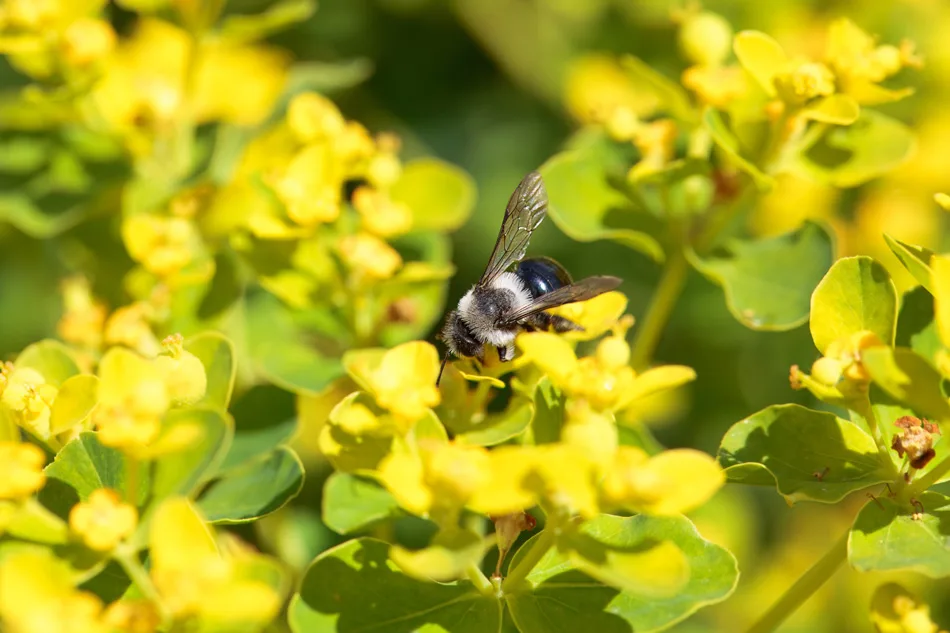
From Pentridge Hill, the view is just about as natural as any landscape in Dorset can be nowadays. Brown hares coddle themselves into forms on the edge of the hill, their eyes on red kites drifting silently only 20 feet above.
Below them is a patchwork of green hankies stitched together with hawthorn blossom. Buttons of ancient tumuli sit beside long barrows. It is sunny. Early April. Still coat weather, but there’s enough warmth that you tip your head back and close your eyes to feel it.
I wasn’t expecting bees.
I’d climbed up to join the Jubilee Trail that runs along the top of the hill. With Blandford in the distance on my left and Martin Down to my right, it’s a show-stopper of a view. But as the sandy, well-trodden footpath dipped in front of me, I looked down and saw the path was alive with ashy mining bees.
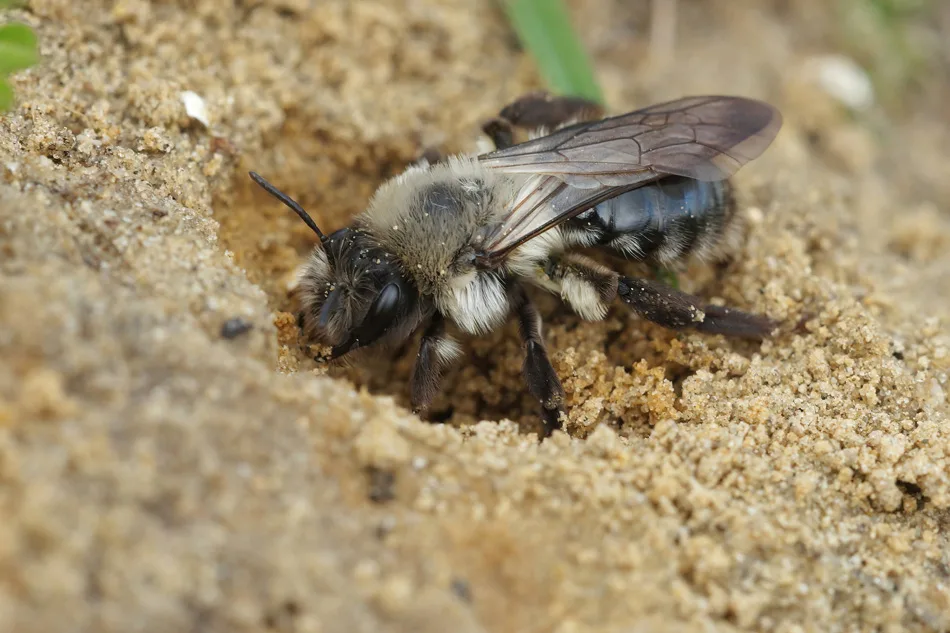
Flying only a few centimetres above the ground, some looked to be in pursuit of mates, others disappearing into holes in the path, each with a small volcano of excavated earth beside it.
With so many holes so close together, it would be easy to think you’d found a communal nest. But these bees are solitary. Each female digs her own burrow about 10-20 cm deep, stocking it with pollen before laying an egg that will develop underground and emerge as an adult next spring. These aggregations of burrows simply form because it’s a perfect place to nest – a bee utopia, you might say.
A friend of mine once described the ashy mining bee as the ‘snow leopard of the bee world’, and it’s definitely a looker. Of the 250 or so solitary bee species in Britain, this is one of the most common and easiest to recognise. Both males and females have black and white bands across the thorax. The female has a glossy black abdomen, while the male’s is dusted with grey hairs.
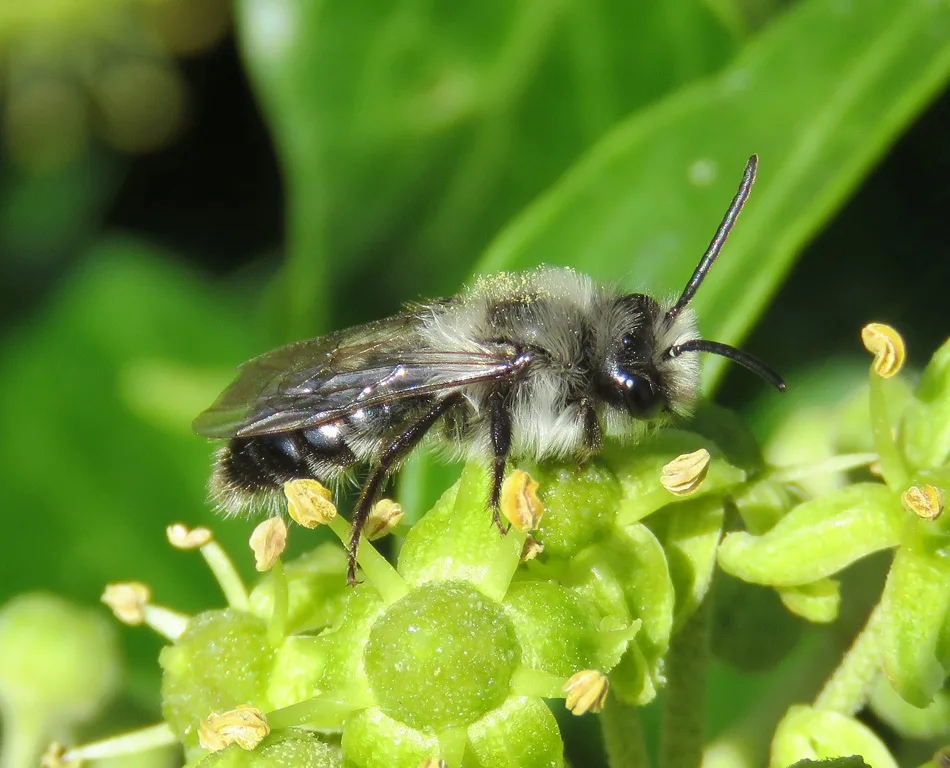
Image © Steven Falk
They only live for a few weeks, but are fantastic pollinators, often emerging just as fruit trees, such as apples and pears, begin to flower.
As with most wild bees, they aren’t aggressive – I sat watching their comings and goings from only a few feet away.
In that moment, my world shrank from the landscape of Cranborne Chase to a five-foot square patch of soil and some black and white bees.
A week later I visited my mum, excited to tell her about the bees at Pentridge. As I sat drinking tea on a bench in her garden, I could feel eyes on us. Sure enough, in the close-cut lawn and neat flowerbeds of her suburban garden, ashy mining bees sat at the entrances to their newly dug nests, their little heads poking out as my mum weeded carefully around them.
‘Oh, them,’ she said when I excitedly pointed them out. ‘They’re here every year.’