

Dorset already ranks among England’s highest council tax area – as bills rise again, sharp variations in parish precepts prompt fresh scrutiny
As council tax bills begin landing on doormats across Dorset, many households will notice another increase.
Dorset Council has agreed a 4.99% rise – the maximum it can charge without triggering a local referendum. While council tax is calculated according to property value, the total bill also includes separate charges for adult social care, the police and fire services, and the parish or town council precept.
Nationally, Dorset is already among the most expensive areas in England for council tax. For 2025/26, Dorset Council’s Band D charge stands at £2,630.30, placing it third highest nationally behind Rutland and the City of Nottingham.
But within Dorset itself, it is the parish and town council precept that varies most dramatically.
What is a precept?
A precept is the amount requested by a parish or town council to fund local services. These range from grass cutting, public toilets and play areas to CCTV systems, street lighting, allotments, recreation grounds and community facilities. Unlike principal authorities, parish councils often have limited income streams and rely heavily on the precept.
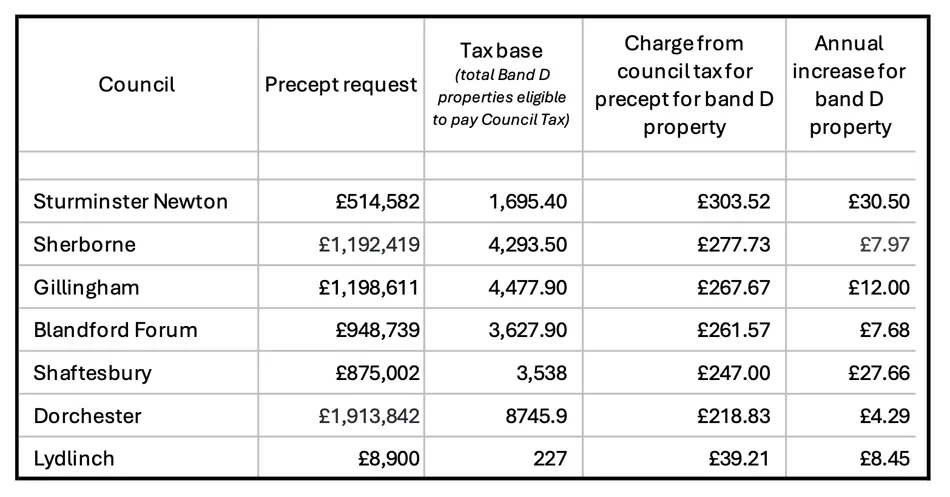
This year, towns and parishes across Dorset have reviewed their budgets against rising costs in wages, fuel, utilities and maintenance. Some have also chosen to fund new projects or expand services. The table opposite shows how precepts vary across several Dorset towns.
A wide variation
The difference is striking.
A Band D household in Lydlinch will pay £39.21 towards its parish council this year. In Dorchester the figure is £218.83. In Sherborne it is £277.73. In Shaftesbury it is £247.
But in Sturminster Newton, the Band D precept charge is £303.52 – the highest among the towns listed – with an annual increase of £30.50: also the highest increase in the county.
So why is Sturminster Newton’s figure higher than larger towns such as Dorchester or Sherborne?
One key factor is the ‘tax base’ – the total number of Band D equivalent properties contributing. Dorchester’s tax base stands at 8,745.9. Sherborne’s is 4,293.5. Sturminster Newton’s is just 1,695.4. When costs are spread across fewer households, the charge per property rises accordingly.
Another factor is income generation. Some councils operate car parks or own significant buildings that generate rental income, helping offset expenditure. Others have fewer assets from which to raise funds.
Sturminster Newton Town Clerk Kate Squire explained the context behind this year’s decision:
‘Sturminster Newton Town Council considered a range of budget options for 2026/27, setting out the impact of different service and project scenarios on the precept. Following that, the council approved a precept request of £514,582.00 for the 2026/27 financial year. For a Band D property, this represents an annual increase of £30.61.
‘The approved budget includes £10,000 to fund one day per week of Citizens Advice provision at The Exchange, supporting local residents with access to independent advice services within the town.
‘Unlike many town councils, Sturminster Newton Town Council does not have significant chargeable assets from which to raise income. The council receives only a modest level of income from sources such as room hire and cemetery fees, and does not operate car parks or other facilities with regular paying customers.
As a result, a greater proportion of the cost of delivering local services must be met through the precept rather than being offset by income. Wherever possible, the council actively seeks to secure external grant funding for projects, in order to reduce the burden on local taxpayers and ensure that improvements and community initiatives are delivered in a cost-effective way.’
Some potential service changes and higher-cost options were considered during the budget-setting process, but councillors concluded that more detailed work and consultation would be needed before pursuing them: ‘Members agreed that proposals of this nature would require community consultation and, if necessary, a review to ensure transparency, fairness and long-term sustainability. The information required to undertake that work could not be gathered and properly considered within the timescales required to meet the statutory precept deadline.
‘The town council’s precept funds a wide range of services and facilities that directly benefit residents and contribute to the day-to-day running, safety and appearance of the town. These include the operation and maintenance of Station Road public toilets, the town’s CCTV system, two equipped recreation grounds and four smaller play areas, two nature reserves, the cemetery, the Mill, and the Youth Club. The Council is also responsible for maintaining over 60 litter bins, more than 30 benches, street cleaning within the town centre, several miles of public footpaths, two allotment sites, formal gardens and other open spaces, as well as street lighting, a community newsletter, and the provision of small community grants.
‘In addition to these visible services, the precept covers the staffing and administrative costs required to deliver them lawfully and to an appropriate standard.’
Different choices
Looking across Dorset, it becomes clear that precepts reflect a combination of:
- The size of the tax base
- The range of services provided
- The number and type of assets owned
- The level of income generated
- Local priorities and projects
Dorchester, for example, has the largest overall precept request in cash terms, reflecting its larger size and wider responsibilities. Sherborne and Gillingham sit close together in Band D charges, despite different tax bases. Smaller parishes such as the village of Lydlinch have far lower absolute costs and therefore lower charges.
With Dorset already among the highest council tax areas nationally, understanding how parish and town precepts are calculated – and why they vary so widely – is likely to become an increasingly important part of local discussion. For many residents, the parish element of the bill is the most visible reminder that local services, however small, come at a cost.