The Blackmore Vale logo
Home Blog Page 9

A hive of progress as North Dorset’s Honey Bee Centre nears completion

0

Years of planning and volunteer effort have turned a corner of a Shillingstone field into a purpose-built Honey Bee Centre, with education firmly at its heart
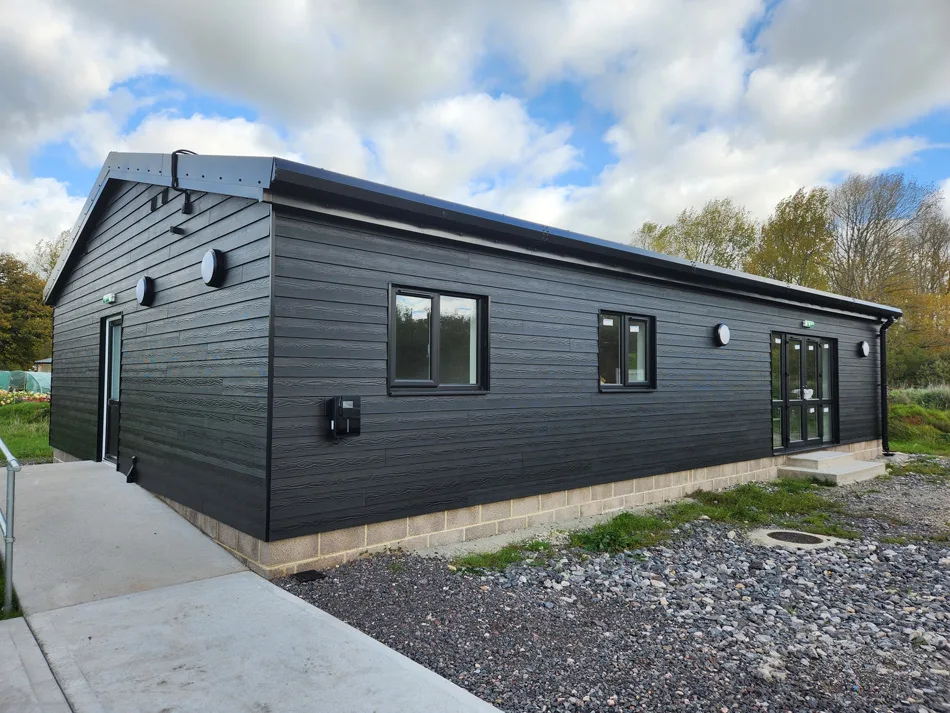
The new North Dorset Honey Bee Centre in Shillingstone is already in use, although the official opening won’t be until May. All images: North Dorset Beekeepers Association

When The BV first spoke to the North Dorset Beekeepers Association in January 2024, the limitations of their exisiting site in Shillingstone were obvious. As spokesman Robbie Baird put it at the time: ‘The site is remote – accessed by crossing a field and two wobbly stiles – and once you’re there, there’s no electricity, running water or any other facilities, just a storage hut and a corner of a field to keep the beehives (the apiary) … It’s better than nothing, but it does mean hosting anyone but the fully able-bodied simply isn’t an option.’ Now, that picture has changed entirely.
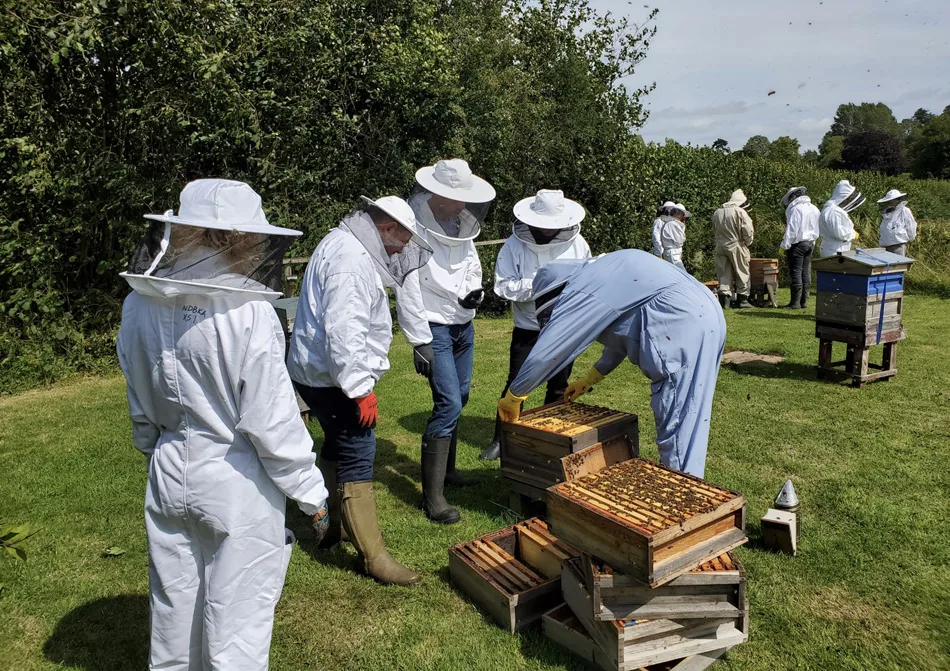
A Bees & Beekeeping Experience Day, run by the North Dorset Beekeepers Association

A practical space
‘It is finished,’ says Ian Condon, a long-standing member of the North Dorset Beekeepers Association. ‘Well – finished in the sense that the building’s there and it’s usable. It’s now just the nitty gritty stuff inside – fire extinguishers, lighting, connecting up the dishwasher … all the boring but essential bits.’
The new North Dorset Honey Bee Centre is the culmination of years of planning, fundraising and volunteer labour. Where once there was a hut and a corner of a field, there is now a purpose-built, eco-friendly teaching facility designed to open beekeeping up to a much wider audience.
Inside, the building is centred around a large main room – roughly nine by ten metres – where meetings, talks and training courses will take place. ‘That’s where people will spend most of their time,’ Ian says. ‘We can sit down, we can teach properly, we can have conversations. That’s something we just couldn’t do before.’
Alongside it is a fully equipped kitchen, toilets, a general store and a bottling/honey room with a dedicated warming cuboard. That last space, Ian explains, is crucial to how honey is handled.
‘People think you just take the honey out of the hive and stick it in a jar,’ he says. ‘But honey crystallises. If you’ve got a solid bucket of honey, you can’t bottle it. At the same time, you can’t just heat it up, because you destroy what makes it honey.’
Instead, the centre includes a warming cupboard where honey can be gently brought back to liquid form over several days. ‘You’re talking about very controlled temperatures,’ Ian says. ‘Slowly does it. That way you keep all the properties of the honey intact.’
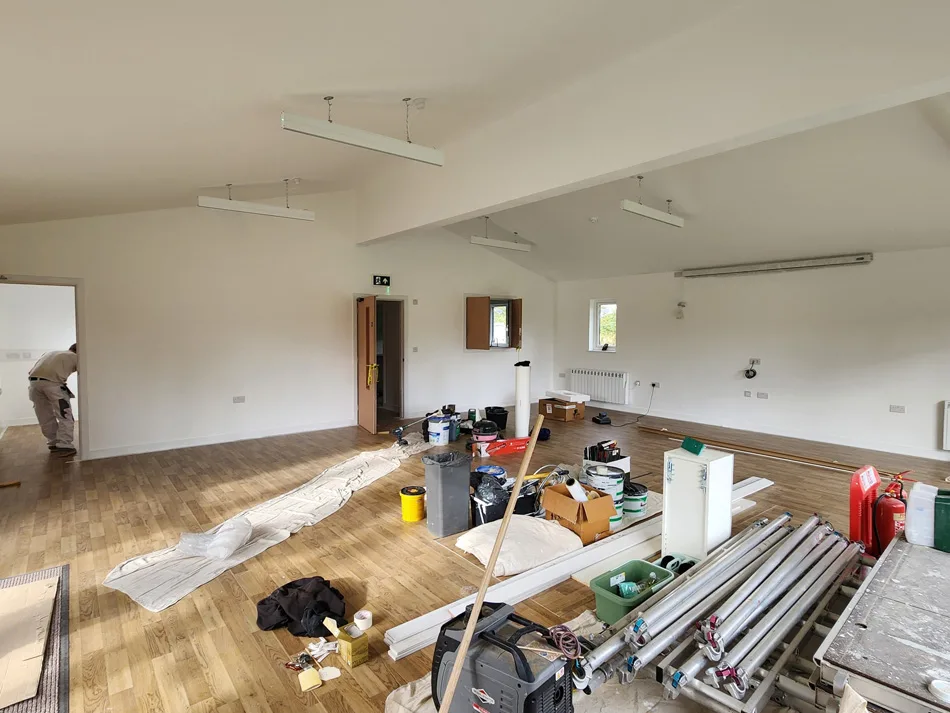
Volunteers are putting the finishing touches to the centre

New opportunities
Education is at the heart of the project. Training courses restart this month, but the ambition goes much further than that: ‘Our whole plan is to open this up to the wider public,’ Ian says. ‘We’d love to see school parties here, adult learning groups, people who are just curious about bees and how important they are. That’s always been the dream.’
Crucially, the new building removes the accessibility barriers that previously limited opportunities. It is not only fully accessible, but also one end features a large picture window overlooking the apiary.
‘Some people just can’t get out to the hives,’ Ian says. ‘That’s the reality. But now they don’t have to. They can stay inside, warm and safe, and still see what’s going on.’
Hives can be positioned outside the window, and a beekeeper can work with them while wearing a radio microphone. ‘They can hold a frame up to the glass, talk people through what they’re seeing, explain what the bees are doing. You can be fully involved without having to put a suit on or walk across uneven ground.’
That focus on access and inclusion sits at the heart of the project. Environmental considerations have also shaped the build. The centre is well insulated and heated entirely by electricity, producing no direct carbon emissions. Solar panels on the roof generate power, feeding surplus back into the grid when not needed, and an electric vehicle charging point has been installed outside.
‘From that point of view, it’s as eco-friendly as we can reasonably make it,’ Ian says. ‘We wanted the building to reflect the values of the association.’
Outside, work continues. Weeks of heavy rain delayed grass seeding, and around 130 metres of native hedging will be planted to surround the site. Areas near the hives will be kept mown for safety during training sessions, with wildflower planting planned elsewhere.
None of this, Ian is keen to stress, would have happened without volunteers. He singles out Robbie Baird for overseeing much of the project, but repeatedly comes back to the collective effort behind it.
‘It’s been a proper team job,’ he says. ‘People have given their time, their skills, their energy. And the fundraising side has been amazing. We didn’t even realise until mid-summer that we’d actually hit our target – and then the National Lottery came in with the final amount that got us there.’
With landscaping still to finish and an official opening planned for late spring, the North Dorset Honey Bee Centre is not quite the finished article yet. But it has already transformed what the association can offer – turning a remote, limited site into a place of learning, inclusion and connection.
‘It’s going to let us do things we’ve never been able to do before,’ Ian says. ‘And that’s incredibly exciting.’
From wobbly stiles to wide doors, the buzz around Shillingstone is well deserved.

There are still a few places open on this year’s Beekeeping for Beginners Course starting in April: see northdorsetbeekeepers.org.uk

Letters to the Editor January 2026

0
Laura
Laura Editor of the BV

Forget these posh new years. I’m in the market for a low-mileage 2005. Maybe a well-cared for 1997.
I miss being plain old sad about the world. Not this perpetual catastrophically horrified. Just … regular sad. The kind you could shake off with a hot drink, a long phone call with your sister or a decent walk.
We launched The BV in the depths of lockdown, mid-pandemic, when the world felt strange and fragile and frightening. But every month I wrote my editor’s letter with a mug of tea in one hand and a virtual pompom in the other, cheerily insisting we’d all bounce back soon.
Five years later and I’ll be honest – the positivity is hanging on by its fingernails.
We did at least personally end 2025 on a high. Christmas was loud, chaotic and utterly brilliant, with three generations squeezed elbow-to-elbow around our table (officially seats eight, actually sat a new record of 11 – thanks to Dorchester Timber and a heroic delivery of a sheet of cut-to-size chipboard). The fridge was emptied, the dishwasher was permanently on, cheese featured at every meal … and I wouldn’t have changed a thing.
Then New Year’s Day arrived, everyone went home, the stunning frozen sunshine appeared … and I immediately caught the latest not-Covid-but-thinks-it’s-Covid virus.
So I spent the first week of 2026 under a blanket with endless mugs of hot honey and lemon, grumpily coughing and feeling both grotty and grateful. Because even with all the throat-clenching doom and global drama – and yes, the news is still doing its level best to make us all despair – I’d had a full nest for the first time in two years. And I also had time and space with a good book (thank you, Thursday Murder Club).
And that counts for something.
So no rallying cry this month. No silver-linings pep talk. Just a nod – from one tired grown-up to another: we’re still here. Still showing up. Still muddling through.
And for January, that’ll do.

Laura x


On West Farm
I’m now well into my seventies, but I’ve worked on the land all my life, and I’ve seen no end of changes in how land and buildings are used. Some for the better, some less so. Reading about West Farm’s transformation, I couldn’t be more pleased.
Turning an old farmhouse into a supported home for young people is a wonderful use of resources – a real act of kindness and long-term thinking. The countryside can be isolating if you’re vulnerable and alone. This scheme offers not only shelter, but dignity, purpose and connection.
Farming teaches you that strong roots matter. It’s heartening to think that West Farm might help some of these young people finally put down roots of their own.
AB, Blandford


I aged out of care in the late ’90s. The day I turned 18, my life felt like it was packed into two black bin bags and a social worker’s timetable. No plan, no support – just a housing list and a warning not to mess it up.
Reading about West Farm stopped me in my tracks. A safe place, surrounded by countryside, with people who understand trauma and take the time to teach life skills? I would have given anything for that. You don’t magically know how to budget, cook or get a job because someone handed you a flat. It’s terrifying and lonely. I’m so glad today’s care leavers in Dorset have the chance I didn’t.
To everyone involved in West Farm: thank you. You’re changing lives before they get broken.
Name withheld


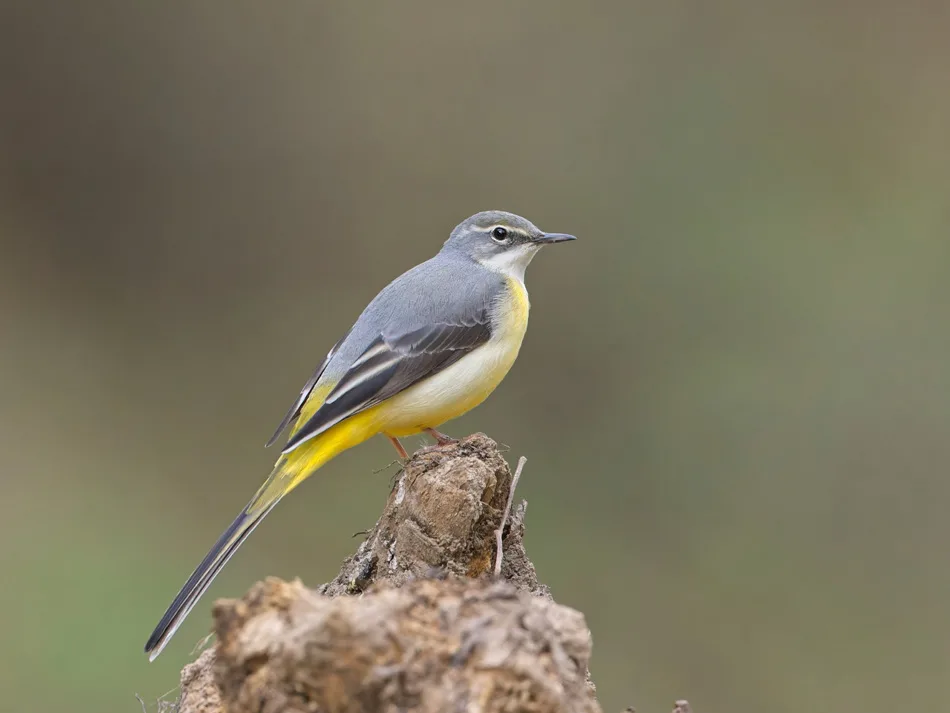
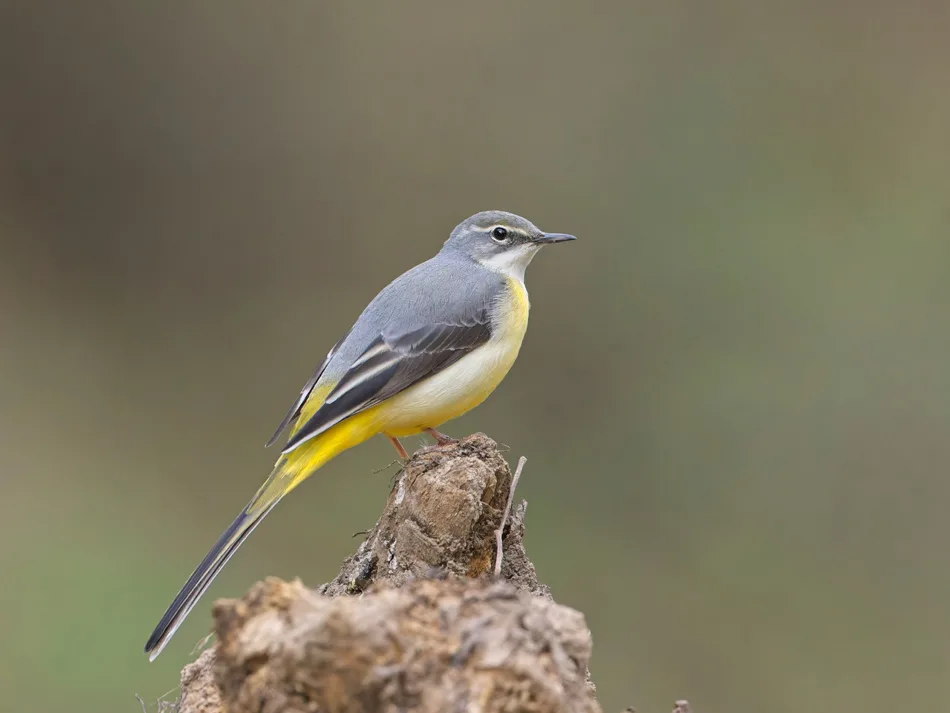
Grey wagtail, Motacilla cinerea, perched on a stump – not to be confused with its yellow cousin, it has that soft grey back and a much longer tail

On wagtails – and Jane Adams
I’m 63, born and bred in Dorset, and for the last 50-odd years I would have confidently told anyone who’d listen that the cheerful, dipping yellow bird spotted near the bridge in Wimborne was a yellow wagtail. Turns out I have been wrong for half a century – and I just wanted to write and thank you for sharing Jane Adams’ words every month.
She’s quite my favourite writer in the magazine, and never fails to both teach me something and make me look at everyday sights with fresh eyes.
Off the top of my head, I think of her when I see a wren outside my back door, rooks gathering at dusk, listen to a yaffling ‘penguin’ woodpecker – and I never walk by the river without glancing to see if I can spot a bubble-covered water shrew.
I also still enjoy telling anyone who’ll listen that those small black beetles you see on dandelions are actually triungulins – not beetles at all, but the larvae of an oil beetle. I know. You can imagine I’m a delight at a dinner party.
Clare S, Corfe Mullen


On Black Pug Books
I’ve been a regular browser at Black Pug Books for years and rather assumed Victoria was simply one of those wonderfully knowledgeable, slightly formidable booksellers you’re grateful still exist.
I had absolutely no idea about her extraordinary life before Wimborne.
Reading her story was a complete delight – and slightly jaw-dropping. Queen, Frost, the Rolling Stones … and there she is now, recommending paperbacks and putting the kettle on. It’s made me see the shop, and Victoria herself, in a whole new light. Next time I’m browsing, I’ll gather my courage and strike up more of a conversation!
J Harvey, Wimborne

I read your piece on Victoria Sturgess and Black Pug Books and immediately told my wife we’re going to Wimborne. I’ll come, of course, for the books – but if I’m honest, I’ll stay for the stories.
Anyone who’s dealt with Queen, travelled with David Frost and still prefers a kettle, a chair and a second-hand book has lived life properly. Wimborne is lucky to have her, and I’m looking forward to hearing a Frost anecdote while pretending to browse with restraint.
PM, Verwood


On wiser landscapes
The biggest problem is building on land. The more you cover it in concrete, the less chance it has to soak up rainwater. Some farmers sell off land for housing – not that I blame them! We do need housing. However, we also need to look at ways to build on already covered land, or at innovative house design. Existing properties will flood if you continue covering land upstream of them.
S. Surtees, on Facebook

Farmers also ripped up hedgerows and created megafields to accommodate larger, heavier machinery, following the subsidies. Overstocking was also a problem. Our local farmers are now doing a great job farming in a wildlife-friendly way and sharing info through a cluster. Beavers and wetlands, restoring meanders and stopping dredging may all help mitigate the effects of climate change – but it’s going to take time.
Kathleen Daly, on Facebook

Farming practices (entirely encouraged by market forces and government policy) have to take some of the blame. Soils are less able to hold water like they used to: lower organic matter, fewer grass leys, more compaction, etc.
Philip Day, on Facebook


On George Hosford’s podcast
One has to wonder what has happened to this once-great country and our education system (one of the more expensive state systems in the world). We expect to import most of what we buy – from food to clothes, dishwashers, TVs to computers.
We find our hospitals are full of imported labour, from doctors to cleaners … the list is endless.
And yet we have millions unemployed and we are close to being bankrupt as a country. Still, our governing class seems determined to close more businesses down by making life more difficult.
L. Gould, West Orchard


Shifting sympathies
Funny, isn’t it, how public empathy moves with the headlines. This time last year we were rightly shouting for Ukraine. Then Gaza (rightly) moved front and centre – and suddenly Kyiv vanished from view.
This isn’t a complaint about people caring – I’m glad they do. But global suffering shouldn’t have to fight for column inches like it’s a talent contest.
Ukrainians are still dying. So are Gazans. So are Sudanese, Yemenis and Afghan women quietly vanishing from public life.
Maybe, just maybe, if we stopped choosing our empathy like a fashion trend and stayed the course, we might actually make a difference.
A Morgan, Shaftesbury


On artificial politics
With both the US and UK heading to the polls this year, we’re sleepwalking into a dangerous new era. AI is now capable of making politicians say things they never said – it’s already happening.
Between deepfakes, bot armies and conspiracy-slinging algorithms, 2024 showed us a preview. 2026 will be the main event. And I fear we’re not ready.
We’ve already lost trust in the press, politicians and public institutions. If we can’t trust our own eyes and ears either, then democracy doesn’t stand a chance.
The question is: who’s regulating this?
Because right now, it’s the Wild West – and truth is the one without a gun.
Judy M, near Blandford


Want to reply? Read something you feel needs commenting on? Our postbag is open! Please send emails to [email protected].
When writing, please include your full name and address; we will not print this, but do require it.

January’s issue is out now :)

0

We know, we know – we’re late this month. We did warn everyone … but we missed us too. On the plus side, it’s only three weeks until February’s issue (on the downside… it’s only three weeks etc…).

This edition is The BV at its eclectic best.

We’ve got hard-hitting reads: why Guys Marsh is currently the most violent prison in the UK, what’s really behind the rural pharmacy crisis, and – yes – yet another bank has closed. But don’t worry, the replacement can do everything you need.
Except handle actual cash, obviously.

Our anonymous parish councillor is back, examining what they’re calling Dorset Council’s Fire Sale. As ever, they have thoughts. And this month’s Grumbler has seen Visit Dorset’s latest video – and isn’t madly impressed.

But it’s not all doom and dysfunction. There are beavers. Bees. Books. A dormouse. There’s the most beautiful ice-fungi combination you’re ever likely to see. And the story of a Dorset man who rose to become the most powerful figure in England – Henry VII’s favourite advisor.

The letters page is bursting. Lizzie’s pear and blue cheese tart is exactly what that sad lump of Christmas Blue Vinny was waiting for. Tamsin’s shooting arrows from horseback (entirely legally), and we’ve got a lovely story of an elderly Thomas Hardy springing to his feet to demonstrate the correct way to dance.

What’s not to love, frankly?

See you in three weeks.

Why AI-Driven Entertainment Works Best in Short Sessions

0

The past 12 months in technology have been defined by AI. In 2025, it sat in an odd middle ground. No longer just a novelty, but not something people fully trusted either. 

Throughout the year, AI has progressed beyond joke filters and party tricks, while quietly transforming how we work, communicate, watch, and create. Almost without noticing, it began reshaping how we spend our free time and entertainment.

Photo by Vitaly Gariev on Unsplash

Bikini filters and viral Grok face-swap tools appeared across Elon Musk’s X rebrand. AI became a pocket interpreter, turning foreign conversations into subtitles. People generated birthday videos, fake trailers, and reanimated Star Wars scenes, including a whole Darth Vader miniseries on social media. 

These won fans over, but only in short bursts. In a year defined by information overload, AI found its natural home in the smallest possible moments.

The rise of social media has certainly been influential. TikTok’s model of 30-second videos gives that quick flash of dopamine and quick hit of entertainment that has proved the most successful way of keeping viewers engaged over the last year. 

Here, we break down the best examples of why it’s working and why we think this will be the overarching theme of 2026 in entertainment.

The Psychology of Short Form

Short sessions are perfect for AI because they generate dense behavioural data in a tiny window. Every swipe, spin, skip, or tap becomes a signal.

Short loops give users control. No long commitment, pure low-friction repeatability that gets used across multiple industries. 

Online casino crash games like Aviator nail this. Players bet on how long a plane will stay airborne, cashing out before it crashes or losing everything if they wait too long. 

The format works so well that Spribe, the online casino game developer, signed multi-million pound partnerships with sports giant TKO Group. As competition intensifies, new casino sites lean on proven providers and familiar fast-loop formats to win players quickly.

Musicians now test 15-30 second TikTok hooks, predicting virality from swipe-away speed. Platforms optimise discovery feeds so every tap trains the algorithm.

This mirrors the casino crash-game loop. Short session, instant feedback, AI adapts, repeat. It’s why songs now break on TikTok before radio, and why artists design intros for the algorithm rather than the album.

AI That Shapes Streaming 

In 2026, streaming isn’t a luxury. It’s a subscription maze. Netflix, Disney+, Prime Video, Apple TV+, Paramount+, Peacock, Discovery. Each with vast libraries, overlapping catalogues, fragmented exclusives, and rising monthly fees. The battle now is for wallet share, loyalty, and habit. AI has to be bang on.

The smartest platforms know the algorithm should never feel like an algorithm. The human element is simple. People arrive at streaming platforms tired. They’ve worked all day, scrolled all evening, and now they want one thing: ease. 

Nobody opens a streaming app hoping to make a decision. They open it, hoping the decision has already been made for them.

That’s why the recommendation moment has to be fast, light, and low-stakes. A hover over a thumbnail, a trailer preview, a quick scroll. That’s all most people have the energy for. If the platform can’t hook them in that window, they bounce.

Momentary sessions match end-of-day reality as people crave results without effort. Netflix knows this. Hit play within three seconds? AI wins. Scroll for 20 minutes, then quit? It fails. The difference is friction.

This is why the algorithm must be invisible. When you feel understood by a platform without having to explain yourself, that’s the algorithm doing its job properly. The comfort comes from emotional relief, not just convenience.

The Cultural Angle

People reject AI when it feels intrusive, preachy, overly automated, or like it’s replacing human creativity. But they embrace AI when it feels helpful, invisible, and personalised. Micro-interactions hide the machinery. You don’t think about the algorithm. You just enjoy the next spin, swipe, or clip.

This is exactly where e-commerce comes in. To many, shopping is entertainment, especially as social media and television influence buying habits. 

It could be a recipe, a piece of clothing, or some merch. Apple Pay and PayPal are perfect examples of low-effort design. No wallet, no card details, no second-guessing, no cognitive load. Just tap, confirm, done.

Behind Apple Pay’s one-tap magic, AI silently handles fraud detection, risk scoring, personalised recommendations, and delivery predictions. All invisible, all keeping you in flow. Just like a 15-second YouTube Short or a single casino spin.

This mirrors the same psychology as a five-second TikTok swipe or a Netflix “Play Something” shuffle. Light-touch interactions where AI can learn fast and act instantly. 

The cultural shift is that people no longer want to think about technology. They want technology to think for them. And AI does that best when it stays quiet, works fast, and gets out of the way.

The reason this matters for entertainment is simple. Attention is now the most valuable currency, and AI is the most efficient way to spend it. When shopping feels like entertainment and entertainment feels effortless, the lines blur completely. 

AI-driven entertainment works because it respects the limits of human attention. It doesn’t demand commitment or patience. It offers instant results, learns from behaviour, and adapts in real time. Whether you’re swiping through TikTok, spinning a casino game, or tapping through Netflix suggestions, the experience is the same: quick, personalised, and low-effort.

As we move further into 2026, expect this model to dominate. Short sessions work because they match how AI learns best and how humans actually behave. What this means for creativity is still unfolding, but it’s clear that the future of entertainment will be about earning attention faster, not holding it longer.

Dorset Council budget relies on Council Tax to fund rising care costs

0

Dorset Council has published its draft budget proposals for 2026/27, revealing that the majority of new spending on social care and services will be funded through Council Tax rises rather than additional government support. The council plans to spend £482.6m running services next year – an increase of £18.9m on 2025/26. Around 60% of that total will be spent on care for elderly residents, vulnerable adults and children.

Council Tax is set to rise by 4.99%, made up of a 3% general increase and a 1.99% adult social care precept. For a Band D household, this equates to an extra £2.02 per week (£105 a year). Dorset already has one of the highest Council Tax levels in the country, with the average Band D bill for 2024/25 standing at £2,454, placing it among the top three local authorities nationally.

The draft budget papers show that Dorset Council’s Core Spending Power will increase by £25.9m in 2026/27. However, £24.1m of that – around 93% – is expected to come from Council Tax rather than new government funding, underlining the council’s growing reliance on taxing local residents to balance its books.

The council says this reflects longstanding unfairness in the way local government funding is distributed. Dorset serves a large rural and coastal area, with dispersed communities that are more costly to serve than urban populations, and an older demographic that places sustained pressure on adult social care budgets.

Cabinet Member for Finance Cllr Simon Clifford said Dorset’s rural nature, ageing population and transport challenges were not properly recognised by national funding formulas.


93% is expected to come from Council Tax, underlining The council’s growing reliance on taxing local residents to balance its books

‘Even though Dorset is a rural county, with the oldest population in the country and poor transport links, this is not recognised by government,’ he said. ‘Dorset deserves fair funding – but it is not getting it.’

Similar concerns have also been raised at a national level. Writing in his column for The BV this month, North Dorset MP Simon Hoare said: ‘There must be a clear rural dimension for funding formulas for schools, police, local government and the Environment Agency. Without it, we are in the fight with one hand tied behind our backs.’

Risk level ‘high’

The draft budget includes an additional £12m for adults and housing services and £5m for children’s services, alongside £1.7m to support children and young people with complex needs. Rising demand and inflationary pressures are cited as the main drivers of the increased spend.

Major capital spending is also proposed, including £8m to complete the new recycling centre in Blandford, £6m to complete major safety works at Dinah’s Hollow on the C13 in North Dorset and £7.7m for a new reablement centre in Bridport. Car parking charges are to be frozen for a further year.

However, the council’s own Medium-Term Financial Plan warns that the financial risks facing Dorset remain high. The report describes both the current and residual financial risk level as ‘high’, and confirms that future budgets are increasingly dependent on Council Tax rises, service efficiencies and outlined savings being delivered.

It also highlights growing pressure from special educational needs and disabilities (SEND) costs. Dorset’s Dedicated Schools Grant deficit is forecast to exceed £150m by March 2026, with servicing costs of around £5m a year. 

While government accounting rules currently prevent the deficit from triggering insolvency, those protections are due to end in 2028. The proposed budget relies on a programme of savings through automation, service redesign, vacancy management and reduced back-office costs. The council acknowledges that failure to deliver these savings, or any further increases in demand-led services, would place additional strain on future budgets.

  • The draft proposals will be scrutinised by councillors at the People and Health Scrutiny Committee on 21 January and the Place and Resources Scrutiny Committee on 22 January. Final recommendations will go to Cabinet on 29 January before being considered by full council in February.
  • All budget papers are published on the Dorset Council website, and the full Budget and Medium-Term Financial Plan Strategy Report can be read here

The BV puzzles – January 2026

0

Welcome to January’s BV Puzzles page – your free spot for a quick brain workout. Complete the crossword, test your logic with a classic sudoku, or relax with our massively popular seasonal Dorset-themed jigsaw: this month we have a December sunset, with a skeletal tree filled with noisy rooks. We were on our way home for an afternoon walk when Courtenay stopped his car right in the middle of the lane (between Hazelbury Bryan and Stoke Wake) to take it!
No logins, no printouts – just free puzzles updated every month right here on The BV.
Perfect for puzzle fans across Dorset and beyond, our digital puzzles work on mobile, tablet or desktop. Enjoy a quiet moment of challenge with new puzzles published every issue of The BV magazine.


Made by The BV with the online crossword maker from Amuse Labs

Play Sudoku online!

Celebrating Dorset, rebuilding trust

0

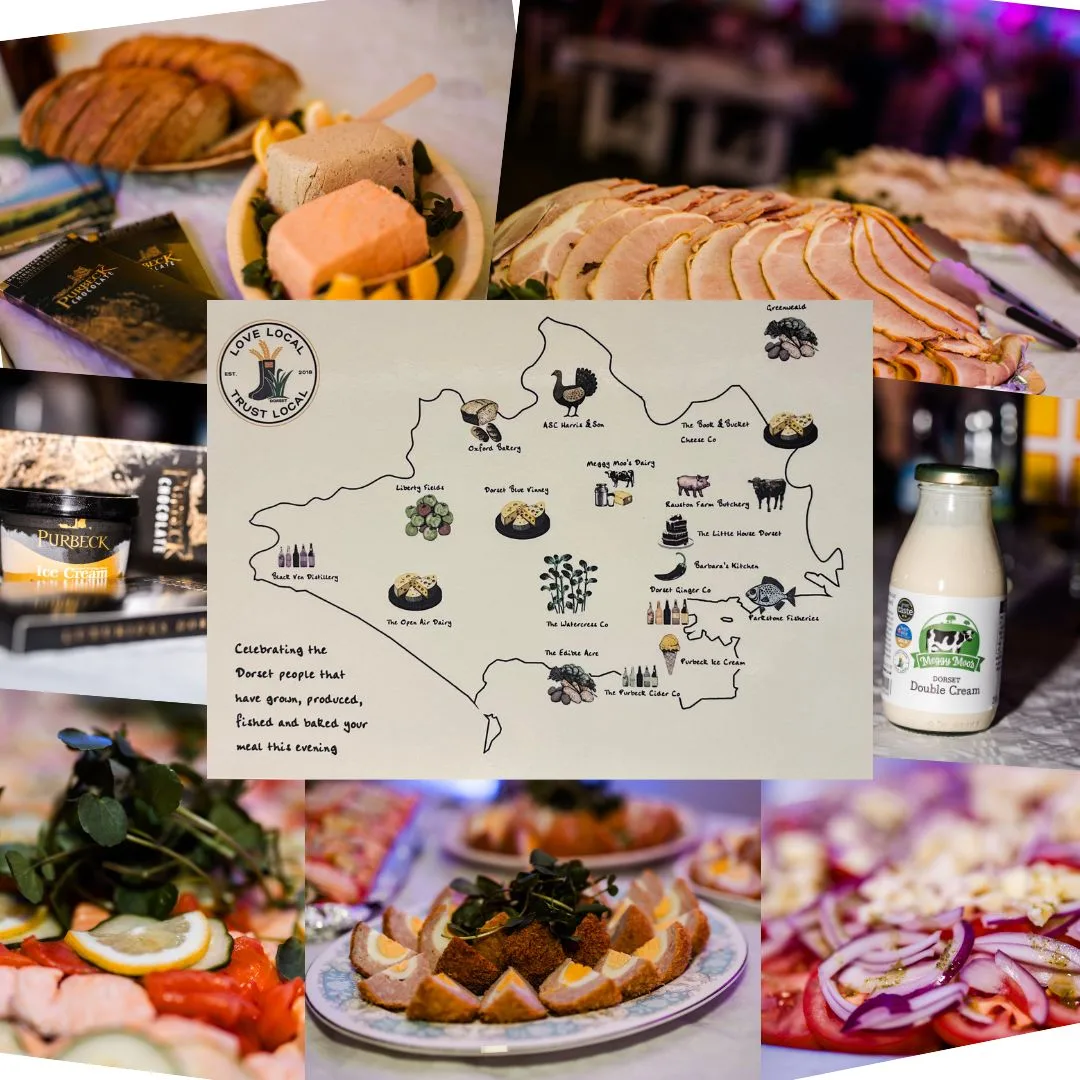
In 2018, Love Local Trust Local was created to bring something back into our local community that many felt had gone missing: trust.


As producers, business owners and customers, we’ve all seen growing confusion around food labelling, sourcing and provenance. We see products marketed as local or British, decorated with flags, logos and claims that suggest one thing – yet when you look closer, the reality often tells a different story. It’s misleading, and it’s unfair to the people working hard every day to create, grow, raise and produce goods with care and integrity.
Most well-known schemes and labels started with good intentions, but over time some have lost their way. Too often they’ve become more about paperwork, scale and pleasing big retailers than protecting the interests of independent producers or consumers. They’re no longer truly producer-led, and they don’t always reflect the real value of local skill, craftsmanship, time and investment.
That’s why Love Local Trust Local exists.
We believe in honest labelling, clear provenance and supporting local producers, local businesses and local pride.
When people see our label, they know exactly where something has come from – right down to the county it was produced in. It’s about rebuilding the connection between products and the people behind them. And it’s about giving customers a real choice and a real reason to support local.
Because when you know who made something, where it came from, and why it matters, trust follows – and communities thrive.


So please get behind the Love Local Trust Local Awards in 2026. Nominate. Enter. Become a sponsor. Get involved.
Help us celebrate and support the incredible producers, makers and businesses here in Dorset
Barbara Cossins

LLTL 2026 awards are now open for entries – find the entry form here – https://www.lovelocaltrustlocal.co.uk/awards-entry-form/

sponsored by Wessex Internet

Angela Rebecca Teasdale

0

5th October 1976 – 14th December 2025

Angie passed away suddenly at home on Sunday 14th December, aged 49 years. Devoted wife to Roger, proud mother to Leighton, much loved by family and friend to so many.

Funeral Service is at Poole Crematorium at 1100 on Friday 16th January, refreshments following at the Exchange, Sturminster Newton 1300-1600.

Family flowers only please but donations in lieu of flowers can be made to Fire Fighters Charity or Teddy20 if desired. The easiest way to do this is via the Much Loved page https://angelateasdale.muchloved.com but if you would prefer you could send donations to Grassby & Close Funeral Service, Sturminster Newton.

For those unable to attend, who may wish to watch the service, streaming is available live and on demand. Please request access to this from Roger in plenty of time.

How the seasons in Blackmore Vale change your daily commute

0

Most drivers treat country lanes the same year-round, but Blackmore Vale’s seasonal shifts demand different approaches to stay safe. From summer’s dust clouds to winter’s frozen ruts, these narrow roads change character completely every few months.

The Blackmore Vale presents unique challenges for motorists throughout the year. Narrow lanes with high hedgerows, limited passing points, and surfaces that deteriorate with weather create conditions rarely found in urban areas. Rural road fatalities account for 60 per cent of all fatalities despite carrying only 44 per cent of road traffic, with one in every 31 accidents resulting in death compared to one in every 120 on urban roads.

Spring brings mud and agricultural activity

Spring brings intensive farming work across the region. Tractors moving between fields deposit thick mud on road surfaces, particularly after rain. Local councils regularly warn drivers about these contaminated surfaces and reduced grip levels. These muddy patches reduce traction significantly and can hide potholes that developed over winter.

Fluctuating temperatures lead to changes in tyre pressure, which can affect handling on already unpredictable surfaces. Spring showers make conditions particularly slippery where mud mixes with rain. Drivers should anticipate sudden stops where farm machinery blocks the road and carry basic supplies, as many lanes lack mobile signal.

Summer creates dust and visibility issues

Dry summer months create their own problems. Dust from harvesting settles on windscreens, reducing visibility when sunlight hits at low angles during morning and evening commutes. Overgrown vegetation narrows already tight lanes, with branches scratching paintwork and obscuring road signs.

High temperatures affect vehicle cooling systems on steep climbs, whilst extended heat exposure impacts tyre pressure and condition. Experts at Precision I.A. Detailing note that overheating becomes a major concern during hot months, especially when cooling systems aren’t in peak condition. Tourist traffic increases substantially, with drivers unfamiliar with single-track etiquette causing delays. Popular walking routes mean more pedestrians on roads without pavements, requiring extra caution around blind corners.

Autumn and winter present the most challenging months

Autumn transforms road conditions dramatically. Fallen leaves create a slippery layer, especially dangerous on corners and hills when wet. They block drainage gullies, causing water to pool across surfaces. Morning frost catches many drivers unprepared, particularly on shaded sections that remain icy while surrounding areas have thawed.

This is when vehicle preparation matters most. Tyre condition becomes critical—worn tread struggles with wet leaves and mud tracked onto tarmac from field entrances. As reported by the AUTODOC expert: “It’s not a good idea to mix different types of tyres on your car, such as winter and summer tyres or different treads, as this can seriously impair handling, braking and stability.” This warning proves particularly relevant on Blackmore Vale’s challenging terrain, where consistent grip across all wheels prevents dangerous skids.

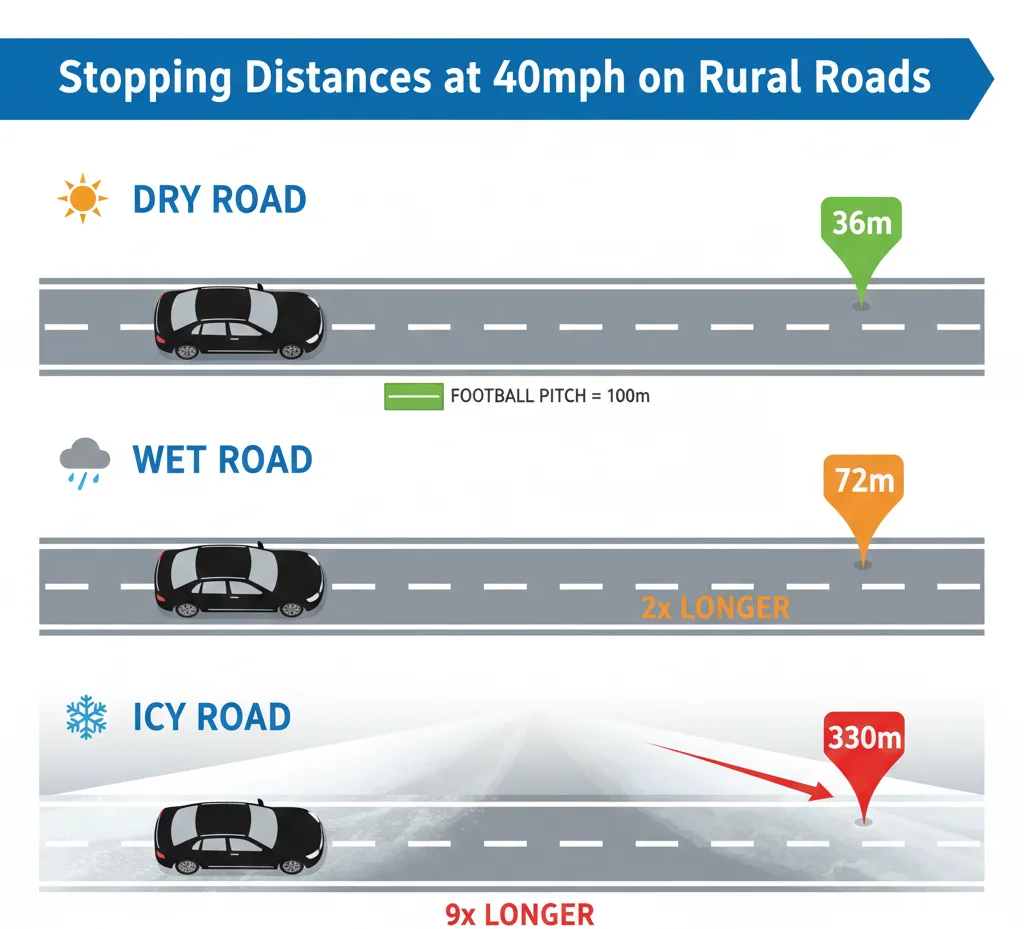
Winter brings the hardest conditions. Stopping distances can be up to ten times greater on icy roads than dry roads, whilst braking distances double in wet weather. Cold temperatures affect battery capacity and thicken engine fluids, making starting difficult on frosty mornings. Ice forms in ruts created by tractors, making steering unpredictable. Many minor lanes receive no gritting treatment, leaving drivers to navigate treacherous surfaces independently.

Understanding stopping distances on rural roads

The difference between safe stopping and a collision often comes down to understanding how weather affects your ability to stop. At 40mph—a typical speed on Blackmore Vale’s narrow lanes—the contrast between conditions is dramatic. On a dry road, you’ll stop within 36 metres, roughly a third of a football pitch. This feels manageable and gives most drivers confidence in their reactions.

Wet conditions tell a different story. That same 40mph now requires 72 metres to stop—double the distance. Suddenly, what seemed like adequate space becomes insufficient, especially on lanes where visibility around bends rarely exceeds 100 metres. Rain doesn’t just make surfaces slippery; it fundamentally changes your vehicle’s relationship with the road.

Winter ice creates genuinely dangerous situations. At 40mph on icy surfaces, your stopping distance extends to 330 metres—nine times longer than on dry roads. That’s longer than three football pitches. On most Blackmore Vale lanes, you simply don’t have that much visible road ahead, meaning if you spot a hazard at normal driving speeds, you’ve already lost the ability to stop in time. This stark reality explains why speed reduction becomes non-negotiable during winter months.

These figures, based on Highway Code and nidirect guidance, demonstrate why experienced rural drivers instinctively slow down when conditions deteriorate. The physics doesn’t care about schedules or familiarity with the route—ice eliminates the margin for error that exists in better weather.

Adapting your approach

Successful navigation requires seasonal awareness. In spring and autumn, assume every corner might have mud or debris. Reduce speed before you see the hazard, not after. Claims data shows a 25 per cent increase in accident claims during November compared with April, highlighting how dramatically conditions change.

Vehicle maintenance shouldn’t follow a standard urban schedule here. Check tyre tread and pressure more frequently, particularly before autumn arrives. Ensure windscreen washers contain proper cleaning fluid capable of removing agricultural residue. Battery checks become especially important before winter. Keep fuel tanks fuller than usual—running low on an empty country road in winter creates unnecessary risk.

Regular users develop instincts about which sections flood, where ice forms first, and which corners collect leaves. This knowledge builds over years, but newcomers can accelerate their learning by driving cautiously and observing how conditions change week to week.

The Blackmore Vale’s beauty comes with responsibility. These roads demand respect and adaptation. Drivers who adjust their habits to match seasonal conditions find rural motoring safer and less stressful throughout the year.

Sources of information: based on UK government data on road traffic accidents (2023), recommendations on traffic rules, the NFU Mutual Rural Road Safety Report (2023), nidirect rules, AUTODOC ( More information about car tyres can be found on autodoc.co.uk ) and Precision I.A. Detailing.

Quick Tips:

Q: When should I switch to winter tyres on Blackmore Vale roads? Consider winter tyres when temperatures consistently drop below 7°C, typically from late October through March, as they significantly improve grip on wet leaves, frost, and icy surfaces common on ungritted lanes.

Q: What’s the most dangerous time of year for driving rural roads in the Vale? November through February present the highest risk, with claims data showing a 25% increase in accidents during November alone due to fallen leaves, ice formation, and limited visibility combined with untreated road surfaces.