The Blackmore Vale logo
Home Blog Page 4

Confessions – from Pepys to Mole

0

In her first Book Corner column for The BV, Victoria Sturgess from Black Pug Books in Wimborne takes us from war to wit in diaries

The New Year often arrives weighed down with resolutions – Dry January, shedding the festive excess, starting a diary… Luckily for us readers, some people really did stick with that last one. And their diaries remain among the most fascinating, upsetting and revealing of books, offering first-hand insights into human history. Samuel Pepys, one of the earliest diarists in modern publishing, gave us a candid, detailed glimpse of 17th century London – from the Great Fire to the plague.

James Lees-Milne diaries

A more modern diary which is known to all is the heart-breaking Anne Frank’s Diary of a Young Girl. Less well-known is her English contemporary: a 49-year-old British woman’s account of life in wartime Britain. It is an unrivalled piece of social history – please read Nella Last’s War for a poignant record of an extraordinary ‘ordinary’ woman.
On an entirely different diary note, if you love waspish, name-dropping, witty tales of aristocratic doings, then you can wallow in 12 volumes of such riches. James Lee-Milne was deeply involved with the National Trust, allowing him to indulge in his love of art and architecture – and gossip.
His style was personified in his declining a CBE in 1993: he felt a knighthood was his due.

Nella Last’s war diary

I think we can all agree to pass over most politicians’ efforts as mainly attempting to blame ‘circumstances‘ for their failures, but a glorious exception is Alan Clark – probably the most gossipy political diaries ever written, with a wickedly sharp account of Margaret Thatcher’s downfall. He liked to style himself a loveable rogue, though I doubt the Iron Lady – once a close personal friend – saw it that way after reading what he’d written about her.

samuel pepys diary

I suspect all political diaries are really written with an eye to notoriety rather than an honest telling of events. Talking of ‘loveable’ rogues, Jeffery Archer’s Prison Diaries are – unexpectedly – an engrossing insight into prison life.
And let’s not forget probably the most read of all diaries: the gloriously hilarious fictional lives of Everyman and Everywoman. Grossmith’s Diary of a Nobody – with the bumbling, absurd yet ultimately endearing character of Mr. Pooter – reflected the snobbishness of middle-class suburbia. E.M. Delafield’s Diary of a Provincial Woman also ridicules the pretensions of an upper middle class woman, this time living in a 1930s Devon village. It’s a comic gem.
It’s also worth noting that, although featuring a now-distant time and society, neither of these last two has ever been out of print. Some human foibles really do never change.
And of course, the only possible way to end is with the GOATS: Adrian Mole and Bridget Jones.

The county Visit Dorset forgot

0

The new big-budget Visit Dorset promotional video has recently been released (see it on the next page), and no doubt sent far and wide to media outlets and influencers in the hope of drawing more visitors to the county. So far, so normal – that is, after all, Visit Dorset’s one job. I happen to work in marketing, so of course I had a professional nosey.
So far the video has had 375,000 views on YouTube. Good job, Visit Dorset! The film is 57 seconds long. It’s beautifully shot, glossy, professionally edited – and it tells you everything you need to know about how Dorset is still being sold to the world.
Clifftops. Beaches. Sea kayaks. Sailing boats. Coastal paths. Big skies over water … Dorset, apparently, begins and ends at the shoreline.

More than a fossil coast
If you blink, you might catch a fleeting glimpse of Sherborne Abbey’s ceiling – two seconds, perhaps – followed by a few seconds of a pretty independent shop and a bakery or café. You’d only know the shop was in Sherborne if you already knew. It could be anywhere.
I still don’t know where the bakery is – but I’m fairly sure it’s not Oxford’s, Dorset’s 200-year-old family bakery that still uses 100-year-old ovens and a 75-year-old dough mixer, the last of its kind in the world. Because why would a PR firm think that was worth shouting about?
After that, it’s back to the coast. Right up until the closing titles, which roll over the only genuinely rural moment in the entire film: a man running after his dog across a stubble field amid farmland.
That’s it. Rural Dorset, reduced to a backdrop for the final credits.
This all matters so much more than you think.
Dorset is not a narrow coastal strip with a bit of countryside tacked on behind it.
Roughly three quarters of the county is rural. Its market towns, villages, farms, hills, footpaths, forests and historic sites are not ‘niche extras’ – they are the place.
And yet, once again, they are barely visible.
I understand the tagline is ‘for a world less travelled’, which may explain the absence of Durdle Door and Gold Hill. But it doesn’t explain the absence of everything else. There are no hillforts. No deep woodland walks. No chalk downland. No ancient tracks and holloways, hidden valleys, ancient parish churches, Georgian market town high streets or even the thatched villages that people already travel hundreds of miles to see.
And certainly nothing so dull as Dorset’s enormous creative and arts sector, including Dorset Art Weeks, one of the largest open studio events in the UK which attracts tens of thousands of visitors.
So none of the things that make inland Dorset not just attractive, but accessible.

Shouting from the sidelines
Why are we making Dorset look so privileged?
How, exactly, is taking the family sailing more aspirational and accessible to most UK households than a walk across a hillfort? Sailing and kayaking require money, kit, confidence, good weather and – crucially – prior experience. Walking requires shoes and a sandwich. Yet the former are endlessly promoted as Dorset’s calling card, while the latter is treated as a footnote, if it’s acknowledged at all.
This isn’t about knocking the coast – Dorset’s coastline is rightly celebrated. It is spectacular, and it underpins a vital part of the county’s tourism economy.
But it is not the county’s whole story. And pretending that it is comes at a real cost. Every time Dorset is marketed as a coastal playground, the rural economy is sidelined. Independent pubs, B&Bs, walking guides, farm attractions, food producers, market towns and countless small inland businesses are left fighting for scraps of attention – despite offering experiences that are often cheaper, greener and more realistic for families and older visitors alike.
The video just has the feel of being written by people who don’t actually live here. The PR agency behind it is based in Exeter, which may be defensible on paper, but it raises an awkward question: if you don’t live here, do you really understand what it is that you are missing?
Local knowledge isn’t parochialism. It’s perspective.
And a little more of it would have gone a long way here.
Dorset’s persistent over-reliance on coastal imagery suggests a strategic blind spot that’s becoming increasingly difficult to ignore.
Tourism marketing is not just about attracting visitors – it’s about directing them. And for Visit Dorset, that’s about spreading footfall, spend and opportunity across a whole county, not simply funnelling it repeatedly to the same already-
pressured places.
Dorset deserves better than being reduced to a postcard of itself. Rural Dorset, in particular, deserves to be seen. When this is how the county is promoted, it’s no wonder so much of it feels invisible. You can’t keep selling Dorset as a playground for the already well-off and then wonder why its rural economy struggles to survive.

***The Grumbler – the open opinion column in The BV. It’s a space for anyone to share their thoughts freely. While the editor will need to know the identity of contributors, all pieces will be published anonymously. With just a few basic guidelines to ensure legality, safety and respect, this is an open forum for honest and unfiltered views. Got something you need to get off your chest? Send it to [email protected]. The Grumbler column is here for you: go on, say it. We dare you.***

Dorset’s beaver believer does dam good work

0

For Steve Oliver, it is more than a job – it’s almost two decades of hands-on protection of the rivers, wildlife and landscapes where he grew up

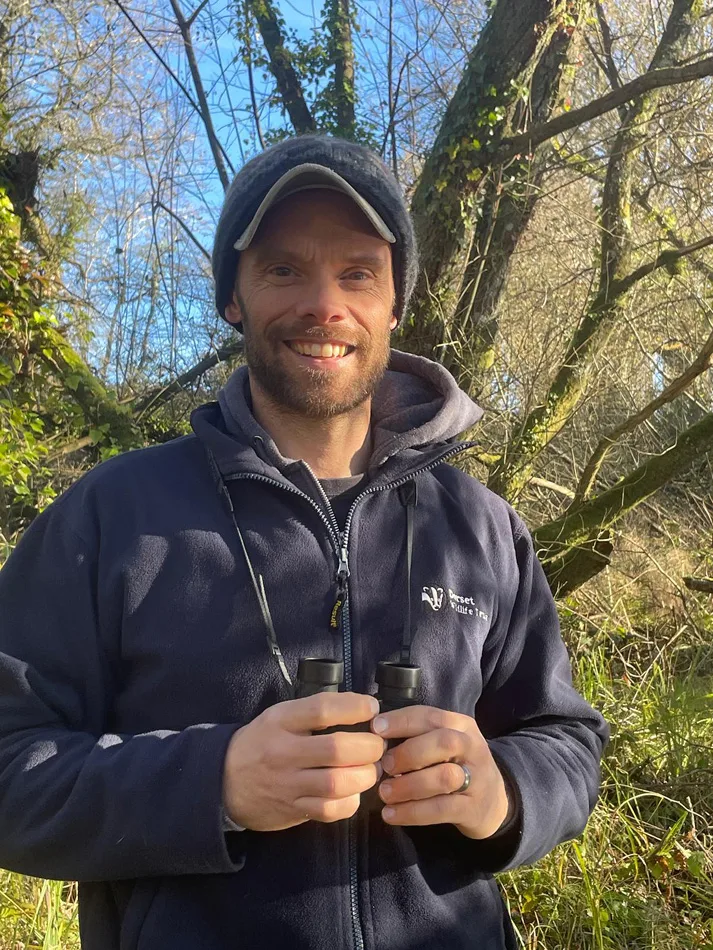
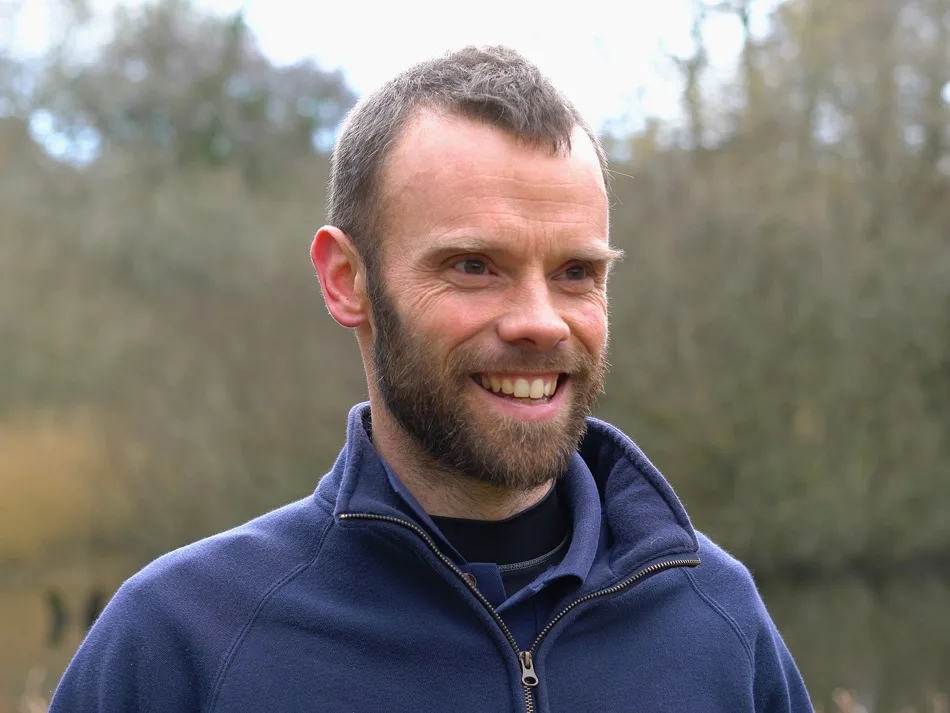
Steve Oliver is rivers conservation officer for Dorset Wildlife Trust
Images by
Tracie Beardsley

Steve Oliver welcomes me into what his wife and children call his ‘second home’. It’s one of those glorious winter days – frost crunches underfoot and the sky is a sharp electric blue.
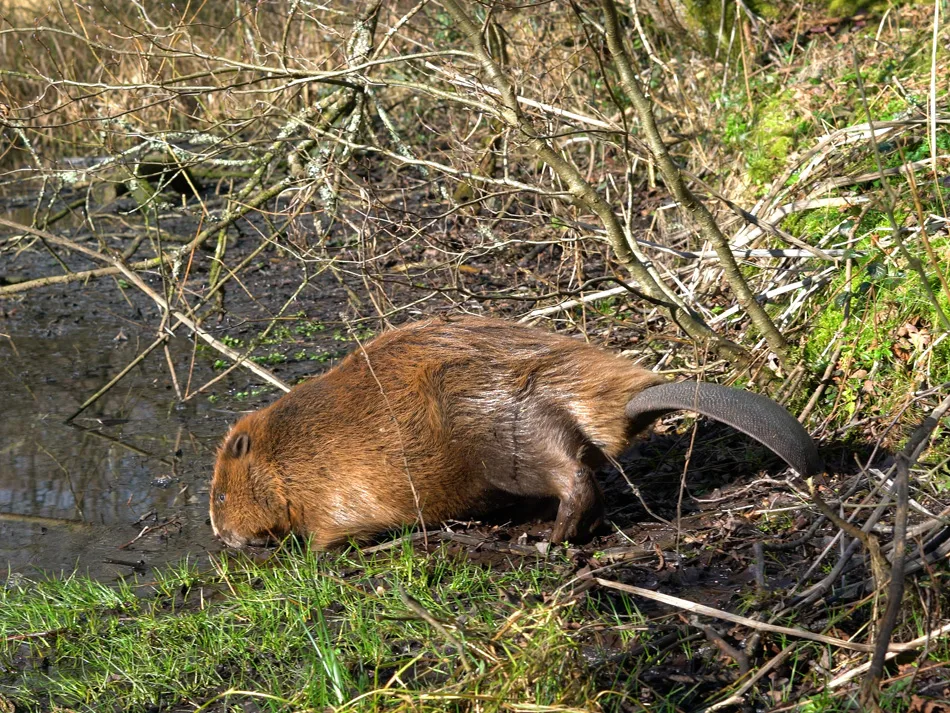
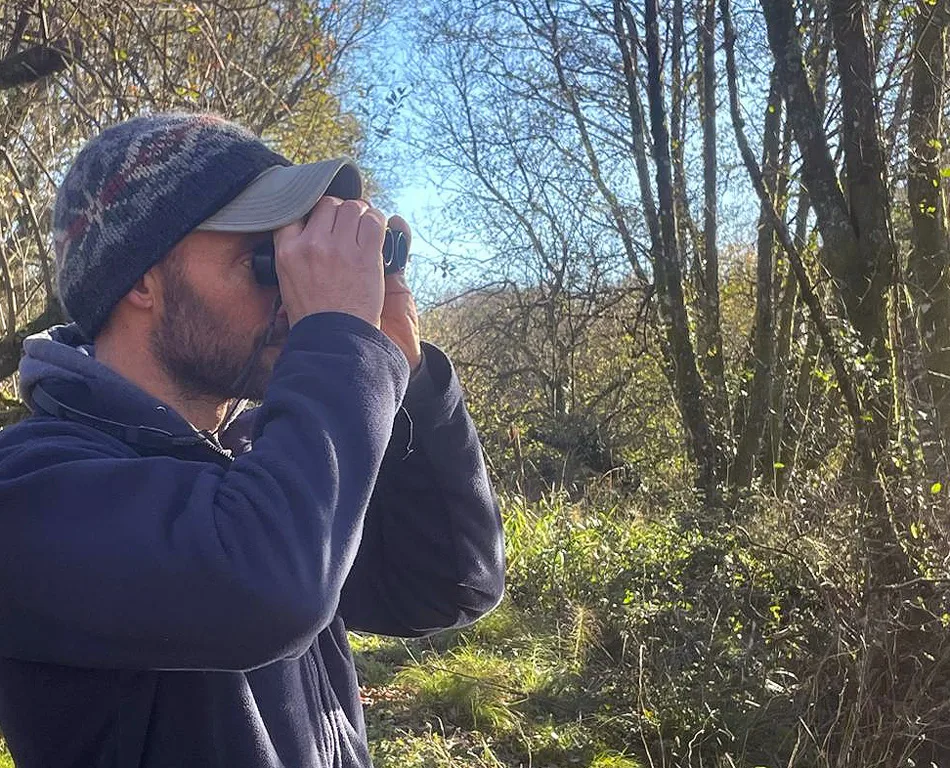
We’re standing in a secret space in West Dorset. A robin skates across frozen water, heading towards an island where twigs, branches and mud are piled high to create a shelter. Steve assures me that snuggled inside this ‘lodge’ is a family of Eurasian beavers (Castor fiber), the first to set paws back in Dorset for more than 400 years.
Whispering so as not to disturb their slumber, Steve can’t hide his pride: ‘I’ve been lucky enough to work for Dorset Wildlife Trust for 18 years and this is the highlight of my conservation career so far,’ he says.
As rivers conservation officer for Dorset Wildlife Trust, Steve is part of a small and dedicated team behind the groundbreaking reintroduction of the world’s second-largest rodent, (adults can weigh up to 30kg) into the Dorset landscape.
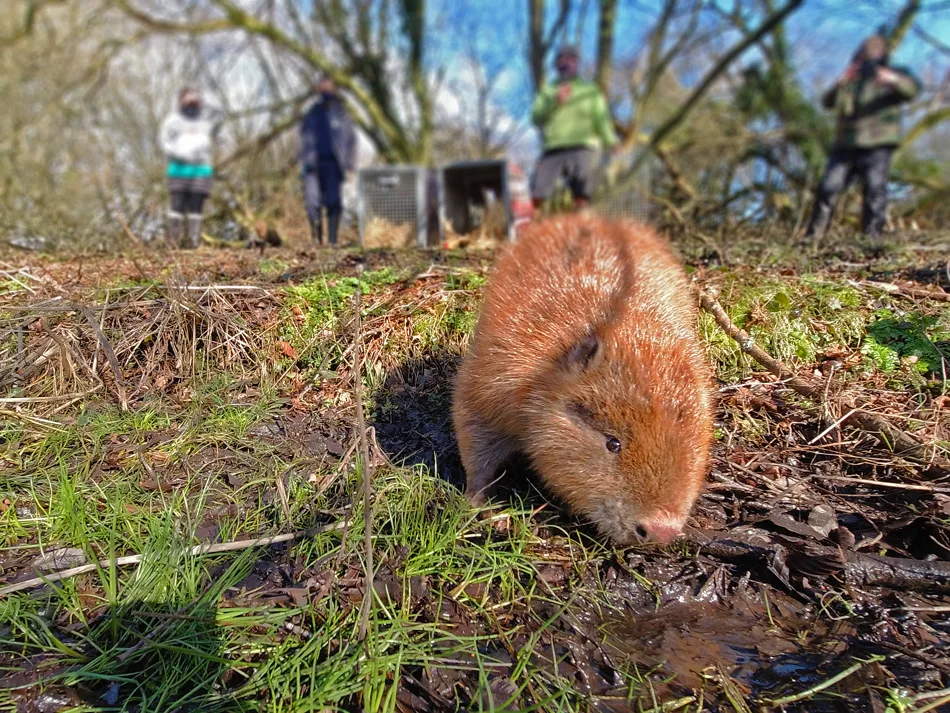
Beaver Steve, as his colleagues have nicknamed him, recalls the historic release: ‘It was a day like today, in February 2021 – cold and fresh. We were in the grip of the Covid pandemic so there were only a couple of us here to witness the historic moment of an adult pair of beavers take their first steps onto Dorset soil after a void of four centuries. ‘After all the years of preparation, it was so exciting – a real privilege to be part of bringing such an important species back to the county.’

Part of Steve’s job is keeping an eye on the family of Eurasian beavers (Castor fiber) that lives in West Dorset

Ecosystem engineering
Fossil records show Eurasian beavers in Britain more than two million years ago, but by the end of the 16th century they were hunted to extinction for their meat, thick fur and castoreum – a secretion from their castor sacs, once prized as a painkiller and a flavouring.
In 2022, the species was officially recognised again as native to England. Nearly five years on from the original release, beavers at this Dorset site are thriving. The first pair have successfully raised kits – but this is not a breeding programme. These animals are ecosystem engineers and hugely influential in their habitats.
‘There was always water here,’ Steve says, ‘but since the beavers built their dams, the water surface area has tripled, creating a wonderful wetland. Even in the dry summer of 2025, water levels held steady. This space was an oasis. Beavers are genius at keeping fresh water in the landscape, and that’s crucial for wildlife – and for us.’
It’s easy to see why Steve loves to come here. On this freezing cold day, it’s beautiful in its winter nakedness. Skeletal frames of alder, oak, ash, hawthorn and willow (which is apparently like candy floss to beavers) frame the banks. Water rail cry out from the shelter of the frozen reed beds.
Steve checks on the site at least once a week, often more, because he is transfixed by the beavers’ impact on the environment. The results are striking: kingfisher, dragonfly, common frog and many bat species are already benefitting: ‘Keep more water in the landscape and you generate life. It’s that simple,’ he says. ‘Beavers are a keystone species that bring benefits to all manner of wildlife.’

‘Beaver Steve’ grew up in Bradford Peverell, and worked for a range of natioponal wildlife charities before finally landing the job of his dreams in Dorset

Connected to wildlife
At 44, Steve radiates positivity and passion for his work. His love of nature began with a childhood in Bradford Peverell. ‘I was an outdoor kid – turning over logs to find the woodlice, netting butterflies, helping my parents dig their veg patch so I could see the worms. I always felt connected to wildlife.’
After studying Environmental Science at Plymouth University, he gained hands-on experience with the RSPB, National Trust and The Conservation Volunteers. His first paid role was as a warden on the Gower peninsula, maintaining coastal paths and surveying butterflies. ‘It took me back to being a child, chasing butterflies around the garden with my brother – I realised I was doing what I loved and getting paid for it!’
In 2007, he joined Dorset Wildlife Trust as an assistant warden. It was a job he’d unsuccessfully applied for three years earlier, but with more practical experience on his CV, this time he proved the perfect fit.
He recalls going for a run after he got the job offer and literally skipping with joy.
‘To be able to help look after the place where I grew up – I’m really privileged,’ says Steve, ‘This was doing all the things I relish – habitat management, looking after nature reserves, surveying plants and animals. That was 18 years ago … time flies when you’re having fun.’

Steve Oliver.
Image courtesy of Dorset Wildlife Trust © James Burland

Dam good news
In his present role as Rivers conservation officer, his remit is looking after rivers across the county, trying to improve both the habitat and the water quality. He actively encourages people to get involved at the beaver project site.
‘We want people to connect with beavers and learn how to co-exist with such an influential species,’ he says. People do see my love for it and then want to be part of it.’
Steve frequently leads guided site visits, gives talks to schools and environmental groups and even hosts summer evening stake-outs, where you may be able to catch glimpses of these elusive crepuscular animals.
This year could mark another milestone – there is talk of a potential wild release project to strengthen the beaver genetic diversity. Dorset Wildlife Trust is planning a public consultation to explore the potential of local communities living alongside wild beavers in the River Frome catchment area.

Dorset Beaver Project © James Burland

River hero
Despite the relentless news of the depressing state of the environment, talking to Steve Oliver gives you hope.
‘Fresh water is the most precious thing we have. Many rivers are under pressure, but projects like this show what’s possible,’ he says. ‘Beavers are a natural and important part of a healthy ecosystem. They evolved to be here, they should be here and our project proves the positive impact they can make for us all.’
dorsetwildlifetrust.org.uk

by Tracie Beadsley

Book now, stay later – respite care that empowers you to plan ahead

0

With the arrival of the new year, comes the desire to plan ahead for warmer days and trips away. Whilst the idea of a summer holiday is something to look forward to, how does this work if you or those you love will need expert care and support factored into their all-inclusive package holiday?

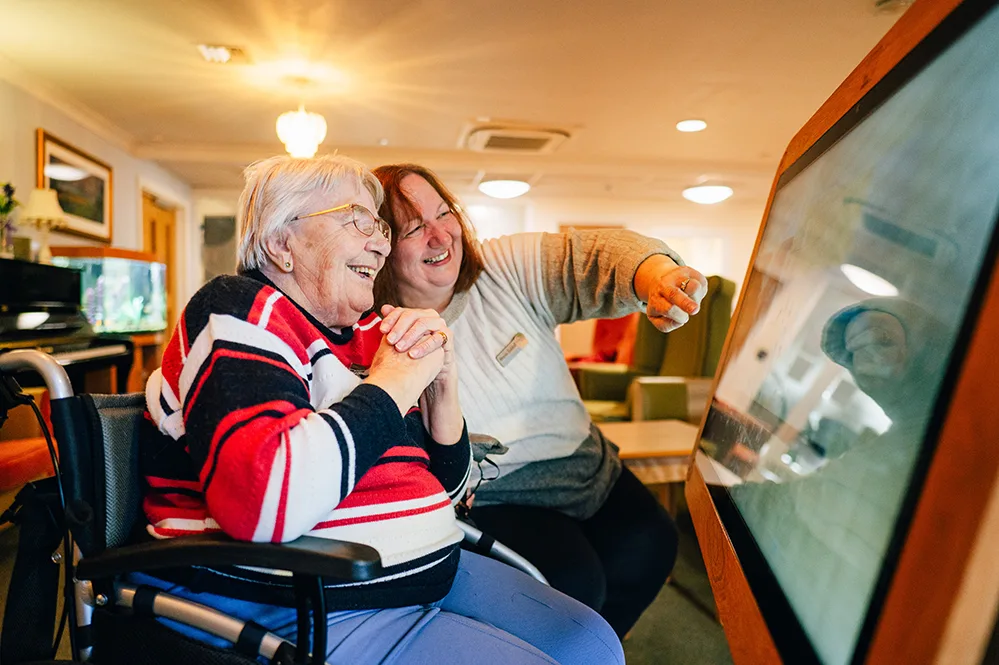
Discover new interests and connect with others © Somerset Care Group.

Short-term respite breaks in a residential care home can be a great option for combining a change of scene with the reassurance of expert, tailored care. Traditionally though, respite breaks can only be booked a few days or weeks in advance, to account for any changes to individual care needs in the interim. With bookings only able to be made at the last minute, attempting to plan time away – especially if this is to coincide with pre-booked holidays for family carers – can be challenging and frustrating.

Thankfully, there is an alternative. Somerset Care’s new book-ahead respite care solution allows you to pre-book your break months in advance, with just a small deposit to reserve your room and support package at your chosen care home.

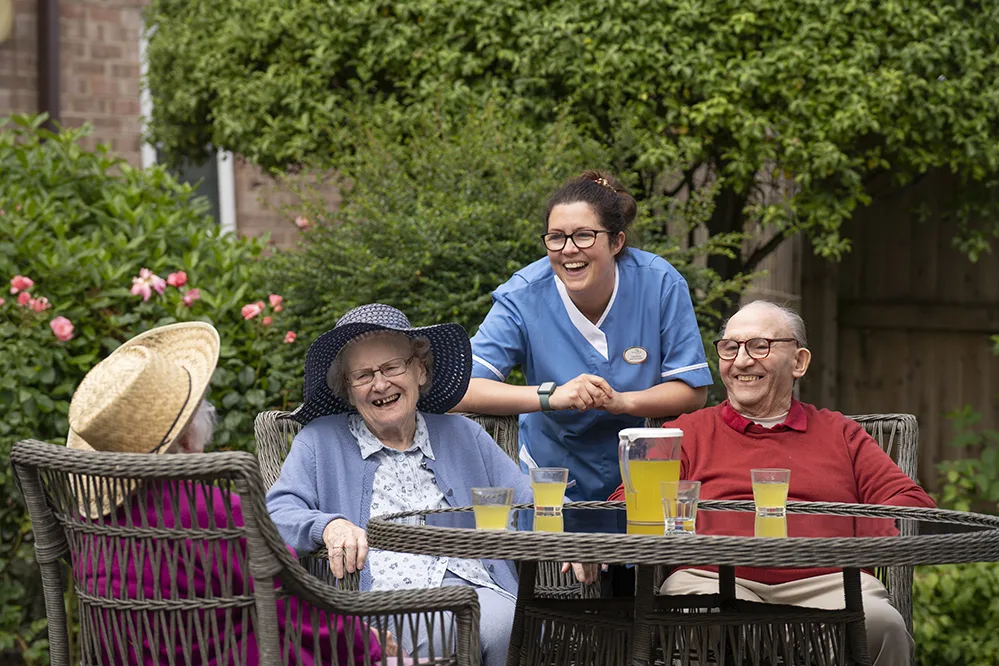
Book your summer respite break with Somerset Care © Somerset Care Group

This means that you are free to choose and book your respite break with confidence; booking in advance to align with family member plans, and making sure everyone has a break to look forward to. As your choice of care home isn’t restricted to last-minute availability, you will also have the maximum range of suitable options available to you, from across Somerset Care’s 22 care homes in Somerset and Devon.

Your break is reserved for you at a time of your choosing, with a care assessment carried out to confirm that your chosen care home can provide the support you need. We will reaffirm your requirements nearer to your booked break, to ensure everything is in place for you to stay safe and enjoy your time away.

Even if your care needs increase, you can relax in the knowledge that, with expert care teams able to provide everything from light help with washing, dressing and daily tasks, right through to hospital-standard, round-the-clock nursing care, Somerset Care is well-positioned to meet your changing needs and support you with the short-term respite care you need. 

A book-ahead respite break enables you to plan ahead and look forward to your time away, safe in the knowledge that your break will include expert care tailored to your needs at the time of your stay.

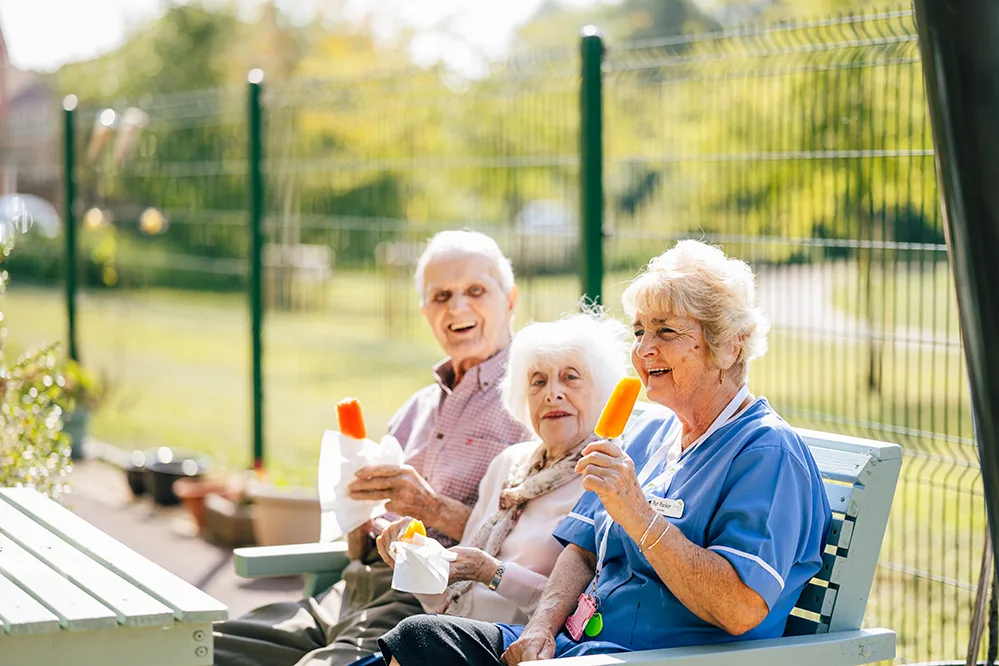
Enjoy companionship and a change of scene with a respite break © Somerset Care Group

For some people, short-term respite breaks provide a well-deserved break for themselves and their carers; for others, it provides an opportunity to experience care home life before making longer-term decisions.

Whenever you choose to stay, and whether you stay for a week or longer, you and your loved ones can now plan ahead with confidence.

Somerset Care’s day care and respite services support you to live independently at home, for as long as possible. For information and advice, please visit www.somersetcare.co.uk/respite, or contact our expert enquiries team on 0800 817 4925.

Dorset and Somerset Air Ambulance sets out plans for new base and provides update on second helicopter

0

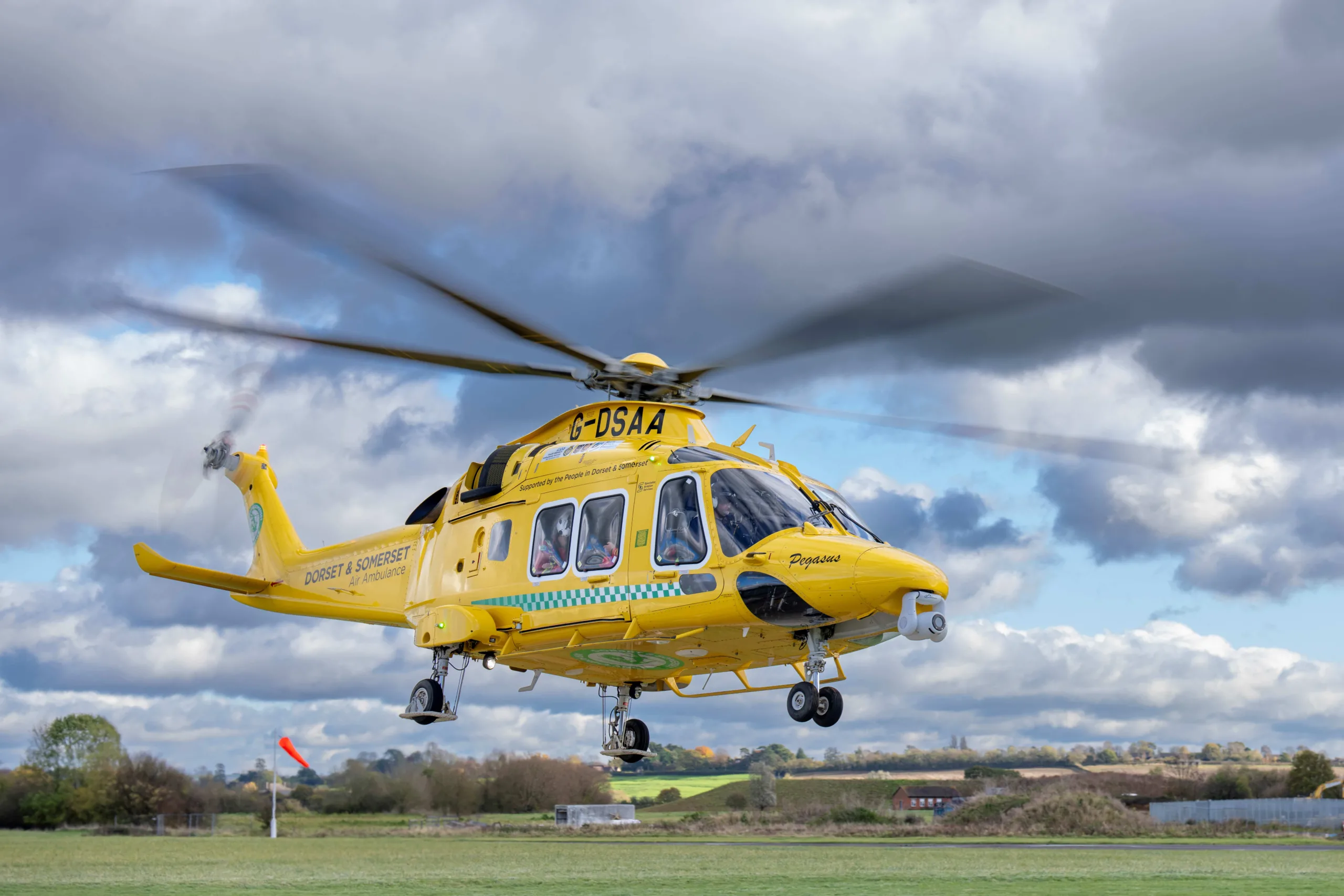
Dorset and Somerset Air Ambulance (DSAA) has announced a series of developments aimed at strengthening its ability to meet rising demand and ensuring patients across the region can access critical pre-hospital care when it matters most.

Demand for DSAA’s life-saving service continues to increase year on year. By air and by road, missions have more than tripled over the past decade. Through sustained innovation, investment and the continued support of local communities, DSAA now provides one of the most advanced levels of care available outside a hospital setting. However, the charity remains aware that there are still patients it cannot yet reach and is focused on closing that gap.

To address this, DSAA is taking steps to expand capacity, modernise infrastructure and secure long-term resilience. These plans include developing a new operational base and progressing the introduction of a second helicopter, all with the aim of giving every patient the best possible chance of survival.


Proposed future operational base at Yeovil’s Leonardo UK site

DSAA has confirmed its long-term intention to develop a new operational base at the Leonardo UK site in Yeovil, known as the Home of British Helicopters. A 35-year lease agreement has been signed, with Leonardo providing the site rent-free.

The proposal follows detailed operational analysis and reflects DSAA’s vision to secure a sustainable, future-proof home for its service. Modern facilities are required to support clinical excellence, rapid deployment and staff wellbeing. A new base would provide purpose-built spaces for patient interaction, training, operational coordination and community engagement, enabling DSAA to continue delivering care across Dorset and Somerset for decades to come.

Operational analysis shows that Yeovil’s location offers excellent aircraft coverage across the region, alongside immediate access to major roads to support rapid response vehicle deployment.

While the intention to relocate to Yeovil is clear, the development remains subject to further steps. These include a public consultation planned for mid-2026, followed by the planning process and fundraising to deliver the project.

As part of finalising the agreements, Leonardo has supported DSAA’s need for long-term security at the site. The charity would operate independently from Leonardo and has the rights required to operate from the location for the full 35-year lease period.

In the meantime, DSAA will continue to operate from Henstridge Airfield, supported by Geoff Jarvis and the local Henstridge community, whose contribution over many years has been fundamental to the charity’s work.


Second helicopter moves closer to UK operations

In September last year, DSAA launched its 2ndHeli Appeal to help fund the purchase and equipping of a second helicopter. The aircraft has since completed test flights and is preparing to fly to Gloucestershire Airport, where Gama Aviation will carry out customisation for Helicopter Emergency Medical Service (HEMS) missions. The second helicopter is expected to become operational in summer 2026.

Charles Hackett, Chief Executive Officer of Dorset and Somerset Air Ambulance, said:

“Firstly, and most importantly, we want to express our sincere thanks for the wonderful support we have received and continue to receive from Geoff Jarvis at Henstridge Airfield and the local community. Their support has taken us from our humble beginnings as a very small operation, flying only a few hours a day, to a transformation in care for our patients. Today, DSAA is one of the most advanced air ambulances services in the UK, touching thousands of lives every year.

We want to assure the people of Yeovil and our wider community that we are committed to working transparently and collaboratively with all stakeholders throughout the process.

To this end, DSAA will be launching a public consultation in mid-2026, giving residents and stakeholders the chance to view the emerging proposals, ask questions, and share their views. We hope the consultation will help shape our plans and build backing for the new facility, designed to support our life-saving service for years to come.

As we embark on this exciting journey, we remain dedicated to providing critical care and rapid response to those in need. In the meantime, we are deeply grateful to be able to continue operating from Henstridge thanks to the incredible support of Geoff Jarvis and all those who support our life-saving work.”


The path ahead

In October 2025, DSAA announced that, through careful stewardship of charity funds, it was able to allocate £30 million from its reserves. This funding will support the purchase and fit-out of a second helicopter, the redevelopment of its operational base, and wider modernisation projects.

The arrival of a second helicopter, the development of a new purpose-built base and the continued support of local communities reflect DSAA’s clear focus: reaching every patient who needs life-saving care and giving them the best possible chance of survival.

With continued community backing, DSAA is preparing to deliver an even greater level of care across Dorset and Somerset in the years ahead.

Shooting from the saddle

0

As winter drags on, mud and headtorches give way to arrows and adrenaline as Tamsin Doar discovers the addictive pull of horseback archery

The Sass Queen checking if Tamsin is serious about this archery thing
All images: Tamsin Doar

Although spring still feels like a while away, and most equestrians will be found floundering in mud, wearing at least seven layers and a headtorch while muttering something about ‘taking up knitting’ as a hobby, we’re all acutely aware that we’ve made it past the Winter Solstice. The days really are slowly getting lighter and we might, maybe (possibly!) be looking ahead to nicer weather. Perhaps making plans to enjoy our wonderful steeds – even if they are currently caked in mud and resembling hairy hippos.
I certainly sit down at the start of every year and write out a vague plan, adding dates in my diary for events over the forthcoming year. This is not because I am organised (far from it!) but because it gives me the motivation to get through the rest of the winter. One thing that is currently helping me to put one foot in front of the other while wallowing my way through the winter mud is looking forward to building on a new-found skill and activity that The Sass Queen and I (along with the previously mentioned Grumpy Uncle) first tried in October: Horseback Archery.
It is something that has always been on my bucket list – given The Sass Queen’s propensity for emulating a full war horse charge at every opportunity (I’m sure she was a cavalry horse in a previous life), I felt it would be something we’d both enjoy. The newly formed Jurassic Coast Horseback Archers, run by qualified coach Tom Drury, means we were able to tick that off the list.
Tom has been riding and driving horses for more than 30 years. He got his first pony, Moses, as a child and you may remember his Horse It In Dorset, where he offered cart rides at local events. He initially qualified as a riding instructor at Burley Villa in the New Forest, and has since taken further qualifications under tuition from the British Horseback Archery Association (BHAA) to qualify as a horseback archery instructor.
His love of archery started from a young age: ‘We had bows and arrows as kids … although my brother shot me with one, which resulted in a few stitches! I discovered horseback archery 16 years ago, and that changed everything. Suddenly there was a fun reason to ride around an arena. Shooting arrows from the ground at targets is fun, but doing it from horseback takes it to a whole new level.’ I can attest to this – ground archery is challenging enough, but when you bring a horse into the mix (especially a bouncy, opinionated one) it’s much harder … but also so much more enjoyable.
‘I’ve always wanted to set up a club, especially as all other clubs are some distance away, but it wasn’t until 2025 that The Jurassic Horseback Archers was formed,’ says Tom. ‘We’re based along the coast, from Dorchester to Lyme Regis, and are very grateful for the use of the arena at Faunbank Stables in Maiden Newton. I hope to find other venues across the county to use, so we can set up another club under ‘Dorset Horseback Archers’, to allow those in different areas to participate. Then we can also have inter-club competitions!’

Tamsin on her first unaccompanied walk past the targets

Make it official
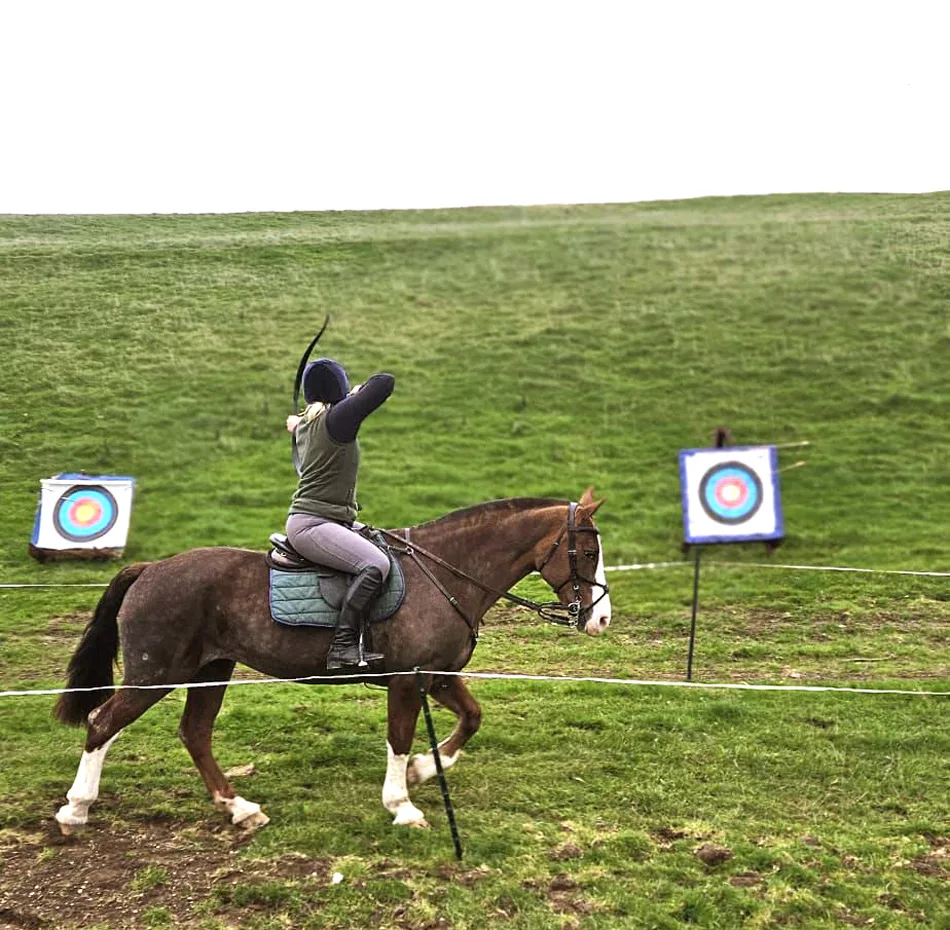
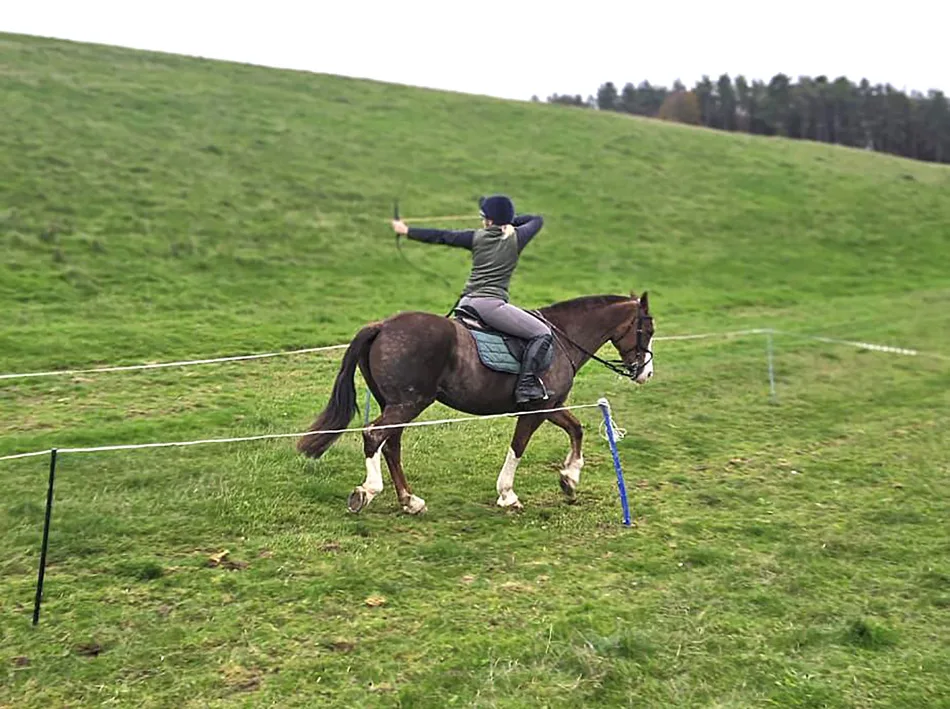
The BHAA promotes safe participation in horseback archery at local and international level. ‘Some people approach it as a sport: it can be as competitive and challenging as any other sport. But I just love it as a fun activity. It’s both challenging and calming. When you’re cantering a 90m run and shooting multiple arrows at three targets, you have to focus on the release – dropping the reins, releasing the arrow, keeping a smooth focused rhythm timed to the horse’s footfall and your breath … it requires quite a lot of focus!’
The competitions run under BHAA include shooting at different targets along a set track at either a walk, trot or canter. Points are usually awarded for accuracy and shooting arrows within the set time – competition-type can vary slightly, but there is always a focus on accuracy. This can also progress up to shooting at targets in a natural environment over jumps. There are competitions all across the country, including at National and International level. In 2025, Britain sent a team to the IHAA World Championships in the USA.
BHS centres across the country offer horseback archery on their horses, so you don’t need your own horse.

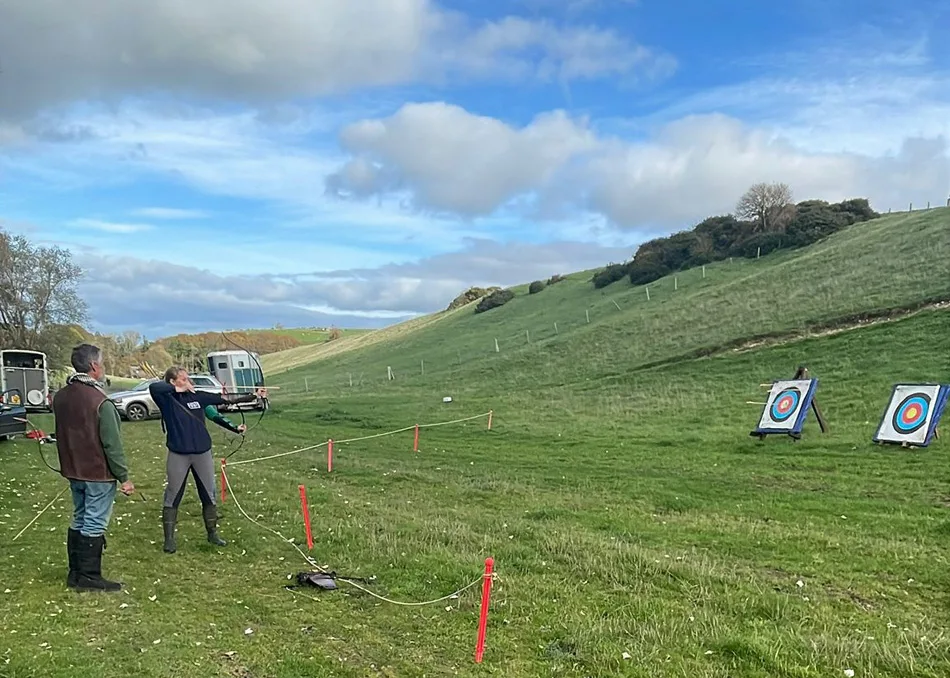
Learning the basics of archery on the ground is the first step

The BHAA also works with the RDA and Pony Clubs to promote inclusivity at all levels. They advise that no previous archery or riding experience is necessary, but it’s preferable to have a good ground in both. ‘Fitting the string while the horse is moving is the real trick, and it takes a lot of practice,’ says Tom.
In the sessions that he runs, non-riders can also join in with ground archery to learn and develop their technique while learning to ride separately, before putting the two together.
He’s in the process of liaising with approved BHS centres across Dorset to make his sessions inclusive to those without access to their own horse. ‘Riders who are interested can also approach their local BHS centre directly to ask if they’d consider offering lessons with a qualified HBAA instructor – the more interest shown, the more likely it is to happen!’

Tamsin Doar trying horseback archery

Starting slow
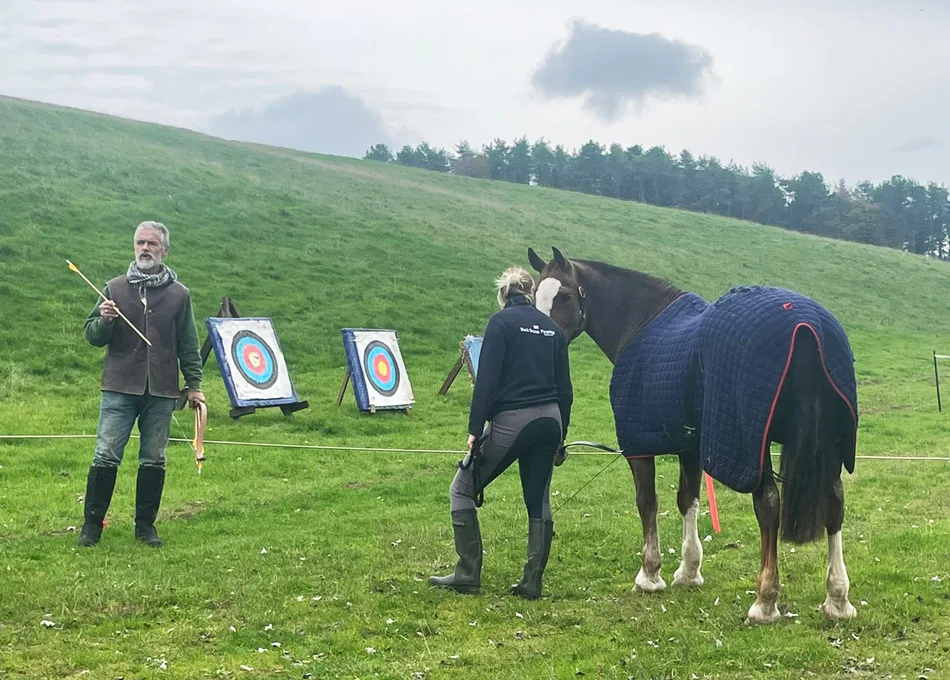
The first session you’ll have with Tom usually consists of an introduction to archery, learning the different techniques and the all-important safety aspects. All the archery equipment is provided and ‘have a go’ sessions are available. He offers 1-to-1 sessions or group lessons. ‘Our typical sessions will then focus on ground archery before moving on to desensitising the horses,’ he says. ‘We start out desensitising them to the bow: showing it to them, moving it around them, giving them a scratch with it to show them there’s nothing to be afraid of.’
(The Sass Queen particularly appreciated me getting her ‘itchy spot’ with the edge of the bow, and thinks we should invest in one as a scratching device) ‘Next we introduce the arrow – again, allowing the horse to just see it and sniff it, while avoiding the sharp tip!
‘Then we move on to an arrow being shot softly, progressing up to it hitting the target.’
I was very impressed with how Tom dealt with each horse as an individual and went at their pace – never rushing them and allowing them time to take it in.
Needless to say, The Sass Queen never dropped her ‘I can take on the world’ attitude and barely batted an eyelid at everything going on around her.
‘Not all horses are suitable by temperament or nature though,’ says Tom. ‘Once they’re comfortanle, we move on to shooting from the saddle – and hopefully hitting the target!’ Thankfully, we started at a walk down the side of a marked-out track, with Tom leading us to prevent The Sass Queen trying to take off in her normal ‘cavalry charge’ mode. This part is usually achieved within a morning or afternoon session. ‘After they’ve attended the introductory session covering health and safety, people are welcome to join our monthly club sessions.’ I think it will take a few sessions for us to progress up through the paces – I’m certainly comfortable staying at a walk for now!

For more information on this thoroughly enjoyable activity (word of warning, it’s quite addictive!) visit the British Horseback Archery Association on bhaa.org.uk.
Contact Tom to organise a session or ask about joining the club through his Instagram or Facebook page
@Dorset Horseback Archers.

Farewell to Adrienne Howell

0

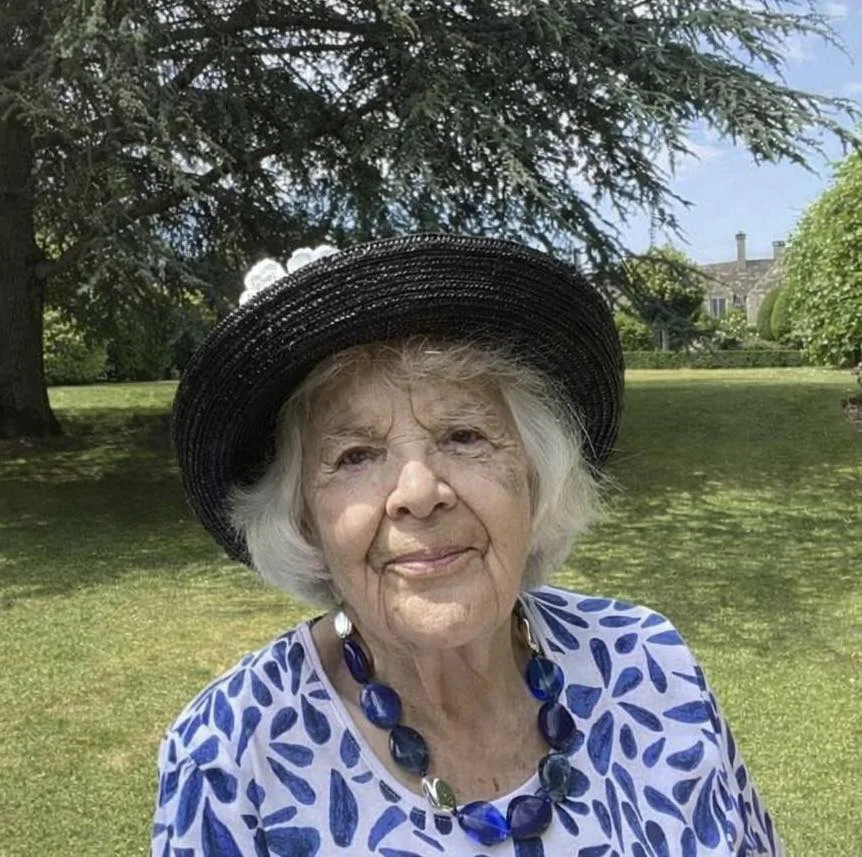
IF Mere had a ‘national treasure’ it would surely be Adrienne Howell, who died on 13th January, aged 87. She was an active part of life in Mere for so many years that it is hard to imagine the town without her.

Adrienne was the founder or driving force of many organisations that continue to be central to life in Mere. A retired teacher, remembered with real affection by many former pupils, she founded Mere Manor Brass with her husband Bernard, more than 50 years ago. 

Her dedication to music and the community was recognised in the 2019 New Year’s Honours with the award of the BEM, which she received, accompanied by her niece Julia Woods, at Buckingham Palace.

Adrienne and her late husband (Bernard died in 2014) were both Life Vice Presidents of the Wessex Brass Band Association. John Woods, the chairman of WBBA, said her commitment and dedication to banding had benefitted many thousands of players and bands in the region.

In 1997, Adrienne founded the Mere Literary Festival. It began as a fundraiser for the Mere & District Link Scheme, a volunteer-run service which helps people in Mere and surrounding communities to get to their medical appointments, shops and social events.

The literary festival established itself quickly and grew into an eagerly-anticipated annual celebration, with author talks, writing workshops, the Pennybank Writers, children’s events, and short story and poetry competitions which attracted entries not only from across the country but from as far as France and South Africa. 

The festival became known for its warm hospitality, welcoming atmosphere and generous helpings of cake! Adrienne ran it with dedication and vision for 22 years, stepping down after the 2018 festival. By then the festival had raised tens of thousands of pounds for Mere Link.

New festival director Ashley Gray says: ‘Adrienne was a remarkable woman who cared deeply for the town of Mere and the community around her. She set a high standard, and we will continue to uphold the spirit she so thoughtfully established.’

As well as the band, Mere Link and the literary festival, her other community involvements included the Pennybank Writers, Mere Rivers Group and Mere Amateur Dramatic Society (MADS)

A keen eye for detail

Adrienne was the longest standing member of MADS, having been part of it for most of its 80 years and she will be greatly missed, says Mary White, ‘not only for her knowledge of the society and its productions but for her energy, support and encouragement.’

As well as acting in plays, Adrienne also directed, ‘with a keen eye for detail!’ – most notably perhaps in the spring production in 2010 of Alan Poole’s Bottom’s Dream, a fantasy based on Shakespeare’s Dream, which she brought to life beautifully. Her final appearance on stage was in 2016 in Lord Arthur Savile’s Crime by Constance Cox, from a short story by Oscar Wilde. 

She had been prompting, Mary recalls, ‘but when a member of the cast was taken ill on the first night, Adrienne stepped in – stitched into her costume and with a covered script, she used her knowledge and experience to be the perfect understudy!’

She was supportive and encouraging to new members and young people in MADS productions, ‘thus helping to maintain the long tradition of live theatre in Mere.’

At times she also sometimes involved MADS in the literary festival and in other local events. She chaired MADS for some years, ‘always involved in its activities, but when her stage days were behind her, she was always happy to help with line rehearsal, front of house or refreshments.’

Perhaps less well-known than her countless community and cultural activities, Adrienne wrote short stories and a selection was published in The Fox’s Lament. She also wrote one-act plays which MADS successfully produced over the years, both at home and in One Act Play Festivals where they won many awards, including Best Play and Best Original Script, as well as awards for actors, costumes and sets.    

Mary says: ‘MADS owes Adrienne so much, and over the coming years we look forward to honouring her memory and celebrating her life with new productions of her plays.’

Loved by many and revered for her huge contribution to the life of Mere and its people, and her work as an educator, Adrienne passed away peacefully at home following a short illness on 13th January, aged 87. She is survived by her niece Julia and nephews Nick, Zed and Seth.

The funeral will take place on Thursday 19th February at 1pm St Michael’s Church in Mere. Local band representatives will provide the music in the service. 

Fanny Charles

Metamorphosis theme for Dorset Art Prize

0

The 12th annual Dorset Art Prize is now open for entries, with Poole Museum announced as this year’s host venue.


Founded in 2014 by Bournemouth and Poole College, in partnership with the Dorset Community Foundation, the free-to-enter competition is open to both amateur and professional artists across two age groups: 16–18 and 18+. Hundreds of entries are submitted each year, with cash prizes of up to £1,000 on offer. Shortlisted artists will see their work exhibited at Poole Museum in July 2026.
This year’s theme is ‘Metamorphosis’, with participants invited to respond in any visual medium – from photography and animation to painting, sculpture or installation.
Stuart Palmer, Director of Creative, Digital, Tech and Service Industries at Bournemouth and Poole College, said: ‘We’re excited to partner with Poole Museum, a place that shares our belief in the transformative power of the arts. The Dorset Art Prize is a fantastic opportunity for local talent to showcase their work and help shape the cultural identity of our county.’
Jaine Fitzpatrick, Interim Director at Poole Museum, added: ‘We’re passionate about celebrating creativity in all its forms – from internationally acclaimed artists to emerging local voices. We’re proud to host the Dorset Art Prize and help shine a light on the incredible talent thriving in our community.’
Entry deadline: Sunday 14th June 2026
For full details and to enter, visit: thecollege.co.uk/dorset-art-prize

sponsored by Wessex Internet

Thank you

0

Jon Sloper reflects on the deeper power of ‘thank you’ – and why saying thank you may be one of the most human acts we have

At this time of year, when thank yous are so frequently shared for seasonal presents and hospitality, I have been reflecting on other thank yous that I’ve noticed.
Just this past weekend we have been saying thank you to a group of Ukrainian children in Dorset who have been part of a cultural group called Grains of Hope. With the help of parents and other adults in the Ukrainian community, they have been sharing the culture and traditions of Ukraine while they are here in Dorset, waiting for the war in their homeland to end.
We’ve also been saying thank you to a group of home care providers who support hundreds of residents across Dorset with all kinds of needs, making it possible for those people to continue to enjoy living at home.
We’ve also been reflecting on the thanks and gratitude we received ourselves last year. Colleagues were variously described as ‘a light in a dark place’ and ‘angels’.
Thank you is such a beautiful expression.
To say thank you to someone shows you have seen them, that you appreciate them and their actions, that you understand the choices and costs of the actions they’ve taken for you. Thank you is so wonderfully complex and multidimensional.
‘Thank you for my Christmas present’ is not only thanks for the pleasure and enjoyment of the gift and what it will bring to the life of the recipient. It is also thanks for the thought behind it, and for the effort to make or buy it. Beyond the moment of giving, if the gift has cost money, there is the effort of work that went into earning the money. And so the ripples spread. If the gift was made, it was probably done so by people we will never meet, perhaps by people from other countries, maybe from other times. The ‘thank you’ allows us to talk about the impact and meaning of the gift we’ve received.

Balance and connection
Receiving a thank you from someone brings visibility – a ‘thankless task’ is one where the person doing it is overlooked, ignored or even shunned.
A thank you, whether offered as good manners or in spontaneous and heartfelt gratitude, creates a bond between the donor and recipient. Balance and connection are made.
Sometimes, meanings and intentions can be revealed through a simple thank you. Two simple words can prompt a conversation, which may then provide a chance to explore deeper meanings.
I was interviewed this week, and after thanking us for the work we do, the interviewer asked: ‘why do you it?’ The simple question caused a brainstorm of feelings and ideas for me. I was disarmed by the directness of it, and hurried a (probably confused) response, trying to express so many ideas, beliefs, stories and values that had been stirred in the few seconds available.
The interviewer’s ‘thank you’ led to a place of immediate connection, whch broke through into a place of values and meaning and identity.
At this time, when so many services are being ‘rationalised’, when for so many the anguish of life is growing daily, these moments of gratitude and connection are an even more vital and precious place for us to be together as people. They give us a chance to understand ourselves and others better. They challenge us and give us a chance to grow and find better ways to be. Together.
Turning narratives away from blame, and fighting back some of our fears, to allow space and find reasons to say ‘thank you’ brings people nearer, makes our world brighter.
Saying thank you in words or just with a smile brings us all closer.

sponsored by Wessex Internet