Tracie Beardsley caught up with Michael Murty, the man at the wheel of the world’s biggest monster trucks as his team prepares to rev into the main ring
Is this Dorset’s biggest larder? With a super-sized new Food Hall and more than 100 producers, we’re thinking: ‘Yes, yes, it is!’
Brilliant and unmissable, The Sheep Show hilariously highlights the importance of wool and the truth about sheep farming … while debunking certain sheep-related myths
Get set to cheer your favourite team – as the Pony Club Mounted Games gallops into the Dorset County Showground for the first time, we find out what happens during the exciting speed games
Meet Dorset’s soap star Kirsty Hearne (and more importantly, Honeybee the matriarch) – creator of a thriving artisan cottage industry selling goats’ milk and the soaps she makes from it.
Planning your visit? Don’t miss the Show Map and Timetables, ensuring you don’t miss a thing during your visit. Make notes and set a plan of attack – it’s a BIG show!
Take a nostalgic stroll through the showground with farmer and columnist Andrew Livingston
If you’ve not got them yet, don’t forget to book your tickets NOW: TICKET DISCOUNTS END ON FRIDAY 1ST SEPTEMBER 2023! Get ready for an unforgettable experience at the Dorset County Show 2023. We can’t wait to see you there!
Gardener Barry Cuff shares his June allotment diary – and admits to a little midnight raindance when the good stuff finally arrived
What a wonderful surprise to wake up in the early hours of Tuesday 20th June and hear the rain. I was so pleased that I put on some clothes and went and stood in the garden to enjoy it for a few minutes! It was a lovely hard rain, exactly what was needed to revive the plants and seedlings – after about 40 days of little-to-no-rainfall it was appreciated all round! We had about 1.2 inches, and an amazing amount of growth was made after the rain. On the allotment, we have a 12 to 14-foot-deep well which supplies seven raised 1,500 litre tanks and two 1,000 litre tanks – all of which are connected to cattle troughs fitted with ballcocks. During June’s dry spell, water was pumped at least five days a week to meet the demand of plot-holders.
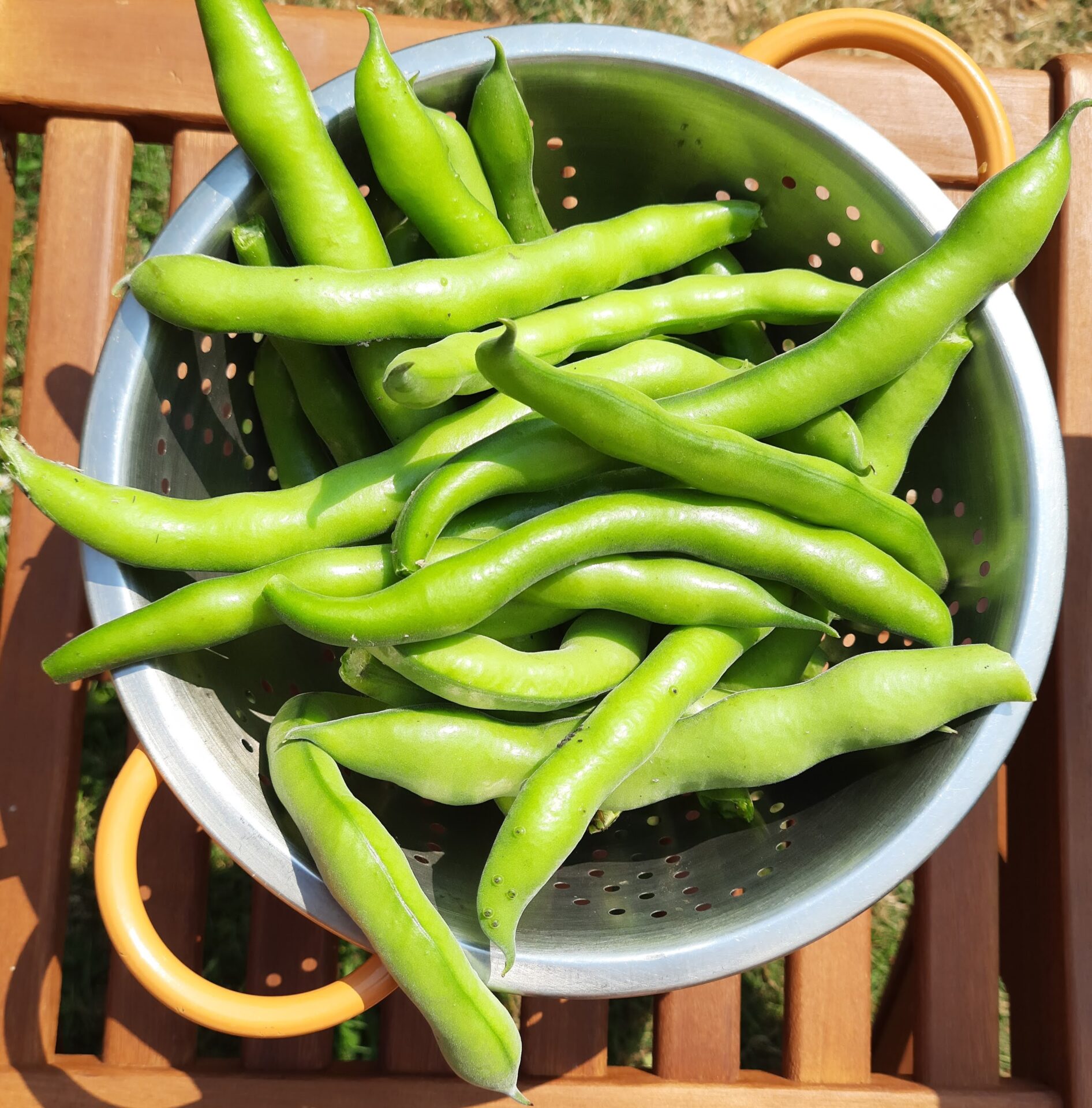
June diary 2nd – Planted out 22 Swift sweetcorn to bring the total to 52 plants. Water. 3rd – Side shoot and feed greenhouse tomatoes. Cut lettuce. 4th – Dug one plant of Jazzy potato (planted earlier than rest of crop). Got 17 good-size spuds plus a few small tubers – a very tasty ‘new potato’. Planted out two Defender, one Black Beauty and one Astia courgettes. Water. 5th – Water. 6th – Planted out 10 Cornichon de Paris gherkins, one Sweet Dumpling squash, four Butterfly Winter squash, four Crown Prince squash. Cut lettuce. Sowed Witloof chicory, coriander, Moulin Rouge beetroot and Early Nantes carrot. Water. 7th – Water. 8th – Water. 10th – Water. 11th – Cut lettuce, water. 13th – Dug three Maris Bard early potatoes. Water. 14th – Planted out from plugs a block of Little Gem lettuce. Feed tomatoes and peppers. Water. 15th – Water. 16th – Picked first two Defender courgettes and also the first broad beans (Masterpiece Green Longpod and Witkiem Manita). Pulled more spring onions and cut lettuce. 17th – Water. 18th – Hand weeding and hoeing. Water. 19th – Sowed French Breakfast radish. Water. 20th – RAIN IN NIGHT! Sowed Purple Magnolia and Carouby de Maussane mangetout peas. Sowed in plug trays Medallion cauliflower, Vertus savoy cabbage and Natalino Romanesco. 21st – Planted out a block of celery, consisting of 11 Tango and 28 Green Utah plants. 23rd – Planted out 20 Monarch celeriac. Dug Jazzy and Maris Bard potatoes. Pulled spring onions. Picked broad beans. Harvested garlic. 24th – Hand weeding and hoeing, cut lettuce. 25th – Planted out cauliflowers; Snow Prince, Cheesy and Cendis. Thinned parsnips and chicory. Hand weeding. 26th – Planted out Ironman calabrese. Sowed White Lisbon spring onion. Picked broad beans, pulled spring onions and cut courgettes. 28th – Picked first peas and more broad beans. Dug two plants of Maris Bard. 30th – Picked first tomato from greenhouse (Santonio)! Cut courgettes, pulled spring onions. Dug remainder of Jazzy potatoes. Planted out Cardinal and an early purple sprouting broccoli. Planted out a block of lettuce.
Fruit We picked strawberries for two weeks but they finished quickly due to the drought, despite watering them well. We started picking blackcurrants around 22nd.
A team of pupils from Thornford Primary School is celebrating after making it to the national finals of the Pokemon Primary School’s Cup!
The Thornford team were made up of Louis (goal keeper), Isaac (captain), Lenny, Zac, Billy, Jaxson, Reuben, Zac WT, Ruben and Benji.
The Year 6 pupils from Thornford began their journey to the King Power Stadium by winning the North Dorset Small Schools tournament in January. This meant they represented Dorset in the south west Regionals. Impressively, it’s the second year running the village primary has reached this stage. They finished top of their group to advance to the semi-finals, which they won in a penalty shoot-out. Ultimately the team narrowly lost a closely-contested final, but were thrilled to discover that the top two schools from the south west would progress to national finals. Thornford teacher Sarah Gibbs, says, ‘The boys were incredibly excited about the trip to Leicester, and the commitment from the parents was amazing. The pupils travelled the night before – one family even cut their holiday short to ensure their son wouldn’t miss the match!’
National finals Competing against the top eight teams from across the country, Thornford achieved a highly respectable 5th place in the national finals. Even more remarkable considering that Thornford Primary, a small rural school in North Dorset, has fewer than 65 pupils in Years 5 and 6 – less than half the maximum allowed for small schools. Sarah continues, ‘The day will be a lasting memory for the boys. The camaraderie they developed is exceptional, and they have all grown into enthusiastic and skilled young sportsmen.’ Jerry Ridout, who has voluntarily coached the school’s football team for the past eight years, played a pivotal role in their success. His youngest son left the school last year, but Jerry agreed to stay for one more year to coach the team. He says, ‘The boys are a credit to the school and their families. They have worked incredibly hard, and each one of them has contributed to the team’s success. It has been an absolute pleasure to be part of this journey, which I hope they will remember for years to come.’
On the first day of his first archaeological dig, CPRE’s Rupert Hardy made a major discovery and uncovered a sad mystery
‘As I carefully scraped away with my small trowel, I became aware that what I was unearthing looked very like a human skull…’ I have written about prehistoric Dorset but was aware I had never actually got my hands dirty doing a ‘dig’. So I signed up as a volunteer for the Durotriges 2023 Big Dig organised by Bournemouth University, to spend a week excavating the Iron Age site on downland at Winterborne Kingston. I was one of 15 to 20 volunteers working alongside more than 60 students, all of us armed with just a tiny archaeological trowel and a kneeler. There were also more than a dozen staff from the faculty, all unfailingly helpful and keen to share their knowledge. On the first day, after the obligatory introductory talks, we set to simply cleaning the chalk site. On the second we were allocated a pit or trench to dig. That second morning was rather disappointing – I watched other people’s ‘finds’ trays filling up with fragments of pottery, shaped flints and animal bones, while mine stayed sadly and resolutely empty. Little did I know my luck was about to change. About seven inches down from the surface I found a large fragment of pottery. On examination, its cross-hatched decoration suggested the Bronze Age, rather older than the Iron Age fragments others were unearthing. A few inches deeper still, I found not more pottery but what looked very like part of a human skull … The passing supervisor got very excited and suddenly my storage pit became the centre of attention on the site (I’m keen to point out this was not down to skill – it was pure beginner’s luck of course!)
Bournemouth University archaeologists examining the finds in Rupert’s pit
The body with a pot Progress slowed somewhat – dealing with human remains requires dignity and respect, as well as considerable record taking, with much input from bone specialists. We made drawings and then I worked with Shelley, a mature second year student, using wooden tools and brushes rather than metal trowels to gently prise away the earth from the fragile bones of what was clearly emerging – a full skeleton buried in a foetal position, with a good set of teeth. Their fragility meant the bones could not be lifted. Alongside the body we discovered a large pot, containing the incinerated remains of a young child. There were no signs of jewellery or weapons – this was no rich tribal leader. Rough estimates suggest the date as around 1,800 BC, but this will be confirmed later by DNA testing.
Iron Age and Bronze Age pottery found this year at the dig, including the pieces found by Rupert Hardy
The other finds Finding a skeleton in such shallow ground is clearly a rarity. Others spent the week digging out storage pits and trenches as deep as two metres – they needed to wear helmets for protection from falling rocks – and were finding sheep skeletons, cow heads, a copper brooch, chalk spindle whorls and a virtually-intact Iron Age pot. The animal remains were not there just for food, they were possibly offerings to the gods. Mine was the only human skeleton discovered that week, although there was another, found in last year’s dig, was being excavated. Five were found at the site in 2022. More will probably be discovered later as the digging gets deeper. Apparently last year the team found hundreds of frogs at the bottom of some pits, suggesting the climate was somewhat wetter than today when the nearest watercourse, the North Winterborne, is nearly a mile from the site, and doesn’t flow at all during the summer.
Rupert Hardy at the Big Dig with ‘his’ pit
The Durotriges Project Established in 2009, Bournemouth University’s Durotriges Project is a programme of archaeological fieldwork designed ‘to investigate the nature of the native cultural footprint and objectively assess how Britons and Romans interacted’. Investigating the prehistoric and Roman societies of central southwestern Britain, The Durotriges Project is studying the role that Dorset’s ancient Iron Age societies played in networks of production, exchange and communication with the rest of Britain and mainland Europe. The main focus of excavation began at a number of sites to the north of Winterborne Kingston near Bere Regis. Of all the Iron Age tribes identified from pre-Roman Britain, the Durotriges were the most culturally distinct. Occupying an area that equates with modern Dorset (one of the best-preserved archaeological landscapes in Britain), with parts of southern Wiltshire and Somerset, the pottery, coinage, settlements and burial practices of the Durotriges clearly mark them out from other tribes. The project was a chance to move away from the traditional interpretation of historical events, with the Durotriges actively resisting the Roman invasion of AD 43, before being defeated in a series of battles, and their culture and identity being subsequently eradicated. Instead, it aimed to discover whether a more rigorous examination of the archaeological data could throw light on the true nature of later Iron Age society, both before the arrival of Romans and its evolution afterwards. One of the most significant discoveries was in 2015 when a major Iron Age settlement of 200 pre-Roman houses was found, dating from 100BC, and named Duropolis after the tribe. Dr Miles Russell from Bournemouth University says: ‘There was nothing on the surface, just ploughed land. It was a town with a large, dense population and a lot of organisation.’ It may have been the first planned town in Britain, and its presence on open unprotected downland underscores the view that the Durotriges lived a relatively peaceful life then, with no need to live in the hillforts which were increasingly being abandoned before the Romans arrived. Other excavations have uncovered an Early Bronze Age cemetery, Later Bronze Age and Early Iron Age settlements, a Middle Iron Age enclosure and a Late Iron Age burial ground and settlement, as well as a Roman villa and cemetery. There was a Public Open Day on this dig on 2nd July. Rupert Hardy, Chair North Dorset CPRE
A notice warning of ‘cudgeling, fighting and boxing’ hints at a violent past across the Blackmore Vale, says Roger Guttridge
Valerie Kelly of Wonston, Hazelbury Bryan, with the incomplete sign warning that ‘cudgeling, fighting and boxing’ will not be tolerated
My reference in the last issue to ‘cudgeling’ intrigued some readers, not least BV editor Laura Hitchcock, who was laughing all the way to the deadline. The word, which appears on an old sign owned by Brian and Valerie Kelly of Wonston, Hazelbury Bryan, hints at tougher times, when gangs of ruffians ruled the Vale. As Philip Taylor, the Collector of Customs at Weymouth around 1720, wrote in a report to London: ‘The Vale of Blackmore is abounding with great numbers of dangerous rogues.’ Some might suggest that not a lot has changed. I couldn’t possibly comment. Brian and Valerie’s sign (above) is missing its top line, but the surviving section is clear enough: ‘…have been sworn in to apprehend any persons seen cudgeling, fighting or boxing.’ My guess is that the top line originally read: ‘Parish constables’ … but other guesses are available. The phrase conjures up images of gangs of young men roaming the countryside, armed with cudgels and other primitive weapons, eager to exercise their labourers’ muscles by scrapping with rival groups. Various sources suggest there was a territorial element to this, with village rivalries providing an excuse for violence. Describing Marnhull’s annual bull-baiting event in the mid-18th century, historian John Hutchins wrote: ‘The practice occasioned dangerous riots and frequently bloodshed by the violent contentions of the inhabitants of the neighbouring parishes. In one of these frays, one Bartlett, of Morside, was actually killed.’ According to my own maternal grandfather, Jim Ridout of Fiddleford, there was intense rivalry between Okeford Fitzpaine and Sturminster Newton. Our Okeford-based ancestor Roger Ridout (1736-1811), the leader of North Dorset’s main smuggling gang, knew he could expect a hot reception if he dared to set foot in ‘Stur’. Arriving in Bridge Street on horseback on one occasion, he found himself surrounded by a mob, who tried to pull him from his horse. According to the family legend, Ridout said to the animal: ‘What would ’ee do ver thy king?’ At which the horse reared up and kicked in someone’s front door. Another time, Ridout is said to have beaten up a revenue official who dared to challenge him as he walked from Fiddleford brewery (now the Fiddleford Inn) to Okeford. Roger, his wife Mary, their eldest son William and another man were actually tried for murder at the Dorset Assizes in 1781, but acquitted. No other details of the case have come to light.
The inscribed beam in the barn roof at the Old Thorney Down, near Sixpenny Handley. All images: Roger Guttridge
Beaten ‘to an unmerciful degree’ Smuggling was rife across Dorset in the 18th and early 19th centuries and directly triggered many violent incidents. In 1719, Weymouth Customs Collector Philip Taylor described a running battle at Hermitage and Middlemarsh, near Sherborne. The episode began when Dorchester revenue man John Oldfield and informers Samuel and Edward Maber searched houses at Hermitage and were offered a guinea not to search Robert Williams’ house. They declined the bribe and, along with parish constable George Fox, headed straight for the house in question and broke down the door. Inside were several tubs of brandy – but before they could seize them, mayhem broke out. The lady of the house, Elizabeth Williams, attacked Fox with an axe, striking him several times. Robert and Thomas Williams and five other men laid into Oldfield and the Mabers, beating them and throwing them out. The smugglers stove in one cask to make it worthless and fled to the woods with the rest. Despite their injuries, Oldfield and his companions gave chase, only to be beaten up again ‘to an unmerciful degree’. In 1779, one smuggler was shot dead and another lost an arm after a battle with dragoons from Blandford, at Hooks Wood, Farnham. In the same year, one of a ‘large and desperate’ gang of smugglers died and many others were desperately wounded in a clash with revenue officials and dragoons from Dorchester.
View to the door through the tiny window at smuggler Isaac Gulliver’s Thorney Down pub
Shin hacking – the kickboxing of its day For those who wanted it, organised fighting was available as a spectator sport, usually in the barns that served as the village halls and community centres of their day. In the roof of an old barn a few feet from the Old Thorney Down – a farm and former pub beside the Blandford-Salisbury road – is a beam inscribed with the words ‘G West vs S Davis 2nd June 1837’ (image opposite). This may have been a bare-knuckle fight, although research by a former neighbour suggests it was a kick-fight in which the protagonists placed their hands on each other’s shoulders and hacked at each other’s shins until one of them gave up or collapsed. Eighteenth-century landlords of the Thorney Down (aka the Blacksmith’s Arms and the King’s Arms) included smugglers Isaac Gulliver and his father-in-law, William Beale. Set in an outside door is a tiny window, measuring six inches by five inches, which lined up with other windows along the main passage and enabled the inhabitants to see who was at the door and make good their escape if necessary (see above). The Old Thorney Down is in the midst of Cranborne Chase which, until it was de-forested in 1830, was a haven for smugglers, poachers and criminals of every kind. Battles between gamekeepers and poachers were legion – but that’s another story …
Sherborne is home to the best wine retailer in the UK – so say the biggest names in the industry. Hannah Wilkins, owner of Vineyards, tells all
The Vineyards team inside their new premises at the Old Yarn Mills in Sherborne
We’re writing this only hours after getting back from London, with our heads still spinning. 2023 is turning out to be an exceptional year – definitely vintage worthy! After winning the Drinks Retailing’s ‘Best Wine shop in UK’ in February, we didn’t think things could get any better for Vineyards. Then the IWC contacted us to say we were a finalist for Single Site Wine Retailer of the Year – and (spoiler alert) we only went and won!
Quite a night On 4th July we headed to the Hurlingham Club in London for the most prestigious wine event in the calendar. Launched in 1991, the The International Wine Challenge (IWC) Merchant Awards recognise and reward the outstanding achievements of the UK wine trade. As in February, we were over the moon to simply be shortlisted and thrilled to have an invite. Truth be told, we were feeling rather out of our depth. We were rubbing shoulders on the night with huge commercial names being recognised across this year’s categories, including Naked Wines, Waitrose, and Majestic. The room was filled with world-class specialists, Masters of Wine and wino heavyweights – we also stood beside Oz Clarke at one point, which was surreal, having watched him on screen swirling a glass and making wine accessible to the masses for years. We were completely certain that being recognised at such a high level was not on the cards for our little rural wine shop – it couldn’t happen twice in a year. But what do we know?
Hannah Wilkins (left) set up Vineyards of Sherborne 18 years ago
It’s more than us When Hannah opened Vineyards in 2005, she wanted to celebrate great wine that was made by fantastic producers and small growers, and be accessible for all budgets – and she has kept her promise. We love what we do. We source with a meticulous approach, we champion independence, we clink glasses with friends, we sell for fair prices for the entire supply chain (in an ever-more-difficult climate) … above all, we are happy when we turn up to work. That’s our daily trophy. So to be recognised by such esteemed judges on an international stage? Overwhelming. After hearing our name called, Sadie was whisked off for a quick interview – and that’s when it started to feel real. We were asked ‘What does it mean to win an IWC?’ and Sadie had to find a way to verbalise the truth – which is simply ‘the world’. We’re rural, we’re neurodiverse, we’re female-led, and until recently we shied away from nominations like this. But in all honesty this feels like it is a win not just for us, but also for great indie wine, for the small growers and fantastic producers we support, for our incredible suppliers, our loyal ‘winos’ – and never forgetting our little market town community.
Sadie Wilkins being interviewed after Vineyard’s were declared as IWC’s Single Site Wine Retailer of the Year
Why Vineyards? So what is so special about Vineyards? We’ve been thinking about this a lot, and with the help of the judges, we feel confident in sharing what they see in us. All we have ever set out to do is be authentic, to make folk feel welcome in what can be an intimidating (wine) world. We only sell wine we source – and love – personally, and we only work with people who share our core values. Our trusted team of wine experts are proud of our extensive (and, yes, eclectic) portfolio and strongly we believe in good old fashioned customer service. But more than that, we see ourselves as a community hub, where locals regularly enjoy tasting evenings, foodie pop-up nights, festivals, charity events and workshops. Come and say hello – pop a cork with us and see for yourself.
Vineyards can be found at The Old Yarn Mills, Sherborne DT9 3RQ. vineyardsofsherborne.co.uk Tue to Thu 12 to 5pm Fri 11am to 9pm and Sat 11am to 6pm
25 special offers for 25 years! 2023 is quite the celebratory year for Vineyards. Our Sherborne wine shop turned 18, I (Hannah) celebrate 25 years in the wine trade, and now we have picked up not one but two awards naming us ‘the best wine sellers in the UK’. To share the love, the whole team at Vineyards have put together 25 special offers for you, our customers, to enjoy – and all the wines are available to try on the drink-in menu throughout July too.
He’s a short, beefed-up robin, a ‘skinhead in a Hawaiian shirt’, and he has a voice ‘like a squeaky wheelbarrow’, says wildlife writer Jane Adams
With his bright pink chest, jet black head, grey back and stocky build, male bullfinches have the look of a skinhead dressed in a Hawaiian shirt. But surprisingly – and I secretly believe each male has an invisibility cloak – they simply disappear into the muted greens of our summer countryside. Admittedly, the Eurasian bullfinch is not a common bird, so is never easy to find. But with a resident population of over half a million, they are not rare either (yet). They are found across the world, from the UK in the west, through northern and central Europe to Russia and Japan on the Pacific coast. They’re seen as a symbol of good luck by the Japanese.
In need of help Back in the UK, it’s the bullfinches that could do with some luck. Their numbers have declined by more than 40 per cent since 1967 – and could drop even further if intensive farming techniques don’t change. They require thick, healthy native hedgerows and woodlands for nesting, along with a supply of seed and flower buds in spring to survive. Bullfinches only visit ten per cent of gardens, but if you’re one of the lucky few, you can help their conservation by providing sunflower hearts, a particular year-round favourite food. If you’re simply trying to tempt them to your garden, make sure it has plenty of dense cover and native fruit trees. In fact, if you do this, even without bullfinches other wildlife will benefit from the habitat you’ve created.
How to see them in the wild? First, listen out for their call. Often described as mournful in bird books, it sounds more like a wheelbarrow with an intermittent squeak to me. Then look for a stocky bird, about the size of a beefed-up robin but with shorter legs. As a bonus, bullfinches mate for life and they do everything together, so if you see one, look out for its mate (you never know, if one is lucky, maybe seeing two is doubly so!).
Bullfinch facts
Female bullfinches are like males but have a muted beige pink, rather than a bright chest. Fledglings are like the females but without the black head.
Both males and females show a tell-tale white rump in flight.
Finches are seed eaters, but will also eat flower buds in spring and will feed insects to their young.
On average, they live for two to three years but the oldest recorded ringed bullfinch was nine years, two months, nine days (set in 1975).
They lay four to five eggs, and can have one or two broods (occasionally three) a year, between late April and mid-July.
On 7th January, in Japan, the ceremony of “Uso-Kae” sees people exchange small wooden bullfinches as a way of exchanging their past lies for future good luck. ‘Uso’ means both bullfinch and a lie in Japanese.
Sophie Giles swapped working on an industrial estate for life as an island girl – Tracie Beardsley met Brownsea Island’s youngest ranger
All images: Courtenay Hitchcock
On her lunch breaks, Sophie Giles used to seek out the only green space on the bleak industrial estate where she worked on a cosmetics production line. Now she spends well-earned lunch hours dipping in the sea or sitting beneath picturesque pines, enjoying incredible views of her workplace – Brownsea Island in Poole Harbour. Her commute is the refreshing boat ride across the world’s second largest natural harbour to the idyllic island. When I meet her, Sophie was still processing the news that she’d just been appointed a National Trust Ranger. One of only three on the island, she’s the youngest and only female in the team.
Sophie has had to learn to drive tractors and crew boats
No longer struggling In a whirlwind year as an apprentice, the 22-year-old has learned to drive tractors, crew a boat, use chainsaws and brushcutters and all manner of other ‘boy’s toys’. As well as learning on the job, her online lessons in ecology, biodiversity, conservation and the island’s history are obviously paying off. Sophie pauses to point out baby oystercatchers, she marvels at the stunning passiflora just coming into bloom and talks confidently about the habitats around her. No wonder her impressed tutor nominated her for Apprentice of the Year. Sophie says: ‘At school, college and university, I fell short and struggled. My grades were low, and though I really wanted to succeed, I found even simple tasks very difficult.’ Although a talented artist, Sophie quit her BA in graphic art in the second year and volunteered on Brownsea for six months. ‘My parents were worried I was dropping out and losing direction, but I felt an urge to be outdoors, to do something that spoke truer to myself. Getting my hands into the soil and doing physical work felt right.’
Sophie Giles
Bracken pulling, ragwort monitoring, thinning out trees – her ranger role involves huge amounts of practical and very physical conservation work. ‘It’s hard work, but I come home exhilarated. In my previous job, I’d drive home and sit in my car for ten minutes with my head resting on the steering wheel just needing to decompress. No energy or enthusiasm. Working with nature I’m super-inspired. It’s really switched on my creative side. I’ve started drawing again.’ Favourite task so far? ‘Surveying butterflies. On a sunny day you walk around the different habitats and log all you see. We share the data with the Butterfly Conservation Trust. It’s a true indicator of the island’s biodiversity.
Sophie’s working day is a far cry from her previous job on a cosmetics production line
Moth traps are super-fun too. You set them at night and in the morning it’s like finding treasure! Lots of wonderful species, vital food for the churring nightjars we have nesting here.’ Keen to share her new-found knowledge, Sophie helps support a government-funded scheme in partnership with Dorset Wildlife Trust, hosting free school visits. She has used her artistic skills to design a series of educational activities, along with an engaging booklet that inspires kids to work within nature. ‘Our aim is to empower children. These school visits are such a success, with kids from all backgrounds and educational levels getting stuck in and curious. It’s a dynamic and exciting project.’
Christmas thermals As we talk, the weather is glorious, with the temperature in the high 20s. I wonder if working on the island in the depths of winter is such fun? Sophie recalls: ‘I’ve worked one winter here. The staff boat broke down so we had to cross on the logistics barge – essentially a metal bath tub. Normally, my Christmas list is full of fru-fru nonsense, but last year insulated socks and fur-lined boots were added to it rapidly! ‘It’s a very chilly start in the winter months, but once you start thinning out trees, you soon warm up. I’m also a great believer in power porridge breakfasts – making sure it’s full of peanuts, almonds, spirulina and chai seeds. ‘Being in an environment I’m truly passionate about, around like-minded people, I’m thriving and finally excelling with my studies. I’m very grateful to have found “my thing” after feeling I couldn’t succeed at anything.’
Pulling bracken is just one of the day to day tasks under Sophie’s responsibility
Quick fire questions:
A-list dinner party guests? I’m a Springwatch fan, especially as it was filmed in Dorset recently, so Chris Packham with Sir David Attenborough. Native American musician Mariee Sioux – her music is so grounding and in tune with nature. It’d be fun inviting Mary Bonham-Christie, the ‘Demon of Brownsea’, the reclusive owner who believed in leaving nature alone. Book by your bedside? The Ship of Magic by Robin Hobb (I love fantasy fiction) and also Feral: Rewilding the Land, Sea and Human Life by George Monbiot – it’s a captivating, beautiful book.
They look glorious in a vase, but flower farmer Charlotte Tombs is also learning how our garden flowers provide for the table too
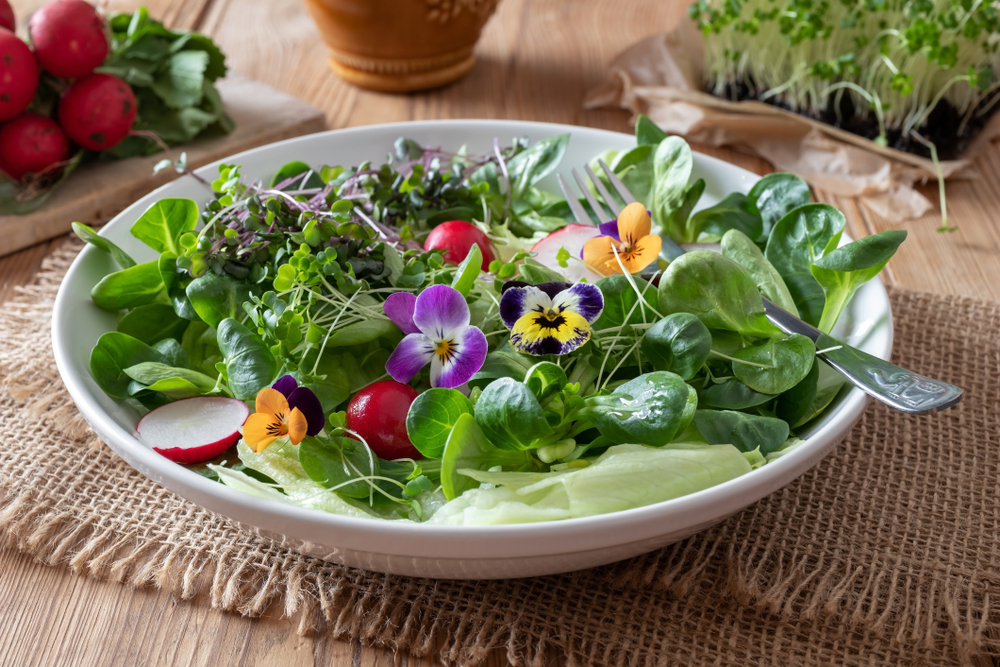
Flowers that you can eat! Perfect in my book – and if you grow your flowers from seed, you know exactly what’s on them. For me that means I know there’s no pesticides and no nasties … but perhaps the odd greenfly … Do note, there are many edible flowers and, as with all foraged food, you do need to be 100 per cent certain what it is that you have picked! Most people know about the common garden nasturtiums – they are deliciously peppery in flavour. The flowers look wonderful on a plate, and you can add the leaves to a salad or make them into a pesto. The seed pods stored in vinegar can be a replacement for capers. Calendula petals are also slightly peppery and can elevate a green salad into a work of art (calendula is also used for its herbal properties, made into soothing balms and lotions). Cornflowers have a peppery-clove aroma with a mild sweet spice flavour – add them to a salad, and they are also delicious dried and used as a tea. Violas are probably one of my favourites to add to a green salad – with their little faces they just look so pretty!
For years chefs have used lavender to flavour sugar; my mother used to make lavender shortbread and there was always a jar of sugar with lavender heads in the larder. From personal experience I can confirm it is not very nice on your cornflakes in the morning! Geranium flowers can also be used and the flavours tend to correspond to the scented leaves. Lemon geraniums are wonderful: try sprinkling them over cakes, they make an unassuming lemon drizzle cake oh-so-glamorous. Chive flowers, coriander flowers, basil flowers … they can all be eaten. In fact, there are so many that once you start Googling, the list feels endless. I’ve just seen that dahlia tubers are edible, as are the flower petals. I’ll let you know how I get on with a tuber!
Charlotte offers workshops throughout the year – please see northcombe.co.uk for further details.