When Seb was eight he received four pigs for Christmas. Now he has one of the largest pedigree herds of the rare British Saddleback pig in the UK. Two years ago he started showing them, and qualified for both the 2022 and 2023 national championships. In 2023 Seb became the youngest ever recipient of the British Pig Association’s New Pedigree Breeder of the Year award, enjoying a swish night out at the National Pig Awards in London last November! Seb, from Sturminster Newton, is about to start the 2024 show season with his team of 12 pigs – he takes it so seriously he even has a show ring set up at home to practise. Seb’s parents take him and the pigs all over the UK – even on the ferry to the Isle of Wight! His pigs are well known in the local area, and he sells them as far afield as Devon, Wiltshire and Hampshire. And as if his own pigs weren’t enough for one teenager, Seb’s recently taken a Saturday job on a local dairy farm, furthering his knowledge and passion for UK agriculture.
Do you have a Future Farmer? Send a picture with a few details to [email protected]
Dorset Chamber CEO Ian Girling encourages local enterprises to shine at the 2024 Dorset Business Awards, and it as a platform for success
This month I’d like to take a minute to talk about the 2024 Dorset Business Awards – they were launched in Dorchester in April, and are open for entries from 1st May to 13th June. The awards are free to enter and open to all businesses in Dorset. The aim is to celebrate the excellence and achievements of Dorset businesses across a wide range of categories. Now in their 27th year, they are widely recognised as one of the leading business awards in the South.
Why should I enter? Entering the awards offers a huge range of benefits to any business. Firstly, at its core it’s an extremely useful exercise to go through the application and to self-assess what you are doing well in that particular category – and also what you could improve or build on in that particular area of your business. This in itself is a very useful self-improvement exercise for any business. If you make the shortlist, being a finalist is incredibly exciting for your business and motivational for your team. Just being shortlisted means you and your team should be very proud of your achievements – this can have an extremely positive effect on morale (even more so if you win!). You’ll feel an incredible feelgood factor in your business. One of the most obvious benefits of being selected as a finalist – and of winning – is the amount of free marketing and PR you will receive for your business. Within the Dorset Business Awards, we promote the finalists in advance of the awards night across our social media channels, and winners can expect to be heavily covered in the local business media – including our own business magazine. Winning, or even being a finalist for an award, builds credibility and trust in your brand. The award recognises your achievements in that particular category, and can only improve your business reputation. This in itself is likely to improve customer retention as well as bring in new business.
Just do it The Dorset Business Awards are independently judged by a panel of business leaders from within Dorset, and the entry process is very straightforward. Entries are open now – my top tip is to always follow the guidance, and don’t leave it too late to start your entry! The awards Gala Dinner and Presentation will be on 10th October. What are you waiting for? dorsetchamber.co.uk
As the 2024 event season gets under way, Jess Rimmer finds herself balancing books and bridles as it coincides with exam season
Jo Rimmer training Jess and Mattie at the yard in Fontmell Parva All images: Courtenay Hitchcock
I thought I’d kick off this month’s report with an insider look at life juggling eventing with university. April saw both our first events of the season and the submission of my dissertation – so I don’t really have brain space to think about anything else!
Mattie gets a rub down after his workout
It’s a common misconception in the horse world that it is necessary to make a choice between pursuing a career in horses and continuing with education. People seem to think it is one or the other – but I didn’t see why I couldn’t do both! It has definitely been a juggle, though, and when I look back over the past three years I sometimes wonder how on earth we made it work! My weeks have generally involved being at uni in Bristol from Monday to Wednesday, then whizzing home to ride for the rest of the week. The pandemic meant a lot of my course was delivered online, which meant I’ve been able to keep up with my degree from home, fitting lectures in wherever possible around the horses’ routines.
Mattie (The Real McKay) missed the first events of the season with an untimely foot bruise, but he is now back on track
May sees the start of exams, which inconveniently clash with some of the first internationals of the season. Obviously I was never going to miss those – which is how I’ve ended up sitting exams from a hotel next to Houghton Hall, from the judge’s box at Bicton International and sitting in the back of a taxi in France! With careful time management, anything is possible. I guess what I’m trying to say is, if you want to go to uni but are worried about missing out on the horses, just go for it! And if anyone reading this is wondering how on earth they can make it work, I am always happy to chat.
Jess on Sir Henry Hall in his dressage test at Moreton
Mattie and Elsa catch up with each other in the stalls
The season begins OK, back to the horses! My season started a little later than usual this year, following a head injury over the winter. But with plenty of patience and support, I am now fully recovered and finally able to get the ball rolling! Our first event was a local one at Moreton, where we had Newt, Elsa and Henry. Newt and Elsa were introduced last month, but we didn’t meet Henry (Sir Henry Hall). He is a complicated horse with bucketloads of talent – but he is the ultimate worrywart. He would love to bury his head in the sand at everything scary – which is frankly most things, from his point of view! However, he always seems to perform under pressure. It’s as if he knows when it counts. At Moreton he jumped brilliantly, as did Elsa and Newt.
Super-groom mum Jo doing Henry’s studs at Moreton
We then went to Cirencester Park with the same trio, where they all performed superbly, setting us up nicely for the season ahead. Mattie (The Real McKay) sadly missed his first runs with an untimely foot bruise, but he is back on track, pictured in a training session at home, under mum’s watchful eye. His season will hopefully start at Tweseldown next month – which happens to be the day before my first exam. And so the juggling act continues! Looking ahead to May … you guessed it: lots of eventing, interspersed with exams – see you on the other side!
Remembering a steadfast leader and community champion in North Dorset
William (Bill) Batty-Smith died on his 95th birthday, 30th March 2024. Familiar to many as a North Dorset councillor, Bill was particularly known locally for his ability to chair the Planning Committee with a rod of iron. I first encountered Bill Batty-Smith at one of “his” North Dorset planning meetings. The air was tense as the room filled with local residents determined to give opinions on why affordable housing developments in Blandford and surrounding villages should not go ahead. What struck me was not only how Bill remained impassive and calm throughout the fiery debate, but also how he ensured council officers were protected from the wrath of the public gallery. It is testament to Bill’s leadership that those affordable homes are today full of young families and Dorset’s key workers.
Bill Batty-Smith, centre, with his family
A life in the East Bill Batty-Smith was born in 1929 and was educated at Sandhurst Military Academy and the Royal Military College of Science. He did his National Service in the Royal Scots Fusiliers, then was commissioned into the Corps of Royal Engineers, ending up with the rank of Captain. He spent much of the 1950s in Singapore, Malaya and Sarawak before a posting as aide-de-camp to the Commander of the British Forces in Hong Kong. Then he returned to the UK. After leaving the army, Bill worked extensively in the Middle East, specialising in oil and petrochemical health and safety. In 1977 he was awarded an MBE for services to the British community in Lebanon during the civil war. He was in Iran during the 1980 Revolution, and also in Jubail, Saudi Arabia, at the outbreak of the First Gulf War. From 1972 right up until he retired in 1995, he worked in Saudi Arabia, Lebanon, UAE, Bahrain, Oman, Qatar, Iran and Kuwait, plus another stint in the Far East in the northern province of North Sumatra in the early 80s. His work in Kuwait during and after the First Gulf War was mainly co-ordination, command and control of emergency services cover for the EOD (Explosive Ordnance Disposal) and oil fire-fighting teams, to ensure their safe passage in and out and to ensure effective casualty evacuation cover in the case of an incident.
Bill spent much of the 1950s in Singapore, Malaya and Sarawak
A tireless community manIn 1996 he found a new and very active role in local politics. He was elected to North Dorset District Council (NDDC) in 1999 as the representative for Stalbridge, and was twice re-elected. He also served on the Dorset County Council Health Scrutiny committee for ten years, and worked as an independent chairman dealing with complaints against the NHS. Bill was also a member of the council of governors at University NHS Foundation Trust.Victor Fox, former chairman of NDDC, worked with him for many years: ‘I first met Bill in 1999, when he and Ron Ash were Conservative candidates for Stalbridge in the North Dorset District Council elections. They won, and we went on to form a new ruling team with help from two independent candidates. Bill quickly became a member of the Planning Committee, where his wide experience of the construction industry was much appreciated by the other members … if not always by the planning officers or developers! ‘I well remember being a member of the committee with Bill as chairman: he would deal with crowded meetings over many a difficult decision with resolute firmness. But he was always polite to everyone.’Graham Carr-Jones also worked with Bill as a district councillor representing Stalbridge.‘He knocked on my door one day and said “I need a running mate. What do you think?” Unfortunately I didn’t say no fast enough! ‘We worked the patch together as a partnership in Stalbridge and we got a lot done. We achieved free car parking, and we got The Hub for the village. We also got the library and kept the public toilets open when Dorset Council was trying to close them. Bill got some affordable housing passed as well.’
Bill with two of his sons
Bill was invited to the Council cabinet, but declined the position, feeling he could be of more use in Planning: “Over the years I have served on almost every committee, and as chairman or vice chairman of most of them, but my main emphasis has been on Planning. This has had its amusing moments, such as the person who put in an application to divide a curtilage and then when it came before committee, spoke eloquently against the division. There were also times when the agenda at full council was sleep-inducing. In my early days, I could rely on Angus Campbell to dig me in the ribs, but when this service was no longer available there was one occasion when Michael Oliver, in the chair, had to use his gavel to wake me up.” When Bill stepped down from NDDC in 2019, just before his 90th birthday, his work was recognised with the title of Honorary Alderman. Bill was proud of the council’s work, and in his letter of thanks, he said “North Dorset has, I think, set a standard for not only the county of Dorset but for how local government should operate. Controversial items have been resolved by sensible discussion between members of all parties and there has been none of the childish and immature ‘slanging’ which seems to be fashionable in the higher levels of what passes for Government these days.” It was acknowledged at the time that he had chaired the most difficult committee in the council – that of planning.
Bill with his daughter, Jules
Daughter Jules Batty-Smith paid tribute to her father: ‘Dad was the wisest and most knowledgeable man I have ever known, my idol and navigator in life. I miss him daily and the house is so quiet without him. He had such a hard time over the past eight months, but it has been my pleasure to spend every single day with him. He was a great distraction while I went through chemo – he waited until I got the all-clear from cancer, just two days before he passed, and until my daughter Georgia returned from university, before he asked to go. For him to leave this world on his 95th birthday, which was also his wedding anniversary, at home and surrounded by family … it is just how he would have wanted it. On his terms, as always. ‘He married mum, Anne Buck, at St Mary The Boltons, London, on 30th March 1957. He met her in Borneo, while he was serving, and asked for her hand two weeks later. She said no, and he pursued her for two years before she gave in. Typical dad, always getting what he wanted in life.’ Bill is survived by four of his five children, and five grandchildren. Graham Carr-Jones summed up his friend: ‘Bill Batty-Smith was a proper action man. He was a professional engineer and an old school do-er. The Bills of this world are a generation we are losing. He was a proper bloke – The Chairman to the last.’
One of the easiest and best ways to encourage wildlife in your garden is to leave a patch of lawn to its own devices, says Pete Harcom
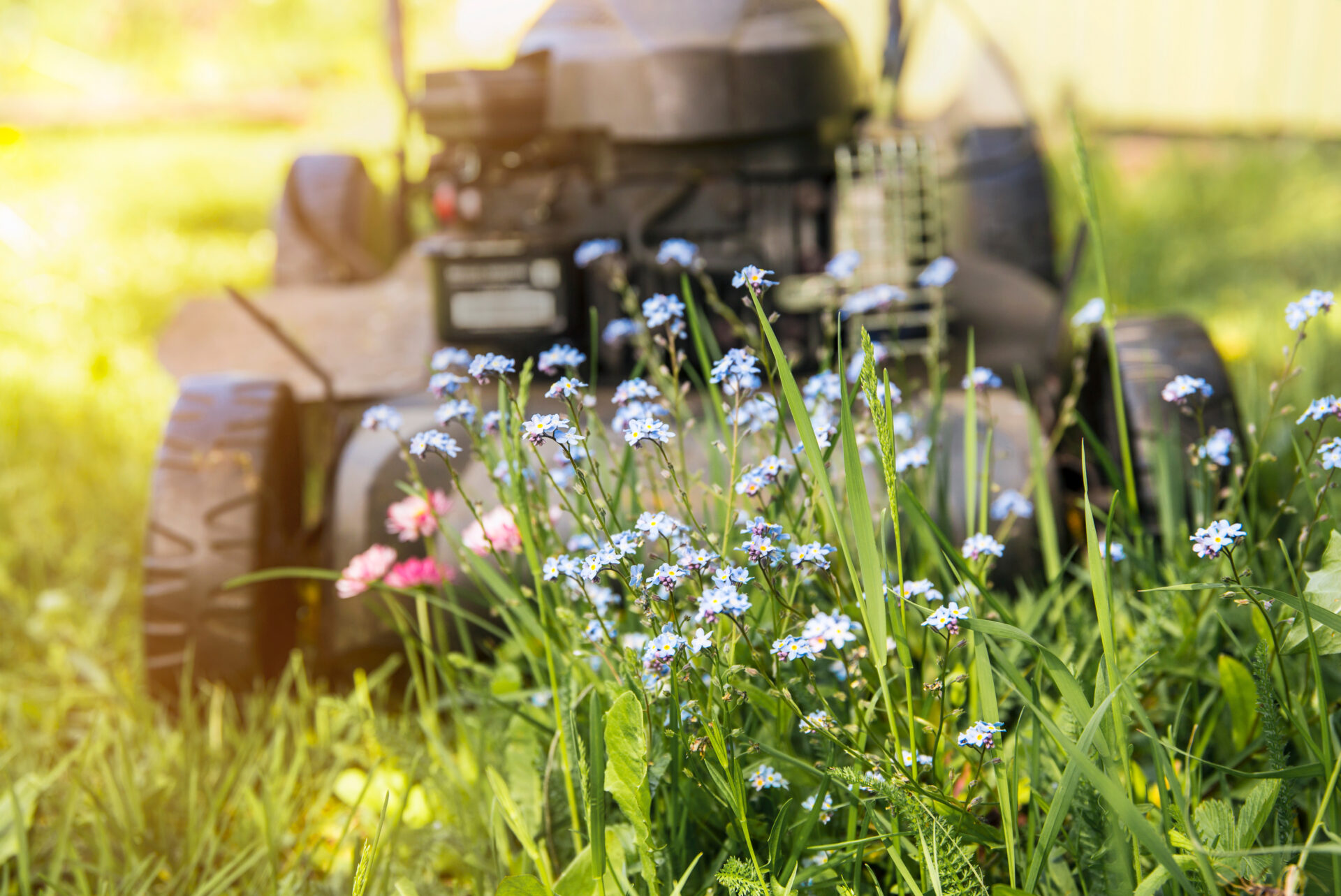
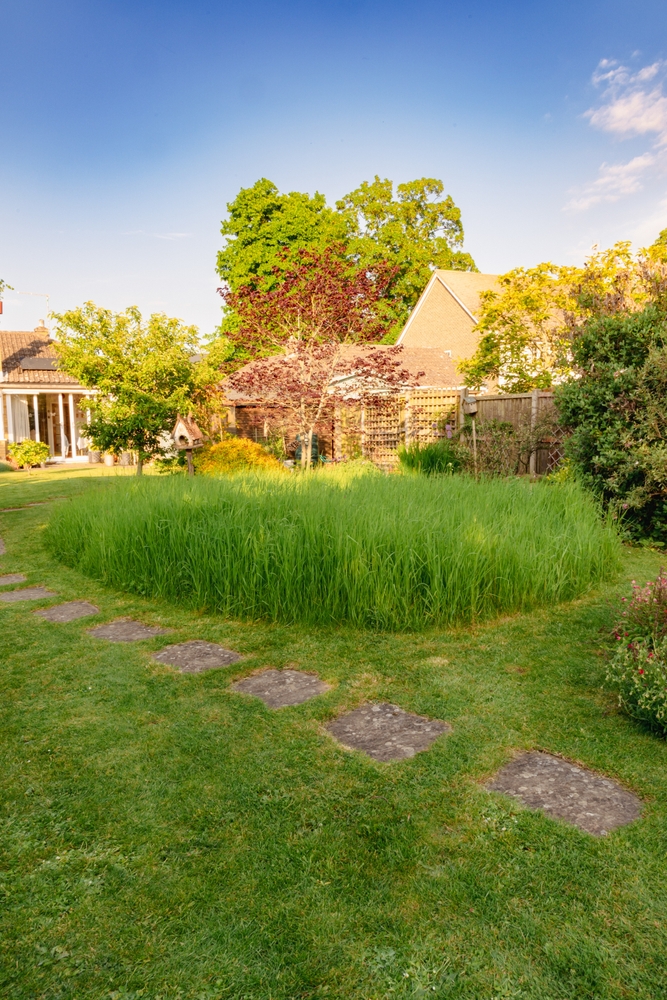
I have been thinking about the ‘No Mow May’ campaign that was started in 2019 by the conservation charity ‘Plantlife’. Perhaps we should all consider this again. How about not mowing our lawns for at least the month of May? Apparently we have lost almost 97 per cent of our flower-rich meadows since the 1930s – and with them we have lost the food needed by pollinators such as bees, moths and butterflies. If your lawn is left to grow and set seed, it produces wildflowers, plants and fungi which all benefit your local wildlife. And all we have to do is NOT mow. Or at least, reduce our mowing from May onwards. If you do need to mow, try leaving a large area unmown – that will still help. Longer grass and wildflowers support a variety of insects such as beetles, spiders and grasshoppers. These insects are an important food source for many birds and other animals, and they also help to pollinate plants and break down organic matter in the soil. The only downside for a gardener may be that weed growth can establish if the grass is not mown for an extended period, so monitor and remove individual weeds if they start getting established.
Even leaving part of the garden unmowed can help your local wildlife
Jobs for May
May should be a lot warmer, but keep an eye on the weather forecast – you may need to wait to plant out bedding plants until the end of the month to guarantee the warmth.
Sweet peas can be sown direct into the ground during May – and if you sowed into pots a few months ago, it’s time to plant out your sweet pea seedlings during a mild spell.
Divide clumps of hosta plants as they come into their new growth.
Trim back aubretia after flowering to encourage compact growth and repeat flowering.
Prune penstemons now – cut back all the old shoots to the base.
If fuchsias and pelargoniums are growing well, take cuttings now to increase them.
Look out for signs of blackspot on roses. Blackspot is a fungus that presents as round, irregular black spots on the leaves and canes of roses. If discovered, and you wish to avoid using a systemic fungicide, pluck and dispose of the leaves, and try to keep the ground clear of dropped leaves where the fungus can thrive.
Prune spring-flowering shrubs – such as deutzia, choisya, weigela and philadelphus – after flowering to maintain shape.
Birds are starting to nest now – please check hedges before trimming them back. It’s possibly best to accept you missed your chance, and to leave the hedges until late summer now.
After a year of rigorous training and overcoming nerves, the young boxer showcases his potential and snatches his first national title
Freddie Norman wins the title
Freddie Norman turned up at the Sturminster Newton boxing gym with his dad just over a year ago. ‘He said he’d visited when we had our open sparring,’ says coach Shaun Weeks. ‘He just loved the feel of the club and the way it was run, and felt that this was the place he wanted to learn the rest of his trade.’ Now Freddie travels up from Parkstone three days a week to train with Shaun and his team – and in April he won his first national title. Still a junior, 14-year-old Freddie boxes in the under 63kg category – a professional Lightweight. ‘When he came to us he’d had six bouts – won three lost three.’ says Shaun. ‘Since then, he’s had 12 bouts and won 11 of them. That single loss was his second contest, he was stopped in a national quarter finals by a lad called Reuben James. ‘And what was nice about the recent competition weekend at Loughborough was that he was pitched against Reuben James again in the semi-final – only this year Freddie got a points win! ‘He then faced Charlie Hewitt, an unbeaten lad from the north west who comes from an old-school boxing family. Freddie beat him on points too, giving him his first national title: National Junior Cadet Champion.’ Following his win, Freddie was invited to the England Boxing Talent pathway trials, but of the 90 boxers who attended only six were selected, and unfortunately Freddie missed out. However, the feedback from the coaches was really positive, and he’s been invited to attend the junior England prep camps for the European Championships and other competitions, to provide sparring practice and to help the competitors prepare. The Junior bracket is a two-year window, currenty for boxers born in 2008 and 2009, and Freddie is right at the bottom of the age group. Selection was always a long shot, says Shaun. ‘And then when he was sparring, he missed his work a little bit. When we spoke afterwards, he admitted he’d been very nervous, it being his first time there. And he felt he rushed his work a little bit. But it’s a great learning curve – and the right people have seen him now. The fact that he’s been invited back to do sparring … It took me 18 months before they’d even look at Ruby Else-White, and she started the same way, by being invited up to spar to aid the England team prepping for a competition. ‘So at least we’ve got our foot in the door. I’m confident he’ll end up boxing for England, he will win national titles in the future – he’s dedicated, and he’s a good lad. ‘And for a small rural club to have not one but TWO national champions! But the quality of the boxers coming through is amazing, we’ve got a great coaching team, a good working committee, and we’ve got lots of local support, which is excellent.’
Freddie with coach Shaun Weeks left and coach Eddie Wareham right
For every competition the Sturminster Newton boxers enter, the club needs sponsors to help with costs: they are usually looking for ten businesses to donate around £200 each. They’ll get their logo on the event uniform T shirt, plus social media exposure. ‘Local trips aren’t so bad,’ says Shaun. ‘But we travel all over the country – we’re off to Sweden in November. ‘Other businesses support the kids with a regular monthly donation: whatever they can manage, even £20 helps, and that really helps to keep us ticking over. We only draw from it for travel costs, mainly for Ruby – and now Freddie – when they’re travelling to wherever the England camps are.’ If you’d like to get involved, contact Shaun on [email protected] or 07817 243101
This month a group of nine North Dorset ladies climbed Britain’s highest three peaks inside 24 hours – and enjoyed a prosecco at the top of each
The nine Rally Girls with their guide, Josh, far right, setting out to tackle the first peak – Ben Nevis
They are usually found at the county’s steam engine rallies and vintage shows, driving old vehicles and maintaining machinery. However, over the past nine months, a group of ladies from North Dorset have been training for a gruelling charity challenge. The Rally Girls swapped their overalls and spanners for hiking boots and walking poles, and spent weekends relentlessly training to climb the three peaks – Ben Nevis, Scafell Pike, and Snowdon – inside 24 hours.
All images: The Rally Girls
The Mountain Challenge The women planned to summit Ben Nevis first, Scotland’s highest peak at 4,409 ft. The total trekking route is nine miles, and there is currently snow at the summit. Next was Scafell Pike, England’s highest mountain at 3,209 ft. It’s a challenging climb at any time, but their ascent was to be in the middle of the night. The final mountain was Snowdon, or Yr Wyddfa, the highest peak in Wales at 3,560ft. Anyone climbing even one of these mountains needs to be fit, but all three of them in 24 hours? How did they do it? Ten friends started the challenge: Jules Hunter, Holly Parsons-Fox, Kerry Antell, Laura Antell, Amey Butler, Selena Newman, Sara Beever, Sara Treeby, Charlotte Young and Trish Channon. The plan initially took seed during last summer’s rally season – admittedly over a cocktail or two.
The Rally Girls absolutely loving life on the peak of Ben Nevis
‘Each time we went to a rally we’d recruit one more person, said Kerry. ‘The steam rallies can be a very male-dominated environment, so when we got together we were intent on doing something for us.’ Nine months of training commenced as the group took the preparation for the challenge seriously, Jules said: ‘We did some training on our own, and then the first meet up was the Blue Moon Swim – we went swimming in the sea at night. Then we did some group trips and long day hikes. We initially had a coach who was helping us – he tragically died on Crib Goch on Remembrance Day. He was an ex-serviceman. Part of our training included a 21 mile memorial walk for him.’ Amey explained how the group had managed their own training. ‘All of us have got kids – we just had to exercise around them. We even fitted walking in by doing it at 5 or 6am before the kids were up!’ Kerry admitted she’d found a lot of new places to walk: ‘I’ve lived in Dorset for 30-odd years, but there are lots of places I have never been. It was great to train on the hills and Jurassic Coast right here in Dorset.’ While Amey had previously done lots of mountain walking, Holly and Jules had never done any. Some of the group had completed marathons or tough mudder challenges but some were complete novices. Holly was swift to share her biggest tip on what helped: ‘Blissful ignorance!’ Unfortunately, just one week before the challenge, Charlotte Young dropped a lawnmower battery on to her foot. ‘The battery is absolutely fine,’ her dad, Norman Young, was quick to reassure everyone. The group were down to nine.
Fundraising ‘It was important that all of the charities we’re supporting mean something to us,’ said Holly. ‘We self-funded all our costs – equipment, coaching and travel. So every penny is going to the charities. Because we’re all friends, we know all the same people – so it made sense that instead of asking each person for money ten times we would just put everything together in one pot, and then divide it equally between the charities we had each chosen.’ The charities the group elected to support are Ducks and Drakes Cancer Trust, Dorset and Somerset Air Ambulance, STARS Appeal, Mouth Cancer Foundation, Endometriosis UK, Devon Air Ambulance, Ickle Pickles, MS Centre Dorset and The Salvation Army. ‘We were hopeful that if we could raise £500 for each charity we would have done really well. But we have exceeded that and donations are still coming in!’ The fundraising pot currently stands at more than £7,000.
The Challenge The Rally Girls met Josh, their guide for the challenge, in Glasgow: ‘When he met us we were all drinking beer – he must have wondered what he had taken on,’ said Kerry. ‘But we loved Ben Nevis. The weather was really good to us and we got to the top and saw those views. We had planned ahead, and we had a tiny prosecco at the top of each mountain! And our children had painted stones for us to leave at each peak. ‘It was beautiful up there, we could have stayed all day. But we knew we had two more peaks to climb in the 24 hour time. We actually slid on our bottoms down Ben Nevis on the snow – it was so much fun! ‘But as much as we had loved Ben Nevis, we hated Scafell more. It was dark, freezing cold and there were huge boulders. We found that very difficult. ‘And it sounds ridiculous, but it was really steep! I genuinely never want to go back there. But we kept going.’ Finally, the group climbed Snowdon via the famous Pyg Track. They reached the peak with time for a swift celebration before making the descent – you have to get back down again before the deadline. ‘It was insane,’ said Jules. ‘We just couldn’t believe we had done all this together. When we were on that very last bit of path from Snowdon we were like a pack of football hooligans. We had DONE IT! And then, on the coach on the way home, we were watching the donations come in … it was just surreal.’
Done … next? After such a gruelling challenge, what advice have the Rally Girls got for others contemplating similar? ‘You have to put the training in to enjoy it,’ said Amey. ‘Then you know you’ve given it your best shot. And just keep going! We had a Whatsapp group chat to keep each other motivated, and a good support network helps. And don’t let fear rule your mind. Mental agility is just as important as physical ability for these challenges.’ Now that the Rally Girls have completed this impressive feat they are up for more fundraising challenges and are open to suggestions! The group will next be together at the Three Okefords Rally in May, kicking off the summer season, and will soon begin planning the next adventure.
Rob Nolan captures a fleeting, once-in-a-lifetime glimpse of the elusive Pons-Brooks comet – and what to see under the Flower Moon
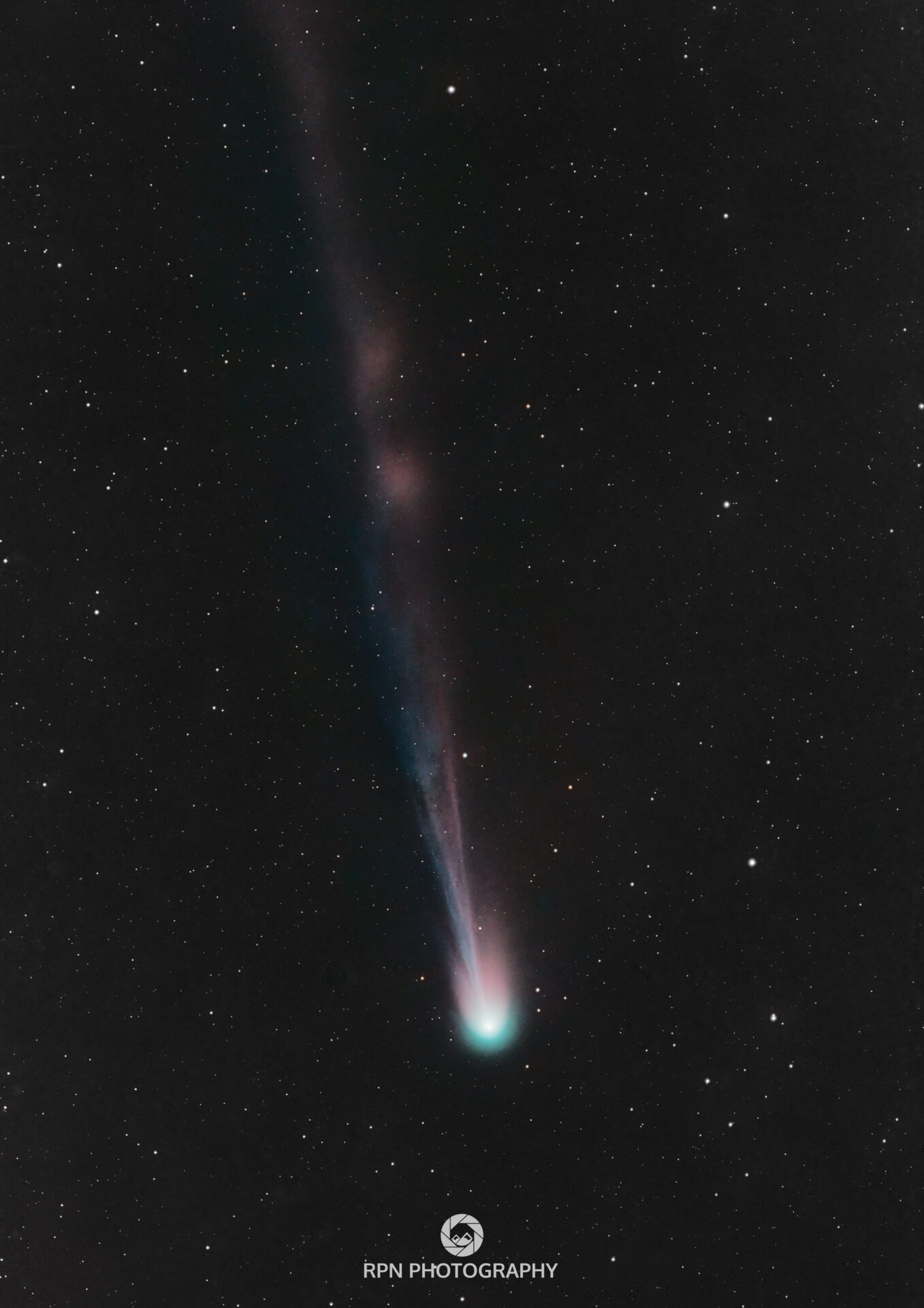
This month’s image was intended for last month … but as I was so excited to share my Aurora image from my surprise trip to Finland, this rather special comet got bumped a few weeks. Sorry 12P/Pons-Brooks! This comet last passed us here on Earth in 1954. During its flyby this year, it will reach perihelion (the point in the orbit at which it is closest to the sun) on 2nd June, when it will be 232 million kilometres from Earth. However, our best views of the comet – with our telescopes and the naked eye – were back in March and April. Due to its low position on the horizon and our swiftly receding dark nights, the comet becomes increasingly difficult to see in the Northern Hemisphere as the year progresses, even though it is yet to reach its closest distance from us. It will continue to be visible in the Southern Hemisphere, but will become less bright as it travels away from the Sun. This comet is also known as the Devil Comet. Its a cryovolcanic comet – literally an ice volcano flying through space. From time to time it erupts, sending bursts of ice and gas into space which cause it to appear much brighter for a few days. This apparently happened around the 29th February, and again in early April, making the comet much brighter in the sky for a time. This image was likely a one-off chance encounter for me – the Pons-Brooks comet won’t be visible in our night skies again for another 71 years, so it’s pretty unlikely that I’ll see it again, making it rather special. This image was taken during 2 nights in March using my Altair 70EDQR Refractor and Dedicated cooled mono astro camera. I was struggling with this data, so my friend Rick Voss who is an extremely talented Software Developer and Astrophotographer offered to help me out. He spent considerable time processing this image from my raw data and was able to create something quite special! Rick creates fantastic astro photographs – head over to rsastro.com to see more of his work!
The night sky, May 2024 – Rob’s guide for your stargazing this month:
This month there aren’t many local objects to observe in our night sky, apart from the passing meteor shower, so it’s a good time to explore the universe through the pinlit curtain of endless stars and enjoy those later dark night skies. Constellations such as Boötes, Scorpius, Libra and Virgo are all great constellations to go hunting for this month if the mood takes you. On 4th May, just before dawn, you’ll be treated to a view of a narrow crescent Moon with Saturn to the upper right at twilight. The big event this month is the annual Eta Aquarids Meteor Shower, peaking the evening of 4th/5th May – and we’re in for a great display this year, if the skies allow, as the Moon will not hinder our view. The Eta Aquarids are tiny pieces of Halley’s Comet, crashing into Earth’s atmosphere as we enter the comet’s trail of debris. Halley’s Comet itself last appeared in our night skies in 1986, and will next appear in 2061 (that’s a date to put in your diary!). Two bright stars will be clearly made out next to the Moon on 12th May – these are Castor and Pollux, the twin stars in the constellation Gemini. Watch the full Moon (May’s full Moon is also called the Flower Moon, or Milk Moon) sail under the bright star Antares on the night of the 23rd/24th May, though you’ll need to wake up early to watch this crossing. Antares is the massive ruby-red star that is brightest in the constellation Scorpius. It is one of the largest known stars, about 700 times larger in diameter than the Sun and about 10,000 times brighter. To close the month off on the 31st, before the dawn Saturn sits to the left of a crescent Moon, but Mars will also be shining bright close by. Until next time, clear skies!
Despite the wet ground, there’s been a lot to do on the allotment, and plenty has been achieved this month, says Barry Cuff
On the last day of March, a line each of Maris Bard and Jazzy potatoes were planted, only possible by working from the path as soil was very wet. April 1st – Collected leeks and purple sprouting broccoli 2nd – Plug tray of Little Gem lettuce placed outside to harden 5th – Cut spicy salad leaves and pea seedlings for salads (trays in greenhouse) 7th – Planted line of Charlotte potatoes 8th – Sowed plug tray of Brendan Brussels sprouts, planted out lettuce under cloche, sowed patch of radish. Pulled sticks of rhubarb for the kitchen. Sowed a plug tray of Neon celeriac and two plug trays of Golden Self Blanching celery. Planted six lines of potatoes – Sagitta, Caledonian Rose, Caledonian Pearl, Jazzy and Desiree (made possible by standing on scaffolding boards to avoid soil compaction) 9th – Dug more ground for more potatoes. It dug well, despite being fairly wet 10th – Removed all of last year’s brassicas. The last of the broccoli plants were covered with snails 11th – The forecast finally looks good, with no rain for at least 10 days but still some cold nights. Planted two lines of Desiree, and noted the Conference pear is in full flower 12th – Pumped water on site, mainly to check the pump as it was last used in September! Planted four rows of Picasso potatoes
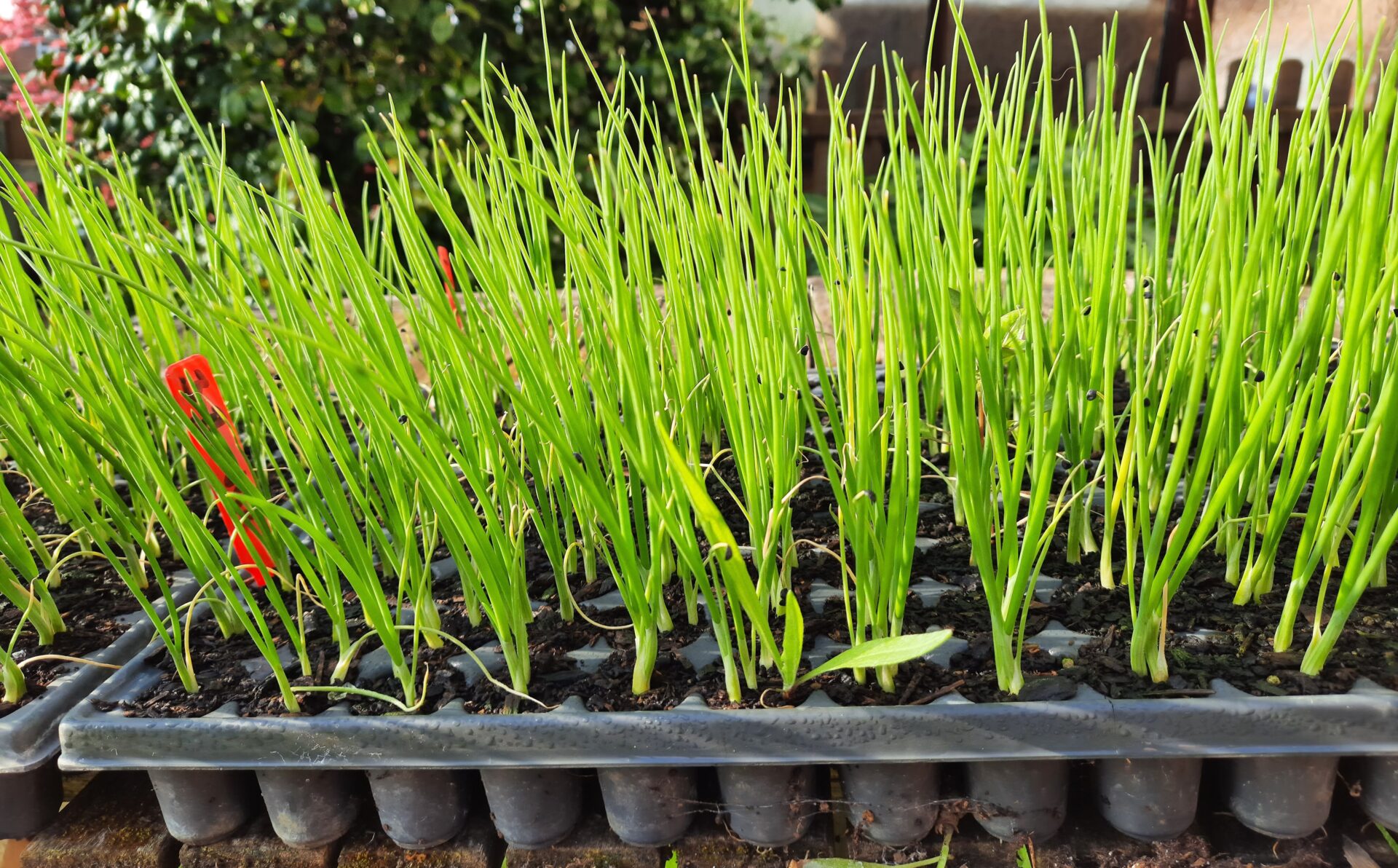
Four lines of onions were planted out, 40 stations per row, with one to three seedlings per station Image: Barry Cuff
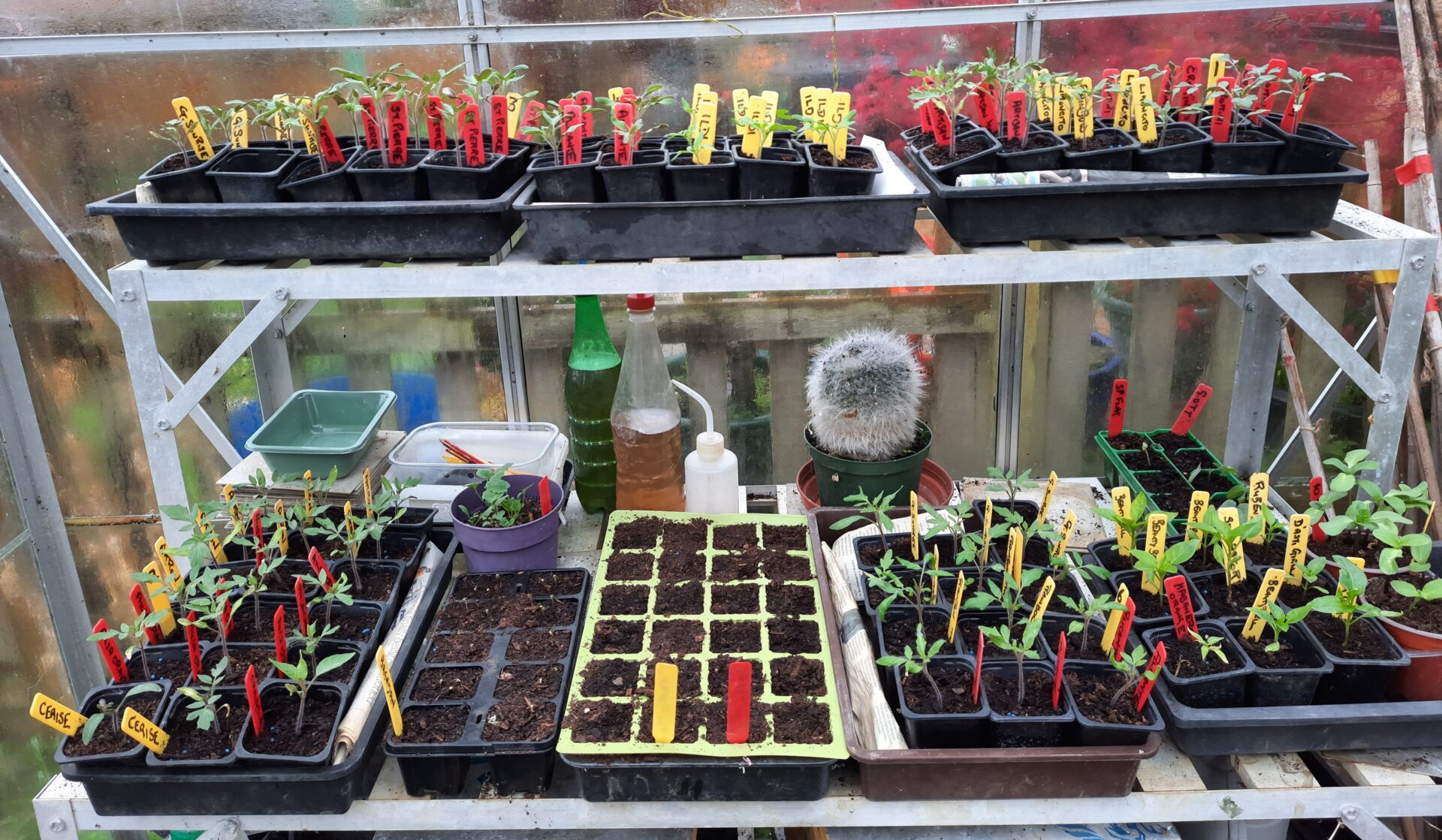
14th – Cut the hedge: a mixture of hazel, blackthorn, hawthorn, elder, snowberry, ivy, blackberry and dog-rose. This hedge is on our northern boundary and gives protection from cold winds. 15th – Planted out a line of Red Drumhead cabbage and covered with cloches to protect from pigeons. Pulled more rhubarb. 16th – Sowed two 3-litre pots of Musselburgh leeks. Weeded strawberry bed – the early varieties are in full flower. Broad beans also have their first two sets of flowers. 17th – Sowed part lines of Early Nantes carrot and Boltardy beetroot. Potted up sweet peppers in the greenhouse. 18th – Dug the ground for onions and parsnips. 19th – Tidied the mint area which has spread during the wet winter. Covered the skulkers* with pots and the strawberry bed with fleece to protect from the forecast frosts 20th – Potted up tomatoes in both greenhouses (we have 14 varieties) 21st – Broke down the large soil lumps on the onion and parsnip plot 24th – Planted out four lines of onions from plug trays: about 40 stations per row, with one to three seedlings per station. Have planted Bonus and a few Red Brunswick 25th – Dug out the weeds in the fruit bush area – mostly grass weeds, with some willowherb and bindweed. Planted a line of strawberries from pots (some of last year’s runners). Depending on the weather, at the time of writing, we hope to sow two lines of peas by 30th April
Skulkers – a Dorset term for ‘volunteer’ potatoes accidentally left in the ground from the previous year.