Home Blog Page 353

Hares, beavers, rolling down a hill – and the fear of what’s coming

0
Hares don’t seem to become an issue, reflects Dorset NFU county chairman George Hosford, but beavers (and, surprisingly, Jeremy Clarkson) pose far tougher questions – and there don’t seem to be any easy answers
The brown hare is Britain’s fastest land mammal, clocking speeds of up to 40mph. The expression to ‘kiss the hare’s foot’, meaning ‘to be late’, alludes to the hare’s great speed and the notion that, if you hesitate, it will have gone and all that will be left is a footprint.
Image: Alan Wicks

Seven or eight hares constitutes grazing pressure equivalent to how many sheep? When does the hare population shift from “I like to see a few of them about” to “I might have to consider doing something about them”?
But when our friend Alan Wicks can produce photos like the above, I just want to celebrate. They look like a bunch of greyhounds racing hell-for-leather around a track, but what would the hares be chasing? A stuffed whippet on a piece of string?
I think they are just doing it for the sheer fun. Alan tells me that he has seen them rough and tumbling in a heap sometimes. I know that some areas suffer from much larger numbers of hares than we do, and that action does indeed need to be taken, but here, hare numbers have been low to modest for as long as I can remember. What is the key factor that limits them? There is, after all, no shortage of food. Has it been due to the presence of too many predators of the leverets, like buzzards and crows? Or is it that we have been too successful in controlling small weeds in crops, which I have long understood are vital for the survival of young ground-nesting birds? Surely a young hare can graze on wheat from the day it’s born? As farmers it is very difficult to get the right balance between a few weeds sufficient for skylark and lapwing chicks, and a wipe-out of a crop due to runaway weed infestation. The chemicals we use are very efficient at their job, and if you use reduced rates you risk encouraging resistance to the sprays in the weeds.

Beavers be damned
All too often when walking, biking or paddling along local rivers, one comes across weirs and sluice gates that are woefully neglected. How much of the flooding that so many tears are shed over – and millions of pounds spent clearing up after – could be saved if the rivers were better managed? Current river policy seems to revolve roughly around re-wilding. Oh, and let’s bung in a few beavers for good measure, there won’t be any flooding then.
How long before a dislodged beaver dam gets washed down to a dodgy old bridge, turning it into a bigger dam, causing flooding upstream, or a tsunami downstream, following its collapse?
I am sure those responsible for intelligent advanced planning have borne all this in mind before launching into the Great Beaver Release Gamble that is approaching; at least five such releases are planned for Dorset. No-one seems to operate the precautionary principle any more. There are numerous tales of beaver trouble from Scotland, where, as so often, they are ahead of us in this game, but has any notice been taken? Apologies for all the questions this month – but does anyone have any answers (oops, there’s another)? Luckily for me, I live on a hill.

Mother knows best
The school visit season has now begun, and so far in pretty co-operative weather. Sometimes a group will bring a picnic, after which they will enjoy running or rolling down a nearby hill, before resuming their tour around the farm, asking plenty of questions along the way.
Didn’t Mother always say you should let your lunch go down before such exertions?

The Eurasian beaver is native to Britain and used to be widespread in England, Wales and Scotland, but was never known in Ireland. They became extinct in the 16th century, mainly because of hunting for their fur, meat and castoreum, a secretion used in perfumes, food and medicine.
There have been more than 200 formal beaver reintroduction projects (plus numerous unofficial releases) in more than 26 European countries and their ecology and management is well-studied.

Clarkson’s got a point
Whatever you might have thought of Jeremy Clarkson in the past, since he began sharing with his huge audience the trials and tribulations of learning to farm, he has surely been a force of good for the industry. His first series from his farm Diddly Squat was highly entertaining, and brought tales so familiar to long-suffering farmers to the attention of the population at large.
His piece in the Sunday Times today, 15th May, is worth looking up (read it here – the Times has a paywall, but there’s a month free trial and it is well worth a read – Ed) – he is publicising, in his usual entertaining style, what our NFU President has been trying so hard to ram home to our wise and wonderful (apparently clueless) leaders for months, since the war began in Ukraine, about the impending crisis in food prices and availability around the world.
What he doesn’t get around to is pointing out all the micro-decisions we are making at farm level to control risk and to preserve our livelihoods, which are very likely to result in reductions in production. Speaking to many farmers it is easy to find those who have reduced their usage of fertiliser this year, accepting that output may fall. This year could be OK – many bought fertiliser at what now seems giveaway prices, and we can currently sell grain, milk and meat at prices well above where we were a year or two ago (with apologies to pig and chicken farmers). Ask about next year though and you get blank looks all round. How do we make sense of such a huge change in circumstances? Should we buy (very expensive) fertiliser for next season now, if we can get it, and back it up with cracking forward grain prices? Unfortunately that doesn’t work in the meat markets. Or do we wait and see? In terms of the environment and climate-damaging emissions, it couldn’t be a better time to rein back on fertiliser applications and test the result. With the ongoing war though, shortfalls in exports of grains from Russia and Ukraine are suggesting the opposite should be done.
At farm level, I suspect we are likely to be cautious, with production likely to fall.

Sponsored by Trethowans – Law. As it should be

Bee careful in the garden

0
Even the UN recognises World Bee Day – Charlotte Tombs shares some beewitching bee facts and how you can make a difference.
Since 1900, the UK has lost 13 species of bee, and a further 35 are considered under threat of extinction. None are protected by law. Across Europe, nearly one in ten wild bee species face extinction.

World Bee Day is now a ‘thing’. These tiny little insects get to have their own day in order to raise awareness about the threats made to pollinators by human activities. It has the approval of the United Nations no less, and the first World Bee Day was celebrated on Sunday 20th May 2018.
For me, one simple solution would be if we all aim to stop using pesticides in our gardens. By stopping the use of such harmful chemicals we could genuinely make a difference to our bee populations – and all those good insects which in time will come to our gardens and improve them, our environment and the world in general.

The bee’s knees
Here are some mind-blowing facts about our humble honey bee for you:

  • In her (sorry chaps, but they only come in a ‘she’ variety) lifetime she will only make 1/12th of a teaspoon of honey. That’s the life’s work of 12 bees to sweeten your herbal tea!
  • She will fly 375 miles and visit 70,000 flowers for that 1/12th of a teaspoon.
  • Bees need a varied diet – there have been studies done and like us the more varieties of flowers they visit the better for them.
  • A bumblebee’s tongue can be as long as 20mm and they often fly with their tongue extended as they collect nectar (a bit like a dog with its head out of a car window, I imagine).
  • In the UK we have 270 bee species, and almost 250 of these are solitary. Only nine are types of honey bees, but they are all amazingly effective pollinators.
Image: Charlotte Tombs

There are lots of things we can do to help the bee population in our gardens and cut flower patches and in doing this we really can all make a difference.

  • Bee ladders
    Bees need to drink water, but can often drown in a bucket or plant pot or wherever water collects. Simply tie a bit of string to the side of your water butt, and the bees can climb up the ‘ladder’.
  • Bee hotels
    Provide or make bee/insect hotels – there is so much information online about this and it’s a great school holiday project for children.
  • Bee-friendly plants
    Try to avoid double-petal blooms as bees like an open-faced flower. Foxgloves are like top floor restaurants for bees, especially as the spotted throats of these flowers act as runway markers for the bees to land and they can come back again and again as each flower opens up the spire. Lavender and honeysuckle aren’t just human favourites, they are a favourite for bees as well. And please do let that ivy grow on your garden wall, the flowers are a great source of bee food when there is not a lot else flowering.
    If you visit your local garden centre they will have an area of pollinator-friendly plants to give you inspiration, along with lots of ideas on how you can help.
  • Let the wilderness in
    If, like me, you have an embarrassing corner of your garden where the nettles have taken hold why not admit defeat? Leave it for the butterfly caterpillars of Red Admiral, Small Tortoiseshell, Painted Lady and Comma. By stopping the use of pesticides in your garden, over time it will benefit from more birds as they come to eat the bugs and the circle of life continues …

    by Charlotte Tombs Charlotte offers workshops through the year – please see northcombe.co.uk for further details.

Higher Level Teaching Assistant | Milborne Port Primary School

0

Higher Level Teaching Assistant

Grade 12, scale point 12

Hourly rate:  £11.69

Hours: 4.5 hours per week

Two afternoons per week, 1pm – 3.15pm

The Governors wish to employ a Higher Level Teaching Assistant to start September 2022

Please contact the School Business Manager Claire Brown on:

 [email protected] for an application form and job description.

Closing date:  Friday 1st July

Interviews:    Week beginning 4th July

All completed applications should be returned to the school email address above.

Milborne Port Primary School is committed to safeguarding and promoting the welfare of children and young people and expects all staff to share in this commitment. 

This post is subject to an enhanced DBS check and medical clearance.

This month’s Book Corner recommendations from Winstone’s

0

“As it’s such a pleasure to share books at events both in the shop and out and about, I thought I’d bring a couple of books to your attention that have the authors visiting Sherborne in June” – Wayne


Taking Stock : A Journey Among Cows by Roger Morgan Grenville £ 16.99

Since Highland cattle ransacked his grandmother’s vegetable patch when he was six, Roger has been fascinated by cows. So at the age of 61, with no farming experience, he signed on as a part-time labourer on a beef cattle farm to tell their side of the story. The result is this lyrical and evocative book. Cattle have existed alongside us, fed and shod us, quenched our thirst, and provided a thousand other tiny services, and yet most of us know little about them. We are also blissfully unaware of the de-natured lives we often ask them to lead. Part history, part adventure and part unsentimental manifesto for how we should treat cows in the 21st century, Taking Stock asks us to think carefully about what we eat, and to let nature back
into food production.

Roger Morgan Grenville is speaking at a Sherborne Literary Society event on June 8th – see more details and book tickets here

A Fortunate Woman: A Country Doctor’s Story by Polly Morland £16.99

Polly Morland was clearing her late mother’s house when she found a battered paperback fallen behind the family bookshelf. She was astonished to see inside an old photograph of the remote, wooded valley in which she lives. The book was A Fortunate Man, John Berger’s classic account of a country doctor working in the same valley more than half a century earlier. This chance discovery led Morland to the remarkable doctor who serves that valley community today, a woman whose own medical vocation was inspired by reading the very same book as a teenager. Interweaving the doctor’s story with those of her patients, reflecting on the relationship between landscape and community, and upon the wider role of medicine in society, a unique portrait of a 21st century family doctor emerges. Illustrated throughout with photographs by Richard Baker.


On June 30th Wayne invites you to join him for an evening with Polly Morland. Enjoy a glass of wine, a talk and a signing. Tickets just £2, redeemable against the book. More details here

In 2022 Winstone’s celebrates 10 years as Sherborne’s Independent Bookseller. Winstone’s has won the British Book Awards South West Bookseller of the Year four times and was winner of the Independent Bookseller of the Year national award in 2016. Owner Wayne Winstone was previously one of the three judges for the Costa Prize for Fiction, and in 2018 Wayne was selected as one of the top 100 people in the Bookseller’s Most Influential Figures listing.

Have you ever considered volunteering with Citizens Advice?

0
Citizens Advice Volunteer Advisers come from different backgrounds, are different ages and have varied life experiences. They all have one thing in common: they want to help their local community

There has never been a more important time to volunteer. Many people in the community are facing hardship from the cost of living crisis – and they need urgent help. Citizens Advice has seen a sharp increase in those needing help. Many local people are struggling to pay the bills and are having to make a choice between paying for food or energy. Over the last three months Citizens Advice has seen a 28 per cent increase in utilities issues and a 26 per cent increase in debt issues. There is help out there through good advice and access to a range of grants and other support.


Citizens Advice needs additional volunteers to meet this demand. The only qualifications we ask for are that you are a good listener, IT literate and have a passion for wanting to help others. You may not think that you have transferable skills but you will be surprised!


We will provide all the training materials you need to get started and you will have a dedicated trainer who will help guide you through the whole process.Elaine Morley, Advice Services Manager for North Dorset Citizens Advice commented:


“We are an important part of our local community. Last year Citizens Advice Central Dorset helped 7,468 people with 22,518 issues. None of this would have been possible without our dedicated volunteers”.


If you feel that you want to do something positive for your community in the North Dorset and Sherborne area, and would like to know more, please email Elaine on [email protected] (North Dorset) or Diana [email protected] (Sherborne) or visit our website centraldorsetca.org.uk. Start making a difference today.

Sheelagh

Sheelagh’s story:
“I started volunteering at my local Citizens Advice office almost seven years ago. I had enjoyed 20 years of headship at Kingdown School in Warminster and 5 more years as a consultant Head, but was not yet quite ready to retire fully from work, so wanted an opportunity to keep my brain active and give something back.
When the training began, I spent several weeks (one half day in training sessions and some time doing homework) learning about the benefit system, managing debt, housing, consumer problems and lots of other information, much of which I knew nothing about. I was able to listen into the telephone advice line and sit in on client meetings with experienced advisers. Everyone in the office was kind and helpful and the supervisor and manager were wonderfully patient. Seven years on, I am still enjoying my time advising, and see clients face to face as well, at drop-in sessions and booked appointments. Come and join our friendly and hard-working team for a rewarding volunteer position!”

Meet the speckled bush-cricket

1
Climate change and pesticides mean wildlife in our gardens is disappearing – writer Jane Adams urges us to look for an oddly cute vegan who won’t dance
What’s bright green, spotty and loves a bramble bush? The speckled bush-cricket thrives in shrubs and grasses in hedgerows and woodland edges. Perched motionless during the day, look for speckled bush-crickets at dusk and in the evening on shrubs and in tall vegetation. You’ll need to search as they are excellently camouflaged. Image is the nymph stage of the speckled bush-cricket – Image: Jane Adams

As I stand in the middle of a flowerbed in my Dorset garden, I’m surrounded by insects. Worker bumblebees scurry in circles over flower heads, a small-white butterfly floats by like a paper plane, and an armoury of shieldbugs patrol the jungle of shrubs. It’s an idyllic June day. The sort you dream of in the depths of winter when you’re cold and tired. But there’s one insect that’s nowhere to be seen. The speckled bush-cricket.
Eventually, long antennae dangling in mid-air give its position away. As I follow the looped tendrils, they lead me to its speckled body, camouflaged against the leaves of a Michaelmas daisy. It’s tiny. A nymph, less than a centimetre long. As it turns its Jiminy Cricket face towards me, I swear it’s going to break into a song and dance routine.

The nymph stage of the speckled bush-cricket, with the moulted skin below the leaf.
Image: Jane Adams

Sadly, it doesn’t. Instead, as I move, its compound eyes follow me, and I’m left wondering just who is watching who. Most of the 23 cricket species we have in the UK are omnivores, but the speckled bush-cricket is strictly vegan. By gorging on young leaves, it will outgrow its skin and moult several times
until it reaches the two to three centimetres of adulthood. If the one I have found is a male, it will eventually
sing to find a mate by strumming the underside of its left forewing with its right forewing – but we won’t hear it.

The frequency of its clicking song, and its mates’ reply, are way beyond the limits of our human hearing. Crickets like the heat, so at the moment most species in Dorset don’t seem to be threatened by climate change. However, with so many insects disappearing from our gardens, there’s still a chance they could be next. So, it’s worth taking care of them – turn a blind eye to a bit of plant nibbling and steer clear of pesticides. Maybe then we’ll see this harmless and beguiling insect again next year.

by Jane Adams

Dorset Tractor Run returns on Father’s Day

0

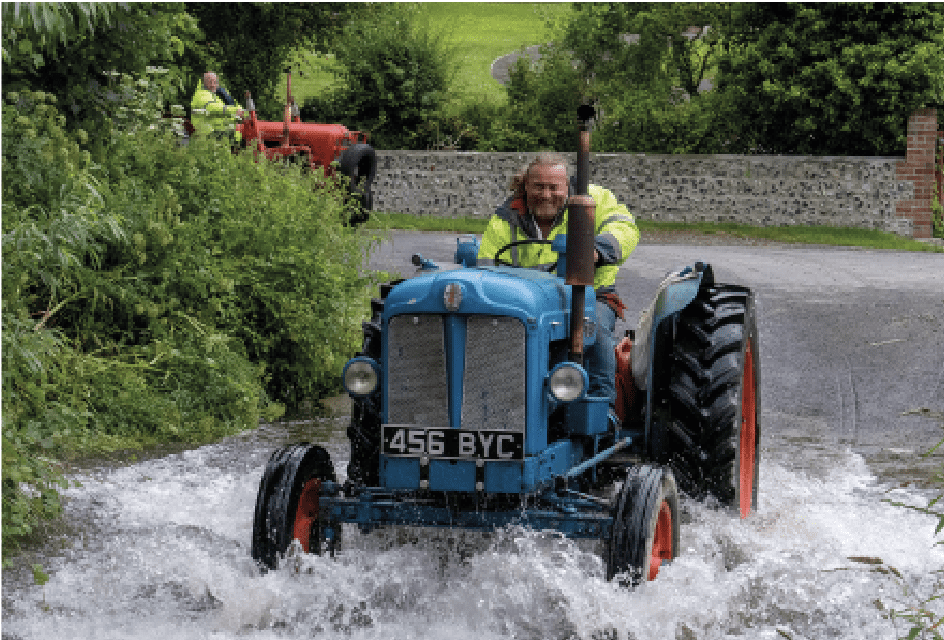
The Dorchester Agricultural Society has announced the return of the Dorset Tractor Run for 2022 on Father’s Day, Sunday 19th June.


The tractor run first took place in 2019, with 99 tractors taking part in the 18-mile route and raising money for First Point Dorset.
Nicki Ralph, Chair of Dorchester Agricultural Society said, “the 2019 tractor run was such a success, we are thrilled to announce its return. It’s a marvellous way for the public to admire the long history of our local agricultural community and view vintage tractors as well as modern machinery.”
This year’s nominated charities are the Farming Community Network and the Royal Agricultural Benevolent Institution.
This year’s tractor run will start and finish at Daggers Gate Grain Store in West Lulworth. Event organisers are expecting more than 100 participants for the event, and spectators are welcome to join at the meeting point at 10am to watch the tractors begin their journey along the Jurassic Coast. Refreshments will be available for spectators to enjoy and a location for lunch will be advised on the day.

Those interested in participating this year can register online here . Tickets are available at £15 per tractor, per driver.

Law firm lands historic country estate client

0

Expanding law firm Blanchards Bailey is celebrating the arrival of a new client in the shape of the historic Stock Gaylard Estate in the heart of Dorset’s Blackmore Vale.The award-winning firm’s Legal 500 ranked agricultural and estates department has won the opportunity to undertake the estate’s legal work.

Stock Gaylard Estate


Stock Gaylard Estate is a small traditional country estate nestled in a mixture of oak woodland and green pastures around four miles from Sturminster Newton and eight miles from Sherborne.
The estate is approximately 1,800 acres with around 300 acres of predominantly oak woodland, 80 acres of common land and an enclosed 80-acre deer park with a small lake.
Over the last couple of hundred years the estate has been used for country sports in an unspoilt environment that also encompasses modern dairy farming and a number of Sites of Special Scientific Interest (SSSI).
Run by the Langmead family, the estate is the latest farming operation to have moved its legal matters to Blandford-based Blanchards Bailey, headed by Managing Partner Paul Dunlop.
He said: “We are humbled and excited to assist such a wonderful family estate, steeped in so much history – the village is mentioned as existing in 1086 and the house is a Grade II* Listed Georgian building – but very much moving with the times today.
“It is a very exciting era for the Langmead family as they diversify the estate, boosting cashflow to assist in keeping the property exactly how it should be and preserving it for future generations.”
Stock Gaylard Estate Property and Event Manager Jack Langmead said: “We are very much looking forward to having a working relationship with Paul and the team at Blanchards Bailey.
“The firm’s expertise in rural matters, their personal approach and local understanding is exactly what we need to help us maintain and diversify the farm and land of which we are custodians.
“With a growing portfolio of ideas and possible ventures in the pipeline for us, Blanchards Bailey is the perfect fit to keep us sailing in the right direction.”

For all legal enquiries contact Blanchards Bailey on 01258 459361 or visit blanchardsbailey.co.uk

A reflection on Dorset’s art festival

0
Edwina visited many of the 250 venues of Dorset Art Weeks and shares personal highlights of her tour around the artistic side of the county
Heather Macgregor in front of Misty Stour (left) and Summer River Image: Edwina Baines

What better time of year could there have been for exploring the Dorset countryside while seeking out
the abundant artistic talent? With 250-plus venues and more than 500 artists taking part in Dorset Art
Weeks (DAW), there were some stand-out artists among the studios, galleries and exhibitions.

Heather MacGregor
I started my exploration in the hills above Durweston, in the stables at Traveller’s Rest Farm (home of BV farming columnist George Hosford) where Heather MacGregor was exhibiting her oil paintings with David Norton and Judy Baker. Heather says: “I paint what I see and how I feel about it. The work aims to give more than an initial visual impact. Principally I make studies in the field which I work up into paintings in the studio. When I am painting, I am conscious of walking on a tightrope. The challenge is in creating an engaging sense of place without slipping into the obvious or the obscure.” She responds with a glorious
exuberance to her subject matter. She is pictured above with two of her works: Misty Stour and Summer River.

A school exhibition
Down the hill into Durweston and to the new Bryanston Knighton House where, alongside that of their tutors, pupils’ work across all the age ranges was on display. One could not help but be impressed by their accomplishments and the variety of media to which they had been introduced. See image below – one little visitor found much to absorb her!

Absorbed in the Bryanston Knighton House Gallery
Image: Edwina Baines

Georgina Wood
In the centre of Blandford, Georgina Wood’s charming house was full of her sensitive paintings, prints and mixed media images. The classic India ink shapes and muted colour palette of various vessels was reminiscent of the work of Italian artist Giorgio Morandi, whose paintings were noted for their tonal subtlety in depicting apparently simple subjects. A few streets away was Rachel Baynes’s pretty, productive garden and exhibition All Kinds of Inks. A wide range of differing methods and media were on display, from collagraph prints to Japanese woodcuts, linocuts and inks. Rachel explained that a collagraph print is made by glueing different materials to cardboard and creating a kind of collage. During the inking process the ink will rub off the surfaces that are smooth or higher and stay on surfaces that hold more ink, for example at
the edges and at lower points, thus creating the image. The results were striking.

Georgina Wood with her collection of vessels in classic India ink shapes and muted colour palette. Image: Edwina Baines

Mark Harris
A drive through the Clenston Valley then led me to Mark Harris’s Gallery in The Old Engine Shed in the beautiful village of Briantspuddle, which is worth visiting as an artwork in its own right. In 1914, the small settlement was sold to Sir Ernest Debenham, grandson of the founder of Debenham’s department store,
who expanded the village to house those working on his self- sufficient farm. Many houses are built from hand-made concrete blocks in the Arts and Crafts style. The listed Bladen Valley is an example of a model estate and well worth a visit, especially the First World War memorial Madonna and Child, whch was sculpted by Eric Gill. Interestingly, the original purpose of the Old Engine Shed was to house Ernest Debenham’s vehicles!
Mark showed me an old photograph of the cars lined up outside the building, now converted into housing, bed and breakfast accommodation and a studio.
The walls of the latter are lined with his striking canvases. Mark gains his inspiration from the surrounding countryside and coastline. Initial marks are made in pastel and charcoal before blocks of acrylic paint are layered, then further pastels and Indian inks are added. Mark started his career as a pastry chef, although he found time to paint throughout that time; it was his sister who actually went to art school! Now a full- time professional artist, during lockdown Mark was unable to purchase large canvases (“I’m obsessed with trees and I love big rolling fields”) which resulted in wonderful triptychs which work extremely well, even in small spaces.

Mark Harris in his studio, with ‘Gully Lane’ (left) and ‘Glorious Dorset’ (triptych) right
Image: Edwina Baines

Digital tools
In his studio, I was curious about a seemingly incongruous painting of a giraffe – it transpired it was part of a design commissioned for a range of labels for a very expensive single malt whisky! Indeed, the image has to reflect not only the taste, but also the flavour and aroma of the whisky, and Mark uses the Brushes app on his iPad to transfer and modify the digital image. He occasionally uses the app when he gets stuck on an image; he finds that by copying and digitising an image, he can experiment by flipping or using different colours. He can therefore make several versions of the same picture. “However, you have to be careful
you don’t get overly distracted!”

Rachel Baynes Woodcutting paraphernalia
Image: Edwina Baines

To Dorchester
Another day took me to Poundbury, Dorchester and a wealth of venues and talent. Top of my list was the
Casterbridge Art Society’s broad- ranging exhibition It’s Up to Us, showcasing the concept of sustainability. Paintings, sculpture, photography, calligraphy, woodwork, textiles and work from pupils at Damers First School were on display.
The exhibition in Queen Mother Square was held in the newly refurbished Jubilee Hall, which incorporates structural elements of The Royal Jubilee Hall from Weymouth. The historic cast iron columns and brackets were recovered and incorporated in the new building alongside the old stone hearth found in a Portland quarry.
I ended up close to home in the converted cowsheds at Gold Hill Organic Farm, in the studios of Rachel Sargent and Emsie Sharp. Rachel’s evocative paintings and prints are full of light, shadows and the elements which chart her walks along local footpaths and the coastline. She is pictured below with the Victorian etching press (her popular workshops will be running again in the autumn). Emsie makes unique and colourful handblown glass, and I will be writing more about her exciting techniques next month.

Rachel Sargent with her Victorian Etching press
Image: Edwina Baines


by Edwina Baines [email protected]