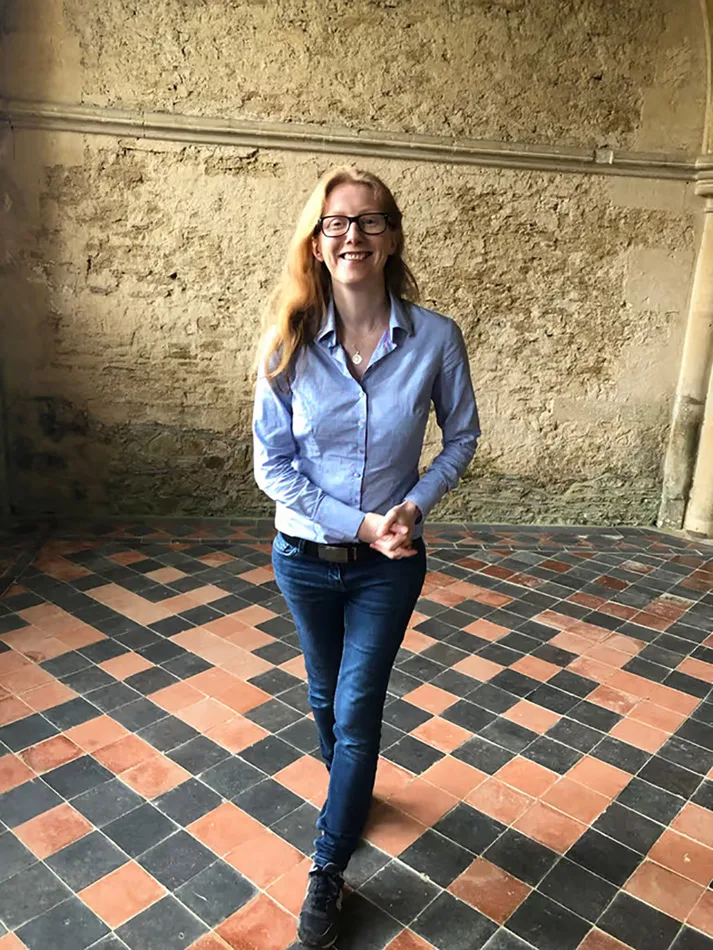
A West Dorset ceramicist has established a new studio business near Charmouth, combining product sales with workshops as part of a deliberately diversified start-up model.
Amelia Christoffers
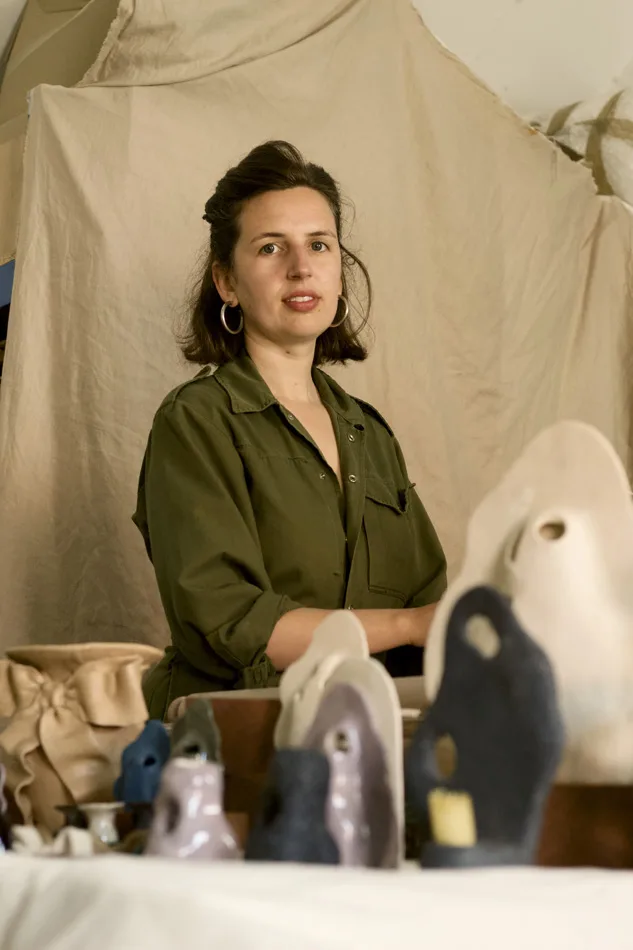
Amelia Christoffers launched Clay and Salt Ceramics in May 2025, initially running the venture alongside part-time retail work before moving to full-time within three months. The studio now generates income through a mix of ceramic sales, private tuition and group courses, with teaching built into the core offer to create a more consistent revenue stream and local customer base. Drawing on a background as a freelance florist in London, she produces ceramics designed for ikebana-style arrangements, focusing on minimal, low-waste floral display. ‘You don’t need huge displays,’ she says. ‘A single bloom can have the same impact.’ The studio was supported by a £3,000 Start Up Loan, funding essential equipment including a potter’s wheel, materials and fit-out, allowing the business to launch fully equipped rather than scaling gradually. Workshops attract individuals, families and groups, with the social element proving a key draw. ‘People enjoy learning together,’ she says. Now operating full-time, Clay and Salt Ceramics reflects a growing trend in rural Dorset towards small creative businesses combining making with experience-led services.
Victoria Sturgess has a clutch of comic classics to remind us that misfortune, misunderstanding and absurdity make great entertainment
Let us use the coming of spring (finally) to cheer ourselves up with some much-needed laughter. It’s not well known that Clockwise, the hilarious film starring John Cleese, was initially planned as a book but instead became Michael Frayn’s first film script.
Brian Stimpson is awarded the honour of being the first comprehensive school headmaster to chair the Annual Conference, and his immaculately ordered world swiftly unravels in a series of unfortunate circumstances. They are set in motion by him boarding the wrong train and proceed to delay him en route, resulting in a genuinely hilarious experience … for us, at least. Another ‘ordinary guy’, Gary, in Bob Mortimer’s The Satsuma Complex, finds himself in a not dissimilar ‘not of his own making’ situation which spirals out of control. As you would expect from the unrivalled storyteller of Would I Lie to You and Gone Fishing, the story unfolds wonderfully, with an entertaining cast of quirky characters: from Gary’s older, cranky neighbour and her chilled sheepdog to the gym-obsessed cafe owner Wayne and his dad. The conversations encapsulate Mortimer’s random sense of humour. Perhaps one of the first gentle comic classics is Jerome K Jerome’s Three Men in a Boat. This 1899 tale, describing a two-week boating holiday on the Thames, was originally intended as a guidebook. Jerome’s digressions into humorous anecdotes soon became the main narrative. There are also classic comedy set pieces such as a Plaster of Paris trout and the ‘Irish stew‘ made by mixing leftovers from their hamper – and not forgetting Montmorency the dog, who supplied a water rat. Catch 22 could never, ever be described as a gentle comic classic – though classic it most certainly is, often cited as one of the most significant novels of the 20th century. It is a savage, satirical book by Joseph Heller examining the absurdity of war and military life through the experiences of Yossarian, one of the most memorable and compelling characters in any genre of literature. He and his cohort desperately try to maintain their sanity in a nightmare world. And Catch 22? If one pleads insanity to stop flying missions with a high mortality rate, one is, in fact sane. However, one must be insane to keep flying those exact missions … Read this incredible giant of a book to see how this illogical logic underlies the whole, sorry – but also often incredibly funny – tale. It’s timeless, as current global absurdities prove. Sorry – I did promise to cheer us up. Only one author for that: P.G. Wodehouse. While Jeeves and Wooster are the (rightly) acclaimed leading players, I read the Blanding Castle series of ten books again and again. Empress of Blandings is an enormous Berkshire sow, and the subject of many plots and schemes, generally involving her kidnap for various purposes – all nefarious – one of which results in her suffering a hangover. Pure cheering-up guaranteed.
The BV community news section is sponsored by Wessex Internet
The following photographs are a selection from a collection of 47 images preserved and shared by the Dorset History Centre. They offer a rare, detailed glimpse of everyday post-war life in Sydling St Nicholas in 1947. These official photographs were issued by the Central Office of Information in London, and each is annotated, though sadly no photographer is credited. They capture not just the village itself, but the people, routines and small moments that defined it.
The Village shop
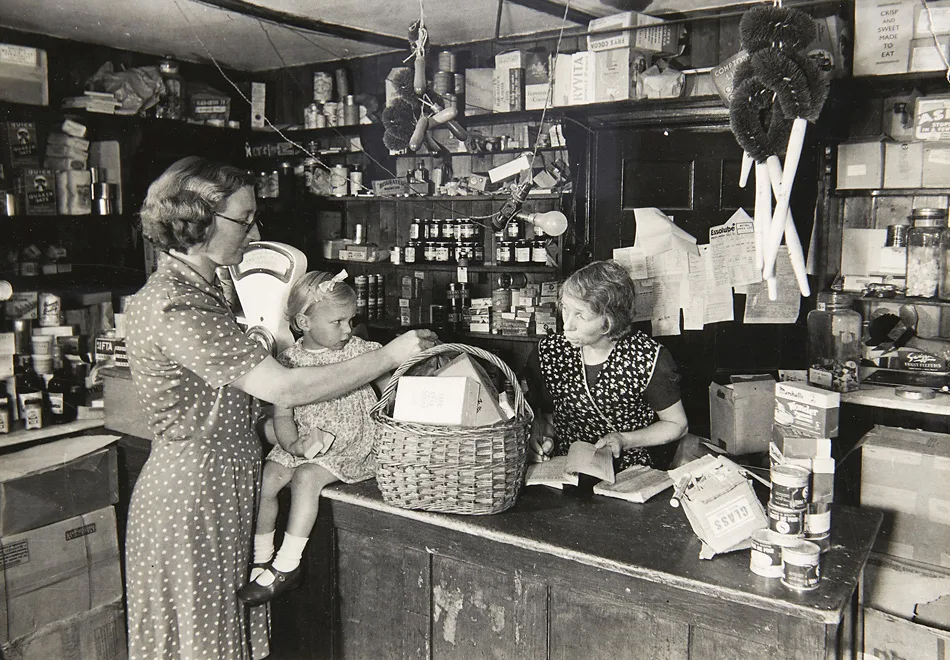
Mrs G L Spriggs runs the local village shop, which is still called Sherry’s Stores after her father. Most of Sydling’s 350 people are registered with Mrs Spriggs for their rations. They can purchase almost everything (with the exception of bread) at the shop. Mrs Spriggs does all her own buying, dealing with as many as 60 different firms, and has over £500 capital tied up in stock. Rationing has added to her task enormously, and dealing with coupons, points and personal points takes up a great deal of her time. Knowing what to stock, and just how much of each item she requires, is a business that would take a lifetime to learn. But as Mrs. Spriggs, being born in the business, says ‘it is an art that must grow on you.’
The Village Petrol pump
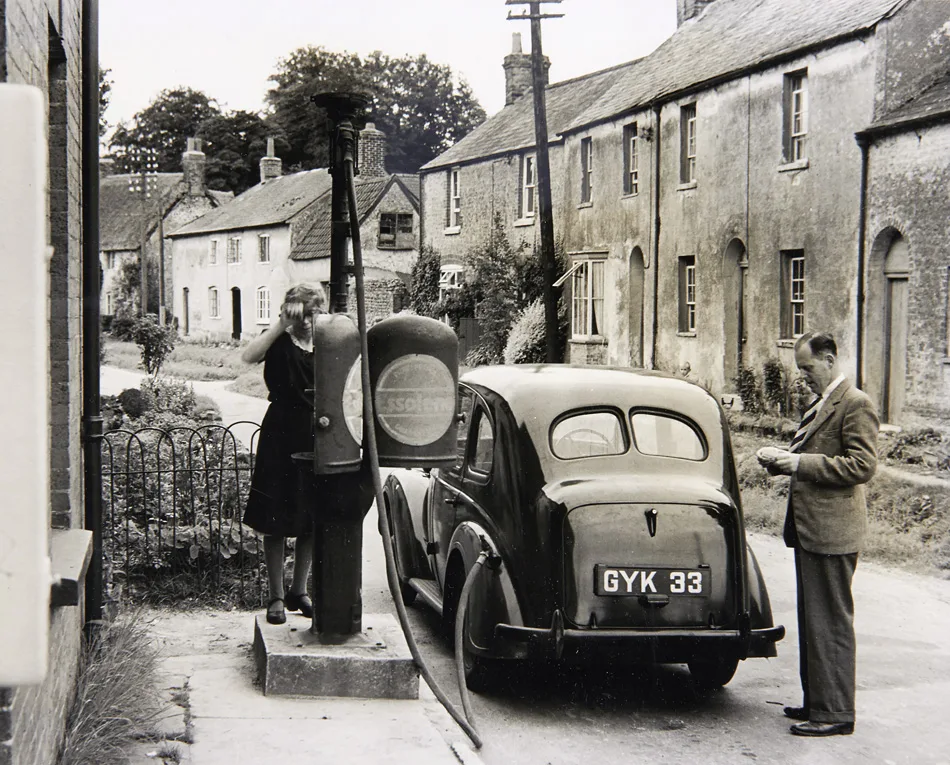
Mrs Spriggs also owns the local petrol pump. A constant stream of cars and commercial vehicles keeps her running in and out of the shop, creating an additional burden in her very busy day. The tank which holds 600 gallons is beneath the small garden behind Mrs Spriggs’.
The village Produce Association
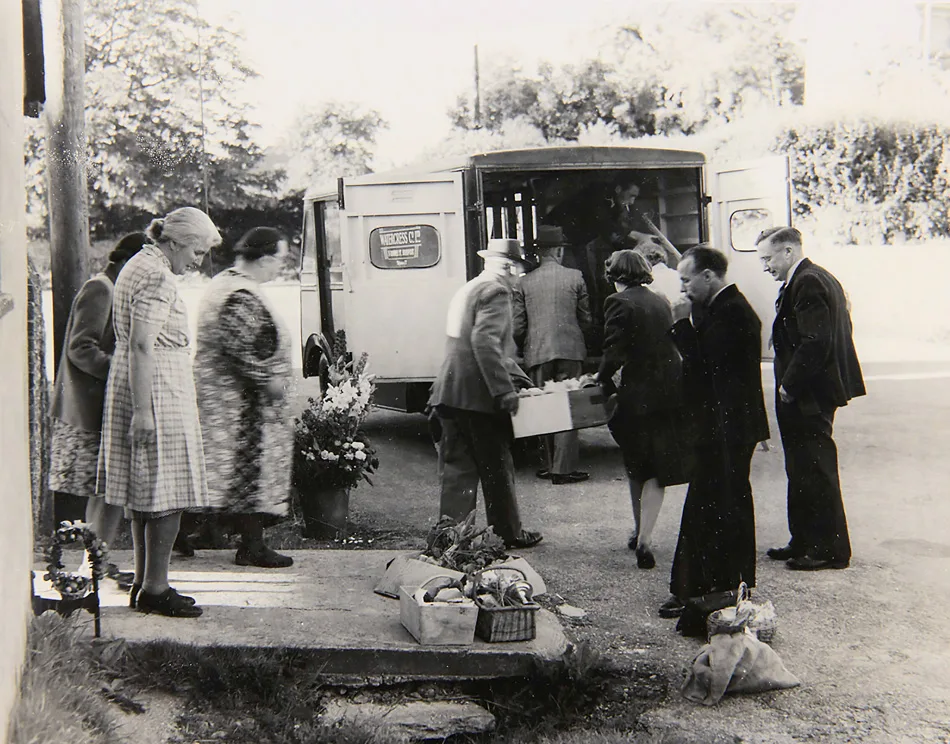
The village Produce Association, formed to encourage home-growing of produce, has 60 members in Sydling. Each pays 1/3d a year subscription, and for this they get seeds 2/6d in the pound cheaper, and seed potatoes 3s 9d in the pound cheaper. Lime is supplied to members at 2/- instead of 5/- a cwt under a Government subsidy. Annually the Dorset Village Produce Association holds a competition, and here (from left to right) is Mrs Bowditch, Miss Ridout, Mrs Palmer, Mr Hallett, Mr Kellaway, Mrs Bowring, Mrs Hallett, Mr Bowring and Mr Bowditch, packing up the produce for the competition which was held in Weymouth.
The Village Fete is the baby show
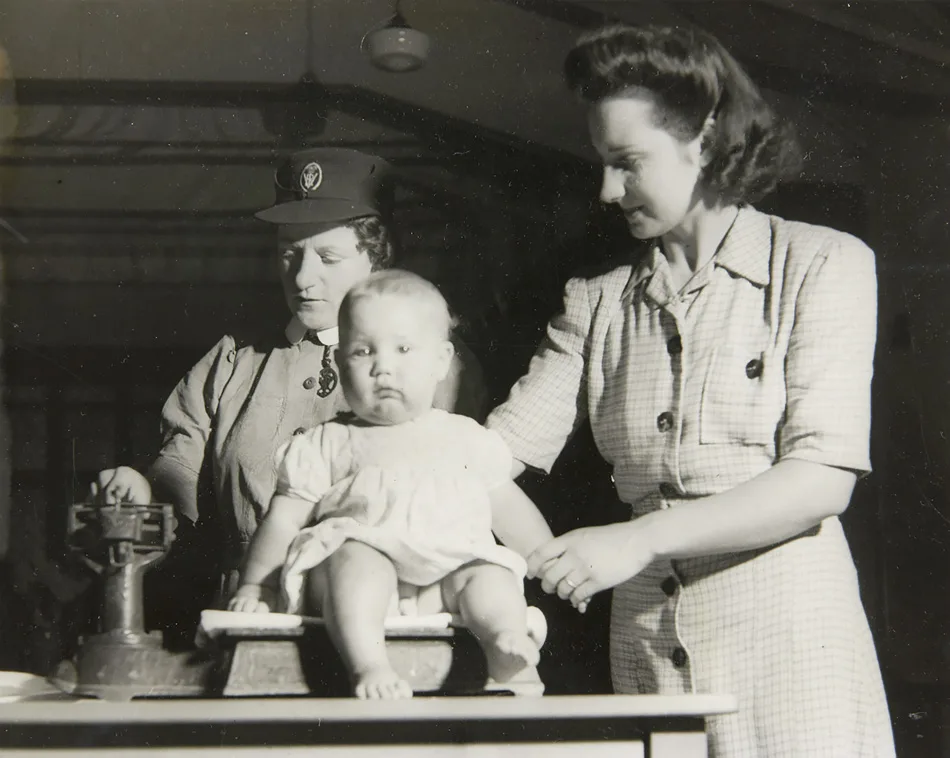
One of the most popular afternoon attractions at the Village Fete is the baby show. Here Nurse Nightingale, the District Nurse, is weighing six-month old, fair-haired, blue-eyed Barry Wilkinson, while attractive Mrs Wilkinson, herself a Sydling girl, holds her baby son.
Health visitors tour the villages to give advice to expectant mothers
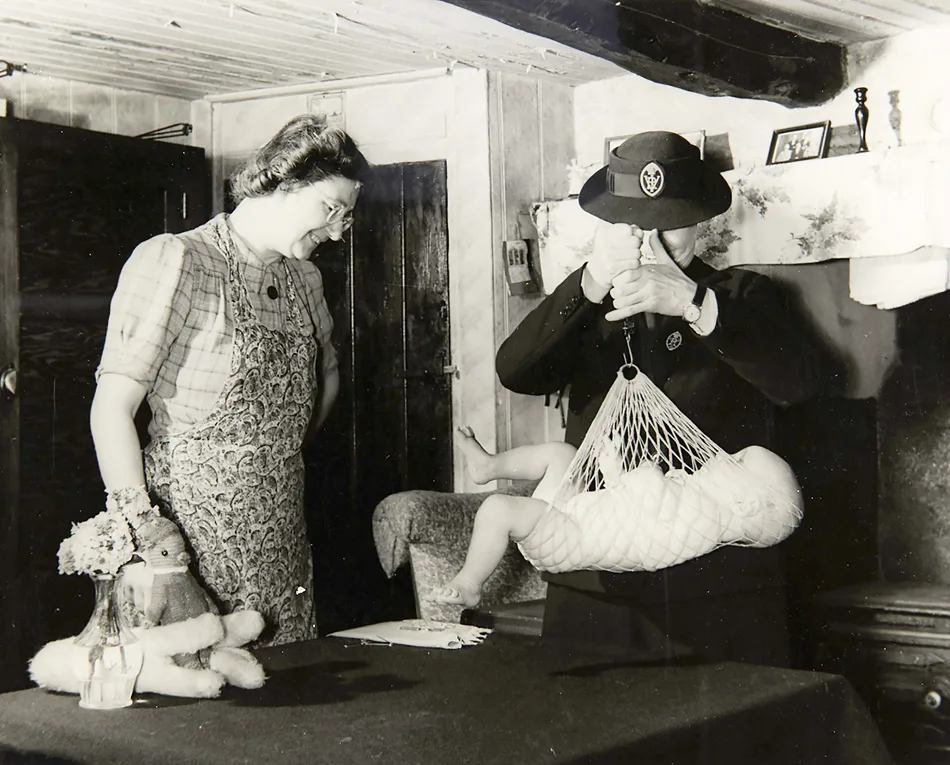
The relationship of the village with the County Town is constant in all matters of health, roads, public utilities and education. From the County Medical Officer of Health’s department, health visitors tour the villages to give advice to expectant mothers and to mothers of young children. Here Nurse Keohane (pronounced Q-harn) calls on Mrs E M Swain of Up Sydling to see her eight-month-old son Terence is gaining weight satisfactorily. Mrs Swain has a cousin, Mrs Thelma Peterson, living in Winnipeg, and an aunt, Mrs H Teal, who lives in Victoria, BC.
Taking a sample of well water to test for purity
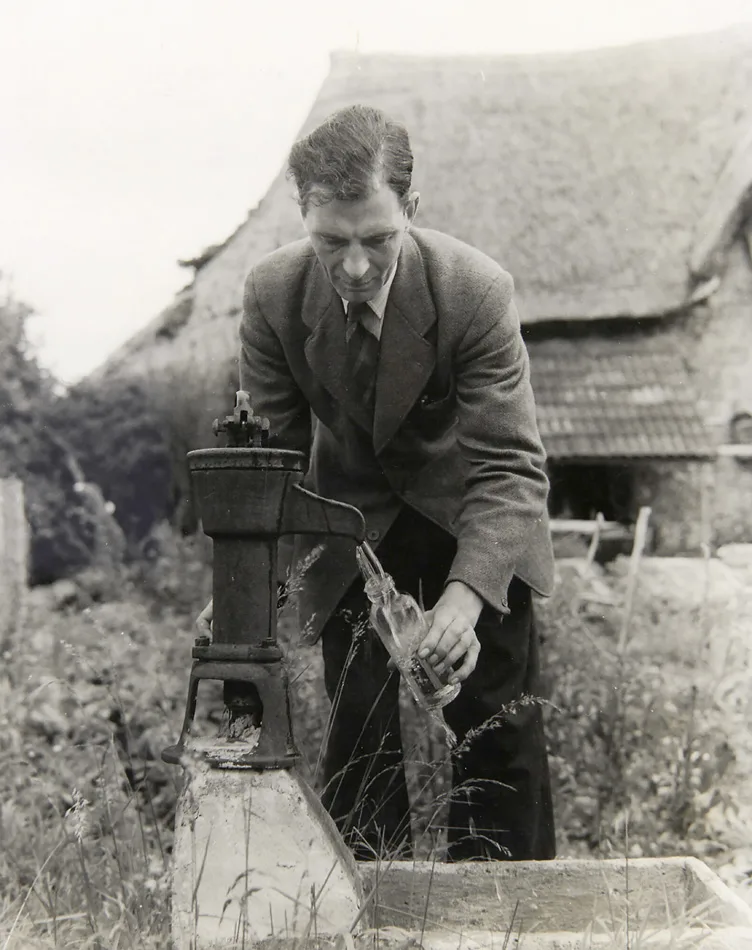
Sydling St Nicholas is dependent for most of its public services on Dorchester, County Town of Dorset. Here, Mr B R Swift, Assistant Sanitary Inspector of the Dorchester Rural District Council, is taking a sample of well water to test for purity. The Dorchester Rural District Council is responsible for 128,000 acres (roughly 20 miles square) of rural areas with a population of 16,000 for housing, water, drainage, inspection of milk producing premises, refuse collection, obstructions of right-of-ways and footpaths.
Drinking water is supplied through pipes running along the village street
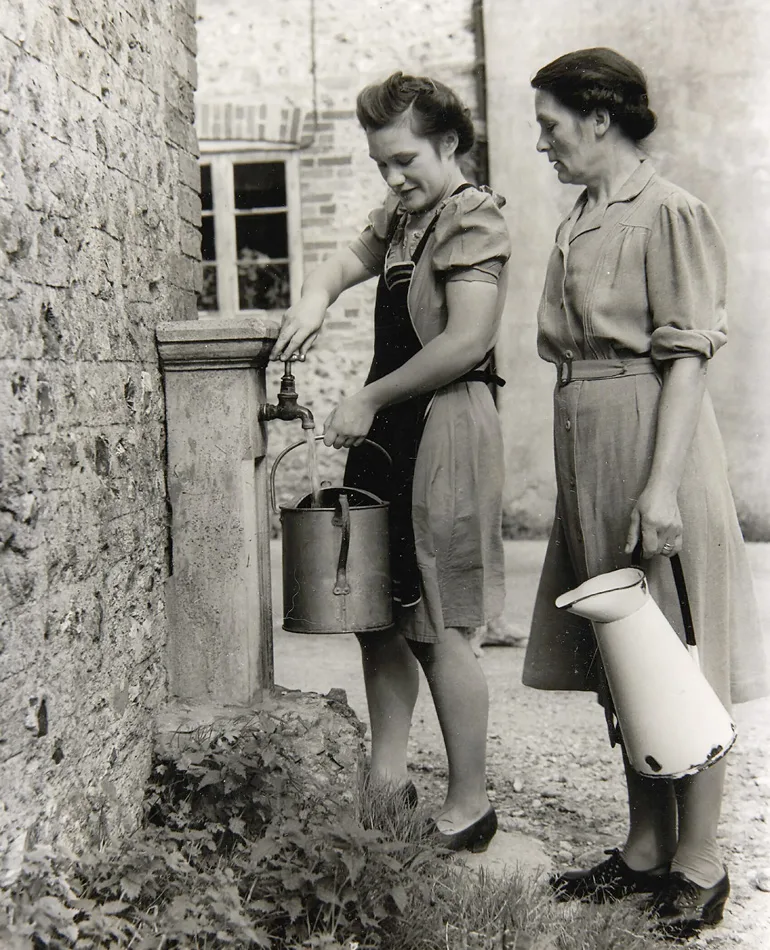
Water is Sydling’s greatest domestic problem. There is no water grid-system, and very few of the cottages and farmhouses have their own well. Drinking water is supplied through pipes running along the village street, tapped at intervels from where the inhabitants can draw their supplies, as Mrs Turner and Joyce Grabb are đoing here.
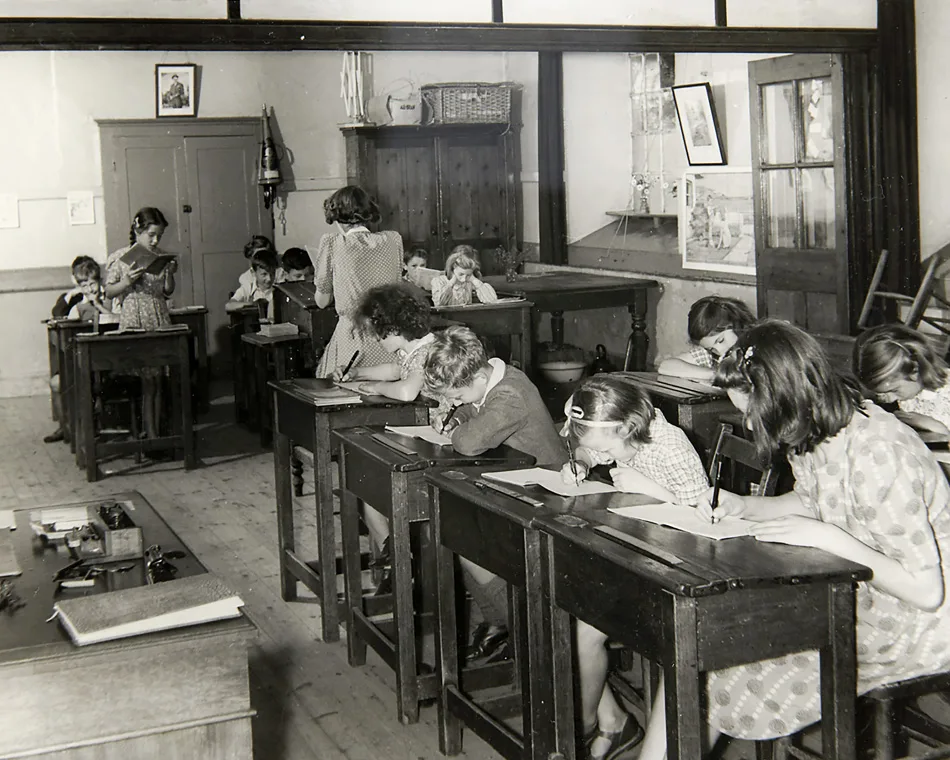
The village school at Sydling St.Nicholas
The village school at Sydling St.Nicholas has 34 children. the headmistress is Mrs I S Bowring, who is also clerk to the Parish Council, Chairman of the Village Produce Association and a member of the WEA Classes. Much of the village life revolves around the headmistress, who is in close contact with the population from early childhood onwards. Here the junior class is in the background, and the senior class in the foreground. The latter will soon be moving on to either the Dorchester County School (for girls), Grammar School (for boys) or the Modern School (mixed).
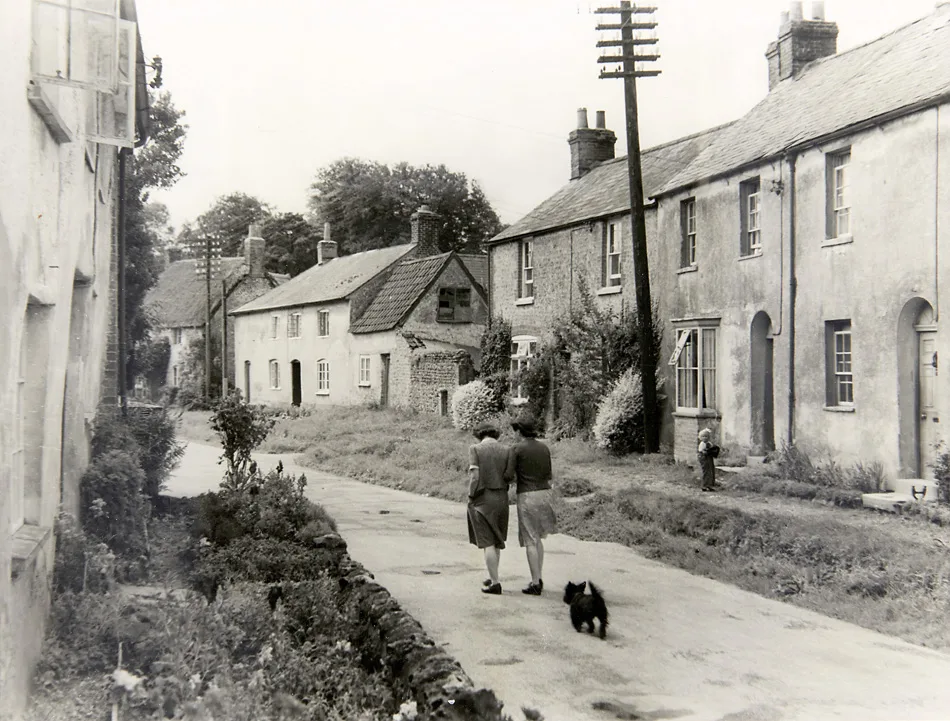
A stroll through the main street
At dusk the village takes on a sleepy appearance, which belies the hard work that goes on from early morning to late at night. Mrs Davies (sister of the headmistress, Mrs Bowring) with her friend Miss Holland, on holiday from Scarborough, stroll through the main street while little Mary Lovell pauses in her play to watch them as they pass.
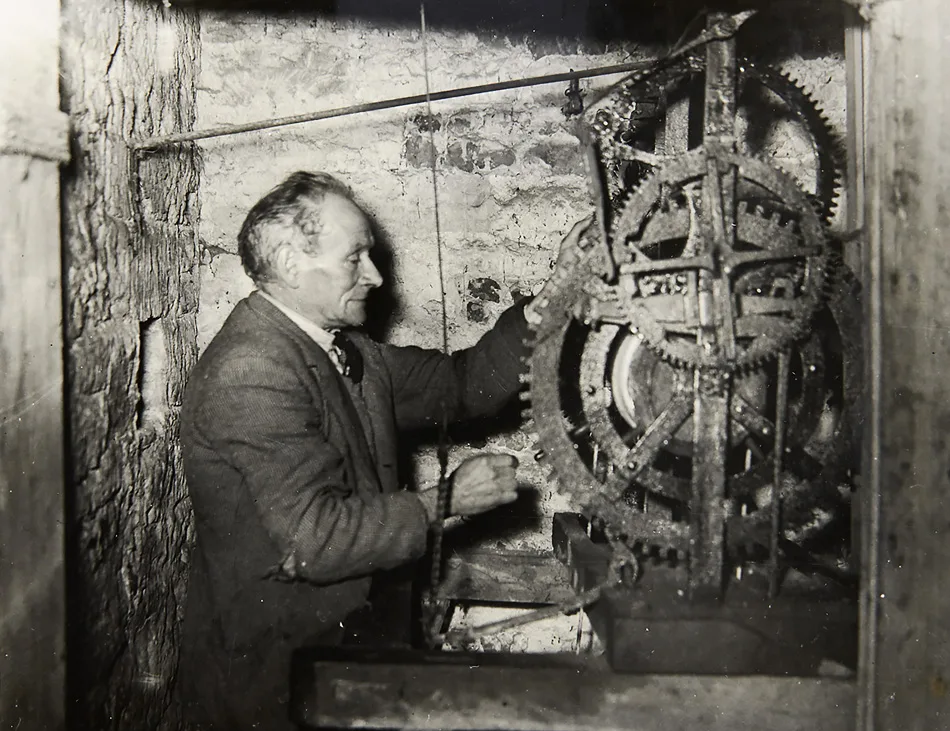
Mr Sherry winds the old Elizabethan clock of the parish church of St Nicholas
Every day Mr Sherry mounts the steps of the parish church of St Nicholas tower to wind the old Elizabethan clock. For this he is paid 1 1/2d [a penny ha’penny] The clock was installed in 1593. It has no clock dial, as was the custom of the period, being designed solely to chime the hours.
One simple flaw underlies the many government failures that have afflicted us for decades. Too many spending decisions are based on short-term cost considerations, with too little regard given to long-term benefits. Expenditure is seen as a drain on public finances, rather than an investment that more than pays for itself over time.
Ken Huggins North Dorset Green Party
A particularly serious example has been exposed in the recent report into the impact of the Covid pandemic. It highlighted just how close the NHS came to collapse – and key to avoiding that collapse were the heroic actions of NHS workers. They battled with shortages of personal protective equipment (PPE), supplies and beds, as wave after wave of infection struck. Many suffered understandable mental health issues, and some even died as a result of the conditions forced upon them. And yet, four years before the outbreak, a simulation exercise was carried out to test the UK’s preparedness for a pandemic. It highlighted a shortage of PPE for NHS workers, but the then Tory government decided against purchasing more – a short-term cost decision that subsequently caused much unnecessary suffering and loss of life, as well as damaging our economy.
If only … Short-term thinking also lies behind the economic damage being caused by the present Middle East war. Had successive governments not steadily backtracked on environmental policies and delayed our transition to renewable energy, we would not now be so badly affected by rocketing gas and oil prices. In Dorset, the Navitus Bay wind farm that was blocked by Conservative councillors in Bournemouth would now have been powering much of our county. Imagine how much less the Iran war would now be costing us if we had invested in upgrading existing properties, built new ones cheaper to live in with high levels of insulation, PV panels and electric heating, and accelerated the transition to electric vehicles. Perhaps those politicians who are fond of describing climate action as ‘net zero stupid’ will now reflect on the real stupidity – dancing to the tune of fossil fuel interests instead of seizing the benefits of addressing climate change. Ken Huggins North Dorset Green Party
Making the transition into care can be an emotionally-charged experience for all involved, particularly if it means taking a step back from directly caring for a loved one. People often find it hard to no longer have minute-by-minute knowledge of their loved one’s wellbeing, while also needing to learn to trust others to administer medication and provide the care they need.
Digital care planning can be a lifeline – providing round-the-clock access to live information about health, wellbeing and activities. Used alongside regular care planning meetings with residents and family members, digital care platforms are a simple way for family members to access real-time information about their loved one’s care, including their fluid and nutrition intake, and night-time checks, providing much-needed reassurance for family members. Vicki explains what access to her Dad’s real-time care plans means to her: “My Dad, Peter, now resides at Cooksons Court in Yeovil. He has been there since April 2025 and I was fortunate enough to visit him from Australia in November 2025. Dad took a few falls before he went to Cooksons and was living on his own. My brother and I felt it was time to find the ‘right’ care home for him that was also close by to where my brother lives. ‘As I live in Australia, it is sometimes very hard to know what is going on, especially now that Dad is getting more forgetful and confused. The time difference can be challenging for him also, and we often chat in the early hours of the morning. ‘When I arrived at Cooksons Court, it just felt right. The staff and carers welcomed me and gave me the space to be with Dad and join in the daily activities. It was so comforting to see firsthand how the residents were looked after. The manager, Kristie, also made sure that I could access the portal to view Dad’s care plans while I was there.
‘I can now see what Dad gets up to each day; who administers his medication; what activities he joins in; how he interacts with the other residents; what food he is given and how often he is checked on. It is such a relief for me to review this every morning and night. I can also have conversations with Dad about the activities which he sometimes forgets. ‘I cannot recommend this enough for family members like myself who live so far away – even for those that are close by. Having the reassurance of knowing what is happening with Dad and that he is so well looked after and safe, is a great comfort.’ All of Somerset Care’s 22 not-for-profit care homes, including Cooksons Court nursing home in Yeovil, offer digital access to person-centred care plans for eligible family members as standard. To find out more please visit somersetcare.co.uk or call 0800 8174 925.
Southern Times and Dorset County Herald – Saturday 07 January 1905 Charles Stay, a tramp, was charged with wilfully exposing three children, Charles, 16, Elizabeth, 11 and James, 6, in a manner likely to cause them unnecessary suffering or injury to health, at Cranborne on December 28th. P.C. Davis said in consequence of complaints he went in search of prisoner, who had gone off with the children in the direction of Fordingbridge.
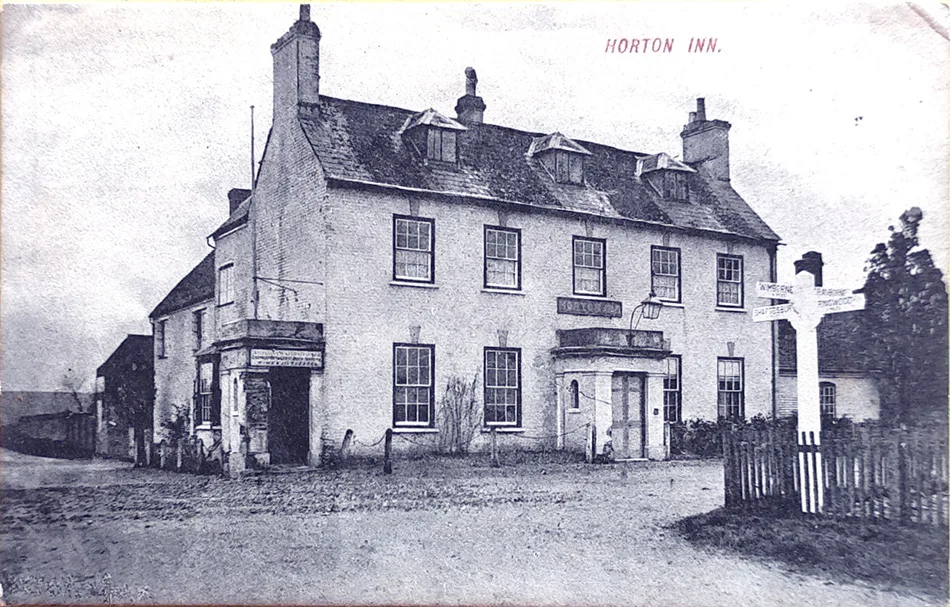
Horton Inn postcard from the Barry Cuff Collection: ‘I can recommend this place for bread & cheese & beer.’
After searching a number of farm premises he discovered prisoner and the children at midnight asleep in a cow shed on a farm between the Horton Inn and Cripplestyle. The farmer had allowed them to lie down on some straw and had given the children some hot milk. The children’s feet were swollen, and it was with difficulty the wet and muddy boots were replaced. They were all shivering with the cold, and especially the youngest. With the assistance of P.C. Otter they were conveyed back to Cranborne, and after he had fed the children they were put to bed in a cell. The next morning he brought them to the Workhouse. The eldest boy said his father had been locked up once before on a similar charge and was sentenced to three months’ imprisonment. Prisoner admitted being convicted at Romsey and Alton. P.C. Otter stated prisoner had 4s. 10d in his possession, made up of sums given to the children on the road. On the day in question, the man and children had tramped from Poole to the other side of Cranborne, a distance of 19 miles.
Dr T. Telford-Smith said the children were imperfectly clothed and the clothes were in a filthy state. There were sores on their feet, and the exposure was likely to affect their health. Prisoner said he intended to work his way back to Lockerley Green, Romsey. He understood there was a workhouse beyond Wimborne, and finding this incorrect he tried to get lodgings, but was unable to do so. The Chairman said prisoner had been guilty of an iniquitous thing, and would be sentenced to 14 days’ imprisonment with hard labour.
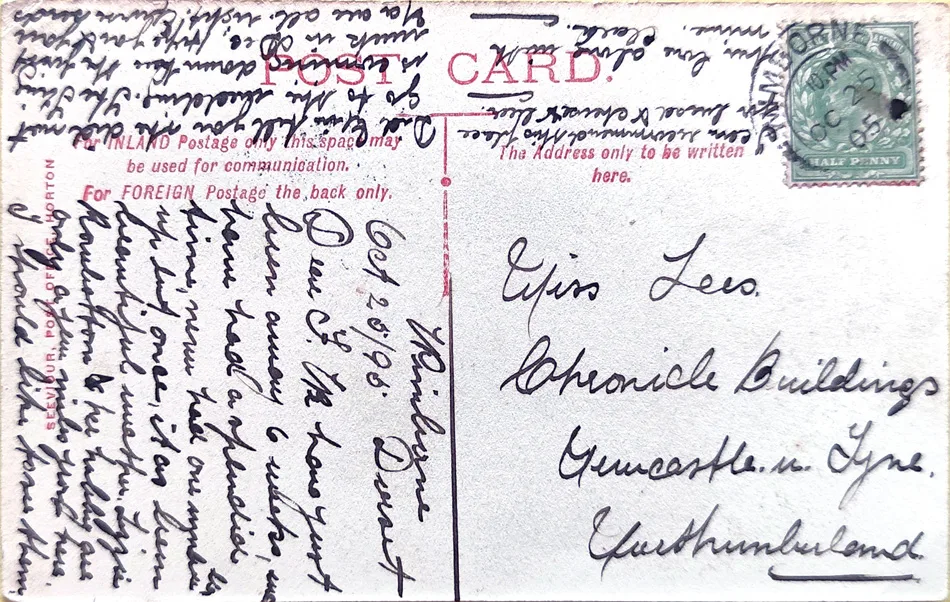
The postcard back reads: Wimborne Dorset Oct 25/05. Dear F, we have just been away 6 weeks and have had a splendid time, never had one umbrella up but once, it has been beautiful weather. Lizzie Rowbottom and her hubby are only a few miles from here. I should like to see them. Did Erin tell you that she did not go to the wedding. The thing is evening down there the first week in Dec. I hope you & your F are all all right. Everyone sends love along with mine. Clare (I can recommend this place for bread & cheese & beer.)
A Dorset-based gardening charity is inviting people to rethink how their gardens work, with a new programme of events focused on wildlife, sustainability and wellbeing. The Knoll Gardens Foundation, based at Knoll Gardens near Wimborne, is running a series of workshops, talks and sessions through 2026 aimed at helping gardeners reduce environmental impact while increasing biodiversity.
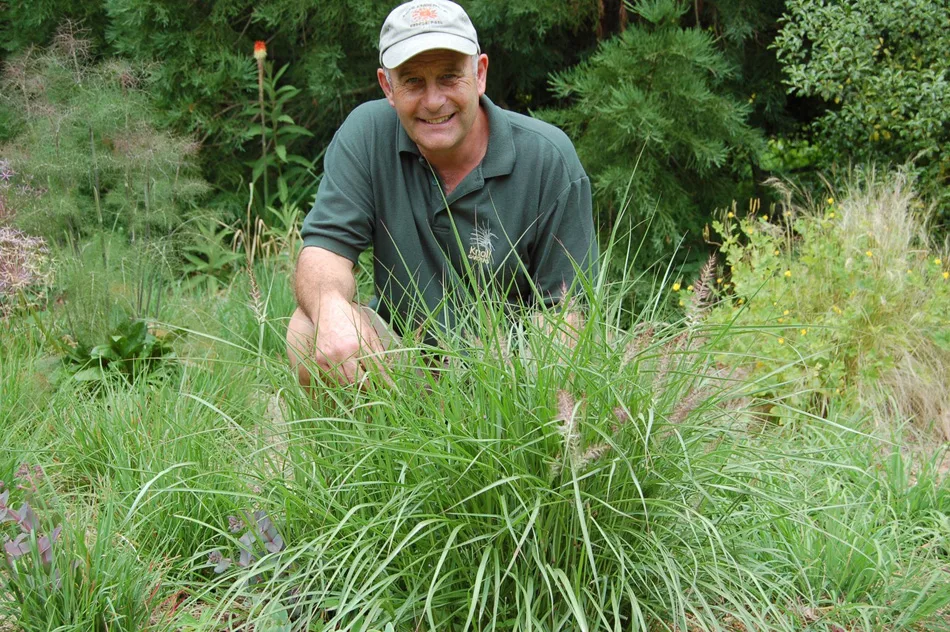
Knoll Gardens, Grass Masterclass with Neil Lucas
Established in 2008, the charity uses the gardens as a working example of naturalistic planting – a style that prioritises long-term resilience, lower resource use and stronger wildlife habitats. Its programme reflects that approach, combining practical learning with time spent in the landscape itself. The first of a new series of workshops begins on 27th April, led by Knoll Gardens director Neil Lucas alongside foundation specialists. These sessions focus on how planting choices affect wildlife, drawing directly on the site’s established planting schemes and ongoing experimentation. Regular garden-based yoga sessions will run throughout the season, while Lucas will also lead his well-known grass masterclasses, offering a more technical look at planting design. Later in the year, Knoll will host National Gardens Scheme events, including an open day in September where admission fees will support nursing and health charities. The programme positions gardening less as decoration and more as land management at a domestic scale – something that can actively contribute to wider environmental recovery. knollgardens.co.uk/events
The BV community news section is sponsored by Wessex Internet
International think tanks, 4* trials … Jess Rimmer’s 2026 season start throws her in the deep end, talking sport one week, riding it the next
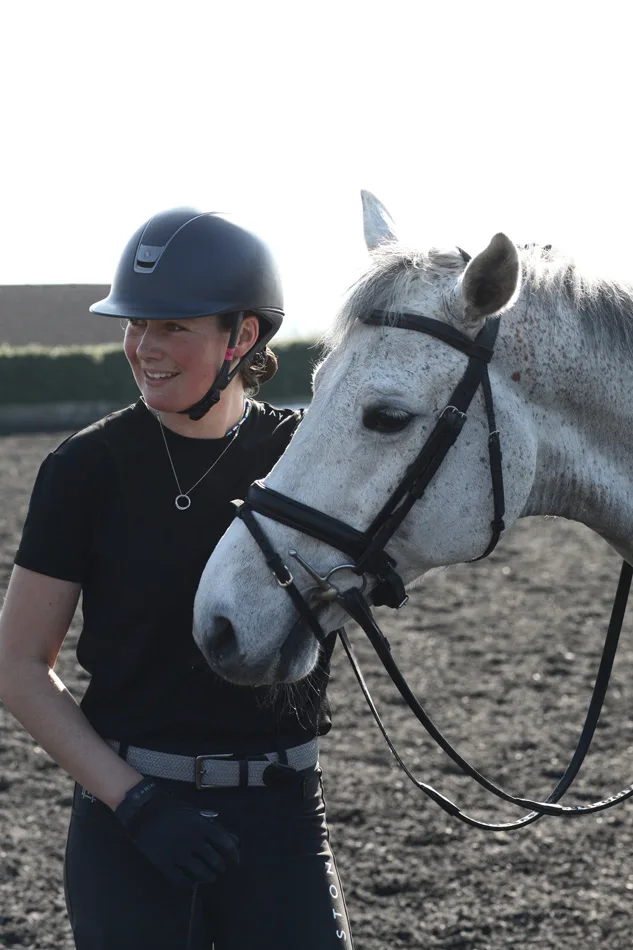
Jess and Max (Mr Mister) image courtesy of Courtenay Hitchcock The BV
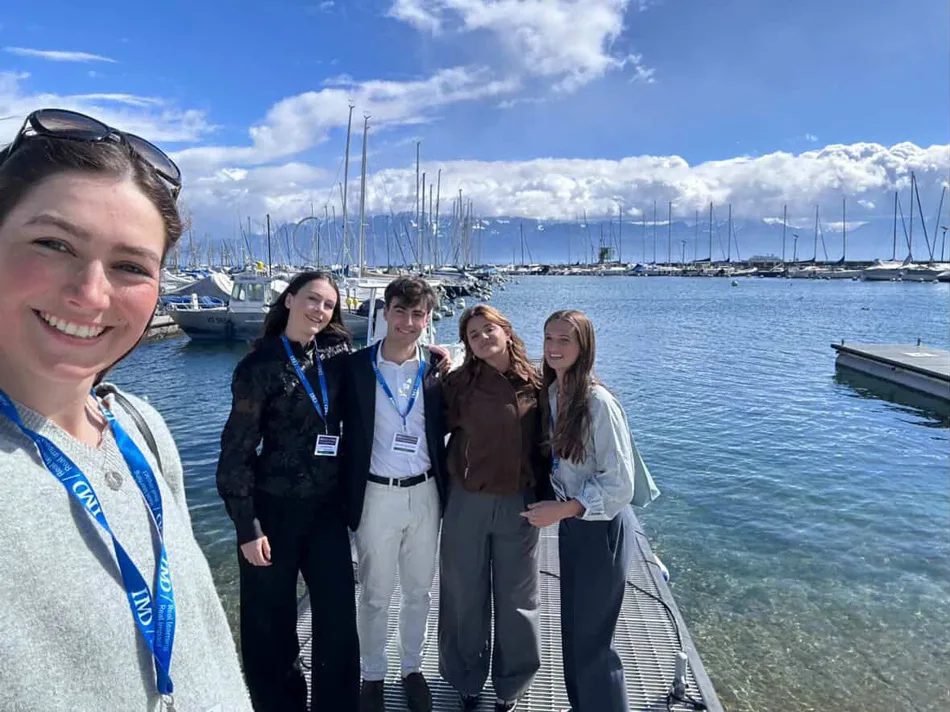
You probably won’t believe me when I tell you I’m writing this from 4,800m in the air, on board a flight home from Geneva on a random Tuesday evening. And no – I haven’t been skiing! I’m on my way home from the FEI Sports Forum: I was fortunate enough to be invited to attend as one of 20 youth representatives (and the only Brit!) to contribute ideas to the future of equestrian sport. I don’t really know how to put into words what an experience the past two days have been – I arrived in Lausanne 48 hours ago, not knowing a soul. I am leaving with new collaborations, fresh ideas and friends for life.
Jess and her FEI Forum Lausanne friends
I hate to break it to you, Eventers-on-Tour, but the dressage, showjumping, vaulting and endurance lot actually are good fun! We covered a diverse range of topics over the two days, involving mentorship approaches, supporting young athletes, marketing strategies and Young Official initiatives just to name a few. I was proud to be surrounded by such an eloquent community of young athletes, and to have an input into the future of equestrian sport was really special. It was a stark reminder, regardless of nationality, background, age or discipline, that we all had one thing in common – the love of the horse. One of my favourite quotes from the two days was actually from the very first session, where Dr George Kohlrieser spoke about psychology and leadership (and also about being held hostage four times … hopefully that one will never apply to the eventing community): ‘I will not follow where the path may lead, but I will go where there is no path, and I will leave a trail.’ (from Wind-Wafted Wild Flowers by Muriel Strode).
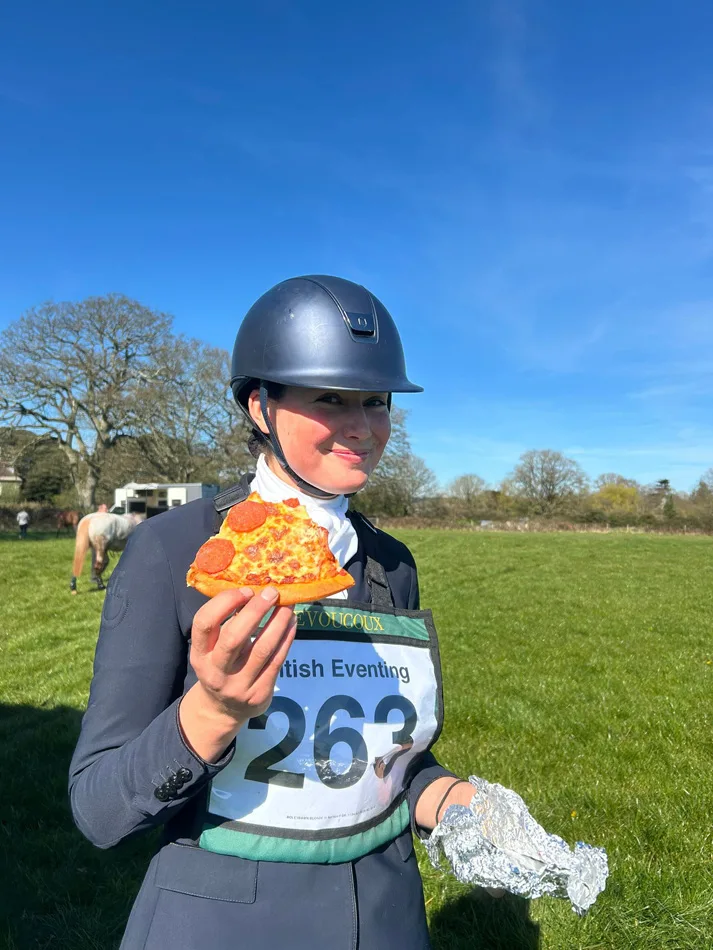
(Jess didn’t mention the snacks this month, so we thought we’d better have them somewhere)
It starts … I’m feeling so grateful to have had the opportunity to attend the Forum, and to see just a fraction of what goes on behind the scenes on the international stage. Which is even more relevant because – oh yeah – we’ve been eventing! WOOHOO! The season is now well and truly under way, and we’ve had a really super start. It’s been a rare spring in that (touch wood) it’s hardly rained at all, which means we’ve had relatively dry, mud-free runs across the board for the entirety of March!
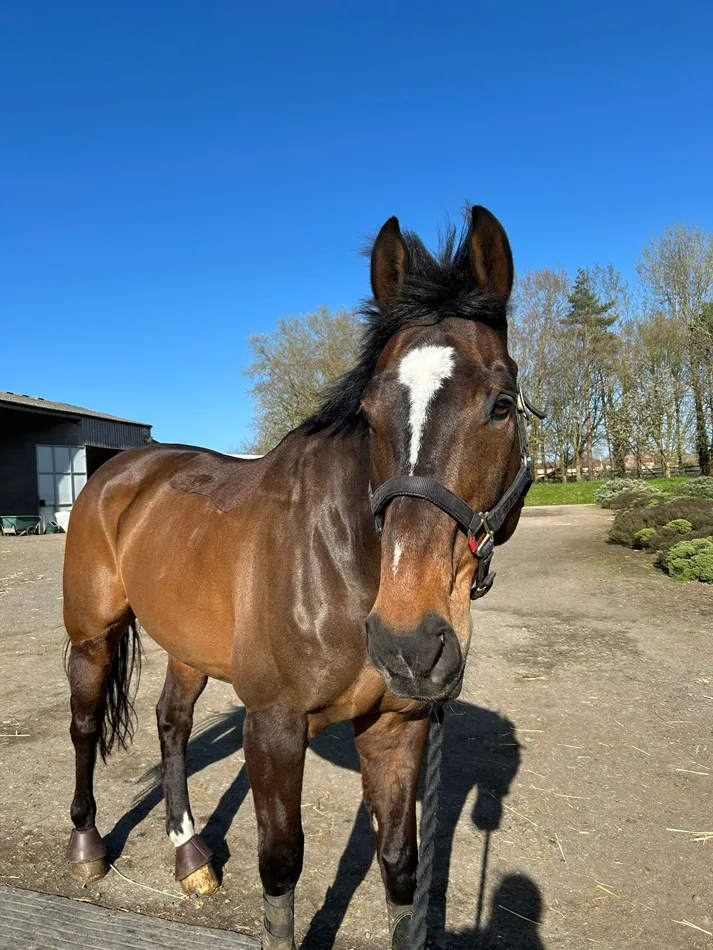
Basil the Spice Merchant is ready for the 4* U25 trial at Thoresby Park this month
We kicked off our 2026 season at the beginning of the month at Tweseldown. I felt slightly thrown in at the deep end – spending all winter training (as opposed to galloping at rather large, solid fences at speed), it’s usually nice to ease back into it with, for example, some friendly Novice fences, just to get my eye back in. But no – the universe had other plans. Basil was the first horse out of the start box for me, competing in the Open Intermediate section in our one-and-only prep run ahead of the 4* U25 trial at Thoresby Park at the beginning of April. Yikes – no pressure! Fortunately, Basil was as consistent as ever, and posted a lovely, steady double clear which (hopefully) sets us in good stead for his next run.
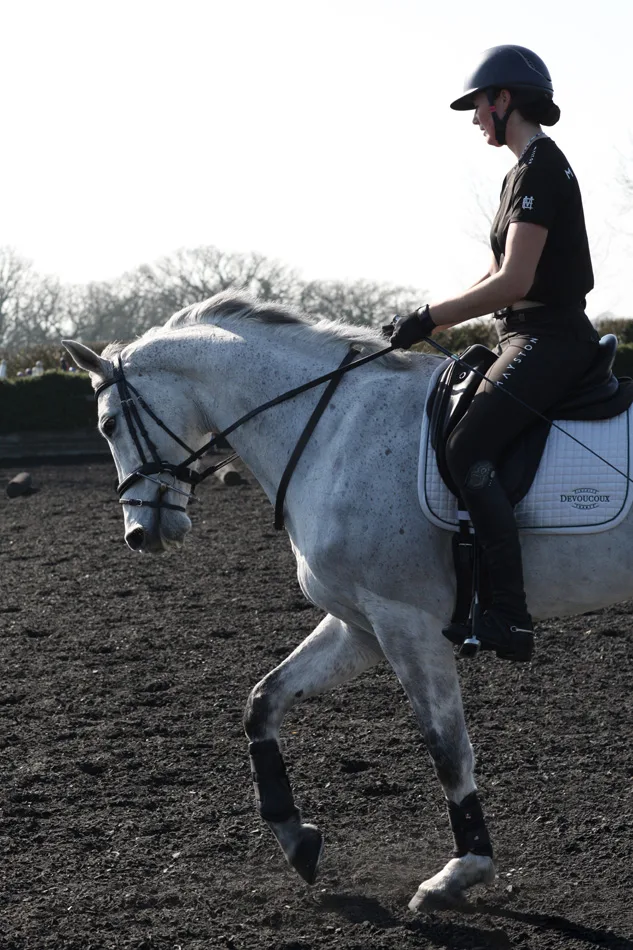
Jess and Max having a pre-season dressage lesson – out of shot is Tracie Robinson, the renowned Dressage coach who trained the senior British team – image Courtenay Hitchcock The BV
I think I can safely say that Max and Jimmy felt nothing other than pure elation to be back on the main eventing stage at Tweseldown. Overall, they were very well behaved and produced some lovely jumping rounds – though some freshness crept in, and I collected some snail penalties cross country (as per my Start of Season instructions!), so no prizes for them yet. By the time we got to Barbury, we had all settled into our rhythm and collected a scattering of top 10 results. I think it’s important to note that the first few runs are not about trying to win: they’re more about settling back into the flow of things and preparing the horses correctly for the season ahead. It’s so easy to become results-orientated and forget the bigger picture!
Jess on Max in Dorset – image Courtenay Hitchcock The BV
Courage and grit Last but certainly not least, the two girls, Cleo and Blondie, have had a fabulous fortnight too. New girl Blondie has been nothing but a delight, jumping clear around Moreton and Barbury novices for 9th and 11th respectively. It’s always exciting building a new partnership, particularly when it’s with a horse as lovely as she is! Cleo (who I’m not sure I’ve introduced before – her fancy name is MBF Musical Note and she’s owned by Victoria Davison), has also been training incredibly well behind the scenes for the past few months as we aimed towards her eventing debut. Naturally she did it in pure style, jumping a lovely double clear on a 29 dressage in the GO BE90 at Moreton. It’s just the start of a really exciting journey for this young horse – she has an abundance of courage and grit, and although at the moment she’s still learning the ins and outs of eventing life, I have every faith that she is going to absolutely adore her job! Although I’m not planning on making any more exciting excursions to Lausanne over the next month or so, the calendar is looking far from quiet! We’re off to our first U25 4* trial this week (yikes!) and some of the team are stepping it up a level (that means bigger jumps) next time out. They feel ready, so let’s all cross our fingers and see you on the other side!
A Dorset-based entrepreneur has launched a new digital platform aimed at helping businesses better support neurodivergent employees – with a focus on reducing burnout and improving retention. Rosie Weldon, an autistic speaker, author and entrepreneur, launched AutiPocket on 1 April to coincide with Autism Acceptance Month. The platform is designed as a practical workplace tool, offering real-time support for neurodivergent staff navigating day-to-day pressures. Weldon says the idea stems from a clear gap between diagnosis and the realities of working life. ‘Many neurodivergent professionals aren’t leaving roles because they lack ability,’ she says. ‘They’re leaving because the environment requires too much invisible labour to sustain.’
Rosie Weldon
Immediate practical guidance Weldon’s own experience sits behind the concept. After graduating with near-perfect academic results, she began a career in banking and was diagnosed as autistic at 25. While outwardly successful, she has since spoken about the impact of sustained masking, sensory overload and burnout. In 2018, she was diagnosed with Functional Neurological Disorder, linked to prolonged stress, after losing the ability to walk. The concept for AutiPocket grew from the informal support she relied on from her brother – Autipocket’s co-founder, Charlie. During moments of overwhelm – whether travel disruption, difficult conversations or sensory stress – he provided immediate, practical guidance. The platform is designed to replicate that kind of support at scale. At its core, AutiPocket provides structured, on-demand guidance to help users prepare for challenging situations, manage them in real time and recover afterwards. A central feature, ‘Welbie’, acts as a digital companion during moments of stress, guiding users through responses and coping strategies.
Autipocket
Better support, better outcomes For employers, the platform is positioned as a complement to existing Employee Assistance Programmes. It allows staff to access support privately, without the need for formal disclosure, while offering businesses anonymised insight into common pressure points across teams. Early interest has been strong, with hundreds joining a waiting list and £15,000 secured in early investment. The project has also engaged with organisations including the National Autistic Society and the University of the West of England’s Launch Space programme. For businesses, the pitch is straightforward: better support leads to better outcomes. By addressing issues before they escalate into absence or resignation, AutiPocket aims to help organisations retain skilled staff and reduce the hidden costs associated with workplace burnout. The platform launched on 1 April and is available via app stores and at autipocket.com.