If you enjoy the outdoor life, NMR have a great opportunity to work within a Farming environment
Area Coordinator (Dorchester/Bridport)
The Area Coordinator will be responsible for delivery of a full milk recording service to approximately 40 farms within the Dorchester/Bridport area. You will need to live within close proximity to the areas mentioned, as this role involves visiting the farms and collecting event data about individual cows and sometimes taking milk samples.
Averaging a 37 hour week Monday-Friday, the daily and weekly hours will have some flexibility to suit the business needs, daytime farm visits and working from home, with early mornings and late evenings. You will be provided with the relevant equipment to undertake the role, including a company van.
For more details & how to apply, please visit our careers page: www.nmr.co.uk
As summer arrives, the job list is a constant round of tending and tweaking and weeding, says gardener Pete Harcom
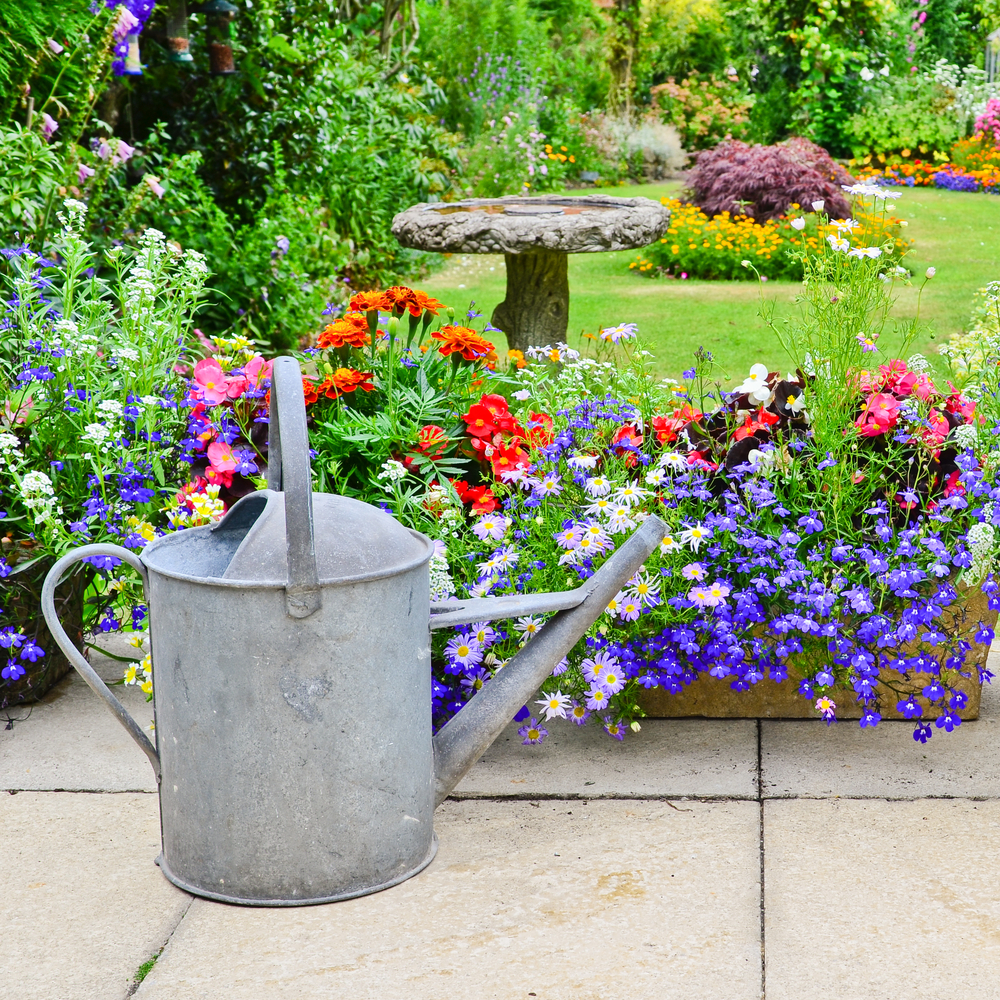
Don’t forget to water your pots – light rain showers do not necessarily reach potted plants properly
At last – we actually have some warmer weather. Thanks to the longer days and some real sunshine, the garden is finally actively growing now … but of course, so are the weeds!
Weeding Hoe and hand-pick annual weeds when you see them, before they get out of hand. Keep deadheading (particularly roses) – removing faded blooms will help continue their display.
Planting and cutting back Plant out summer bedding, including potting up hanging baskets. Trim back trailing /spreading plants (eg Aubretia), as this will encourage fresh growth. Pinch out the tips of fuchsias to encourage bushy growth and more flowers. If planting out newly purchased clematis plants, put a few handfuls of grit in the bottom of the hole. This will help with drainage and reduce waterlogging. Tie up the stems of sweet peas – the plants are growing fast and a strong gust of wind or heavy downpour can quickly damage these plants. Secure to a support every 10cm with garden twine. Once they start, pick the flowers often to encourage more blooms.
Cuttings Now is the perfect time to take softwood cuttings of many shrubs, including lavender, fuchsia, forsythia and philadelphus. Collect healthy shoots from the tips of plants and make 5-10cm long cuttings – slice through the stem below a pair of leaves and remove the lower set of leaves. Simply push the cuttings into a small pot filled with gritty cutting compost and place in a shady part of the greenhouse or a windowsill propagator until rooted.
Sowing In the greenhouse, use blinds, shade cloth or apply shade paint on the external side of greenhouse glass to prevent overheating through the summer months. Remember to always open vents and doors on warm days (automatic window openers are a real bonus this time of year). Start sowing perennials and biennials such as wallflowers, pansies, daisies, bellis perennis and Sweet Williams between May and July, for flowering next spring and summer. Sow in trays, cover with vermiculite and place in an unheated propagator. Plant into their flowering positions in autumn.
Watering and feeding Keep an eye on your pots – light rain showers do not necessarily reach potted plants properly. Start to feed fuchsias and petunias in hanging baskets – and any other flowering pot plants – once you notice flower buds forming. Feed with fertiliser once a week to boost the flowering and continue feeding until the plants run out of steam in early autumn. Don’t worry about purchasing special products – simply use a high potash liquid tomato feed.
Paul King has swapped modern landscaping for an extraordinary, extravagant Victorian pleasure garden dating back to 1880. Tracie Beardsley reports.
Larmer Tree gardens, with the view to the Roman temple All images: Courtenay Hitchcock
It’s seven in the morning. Paul King opens the door to his new “office”. No fusty filing cabinets here. Instead, a breathtaking site with manicured lawns, a green canopy of ancient trees and winding pathways that lure you in. The 41-year-old is the new head gardener at the Larmer Tree Gardens, near Tollard Royal, a Victorian garden originating in 1880, nestling in the undulating fields of Rushmore Estate at the heart of Cranborne Chase. Created by the visionary General Augustus Pitt Rivers, it was the first privately-owned gardens to be opened for “public enlightenment and entertainment.”
Paul King, head gardener at Larmer Tree, standing in front of the famous open air stage
Today it still does the same – a stunning space for picnics, relaxation and festivals alongside becoming an award-winning wedding venue. (I’m proud to say that, 23 years ago, my wedding was one of first in these exquisite gardens). Paul is little more than five months into his role. ‘I’m still in awe every time I come through the gates,’ he says. ‘My welcome committee every day is free-flying macaws and strutting peacocks. I love being here first and having the garden to myself. I somehow expect to turn a corner and catch a glimpse of a Victorian child in a white dress and summer hat playing on the lawn.’ The gardens do exude a time-traveller charm with quirky buildings, the shady Dell and even a Roman Temple. How does Paul feel about being responsible for a garden designated by English Heritage as a Garden of National Importance? ‘It’s an absolute privilege. The garden was here long before me and will be long after I’m gone. I feel like I’ve been here five years, not five months, and I put that down to settling in well. I’m not daunted. The challenge is exciting.’
BV magazine June 2023 – Image Courtenay Hitchcock
A determined path In Victorian times these gardens would have employed an army of gardeners. Paul manages the huge workload with just one other full-time member of staff and Google (his go-to gardening guru). There’s also the juggling act of working around wedding ceremonies. ‘You can’t have a hedgecutter drowning out wedding vows – scheduling tasks is important!’ He’s also inviting horticultural students from Sparsholt College to gain work experience. ‘It’s great to have another pair of hands but I’m also keen to get people learning on the job. I’d have loved such an experience when I was at college.’ From an early age Paul knew he wanted to work outdoors. ‘As a kid, I was always out in the countryside, exploring on my bike. As an adult, I still struggle if I must go into an office for training. I fidget if I’m indoors too long.’ Adamant that he didn’t want to take A-levels and certain he wanted to work outside, Paul studied at Wiltshire College gaining a National Diploma in Horticulture and a City and Guilds in Landscape Design and Construction. ‘I wanted to design gardens, build gardens and be in gardens.’ He did just that, working for landscape and gardening companies before becoming self-employed.
Peacocks freely roam the gardens
‘Gardening can be lonely at times, so I also worked for Avon and Somerset Police as part of the Neighbourhood Teams, investigating local crime and building up community relations. This gave me invaluable teamwork experience which comes into play here, working alongside the events team and the wider Rushmore Estate crew.’ There’s certainly no danger of getting lonely at Larmer Tree.
The Dell, which Paul is keen to restore to its gently undulating grass-banked original design
New plans Paul, a keen historian, is already swotting up on the garden’s history so he can confidently answer the many questions visitors ask. ‘I’d love to reinstate garden tours as there’s so much history here. I really don’t mind having to do some homework.’ Not a list man (‘I’d just lose it somewhere in the garden’), Paul’s head is brim-full of ideas, including planting swathes of ornamental grasses and restoring the Dell back to its original Victorian splendour. ‘I’m keen to implement changes but not sweeping ones. I’m a fresh pair of eyes on a garden that has its roots in history and its future is evolving – I’m very well aware that this is a marathon not a sprint.’ And his advice to those of us with our own gardens? ‘Just sit and be in it! A pleasure in itself.’
Instead of the huge team a Victorian head gardener would have enjoyed, Paul has just one assistant and is constantly busy
Quick fire questions:
A-list barbecue guests? Actor Stephen Fry. I love his humour and he’s so articulate. I’m also a huge fan of 007 so Roger Moore – he’s my favourite Bond. The Queen, she was a keen gardener and of course, Pitt Rivers himself so I could better understand his vision. Book by your bedside? Ben Fogle’s Life Lessons from the Wilderness – another man who must be outdoors!
Tackling many of Dorset’s challenges, most people are unaware of the importance, scope and complexity of Jane’s multi-faceted role
Cllr Jane Somper, Beacon Ward councillor and new cabinet member for Adult Social Care, Health and Housing.
Since 2019, Jane Somper has been the councillor for Beacon ward, one of the most rural in Dorset. As such, she is responsible for the numerous Blackmore Vale villages from the edge of Shaftesbury out to East Stour, across to Manston and Shroton and back to the giddy heights of Ashmore and Charlton Down. For a seemingly sleepy, sparsely-populated ward, Jane is kept busier than you might expect for a local councillor … not to mention regularly being found on Twitter sharing the stunning views from Fontmell and Compton Downs as she sneaks a break to walk her dog. For the last 18 months Jane has been a lead member in Dorset Council’s Adult Social Care and Health team. In May, council leader Spencer Flower asked her to take on the cabinet role with additional responsibility for housing. Jane says: ’That’s an area I hadn’t dealt with before, so a big learning curve for me. ‘But of course I now have my own lead members; Graham Carr-Jones has worked on housing for maybe 18 years. He’s incredibly passionate about it – totally understands it – and I’m relying on him as I learn.’
Common misconception ‘Dorset Council doesn’t have its own properties. So my job is around how we fill the gaps that we clearly have. We need to be able to facilitate much more social housing. As a council, we do that by working with certain providers. We simply don’t provide ‘council houses’ ourselves, though I know many people still believe that we do. ‘But it’s such a huge undertaking, and so difficult – tussling with both local issues and those on a national scale around housing supply, land banking, certain unscrupulous developers … I’ve been doing this for less than a month, and already I’m seeing the possibilities of what Dorset Council can achieve in working with housing associations, because, contrary to popular belief, there are a lot of very good ones. ‘And of course they get labelled, because they’re a “developer”, when they’re actually doing really good work. We have to help them, in order to facilitate the right kind of houses we so desperately need.
Broad life experience Jane now has a massive remit – she has ultimate control and responsibility for around 45 per cent of the entire council budget. So what rests on Jane’s shoulders particularly heavily? ‘It’s alarming when you put it like that. What am I responsible for? What does fall on my shoulders? That makes you stop and think. ‘It’s clear when I talk to people that they often don’t really understand what Adult Social Care is. It’s a whole raft of things – yes, it’s care homes, but it’s also who comes to help you a bit when you’ve come out of hospital. Or who sorts it if you need a little care with your daily living … it comes into so many areas, and yet very few people really know who’s providing which service. ‘Dorset Council has the highest age demographic in the entire country. That’s something that really focuses my mind – what the future requirements of those people are going to be. There’s a very negative narrative around “the elderly” in Dorset, but you know, the retired have such broad life experience. And they’re contributing huge amounts to their communities; the voluntary and community sector really can’t survive without them. I think we all know they are a huge asset. ‘I’ve got a lot of parish councils in my ward, and these are the exact people who sit on those councils. They’re the people who have experience in business, and law and accountancy, in medicine … they know their stuff, and they make things happen. They want to help and they have the time. And they’re really good at organising things!
A stitch in time ‘So in that sense, I think we’re actually really lucky in Dorset to have that wealth of knowledge to tap into. Of course, as people get older, things start to happen, and then they’re going to need a bit of care and support in return. That’s where adult services steps in. ‘A piece of work that’s being carried out at the moment is the re-ablement service, which is basically short-term rehabilitation. When people no longer need hospital care, but are not quite ready to go home, we need to get them out of the hospital environment to a place where they are able to get up every day, to get dressed, to start to re-engage with cooking and organising their own medication … building them up to a point where they can go home. This should prevent that yo-yo of going home, and then bouncing back into hospital again. That’s obviously an investment, but it pays strong dividends. ‘If people are living their strongest, best life, the most fulfilled way that they can, that’s better for everyone. And of course, along the line somewhere – either for Adult Social Care or for Health – there are savings when you act pre-emptively, and fewer people are coming into crisis. ‘A couple living in my ward came to see me recently. They are both in their 80s, and the gentleman is in the early stages of dementia. The wife is probably not in the best of health herself, but she’s keeping it together. However, she’s been getting stressed about dealing with it all – there’s lots of paperwork, lots of things she’s trying to understand and she’s been getting really anxious, which is impacting her own health. So we are able to step in and offer a little support, guidance on how to get appropriate financial and medical assistance, or tech – we have a lot of fantastic tech! This gentleman still likes to go for a walk, and of course she worries about him. But now she can track him with the tech, so she doesn’t worry nearly so much. There’s lots of other options for low-level monitoring, and any issues can be picked up quickly, and then acted on, perhaps by a social worker. Just being able to offer that tiny bit of support has helped her enormously. She’s feeling far less anxious and more confident.
A real culture-shift ‘The key is that early intervention, preventing the escalation. My overall aim is just better outcomes – looking at where we can intervene, providing that early help so things don’t get to crisis point. ‘Because everything – everything – we do has to be person-centred. That’s another area we’re working to change, ensuring that all the decisions made around someone’s care are what that person wants. That’s really important. Take a domestic abuse issue, for example. It’s never straightforward, and it’s about understanding what is the outcome that person wants – and not what we think it should be. The view of the care worker or social worker should be removed from the situation. ‘There’s a real culture shift to understanding and properly listening to the person. Because if you’re providing what people want, rather than what you think they need, the whole process is much more positive. You’re working together, rather than dragging someone with you. You know, I’m not an expert. My team are the experts – and they’re so good at what they do. But when you simplify my job, it is helping people to live their best lives in the way that they want to. We’re just there to provide help and support when they want it.
In Barry Cuff’s report from May, early sowings of some veg failed, while broad beans, cabbages and potatoes flourished – rain is eagerly awaited.
May is one of the busiest months on our allotment. The weather was generally kind with no frosts. About two inches of rain fell in the first week and then dry weather set in. There were some quite cold nights, with the wind during the day coming from a northerly direction, but there was plenty of sun. As it was the vegetables high on the agenda this month, I’ve listed all that we did by vegetable!
Beetroot Our two early sowings failed to produce any seedlings. More were sown on 23rd. Broad beans All are in full flower with no sign of blackfly. To hasten pod set, the tops were pinched out. Brussel sprouts We planted these out from plug trays on 15th. Cabbages Both red and white were planted out in April and are doing well – we fed with liquid seaweed. Carrot As with the beetroot, the two early sowings failed and more were sown on 23rd (maybe the soil was too cold?). Cauliflower On 8th and 15th we sowed Fargo, Cheesy, Snow Prince and Cendis in plug trays. These should give a supply of curds from September to January. Celery and celeriac The seeds sown in April have now produced some healthy seedlings ready to plant out in June. Courgettes and squashes These were all sown individually into small pots on the 1st and are now ready to plant out. Early purple sprouting broccoli Sown in plug trays on the 8th. French beans These were doing well, planted out from pots on 26th. Leeks The two large pots sown in April are now looking well despite a surprise attack from either a bird or a Squirrel! Lettuce We are already picking our first sown, and continue making new sowings each month. Mangetout peas Sown on the 15th and now emerging well. Onions and spring onions Sown in small plugs in March, these were all planted out on 2nd, with one to three seedlings per station. Our first spring onions were pulled on 21st! Parsnips With very little sign of any seedlings, more were sown (parsnips can take up to 28 days to germinate so it’s possible I should be more patient …). Peas Two lines were sown in April, and another two in May. There’s been some weevil attack but generally looking good. They’re well protected from pigeons this year! Potatoes So far they’re looking exceptionally well (see image above). Have already needed to water the earlies (Maris Bard). Radish Successional sowings are already providing us with tasty roots for our salads. Runner beans Canes erected and we planted out from pots on 20th. Sweetcorn We planted out 30 plants on 26th of the month, with more to be planted out later. Now all we desperately need is some good warm rain!
Shaftesbury Rotary Club’s Gold Hill Festival will be held at Barton Hill on Saturday 1st and Sunday 2nd July. As well as the usual terrific range of stalls, music and fun, this year’s festival will, for the first time, feature a Fun Dog Show, sponsored by Branscombe Kennels and Cattery. The Dog Show will take place on Sunday 2nd July from 11am to 4pm. Classes will be as follows: 11am Best Dressed Dog 12 noon Best Dog/Owner Match 1pm Cutest Dog 2pm Sweetest Eyes 3pm Waggiest Tail. As well as prizes for the category winners – kindly donated by Friars Moor Veterinary Clinic – there will be rosettes for the first to fourth placed dogs in each category. Spot prizes will also be awarded by the judges, and every entrant will also receive a doggie gift! There will be an entry fee of £5.00 – please register your interest by emailing [email protected]
Balmy summer nights are coming; it’s time to take the risk and book for one of the many open air plays coming to a garden or a field near you
Three Inch Fools performing in 2022
Like food and music, theatre in the open air is always special. Dorset’s lucky to have some of the best venues and a strong reputation of touring outdoor productions in the summer months. Some of them are really worth making a longer trip to see. As always, Shakespeare is high on the list of productions, but several companies have chosen newer shows, and even a couple of original plays written specially for summer 2023. Most are in the evening, but there are some daytime performances for younger members of the family. Audiences are usually encouraged to take low backed chairs (so as not to spoil the view for the people behind) or rugs, and picnics are to be eaten before the action starts or in the interval – not during the performance! Fifteen of the touring companies are coming to, or quite near to, The BV’s area. All you have to do is to book early to avoid disappointment and send up a prayer to the weather gods for a warm, dry night!
Chapterhouse One of the best-established companies, Chapterhouse, brings The Importance of Being Earnest to Holme for Gardens near Wareham on 30th July. The company is also touring Sense and Sensibility, coming to the same venue on 7th August and then to Stourhead on 27th and 28th August. In between, the Chapterhouse production of The Secret Garden comes to Stourhead on 22nd and 23rd August.
Festival Players Festival Players’ 2023 summer tour is Shakespeare’s Twelfth Night, coming to Shaftesbury Abbey on 24th June and Abbotsbury Sub-Tropical Gardens on 26th June. It will be performed at Speeds Farm, Lamyatt (near Bruton) on 8th July and the beautiful Meerhay Manor at Beaminster on 27th August.
Illyria’s 2023 production of Robin Hood
Folksy Theatre Folksy Theatre has two touring plays, Shakespeare’s The Merry Wives of Windsor and Andersen’s The Ugly Duckling. The Merry Wives is at the ECOS Amphitheatre in Frome on 2nd August, overlooking Lyme Bay at the Marine in Lyme Regis on 3rd, and at Holme for Gardens near Wareham on 11th August. The little duck who turned out to be a swan is at Holme for Gardens on Saturday 5th August, at 3pm.
The Handlebards The all male troupe that specialises in travelling between venues on bicycles, is touring A Midsummer Night’s Dream this year, stopping at the Roman Villa at Rockbourne on 21st June, Maumbury Rings in Dorchester on 23rd and the Marine Theatre at Lyme Regis on 24th.
Heartbreak This summer Heartbreak has three shows on tour. The Shakespeare medley, MacHamLear, comes to Holme for Gardens near Wareham on 19th July, Bad Dad, the David Walliams adaptation, comes to Maumbury Rings in Dorchester on 2nd August, Corfe Castle on 3rd and Somerset Cider Brandy at Kingsbury Episcopi on 4th August. Sense and Sensibility is at Maumbury Rings on 18th August.
The Last Baguette The Last Baguette is touring the original show Pandora’s Box, coming to the Millennium Green in Bridport on 3rd August, to Winterborne Stickland on 16th and the Marine Theatre at Lyme Regis on 17th August.
The Lord Chamberlain’s Men at Kingston Lacy in 2021
Illyria Another of the longest-established touring companies, Illyria has three productions this year, Twelfth Night, Robin Hood and Pride and Prejudice. The Shakespeare play of mistaken identity and love is at Castle Gardens in Sherborne on 5th July, and at the ECOS Amphitheatre in Frome on 3rd September. Robin Hood is at Kingston Lacy near Wimborne on 3rd August, and Jane Austen’s ever popular romance is at Castle Gardens, Sherborne on 14th July and Frome ECOS on 14th, as well as in the extraordinary setting of Corfe Castle on 10th August.
Lord Chamberlains Men The all-male Lord Chamberlains Men are performing the world’s greatest love story, Romeo and Juliet, on tour this summer. See them in June at Glastonbury Abbey (7th), Lyme Regis Marine (8th) or Rack Close in Salisbury Cathedral Close on 9th and 10th. They will also be performing at Kingston Lacy on 27th July and at Breamore House on 26th August.
The Pantaloons The Pantaloons is another company with three tours on the road for 2023. They will be performing Jane Austen’s Emma at Wells’ Bishop’s Palace on 3rd August, Alice’s Adventures in Wonderland at Midelney Manor near Langport on 4th August and at Wells Bishop’s Palace on 9th August. Shakespeare’s Antipholus and Dromio will be playing out their Comedy of Errors at Rockbourne Roman Villa on 20th July and at Montacute House near Yeovil the following night.
Quantum Theatre The summer touring trio from Quantum Theatre is A Midsummer Night’s Dream, Wind in the Willows and The Tales of Peter Rabbit. The Dream is at the ECOS, Frome on 11th June and Glastonbury Rural Life Museum on 15th August. The Wind in the Willows will be performed alongside the Avon at the Wardrobe Rifles Museum in Salisbury Cathedral Close on 25th July, and Peter will be soporifically searching for lettuce at the Salisbury museum on 10th August and at Corfe Castle on 24th August.
Rain or Shine There’s another outing for Shakespeare’s A Comedy of Errors with Rain or Shine, the company whose weather policy is in the name. They will be at All Saints School in Montacute on 30th June, Bishop Wordsworth’s School in Salisbury on 7th July, Upper Leigh Farm in East Knoyle on 21st July, the Roman Villa at Rockbourne on 10th August and Prince Albert Gardens in Swanage on 14th August.
The Rude Mechanicals The company whose style is Commedia del’Arte and which always brings an original show, Rude Mechanicals has devised the tale of Miss Popplewell’s Garden for 2023. See it in June at the Square and Compass, Worth Matravers (9th), Abbey House in Abbotsbury (10th) and on the Village Hall Field at Stourpaine on 29th. In July it will be performed at East Farm, Tarrant Monkton (20th), Mill Farm at Bradford Abbas (21st) and Child Okeford Recreation Ground on 22nd.
Troubadour Stageworks performing in Yeovil in 2022
Slapstick Picnic The spin-off of The Handlebards, Slapstick Picnic exchanges bicycles for an English afternoon tea, and has chosen Peter Pan for this year’s show. See it at the Larmer Tree at Tollard Royal on 20th July, Maumbury Rings in Dorchester on 22nd and the Marine at Lyme Regis on 23rd July.
Three Inch Fools The troupe of actor-musicians Three Inch Fools has two shows this year, Shakespeare’s As You Like It and Robin Hood. Follow the adventures of Rosalind and Orlando in the Forest of Arden at Beaminster Manor on 11th June, Upton Country Park near Poole on 16th August and Stourhead on 25th August. Robin Hood will be in Nottingham Forest at Higher Orchard, Sandford Orcas on 15th August, Corfe Castle (great setting!) on 17th August and Stourhead gardens on 26th August.
Troubadour Stageworks One of the newer companies, Troubadour Stageworks also has two productions on tour – The Odyssey and Romeo and Juliet. See the world’s most famous lovers at Hatch House in West Hatch on 10th June and Bush Farm at West Knoyle on 9th September. Homer’s hero does his thing at Kingsettle Stud, Cholderton on 30th August.
For more details of all these productions, go online to either the company or the venue, where all booking details should be available.
Farmers can be prosecuted for damaging short stretches of river, but when will water companies be held accountable for their actions, asks Andrew Livingston
Before and after images of the destruction of the River Lug by farmer John Price. Images: Environment Agency / Natural England
From childhood we learn that living organisms need water to grow. Obviously, then, water is quite a big deal in agriculture. Farmers need clean, good quality water to help grow their crops and hydrate their animals. Recently, news broke of a Herefordshire farmer, John Price, sentenced to 12 months imprisonment for irreparably damaging the River Lug, which passes through his land. The images are horrific. The beautiful stretch of river now looks like a canal after he ripped out and felled 95 bankside trees before dredging the river and creating a hard-standing area along the banks. Once again, farmers are negatively portrayed in the news. Mr Price’s previous record, detailed to the court, dates back 35 years, and shows his attitude to environmental legislation as it affects farmers. His latest actions were partly in breach of the 2018 Farming Rules For Water, which were introduced to reduce and prevent diffuse water pollution from agricultural sources. His is the first prosecution under those rules. I hope the farming community takes note – although only a minority would have acted as Mr Price did.
Farmer John Price was sentenced to 12 months in prison and ordered to pay £600,000 prosecution costs. A Restoration Order was also imposed. Image: Herefordshire Wildlife Trust
Raw sewage
The Rivers Trust states that only 14 per cent of England’s rivers are in good ecological health – and this includes 85 per cent of the entire world’s precious chalk streams (more than 40 chalk streams are found in Dorset and Hampshire). Every single one of England’s rivers fails to meet chemical standards. Rivers are being damaged and compromised not with diggers and chainsaws, but with raw sewage. Nationally, water companies are not doing enough to protect rivers from the sewage leaking into the fragile ecosystems – and nobody is holding them accountable. Last year, four Wessex Water bosses received eye-watering bonuses for hitting targets relating to the protection of the environment – in spite of many reports of sewage in the Wessex Water region’s rivers.The company’s chief executive, Colin Skellett, received £61,548 from a total bonus of £189,500 last year ‘for meeting environmental targets’, despite Wessex Water’s environmental rating in fact dropping from four stars to two.
The Parrett and Yeo Phosphate Pollution Study, which tests water quality in the River Parrett – flowing from Cheddington in West Dorset to Bridgwater Bay in Somerset – has consistently found harmful levels of phosphates. Wessex Water has blamed farmers but the study found that phosphate levels in the river never dropped, even when the streams entirely dried up during the summer months. The report suggests instead that the main sources of phosphate in the Parrett are the 11 sewage treatment plants whose outflows enter the river. None has a phosphate removal stage, and the report suggests that they account for more than 90 per cent of the phosphates entering the river. The study also shows that where farmers follow DEFRA guidelines for farming near water, phosphate run-off into local watercourses is in fact almost undetectable. If farmers are being charged with breaches of the new Rules and other environmental legislation, is it not time for water companies to be held equally accountable for the quality of the water in the rivers for which they are responsible? The Rivers Trust has produced an interactive map here, showing where the sewerage network discharges both treated sewage and overflows of untreated sewage and storm water into rivers in England and Wales in 2022. It’s all too easy to blame little farmers rather than to take on the big companies. It has recently been announced that the government can fine water companies an unlimited amount for polluting rivers, with the money being used for the restoration of the waterways. It’s a start.
As most people know, we headed to Mayfair this month for the swish awards do. As a tiny team, just to be shortlisted for Regional Publication Of The Year – to be considered among the top three regional titles in the country – was an honour. On the night we didn’t win, but did receive a Highly Commended accolade, one of only four on the night. This was beyond anything we expected – we were thrilled just to be in the room (and suspect we were the only ones there who had actually paid for their own seat…). In other news this month: After a seemingly unending spring of chilly greyness, summer seemed to rush at us in May. The blackthorn was lush, but the hawthorn has been positively frothing, hasn’t it? I have never seen the hedgerows so thick with white, it’s been utterly glorious. The buttercups and cow parsley too. Dorset has been flashing its prettiest ankle at us, and I’m happily woo-ed (though some are less happy about a council mow of said cow parsley – there are some disgruntled readers on the letters page this month). If you’ve been watching Springwatch (those poor little wren chicks! I was stricken!), then you might be feeling inspired to go and explore the AONB near Swanage. In a weird twist, our own best walk this month was from Studland. There are few public footpaths across the RSPB Arne reserve itself, for obvious reason, but the wider area’s stunning heathland is criss-crossed by them. If you’ve never explored it then now is the perfect time. We did a long walk (13 miles), but it’s very adaptable (it’s easy to cut the route to your own length – the map’s on p50) – and also very flat! We thoroughly recommend going, it’s simply beautiful, and we’d go now, before the summer hoardes arrive. Lastly, in a quick double answer to current FAQs in my inbox: Mochi, our son’s fifth-floor-window-diving cat, is doing amazingly. Her cast is finally off, she’s still limping but getting around beautifully. And no, I have not yet gone mug shopping. But I am thrilled by the number of people who got in touch to share that they also have a specific mug for every time of day/type of drink/mood. It’s the only way. Finally, I have a kickboxing grading tomorrow. I am feeling The Fear… but I love the sport, and work hard at progresing (if I pass tomorrow I’ll be just two away from a black belt). I only started it to spite my teenagers (no, really), and though I guarantee my body is the exact opposite of what you picture when you think ‘kickboxer’ it always brings me joy. Even if my creaking bones and weeping joints keep pretending I’m far too old for this nonsense.
PS – the photography submissions were SO strong this month, we’ve even changed the design of the back page to squeeze in just-one-more. Don’t miss it!
Thank you I would like to put in your magazine a big heartfelt thankyou. My brother collapsed in Gillingham surgery Monday 22nd. Help was there immediately, but although they worked on him he couldn’t be bought back. As a family we would like to thank everyone who helped him, it shows what great service we have in Dorset. Thankyou Melvie Martin & family
Rage against the mow I’m writing with a heavy heart and a dollop of shock about the premature trimming of our grass verges surrounding Sturminster Newton. Right during our cherished “No Mow May”. It seems the council, bless them, might’ve misplaced their calendars! Our lovely local wildlife relies on this period, and the council’s actions seem to sidestep the importance of this initiative. It’s like putting a full stop in the middle of a sentence, it just doesn’t make sense! We need to ponder the cost of such haste on nature’s precious cycle. We’re expecting a bit of clarity here, as well as an assurance that our “No Mow May” will be left undisturbed in future. I’m sure many of us would be pleased to see our council showing more regard for these matters. Sarah G, Sturminster Newton
I wish to voice my anger at what I presume are the actions of our council. It’s been so disheartening to witness the early cutting of our grass verges around the Sturminster Newton’s perimeter – sad at any time of year on unnecessary road stretches, but utterly unwarranted during “No Mow May”. Worse was to come however. Every morning I drive through the village of Hammoon. Every day in recent weeks I have gloried in the stunning shoulder-high swathes of cow parsley which have adorned the lane verges. They have neither impeded my vision, nor can I conceive that the lush thick verges of tall straight-growing plants have caused any other road user any safety issues. And yet these too have been subject to a ground-level mow in the last few days. I am horrified and enraged at this senselessness. The month of May is a critical period in our UK ecology – we choose it for no mowing for a reason. Wildflowers and grasses are in full bloom, providing vital habitats and food sources for insects, spiders, snails, small mammals and birds. By allowing the verges to grow, we ensure the survival of our local flora and fauna, supporting pollinators essential for our ecosystem’s health. I implore the council to reconsider their actions and respect our commitment to preserving and enhancing local biodiversity. Alan Watts, by email
On unintended consequences I am writing in support of Andrew Livingston’s thought-provoking piece on the delicate balance of biodiversity in the UK’s struggling ecosystems (The law of unintended consequences, May 23). The topic is a critical one, especially given the dire state of many of our native species and the implications of human actions on their survival. Andrew’s focus on the issue of legal protections, such as for raptors, and the unintended consequences of the, was interesting. While it is essential to protect threatened species, we must indeed acknowledge the ripple effects such interventions may have on the entire food chain. A stronger focus on habitat construction than on specific-species protection to enhance biodiversity. It would lead to a more sustainable balance in our ecosystems without disadvantaging other species in the process . The “law of unintended consequences” rings so true here. As we strive to protect and foster wildlife, we must remain vigilant to the complex dynamics of our ecosystems. James Smith, Sherborne
On the protesters In response to the letter by M. Holderness of Charlton (The BV, May 23), I share his concerns about the widespread dismissal of climate activists’ efforts. The urgency and severity of the climate crisis demand far-reaching, revolutionary changes, and I appreciate that activists are working to convey this message. It is true that climate activism is often met with antagonism, and its strategies can be seen as inconvenient or disruptive. However, the primary goal of such activism is to stir conversation and incite action, which, judging by the attention these movements have received, has been successful. The fact that we’re now discussing these issues more openly is evidence of the impact these protests have had. Scientific warnings about the catastrophic implications of climate change have been falling on deaf ears for decades. Far far too long. Consequently, the need for dramatic action to reverse the effects of climate change has become critical. It’s not about causing public disorder but about sounding the alarm to save our planet! I hope that more people will understand the desperate circumstances that have led to these protests and see them not as a nuisance but as a necessary wake-up call. The “revolution” Holderness speaks of should be seen not as an act of rebellion, but as an urgent call to action to ensure a sustainable future for our planet. Ellie Holding, Sherborne
On the digital business In response to Susan N’s letter from Blandford (The BV, May 23), I wholeheartedly concur with her perspective. As we advance further into the digital age, it is imperative for businesses, irrespective of their establishment date, to adapt and evolve with the changing times. It is understandable that some long-standing businesses might find the transition to digital platforms challenging. However, the advantages of such a move significantly outweigh the potential discomfort of adapting to new tools and technologies. Susan aptly pointed out the valuable opportunities for audience engagement, brand awareness, and promotion provided by social media platforms. There is ample help available in terms of training and resources for businesses seeking to improve their digital presence. The ability to harness digital platforms is no longer an optional extra but a crucial component of business survival in today’s highly competitive market. It’s been here for a generation now. The time has come for all businesses, irrespective of their size or establishment date, to embrace the digital era fully. By doing so, they not only stay relevant and attractive to new customers but also ensure their own continued growth and success. Ruby P (aged 62, and writing on my iPad!), by email
On disposable barbecues Your article on disposable barbecues (May 23) made alarming reading. Despite the horrific consequences, how is it that disposable barbecues remain readily available in the market? From instigating wildfires to contaminating the soil, endangering wildlife and simply causing sever burns, the threat these items pose is significant. While I am encouraged by the actions taken by Dorset Council, Litter Free Dorset, and responsible retailers such as Southern Co-op in raising awareness and removing disposable barbecues from their shelves, I believe more stringent measures are needed. Why can’t disposable barbecues be banned? Is it not justifiable to consider an all-out prohibition? We must strive for long-term changes. Convenience should never supersede safety and environmental responsibility. Anna B, by email
Every month we receive pet pictures which are submitted for the Reader’s Photography pages. It’s rare for them to make the photography pages, but we always feel a little guilty – they’re good pets, they deserve their own recognition. Every month we’ll now pick our favourite. Would you like your pet to be featured? Just send to [email protected]. Please be sure to include your pet’s name, age, and a couple of fun details about them.