The Blackmore Vale logo
Home Blog Page 24

Laminitis, acorns and the final-final foal has landed

0

The drought’s broken, the foals are growing, and this year weaning is later – the final weeks of summer have brought a fresh focus on long-term performance at TGS

Inside the creep feeder
All images: Courtenay Hitchcock

Two months ago, in this column, we were celebrating our last foal of the season. A few weeks later, we were asked to foal two polo mares, so it was back to split sleeping shifts for Doug. The second mare hung on and foaled so close to the end of August, we had begun to think that we were going to still be sitting up in September: unheard of at TGS!

The final, final foal of the season, a friendly and bold polo pony colt, just one week old in this photo. His dam was a highly rated, but now retired, polo pony mare, and his sire is Dolfina Cuarteto de Nos, himself a champion polo pony.
With his Thoroughbred genetics, this colt loves to gallop – and although he isn’t destined for the racecourse, he will need that speed on the polo field in years to come. He also gets this year’s prize for the foal with the shaggiest whiskers!


Thankfully, the drought has finally broken and the fields which had become brown and dusty are quickly greening up with fresh grass growth. It has been an expensive summer though: we have fed more hard feed than usual, and we have been putting hay out each day. The extra feed was to help ensure that the mares had sufficient nutrients and calories to produce good quality milk for those with foals at foot and optimal embryo growth conditions for those mares back in foal.

Things can get a bit wild in the creep feeder at the beginning of breakfast, until the foals settle down. One person tends to stay with the foals whilst they eat the majority of their feed to help ensure that the more timid foals do not get pushed off.


With all the new grass, we need to keep a close eye out for any mares beginning to look footsore or lame. It is not just fat ponies that can get laminitis. In all cases, laminitis involves inflammation of the laminae, the tissues that attach the hoof wall to the bones in the foot. It causes severe pain and damage to the hoof structure. Although relatively rare in Thoroughbreds, this current flush of new grass, with its high sugar and starch content, could still pose a danger that we have to be aware of. Only last week, Ruling Court, an exciting Godolphin-owned 3-year-old who won the prestigious 2,000 Guineas, Group 1 flat race at Newmarket in May, had to be put down due to complications arising from laminitis.
We also need to monitor the acorn drop because acorn poisoning is another very real danger for horses – and indeed, dogs. In normal years, there is plenty of grass and the horses tend to ignore the acorns. This year, however, with grass only just beginning to grow and therefore still in short supply, there is a greater danger that hungry mares or foals might turn to the acorns as a tasty smackerel of a tummy filler.

The creep feeder is made of lightweight but robust plastic with five metal gateways that are big enough to let the foals access the feeder, but which are too small for the mares to fit through.

Always adapting
We haven’t quite started weaning the foals yet. New research conducted by the Royal Veterinary College has revealed that Thoroughbred foals that are given extensive turnout in large pastures during their first six months, and those weaned later, are more likely to go on to race, compete more often and earn more prize money. Our foals have always had acres of space to gallop around and play in, but this year we are consciously keeping them with their dams that little bit longer. If applying the findings of the RVC’s study can help us keep the Thoroughbreds we breed within racing, and also support them in reaching their full athletic potential, then we’re keen to follow that guidance and align with the Welfare Board’s strategic priorities for the care of horses bred for racing.

Our inquisitive Golden Horn colt, taking a brief break from troughing his breakfast to investigate Courtenay’s camera. The feeder itself is made of tractor tyres, the top one cut in half horizontally, and with no sharp edges it is very safe for the foals


In addition to their dam’s milk, foals quickly copy their mothers grazing behaviour to supplement their diet, and with this summer’s lack of grass, they have been tucking into the hay put out in the fields, alongside their mothers, each afternoon. The foals also quickly start picking at their mother’s feed from a very early age. To help promote good, healthy growth by ensuring that the foals have all the important nutrients required, and also to help reduce the stress at weaning, a specially-formulated stud concentrate feed is provided from around three to four months of age. We feed the foals in a creep feeder, which they can walk into, but the mares cannot access as they are too big to fit under the bars or through the gates. So the foals can happily eat without the mares pushing them off and scoffing the lot.
For now, we are happy that the very final-final foal has been foaled, and we can get on with prepping the first few Thoroughbred foals of the year: they are almost six months old, and we will soon be getting them ready for the autumn/winter sales.

Why does Sturminster Newton have The Exchange?

0

When Sturminster Newton’s 778-year-old livestock market closed, the ringing of its bell marked the end of an era. For centuries the market had shaped the town, but suddenly seven acres in its heart lay empty – and Stur soon faced one of the biggest upheavals in its history.
What followed was a decade of plans, plots and protest meetings, of political battles and planning disagreements.

Stur Exchange


The much-loved Sturminster Hall, home to community life for forty years, was lost along the way. Yet out of the arguments and uncertainty came The Exchange – the wonderful community building and arts centre the rest of Dorset wishes it had.
That journey, and the story of how the old market bell now hangs inside The Exchange, is one of the themes explored during Sturminster History Week (20th–28th September). Visitors will also find out why the building is called The Exchange, how it was paid for, what it is for, and why it matters.
Drop in during History Week to see the Market Signal and bell, the river-themed staircase, and an art exhibition in the café. Learn what goes on inside The Exchange today, pick up a brochure, and enjoy exploring a pivotal chapter in the town’s story. Entry is free and everyone is very welcome.

sponsored by Wessex Internet

Oh good, it’s mud season again

0

It finally rained, it’s autumn eventing season – and for Jess Rimmer it’s a fresh reminder that eventers are never quite satisfied

Jess working with Jimmy (Talan Blue)
All images: Courtenay Hitchcock

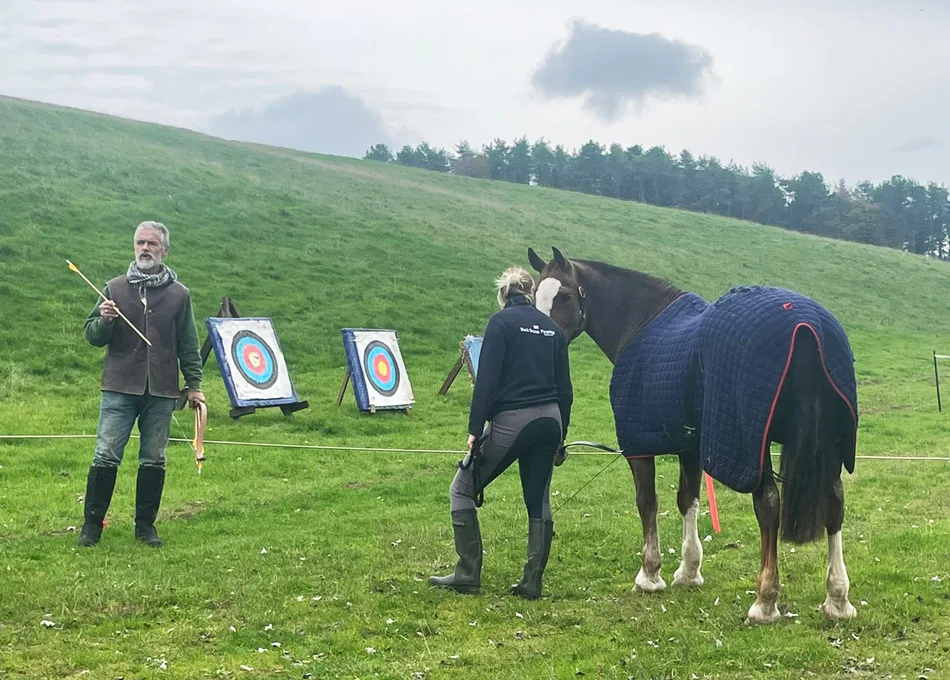
Right – I know we’ve been doing our rain dance for weeks now, but BOO! It really feels like winter is here already, and oh my days I haven’t missed it … Muddy hooves, fresh horses, being soaked through by 10am … yuck!
Don’t get me wrong, the ground has seriously needed it, and I think we are all secretly grateful that our autumn events will hopefully require significantly less watering, spiking and aggravating to give us the going we’re after.
For those unaccustomed to the pickiness of us event riders, we quite like the best going possible for our horses, regardless of the time of year, climate and location. In a dream world, we’ll always have even, smooth ground with good grass coverage and enough “give” in it to minimise concussion to the horses’ feet, joints and tendons. All of which is EASY PEASY over acres and acres of grassland which hasn’t seen rain in months …
The amount of work the major events have been putting into the ground recently is second-to-none – at Hartpury, the track we rode was deep lush green grass, while the going either side was crisp, brown and baked! The lengths the event teams have been going to certainly don’t go unnoticed (or unappreciated), but I’m sure the autumn event teams are breathing out a big sigh of relief!
But now we get into the really picky Goldilocks part – there will be a lovely window where the ground softens as a result of the recent rain … and then we’ll all be begging it to stop. Too much rain and the ground becomes a mucky, churned-up quagmire from which many horses find it difficult to extract themselves, often leaving shoes behind in the process!

Jess climbing on 17.2hh Jimmy

When the going gets … sticky
Just like people, different horses prefer different types of going. Anyone familiar with the racing world knows this – some horses like heavy going, whereas others would rather stay “on top” of the ground.
It’s trial-and-error with each horse, really, but there’s a bit of a nature vs nurture debate: horses exposed to all kinds of terrain as young horses often cope better as they grow up, feeling more confident in their own balance and strength.

image Courtenay Hitchcock The BV

But with the recent influx of European breeding and imports, lots of our up-and-coming horses have missed out on this early education. Which is where the “nature” part comes in! Jimmy and Max are perfect examples – Max was born and raised in the Netherlands, Jimmy in Germany, both with strong European showjumping breeding lines. Neither of them grew up with the mud and hilly terrain the Irish-bred horses do, meaning they were both introduced to it a little later in life.
Max is naturally very nimble and well-balanced – but he is absolutely the little prince when it comes to mud. He would much prefer a nice, even astro turf to run on, please!
Jimmy, on the other hand, has the balance of a top-heavy milk-drunk toddler. But his footwork is brilliant, and if you asked him what he thought of the mud, he’d say: “Mud?! What mud?”. He really couldn’t give a monkeys. He just ploughs his way through it all in blissful ignorance.

Sir Isaac Newton would like to show you his rosette for 6th in the OI at Wellington International Horse Trials this month

I’m not saying that either one of these is better than the other. Both of the horses have their own strengths and weaknesses, and now that it has rained we will use their autumn runs to practice in different conditions and strengthen them, so that they’re ready to win a wet, mucky Badminton when nobody else makes the time (hey – a girl can dream!). Time will tell what sort of autumn we will have – regardless of whether it stops raining, the horses are feeling on great form and are ready to crack on with their exciting September runs. See you on the other side!

Ibberton church secures funds for vital restoration

0

St Eustace Church, the 14th-century Grade II* parish church at Ibberton, is in the midst of a busy programme of repair and conservation. Perched above the village with sweeping views across the Blackmore Vale, the church has stood for more than 650 years – but time and weather are taking their toll.
The major task in recent months has been stabilisation of the north aisle walls, where specialist contractors used anchors and concrete beams to secure the structure. Heavy machinery had to be coaxed up the steep church path, with water hauled from the village hall to cool drills. During the work some slow worms, a toad and a newt were carefully rescued and released from the damp ground around the foundations. Inside the tower, rotten timbers and a collapsed threshold had left the top steps to the roof unsafe. These have now been rebuilt in concrete, ensuring safe access once again.

St Eustace Church, the 14th-century Grade II* parish church at Ibberton


Alongside the structural works, the PCC secured two grants from the Pilgrim Trust to fund surveys of the church’s historic monuments and its medieval stained glass. The glass includes a panel believed to be linked to Jane Seymour, Henry VIII’s third wife and Queen of England for just eighteen months. Surviving examples of Tudor-period stained glass are rare in Dorset, and the Ibberton window provides a tangible connection to one of the most dramatic episodes in English history.

Renovation echoes
This isn’t the first time the village has rallied to safeguard its church. As Roger Guttridge wrote in his BV column in January 2021 column, a local diarist wrote the ‘roof had fallen in and the knave was expected to folow’ in 1892. Between 1902 and 1909 St Eustace underwent a major restoration under Rev. L.S. Plowman, with worship held in a temporary building – now the village hall – until the Bishop of Salisbury reopened the church in July 1909.
Modern attention now turns to the roof, where slipped tiles, leaks, rot and corroded nails mean a complete re-lay is once again urgently needed. Planned future works include trimming back the yews to protect the fabric of the building, repairing the bell tower louvers and eventually replacing the tower roof. The church community remains grateful for local support, both in donations and volunteer help, as it works to secure the future of this much-loved landmark.

Sponsored by Wessex Internet

Norman John Davis

0

14/04/1942 – 03/09/25

On the 3rd September 2025, peacefully in Salisbury Hospice, aged 83, of Mere, formerly Gillingham. Reunited with his late wife, Pauline. Much loved dad, grandad & great grandad, friend to many. Funeral service will take place at Yeovil Crematorium on Wednesday 24th September at 2pm. Donations in memory of Norman for Salisbury Hospice https://norman-john-davis.muchloved.com/ or may be sent to L C Hill & Son, Mere.

Leweston School’s Boys Rugby Team to Make Historic National Debut

0

eweston School is proud to announce that its Boys Rugby Team will compete in the National U18 Continental Tyres Schools Vase for the very first time since the school became co-educational in 2019. This achievement marks a significant milestone in the school’s sporting journey.

Over the past six years, Leweston has focused on building a competitive boys rugby programme, cultivating a squad renowned for their exceptional skill, teamwork, and sportsmanship. The team’s dedication and hard work this season have earned them a coveted spot on the national stage, highlighting the commitment and vision of both players and coaching staff.

Leweston School’s Boys Rugby Team 2025-26 – image Leweston School

In their opening match, Leweston will face The Thomas Hardye School away in Dorchester, with the winner advancing to meet either Bryanston School or Clayesmore in the next round. The competition begins with eight regional groups, each producing a quarter-finalist, before moving into the national knockout stages.

Head Coach Frazer Wilford praised the team’s preparation, saying: “The boys have exceeded all expectations in training and shown outstanding commitment. We are the most prepared we have ever been at the start of a season, and our success will be measured at the end of the term on how much the boys have enjoyed their experience.”

Recent investments in new team kits and a state-of-the-art rugby pitch have generated further excitement and pride within the squad. With 90% of Leweston’s rugby-playing boys representing the school in fixtures, the programme continues to thrive, further strengthened by Leweston’s partnership with the Bath Rugby Development Programme, which offers specialist coaching, masterclasses, and development opportunities. Looking ahead, the school is also planning to launch a girls rugby team next term.

Leweston’s Rugby Coach Frazer Wilford – image Leweston School

Sport at Leweston – Excellence, Opportunity, and Inclusion:

Sport lies at the heart of life at Leweston, where every pupil – from our youngest in Nursery participating in activities like Rugby Tots, to Sixth Form athletes – is encouraged to explore a wide range of activities and pursue the sports that inspire them. Regular PE lessons, a diverse extracurricular programme, and personalised training opportunities ensure that all children can develop their skills and reach their full potential.

We support pupils in competing at their desired level, whether it’s enjoying friendly fixtures or representing the school in local, national, and international competitions. The broad and inclusive range of sports offered includes rugby, hockey, netball, tennis, pentathlon, cross-country, athletics, fencing, sailing, and more.

Leweston athletes consistently achieve outstanding results, with both girls and boys earning selection for District, County, and Regional development centres, reaching National Athletics Finals, and securing top performances in County and Regional cross-country events.

On the rise with The Cherries

0

With recent success, new signings, big ambition and a community behind them, Sturminster Newton’s football club means business this season

The Cherries

Five seasons ago, Sturminster Newton Football Club – affectionately known as The Cherries, but not to be confused with bigger AFC Bournemouth down the road – were celebrating a Dorset Senior Trophy win under manager Nick Squires. Since then, they’ve barely paused to catch their breath.
Back-to-back successes followed: the Dorset Premier League Cup, then the league title itself, and promotion into Step 6 of the football pyramid. Now playing in Western League Division One, the club exceeded expectations in their debut season, finishing 8th in a tough 21-team league – just two places outside the playoffs.

In 2021-22 under the management of Nick Squires the club won its second Dorset Senior Trophy, beating Merley Cobham Sports 2-1 at The County Ground, Hamworthy

This season, the Cherries have picked up right where they left off – at the time of writing they had won all four of their opening games and are sitting confidently at the top of the table.
‘Last year we just wanted to make sure we stayed in the division,’ says Ian Myall, vice-chairman since May 2022. ‘Finishing eighth was a great result. This year, we’ve strengthened the squad with four new signings and set our sights on the playoffs – or better.’

To compete at Step 6 SNUFC had to meet strict FA ground grading requirements, which included installing a new 50-seat stand – image Courtenay Hitchcock The BV

Grassroots to league standards
Most of the squad have stayed with the club through its rise, with strong local roots in Sturminster Newton, Gillingham and Shaftesbury. ‘Once players come here, they tend to stay,’ Ian says. ‘That in itself says a lot about the club.’
To compete at Step 6, the club had to meet strict FA ground grading requirements. That meant installing a new 50-seat stand, upgrading standing areas, adding perimeter pathways and refurbishing changing rooms. And if promotion to Step 5 becomes reality, there’s more work to come: expanded spectator areas, a PA system and more infrastructure.
Off the pitch, the club has increased its committee to 14 active members and introduced new roles such as Director of Operations and Director of Football. The clubhouse has also expanded its offer with darts, skittles, televised matches and a thriving membership structure – all for just £15 a year for individuals, or £6 for concessions.

Community at the core
In 1874 the club, which was then known as the Panthers FC, became the first ever club from the West Country to participate in the FA Cup, reaching the second round on three occasions over its history. The Cherries currently field seven youth teams across a range of age groups, plus the popular Tiny Cherries sessions on Saturday mornings for the youngest players. A ladies’ or girls’ side remains an ambition, but recruitment has been a challenge with other clubs nearby: ‘We’d love to offer girls’ football again,’ says Ian. ‘But with Shaftesbury and Blandford already fielding teams, we’d need more numbers than we have to make it sustainable.’
Home matches now regularly attract more than 100 supporters, with some derby games drawing more than 300 through the gate. Vale Coaches provide travel for up to eight away games a season – with fans and players travelling together to keep the club spirit high as they travel.

Backing the climb
Promotion comes with pressure, of course – and not just on the pitch. The club is actively seeking sponsorship for kits, players and perimeter boards, and encourages locals to join the club or become members.
‘It’s a friendly club,’ Ian says. ‘Stability’s been key – the management, the squad, the committee: we’ve all built something that’s moving in the right direction. We’re working hard, doing things the right way, step by step.’
As the Cherries chase another season of success, the call is simple: get behind your local club – they’re going places.
snufc.com

Stur Half draws runners from near and far

0

The 34th Stur Half Marathon saw 331 runners cross the finish line in Sturminster Newton on 3rd August, with entrants travelling not just from across Dorset but from as far afield as Europe and Texas.
This year the race formed part of the Dorset Road Race League, and doubled as the county half marathon championships.

331 runners at the start line


Lester James of Team Bath AC was first man home in 1:10:59, while Isabel Zanconato of Purbeck Runners took the women’s title in 1:28:06.
There was plenty of local pride too. Dorset Doddler Emma Mogridge finished as first Dorset woman in 1:19:12, and fellow club runner Rich White was the first Sturminster Newton resident in 1:16:21. Ages ranged from 17 to 85, with milestones including 40th and 70th birthdays – and even a wedding celebration – marked on the course.

stur Half

The companion 5K event continues to grow, attracting 50 finishers this year. Wins went to Wilfred Hughes in 17:08 and Emily Shaw in 18:03.
Proceeds from the day go to the Vale Family Hub, with thanks due to the many marshals, volunteers, the High School, and local sponsors including Honeybuns, Root & Vine, Harts of Stur, Oltra, Running Free and Symonds & Sampson.
The Doddlers’ next race is The Stickler on 26th October – details at thestickler.co.uk.

Sponsored by Wessex Internet

A smooth harvest soured by TB

0

Early harvest, fuel costs down, yields beat expectations … but another wave of TB positives has overshadowed everything for James Cossins

James Cossins watches the Rawston Farm harvest get under way.
All images: James Cossins

Here at Rawston Farm, harvest came to a close in the middle of August – one of the earliest finishes we’ve known. The hot dry weather meant that very little drying of the grains had to take place, resulting in a considerable saving in fuel costs to keep our produce safe in store. Mechanical interruptions were kept to a minimum, too, due to good crop conditions during harvesting. We did have an issue with the combine which meant losing a day when a broken part had to be sourced from Germany. The yields were above expectations, in spite of the drought conditions during the growing period. The winter-sown crops yielded well, but the spring crops, such as the barley and the beans, were much more variable, with some fields disappointing due to the lack of moisture.
The other disappointing factor this harvest is the low prices for all of our combinable crops: it seems that there is an abundance of good crops world-wide, leading to an over-supply and hence the lower prices. Here in the UK, the yields have been very variable, with the Midlands being badly affected. Normally in years with poor yields, we would expect higher prices to compensate, but it seems not this year.
At the time of writing, the rain has finally arrived – too late to help the harvested crops, but it will hopefully revive the grass and ease the shortfall faced by many livestock keepers in recent months. We are also turning our attention to sowing our oilseeds and grass seeds, now that the moisture is available to get them growing.

Harvest was finished by the middle of August – one of the earliest the Cossins family can remember

TB update
During harvest we also had to fit in our 60-day TB test, with not only the regular skin test but also the gamma blood test on all cattle over six months. The test took up most of one week, with the afternoons and evenings left free for harvesting. We also managed to give all the high-risk cattle their first bluetongue vaccine, recommended by our vets to prevent milk drop in the dairy cows. The results from the TB skin test were encouraging, with just one inconclusive animal, so we waited for the blood test results in a positive mind … only to find that there were 28 positive cases.
Obviously we were very disappointed with the results, which included 20 milking cows and both of our Aberdeen Angus stock bulls. It took two lorries to take all of them to the abattoir.
As I write, the official results have just been received: there appears to be no evidence of TB lesions in the carcasses.
Yet all we can do now is hope that the next 60-day skin test can give us a better result.
I have been contacted by other farmers in a similar position, in absolute despair at the circumstances. I can only reassure them that they are not alone in this thoroughly desperate situation, with just the hope that eventually we will go clear one day … but it’s difficult to see when.

End of harvest in the Tarrant Valley

I should add that farmers do get compensated for the loss of the animals – at the tax payers’ expense – but this does not make up for the loss of milk value. We are, as an industry, pressing the government to roll out a TB cattle vaccine to protect our animals. In Dorset, the NFU has set up a TB advisory group to look into how we can help fellow farmers with TB issues and to see what further trials and controls can be put in place to reduce the incidence of this disease.
I’m sorry to close on a negative note, but it’s been a frustrating month.

James