Clayesmore School is an Independent School that prides itself in the quality of the education, opportunities and facilities available to pupils. The efficiency and effectiveness of our transport service is extremely important, playing a significant part in attracting and retaining pupils. School transport is highly visible within the community and so the appearance of vehicles and the behaviour and appearance of drivers will help determine how the school is judged.
The primary purpose of this position is to work with the Transport Manager to coordinate all aspects of operating the Clayesmore transport fleet and managing the transport requirements of staff and pupils.
The hours for the role are 25 hours per week, to be worked Monday to Friday, 12.45pm until 5.45pm.
A competitive salary and attractive benefits are provided for the successful candidate.
Closing date: 8.00 am on Thursday, 12 October 2023
For further information and details of how to apply, please go to:
Clayesmore is committed to the safeguarding and promotion of children’s and young people’s welfare and expects all staff and volunteers to share in this commitment.
We are currently looking for a cheerful happy honest reliable housekeeper/cook for a 77 year old gentleman living in a village near Gillingham/Wincanton. Must also be a dog lover!
This can be live in or out. Separate accommodation is provided.
Must have references and willing to have a CRB check.
For more information and a full job description please email [email protected]
Fairmead Community Special School transforms the lives of pupils aged between 4-19 years with additional learning needs (MLD and ASD). The school works in partnership with parents/carers and other stakeholders to develop our pupils in becoming positive individuals who make a valuable contribution to their community.
LEARNING SUPPORT ASSISTANT (LSA) 34.50 Hours per week, Term Time only (39 weeks)
Grade 15-14 – £16,919 – £17,540 (gross annual salary). Subject to an annual increase
Working hours Mon, Wed, Thurs, and Fri 8.30am-3.45pm and Tues 8.30pm-4.30pm – 34.50 working hours
We are seeking to appoint outstanding Learning Support practitioners who are compassionate, dynamic and resourceful individuals to join our dedicated and hardworking team of skilful support staff to work across the whole school. A desired element to this role would be experience of supporting young people with Autism and moderate learning needs.
Jason Bennett is dedicated to preserving England’s oldest cattle breeds and is committed to educating the public about meat quality
Jason keeps British Whites and Gloucesters as well as the Dexters he uses for meat boxes
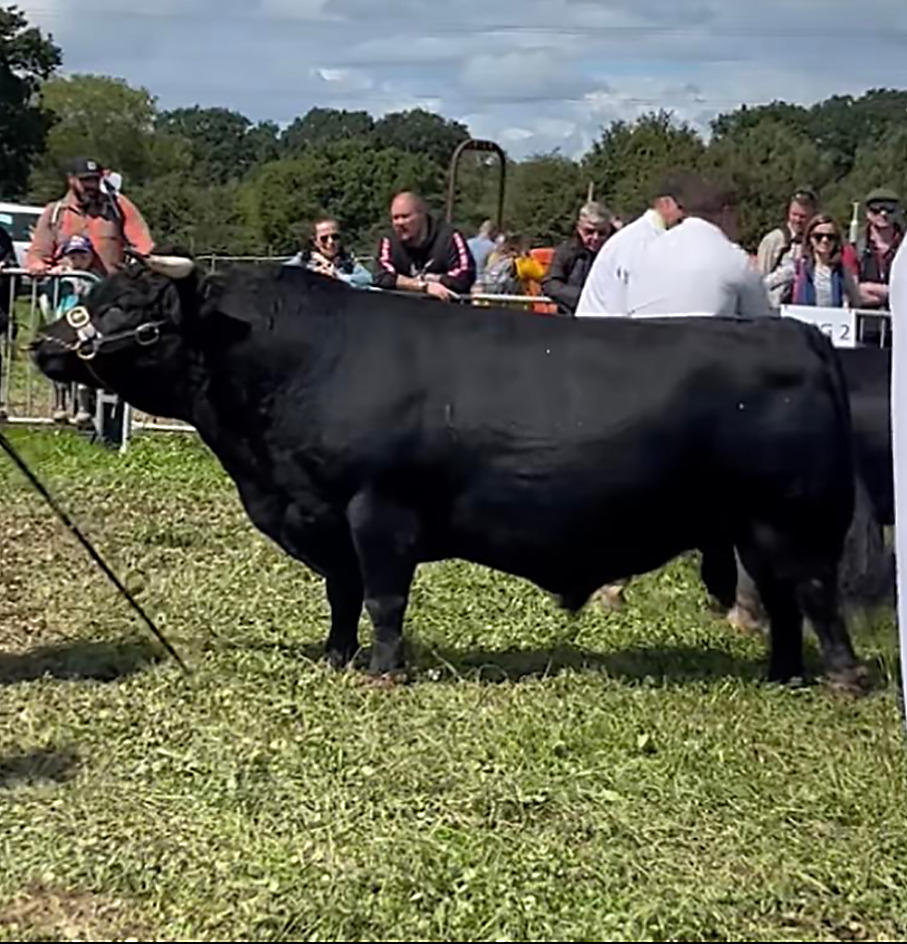
British Whites and Gloucesters are two of the oldest native English cattle breeds – Gloucesters date back to the 13th century. Jason Bennett, who runs a smallholding two miles from Wells Cathedral, is passionate about rare breeds. ‘My daughter and I have British Whites and a Gloucester. We also keep Dexters. It’s a father-and-daughter collaboration. Gloucester cattle are rarer than the giant panda – there are more than 2,000 giant pandas in the world, but fewer than 600 Gloucesters. The biggest Gloucester herd has 300 animals, and is in Gloucestershire. We are beef farmers, although Dexters and Gloucesters are dual-purpose beef and dairy breeds. We do beef boxes from the Dexters and then rare breed burgers and patties. Our Dexters are doing well at the moment. This year we won the Inter-breeds Championship and Reserve Championship at Honiton Show.’
With bulls it’s softly, softly You only have to walk around the cattle area at an agricultural show to see the constant work needed to get the animals ready. How does Jason know which cattle will be potential champions that he can train for showing? ‘It starts when they are calves. You look for the ones that show a bit of promise, it’s all in how they stand and look. At three months, they start looking like a bull – that’s when I start them on a halter and lead them with their mum so they get used to it. ‘With a bull, it’s all about “trickery”. If a bull plans to run away … it will. They weigh around half a ton! ‘So we start them from a young age and teach them to run on a lead, softly, softly. Obviously with any animal things could go wrong, so we have the halter and a nose ring. I’ll lead it, and there’s someone else at the rear. But the bulls also learn that they get fed and have a nice bath for the show. And we use tea tree oil on them – they love that! I also give the bulls a massage. People love watching me massaging them at the shows.’
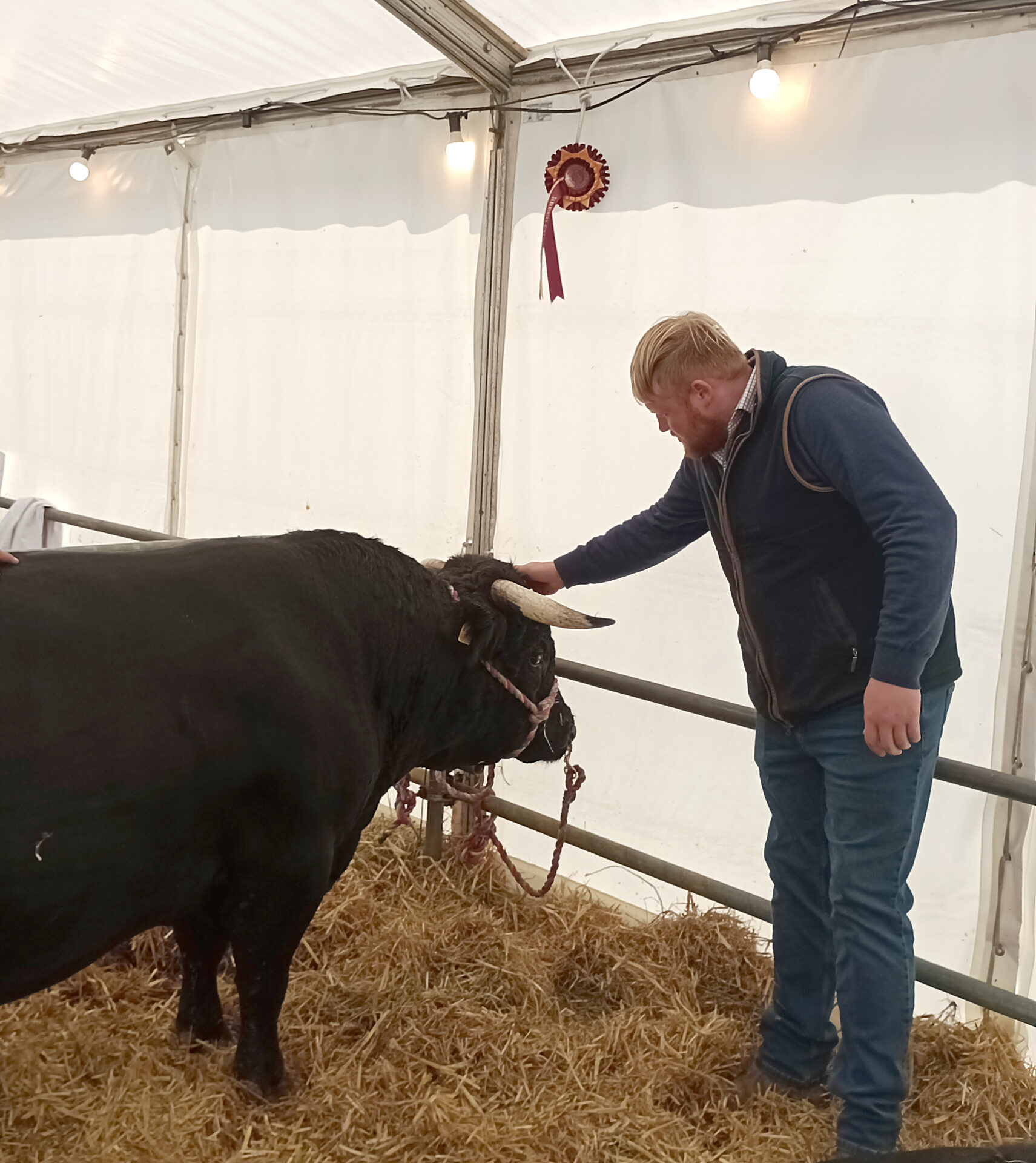
Caleb Cooper from Clarkson’s Farm getting to know Jason’s prize-winning Dexter bull.
Education, education, education Cattle, beef and dairy farming have been getting a bad press recently with the green agenda. It’s something Jason feels strongly about. ‘The public aren’t stupid. They know a cow fart won’t blow a hole in the ozone layer. And if you stand my cow next to a diesel engine, the public will prefer the cow. During COVID, when the motorised boats and gondolas stopped in Venice, the dolphins returned to the canals within two weeks. They should go after these football players and billionaires in private planes who are doing far more damage. ‘I recently did the Farm to Fork event at Bath & West Showground. We had 12,000 kids come through. It was fantastic. I love teaching children. If you tell them something, they’ll absorb it like a sponge. It’s also essential that people can see the animals are treated well. ‘When each group of kids came up, I asked “Who’s had a McDonalds? Obviously 99% of them put their hands up. And whose Dad enjoys a steak? And who likes Mum’s spag bol? And then I say, well, these cows will become your steaks … ‘The kids must learn where food comes from. My mantra is “to save a rare breed you have to eat a rare breed”. When you have two, you eat one and breed the other. Some might be a bit put off by it, but a couple of people came by my stand afterwards and said the children had told them what they had learned, and of course then the kids help teach the parents.
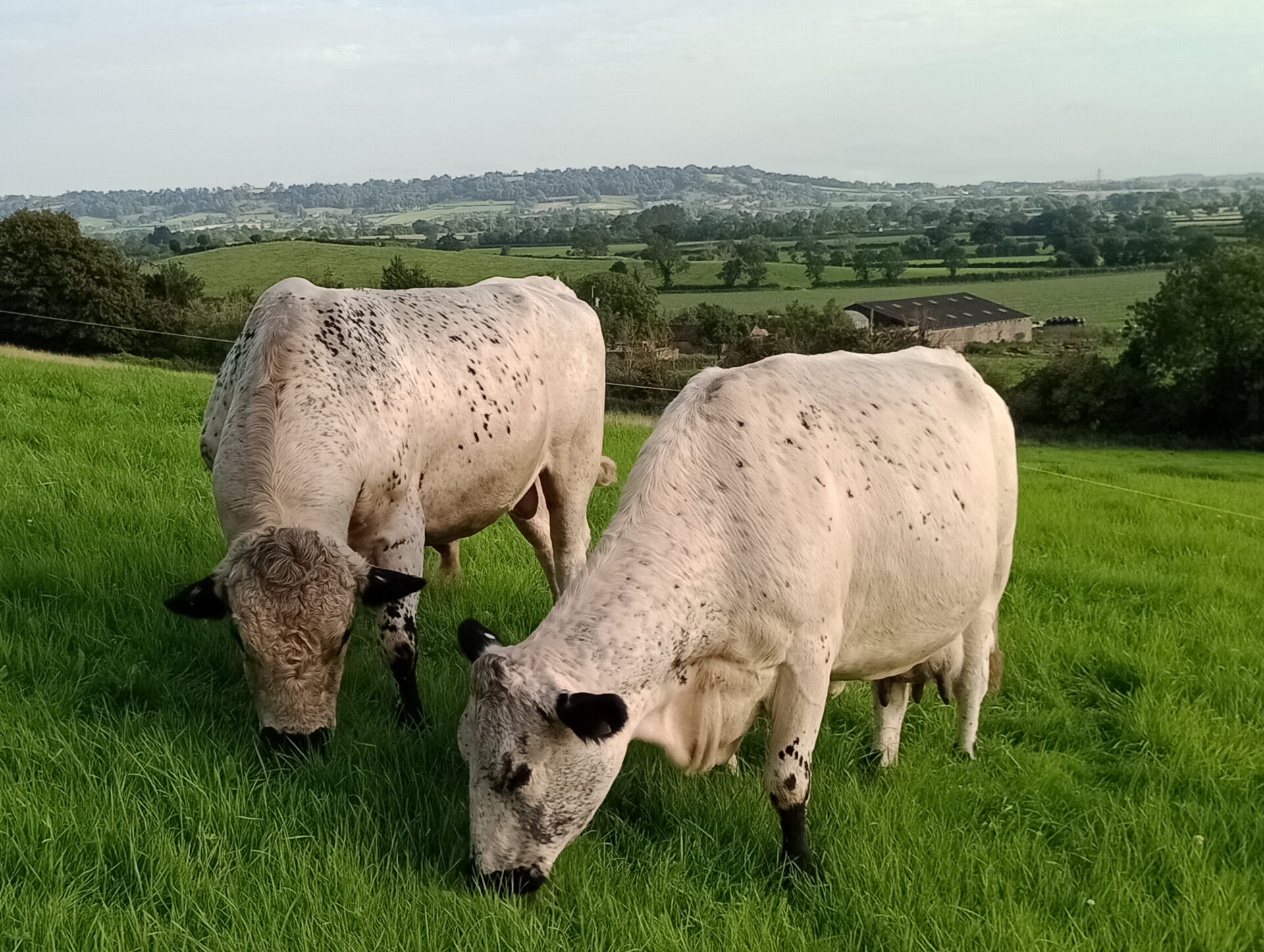
Jason’s British Whites at home on the Mendips
‘We should all probably eat less meat – but make sure what we do eat is decent quality stuff, better food. Don’t eat crap.’ Jason is clearly passionate about promoting farming and his rare breeds – and recently he’s had some standout moments. ‘It was good this week at the South Gloucestershire Show when we won the inter-breed. But we also had our rare breed burgers there (Wessex Rare Breeds), and I got a thumbs up from Caleb Cooper for our burgers!’ Of course Jason will be showing his cattle at the Gillingham & Shaftesbury Show. ‘I’m looking forward to two things – showing the Dexters because they are our passion and also having our catering enterprise at the show.’ As a show pro, Jason has some excellent advice for any first-time visitor to Gillingham & Shaftesbury Show this summer: ‘Make sure you explore and check out the livestock. Traders basically pack a trailer and take it to a show, but the preparation that goes into showing animals is phenomenal. So please just take five or ten minutes to walk up and down the aisles to appreciate the work of the farmers. And once you’ve seen the rare breed cattle, go and taste one! If every farmer had a rare breed on their farms we would no longer have rare breeds.’
Summer is officially over – and if you are a stay-at-home mum (either worried about or looking forward to) your kids going back to school, this month’s article is for you! I have been thinking about some activities mums can do while their kids are in school. Being a stay-at-home mum can be overwhelming. When your children finally head off to school, either for the first time or after a long summer holiday, you might feel at a loose end. But now is your opportunity for some much-needed “ME” time! Do you find regular exercise hard to fit in? It might be time to check out your local gym! Book into a regaulr class, and make new friends while you’re at it. If a hard work-out isn’t for you, look out for a yoga or Tai Chi class. These are more gentle forms of exercise to help you relax and get fit. Have you been missing time with friends that wasn’t centred around the kids? I bet your freinds have too. Why not set up a weekly coffee date in a local cafe with freinds or neighbours. If you’re stuck for who to meet, try the MumsMeetUp site to connect with local mums. If you have a toddler still at home, maybe with a busy schedule of morning jobs, take a break during nap time to catch up on a box set or a film. Yes it is important to get some jobs done but you also need to find some time for yourself! Learning a new skill or taking up a hobby is agreat idea – there’s masses of information on YouTube for free. Lots of people learn new skills that way. Formal learning (online or in-person) is another great option. You can find details of adult learning courses on the Adult Community Education website SkillsandLearning here, with a huge range of subjectes from maths and creative writing to counselling and barbering. Online classes can be done at your own pace, and are easy to fit in when you have the time. In-person classes are a great way to meet people with the same interests as you. Check your local library – Gillingham has a very active Craft Club that meets every Friday, and most local libraries have similar groups.
Employ My Ability offers vocational training for students with learning disabilities and special educational needs and disabilities. One of their students, Maddie Walters, spent her work experinece with us, and now writes a regular column – Ed
Dorset farmer and BV Magazine columnist George Hosford gives to show visitors an insight into modern farming with his July farm diary
After three years, George has successfully established herbal plants into an aged and worn-out permanent pasture – it’s had very little grazing while it has slowly rooted.
Grasshopper: long word – short antennae Cricket: short word – long antennae Katydid: odd word, also known as a bush cricket, definitely confusing the issue
It’s a Meadow Grasshopper on the thumb and a long winged meadow Katydid in the image below – and they’re on the hand of the teacher who brought a class from Durweston to the farm at the beginning of July. That’s what the ‘Picture Insect’ app tells me at least – and yes, a proper student of wildlife would cross-check in a book, but life is too short to be buried in reference books. Apps like this one, the ‘Merlin bird song app’, and ‘Picture This’ for plants and trees, have revolutionised my life … and increased my screen time and shortened my phone battery life alarmingly! It was a lovely sunny day for this particular school visit. We had great fun looking at crops approaching harvest and wild flowers on chalk downland, and spent ages catching (mostly) grasshoppers plus quite a few other mini beasts. A sunny day in July is perfect for crawling about on hands and knees trying to catch insects for identification, and for learning new plants. After that it was time to pull on the rubber gloves and find a suitable cowpat for excavation. We needed one not too old, not too fresh … as Goldilocks said, it needs to be just right. Covered in holes on the surface, firm enough to be a little crusty, but still soft enough inside to be populated with a variety of insect life, hopefully including some dung beetles. If we don’t dose our animals with wormers then there will be a better chance of dung beetle presence – they are an indicator of, and contributor towards, soil health, carrying dung deep into the soil with their burrowing activity. On this occasion we found a couple of beetles who rapidly tried to burrow away from daylight, numerous small unidentifiable flies and one mealworm from another beetle species. At least a bird not worried about a dirty beak would be very pleased to find it!
It’s always the weather We have been pushing on with harvest when the weather has given us a chance. We nibbled at the Wildfarmed* winter wheat, which has ripened earlier than the other wheats, but it wasn’t quite ready so we moved on to the spring barley, which is equally weather-sensitive. Once milling wheat or malting barley is properly ripe, it is important to gather it swiftly, before the weather breaks and essential quality levels deteriorate. We also try to keep one eye on the straw, so that our long-suffering straw contractor stands a chance of baling the straw before it gets soaked. If it looks as though rain is imminent, it’s a bit unfair to race through a damp crop with the combine leaving line after line of soaking straw. This will only delay our return to the field to sow the next crop, so usually it pays to be patient. The baler running right behind the combine on a sunny day, dust flying, is the best of all. Once the harvest is in, some decent damp weather means the oilseed rape or cover crops – which will be sown as soon as possible afterwards – have a greater chance of swift emergence and growing away while the sun is still high in the sky. Every week’s delay in sowing reduces the sunshine hours available for important early growth before winter. By the end of July we had cut all of the winter barley and the oilseed rape, the early-sown spring barleys, and the Wildfarmed winter wheat – and in all cases the heaps in the shed are sadly rather smaller than we had hoped.
Not quite ready – ‘having a nibble’ at the Wildfarmed wheat
We are still debating why this is; the usual suspect is the weather, and it’s no different this year. A wet and cold winter, late cool spring and a boiling hot June have conspired to depress yield prospects. Once again we have been experimenting with fertiliser and spray inputs. So we have yet to discover what the main wheat crop has in store.
Grow Your Own for next year We have sown a selection of crops in one field, in order to save the seed and use it to sow our over-wintering cover crops. This will be the third year we have done so and it is amazing how well the combine copes with such variation (admittedly it is possibly something to do with the operator?!). The seeds are very different from our other crops, and the straw is variable in texture and quantity, yet we have ended up with usable samples. Some of this year’s crops won’t be cut until after their seeds would need to have been sown, so we will dry and store those until next year. The turnips on the far left of the image have already been cut and cleaned with our ancient Rutherford cleaner, and are ready to sow again soon.
Farming or marketing? This summer we became the proud parents of another graduate in the family. In the ceremony lists of graduates I found it a little odd that there were twice as many students of consumer behaviour and marketing than there were of agriculture. I can’t help feeling that this could reflect the reducing numbers of people occupied in grass-roots food production across the world.
Technological advances and the relentless drive to reduce the cost of food inevitably drives people out of the industry, thus making it ever more dependent on chemicals and fertilisers applied in textbook fashion across vast areas which cannot possibly be managed in a way that can produce food while simultaneously preserving (let alone improving) soil health and protecting environmental diversity. In order to compete in a cut-throat world driven by the retailers and cost-conscious consumers, farming has become hugely competitive. Arable farmers have long been paying silly money for rented or contracted land, and to cover it all they need hugely expensive machines. Once committed to this capital expenditure, along with often unsustainable rent levels, the last thing they can risk is losing yield. So every avenue is followed to optimise production. This is very expensive – in many cases, farmers are over-applying inputs because they can’t risk what they see as failure. In our own case, we have achieved 11 tons per ha of wheat in four out of the last ten years. That for us is amazing, but we would be fools to think we can do that every year – the rainfall makes sure of that. Rainfall and sunshine distribution will always have more influence than fertiliser and chemicals. Should we stick to the high input policy of those good years – thereby implying that in the other six years we over-applied fert and chem? Or should we settle for a bit less yield in the best years, instead matching our chemical input levels to the average output we might expect? Paying close attention to the financial margins of different levels of input and output, while weathering the vagaries of international markets for grain and gas (fertiliser), is of course essential bedtime reading.
Chemical cons Along the way we are learning about the damage that chemical fertiliser does to the soil. We know now that it destroys organic matter and soil health. And are the fungicides we use to keep disease at bay on the plants above ground actually destroying the mycorrhizal fungi within the soil that are so important for healthy plant/soil interaction? If we are to be serious about global temperature and the human effect on the planet’s ecosystems, we really do need to address these issues.
George Hosford farms near Blandford, and writes a regular monthly farm diary on his blog View From The Hill
Wildfarmed works with farmers, believing that affordable, nutritious food must be grown in ways that mimic natural systems, restoring soil and with far fewer inputs.
The recent decision by Dorset Council to approve the development of a solar farm, close to where I live in the Blackmore Vale, prompted an exchange of views on social media after someone posted an article from the Daily Mail which was headlined ‘Fury as huge solar farm given the go-ahead in Hardy Country’. Not so long ago all the comments would have been strongly against the development, but this time there were a number of comments in favour. A reflection perhaps of an increasing awareness of the urgency of the situation? It’s certainly getting harder to deny that the climate is changing, as evidenced by extreme weather-related events this year, including here in the UK and in Europe. Weather has always fluctuated of course, but the increasing trend to severe events is obvious. Some commentators were also clearly aware of the way the government has failed us so badly in the urgent need to transition away from fossil fuels. The failure to develop the necessary infrastructure in renewable energy was also considered to be reflected in the ever-growing problems with health, education, sewerage and water etc. To those who call for development to be placed anywhere but in our own back yard, I would point out that we are all in the same boat. We all have to play our part if we are to avoid sinking together. I doubt anyone thinks solar farms are visually attractive – or wind turbines for that matter. I certainly don’t. I would much rather we didn’t have to have them. But the fact of the matter is that humanity has boxed itself into a corner. Or rather, we’ve been boxed into a corner by corporations greedily pursuing profit before people and planet, and by governments failing to regulate those corporations to prevent the damage they cause. We now have to throw everything we can at the problem of global warming, in order to have any chance of stopping it getting out of hand. Co-operation needs to extend internationally of course; thankfully there are signs that’s happening as catastrophe knocks on everyone’s doors. Ken Huggins North Dorset Green Party
August has served up a strong reminder of the size and diversity of the North Dorset constituency – even after the Boundary Commission has wrought its most recent changes (the latest proposals are on their website now). I say this because August has seen the Liberal Democrat team mount a presence at both the Gillingham and Shaftesbury Show and the Verwood Rustic Fayre. The two events are a long way apart in geographical terms and they also feel quite different: one is deeply rural and agricultural while the other has an air of New Forest edge-of-metropolis.
What is interesting is that with exactly the same stand and precisely the same approach – asking some pertinent questions and listening hard – we had a very similar response. There is that age-old issue that when you have lost your car keys at night you only look for them under the lamppost where there is light. We did not do that. We talked to people long and hard right across the spectrum of age, gender and the rest of the demographic niceties. We stood our ground against the diehards, meeting them with a rueful grin or two but mostly we had good amicable and engaged discussions. Over two days at the G & S and through the day in Verwood, we had something approaching 200 conversations – about one every five minutes. There were some big ticket issues from these conversations: Why doesn’t anything work properly; the self-seeking nature of politics; how out of touch our politicians are; why can’t we find a decent solution to the asylum seeker crisis; how could we have let Brexit end up like this; why can’t we come together as a nation to stop us going downhill; why do governments do things mostly for the minority that put them there; there must be a better way of doing all this. You get the picture? Quite a lot of despair and even more disdain for the political classes. Lessons for all. I am delighted, therefore, to watch Sarah Dyke, our new local MP for Somerton & Frome embark on a constituency wide tour as the first thing she does. To see, hear and seek to understand about all of her constituency. My goodness me, she is a force. Still, on the lighter side, we asked attendees at both shows whether the current lot deserve another five years. The best answer we got was from the Daleks. I leave you to imagine the one-word answer… Mike Chapman Blackmore Vale LibDem