The annual Open Garden event at Hatch House last month broke a new record, raising a grand total of more than £26,000 for Salisbury Hospice Charity. Visitors eagerly lined up, waiting for the garden gates to open. They explored an array of stalls offering vintage clothing, collectibles, books, hats, shoes, and more. The glorious weather complemented the garden’s bloom, providing a picturesque backdrop for attendees to enjoy the scenery, unwind in the 17th-century walled Dutch garden with Pimms, savour barbecue from Compton McRae, and delight in the music of local vocalist Charlie Greenwood. Sir Henry and Lady Rumbold expressed their absolute delight at achieving a new fundraising record this year, with lady Rumbold admitting she was ‘..struck dumb by the generosity of everyone giving their time, the most precious of all things.’ They conveyed their heartfelt gratitude to the team at Salisbury Hospice, and the volunteers and the Tisbury Committee for their relentless efforts that contributed to the Open Garden’s resounding success. They also extended their thanks to everyone who generously donated items for sale and to the numerous visitors who attended the event. Tamsin Murley, Community Fundraiser for Salisbury Hospice, said: ‘The continued support shown by Sir Henry and Lady Rumbold is phenomenal, and they are without doubt the heart and soul of this event.’
Selling from the field, the calorific need of pregnant mares and a galloping success story – Lucy Procter has had an intense few weeks
All images: Lucy Procter
Scrolling back through photos on my phone, I can see that September brought both warm sunshine and heavy downpours, which has meant the grass has continued to grow extremely well. The mares are receiving sufficient calories from grazing this lush grass, so we are still just feeding the pregnant mares a daily cupful of a nutrition-rich ‘balancer’, carefully formulated by Saracen, our trusted feed company, to ensure that they are getting all the nutrients they need in the correct proportions. As the nutrient and calorific value of the grass drops off towards winter, we will start feeding stud nuts (known as ‘hard feed’), in larger quantities, which will increase the calories the mares are consuming. As the early foaling mares enter their last three months of pregnancy, their hard feed will be increased again, to support the demands of the foal growing inside them. Our earliest foal is due in February, so we will be making this increase for some of the mares in early November.
Bloodstock agents and trainers have visited to see the youngsters for sale, who have been paraded in-hand, in walk and trot, up and down the yard
Selling from the field We have been busy welcoming bloodstock agents and trainers to our yard this month, to show them our young horses. Although we regularly offer our youngstock for sale at various auctions throughout the year, we also sell ‘from the field’. The youngsters are not yet old enough to have a rider on their backs so, as well as a good pedigree, buyers want to see a big athletic walk and an active trot. In order to show them at their best, we usually bring them into the stables, give them a good groom and then parade them in-hand, in walk and trot, up and down the yard. All our horses are well-handled, so this is usually a fairly straightforward process and it’s good for their ongoing education.
Lettuce was born with shockingly slack hind pasterns – by a long way the worst case anyone on the TGS team had ever seen, and potentially life-threatening
A tale of Lettuce All our Thoroughbred foals are now weaned, and it is just the two sport-horse foals, born in June and July, that are still with their mothers. We usually wean when a foal is four to five months old, so we will wean both of these last two foals in November. The Thoroughbred foals are now in sales prep for a new National Hunt foal sale in November, so they are all in overnight and being well fed in individual stables. Before being turned out they are walked in-hand for half an hour to help ensure they are fit enough to be led out and paraded for buyers, multiple times a day, at the sales ground. One of the sport-horse foals, Lettuce, was born with shockingly slack hind pasterns, known as digital hyperextension, which resulted in him rocking back onto his heels with toes pointing skywards. Although often not disastrous this extreme case, if not treated and rehabilitated correctly, was life threatening. It was by a long way the worst case any of us had seen but, with expert vet, farrier and physio attention and restricted turnout, there was a chance. Lettuce was particularly worrying as the normal early intervention – gluing hoof extensions onto his feet, seen in the June issue – wasn’t producing the improvements we usually would have expected. After much consultation with our vet Paul Legerton our vet, our farrier Dom Blades and ACPAT veterinary physiotherapist Celia Cohen, we stopped his turn out altogether. Although Lettuce had only been going out for ten minutes at a time in a small paddock, he was still galloping around and it was thought that this stretching of the ligaments in his hind pasterns would be having a detrimental effect. The thinking was that we would try a period of controlled exercise, walking the foal in-hand alongside his dam, for fifteen minutes, several times a day. This was supported by a muscle stimulation machine, which – to our team and Celia’s amazement – he not only tolerated, he was a perfect patient for. He could then start his programme of rehabilitation to activate and strengthen the tendons to support and lift his fetlocks.
ACPAT veterinary physiotherapist Celia Cohen treated Lettuce with a muscle stimulation machine to help activate and strengthen the tendons
Another issue that had to be addressed was that the hoof extensions, which are normally glued onto the bottom of the hoof by the farrier to help the lower leg stay in a correct posture, had been in use for a longer period of time than was ideal and were beginning to restrict the hoof growth at the heel. To prevent any long-term damage to the hooves, we had two metal plates made which we bandaged onto the hind hooves each morning before his first walk, and Lettuce was kept on rubber matting during the day. The metal plates were then removed in the afternoon so that the development of the hooves was not restricted, and he was returned to a deep straw bed overnight Now of course ‘normal’ foals spend 24 hours a day in a field with their mothers and other foals. They gallop, they play, they sleep.
Three TGS thoroughbred foals in prep for the sales. From left: ‘Radish’ – Golden Horn colt out of Roc Royal ‘Mustard’ – Spanish Moon filly out of Mystery Drama ‘Cress’ – Brave Mansonnien filly out of Cosmic Diamond
In contrast, Lettuce was being deliberately prevented from any galloping or playing. He was restricted to his stable and only allowed to walk for 15 minutes at a time, four times a day, led from a headcollar. He was just two months old … we anticipated that he would quickly get frustrated and become difficult to handle. But it was quite the opposite – Lettuce was an absolute dream! He happily stood patiently for the metal plates to be bandaged onto his hooves in the morning. He walked quietly. He stopped to peacefully graze. He stood still while we used the EMS machine for up to half an hour at a time. In fact it was his mother who was really rather unhappy about not being turned out in a field! Slowly and gradually, we saw improvements; his hind pasterns strengthened and his hooves began landing square to the ground as he walked. After six weeks of this intensive regime, we trimmed his feet again and our vet declared that he could turn out in the field. The joy! Lettuce galloped. Lettuce bucked – and yes, Lettuce’s mother also galloped and bucked! – and he slowly got brave enough to start playing with the other foal. It is a real pleasure to be able to effect such a dramatic improvement in a young horse. Now, two months later, you would never be able to tell that he had once had such a severe problem (see image above); we had feared that he may not survive, let alone ever be ridden. Job done!
Lettuce in his ‘after’ shot, now standing proud and flat on his hooves
We are recruiting! We have seasonal and permanent yard positions, and both full and part-time hours available at the stud at Glanvilles Wootton. See the ad in the jobs section and phone Doug on 07974 314262 or email [email protected] for more information. We look forward to hearing from you!
The Book & Bucket Cheese Company’s new limited edition cow’s milk brie-style cheese debuts in November, just in time for Christmas
image: Heather Brown
The Book & Bucket Cheese Company in Cranborne, Dorset, has been working on a new limited-edition cheese for the upcoming festive season. Launching in November, Cranborne Dark Sky is a brie-style cheese made from cow’s milk, featuring a delectable layer of dark truffle running through its core. Rather than adding the truffle at the end of the cheesemaking process, the layer is incorporated into the curds during production, allowing the rich truffle flavour to permeate the entire cheese. Customer and chef requests have driven the development of this cheese, which underwent various stages of testing for over a year. Peter Morgan, the founder of The Book & Bucket Cheese Company, turned to social media for help in naming the new cheese. In recognition of the Area of Outstanding Natural Beauty where the dairy is situated – as well as the area’s recent designation as an International Dark Sky Reserve – followers were asked to choose between two names: Cranborne Dark Sky and Cranborne Reserve. With more than 75 per cent of the votes, Cranborne Dark Sky won. The cheese is now ready for launch and will be available for purchase on The Book & Bucket Cheese Company’s website and for wholesale orders starting in November 2023.
Mandy and Peter Morgan accepting their 100 Taste Award in September
A rapid rise Founded in 2019, The Book & Bucket Cheese Company initially offered a small range of artisan sheep’s milk cheeses, each named after famous authors. They swiftly gained popularity among local hospitality establishments, delis and farm shops. However, when the pandemic struck in March 2020 and the hospitality sector temporarily closed, the company faced a quiet order book. In response, The Book & Bucket Cheese Company collaborated with a local farmer grappling with excess cow’s milk and utilised the downtime to develop a new range of cow’s milk cheeses. Over the following year, despite the pandemic’s challenges the company doubled its cheese offerings. Now, in 2023, The Book & Bucket Cheese Company is thriving, with many of its cheeses earning prestigious national and international awards. Several of their products have received accolades from the Great Taste awards, Taste of the West Awards, Artisan Cheese Awards, and three cheeses have been honoured at the international World Cheese Awards. Among them, the Shakespeare cheese earned the coveted World Cheese Awards Gold Award. Most recently, in September Book & Bucket was recognised in the national 100 Taste Awards at Tate Modern, which celebrate the most outstanding food companies and enterprises each year. Peter Morgan expressed his excitement in the new cheese, stating, ‘What is now called Cranborne Dark Sky has been on my to-do list for a few years. I have trialled a number of different ideas – in my head, I wanted something that hit the spot both visually and flavour-wise. The whole team are so happy and proud of Cranborne Dark Sky. ‘We’re confident this will be a cheese that will become a must on every cheeseboard!’
The National Association of Local Councils (NALC) has announced its finalists in the prestigious Star Council Awards. After an exhaustive evaluation process, an expert panel of judges has selected a shortlist for each category – and two on the list are in Dorset!
Sherborne Town Council is a finalist Council of the Year, and Shaftesbury’s Brie Logan is a finalist as Town Clerk of the Year. Judges comments include that ‘Sherborne Town Council has showcased remarkable accomplishments, underscoring their dedication to engaging with the community, promoting sustainable practices, and fostering collaborations with local organisations.’ NALC’s Star Council Awards are the only awards in England that recognise local (parish and town) councils’ contributions to their communities. The long-running awards celebrate local councils, councillors, young councillors and town clerks’ positive impact on their communities. Of Brie Logan, the judges commented on her ‘transformative leadership’ and that her time at Shaftesbury Town Council ’has been extraordinary’, stating that her ‘boundless enthusiasm and exceptional communication skills have united her team, councillors, stakeholders, residents, and unitary officers in a mission of excellence. ‘Brie’s ambitions for Shaftesbury far surpass typical small-town council objectives, igniting inspiration throughout the North Dorset community.’ The winners will be announced at a reception in the House of Lords on 29th November.
Inspired by craft ales and Coldplay, Steve Farrell has brought commercial brewing back to Wimborne after a nearly 80-year dry spell
Steve Farrell, Master Brewer, inside the Eight Arches Brewery All images: Courtenay Hitchcock
Would you get to 40 and regret not giving it a go?’ This was the catalyst question from Ellie Farrell that inspired her husband, Steve, to move from a homebrewing hobby to starting his own commercial brewery. Forty next year, Steve Farrell needn’t have any regrets. From a small industrial unit in Wimborne, his Eight Arch brewery is a phenomenal success. In just eight years it has racked up a host of industry awards, is sold in shops and pubs across Dorset and runs pop-up tap rooms at festivals and events. Every Friday, its own Tap Room on the riverside industrial estate is the go-to place. Pints are pulled from 3 and by 4.30 there’s barely a vacant beer-barrel seat. Local MP and Eight Arch fan Michael Tomlinson organised the beer to be sold in the Houses of Parliament’s watering holes. Named after the eight arches of Wimborne’s landmark Julian’s Bridge, the company brought brewing back after 78 years.*
image Courtenay Hitchcock
The home-brew escalation It’s a busy brew day when I interview Steve. Head brewer Mark Wainwright is canning beers on the small production line as KLF tracks boom out. When Steve’s in charge, it’s Coldplay – he’s seen them in concert 15 times! In his small office, you can’t see his desk for paperwork and to-do lists. His children’s paintings are displayed alongside red-dotted maps of outlets, stretching from Southampton to East Dorset and throughout the Blackmore Vale. Shelves groan under the weight of awards. He’s now a Master Brewer, but he refers to himself as office admin! ‘When I started homebrewing, I got truly bitten by the brewing bug,’ Steve says. ‘I began with starter extract kits – just a plastic fermenting bucket, a tin of malting extract that looks like golden syrup, yeast and water. ‘I’d try out my concoctions on friends, who – through gritted teeth – told me it was good! ‘I did a lot of research, and escalated to homebrewing all-grain. You mash the malt, boil it at the right temperature, add the hops and ferment it. On a very small scale, I was doing in my garage exactly what I do now!’
Behind the Tap Room bar, which started life as a makeshift pallet bar with a few beer taps attached and just 105 pints available
After an apprenticeship in mechanics, Steve worked in his parent’s haulage company. When the business closed, the road ahead for the HGV master technician was clear – to become a Master Brewer. ‘I’d been on BrewLab courses in Sunderland and I volunteered to help at other breweries in Dorset, digging their mash out, seeing how they worked.’ Steve pulled his first pint in 2015 and says the first year was frenetic. He brewed, packed, sold, delivered and ran the Tap Room: ‘We opened the Tap Room with a makeshift pallet bar that had a few beer taps attached – we had 105 pints available and by 6.30pm we’d sold out. ‘I served and Ellie and her mum washed all the glasses by hand in a tiny sink. I was so scared to tell the queue we’d run out of beer, but actually the news was met with huge applause.’ It’s the local support that Steve never forgets. Born and raised in Wimborne, he keeps his business true to its roots. ‘At one point we were exporting to Switzerland, Norway and Italy. We had so many wholesalers and the Tap Room was getting so busy we were overstretched. I pulled back my focus to the local market which had always bought our beer.’
Just some of the industry awards Steve has achieved for Eight Arch Brewing Co
It was a good call. His distribution radius has shrunk but sales have gone up. Alongside head brewer Mark, the Eight Arch family has expanded – now there’s Mike in sales, brewery assistant Joe, Nick and Kat helping run the Tap Room and Archie, the fostered cat who sleeps on the bar and features in their marketing. The beers are named after different arches – Corbel, Parabolic, Bowstring – along with Steve’s other loves of music and football. Under The Radar was inspired by AFC Bournemouth getting promoted, and of course there’s a beer with a nod to his beloved Coldplay: Square Logic, his bestselling IPA, is a combination of two song titles. And for his 40th year the company is moving over the road to premises twice the size. ’Perhaps it will be somewhere to have my 40th birthday party!’
Archie, the fostered cat who sleeps on the bar and is ‘even more grumpy than he looks!’
www.8archbrewing.co.uk Tap Room is open Fridays 3-8pm, with a guest food van. Unit 3, Stone Lane Industrial Estate, Wimborne, BH21 1HB Follow them on socials as 8ArchBrewing
The last brewery was the Town Brewery, by then known as Ellis and Sons, closed in 1937. It was bought (and swiftly closed) by Hall and Woodhouse.
A typically busy Friday night at the Tap Room
Quick fire question: Dream Tap Room guest? George Best – it would be great to have a chat with him. But maybe not a drink! I’m a massive Manchester United fan. And Duncan Edwards. I was born on the same day as the Munich air disaster in which he died, at just 21. I’m convinced he would have been England captain at the ‘66 World Cup.
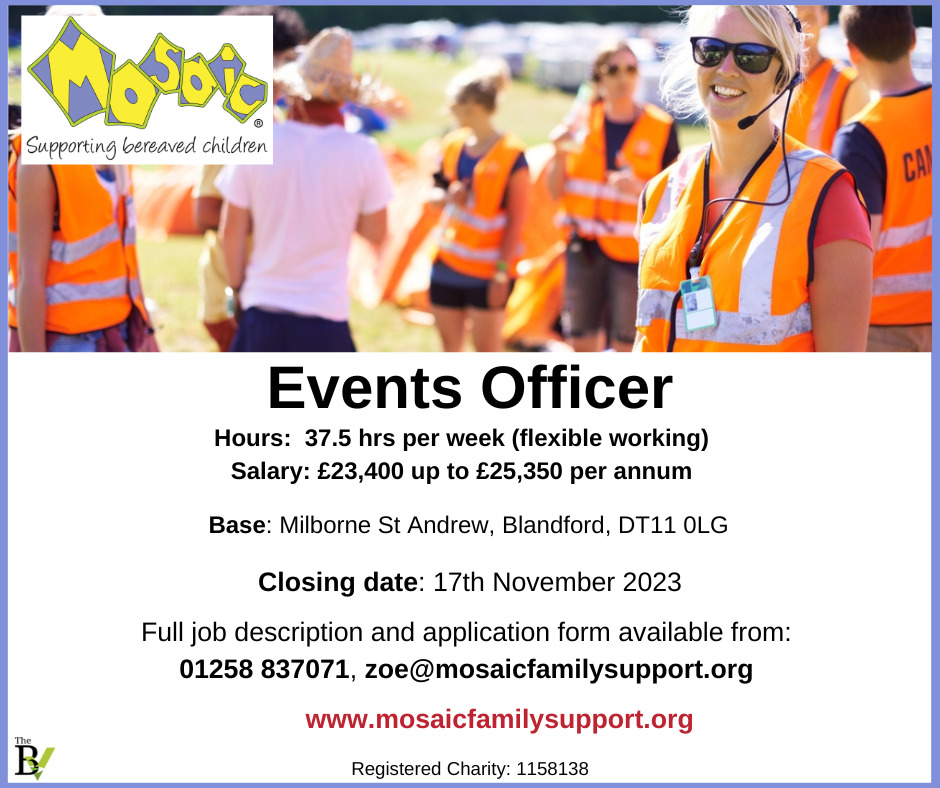
Are you looking to use your experience to help others? We are looking for an enthusiastic and committed person to join the Mosaic team. Events play a huge part in the success of Mosaic’s brand as well as the charities ethos to give an enjoyable and memorable event/activity day for our families and children. You will be a highly motivated individual with excellent people skills and a passion for facilitating and connecting bereaved children and families to experiences that could be new, therapeutic, and fun.
Requirements:
Passionate about working or volunteering within the charity sector.
Excellent (keen eye for detail) at managing, event planning and experiences from conception through to delivery.
Excellent organisational skills and time management.
Excellent knowledge of Microsoft 365 (Word, Excel, PowerPoint, Outlook).
Advantageous:
Qualification in experiences programming or event management.
Experience of working with children, families, carers, schools and external event contractors.
Closing date: 17th November 2023
Full job description and application form available from: [email protected]
Shaftesbury CE Primary School hosted members of the Kyiv City Ballet on 3rd October as the world-renowned international dance company started their whistle-stop tour of North Dorset. The Ukrainian students from Shaftesbury Primary were joined by their compatriots from Shaftesbury Abbey, St Andrew’s (Yetminster) and St George’s in Bourton to take part in a morning of dance and Ukrainian culture.
The Kyiv City Ballet representatives, including Ivan Kozlov (founder and director), Mykhailo Shcherbakov (rehearsal director) and a selection of dancers, lead a personal and informal session for the Ukrainian children and close friends. The children were shown some of the intricate costumes and shoes of the ballet company, before participating in a workshop where they were taught some of the basic ballet positions and moves. Afterwards the children were joined by some Ukrainian parents along with Years 4, 5 and 6 from Shaftesbury Primary for an informative and inspirational assembly. Ivan spoke to the children about how the Kyiv City Ballet had left Kyiv the day before the Russian invasion in 2022 to start a three-week tour of France, and how they are effectively still on that tour, having been unable to get home. Their tour soon became known as the Infinity Tour!
Ben Smiley, teacher at Shaftesbury Primary, said, ‘It was our pleasure to host the Kyiv City Ballet. For them to take time out of their busy schedule to spend a day with some of the Ukrainian students in the North Dorset area is a hugely generous gesture. The connection between the Ivan and his team with the children was instant, and it has undoubtedly created a sense of pride in the Ukrainian culture within our refugee children. Thanks go to Ivan, the Kyiv City Ballet and Stuart Twiss of the Shaftesbury Refugee Group for their time and energy in inspiring our children.
This month’s recipe is nice and easy and lovely and cosy. I am 100 per cent about the cosy right now. It may bring back early lockdown memories – remember when everyone seemed to be making banana bread? But this banana and chocolate cake is so simple to make and so delicious. As autumn draws in it’s perfect to enjoy in your snuggliest jumper with a hot cup of tea. I personally tend to leave my chocolate in big chunks – I think it works beautifully with the slightly squidgy texture of all the banana. This cake is also a great one to make with children, the recipe is quite forgiving and they can get stuck in helping break up the banana and chocolate! Heather
Ingredients
115g / 4oz butter
115g / 4oz soft brown sugar
1tsp vanilla extract
1 egg
3 bananas
200g / 7oz of chocolate
170g / 6oz self raising flour
60ml milk
Method
Preheat the oven to gas 5/160º fan and line a 20cm x 20cm (8” x 8”) tin.
Beat together the butter and sugar well. Add the egg and vanilla and beat again.
Add in the banana by breaking it into smallish pieces using your fingers and stir in.
Add the flour and milk and mix gently.
Finally, add the chocolate once you have broken it into pieces – the chunkier the better!
Spoon the mix into the prepared tin and bake for about 25-30 mins (check after 20 mins) until it’s golden on top and it springs back to the touch in the middle.
Leave to cool in the tin.
Heather Brown is a special officer for the Guild of Food Writers, and has worked in the food industry for 20 years. She is a food writer and photographer, offering one to one help to local businesses for content and websites.
Notes:
The large pieces of banana and chocolate will mean that a skewer probably won’t come out clean when it is fully cooked. It will be quite a dense bake but you are looking for the cake not to ‘wobble’ if you gently shake the tin.
You can finish this cake with a drizzle of melted chocolate on top if you wish.
You can also make this cake in a 2lb loaf tin. I would recommend lowering the oven temperature to gas 4/140º fan and baking for 45+ minutes to make sure its cooked properly all the way through.
In England more than 120,000 people died last year while on an NHS waiting list for treatment – double the number recorded in 2018. It’s a stark reminder of the impacts of long waits for care. While the additional pressure of Covid and the resulting backlogs will clearly have had an impact on these figures, there’s no dodging the fact that more than 13 years of Tory underinvestment in staff, beds, equipment and the NHS’s crumbling infrastructure has played a huge role in the crisis. Sceptics will quite rightly claim that the 120,000 figure does not accurately account for variation between NHS trusts. Nor does it link deaths to cause of death, or provide any further details on the person’s age and medical conditions. It doesn’t account for the nuance of each individual case. Indeed, it does very little in itself to illustrate the pain and agony that individuals and their families are experiencing in their final months while waiting for treatment that never comes. As such, the 120,000 figure merely emphasises the potential scale of avoidable human tragedy when waiting lists balloon to 7.6 million – a figure that indicates that almost one in seven of us is waiting for treatment. As waiting lists are set to increase further in the coming winter months – potentially reaching the nine million predicted by the Tories’ own ex-health secretary, Sajid Javid – Rishi Sunak’s key election pledge to cut NHS waiting lists lies in shreds. This is a tragedy of the Prime Minister and his Chancellor’s own making, born of their failure to get to grips with the key issues affecting the NHS, and their disgraceful ideologically-driven refusal to enter into meaningful discussions with the British Medical Association over pay and conditions of those that give us care.