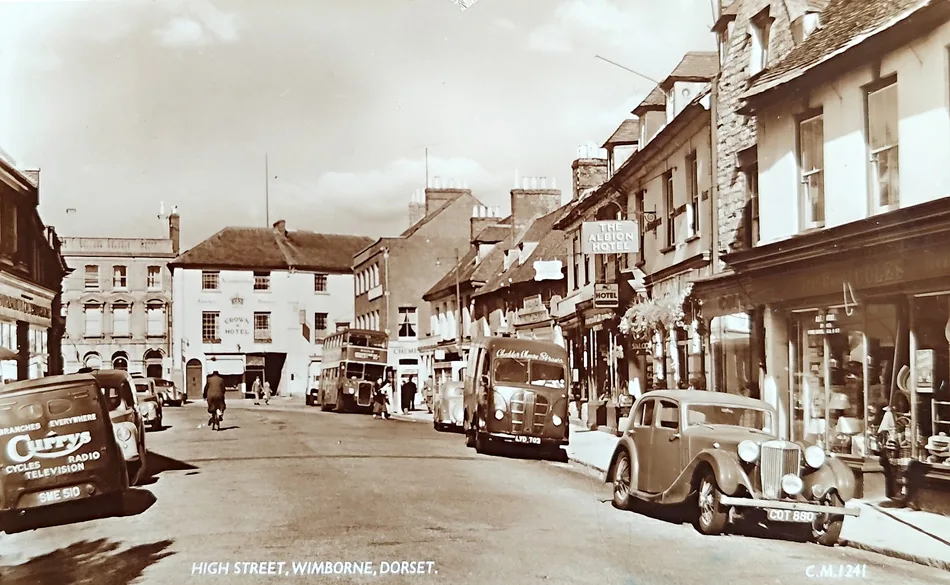
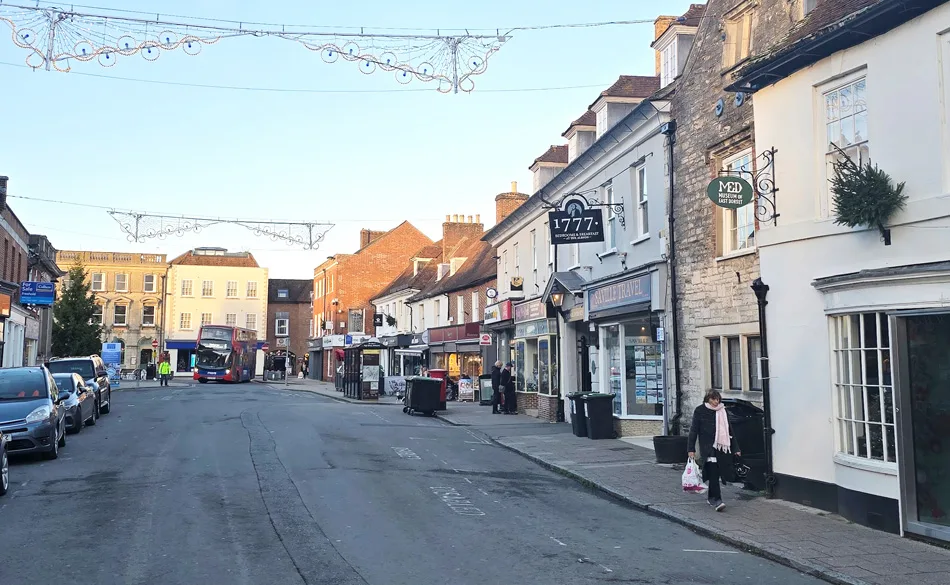
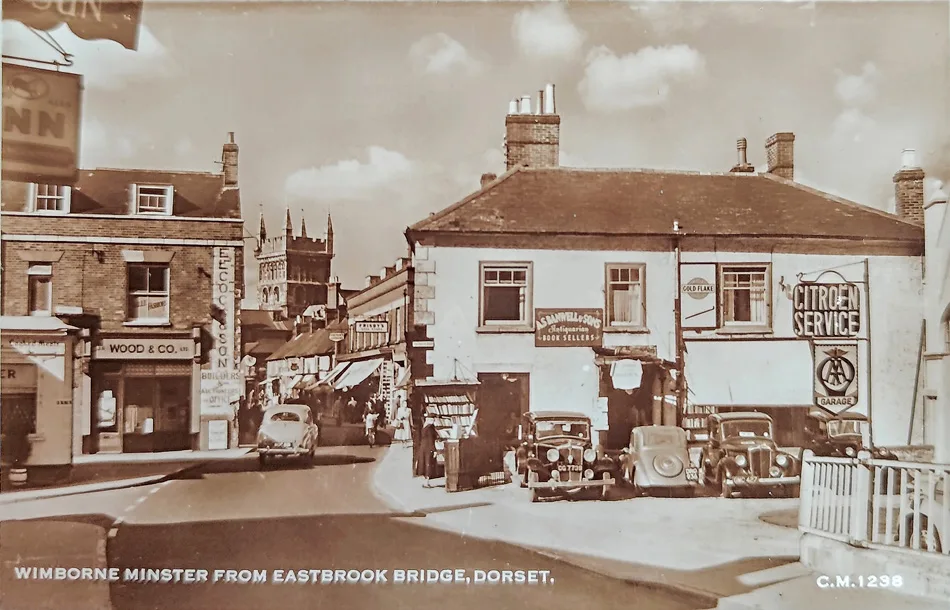
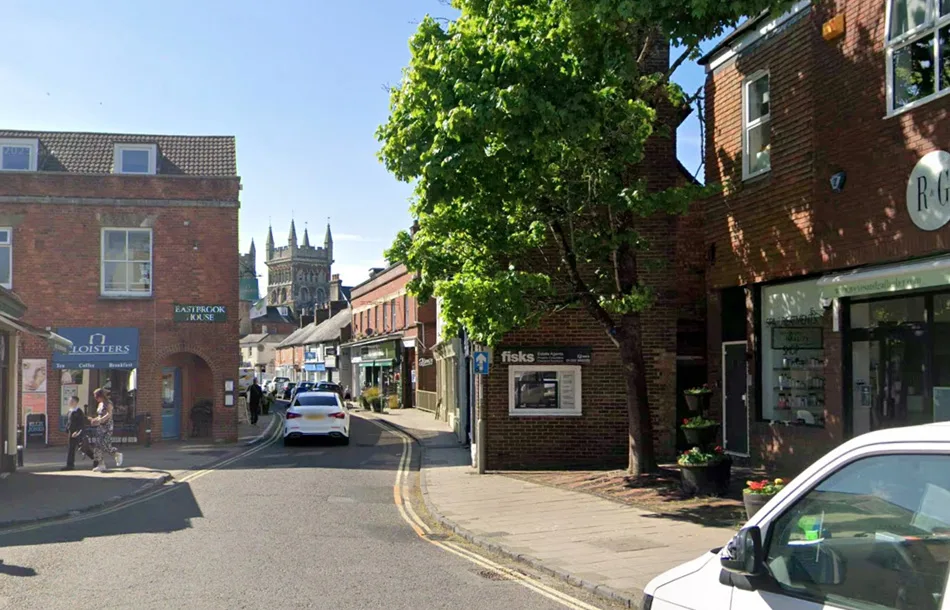
This month Barry Cuff has selected two images of Wimborne Minster – and while the passing decades have brought inevitable change to the town, its sense of place remains strikingly intact. The towering silhouette of the Minster still anchors the town, just as it did when Currys delivery vans advertised cycles as well as radios and televisions, and full-height double-decker buses served the town. Independent shops have come and gone, but the rhythm of the High Street continues. The photographs from the middle of the last century capture everyday life looking remarkably similar to that 75 years later. Today’s streets might have different cars, the streets themselves have different edges, and the shopfronts less signage and awnings, but the view down Eastbrook or along the High Street is still unmistakably Wimborne.
The 1950s High Street is a busy place – and it was served by double decker bus. Note the Currys delivery van, front left.Today the High Street is still recogmisable. Coles, front right, is now the Museum of East Dorset, and the Albion is now known as 1777 at the Albion.Wimborne Minster visible through the streets to Eastbrook Bridge over the Allen. ‘Then’ postcards courtesy of the Barry Cuff Collection, and ‘now’ images by Courtenay HitchcockThe scene today – The large white building which housed the Citroen garage and Banwell the antiquarian bookseller is gone, but much of the rest of the street is recognisable, despite modern facelifts
Rupert Hardy says Dorset’s draft Local Plan could be ruled unsound if it sticks to inflated government housing targets – ONS data says Dorset’s true need is far lower
Dorset Council’s emerging Local Plan risks being found unsound if it continues to rely on the government’s Standard Method figure of 3,246 new homes a year. The latest household projections from the Office for National Statistics (ONS) now cast serious doubt on that target. Just as Dorset residents thought the Local Plan (LP) Consultation was over – and we agree it was a very time-consuming process for those who got involved – Dorset Council (DC) now needs to consider the latest ONS 2022-based household projections, published in late October. They indicate that Dorset’s true household growth will be between 1,700 and 2,000 per annum, depending on migration assumptions. This stark difference exposes a fundamental conflict within the National Planning Policy Framework (NPPF) itself. On the one hand, the NPPF requires councils to use the government’s Standard Method to calculate housing need. On the other, it requires plans to be effective – that is, demonstrably deliverable over the plan period. In Dorset’s case, these two tests cannot both be met. A plan built around 3,246 homes a year would not be deliverable, so it cannot be considered sound.
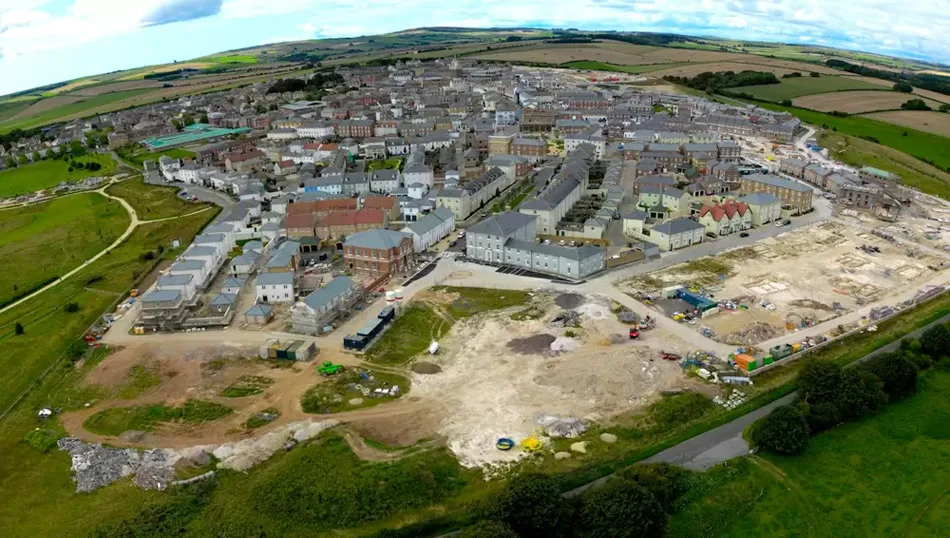
Aerial view of new housing being built on the outskirts of Wimborne
Government housing targets By way of background, we have consistently argued that the government’s Standard Method produces housing targets that are both unsustainable and undeliverable. The method applies an arbitrary baseline of existing housing stock and then inflates it to reflect assumed affordability pressures. In Dorset, this generates targets of around 3,300 homes a year – figures that bear no relation to reality. Over the past two decades, delivery has averaged only 1,300 homes a year, and anything close to the government’s target would overwhelm local infrastructure. North Dorset CPRE strongly supports the council in pursuing a locally justified housing figure based on Dorset’s environmental capacity, infrastructure limitations, and genuine housing need, including truly affordable homes for local people. In support of this, we welcomed Dorset Council’s decision to commission, jointly with Bournemouth, Christchurch and Poole (BCP), an up-to-date assessment of Dorset’s housing need. This work, together with new evidence such as the Green Belt Review and site assessments, should inform a draft Local Plan that is realistic and environmentally responsible. The ONS Household Projections make it even more important.
The evidence from ONS The ONS projections, which incorporate the latest population and migration data, show that: Under the recommended migration category variant, Dorset will see growth of 29,430 households (≈1,730 p.a.) between 2026 and 2043. Even under a high in-migration scenario, growth rises only to 35,349 households (≈2,080 p.a.). The Standard Method requirement of 55,182 homes is therefore at least 20,000 dwellings higher than any credible demographic projection. Moreover, 88% of Dorset’s projected household growth comes from people aged 70 and over, with almost all of the increase in one- and two-person households as average household size continues to fall. The Local Plan must reflect this reality.
Dorset’s physical constraints Even if demand were sufficient, Dorset faces severe environmental and infrastructural limitations: More than 40% of the county lies within National Landscapes (formerly AONBs), protected for their scenic and ecological value. The county has a dispersed rural settlement pattern, limited public transport and a road network already at or beyond capacity in many areas. Utilities and public services (sewerage, GP capacity, water supply, schools) are constrained and cannot easily accommodate large-scale dispersed growth particularly re health care for population growth in people over 70 years. These constraints further limit both the scale and the location of sites that can realistically be delivered. A target of 3,246 homes a year would force development into unsustainable locations, in direct conflict with the NPPF’s environmental and infrastructure principles.
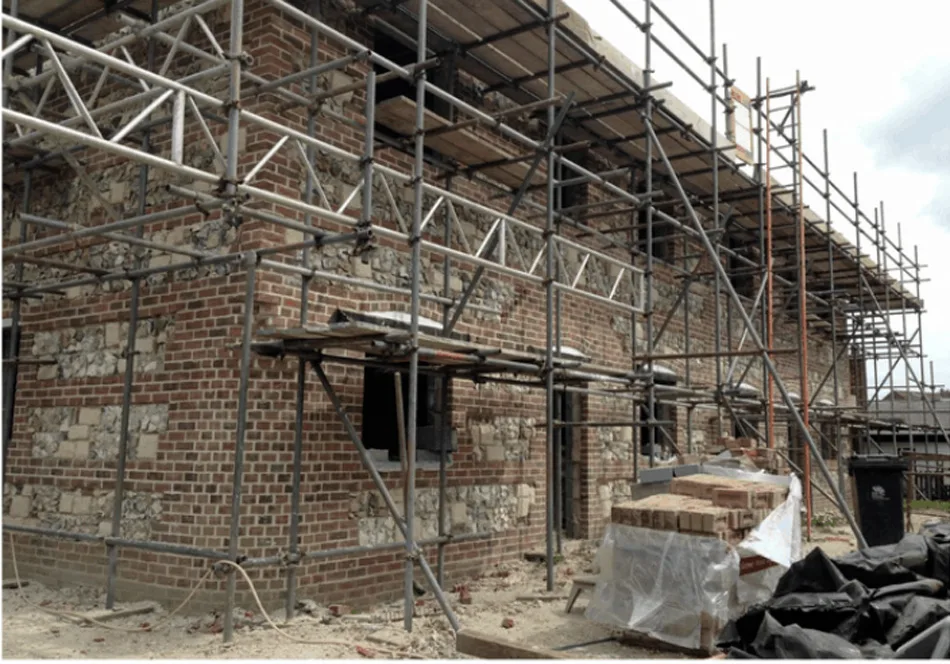
House building in Shillingstone. Image: CPRE
Market realities Developers build to meet demand, not targets. Dorset already has 10,000 plots with planning permission that remain undeveloped. Increasing allocations or permissions will not result in faster build-out: it will simply lengthen developer control of supply. Demand for housing is not governed by theoretical, over-simplified formulae which purport to reflect “need” or “affordability”. Even IF local incomes rise substantially or major subsidies are introduced, the market cannot absorb the level of construction implied by the Standard Method.
Consequences of the Standard Method Proceeding with an undeliverable target exposes the Local Plan to two levels of failure. At examination, the Plan risks rejection by the Planning Inspector as unsound, since its housing strategy would fail the NPPF test of deliverability. On the other hand, if adopted, the Plan would inevitably fail to meet its own delivery targets, fuelling speculative development and undermining confidence in the planning system.
A realistic approach North Dorset CPRE therefore urges the council to: Base its housing requirement on the ONS 2022-based projections, particularly the migration category variant, implying around 1,700 or so dwellings per annum; Demonstrate that this level is both deliverable and potentially compatible with Dorset’s landscape and infrastructure capacity; Highlight the inherent policy conflict within the NPPF as part of its evidence to Government and the Planning Inspectorate and Ensure that the terms of reference for the forthcoming Housing Needs Assessment make full reference to ONS 2022-based projections and the local need for truly affordable social rent housing. Such an approach would be consistent with the evidence, faithful to NPPF soundness tests, and sustainable in Dorset’s environmental context.
What happens when the people who own the land stop caring about it? In this final episode of the year, George Hosford returns with a fierce warning about farmland, legacy and the future of British agriculture. There’s also hope – in the form of a new beekeeping centre in Shillingstone, a pioneering housing project near Bridport, and even a delightfully furious festive Grumbler. It’s Dorset at its most thoughtful, practical and sharp. Hit play.
The Frustrated Farmer returns: George Hosford says “If you don’t care about the land, you shouldn’t own it.”
This month, George is angry – and rightly so. As public support payments disappear and corporate investors quietly sell up, a new crisis is brewing: farmland is being snapped up by those with no connection to it, and no interest in what happens next.
In another powerful interview, George makes the case for long-term stewardship over short-term gain – and explains why land ownership rules need urgent reform if we’re to protect Britain’s food, soil and future.
He says that we have people buying farmland who don’t want to farm, don’t want to engage with local communities, and don’t care what happens to the land – and why that should worry everyone.
Bees and the Big Build: A new chapter in Shillingstone Jenny speaks to Ian Condon about the new eco-friendly North Dorset Beekeepers’ Centre – complete with honey warmers, public displays and a demonstration hive window for curious visitors.
💬 “We’ve built something special – a teaching centre, a community space, and a love letter to bees.”
Hope at West Farm: new beginnings for Dorset’s hidden homeless Jill Cook from Salvation Army Homes explains how a new supported housing project near Bridport will offer not just shelter but space, safety and purpose to vulnerable young people.
💬 “You can’t fix homelessness with a roof alone. This is about roots, growth and confidence.”
The Grumbler Returns: Christmas, 1874-style Boot-losing mud, weaponised wassailing, and nutcrackers no one asked for – our festive Grumbler has thoughts.
I daresay the season of goodwill has arrived, though you would hardly know it from the state of affairs in our parish. The roads, for instance, are now so deep in mud that a man may lose a boot simply attempting to cross from the smithy to the bakery. Yet every year the parish council – a body composed chiefly of gentlemen whose boots are mysteriously never muddied – assures us that repairs are imminent. I believe these repairs are scheduled to occur around the same time as the Second Coming. As for the post, it remains wonderfully reliable: provided you do not actually require your letters to reach you. Only this morning, a parcel addressed to my neighbour Mrs Docket was discovered wedged in a hedge half a mile from her door, the string gnawed through by either a rat or, more likely, a disgruntled postman. Mrs Docket insists she will write to the Postmaster General. I wish her every joy of that.
The perils of intemperance Our local traders seem possessed by a festive madness, convinced that every household requires a mechanical nutcracker or a self-stirring gravy ladle. I am certain these contraptions will soon gather dust beside last year’s “improved” candle-holders which had the admirable quality of setting tablecloths alight. Meanwhile, the young insist on gathering in the square for what they call “seasonal merriment” – a pastime involving loud music, questionable dancing and the consumption of drinks so sweet they might reasonably attract wasps in January. Naturally, they complain bitterly when anyone suggests their revelry might be heard half a county away. I recall when a simple wassail song was considered lively enough, and no one required a portable brass band to accompany them. And now the rector has declared that this year’s Christmas sermon will address “the perils of intemperance, vanity and modern excess”. A brave choice, given half the congregation derives its chief joy from precisely those pursuits. Still, I applaud his optimism; I believe it is the only cheerful thing I have witnessed in weeks.
A merry Christmas I do not wish to seem unseasonal. Christmas, after all, is a time for hope, reflection and the annual rediscovery that one’s relations are altogether more trying in person than on paper. I shall dutifully partake of the goose, endure the pudding, and attempt to look grateful when presented with another knitted muffler of alarming hue. But if, by the grace of all that is holy, the weather should refrain from raining sideways for an entire day, I might consider 1874 a triumph. Until then, I remain, Yours in wintery exasperation.
The Grumbler – the open opinion column in The BV. It’s a space for anyone to share their thoughts freely. While the editor will need to know the identity of contributors, all pieces will be published anonymously. With just a few basic guidelines to ensure legality, safety and respect, this is an open forum for honest and unfiltered views. Got something you need to get off your chest? Send it to [email protected]. The Grumbler column is here for you: go on, say it. We dare you.
George Hosford muses on profit-driven big agribusiness, vicious mink and the rediscovered therapy of a day behind the plough
A letter landed in my lap recently from a well-known corporate farming agency – the kind that manages thousands of acres for landowners, running slick operations with bulk buying power for fertiliser, chemicals, tractors and fuel. They run crop trials and manager trainee schemes and employ highly skilled managers who might oversee 3,000 acres each. They appear to be bailing out of many of their farming contracts because they have found that – surprise, surprise – agriculture is no longer giving them enough profit. For years, these agencies promised landowners better returns than a traditional tenant could offer. But the Basic Payment Scheme is gone (axed two years early). The new SFI is closed to fresh applications, and a vague promise that it will appear ‘next year’ is simply not good enough for an industry that functions on decade-long decision cycles.
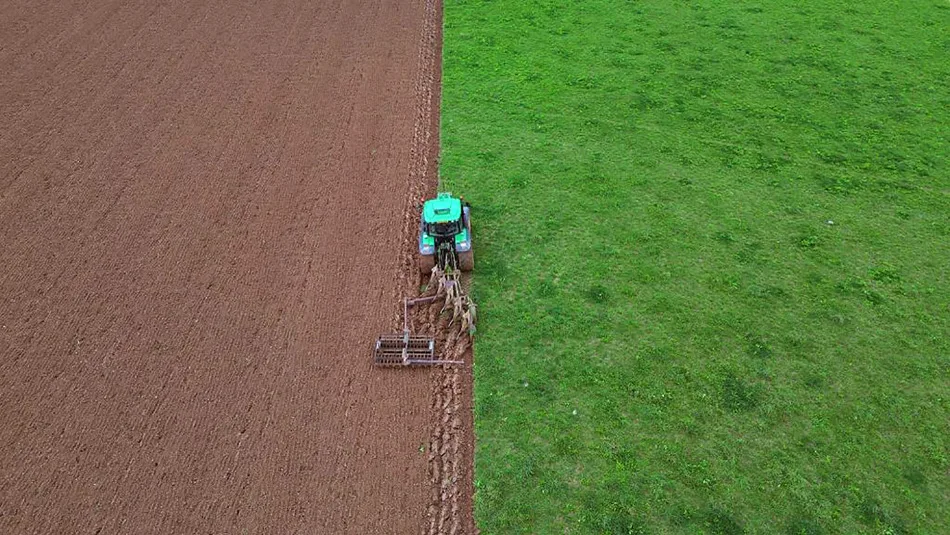
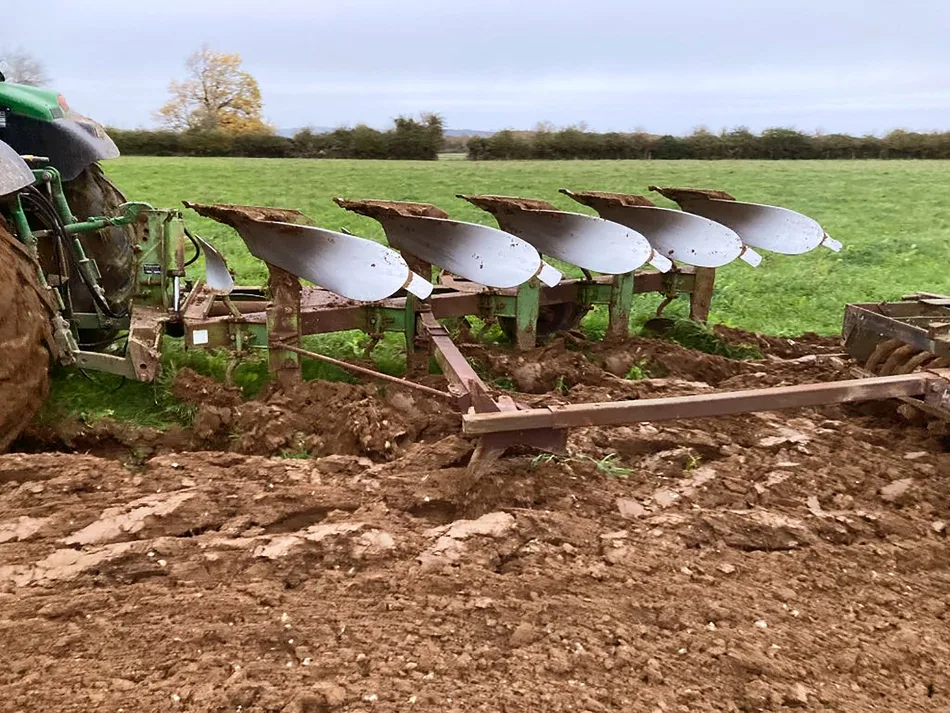
For the first time in 23 years, the plough was rescued from the bushes and pressed back into action on Travellers Rest Farm. All images: George Hosford
Input costs have soared. Crop prices have tanked. For those with finely balanced contractual arrangements, it’s a perfect storm. Corporate farming brings scale and efficiency – but I wonder whether it fits the sustainability, climate-friendly, clean water and soil health agenda that so many preach these days? How much love is lavished on the land that is farmed in this way, when one ‘farm’ is really six stitched-together blocks, spread across 20 miles? One might say it is inevitable, as food production becomes ever tighter financially, but the heart is being ripped out of rural life. There is a link to the debate on Inheritance tax buried somewhere here. Land holdings become ever larger, farms have for many years been bought up by wealthy individuals who have earned their wealth elsewhere, or sometimes by real farmers selling farmland for development, who are allowed to roll over the often astronomical proceeds into more land, tax free (thanks to capital gains tax rollover relief, which to my mind needs reform before IHT). But more often than not land is bought up by people or institutions looking for a safe investment, who are not farmers. In the past they would have rented it out to a tenant to do the actual farming, but sadly this happens a lot less these days because of the corporate farming agencies who convince the owners that they can earn more for them than a tenant could afford in rent as a one-person business. Perhaps we all need to take a good hard look at what is best for the land and the environment. If landowners are not going to farm the land themselves, should they be allowed to own it at all? Discuss.
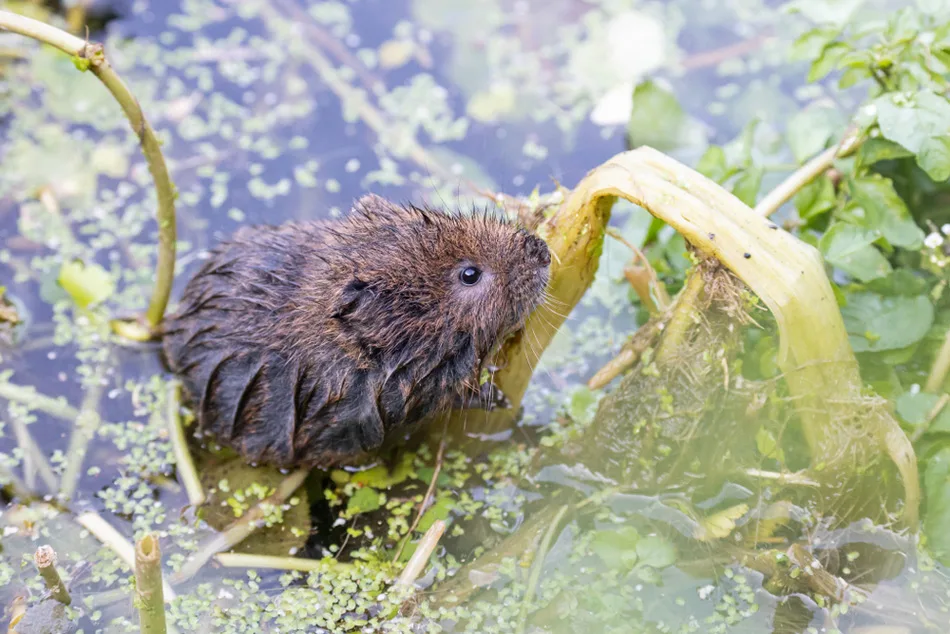
Water voles have no defence against vicious and deadly mink
Destroy the squirrels An evening spent on the bank of the Stour at Cowgrove farm near Wimborne, as a guest of the Badbury Rings farmer cluster group, was a real treat last month. Neve Bray from Dorset FWAG (Farming and Wildlife Advisory Group) brought us up to date on local beaver releases and progress. There are known to be beavers on parts of the Stour now – their presence is hard to confuse with any other species, their toothmarks and the obvious strength of their jaws are unmistakeable. Some farmers worry they will cause flooding of farmland and devastation of trees, while others are prepared to take the long term view: slowing down water movement in heavy rainfall periods, which should actually reduce flood risk downstream, and the creation of more watery habitat. Dr Merryl Gelling from the Mammal Society then provided a fascinating talk about water voles, whose population has been devastated by predators – largely mink, an alien species which now exist widely in the wild. They have either escaped from fur farms (until the 2002 ban) or were released on purpose by misguided anti-fur farming protestors, who have inadvertently caused the near-destruction of the water vole in the UK. Mink are just the right size to fit into water vole burrows, the entrances to which are usually located just below the water line on rivers, to protect them from non-swimming predators, and they have no defence against the vicious and deadly mink, which also causes much damage to salmon and ground nesting bird populations. There are now a number of mink destruction schemes operating around the country, using traps baited with smelly mixtures involving meat, fish or, best of all, the scent from another mink. With luck, a scheme might begin soon on stretches of the Stour. Training is available to groups who wish to undertake such activity. The squeamish should not blink: the mink is a deadly predator which causes huge environmental destruction (once caught it is illegal to release). The same is the case with rats and grey squirrels. In the 1880s, the 11th Duke of Bedford, recklessly released imported American grey squirrels, which he considered to be ‘interesting exotics’, from his Woburn estate. He also presented breeding pairs to landowning friends around the country. His catastrophic actions have resulted in the near-destruction of our native red squirrel, all but wiped out in most of the country by habitat poaching, and by the disease squirrelpox that was brought into the country by greys. There are now an estimated 2.7 million greys in the UK, and less than 200,000 reds, which only remain in isolated places like Brownsea Island in Poole harbour, the Isle of Wight, and more widely in Scotland. To optimise success rates from all the tree planting that well-meaning environmentalists wish landowners to carry out, they also need to find people who are prepared to trap and destroy grey squirrels, on a very large scale. The grey is responsible for staggering amounts of damage to trees across the country, by eating out growing points, and damaging bark. I could start on deer here, which also challenge our chances of reforesting areas of the country, but that could be too much for one sitting…
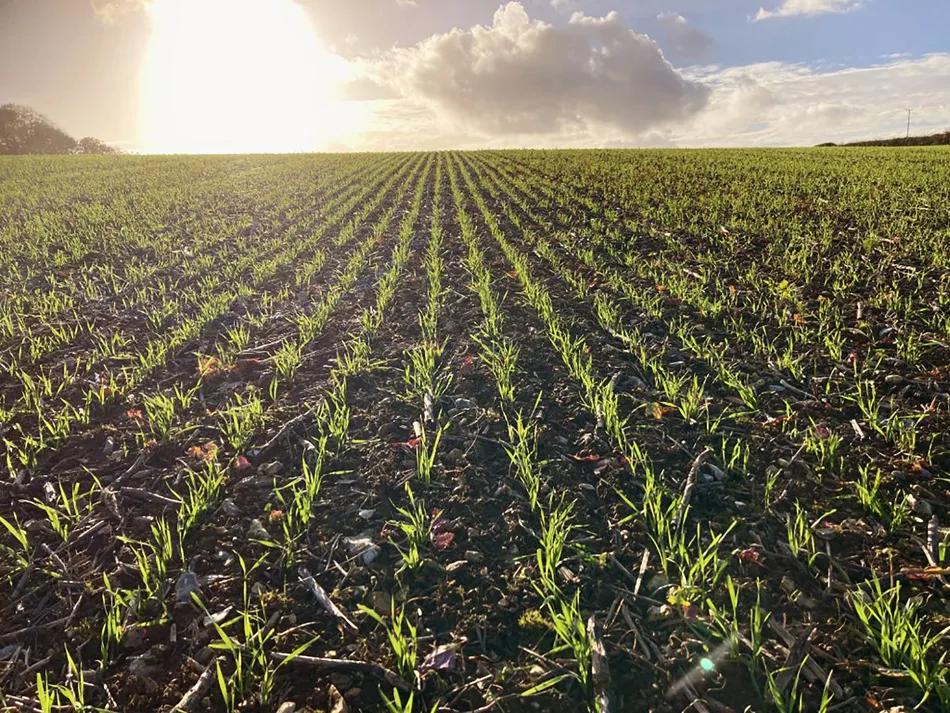
Direct drilled wheat emerging well among the remnants of the previous oil seed rape crop
Digging out the plough Finally, we returned to an old fashioned and often highly damaging machine last month. On most of our autumn acreage we have stuck to drilling direct, as we have done for the last four seasons. But this method did not work well when we tried it the last time we terminated a grass ley, so after much debate we opted for the return of the plough … just as soon as we could find it. It eventually turned up in the bushes, and Will spent two days with wire brushes and numerous buffing discs removing 23 years of rust. He then set forth into the first of two herbal ley fields due to return to wheat cropping.
First plough for 20 years
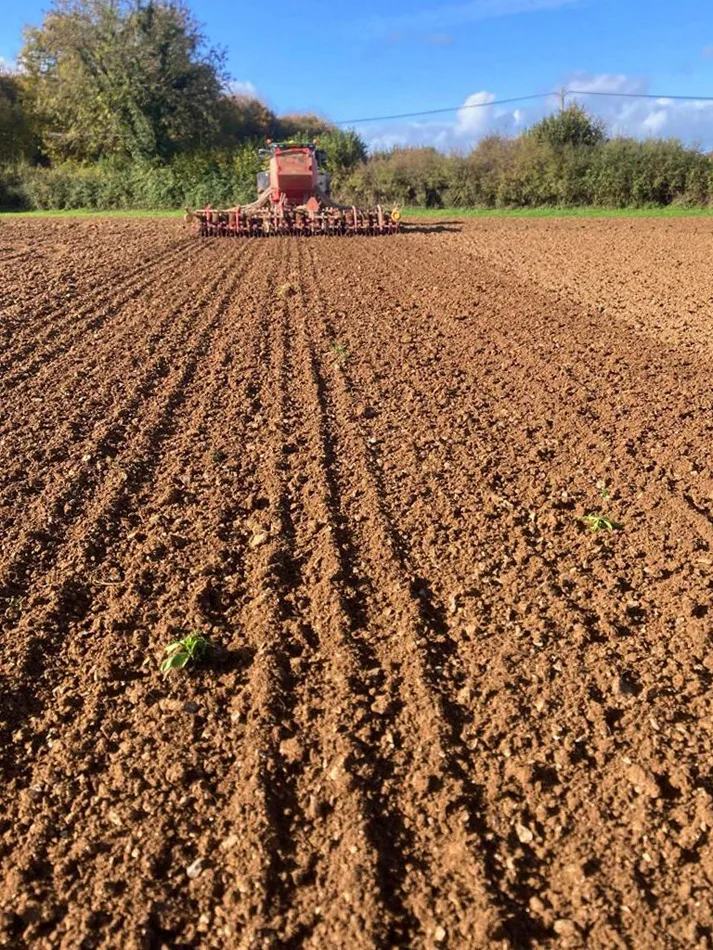
His elbow grease worked wonders: within a couple of turns of the field the plough furrows were properly shiny, and turning over the soil beautifully. The furrow press trolling along behind the plough, kindly loaned by Nigel from Gussage, did a good job of firming the soil to help prevent the next tractor into the field from sinking too deep and making a mess. The plough was followed by the Vaderstad Rapid drill, which consists of a set of discs in front of the drill coulters: these should shake down the soil a little, and disturb any lurking leatherjackets (the larva of the crane fly, or Daddy long legs – a voracious devourer of young cereal plants and the reason we’d had to rummage for the plough in the first place). We needed to push on promptly with the drill before we got some wet weather, because freshly ploughed soil turns to a pudding very quickly when it starts raining, and takes far longer than undisturbed soil to dry out again.
The Vaderstad weaves its magic: plough to seedbed in one pass
One soon remembers why we gave up ploughing all those years ago. It is slow, labour and fuel intensive, leaves the soil loose and vulnerable to rain, destroys organic matter and wears out metal and rubber on machine and tractor. Sowing into grassland presents its own special issues, but we only had 35 acres to do, and with luck will get a better wheat crop than we might have done any other way. Never say never. Before we leave ploughing, here are some thoughts from nature writer John Lewis-Stempel’s latest book England, A Natural History: “I am always happy ploughing. A mental state, according to scientists at the University of Bristol, enhanced by the very soil itself. A specific soil bacterium, Mycobacterium vaccae, activates a set of seratonin-releasing neurons in the dorsal raphe nucleus of the brain – the same ones targeted by Prozac. You can get a very effective dose of Mycobacterium vaccae ploughing. Or gardening.” Presumably you’d get an even bigger hit if ploughing behind a horse. You can follow George’s unabridged farm diary on his blog viewfromthehill.org.uk
Supergroups are all the rage. The success of Boygenius, the hyper-successful collaboration of indie-folk heavyweights Phoebe Bridgers, Lucy Dacus and Julien Baker, has inspired a slew of similar projects, including another contender for this column with an excellent recent release, Snocaps. But something I most definitely did not have on my bingo card at the start of 2025 was a new collaboration between North Carolinian Americana duo Avett Brothers, and alternative rock icon / Faith No More frontman Mike Patton. Patton, evidently a fan of Scott and Seth Avett’s work, reached out to the duo and a period of remote songwriting collaboration followed, from which the tracks comprising AVTT/PTTN were formed. The resulting work leans more heavily towards The Avett Brothers previous work: however the contributions of Patton cannot be underestimated. The nine tracks included on the record are wholly without the superficiality which has at times self-sabotaged the brother’s ability to connect deeply with the listener (I present as evidence Kick Drum Heart from their otherwise excellent 2009 L.P., I And Love And You: “We’re holding hands in the rain, s-sayin’ words like ‘I love you’”). Somewhat surprisingly, it all hangs together extremely well, feeling essential and weighty rather than (as with many other similar collaborations) superfluous and fleeting.
The album opens with a trademark picked guitar and a flourish of tambourine, before Patton, backed by the brothers in a line which feels like a deeply honest reflection of the mental health issues which saw him cancel Faith No More’s 2021 tour, intones “I’ve been taking time to get well all alone, but parts of me aren’t healing”. And while similar themes pervade the record, it’s not all doom and gloom. In the steady ballad Too Awesome, a refrain of “You are beloved, you are a gift. The mountains bow before you, the wind it calls your name” provides the balance essential to prevent the album from descending into self-pity. It’s a fine line, but AVTT/PTTN walk it with aplomb. Let’s hope this is just the start. 4.5/5 stars
A local expert from Citizen’s Advice provides timely tips on consumer issues.
Q: A friend has fallen ill, which has made me think about getting my affairs in order. I’ve heard of setting up a lasting power of attorney, but I don’t know where to begin. A : Appointing a Lasting Power of Attorney (LPA) means nominating someone to act on your behalf if you ever lose mental capacity. This could be because you’re diagnosed with a health condition or because something happens to you, like an accident. The kinds of illness which might prevent you from making decisions for yourself include dementia, mental health problems, a brain injury, alcohol or drug misuse or the side-effects of medical treatment. Setting up an LPA doesn’t mean you’re expecting anything to happen – it’s something you might want to do in case something happens in the future. You must make an LPA while you are still capable of making decisions for yourself.ƒ There are two types of LPA: property and financial affairs and health and welfare. Both types must be registered before they can be used, and you should choose who manages your affairs for you if you’re no longer able to, very carefully. A property and financial affairs LPA gives someone the authority to make decisions about things like buying or selling property, bank, building society accounts, welfare benefits and debts. A health and welfare LPA gives your chosen person the authority to make decisions about things like where you live, your day-to-day care, and your healthcare treatment. It’s not possible to use a health and welfare LPA until the person who made it has lost their mental capacity. There are two ways you can make an LPA – either online at gov.uk or by downloading the forms from gov.uk. There is one form for property and affairs and one for health and welfare. If you want someone to look after both aspects, you will need two separate LPAs. You need to register the LPA by sending the completed forms to the Office of the Public Guardian. If you need to pay a registration fee, you’ll need to send that too. If the form has been correctly completed and there are no objections after people have been notified, the Public Guardian must register it. This can take around 20 weeks. The Public Guardian must notify you and your attorneys that they have registered the LPA, and it can then be used. You can find lots of information on LPAs and other shorter term power of attorneys by visiting the Citizens Advice website.
Minette Batters’ long-awaited Farming Profitability Review, published today, delivers a forensic challenge to one of the most persistent assumptions in Whitehall: that farming is economically marginal and therefore politically expendable.
The review confronts head-on the pervasive view that farming does not matter because it contributes just 0.6% of GDP. In raw terms, farming directly adds £10.5 billion to the UK economy (GVA, 2024). But Batters is clear that this figure tells only a fraction of the story – in counties like Dorset, where farming underpins not just food production but jobs, land use, water management and village economies, the consequences of that miscounting are felt daily.
She calls on Defra and the Office for National Statistics to reassess how farming is counted in GDP, pointing to international evidence showing that better accounting of supply-chain multipliers can increase a sector’s recorded value by as much as 80%.
UK farming underpins an agri-food supply chain worth £150 billion – around 6% of total UK economic output – supporting 4.2 million jobs across manufacturing, logistics, retail and hospitality. That is 13% of all employment in Great Britain. The sector also generates £25 billion a year in food, drink and feed exports. Remove domestic farming, the review argues, and that entire economic ecosystem is destabilised.
MInette Batters’ long-awaited Farming Profitability Review 2025 has been published
At the same time, UK food self-sufficiency has fallen to 65%, down from 78% in the mid-1980s. Britain is now increasingly reliant on volatile international markets while holding its own farmers to higher environmental and welfare standards than most competitors. In rural counties like Dorset, that decline is not abstract – it plays out in land use decisions, livestock numbers and the long-term viability of family farms.
Batters describes farming as ‘our only remaining primary manufacturing sector that still exists in every county across the country’ – reframing agriculture not as a lifestyle choice, but as nationally distributed economic infrastructure.
The review is blunt about cost pressures. Since the start of the agricultural transition, machinery prices have risen by 31%, while wage and energy costs have surged. The Office for Budget Responsibility forecasts input costs will be 30% higher in 2026 than in 2020. Yet the £2.4 billion English farming budget has remained broadly static since 2007, never uprated for inflation.
Trade policy comes in for particular criticism. While countries such as the United States, Australia and New Zealand routinely include farmer representatives in official trade delegations, the UK does not. Despite the UK being widely recognised as ‘one of the most prized food markets in the world’, Batters notes that overseas delegations arrive with clear priorities for their agricultural sectors, while British farmers are largely absent from negotiations.
‘Every trade delegation like the recent one to India, led by the Prime Minister, should have a farmer representative from each of the Devolved Administrations,’ she argues, ‘sitting alongside the best of British businesses – selling British and Welsh lamb, British and Scotch beef, Northern Ireland pork and English apples and cheese to international markets.’
The review recommends formally including farming representatives in future UK trade delegations, bringing Britain into line with competitor nations where farmers sit at the table when market access is negotiated.
Section 2.3 shifts from diagnosis to opportunity. Batters argues that government support should focus on growing demand for British produce at home and abroad, rather than subsidising survival. She points to British Airways’ sourcing of Rodda’s clotted cream, Netherend Farm butter and Tiptree jam as evidence that strategic public procurement and export alignment can open markets for distinctive regional brands.
A reset of supply-chain law to curb unfair practices and rebalance power between farmers, processors and retailers, alongside a clear shift away from paying landowners simply for holding acreage.
The recommendations are wide-ranging, but the direction of travel is unmistakable. Batters argues that food security must be treated as critical national infrastructure and hard-wired into planning, trade and economic policy, rather than handled as an environmental afterthought. She calls for a reset of supply-chain law to curb unfair practices and rebalance power between farmers, processors and retailers, alongside a clear shift away from paying landowners simply for holding acreage.
Planning reform is framed not as a marginal issue but as an economic lever. In counties like Dorset – where reservoirs, slurry storage, renewable infrastructure and modern livestock buildings are routinely delayed or blocked – slow planning decisions directly cap productivity, resilience and environmental progress. The review argues that faster approval of on-farm reservoirs, renewable energy and modern buildings is essential if farms are to improve productivity, strengthen resilience and meet rising welfare and environmental standards.
Above all, the review stresses the need for policy stability. In a sector where decisions on breeding, planting and investment are made years before any return is realised, operating without long-term regulatory and financial certainty is not merely inefficient, but fundamentally destabilising. Without clarity on trade standards, environmental requirements and future support, Batters warns that confidence will continue to drain from the sector, taking investment, skills and domestic food production capacity with it.
The underlying challenge is cultural as much as economic: and in a county where agriculture still shapes landscapes, employment and supply chains from the Blackmore Vale to the coast, that cultural shift would be hard to ignore. The review asks government to abandon the complacent idea that farming is simply ‘growing things we can always import from elsewhere’.
Instead, it makes the case – firmly and with evidence – that farming builds value, sustains jobs, anchors rural economies and underwrites national resilience.
What gives the review its weight is not who commissioned it, but who wrote it. This is not a ministerial vision document or a civil service compromise, but a practical blueprint grounded in how farming actually functions – economically, operationally and over time. Batters’ argument is not that farming could become a cornerstone of the UK economy, but that it already is.
The question the review leaves hanging is no longer whether farming matters, but whether government is prepared to act as if it does.
She wrangled Queen, Frost and the Rolling Stones – 50 years on Victoria Sturgess runs Black Pug Books with the same wit, grit and eye for a story
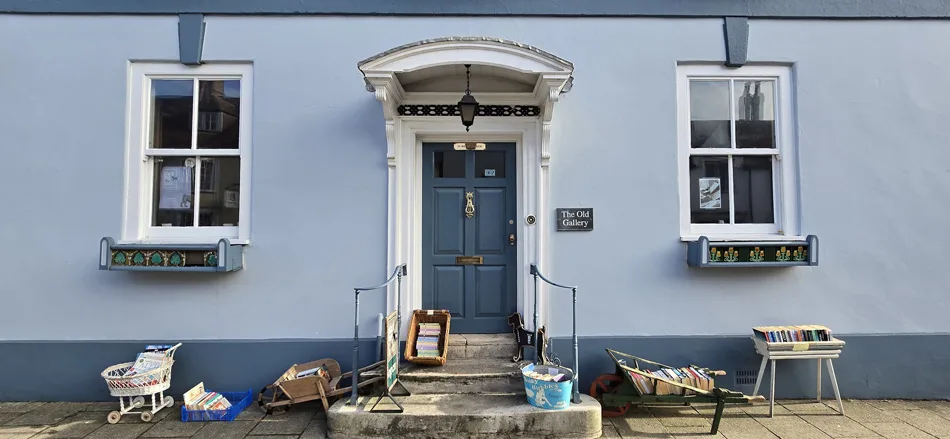
Vintage prams and tin pails filled with books lure passersby into Black Pug books. Images by Courtenay Hitchcock
In Elstree Studios, music director Bruce Gowers is cadging ciggies (something he was renowned for) from his trusted production assistant and right-hand woman Victoria Sturgess, as she’s trying to make conversation with a shy, awkward man with striking cheekbones, slightly buck teeth and intense dark eyes. Four hours later, one of the world’s most iconic pop videos, Bohemian Rhapsody, is “in the can”. Victoria recalls that day 50 years ago: ‘For us it was just another day. We were slightly annoyed we didn’t finish in time for last orders at the pub!’
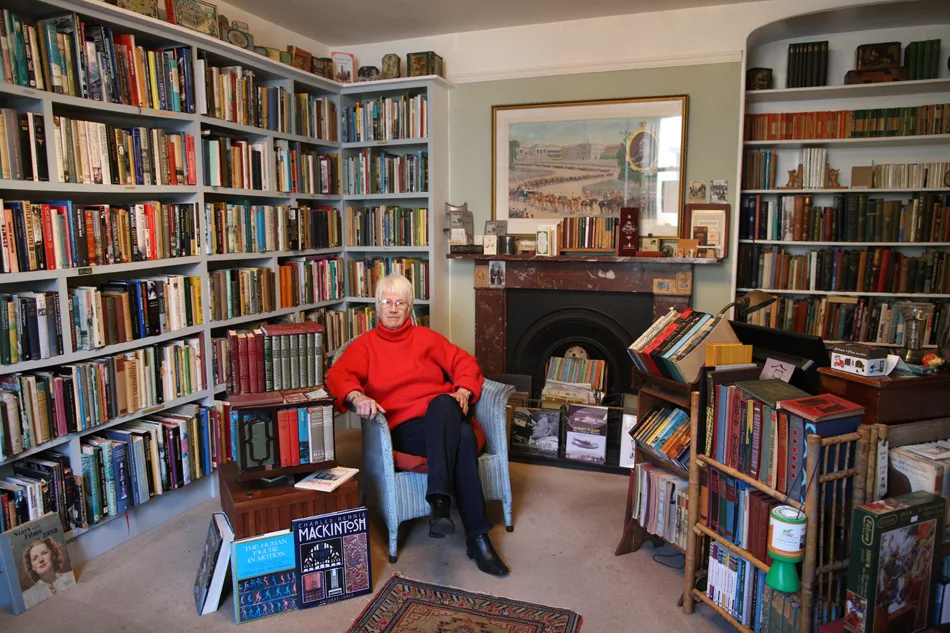
Victoria Sturgess in her beautiful Georgian home – which is also Black Pug books.
The video was ground-breaking, launching the career of Emmy award-winner Gowers and propelling Queen into the supergroup stratosphere. It kept Bohemian Rhapsody (all five minutes and 55 seconds of it) at number one in the music charts for nine weeks. ‘We had such fun with the special effects,’ says Victoria, explaining how the disembodied heads of Queen floating in halos were created simply with cameras and monitors. ‘It’s called a visual howlround. The camera looks at its own image on the monitor output’. The result – a four-way harmony shot that mirrors the cover of Queen II album.
Victoria was music director Bruce Gowers’ production assistant
That day was just one highlight in a career that reads like a roll call of entertainment legends, including comic pianist Victor Borge and Hollywood’s Ethel Merman (‘she knitted between takes’). Victoria worked on the first live pop concert in Hyde Park, filming supergroup Blind Faith with Ginger Baker, Stevie Winwood and Eric Clapton, and later the Rolling Stones. Film producer and impresario Robert Stigwood enlisted her for the Bee Gees’ cult film Cucumber Castle, in which Vincent Price, Lulu and Spike Milligan all made cameo appearances. ‘Thanks to Stiggy, I earned enough money that summer to buy a flash sportscar,’ she grins.
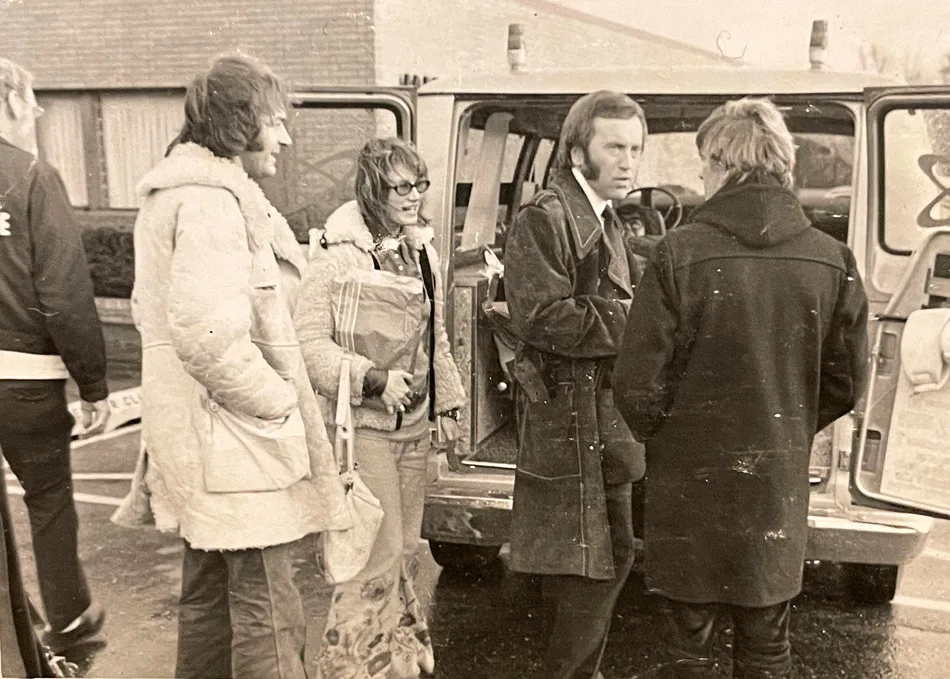
Bruce Gowers, Victoria and David Frost using an ambulance to get through a road block from Peoria to Chicago along Route 66 so they could get back to the UK from the USA in time to go live about Nixon
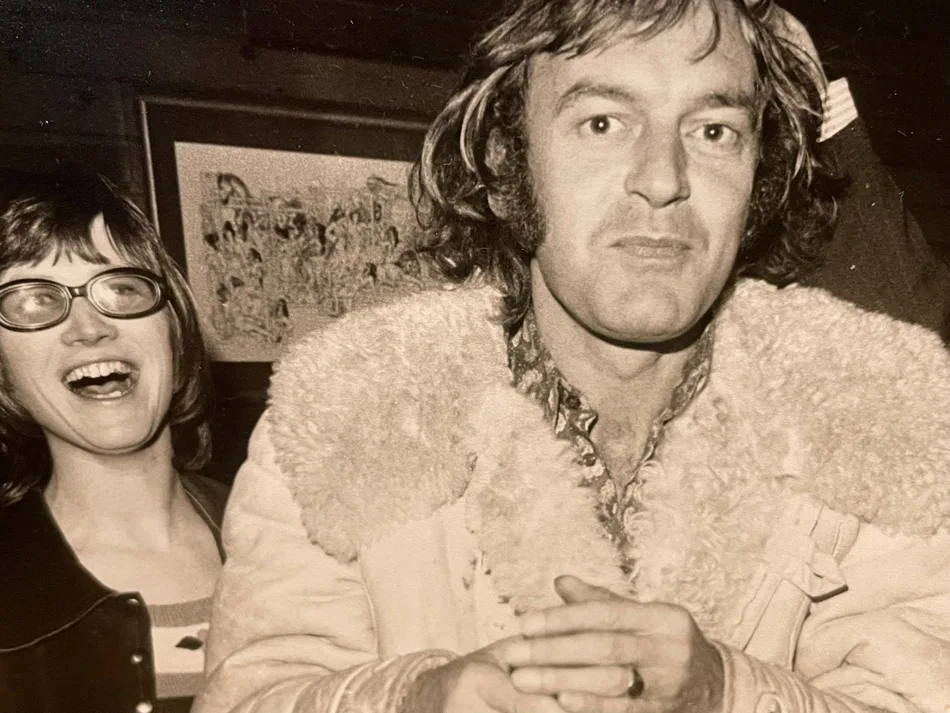
Fashion to Frost Turning down university for “life experience,” her first job was at Vogue magazine, organising shoots for photographers David Bailey and Helmut Newton. ‘Demanding, but great fun,’ she says. ‘I had suffered 12 excruciating months at the London College of Secretaries in Regents Park to appease my father, but I did learn French shorthand. That’s what got me the job at Vogue, aged 18 – I could take dictation on the Paris collections straight from the French editors verbatim over the phone.’ From there she moved into television, rising quickly at Southern TV and then London Weekend Television (LWT), where she became a principal production assistant – one of the highest production roles in what was then a very male-dominated industry – while still only in her early twenties. She travelled the world with journalist and interviewer David Frost, covering Nixon and the Watergate scandal, thriving on the adrenaline of live TV. ‘Bad for the heart, good for the bowels!’ she says. It was the heyday of black and white television. ‘At that time, LWT had more than 2,000 staff! It was such a fantastic industry to be in, maybe because there were only three TV channels. The celebrities treated you with respect, because they needed you as much as you needed them. And we knew how to handle hellraisers like Ollie Reed. As a production assistant, I was the power behind the throne – PAs open lots of doors … or firmly close them!’
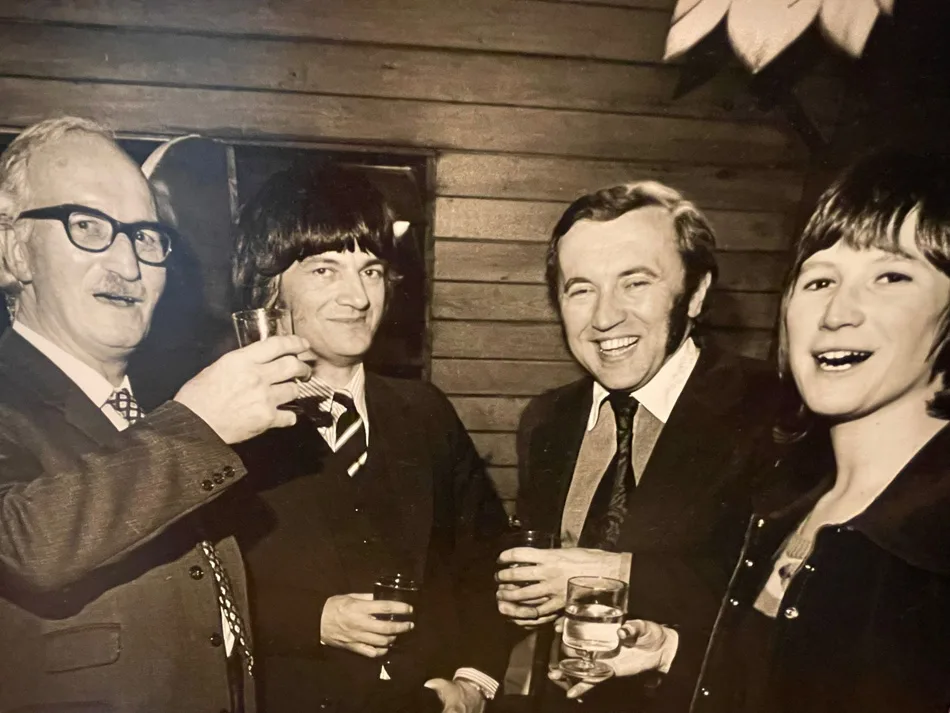
Taken at her wedding in 1973, from left, Victoria’s dad, new husband Leo, David Frost and the bride
Victoria married on her 26th birthday in 1973, at Chelsea Registry Office. ‘Kate, my eldest, was swiftly born in 1974. I kept working, leaving LWT and freelancing, moving from London to Winchester. ‘Hannah was born in 79, and then Leo moved to America when we separated in 1982. ‘I was now a single parent and the sole breadwinner: I turned to freelancing again, including working for the first satellite TV company, before rejoining LWT. I was back on live broadcasts, elections, the Olympics … and had a stint with Saint (Ian St John) and Greavsie (Jimmy Greaves), which was great fun!’ Burnout made redundancy an easy decision in 1989, and after ‘a couple of months doing diddly squit’, Victoria carved out a new freelance life that took her from Scandinavia to Hong Kong, Jakarta, Spain, Dubai and Jamaica. ‘My last big event was the Manchester Commonwealth Games for the BBC, before I finally quit in 2005.’ With her girls now adults, Victoria seriously started researching her next move.
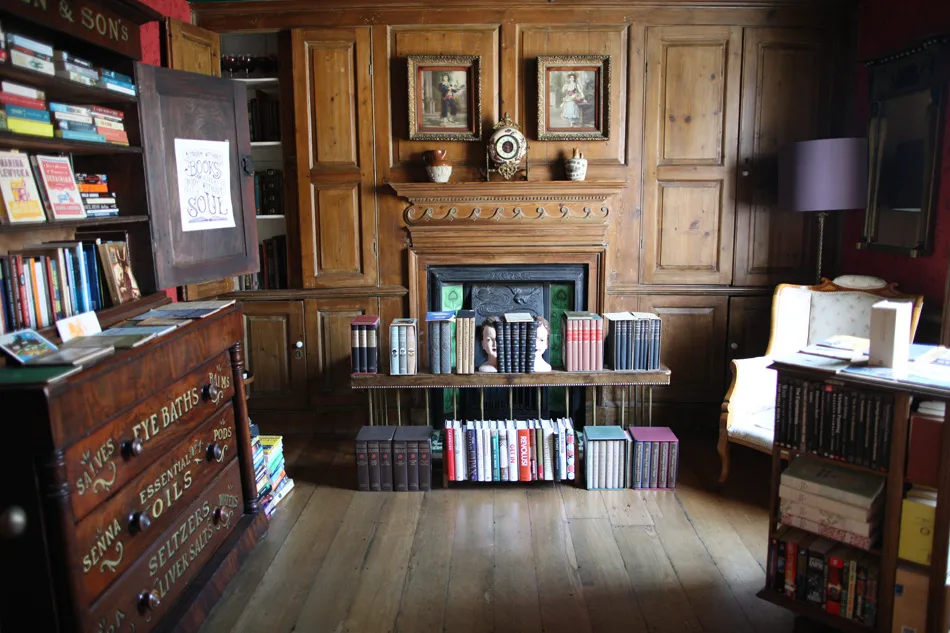
The antique apothecary cabinet holds maps, old newspapers and theatre programmes – all popular gifts
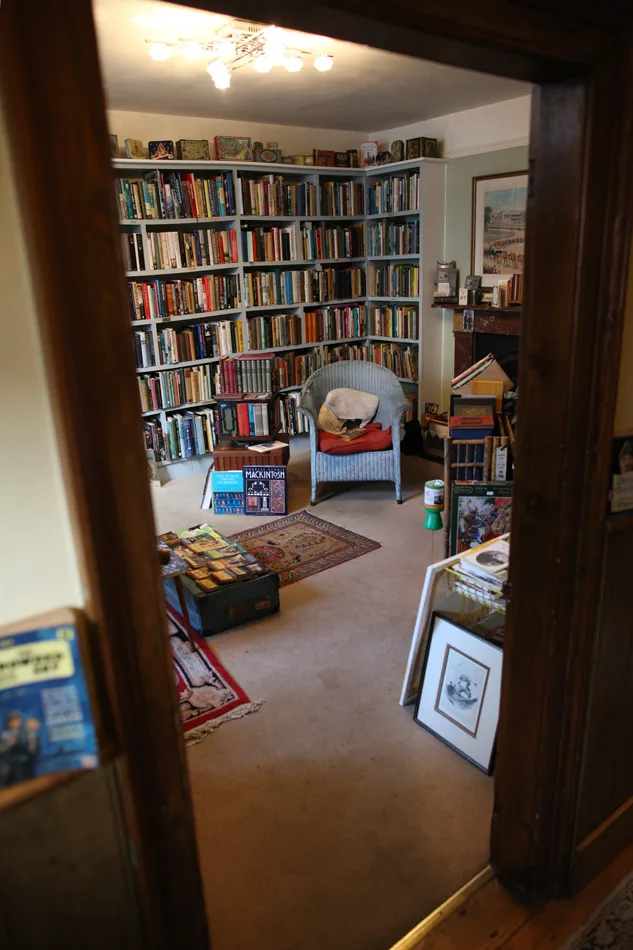
A new chapter ‘I’ve always been a voracious reader and longed to own a bookshop. I soon realised I could either sit on my backside and talk about it or I could get off my backside and do it! ‘My father had a cottage in Swyre, and I’d always loved Dorset.’ In 2011 her search brought her to a stunning Georgian house in the heart of Wimborne Minster. ‘As soon as I stepped through the door, I knew this was my new home and my second-hand bookshop,’ she says. Step through that same front door today, turn left and you’re greeted by floor-to-ceiling bookshelves, groaning under the weight of autobiographies, fiction, non-fiction, poetry … every imaginable genre. Modern titles sit alongside first and rare editions. There are LPs and prints too. And of course that wonderful bibliosmia that is one of the joys of old books. Turn right, and you’re into the other front room, where an antique apothecary cabinet holds maps, old newspapers and theatre programmes. ‘People love buying these as birthday gifts relating to the year the person was born’, she says. There’s a permanent invitation to sit and browse your choices before buying. Coffee and tea are always at hand.
Browsers are welcome to sit awhile – the kettle is always on
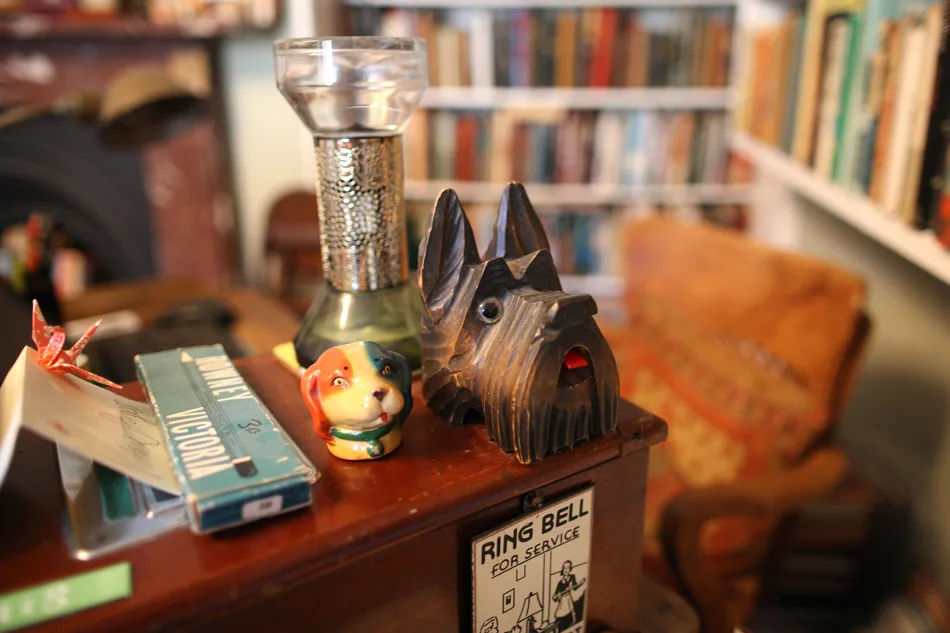
Every surface is crammed with curios and vintage fun
And why the name? ‘My partner’s black pug waddled in one day and was promptly sick all over the carpet. Black Pug Books sounded perfect!’ Victoria prides herself on being able to track down the rarest of titles. ‘I’ve got a network of independent booksellers across the country and we all help each other,’ says Victoria. A ‘bookhound’ for the local museum, she sniffs out potentially rare books donated to their second-hand bookshop. A collectible copy of Jane Austen’s Pride and Prejudice, which could have been sold for a few pounds, recently raised more than £800 for the museum. She also donates proceeds from her £2 paperbacks to charity – Dorset & Somerset Air Ambulance and Margaret Green Animal Rescue. Victoria’s business is resolutely non-digital. She hates Kindles, preferring the tactile pleasure of books. She refuses to sell online and has very little social media presence.
Victoria’s top Christmas gift suggestions: ‘no one can resist a cosy
Outside, a vintage pram and washing tub filled with paperbacks lure people in. Once there, Victoria’s incredible knowledge and warm hospitality mean you rarely leave empty-handed. ‘Books become friends – they can stir memories, help you through tricky times and if you hold onto them, they’re always there for you to revisit. I simply couldn’t imagine life without books. There’s no soul in a home without books. To me, they are works of art.’ Her customers, who include celebrities, come from all over the country. Cricket commentator Henry Blofeld always pops in when he’s in town. Comedian David Baddiel couldn’t resist a peek when performing at the Tivoli Theatre (which is almost opposite Black Pug Books). And if Victoria can’t find you a book, she can certainly tell you a great story. From Queen’s groundbreaking video to a cosy Wimborne bookshop, Victoria Sturgess has lived many fascinating chapters. Perhaps her next should be to write her own autobiography.
Find Black Pug Books opposite the Tivoli Theatre, at 24 West Borough, Wimborne Minster or call Victoria on 01202 889383 Open Thursday to Saturday 10am to 4pm
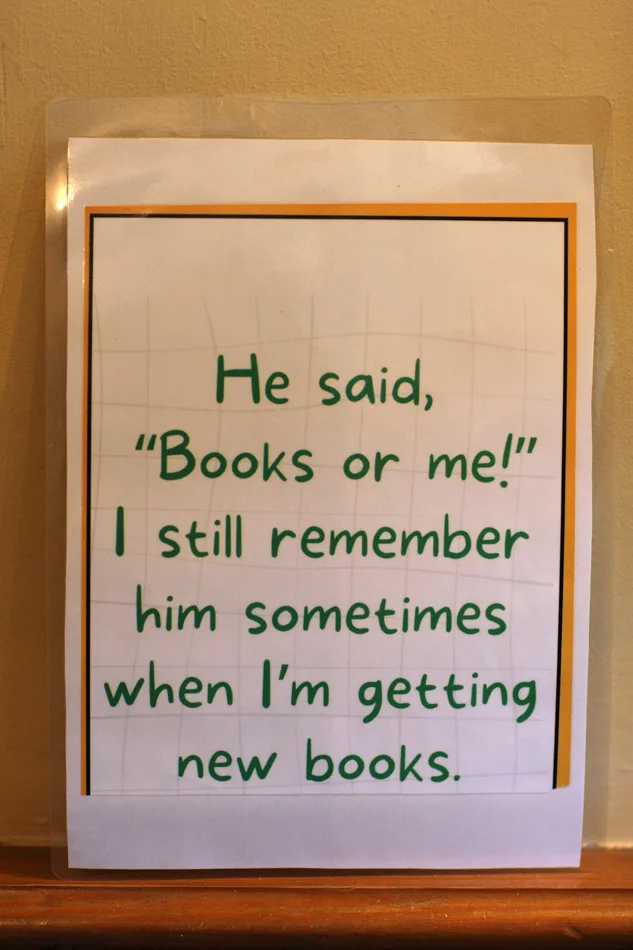
Victoria’s grandson has created a number of posters to amuse browsers
Quickfire questions for Victoria:
What sells best at Christmas? MURDER! It’s a little bit odd, but no one seems able to resist a nice cosy seasonal crime story filled with death …
Book by your bedside? My daughters always enquire ‘how are your teetering, piles mother?’ – it’s a family joke as I’ve so many books by my bedside. Teetering on the top currently is John Nichol’s ‘The Unknown Warrior’. Since I studied First World War poetry at school, I’ve found the stories from this time jaw-droppingly awful. I have a unique collection of First World War literature that I will never sell. It’s going to the Imperial War Museum when I die.
A-list dinner party guests? David Frost – he’d get drunk so quickly! My Bohemian buddy Bruce Gowers, he was such a good friend. Actress Cate Blanchett, and comedians Graham Norton and Julie Walters – what a hoot! No egos … they’d probably even help with the washing up.