Kingston Maurward become the only college to win a second Silver Gilt at RHS Chelsea Flower Show for its Sanctuary category garden.
The fragrant flowers of Wisteria floribunda ‘Alba’ welcome visitors for contemplation. Architectural plants and soft colours lead the eye around the circular walkway.
Kingston Maurward College (KMC) was celebrating last week, winning a Silver Gilt medal at the prestigious RHS Chelsea Flower Show. Their garden The Space Within was entered in the Sanctuary category and was designed to provide a nurturing and calming space in which to relax and unwind. College Principal Luke Rake said: “This is the second Silver Gilt that the college has won for a garden, something no other college has ever achieved. It’s the second highest possible award and is a fabulous outcome for everyone here – and for Dorset.” KMC is one of the UK’s few land-based colleges, providing education and training in agriculture, land and animal sciences– the skills needed for rural economies. The garden was designed by ex-KMC graduate Michelle Brown. It was completed as a team effort by staff and students, said Luke Rake: “More than 100 people were involved in the creation, from welding and blacksmithing to countryside and horticulture specialists, all pulling together to create something magical. “I’m so proud of them, it’s a genuinely world-class performance and it was a real privilege to be able to see the garden in situ after all the hard work.”
Michelle Brown’s The Space Within design resulted in a unique second Silver Gilt award for the college
The Space Within The garden contains a contemporary arch providing an entrance to a secret jungle of foliage planting inspired by the sub-tropical gardens of the Mediterranean and punctuated by specimen architectural plants and trees. Elevated pathways lead to a daybed platform where the visitor can rest, totally immersed in plants. The asymmetric social platform and seating is inspired by childhood den-making and entices the visitor with its playful shape. The sanctuary boundaries are created as wildlife habitats, using fallen trees and waste timber to enclose the space.
If you’d like a glimpse inside the garden, it was on the BBC’s Chelsea show – click play HERE and skip forward exactly 30 minutes.
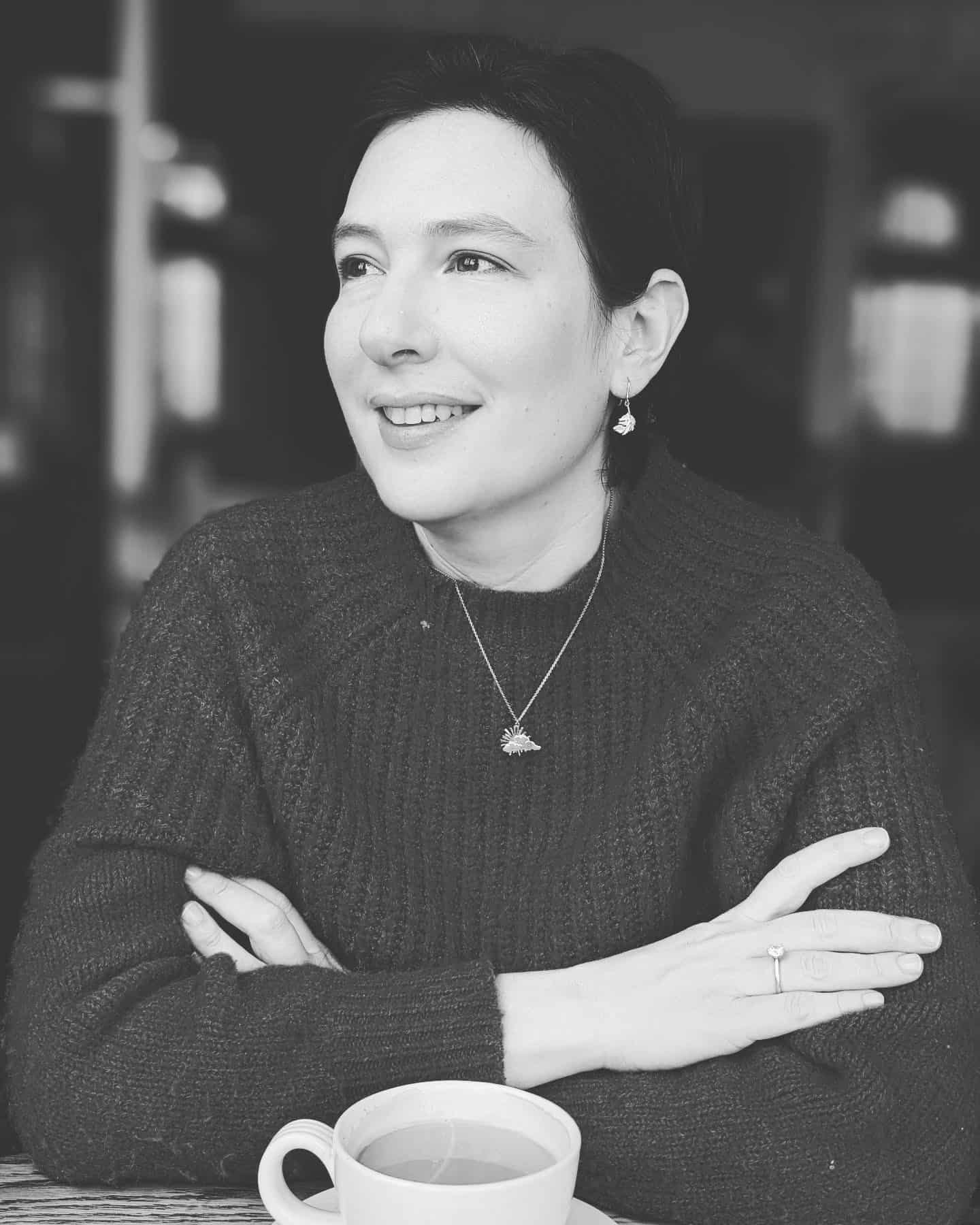
Natasha Solomons is the author of five novels, including Mr Rosenblum’s List (set in Dorset) and The Novel in the Viola, which was chosen for the Richard & Judy Book Club. Her latest book, I, Mona Lisa, is just out in paperback
“After university I completed an MPhil in 18th century literature and then began a doctorate researching Women’s Romantic Poetry and the Domestic Muse. Unfortunately, I became un-stuck on a chapter on Verse Letters and so began writing my first novel as a way of avoiding correcting the footnotes. My entire career to date has been an extremely elaborate form of avoiding that tricky chapter …”
1. What’s your relationship with the Blackmore Vale (the loose North Dorset area, not us!)?
My grandparents bought a house here in the 70s with restitution money from Germany. I came here as a child for weekends and holidays, though I went to school in London. I moved here as soon as I could – it was the place in my heart. My first novel was set here and this is the place I feel centred, the place I always come back to. The Blackmore Vale is where I love to come home to.
2. What was the last song you sang out loud in your car?
I’m not allowed to sing out loud in the car. The second I do, my children tell me to stop that awful noise. My daughter complains if I sing she might actually die. Even when I’m alone, their voices are in my head, stopping me.
I used to sing in choirs and probably would have tried singing something like Sumer Is Icumen In to torment them on the 1st May and that would have elicited that response.
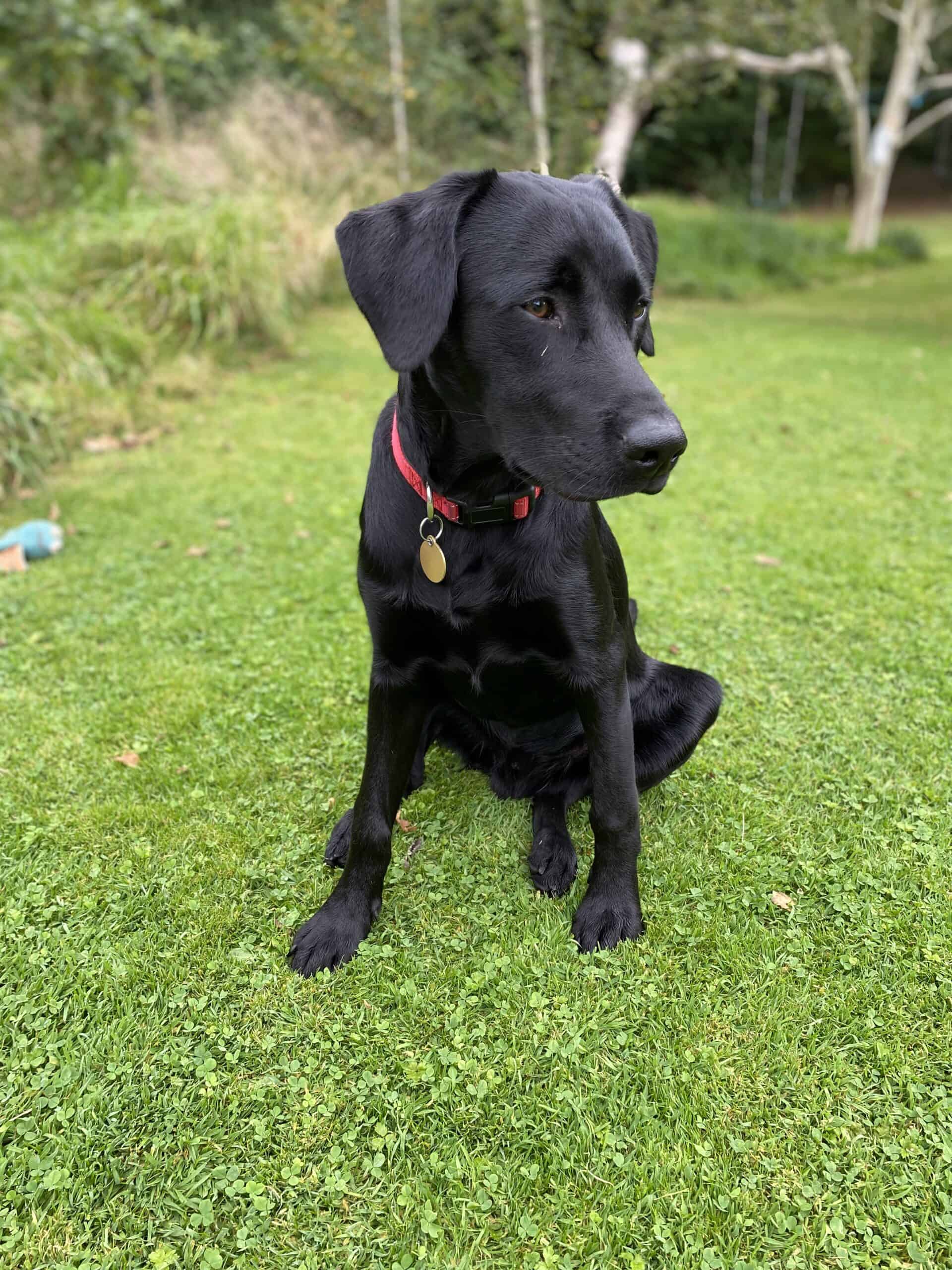
Natasha Solomons, author of I, Mona Lisa, lives in the Blackmore Vale with her husband, children’s author David Solomons, and their two young children, plus sausage-loving Mr Bingley the labrado
3. What was the last movie you watched? Would you recommend it?
After two and a half years of not going to the cinema, the last movie I watched was Sonic the Hedgehog. No. I want those hours of my life back. I ate a lot of pick ‘n’ mix, just for something to do, so that my tongue went blue. No. I wish I had ended my cinema drought with something else.
4. Your favourite quote? Movie, book or inspirational – we won’t judge, but would like to know why.
I don’t have one. It’s not really my thing. I … maybe it’s the Douglas Adams one: ‘I love deadlines. I like the whooshing sound they make as they fly by.’
But … I mean I like it. It’s one I like. But saying it’s my favourite would suggest that I like it more than a line from Jane Austen. I don’t. I like it, it’s funny and true. But how can I like it more than Jane Austen? And how can I like one line from Jane Austen over and above another?
No. I have no favourites. It’s too anxiety-inducing to choose. The pressure’s too much.
5. It’s Friday night – you have the house to yourself, and no work is allowed. What are you going to do?
Run a bath. Read a book. Pour a glass of something to drink in the bath while reading the book. And try really hard not to dip the book in the bath.
6. What is your comfort meal?
Corned beef hash and a big green salad.
And failing that, if I need a lot more comfort, wine.
7. What would you like to tell 15 year old you?
Oh, I need something that 15 year old me will understand, but no one else will …
*Thinks*
“It’ll be okay in the end. And nobody knows anything.”
8. What shop can you never pass by?
The Hambledon Gallery in Blandford. I can NEVER pass it. I love it.
9. What book did you read last year that stayed with you? What made you love it?
Can I cheat and have two? I’ll make it one fiction, one non … Stay with me.
My favourite piece of fiction was by Gabriel Tallent – My Absolute Darling. The subject matter is quite shocking, but that’s not why I loved it. I loved it for its evocation of rural and coastal California. The way he writes about the natural world and the main characters’ relationship with nature, in a place I didn’t know at all, was like nothing else. Lots of people were very uncomfortable with a man writing about a female character, but I find it’s very strange that we’ve got to a place where, as writers, we have to limit our imagination. I found his depiction of a young woman totally convincing.
His descriptions of the storms and the sea, I just loved that part of the book. Parts of it were shocking and disturbing and difficult to read, but I … like books that disturb and challenge me. Some found it too much, but I … didn’t.
My other book is Consent: A Memoir of Stolen Adolescence by Vanessa Springora. She’s an editor in France and she wrote a memoir about her relationship with a famous French writer when she was 14 and he was in his late 40s/early 50s. Essentially he was a serial paedophile. Various women over the years tried to expose this writer for what he was, but the French establishment and police wouldn’t listen – he was so well known he was entirely protected.
Until finally, this very well-known editor in France wrote this book. And now France is beginning to wake up and have its Me Too movement.
But it’s taken 40 years.
It’s remarkable for her strength and courage, but also because it’s an astonishing piece of literature – a sort of anti-Lolita where she writes about his erasure of her self. He not only takes her girlhood and innocence but he steals her voice. He turns her into a character in several of his novels, steals her name, and turns her into ‘his’ character, which is a warped version of herself.
This fictionalised version chases her through her life. She pleads with him and his publishers to remove her from the books, but neither he nor they will. He uses a photograph of her as a child and refuses to stop using it. He doesn’t just take her body, he steals and publishes her voice. And so this unbelievably well-written book is a reckoning, where she says “Here I am” and settles the account. It’s written with such acidity and beauty. Utterly brilliant.
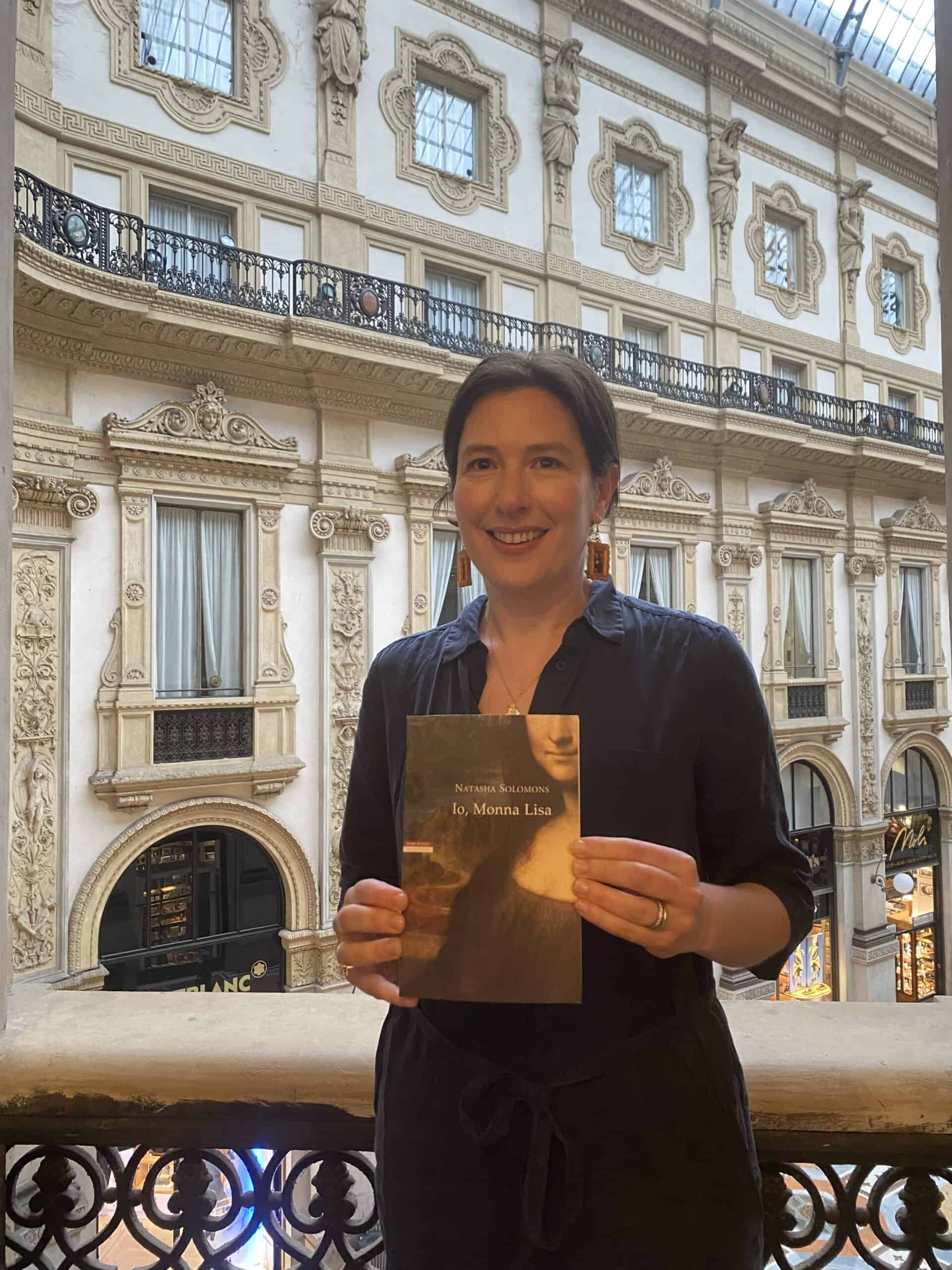
Natasha at Milan’s Leonardo3 museum with the Italian edition of I,Mona Lisa
10. Favourite crisps flavour?
*unhesitatingly swift* Salt and vineger. So vinegary they make your cheeks pucker.
11. Cats or dogs?
DOGS. *glances happily at Mr Bingley currently loafing handsomely under the table*
12. What are your top three most-visited, favourite websites (excluding social media and BBC News!)?
How to get your dog to stop barking
The British Library
Authentic Shakespearean insults. I do go there a lot.
Oh and a high runner-up would be an unceasing search for holidays in Italy.
13. What’s the best biscuit for dunking?
I don’t like to dunk biscuits.
Who wants floaters in their tea?
I just don’t like soggy biscuits. Sorry.
Actually, I’m not.
14. What’s your most annoying trait?
Er … I’ve got quite a lot? How do I pick one? I worry about everything. Super anxious. Super self-critical. Nothing’s ever good enough.
I’m also disorganised and forgetful. If left to my own devices, I will forget everything. I’ll casually throw away really important stuff.
We could be here a while … do you need more?
15. Tell us about one of the best evenings you’ve ever had?
Can I cheat with an afternoon instead? We had a really great afternoon in Bath with my children about a month ago to celebrate my most recent book being out. It was so special. We went to an Italian restaurant (obviously – the book’s set in Italy). It was just one of those times. I got tiddly on some prosecco, and we ate so much that my daughter said “she felt like an overstuffed pillowcase”. Then we toddled round Bath, and I signed hundreds of books, and we went to the Baths, and it was just really fun. Low key, just a good day. Being with happy children, having happy times.
Oh, and then in Milan last week, in the Leonardo3 museum, that was really lovely. The photo opposite is of me on the balcony – I was so happy. That was a great evening.
*checks under the table*
Mr Bingley’s is that time he got a sausage for dinner.
Handsome Mr Bingley
16. What was the last gift you gave someone?
Genuinely the most recent? A sausage. For my husband. It was much appreciated.
17. What’s your secret superpower?
I have two. First is the Maternal Object Echo Location Service. It’s a widespread phenomenon, found in most mothers, actually. It’s an ability to find objects that hitherto have been lost, and searched for to no avail for some time up to this point. Socks, toys, pants, shoes, bags … I can find these objects even when I’m not in the room. Even over the phone I have been known to locate them.
My second is every writer’s superpower – an empathic ability to imagine yourself as someone else, in another time, in another situation.
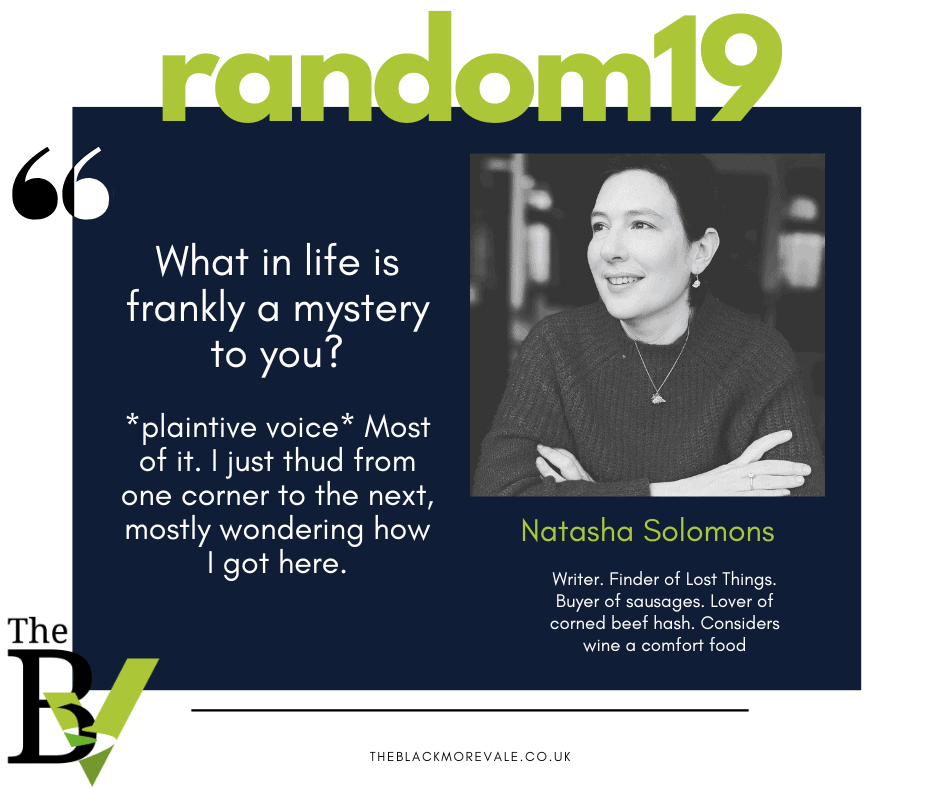
18. What in life is frankly a mystery to you?
*plaintive voice* Most of it. I just thud from one corner to the next, mostly wondering how I got here.
19. You have the power to pass one law tomorrow, uncontested. What would you do?
Stop dunking. Is that too controversial? It’s just too much power. My daughter always wishes for wings. It’s not very practical, but it’s an excellent wish. I think she’d have wings made legal, so I’m going to go with hers.
“Listen to my history. My adventures are worth hearing. I have lived many lifetimes and been loved by emperors, kings and thieves. I have survived kidnap and assault. Revolution and two world wars. But this is also a love story. And the story of what we will do for those we love.”
In Leonardo da Vinci’s studio, bursting with genius imagination, towering commissions and needling patrons, as well as discontented muses, friends and rivals, sits the painting of the Mona Lisa. For five hundred tumultuous years, amid a whirlwind of power, money, intrigue, the portrait of Lisa del Gioconda is sought after and stolen. Over the centuries, few could hear her voice, but now she is ready to tell her own story, in her own words – a tale of rivalry, murder and heartbreak. Weaving through the years, she takes us from the dazzling world of Florentine studios to the French courts at Fontainebleau and Versailles, and into the Twentieth Century.
I, Mona Lisa is a deliciously vivid and illuminating story about the lost and forgotten women throughout history.
Well folks, we said farewell to astronomical darkness at the end of May, so it will soon be time to turn our attention to the planets in our solar system to explore through our telescopes. Exciting update; I have now acquired some additional equipment including a planetary imaging camera so hopefully I might be able to start capturing some planetary, solar and close- up lunar surface images myself. Watch this space (yes, that pun was unintentional)! This month I was planning to share the M13 Globular Cluster, but unfortunately the image I tried to capture didn’t quite cut the mustard. So instead I’m going to share with you this rather impressive supernova remnant captured a couple of months ago. Last month I shared an image of a brand new supernova just starting to occur. However IC443, also known as the Jellyfish Nebula, shows what a supernova looks like after thousands of years, with this stunning blast wave of gas and dust. IC443 is around 70 light years across and 5000 light years from Earth. This image was captured using my bigger Sky-watcher Newtonian Reflector Telescope and Cooled Astro Camera.
IC443
The night sky, June 2022 – Rob’s guide for your stargazing this month:
Inevitably, this being the UK, those of us who got up super-early to try to watch the total lunar eclipse in May were thwarted. Mother Nature naturally decided to obscure our view with clouds and rain. However in June we do at least have a chance to see the second supermoon of 2022, which is only one per cent smaller than the biggest supermoon event coming up in July. A supermoon occurs when the moon’s orbit is closest (perigee) to Earth at the same time it is full. On the 14th of June, the supermoon will hopefully reveal itself, so grab those binoculars or a telescope and have an explore of the detailed lunar surface across the entire visible face of this full moon.
Summer solstice The planets aren’t currently visible in the evening skies, but do wake up early to see a beautiful procession of the planets before dawn. On the 21st June, the bright ‘star’ seen nearest to the Moon will be Jupiter. Also on the 21st of June at 10:13am we witness the Summer Solstice. The sun will reach its northerly-most point in the sky, marking the Midsummer’s Day, with the longest period of daylight and shortest night. On the 22nd June, before dawn, look to the right of the Moon to see Jupiter, with Mars flanking from the left. On the 23rd June, also before dawn, Mars will switch positions and be visible to the right of the Moon. On the 26th June, Venus alongside the crescent moon make a picture-perfect arrangement with the Pleiades visible above if observing with binoculars. Mercury will also appear, completing the arrangement to the lower left. Wake up early again on the 27th June (it’s clearly a month of early starts) to reveal a very thin crescent Moon, with Venus visible to the right, and Mercury below.
Summer Solstice The summer solstice, also known as estival solstice or midsummer, occurs when one of Earth’s poles has its maximum tilt toward the Sun. It happens twice yearly, once in each hemisphere (Northern and Southern). For each hemisphere, the summer solstice is when the Sun reaches its highest position in the sky (for areas outside of the tropics) and is the day with the longest period of daylight. Within the Arctic circle (for the northern hemisphere) or Antarctic circle (for the southern hemisphere), there is continuous daylight around the summer solstice. Since prehistory, the summer solstice has been seen as a significant time of year in many cultures, and has been marked by festivals and rituals. Traditionally, in many temperate regions (especially Europe), the summer solstice is seen as the middle of summer and referred to as “midsummer”.
by Rob Nolan – Find RPN Photography on Facebook here
Sturminster Newton is ready to celebrate the Queen’s 70 years with four fantastic days of celebrations around the town
The Jubilee celebrations happen to coincide with Sturminster’s Big Weekend, which started on Thursday 2nd June with a Teddy Bear’s Picnic at the Mill, Evensong at the church culminating at 9.45pm with a Beacon lighting in the Railway Gardens. From today (Friday 3rd June) through to Sunday there is an Ale and Cider Festival taking place at The Exchange. Saturday in Sturminster is a big day for shoppers, with a Plant Sale being held by the Rotary Club in the Railway Gardens, the Anonymous Travelling Market is coming to town and there is also a Craft Fair being held in the Exchange. On Saturday morning the monthly Car Enthusiasts meet-up is on, but thanks to its swiftly rising popularity it will now be held at the Rec. Over 100 vehicles of all eras from vintage to modern supercars came to the event last time. Anyone is welcome to wander round the vehicles and talk to the owners, who are only too happy to tell you about them. On Sunday St Mary’s Church welcomes you to a Civic Service at 11am ,and then from 12pm – 3pm, the Rotary are holding the Jubilee Big Lunch in the Railway Gardens. The WI are also serving tea and cakes in the Bow room at the Exchange.
Open all weekend The Emporium and The Boutique will be open throughout the Jubilee celebrations, so why not come in and look at what’s on offer – perfect for that regal outfit. Margaret Ann’s Art Gallery has many lovely, donated paintings and pictures which are displayed for sale in a dedicated space in the Emporium.
1855 Work continues to progress on the proposed 1855 shopping experience in the former Nat West building. If you are interested in a customer-faced selling space for your business let The Emporium staff know or email [email protected]
Library friends And some good news – the Friends of the Library are finally back in business! Sturminster Library Coffee Mornings are back on the first Thursday morning of each month (except 9th June), plus there will be children’s crafts and the Summer Reading Challenge is back. Volunteers are always welcome and much-needed to help with extra opening hours, or with the craft or other activities. Please contact [email protected] if you think you can help.
For full details of all the Jubilee activities on offer please see the poster opposite, and find out more on the Town Councils website and its Facebook page.
In a remote barn in Dorset, with pigeons and podcasts for company, Sophia Campbell is quietly revolutionising funerals with her reusable coffins and environmentally-friendly farewells, Tracie Beardsley reports.
Sophia began weaving willow when she was nursing her dying mother. Her daughter’s birth coinciding with another family death caused a major re-think in her priorities, and Sophia set out to master willow coffin making. Image: Courtenay Hitchcock
As we talk, Sophia is creating a beautiful willow coffin for a man whose photo is propped nearby – families send pictures of loved ones so she gets an idea of the character for whom she’s creating a coffin. ‘Cradle to grave’ has never felt more apt – the design is an adult Moses basket. Unlike the dread that fills me from a traditional coffin, I’m happy to run my hands over the smooth weave, finding it comforting to the touch. Rustic hemp ropes replace cold metallic handles. There’s understated cotton lining inside – no gaudy satin in sight! The weave is so tight you can’t see through the willow and these fragile-looking coffins will hold up to 23 stone. Sophia’s business was born out of bereavement. She’d begun weaving willow when she was nursing her dying mother, who died when Sophia was 22. She continued weaving, finding ‘great bereavement therapy’ and began to sell baskets as a sideline. Then life threw her joy and tragedy. Eight weeks after the birth of her first child, Ava, Sophia’s 26 year old sister, Anna, was killed in action in Syria. “I had this incredible experience of my life being thrown up into the air – becoming a mum and losing another family member. It took me a while to percolate my emotions, but I came away with a better awareness of the preciousness and the sheer transience of life, prompting me to reset my goals.” With ten-month Ava in a sling on her back, Sophia mastered willow coffin making and launched Woven Farewell four years ago. Now her second child, one-year old son Idris, sits on her back as she works.
Unlike the dread that fills me from a traditional coffin, I’m happy to run my hands over the smooth weave, finding it comforting to the touch. Image: Courtenay Hitchcock
True sustainability Sophia’s environmental ethos is impressive. This is no ‘greenwashing’ but a true commitment to a greener footprint in an industry that is highly polluting. The willow is grown just down the road in Somerset, wood for the base slats comes from Bridport’s Eggardon Saw Mill and biodegradable plastic or organic cotton is used for the lining. All coffins are biodegradable, releasing no harmful gases during cremation. Sophia even donates five per cent of her business profits to the Woodland Trust. She says: “I’m genuine in my sustainability policy. My philosophy is very much that life and death are simply part of the same coin.’’ Added to this is what Sophia describes as “a twin funnelling of a cost-of-living crisis and the climate crisis. Funerals are neither cheap nor ‘green’. “In America, rental coffins are a lot more mainstream. There’s a panel at the end of the coffin which folds down and the coffin liner slides in and out, so it’s very hygienic. The deceased doesn’t touch the sides of the rental coffin at all. “We don’t have this culture in the UK. It requires a mind-shift on a taboo subject, as well as greater awareness of hygiene standards and how the aesthetics work – so people feel they can trust something new. “ Willow coffins are made with one continuous panel so can’t be reused … yet! Sophia is designing one with a collapsible willow foot panel that she aims to test with local funeral businesses – probably the first of its kind in the world. She’s also working on a willow canopy to go over a cardboard coffin so that it can be lifted off and reused many times.
In 2020, UK cremations generated more than 80,000 tomes of carbon emissions.Three million single-use plastic coffin handles are used every year. Image: Courtenay Hitchcock
A cathartic process Sophia welcomes bereaved families to her workshop and they can even get involved in the making of the willow coffin. “Giving people the opportunity to see the coffin before the funeral and, if they wish, take part in making it, can be cathartic and an important part of the bereavement process. I’ve even had someone help me weave their own coffin.”
A willow coffin weaver needs to master a number of skills – it is tough, physical work. Each adult coffin can take up to 25 hours to weave Image: Courtenay Hitchcock
Sophia is already a national award-winner – silver in Best Businesswomen Awards 2021 – but she is modest about her achievements. “There is a definite mind-shift towards more sustainable, family-centric funerals. I feel like a very small peg in the loom of a bigger momentum. I’ve never had a livelihood like this – every order feels like an absolute honour.”
Shared by Sophia on social media was the story of one family gathering to help with weaving their father’s coffin. Sophia wrote: “One of the most special parts of what I do is that I get to give folks the opportunity to not only help weave their loved one’s coffin, but to come together as family and friends over that process. We drank tea, ate cake, whacked willow, spoke and listened. All the simple things really.” The family commented: “It felt good to be part of this very intimate final process of saying goodbye to Dad.” Image: Courtenay Hitchcock
Quick-fire questionswith Sophia:
A-list dinner party guests past or present? My mum and sister. Gandhi. Books on your bedside? A mixture of inspirational and factual – meditation, women’s sexual health and an autobiography of a cancer survivor. How do you relax? I love gardening and flowers. I’m also one of those crazy cold water swimmers.
Adrian and Marie Fisher in Durweston have welcomed three generations of one Ukrainian family. Adrian shares how they are settling into life in Dorset.
A spring walk near Tollard Royal with grandmother Liliia, Damir (aged 10) and his mother Iryna from Ukraine, and their English host Marie Fisher.
This spring saw Ukrainian families begin to arrive in large numbers to the UK, fleeing from their war-torn country, and adding a new and unfolding chapter to the history of our county. A family of three – grandmother Liliia is 59, Iryna is 32 and her son Damir is 10 – have been living with us since April. Every day that passes sees new accomplishments, as they establish their lives here in North Dorset. They are gaining increased mastery of English, making progress at Durweston School and weaving through the byzantine bureaucracy that was never designed with ease of use and swiftness of effective action in mind. There is the shared support network of a dozen host families and their respective dozen Ukrainian families who manage get-togethers in the district every week. Somehow, nothing really matters compared with packing a bag at an hour’s notice with just three changes of clothes, leaving everything else in your life behind. In response to the Ukrainian crisis, so many people across our villages are stepping up to host a family, simply because it’s the right thing to do.
An early visit to the White Horse pub in Stourpaine. Iryna and Liliia from Ukraine, with Becky Waker and Adrian Fisher, their hosts in Durweston.
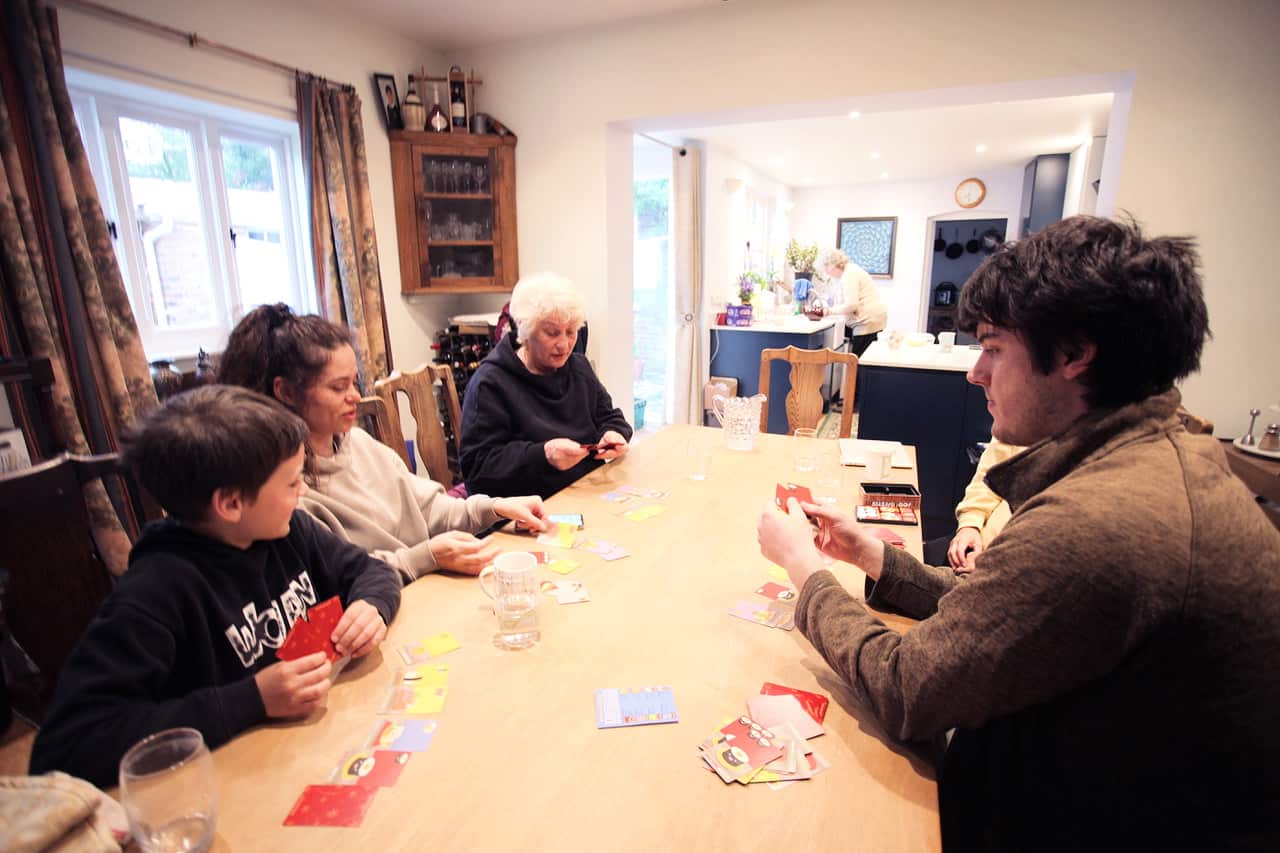
Day-to-day practicalities Some things have worked out well, such as playing cards together, and trips to Poole Quay, Weymouth and the Jurassic Coast. All are relaxing ways of simply getting to know each other. Google Translate was brilliant at the start, though now we are encouraging them all to use it less and try to converse in spoken English more. English lessons are also helping so much.
Experiences of war There are harsh realities in their experiences. Some mothers got out of Ukraine with their children on the day the invasion began, determined that their children should never see or experience atrocities which would scar them mentally for life. They were so wise. Weeks later, women now crossing into Romania are describing their single worst shared reality – the rape of mothers, daughters and even young sons. They are so traumatised.
It’s no holiday Our own Ukrainian family announced as soon as they arrived that they were not here for a holiday. They need to work, to earn money and send it back to Ukraine for Liliia’s husband and his brother. Her husband was a manager at a brick factory. The factory has been destroyed, the company ceased to exist, and his job, income and prospects have vanished. Instead, his skills are put to use organising military logistics. Serving as volunteers, both men receive only €15 a month while the cost of food has doubled (that’s if it is available), and they are eating canned dog food to feed themselves.
Ukrainian families meet every Thursday morning at St Nick’s Cafe, which is held in St Nicholas’ Church, Durweston. Damir’s 10 year old Ukrainian classmates are spread out in five countries across Europe and they keep in touch by phone.
Every day that they manage to speak, they know their loved ones are still alive. Our Ukrainian family did not wish to come to England under such circumstances. They are decent and hard-working people. Like them, we are living each day at a time. That’s all any of us can do.
A get-together on 20th May at The Hub, provided by the village of Stourpaine as a meeting place for Ukrainian families in the district. There have also been social occasions such as a barbecue at a host’s home in Stourpaine, where host families exchanged ideas and their Ukrainian families got to know each other.
HOW YOU CAN HELP 1. Support the Blandford Welcome Group (BWG), whose latest initiative is their “Fundraising with Art Event”. See the website: www.blandfordwelcome.group 2. Buy a raffle ticket in the Fundraising with Art Event, with a special exhibition in September when everyone gets to take a piece of art home. Contact Chrissie Anderson on [email protected], or Marie Fisher on [email protected] 3. As an artist, pledge to create a work of art for the Fundraising with Art Event. Then create it by 15 July 2022. Again, please contact Chrissie Anderson or Marie Fisher. 4. Offer to host a Ukrainian family. See the website: www.ukrainedorset.org 5. Order copies of “Blue and Yellow – Hope for Ukraine” colouring book; to sell through your organisation (minimum batch one carton), to enable free copies to be distributed to Ukrainian refugees in Eastern Europe. Contact Adrian Fisher on [email protected] 6. Donations are always welcome, to provide more help for refugees. 7. Generosity in kind is also most effective – from a donated kid’s bike or unused computer to smart women’s clothes. Typically each refugee only arrived with one suitcase.
May issue out now! Grab a coffee and settle in for your favourite half hour of the month… https://bit.ly/TheBV
(that gorgeous front cover of ‘Bruiser the hare’ by Graham P Bannister WildlifePhotography)
Top stories this month:
A Dorset Kitchen is so much more than a cookbook. Life could have been shattered by the death of a son. But a local family have strained every sinew to wrestle good from the tragedy, says Rachael Rowe p.4
Storm clouds are brewing on the horizon at The Vale Pantry. A growing number of proud pensioners are in tears when seeking help to feed themselves – the Pantry’s Carole Jones spoke to Rachael Rowe p. 8
Philip Hart 1958 – 2022
‘I’ll always remember his infectious laugh’.
“We are sad to say ‘farewell’ to a community-minded employer, a stalwart of local business, and simply my friend” says Jon Dart
The Covent Garden Dance Co. Director Matt Brady takes on the Random 19 questions ahead of this year’s Ballet Under the Stars at Hatch House p.19.
It heads a section on live performance, with an essential round up of this summer’s open air theatre in Dorset, and Artsreach Dorset‘s ‘must see’ events this year
‘Forging ahead to restore the past’ seems a good motto for Ian Ring, who owns Newton Forge, the Sturminster-based World Heritage business, whose work is in demand across the UK. Tracie Beardsley reports in A Country Living p.15
This month’s Equestrian section (starts p.54) is packed – we have the inspiring story of paradressage rider Jemima Green. Also there’s life or death foals, DIY one-sided milking, windswept legs, film stardom and “Go Honeysuckle, go!” – it’s another average month at The Glanvilles Stud with Lucy Procter, and we have a duffer’s guide to three day eventing as Toots Bartlett gets her season under way.
In local history (from p.64), the tale of an innocent Stalbridge boy who quickly became a man in the horrors of the Napoleonic war is vividly described by Roger Guttridge, and he shares a ‘Then & Now’ of The Cricketers. Rupert Hardy shares the Battle of Hambledon Hill. Starts on p.48
In the Trethowans‘ farming section (from p.84), NFU county chair George Hosford is battling the beetle, unseasonal weather and confusing, costly messages from the EA. James Cossins is worried about war and water, and Andrew tackles the truth behind ‘green credibility’
The Thorngrove Garden Centre ‘Out of Doors’ section starts on p.80 with news from Barry Cuff’s allotment and this month’s garden jobs from Pete Harcom.
Reader’s Photography starts on p.46 – and it’s gorgeous as always.
The Castleman is a stunning original, sitting at the heart of a warm and visionary community that is reconnecting food, land and culture. This is no ordinary rural getaway.
To enter, simply scroll to the bottom
Dining and staying at The Castleman Hotel is like coming home to the warmth of family.
We offer guests homegrown and seasonal local produce, often picked from the walled garden and hedgerows, crafted into interesting dishes by talented chefs. As locally sourced as possible, the provenance of our meat, game and fish is a top priority, securing the tastiest cuts with sustainability in mind. Heritage grains and vegetables are often the stars of the show.
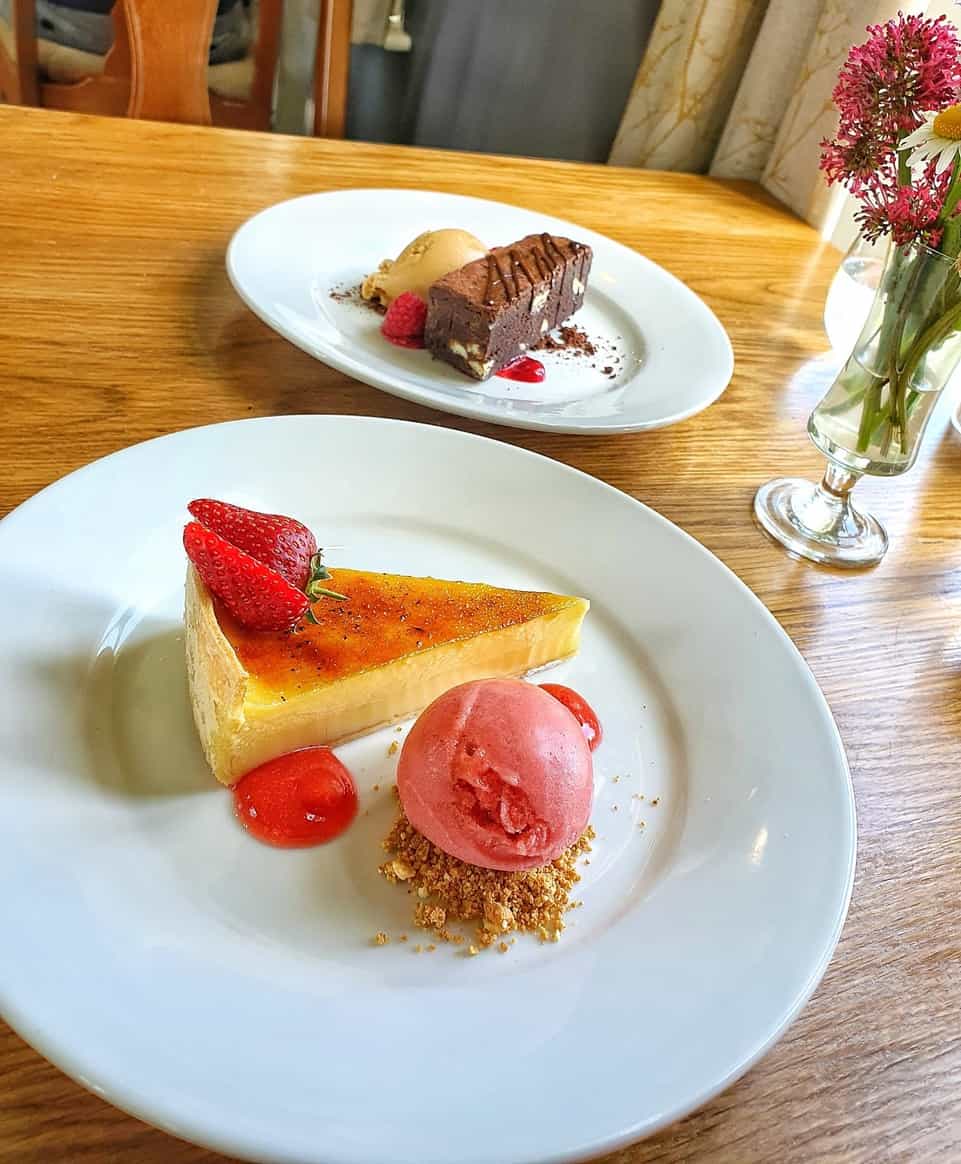
Our menu is often described as ‘fine dining enough to be a special meal, but not fussy and pretentious’. Simple, delicious and consistent, you will currently find dishes such as Hake ‘Kyiv’ with Sorrel Butter, Clarke’s Brisket Croquettes with Celeriac Remoulade and Vanilla Crème Brulée topped with Poached Rhubarb on the menu. Food at The Castleman is paired with a small, but well-chosen cocktail menu and an interesting and diverse wine list.
This big-hearted community is passionate about regenerating our English countryside. You may decide to head off round the estate, amble through the adjacent meadows and old woodlands up to ancient long barrows or viewpoints overlooking the Cranborne Chase AONB.
If you prefer to take it easy, find a seat in the dappled light beneath ancient trees in our spacious garden or stroll along its pear walk towards the delightful thatched village and pop into the famously quirky Chettle Village Store for a pie. There is also a charming play park for any smaller guests.
If there’s a chill in the air, you will find a plethora of comfy sofas and armchairs at The Castleman, surrounded by piles of interesting books to read. Or simply head upstairs to enjoy your beautifully curated en-suite room with roll top bath, glorious views over the garden and surrounding fields, comfy mattress and fluffy white towels.
Curious? You are warmly invited to come and enjoy the generous hospitality of this tiny community and find out more about its extraordinary history and plans for the future.
To be in with a chance to win a one night stay at The Castleman Hotel – including dinner, bed and breakfast for two – just answer the first three questions in the widget box below. There are more chances to win by completing the other entry options if you so wish – they’re entirely up to you! The closing date for this competition is 24th June 2022 and only entries received on or before that date can be included. The prize will go to the first randomly chosen entry. Good luck! (competition opens when the May issue of the magazine publishes on the 3rd June)









 A Dorset Kitchen is so much more than a cookbook. Life could have been shattered by the death of a son. But a local family have strained every sinew to wrestle good from the tragedy, says Rachael Rowe p.4