Milton Abbey School seeks a flexible and competent Exam Assistant to work within our Examinations Team. This will be zero hours, term time only, varied role within our award-winning Academic Department. Working days will be Monday to Friday to fit with the termly examinations schedule.
The successful candidate must hold a reasonable IT level and the ability to organise paperwork for this important role.
You will be part of a friendly and supportive team, and training will be available to enhance skills. Staff also benefit from free parking, free daily lunch, and the opportunity to work on our historic and beautiful school site.
Further details may be obtained from our website or from HR on 01258 882182 or email [email protected]. Applications must be submitted on the school’s application form.
The closing date for applications is Friday 13th October 2023.
Milton Abbey School is committed to safeguarding and promoting the welfare of children. The appointment will be the subject of an enhanced disclosure from the Disclosure and Barring Service. Additionally, please be aware that Milton Abbey School will conduct online searches of shortlisted candidates. This check will be part of a safeguarding check, and the search will purely be based on whether an individual is suitable to work with children. To avoid unconscious bias and any risk of discrimination a person who will not on the appointment panel will conduct the search and will only share information if and when findings are relevant and of concern.
Please note that our school is a no smoking site. www.miltonabbey.co.uk Registered Charity No 306318
In the first of September 23’s episodes of the BV podcast we have the letters and politics, the obituary of our writer, columnist and friend Roger Guttridge, and Jenny interviewed composer Helen Ottaway to discover her Dorset Island Discs.
Letters (from and to) the editor
In politics, Chris Loder, MP for West Dorset, discusses the fact that the declining use of cash particularly affects the elderly and rural dwellers. Ken Huggins of the Greens agrees that he, too, hates wind turbines. But that that’s not the point! And Mike Chapman of the Lib Dems has been at two big rural shows recently – and despite a very different audience at each, there were some strong common themes being discussed.
In this month’s Dorset Island Discs, Jenny spent sime time chatting to composer Helen Ottaway. From folk to installation art, you can hear Helen talking about her multi-dimensional journey in music as she chooses the discs she can’t live without as an island castaway
We have the obituary of our writer, columnist and dear freind Roger Guttridge, who passed away this month. Most BV readers will know him well from his terrific local history columns, and possibly remmeber him as a local journalist – but did you know he was also a Team GB reporter who covered three Olympics, and was press officer for the Great Britain Swim Team?
There’s growing uncertainty among the UK’s dairy farmers and little confidence to face the challenges, says county advisor Gemma Harvey
Britain’s dairy farmers are being forced to think seriously about their future, a new NFU survey shows, thanks to increasing concerns over insufficient returns, volatile markets and the scale of on-farm investment. A survey of the intentions of nearly 600 dairy farmers reveals that 9% of producers believe they are likely to stop producing milk by 2025 – up from 7% last year. A further 23% said they were ‘unsure’ if their business would continue producing milk beyond 2025 – just two more years. Of the dairy farmers who responded, 87% said they are concerned about the impact of government regulation, with feed prices (84%), energy prices (83%) and cash flow and profitability (80%) other key factors that would curtail milk supplies. Meanwhile, 91% of dairy farmers said the main factor preventing them increasing milk production was the scale of investment needed for things such as suitable slurry storage to ensure their farms comply with current regulations. This supports the NFU call for DEFRA’s Slurry Infrastructure Grant to be extended to cover more areas and to reduce the minimum spend threshold needed to access the funding. NFU dairy board chairman Michael Oakes says: ‘It’s clear that significant inflationary pressures, combined with below-cost-of-production prices are continuing to threaten the resilience of British dairy farming businesses. We are now facing a crisis of confidence among Britain’s dairy farmers. ‘The results of this survey show that, now more than ever, we need resilient and collaborative dairy supply chains. It’s vital that we invest and reverse this trend of boom or bust. The new industry-wide regulation on contracts – expected to be introduced later this year – must support fairer, more transparent and accountable supply chains. But regulation isn’t a silver bullet. ‘With increasing global demand for British dairy produce, we know that the long-term future is bright for our sector. To ensure we maximise this potential, it’s imperative that the government continues to work with us to ensure we have the right environmental, regulatory and trade framework in place to support the production of high quality, nutritious and sustainable food.’
This year, the Gillingham & Shaftesbury Show has a special treat for both seasoned attendees and newcomers alike. The South Downs Bloodhounds will be parading in both rings over the two days, promising a unique spectacle – hunting tradition without the controversy.
Established in 2004 by Jeremy Whaley, the current senior Joint Master – who also takes the role of Huntsman – the South Downs Bloodhounds offers a fresh twist on the traditional British hunt. Rather than pursuing foxes, in clean boot hunting the hounds chase after a ‘clean boot,’ which refers to the scent of human runners (volunteer ones, obviously! They don’t just take off after passing strangers!).
These runners, called quarries, set out between 20 and 60 minutes before the hounds, along planned routes. The chase can span varying distances, and with three to five hunts in a day, participants can engage in as many or as few as they choose. The hunts have been thoughtfully designed to keep the exhilaration of the chase alive, while simultaneously respecting and protecting wildlife. It’s a wonderful way to celebrate our countryside’s rich traditions while safeguarding its natural wonders.
If you are interested to try it for yourself, there are lots of ways to get involved. The South Downs Bloodhounds may be based in Hampshire, but last season they had hunts locally in the Tarrant Valley and Sixpenny Handley on Cranborne Chase. Those curious about this human-hunting spectacle are welcome to take part on horseback or on foot – or even to try leading the way as a quarry. Non-participants are also welcome to witness the thrilling chase as car followers. The South Downs Bloodhounds guarantee exhilarating hunts without putting any wild animal at risk. They strongly promote a community where everyone, regardless of their role, can come together and continue an ancient tradition into the 21st century.
The inclusion of the South Downs Bloodhounds to demonstrate clean boot hunting is not just about entertaining the crowds at the G&S Show, but also about conveying a message of respect for tradition, wildlife and the countryside. The South Downs Bloodhounds team are renowned for their professionalism and skill with their hounds – watch out for the cheerful dogs and the Huntmaster’s absolute control. It promises to be an unforgettable experience and a significant milestone in promoting new ways of keeping our traditions alive.
The South Downs Bloodhounds will be parading in the Gritchie Brewing Co Main Ring on Wednesday 16th, and in the Turnpike Ring on both days of the show.
“The whole team is proud of the fact that the Dorset County Show is a crucial part of the county’s farming year. We bring together people from all over the countryside, creating opportunities not just for networking and business, but also for celebration. We love that the show is a treasured event in so many calendars, as individuals and families come together, taking delight in the brilliant community that is Dorset.” James Cox, Dorset County Show Organiser
“The Dorset County Show has been an essential part of the local calendar from my earliest memories, as a celebration of my culture and the end of bringing in the harvest on the farm. It has been my pleasure to have been involved as a volunteer for more than 40 years. Being the Chair of the show has been an honour – but not without its challenges! The COVID pandemic put the survival of all such events at huge risk, but it’s at these times that we realise the important part we can play in the fabric of both our community and our local economy. I would like to take this opportunity to thank our supporters and many visitors – without you we simply wouldn’t be here. I am excited that when we open our gates we will not only be sharing our usual attractions and traditions but also introducing many more too.” Nicki Ralph, Dorset County Show Chair
“Shows are in our blood! They’re such an important part of the community we support. Meeting with your customers is a really important part of any business and for us – an insurer that focuses entirely on the agricultural sector – rural shows are such a key part of that.” Peter Beaumont, Managing Director, Cornish Mutual
“Big rural events like agricultural shows are a vital ingredient in the farming calendar, bringing together people from across the rural community to celebrate food, farming and the countryside. The Dorset County Show is a great opportunity to showcase the quality of Dorset food, drink and produce – as well as some of the finest livestock in the South West. All grown and reared by farmers who work to impeccably high standards. The iconic Dorset landscape has been shaped by generations of farmers and growers who work the land and who also care for the farmed environment. The county show is a great place for farmers to meet the public and showcase what they do, and we are always delighted to see such quality animals on show in various classes. The show is also a wonderful opportunity for the NFU to catch up with farmers; on our stand next to the main ring we will have refreshments aplenty and our team will be on hand to discuss all the work and campaigning that is happening on their behalf.” Gemma Harvey, Dorset County Adviser, NFU
“Of all the blue cheeses, I love this one the best.”
A sharp elbowed lady ploughed through the crowds hovering by the samples and made a beeline for the pieces of Dorset Blue Vinny, clearly knowing a fine local cheese from the massive selection on offer. Sturminster Newton Cheese Festival is a fantastic place to taste your favourite cheeses – but it’s also an opportunity to try something completely new and unusual.
Sturminster Newton cheese festival stall. Image: Chris Robinson
The festival is a showcase of cheeses from across the South West. Sampling a three year old vintage cheddar from Keen’s, I loved the strong mature flavour. White Lake Cheese’s sheep feta from near Shepton Mallet, aptly called Fetish, is barrel-aged in brine – it was a refreshing change to the standard supermarket imports that end up in a Greek salad. La Fresca Margarita, an award winning queso fresco from Feltham’s Farm that was drizzled with honey was a winner, as was their creamy Gert Lush.
Book & Bucket Cheese at the Sturminster Newton cheese festival. Image: Chris Robinson
There were crowds around the Sparkenhoe Blue cheese from Leicestershire, and at the Book and Bucket Cheese Company where the range of cheeses, all with a literary theme, was a conversation starter. Will it be Hardy or Shakespeare? The unusual-looking cheese with a bluish purple rinse turned out to be a wine-soaked variety from Italy. Another pungent tase was a beer-drunk Italian soft cheese – their truffle-infused cheese was more palatable for some.
And that’s the beauty of the festival. You can discover a new (or old) favourite, or experiment with something you would never consider buying on your weekly shop.
Sturminster Newton cheese festival. Image: Chris Robinson
The rising temperatures
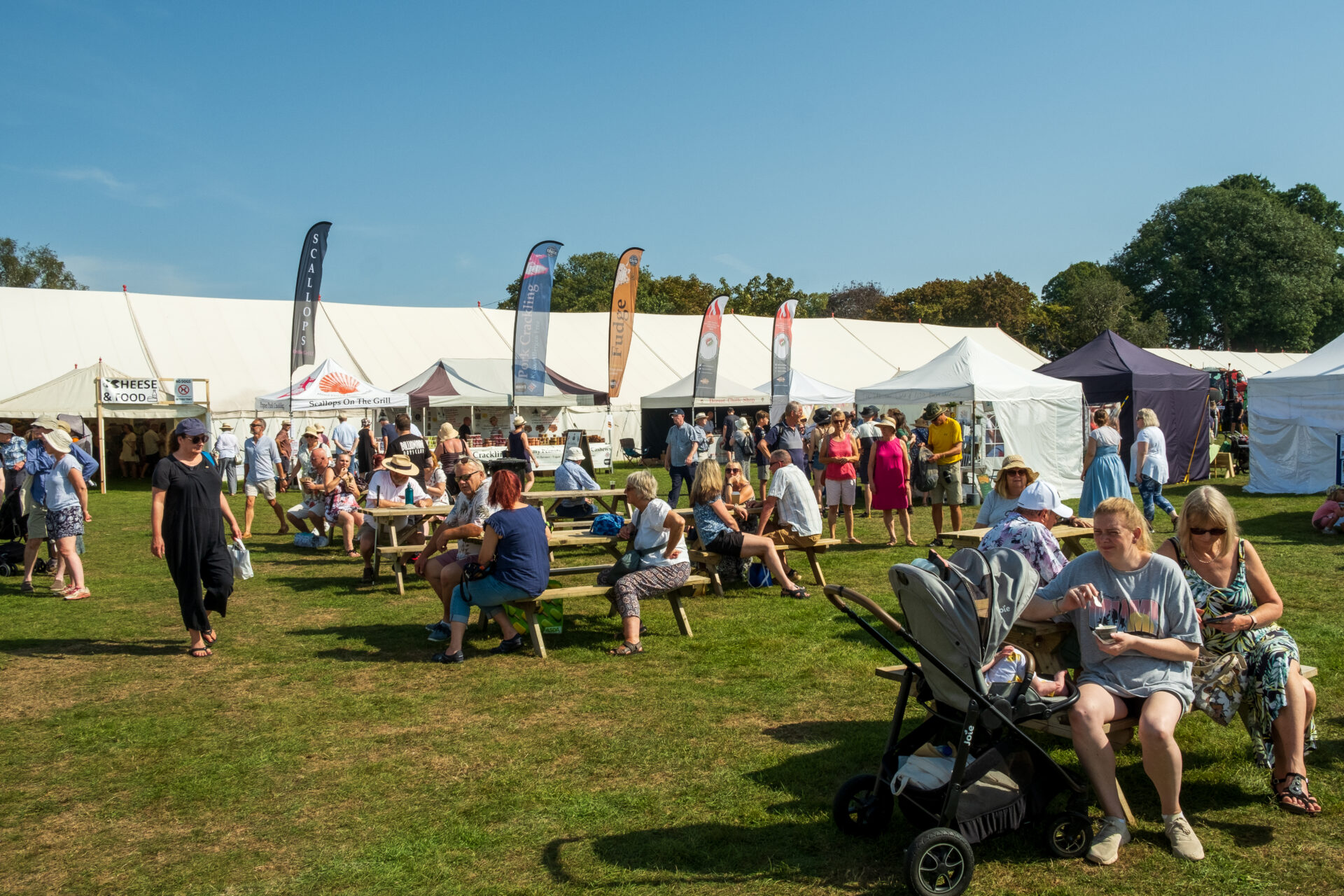
With the distinctive aromas of Renegade Monk and Tunworth cheese infiltrating the tents, how did the traders manage on one of the hottest days of the year when temperatures hit 30 degrees? Did the cheese melt? The 2023 festival will certainly be remembered as one of the hottest.
“We only took out the cheeses we were sampling and we had lots of refrigerated ice packed containers,” said Penny Nagle from Feltham’s Farm. “But it was so so hot in the tent!”
Traders came well prepared for working in heatwave with perishable goods. Sue Plummer, helping on the Mere Trout stall, had crates densely packed with ice, including chilled containers for people who wanted to store their shopping while still looking around. On the Real Cure venison burger stand, the good weather was a relief: they echoed many farners as they said “At least we got the harvest in!”
Sturminster Newton cheese festival 2023 was the hottest on record. Image: Chris Robinson
More than cheese
But there’s a lot more than cheese at Sturminster Newton Cheese Festival. The food vans had everything from raclette to Thai street food and crepes. There were fresh hand-dived scallops and crab sandwiches from Lyme Regis. Enticing fish cakes from Calshot-based Fabulous Catch Company, included show specials with cheesy recipes. The festival is increasingly a focal point for quality specialist food connoisseurs. Spice traders, Stony Groves from near Dorchester, displayed their Cambodian Kampot pepper and Himalayan pink salt – renowned as being among the best in the world. Tea sampling at Comins was a delight, with the refreshing taste of a first flush Darjeeling and Japanese green tea.
Orchard 101 at Sturminster Newton Cheese Festival. Image: Chris Robinson
Their exquisitely delicate tea pots on display added a charm to this specialist stand. Local Orchard 101 did a roaring trade in apple cider vinegar from Sturminster Newton. Mounter’s Gin from Marnhull flew the flag for local alcohol, along with liqueurs from Mure Liqueurs and from Forager Spirit. It was another opportunity to try something unusual such as cherry kombucha from Bath Culture House, learning about fermented food and their benefits to your gut. The charcuterie was also out in force, with abundant samples of cured meats such as Filletto or fennel salami from Somerset Charcuterie (an ideal accompaniment to all that cheese!).
Sturminster Newton Cheese Festival crafts and artisans. Image: Chris Robinson
In an adjacent tent and outside, there were rows and rows of crafts. From jewellery to chopping boards, mirrors to knitted hats, there was something to tempt most people. There were charity stalls too, including the popular Vale Pantry tombola. In the background, the cheers from the children’s entertainer’s crowd and the squawk of a Punch and Judy show blended with the traditional sound of folk music. People chatted over a beer or ice cream, relieved that tiny droplets of rain were beginning to fall and finally breaking the heatwave.
Sturminster Newton Cheese Festival is much more than cheese – it is emerging into a fine food event, and a terrific opportunity to showcase the best local produce. Here’s to 2024.
This month, more than 300 makers and artists will be taking part in the first full the Somerset Art Weeks Open Studios event for five years
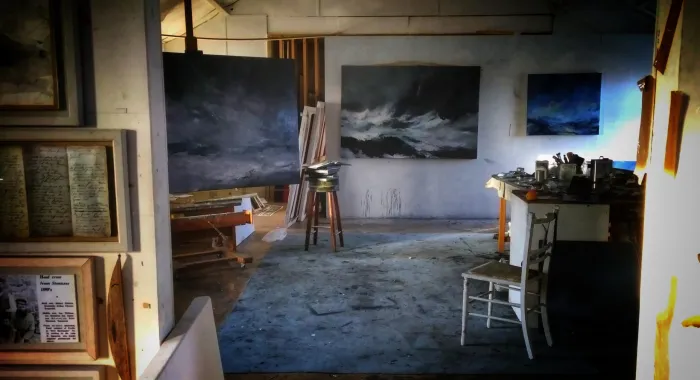
Jannette Kerr – known for depiction of wild seas – is opening her studio in Coleford
HIS year’s Somerset Art Weeks, from 16th September to 1st October, will be the first full Open Studios event since 2018, with more than 300 makers and artists across the county, from Wincanton to Watchet, wil be inviting the public into their work-places. Organised by Somerset Art Works, since its inception in 1994, the the open studios fortnight has become an important event in Somerset’s cultural calendar. Traditionally biennial, alternating with group and gallery shows, it is an invitation to meet some of the area’s most exciting and original creative people in their own place – studio, workshop, home or shed. Painters, photographers, printmakers, sculptors, potters, woodworkers and textile artists will all be opening their space to show their work. It’s not only an opportunity to meet interesting, creative people but also to explore the county and discover places you didn’t know! It’s the perfect chance for the casual and curious visitor to see what goes on behind normally-closed studio doors. Artists value the engagement that the event provides; a chance comment or connection can sometimes provide invaluable encouragement. In Batcombe, a collection of artists are working together: Jo Addison creates linocuts, etchings and watercolours of natural subjects. Camilla Frederick is a portrait artist who works in oils. Alison Harrison is a sculptor works in bronze and mixed media. Debbie Hart specialises in tesxtile art with patchwork and quilting. Jade Ogden makes handwoven scarves and soft furnishings using dyed and undyed local and Shetland wool. Jan Pitt creates her work in pastels and oils. Peter Sheldon’s is showing a collection of quirky illustration and newsprint collages. Castle Cary hosts an exciting cluster of creatives at Pithers Yard, including photographer Dave Watts, painter Franny Watts, prop maker Charlotte Austin as well as Tom Baskeyfield and Lotte Scott, who create works informed by interests in ecology, spirituality, matter and place. Near Frome, ceramicists Christine-Ann Richards and Lutz Krainhoefner have a joint studio venue, with work, inspired by their travels to China and Japan, featuring burnished, smoke-fired pottery and glazed stoneware. The Somerset Open Studios 2023 Guide is online here and Somerset Art Weeks (SAW) venue signs will guide you to the sometimes hidden venues. SAW is also working with Visit Somerset to give an increased profile for the event and its artists on the Visit Somerset website. For more details and to plan your visit, please visit somersetartworks.org.uk or visitsomerset.co.uk
Inspired by post-Impressionists, Carolyne captures intimate, light-filled interiors in her Shaftesbury studio
Carolyne Moran in her garden
During lockdown, we were plunged into a world where both work and social life were played out in a virtual world – and we suddenly had the opportunity to sneak a look into the personal spaces of our friends, of colleagues and celebrities. This intimate snapshot into the lives of others is not entirely new – artists have always taken inspiration from their immediate surroundings, often revealing much about their everyday lives. The things we have in our homes say a lot about both us and the lives we lead. Interiors become a portrait of the owner; the human essence that is left behind when the room empties. Carolyne Moran is an artist drawn to interiors: ‘But it has to be the right interior. It’s to do with light against dark, or certain reflections. Older properties inspire me … and I get very attached to chairs and odd pieces of furniture,’ she says. In her studio, at the foot of Shaftesbury’s Tout Hill, alongside her paintings is an eclectic mix of antique chairs and objets d’art.
All images: Edwina Baines
Antiques and art Carolyne studied Fine Art at Bournemouth and Exeter colleges of art. After six years of training, she worked for some years with the influential Bath artist Saied Dai. She completed her PGCE at Cardiff College before embarking on a career as head of the art department in several Dorset schools. She has had regular exhibitions at the Mall and Bankside Galleries in London, where she has won two awards. Her work has been featured in numerous art publications including The Artist magazine, and she is listed in Who’s Who in Art. Some years ago she ran an antique shop in Blandford where her love of beautiful furniture led to a constant hunt for new finds – many of which are included in her paintings.
Carolyne’s studio is filled with an eclectic array of objets d’art
The Red Aga – a work in progress
Putting in the work Carolyne is inspired by the Post-Impressionists Pierre Bonnard and Edouard Vuillard, founder members with other young artists of the avant-garde brotherhood Les Nabis (The Prophets). This Parisian group played a large part in the transition from Impressionism to Abstract art. After Les Nabis disbanded, Bonnard and Vuillard were involved in the Intimism movement, which is known for the depiction of everyday scenes, particularly within domestic interiors. ‘The first Bonnard exhibition I went to, I cried the whole way around,’ Carolyne says. ‘I found his paintings so moving.’ The influence of Bonnard is evident in many of Carolyne’s paintings – his interiors with their characteristic intimate and cosy atmosphere and his use of colour to capture the play of light and shadow. Vuillard was also known for his small-scale interior works, combining flat patterns with delicate colours. Carolyne’s favourite place to paint is sitting by the window with views of her garden: ‘I try to have discipline in my art. Painting is hard work. You have to set aside the time,’ she says.Once at work on a painting, she will often stay at the easel until late at night – and then lie awake thinking about the next stage. Painting mainly in gouache and oils, she will spend a day working out the composition in pencil or charcoal before applying a tint to the paper. Work may continue on several pieces at once and it could take up to a month to finish a complete painting.
Looking Through to the Little Stone Conservatory
‘Shapes, patterns and colours are important to me. I don’t do big landscapes. Often my flowers and garden paintings are like rooms. I’m often looking through the window … It’s your personality that you put on a piece of paper or a canvas,’ she says.Holidays in France offer further time for painting. Each of Carolyne’s works tells a story. In Looking Through to the Little Stone Conservatory, someone may have just walked out of the room into the sunlight, leaving the door open behind them. Another shows a soft glow from table lamps – perhaps showing a favourite spot for the owner to sit and read. Carolyne’s own garden – full of flowers, especially foxgloves – is also a source of inspiration. Everyday objects with a particular shape, pattern or colour can also capture her imagination. Her striped kimono hanging on the back of her bedroom door has been the source of several paintings and the red Aga – central in a current work in progress – has been featured several times. The kimono and the Aga both symbolise comfort and a familiar warmth.
Studio Interior With The Green Chair
Open studio Carolyne opens her studio for the second Blackmore Vale Art Trail which runs from 9th to 17th September. Participants all live within a ten-mile radius of Shaftesbury. Artists across a wide range of disciplines, from painting to jewellery, are opening their studios. Brochures are free and available in shops, pubs, cafes and libraries.
Get set to cheer your favourite team as the Pony Club Mounted Games gallops into the Dorset County Showground for the first time
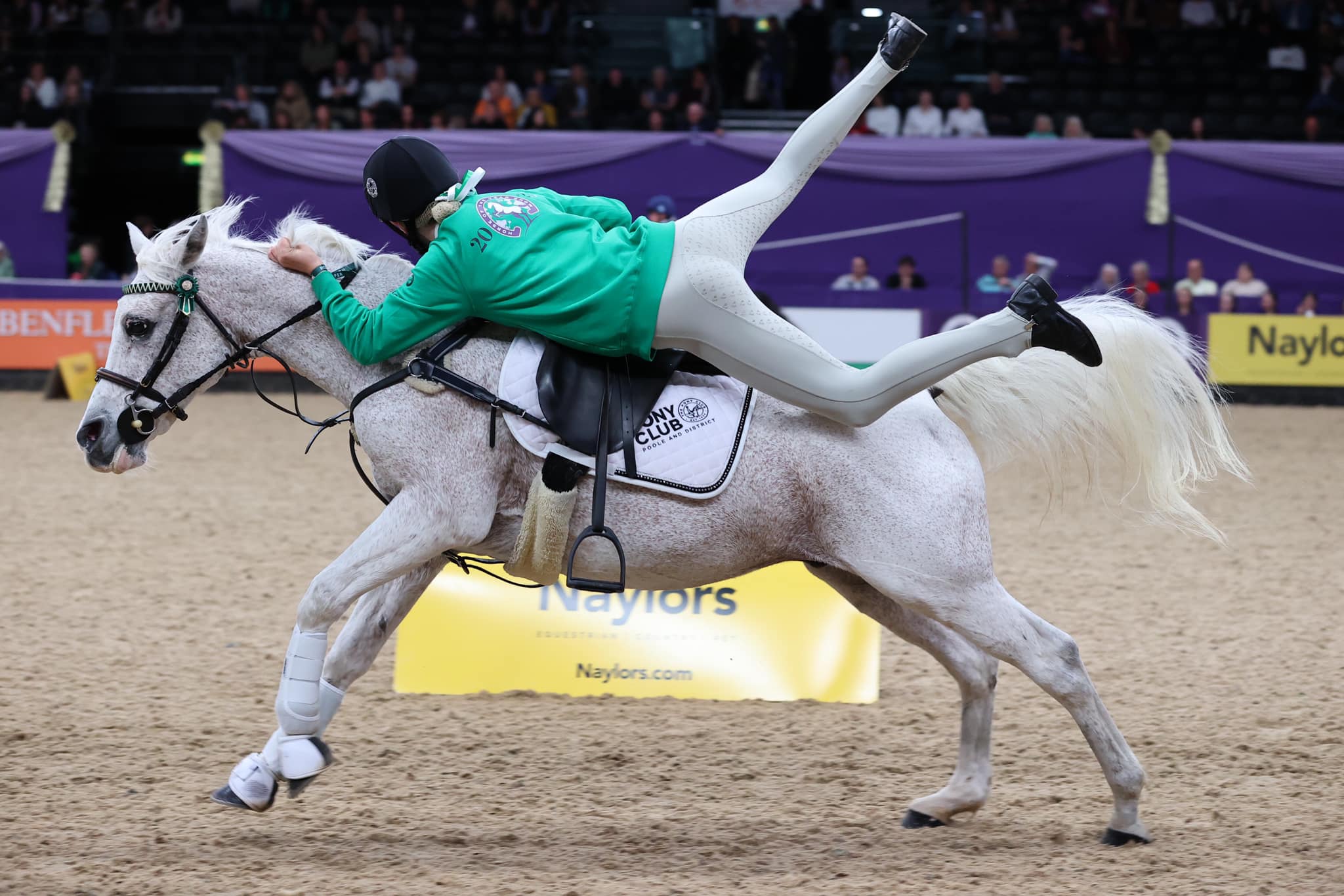
Poole & District Pony Club’s Holly riding Dude at NEC Birmingham in the Horse of the Year Show 2022
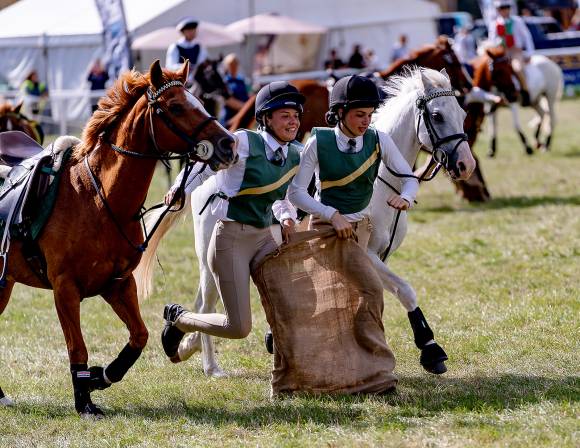
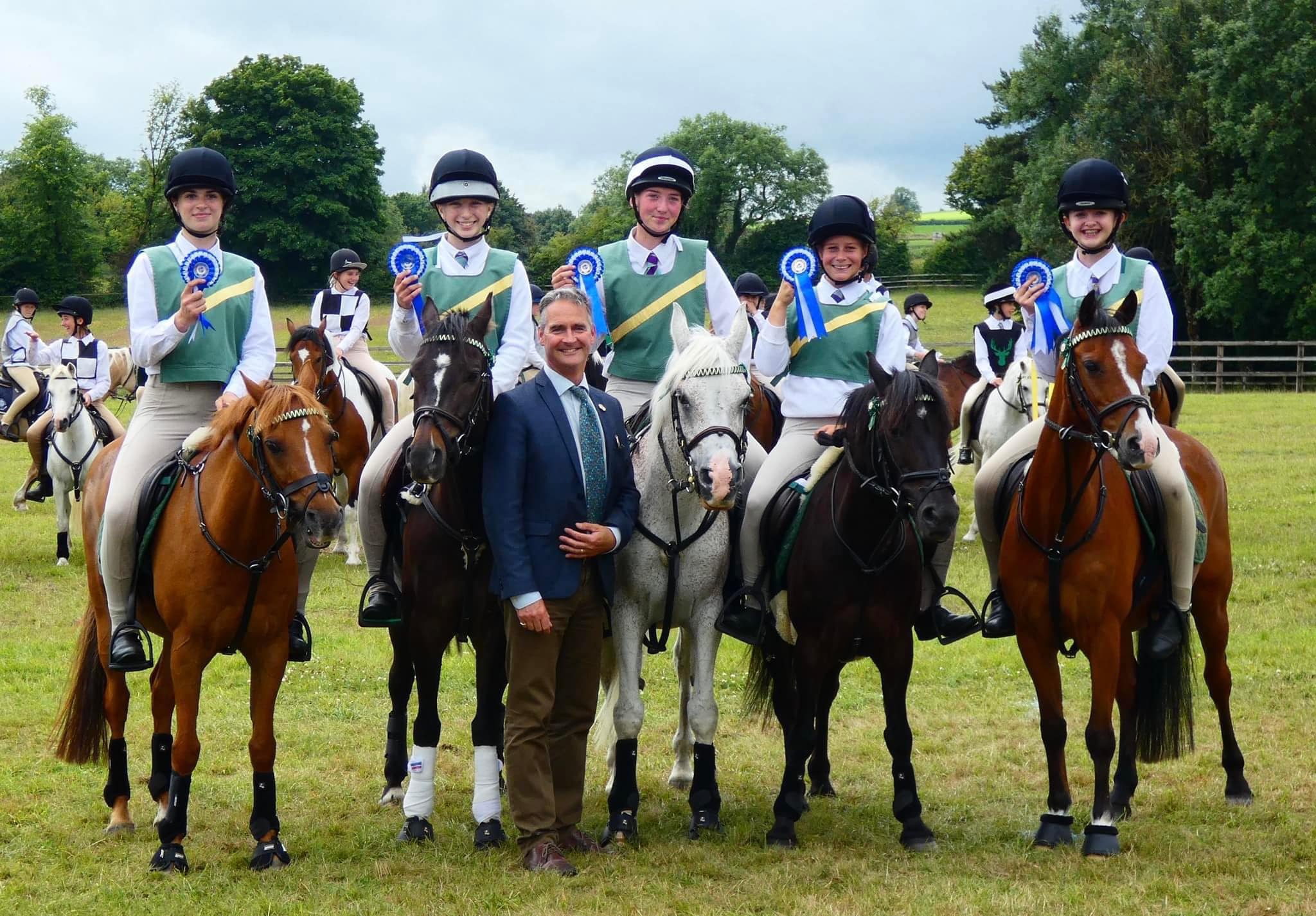
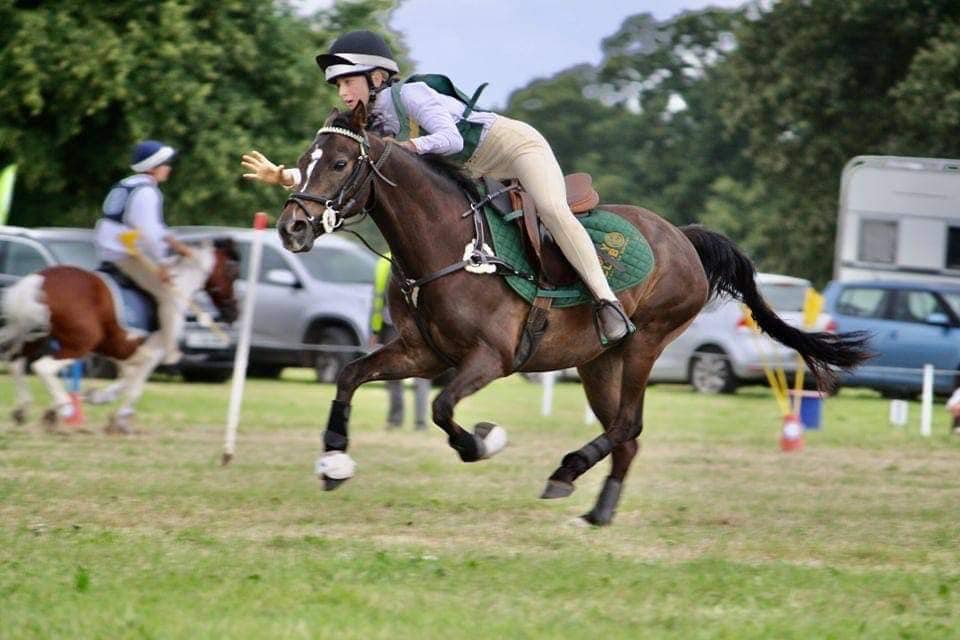
Think school sports day … but on turbo-charged ponies! The thrilling Pony Club Mounted Games are another new attraction at this year’s Dorset County Show, and it all happens in the brand new Hill Top Ring. Featuring fearless young riders ranging in age from eight to 15, teams of four or five riders and their speedy ponies compete in a series of exciting relay races that involve a mix of turns, handover skills, vaulting and galloping.
Riders must navigate their way through a variety of obstacle races, which can include bending poles, stepping stones and a stacking race. All classes rely on the skill, control and agility of the rider to complete without penalties – and of course finish quicker than the other teams. The ponies must be calm, fast and able to turn on a sixpence – which makes great entertainment for spectators! Each team sports a different colour bib so you can cheer on your favourite.
Top tip – the last rider in each team wears a white headband, so be sure to look out for them crossing the finishing line! Ian Mariner, Pony Club Mounted Games chairman, explains: ‘These games are an adaptation of the traditional gymkhana, which tends to have solo competitors. Mounted Games focus on teamwork. It’s all about the three C’s – concentration, competitiveness and commitment. Plus, of course, a love of ponies. ‘And the ponies love it too. It’s just like teaching a dog, they come to understand the games and what is being asked of them. They get as excited as the riders!’ ‘The more mature ponies are definitely the best,’ says Nicola Way, the Mounted Games Area Coordinator and trainer at the Poole & District Pony Club. ‘They have years of experience to cope well with the sights and sounds of big events.’ ‘These exhilarating games are not just about having fun,’ says Ian. ‘They are also teaching these young horse riders valuable skills – improving accuracy, agility, concentration, speed, hand to eye co-ordination, team work and sportsmanship.’
Many of the Mounted Games riders go on to compete for their country, working their way up through local, regional, national and even international championships. Part of the Pony Club agenda is to also teach young riders about animal welfare and care of their ponies. Many competitions now include an element of stable management as part of the judging process. The four tiers of Mounted Games competitions culminate in the six top teams competing at The Horse of the Year Show for the coveted Prince Phillip Cup. Ian Mariner says: ‘Many of these young riders you see today competing could end up as stars in the equestrian world. You could be cheering on a future Olympian!’
Did you know?
The Pony Club, founded in 1929, is represented in 27 countries with a worldwide membership exceeding 110,000, making it the largest association of young riders in the world. Mounted Games is one of nine disciplines Pony Club members can learn, along with show jumping, dressage, endurance, eventing, polo, polocrosse, pony racing and tetrathlon.