Easy to identify and a downright astonishing lifecycle – conservation officer Mariko Whyte takes a closer look at one of our most intriguing native insects
The violet oil beetle (Meloe violaceus, shown) and the black oil beetle (Meloe proscarabaeus) are found across Dorset
Of the UK’s eight native oil beetle species, three are now extinct and three are extremely rare. All are under threat, suffering dramatic declines due to changes in how we manage the countryside, as their fate is intertwined with some of our most important native pollinators. The most common species, the violet oil beetle (Meloe violaceus) and the black oil beetle (Meloe proscarabaeus) are found across Dorset, and are widespread throughout Britain. Up to 30mm in length, both species are black, often with a bluish metallic shine. Despite the names they are not easy to tell apart! Unusually among beetles they are flightless, having reduced wing cases, a sausage-like segmented body and long antennae. The oil in their name refers to a noxious orange fluid exuded from their joints when they are threatened, repelling predators. The oil beetle’s way of life is just as odd as its appearance, inextricably linked with certain species of solitary mining bees. Sharing the same flower-rich habitats as their associated bee species, black oil beetles are found mainly in grasslands while violet oil beetles are commonly found in woodland. Adults emerge from the ground in spring and can be spotted bumbling around on sunny days between February and May, grazing on vegetation and seeking a potential mate. Males have modified segments in their antennae which they use in courtship to clasp and stroke the female’s antennae (presumably to get her in the mood).
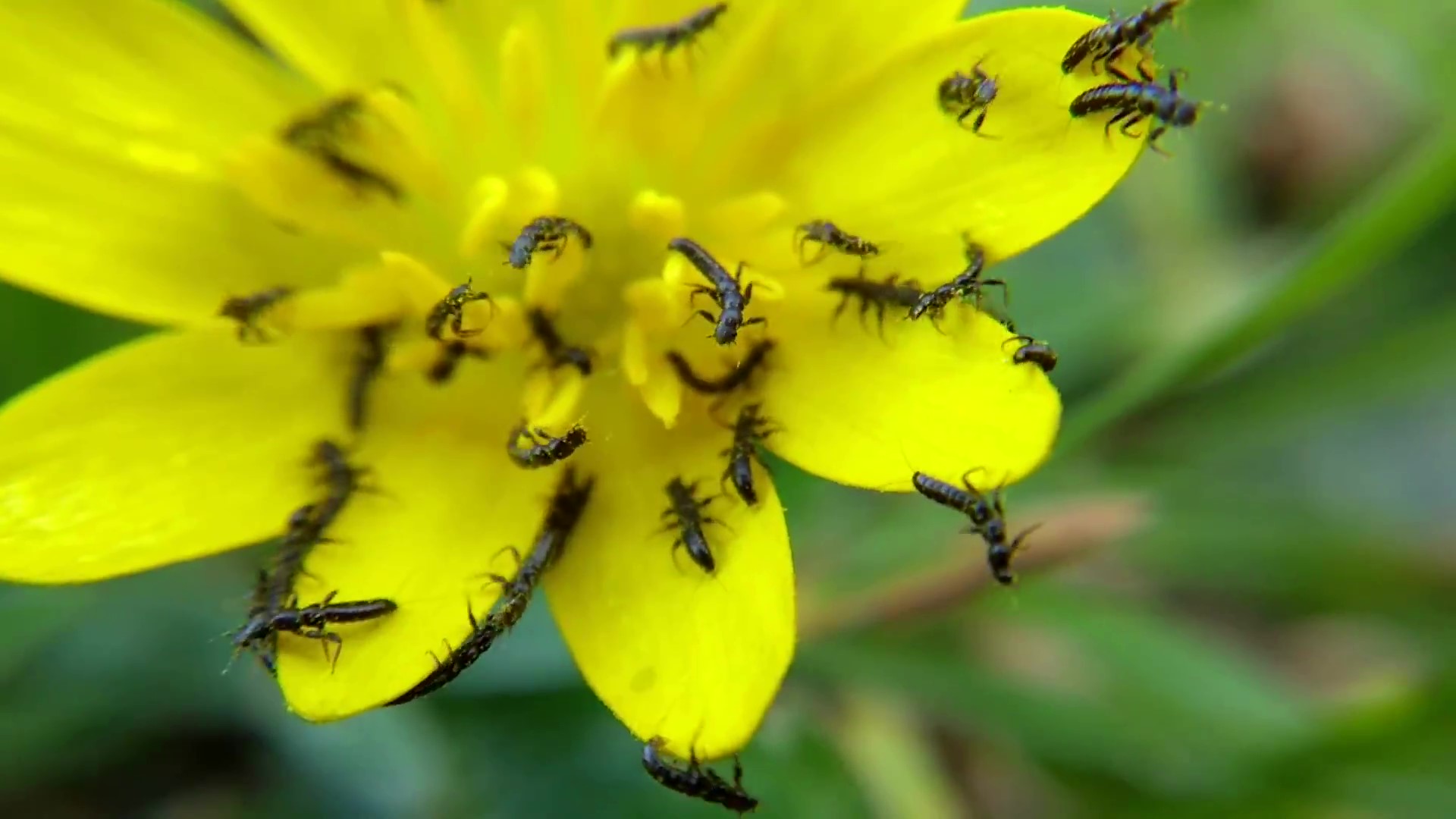
Violet oil beetle larvae on a lesser celandine. Image: Mariko Whyte
Bee parasites The female lays batches of about 1,000 eggs in shallow burrows dug in loose, warm soil – laying an astonishing 40,000 eggs in her short two-month lifespan. For black oil beetles, the eggs hatch into active earwig-like larvae within a few weeks, with thousands of 2mm orange triungulins (the baby beetles) scrabbling to reach the top of nearby flowers, scurrying with frenetic energy. Then they wait for passing insects to grasp onto. Violet oil beetle triungulins are black and don’t emerge from the ground for a whole year after eggs are laid, so they are active earlier in the spring, overlapping with the adult generation. The oil beetle larvae are effectively parasites of mining bees, hitching a lift from the flower to the bee’s nest. Once inside, the triungulins feed on the egg and pollen stores of their host and quickly moult to more typical grub-like larvae, eventually pupating and overwintering as adults underground before emerging as a new generation in the spring. Visit dorsetwildlifetrust.org.uk to learn more about Dorset’s beetles.
The colour-changing flower crab spider hunts among the summer blooms: they fascinate ex-arachnophobe wildlife writer Jane Adams
I’m watching a spider on a flower, in the garden. The bloom of the pink allium resembles a lollipop perched precariously atop a wobbly bare stick. From the four bulbs I planted last autumn, there are now four perfect spheres, each one covered in bumblebees, honeybees and hoverflies. The spider, more precisely a flower crab spider, has set up shop on one of these blooms. For years, flying insects have fascinated me. Their artful flight and tuneless buzzing are the essence of summer days and warm, soothing sunshine. But I am also fascinated by arachnids. Not that long ago, I had an irrational fear of them, and would run a mile if ever I saw one. However, over time (and a lot of close-up photography), I have grown to love them. The only complication is this particular spider also has a love of my favourite flying insects…
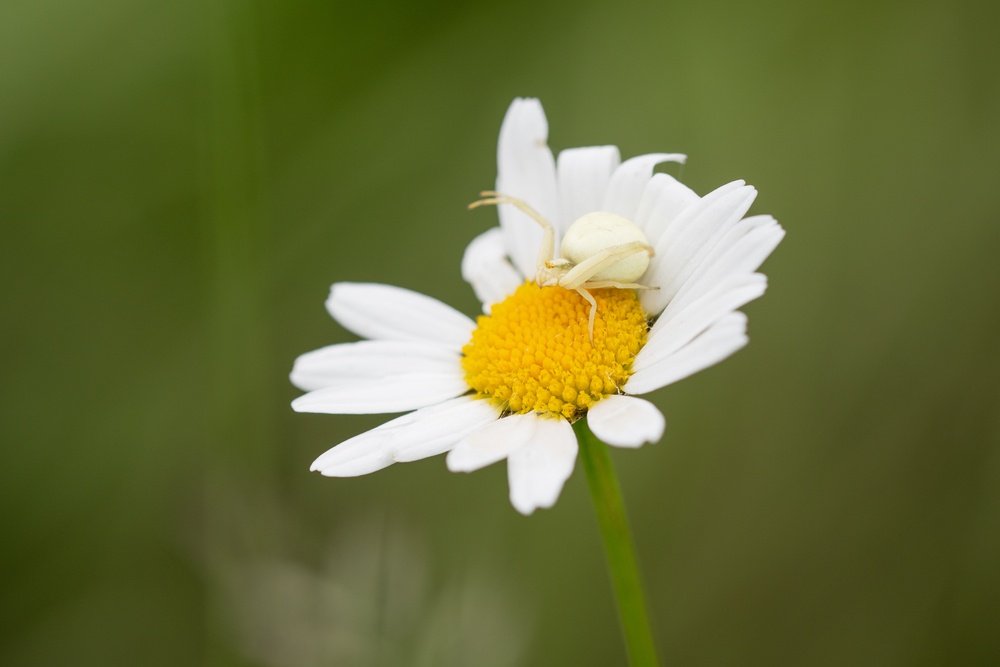
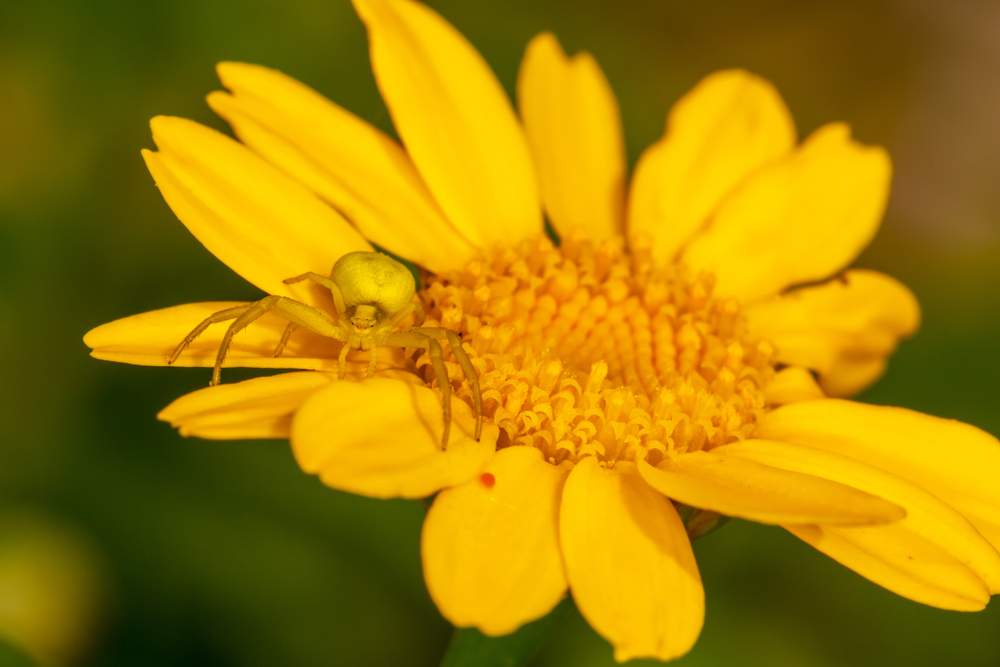
Some party trick Flower crab spiders, or Misumena vatia, are common in gardens throughout the south. The Latin term ‘vatia’ means bent or curved, and as I watch this spider, she sits motionless with her powerful crab-like front legs ready to pounce: I’m mesmerised. Unlike many species of spider, the crab spider doesn’t make a web. Instead, she excels in the art of ambush. If and when she catches something, she will immobilise it by injecting digestive enzymes into its body with her fangs, before eventually sucking out its bodily fluids. I know, I can hear you now. Ewww! How on earth can you love THAT? Maybe love is too strong a word, but I definitely admire a transformative trick she keeps up her hairy sleeve. The female flower crab spider has the remarkable ability to perceive and see colour, and she can adapt and change the colour of her own body. This unique skill means she can blend seamlessly with the flowers that attract the highest number of prey. Admittedly, it can take her a while to change her shade – usually between ten and 25 days – but by secreting a liquid pigment into her body’s outer cell layer, she can morph from white to yellow, pale green… or even pink. Imagine that as a party trick.
It can take her up to 25 days to change her shade, but the crab spider can morph from white to yellow, pale green, or even pink, to match her chosen flower
Flower crab spider facts:
Size: Female 5-9mm Male 3-4mm (the female will eat the male before or after mating, if he isn’t quick to escape!)
Eats: Flies, bees, butterflies, grasshoppers and moths
Find them: On garden and wild flowers from May to August (but you may need to look hard to discover them!)
A local expert from Citizen’s Advice provides timely tips on consumer issues.
Q: ‘I’m moving house and will be renting somewhere on my own for the first time. Do you have any advice on what I should do when looking for a new home?’
A: Once you have decided whether you want to rent directly from a landlord or through a letting agent, you can use websites to find somewhere to rent – also check the local press, visit local estate agents and you can also ask friends and family to help. Never pay any money before viewing the property, and if possible take someone with you. Avoid renting directly from an existing tenant (‘subletting’) as the tenant might not have the landlord’s permission to rent to you. If a tenant shows you around the property on behalf of the landlord they should give you the landlord’s contact details.
Make sure the property is safe and affordable by asking some key questions. For example:
How much rent is and how it should be paid
If the rent includes any bills
How long the tenancy is
If there’s the opportunity to renew and if there’s a break clause in case you need to end the tenancy early
If you need to pay a holding deposit while the landlord carries out pre-tenancy checks
What documents you’ll need to provide, including evidence of your Right to Rent
How your tenancy deposit will be protected
If any furniture or appliances are included in the tenancy
Whether you can have pets
You should also request any obvious problems with the property are fixed before you move in.
If a landlord refuses to rent to you because of who you are, this may be discrimination, as may a ‘no kids policy’ or refusing to rent to you because you get benefits. You only need to tell a landlord or letting agent you receive benefits if they ask. Some may then require a guarantor. They can still refuse to rent to you if they think you won’t be able to afford it. Remember, if you need any other advice on renting or you run into any problems, you can contact Citizens Advice on 0800 144 8848.
This month Barry Cuff has chosen century-old postcards of Cheap Street and what was then the Ladies College in Sherborne…
Sent to Miss L Sharp in Pokesdown (Bournemouth was still in Hampshire – it was ‘moved’ to Dorset in 1974) – note the stamp placement, which is significant. This 45º angle was the stamp code for ‘A Kiss’ from disappointed Frank: ‘Dear Lil, I am awfully disappointed you have not wrote as you promised. I quite expected to hear from you. I do not wish you to write by return but as you promised, I think your letter must have got lost. I writing this in shop, by the time I get home I quite expect to hear from you kind regards love Frank
The image is of what is now Sherborne Girl’s School, which at the turn of the last century was known as Ladies College, Sherborne. The card was sent in 1913 to Miss Hatcher, at Boxmoor in Hertfordshire, by Jimmy, who appears to be a teacher at the school – from the message he would seem to be her brother: ‘My darling Pud. This postcard shows you the school. It only shows a little bit of the white lodge, but it takes in our bedroom window, which I have marked. I expect mother has broken the news to you by this time about our returning for a 2nd term. I hope you are surviving the shock. Isn’t it gorgeous to think of 5 weeks today! We may be going to bring a Seoteh (?) girl back for one night, to break her journey! Jimmy’s hands are smelling simply disgusting of onions as he had to chop some onions in the kitchen this morning! Doubtless you would enjoy the scent! I don’t.We are keeping one of the students 21st birthday today, we are going to give her an awfully nice pair of earrings. Please write soon. Heaps of love. Jimmy
This is a simple and oh-so-tasty summer dish, combining the delicious umami flavours of soy and miso with the decadence of honey and sesame. You can remove the chilli oil if you don’t like any heat at all, but in this recipe its designed just to be in the background. I love the cashew nuts here – they add a little bit of healthy fats into the mix, but you can leave them out if you don’t like or can’t eat nuts.
Ingredients (feeds 4)
For the sauce:
1tbs sesame oil
2tbs oyster sauce
4tbs dark soy sauce
6tbs honey
1tsp chopped ginger
1tsp chopped garlic
1tsp fish sauce
1tbs miso
1tsp apple cider vinegar
1tsp chilli oil
Extra sesame oil for frying
Sesame seeds for finishing
Then:
100g cashew nuts
4 spring onions
Stir-fry vegetables (beansprouts, mushrooms, shredded cabbage and carrots etc). For ease you can buy a pre-prepared packet of veg to use here
Rice for four – 1/2 cup uncooked per person is a good guide
Salmon fillets – you may need more than four if they are small, just use your judgement
Preheat the oven to 180º fan/gas 6. and line a baking sheet or roasting tin.
Add all the sauce ingredients into a large bowl and mix well. Remove any skin from the salmon and cut into roughly one inch pieces. Place them into the bowl with the sauce and gently mix until the salmon is well-coated. Leave for 10 to 15 minutes.
In a hot frying pan, heat the cashew nuts in a little sesame oil just until they have a little extra colour from the pan. Remove from the heat and place into a bowl until later.
Start your rice cooking – just plain boiled rice, made according to the packet instructions.
Remove the salmon pieces from the bowl and spread them out onto the baking tray. Bake in the oven for 15 minutes. Keep the remaining sauce!
While the salmon bakes, drizzle 1tbs of sesame oil into a large frying pan and leave to get hot. When hot, add your vegetables – use a pair of scissors to snip your spring onions into small pieces and add to the pan with the rest. Stir-fry until the vegetables are just cooked and getting a little colour, then pour in the remaining sauce. If your hob runs very hot, turn the stove down at this point and cook the sauce through with the vegetables.
To plate, add your rice, top with the stir-fry, add some of the toasted cashews, drizzle on the sauce and then finish with the salmon pieces. A sprinkle of sesame seeds adds a little razzle dazzle!
In the heart of Winterborne Stickland, a village community is rallying to save a piece of their village’s history. The Stickleberries pre-school and day nursery abruptly closed its doors in August 2023, leaving many families scrambling for childcare. Stickleberries nursery had opened in the former school building in 2015. Last August, Ofsted had suspended the nursery’s registration three days before its closure because inspectors believed children “may be at risk of harm”. The nursery resigned its registration the following day. Now, a determined group of locals has launched a GoFundMe campaign to buy the historic building and reopen it as the Winterborne Stickland Nursery School. The site in Winterborne Stickland was gifted for use as a school to the Diocese of Salisbury in 1859 by banker Carl Joachim Hambro, then owner of Milton Abbey. It served as the village school until 2013. The nursery which succeeded it offered essential services like after-school and holiday clubs, benefitting children from the village and surrounding areas, including Blandford. When the day nursery closed it triggered a clause which meant the whole site gets handed back to the benefactor’s family. The building is now under threat of being sold at auction: The Diocese of Salisbury, which is currently holding the site as trustee, said: ‘The legal process to trace descendants has recently finished and there is a valid claim.’ Locals fear a sale of the site could potentially lead to its demolition. Leading the effort to save the school are locals Anna Way and Carole House, who have formed a Community Interest Company (CIC) to manage the nursery if they can secure the building. The village has shown overwhelming support, with various locals donating their professional expertise free of charge. Anna and Carole are driven not only by a passion to preserve the legacy of the school but also to meet the urgent need for a pre-school with wraparound childcare in the area. Ann says she hopes reopening the school would be the ‘catalyst for really positive change. There’s a terrible shortage of childcare in North Dorset.’
EXCITING NEWS – guess who’s been shortlisted (again) for another national award? Yep, it’s us! The BV is a finalist for Regional News Website of The Year at the prestigious Press Gazette’s Future of Media Awards!
We’re blushing a bit here – this is the third time this year we’ve been on the national stage. We might have to build a bigger trophy cabinet (just kidding, we’ve only actually won one. So far … ).
These awards celebrate excellence in digital news media – the judges were looking for technical excellence, evidence of both audience and commercial success and naturally for editorial brilliance. To be recognised among the best in the industry is always an honour. To find ourselves on a nationally-respected shortlist three times in one year is mildly bonkers.
We couldn’t have done it without the genuinely amazing BV team – and our fantastic readers.
Thank you for your support: here’s to more great stories ahead!
Rescued Shetland pony Blackberry may be small, but overcame neglect to rule as the farm’s feisty leader with a big personality beloved by all
Blackberry is now irrepressibly nosy. Image: Courtenay Hitchcock
Blackberry is the quietest member of our herd. As her name might indicate she is a black mare – a diminutive, placid Shetland. But looks can be deceiving… She may be the smallest family member, but she is the absolute queen of the farm and totally in charge. The donkeys are in awe of her big personality, and one look, one flick of the tail, and they are off. Grandma has spoken! Two years ago I was asked if I would rescue one of four local Shetlands very much in need of a decent home. On the appointed day, a sad and sorry figure walked up the drive, coughing and wheezing. Blackberry had mites and fleas, very little coat and sweet itch had caused areas of raw flesh. Large of belly, she had clearly carried many foals in her time (but fortunately not when she arrived with us!). She was promptly given the full beauty treatment, clipped and bathed, and then the vet assessment commenced. As my husband says: ‘She may have cost just a pound (always pay a pecuniary sum to make sure that the animal is legally yours) but she’s cost a great deal more since! It’s fortunate that I am rather fond of her…’
Blackberry a week after arrival – clipped and sore but treated and on the mend. Image: Sally Cooper
Ancient and sturdy Small ponies have existed in the Shetland Isles for more than 2,000 years, and archaeologists have found evidence of them being domesticated since the Bronze Age. Immortalised by Thelwell cartoons, they are well-loved even by non-equestrians. A hardy breed from the Scottish islands, they have a very thick coats to withstand the extreme conditions of their native home, and their short legs make them very sure-footed. They average about 11 hands high – the breed standard states they must be a maximum of 42 inches (107cm). Many describe them as docile – but this is not a description I recognise! I prefer feisty, intelligent, extremely loyal… and they are wonderful companions. They prefer to live out all year with rough grazing and are known for having a sixth sense for danger. Blackberry will stay out in a howling gale with icicles hanging from her coat, sniffing contemptuously at everyone else in in the barn in their rugs. The strength of Shetland ponies is legendary – they are the strongest of all horse breeds, relative to their size. For centuries, these ponies have cultivated land, carried peat, transported seaweed, and served as transportation for their owners. Fishermen who owned them even used hair from their tails for fishing lines. When children were banned from working in the mines, the Shetland ponies were used instead, and the miners were said to be very fond of them. These days they are used as first ponies, mascots, in carriage driving and many have successful careers as racing ponies. They may have little legs, but boy can they shift … when they choose to! They are also famous for their longevity. The oldest recorded pony was Sugar Puff, a Shetland-Exmoor cross, who reached 56. The oldest known Shetland pony was Twiglet who lived a happy retirement roaming free at Forde Abbey, and who died at the age of 50 in 2017.
Sadly, Blackberry did not come to us with any papers or passport, but the equine vet assessed her teeth and thinks she’s in her late 30s. Blackberry’s teeth were actually the culprits hindering her recovery. Horse teeth are not like human teeth, they grow continually and need to be level for them to grind food correctly. Equestrians will have an equine vet assess their horse’s teeth annually to level the teeth off for easy eating. Our own equine vet took lots of photos of Blackberry’s terrible teeth and jaw for a presentation entitled: ‘How not to look after your horse’s teeth’. When she arrived, they were so bad that Blackberry could only roll and suck her food and then spit it out in wet balls. After several grindings and the removal of two rotten teeth, I am pleased to report that her eating has improved.
She’s the boss Blackberry is absolutely intolerant of just one thing: vets with needles. When she spots one, the vet declares she transforms from Shetland to Shitland. And being short of stature with an equally low centre of gravity, when she decides that she will not stand still she is an absolute force to be reckoned with. At the (now required) microchip insertion, things almost got out of hand. Bribery was the only course of action. I am pleased to report that two years on, Blackberry is now very much part of the family. She babysits the big horses when the others are out competing and the young donkeys adore and respect her. Her coat is finally black, thick and shiny, and she is always in the right place at the right time: “No halter required thank you”. She will see out her dotage with us and her motto is absolutely clear: “This Little Lady Is In Charge.”
Blackberry today, in sturdy health with a thick and glossy coat, ruling the garden with a definite bossy gleam in her eye. Image: Courtenay Hitchcock
Horse and pony rescue If you’re now thinking you also have some space for a rescue pony, there’s a few things to consider first. As with any animal, rescuing an equine is a worthwhile and rewarding opportunity, but it is not without its difficulties. There are many challenges to consider:
Be prepared: You will need be assessed for suitability – of yourself, your facilities and also your knowledge.
Health: Mistreated rescues often have ongoing health issues. Be ready for the additional cost of vets, meds, vaccinations, teeth, worms, skin and coat problems, allergies and gut issues. There are often feet and hoof problems for your farrier to sort out too.
Behavioural Challenges: Rescue animals have often been poorly handled or kept in frightening conditions. Understandably this can make them nervous of many situations.
Time Commitment: Rescue animals are often slow to acclimatise and trust – you will need lots of time and endless patience to help them settle.
Long Term Love: Having been let down once it is important that you make a lifetime commitment to your new family member.
Above all remember that in rescuing a pony you give them another chance – and possibly save their life. From personal experience I can say you will develop a close and very special bond. To be trusted by those who have been abused is the greatest honour.





 The BV is a finalist for Regional News Website of The Year at the prestigious Press Gazette’s Future of Media Awards!
 ).
).