Home Blog Page 446

THE IMPORTANCE OF HEDGEROWS

0

In 2000 our future CPRE President, Bill Bryson, wrote: “For well over a thousand years hedgerows have been a defining attribute of rural England, the stitching that holds the fabric of the countryside together. From a distance they give the landscape form and distinction. Up close they give it life, filling fields and byways with birdsong and darting insects and the furtive rustles of rodents…Hedgerows don’t merely enhance the countryside. They make it.” Nowhere is this more true than in the pastoral landscape of North Dorset, with the added realization of the key role hedgerows can play in halting biodiversity decline and tackling climate change, by capturing carbon from the air and storing it in plants.
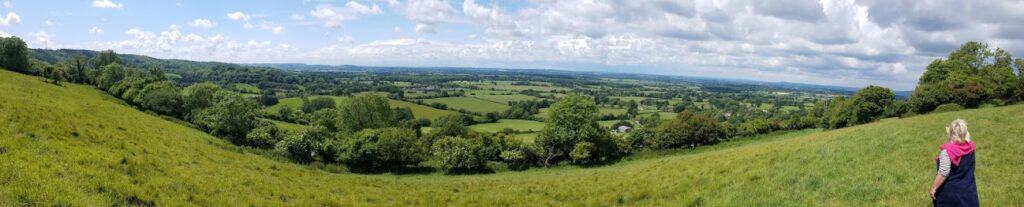
Thomas Hardy’s “Vale of the Little Dairies” in the Blackmore Vale is characterised by its irregular patchwork of small fields divided by ancient hedgerows. Some hedges are Bronze Age, maybe even Neolithic, in origin. As the first farmers began clearing small areas for cultivation, they left strips of trees as boundaries.

The post-war decades were incredibly damaging with farmers encouraged to grub up hedgerows to intensify food production, although the destruction was much less marked in pastoral North Dorset than in arable East Anglia. In 1980 we called for an end to these grants and for the same protection to be given to hedgerows as were given to trees. Yet in this decade the UK was still losing 4,000 miles of hedgerows a year. In 1990 the government’s first-ever Environment White Paper accepted our case for statutory hedgerow protection, although it was not until 1997 that hedgerow regulations were finally introduced. In recent years the situation has stabilized, but many hedgerows are in poor condition. We welcomed the government’s Committee on Climate Change report in 2019 calling for a 40% extension of the UK’s hedgerows, but sadly the government has done little to implement this. This May the government announced an action plan to restore and enhance trees and peatland, but inexplicably left hedgerows out.

Dorset CPRE is involved in a new project, called Hedgerow Heroes, to plant or restore over 15 kilometres of hedge across the country, including the planting of over 50,000 trees. On the Hinton Admiral Estate straddling the Dorset/ Hampshire border, it involves the planting of 1.7 km of new hedgerow and improving a further 1.3 km of existing hedgerow to create a better habitat for wildlife, and improve the amenity value of the area. We are looking for similar projects in North Dorset too, but also volunteers who would like to help on the Hinton Admiral project (please email [email protected]). Most people are now focused on planting trees to offset climate change, but do consider a hedge too. Remember it is not just the birds, insects and small mammals that will be grateful, but your children too.

Rupert Hardy, Chairman North Dorset CPRE

Blandford Parish Church receives over £600,000

0

The members of the Blandford Parish Church Big Church Project are thrilled to announce that they have been awarded a grant of £664,400 by the National Lottery Heritage Fund.

The decades of patching the roof will finally be over, as the funding is now in place for a complete refurbishment.

Alongside the repair work there will be an exciting project to research, record and explore, with the help of volunteers, the lives of those who have been connected with the church; from Hannah, ‘a Black Woman Servant of Mrs Holder’, who was baptised in the church in 1770, to George Vince, a Blandfordian who died by falling over an ice cliff while on one of Scott’s Antarctic Expeditions; to investigate the relationship between the church and various communities including the Travellers. 

Sara Loch, Chairman of the Big Church Project, the group overseeing the project, said: “No more buckets scattered around the building! And we can make the space, both inside the church and outside in the churchyard, a vibrant community resource.”

All the tiles from the roof will be removed, so that the wooden battens underneath can be sorted. It is hoped that a majority of the tiles will be re-used, but some will have to be replaced, creating a chance to have their name/suitable message recorded in perpetuity on the underside of the new tiles. So look out for an opportunity to ‘Tag-A-Tile’.

By: Laura Hitchcock

Secret Wine Gem in the Blackmore Vale

0

Wine growing in the Blackmore Vale is a tasteful and expanding business!

Recently, whilst leading a tour group in the Shaftesbury area, we came across a welcoming hidden gem – the Melbury Vale Vineyard and Winery.  The Vineyard is located just off the A350, on Foots Hill, about 1.5 miles south of Shaftesbury at Cann Bridge.

Image: Paul Birbeck

The small, family owned, rural business, is situated on 28 acres of south-facing, rolling hillside in the beautiful Stirkel Valley, renowned for its milling history. The Winery specializes in making artisan wines, liqueurs, brandy, aromatised wines and cider.

My group were enthusiastically greeted by the owner, Clare Pestell who, together with her brother, bought Melbury Vale Farm in December 2003. By 2006 they had planted the vineyard and built the winery (now also a craft distillery) in 2013.

Having followed the appropriate Covid entry procedures, we were lead into a pleasantly airy dining and tasting area, with socially distanced tables. The locally produced ploughman’s lunch using bread from The Vale Bakery, local salad, meat and selection of Dorset cheese products was delicious – the home-made rhubarb chutney being particularly tasty. Of course, a selection of wine, and non-alcoholic drinks were available to accompany the meal.

Before the group became too engrossed in sampling different wines, Clare took us into the vineyard, a visit into the winery so we could see where and how the grapes grow, how they are produced and sample the finished product all in one place.

Image: Paul Birbeck

The setting for the vineyard is surprising as normal wine-growing wisdom would suggest well drained, ideally chalky soil, are best. Given the vineyards relatively high altitude combined with heavy clay and greensand soil, plus climate conditions such as late spring frosts, early autumn frosts, mildew due to humidity in the summer; and pests – deer, badgers, pheasants, starlings and wasps, the venture was definitely experimental but obviously worth the risk!

The site has the advantage of being a sunny, south facing hillside that drains down to a river with reasonably Ph neutral soil, all of which help with vine growing. It is also well placed to the A350 which gives the winery good access to get to the other Dorset vineyards that we now work with; and is easy for visitors to find us!

Like many small enterprises, the pandemic adversely effected business. Relying on tourism and wholesale business to restaurants, hotels and pubs during a period when all have been closed has reduced trade the Vineyard has been forced to sell online and rely on sales from passing trade.

Image: Paul Birbeck

As to the future, Clare said “English wines growing reputation for high quality and excellence mean that both the wholesale and retail market is growing. We also provide glamping accommodation and soon to have self contained holiday lodges. We believe from the great feedback that we receive that the tourism and staycation market will flourish. It is a beautiful place to visit and guests really enjoy the whole experience.”

One can only agree. The vineyard is well hidden, but well worth a visit this summer. My group left happy and came away with boxes of delicious local wine. Find out more at https://mvwinery.co.uk..

By: Paul Birbeck Sherborne Walks & Blue Badge Tour Guide

August issue of the digital Blackmore Vale magazine is out now!

0

August’s digital Blackmore Vale magazine is out – read it free here https://bit.ly/BVAug21FS – take your time, it’s an absolute corker!

This month in the digital Blackmore Vale magazine

  • last week armed police chased suspected hare coursers near Blandford, arresting four suspects – we have the details, plus why illegal hare coursing is still an issue (p.4).
  • we’ve beautiful imagery of the crop circle on Okeford Hill – and have looked at the impact to the farmer (p.6)
  • We have Kate Adie (KATE ADIE!) answering our Random 19 questions this month (p.60). Journalist, war correspondent, broadcaster and author… she’s been a personal inspiration for decades. Imagine my disappointment at her attitude to dunking chocolate digestives.
  • Local girl Honeysuckle makes history: the record-breaking racehorse has this week became the first mare to be crowned Leading Hurdler by the TBA (p.42).
  • Britain’s Best Bangers – officially found in the tiny village of Ludwell (p.8 )
  • We attended Dorset Chamber’s trailblazing event ‘Talking Menopause’ – the online business event was so groundbreaking it made the BBC news.
  • The ‘alpaca-shaped evil nemesis’ of Andrew is already causing comment (p.52)
  • Oh, and Thomas Hardy fans will probably wish to skip Andy Palmer’s column this month… (p.26).
  • I seem to say it every month – but this month’s Reader’s Photography submission pile was our biggest and best yet. Do take your time to appreciate those pages (p84-87). This month’s stunning cover photo of the hiding roe deer is by Marilyn Peddle, and the astonishing night sky image as always by RPN Photography.

    https://bit.ly/BVAug21FS (remember we’re *never printed*, the only place to read us is right here online)

It’s our anniversary edition – we’d just like to say a huge thank you to everyone who has read, liked, commented and shared over the last twelve months. 🙌
Do pass us on – you can share the whole magazine, but most people hit the share button just for a particular article.As always, feel free to come have a chat. Coffee’s at 11 (we’re lying, obviously. Every hour is coffee hour), and we like posh biscuits.Laura & Courtenay

Voice of a Farmer | August 2021

0

We finally started our cereal harvest in July after being a week or two late. Our first crop to harvest is the winter barley grown for malting under contract to Molston Coors in Burton on Trent who produce many well known beers and lagers.At the beginning of harvest there is always a certain amount of trepidation as to how well the machinery and grainstores will perform even after their winter servicing . Fortunately all performed well helped by ideal conditions we were able to harvest the barley although it was a little hot . Thank goodness for airconditioning in modern combines and tractors. The grain was alittle too dry coming in at 11.00 -12.00 % moisture when it can be up to 14.50 % when it leaves the farm. The yields were what I would describe as average with quite a lot of small grains probably as a result of all those frosts and dry weather in April.

1960’s

We have had an abundance of grass to deal with as the cattle struggle to keep on top of it .All the silage pits are full  and we are now making silage bales and hay when the weather allows. Will this mean we are in for a long and hard winter I wonder ?

On the cattle front we have had a disappointing time regarding bovine Tb.  We had to retest three of our milking cows only to find that they were inconclusive for the second time and so had to leave the farm for the abbatoir. A post mortem examination showed that there was no evidence of Tb but that they may have been exposed to Tb. Very demoralising for us all as now we have limited markets as to where we can sell cattle and also at a much reduced price.We also now have  to retest all  the cattle again in September. The Government are trialling a vaccine for cattle against Tb as lets hope it proves to be successful and we can finally keep this disease under control.

Looking through the farm diary from 100 hundred years ago July was also very hot and dry with many crops failing .My great Grand Father even had to sell some lambs due to the lack of feed which he points out he made a considerable financial loss to him !  It seems that even 100 hundred years ago there were weather extremes.

2021

One aspect of agriculture that the industry is trying to address is our poor Health and Safety record. In the last twelve months there have been 41 fatalities. The causes range from being struck by moving vehicles ,killed by injuries by livestock and finally being killed by machinery accidents. There is currently a campaign Keep Harvest Safe with much support and advice so lets hope we can have a safe harvest in the field and on the road. I would urge all drivers of machinery on the roads especially country lanes to drive carefully .Many members of the public have commented to me how intimidating large tractors can be when coming towards you. 

Happy harvesting and Keep Safe

By: James Cossins

Sponsored by: Trethowans

Stop to See Strikingly Beautiful Art at Elm Yard Gallery

0

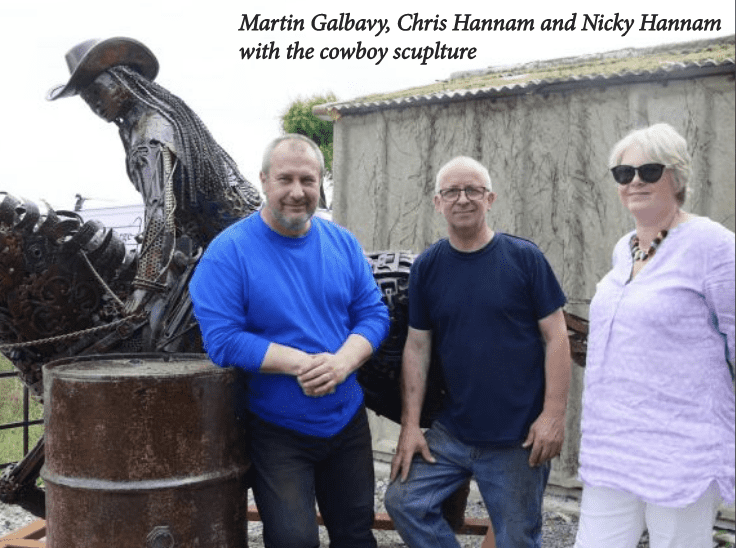
For some people it is the vultures, and for others it is the metal cowboy that makes them slow down on the A3030 at North Wootton. Many people will have seen the recent cow sculpture funded by a community fundraiser in Sturminster Newton, and the giant metal soldier that got national attention.  Now there’s another excuse to take a break, park up and visit the delightful Elm Yard Gallery.

Image Rachael Rowe

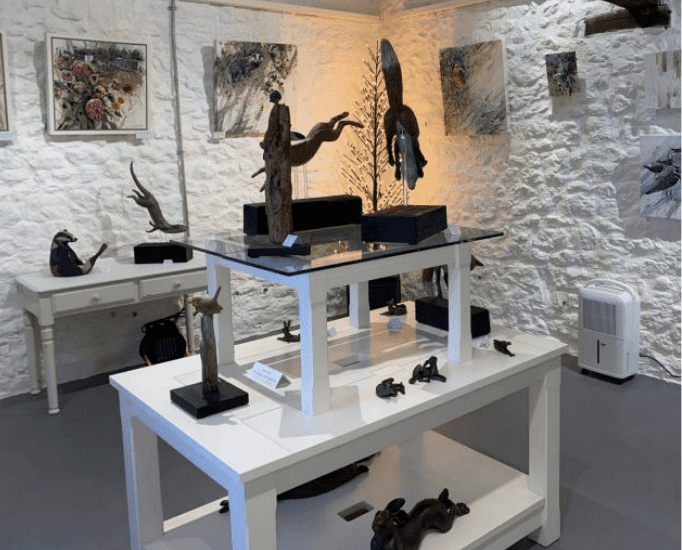
A unique door looking like something from Lord of the Rings leads into the bright art gallery that opened just before Christmas last year, and closed swiftly again with lockdown. The door is the handiwork of on site sculptor Martin Galbavy. Owners Chris and Nicky Hannam have filled the space with work from local artists to complement the unique metal sculptures from partner Dorset Forge & Fabrication. The Elms Farmhouse Kitchen is the third business on site, providing light meals and refreshments.  

Nicky tells me she selects artists for the gallery and is about to choose more. There are paintings by Laurence Belbin and Caundle  Marsh based artist Sam Dodd. Sam uses acrylics and has recently added gold leaf to give an extra dimension to her nature designs. 

Image Rachael Rowe

Glass art by Claire Waters is strikingly beautiful, and just when I think the gallery has a nature theme, the fun camper vans in artwork by James Frames change that assumption. There are colourful ceramics as well as Martin Galbavy’s iconic metal creations.

All of us have probably stood in a gallery like this at some time and either not been inspired to buy a thing or found it beyond our budget. What is striking about Elm Yard is the amount of art that is tasteful and affordable- and would look good in the average home. Nicky points to the armchair and laughs: “It’s very easy to sit in that chair, look at a piece, and fall in love with it.”

Martin Galbavy is originally from Slovakia and was Coppersmith of the Year in his country. He sources his metal from reclaim yards and car boots, but during lockdown, people brought old tools they thought he could use. Martin also sculpts items from the old tools of people who have died so their family has something to remember them by. That’s something I wish I had known when clearing Dad’s “might come in handy one day” tool collection.

Image Rachael Rowe

People sometimes assume the yard only creates massive metal sculptures but there is so much more to the forge.  Many smaller pieces are displayed in the gallery and are compelling to look at with their intricate welded metal fragments. They are popular. An intricate metal horse head and child sculpture sold within three hours of being placed on social media recently. Martin Galbavy points out the colossal hulk in the yard. I had passed the imposing monster countless times from the road, but who knew it was made from 140,000 ball bearings all individually welded together? “The supplier double checked we really wanted that amount,” laughs Chris Hannam. 

In the Hulk’s hand is a metal spiky coronavirus. 

Nicky explained: “Martin’s idea is that all of us want to fight this coronavirus; so he was inspired to make the hulk.” 

It took him four months as a lockdown project see it as our jigsaw this month on p.93.

Image Rachael Rowe

Elm Yard is a fantastic example of businesses working together and creating inspirational art. Next time you are on the A3030, stop off at North Wootton to take a closer look at the dramatic metal sculptures and visit Elm Yard Gallery.

Elm Yard Gallery is open from Wednesdays to Saturday. https://www.facebook.com/ElmYardGallery/

Elm Yard, North Wootton, Sherborne DT9 5JW

Pets and their diet

0

Diet and the right nutrition has come a long way in the pet industry over the last few years and getting it right can often be mind boggling, particularly when you’re a first time pet-owner.

Firstly, you need to establish your pet’s ‘life stage’.  In other words do you have a puppy or kitten, an adult dog or cat, or a more senior furry friend?

Shutterstock

What we call ‘life stage’ diets are tailored to your pet’s needs and will provide more of what is needed nutritionally during each stage of their life.  For instance, feeding your new pup on specific puppy food will give them a diet specially formulated to meet the nutritional needs for their normal development. Puppies need to eat more in the way of protein (including higher concentrations of specific amino acids), fat, and certain minerals than adult dogs.  Growth and development take a lot of energy, so puppies need to take in more calories than adult dogs, even for those of a similar size

Secondly, look at the ingredients.  If you’re a bit confused, take a look at another food.  The ingredients’ list shouldn’t be too confusing and you should be able to work out exactly what’s in the food.  Food ingredients will be listed in quantity, so the first ingredient on the list, say it says chicken, will be what it contains the most of. 

Feeding guidelines for all stages of your pet’s life can be a bit confusing and we always recommend having a conversation with the veterinary nurse at your registered vets.  They will be able to help and guide you throughout your pet’s life in the diet changes that need to be made.  Most vet nurses also run what we call ‘weight clinics’ and can help if you think your dog or cat has perhaps put on little bit of excess that needs to be got under control. 

It’s important to establish your pet’s ‘body condition score’.   Body condition scoring is a management tool designed to assess body reserves or fat accumulation of an animal.  Your vet nurse will use this as a method of examining the nutritional status of your pet and guide you appropriately. 

As we said, it can be a bit overwhelming, but discussing your pet’s diet and any specific needs is always recommended.

Guest post by: www.vetsmiths.co.uk

01202 119988

Fired Up with Dorset potter Jonathan Garratt

0

Meet the Dorset potter who moved 25,000 bricks to rebuild his kiln and start a new life near Shaftesbury.

When Dorset potter Jonathan Garratt relocated from Cranborne to near Shaftesbury, he moved lock, stock, and many pots, as well as dismantling a 25,000 brick kiln and painstakingly rebuilding his renowned pottery business at Jolliffe’s Cottage in the village of Stour Row.

Dorset potter Jonathan Garratt
Sitting at the wheel he made from an old plastic dog’s bed, a washing up bowl and pieces of scrap wood and metal forty years ago. Over Jonathans shoulder you can see the firing room and Kiln. Image by Courtenay Hitchcock

Seven years on, Jonathan has converted a car port to house his beloved kiln and a former kindergarten has become his pottery studio. Here, this sprightly 67 year-old works to a choice of eclectic music, surrounded by his beautiful creations made from Cranborne clay, and all exclusively fired with wood.   

Wood-fired flower pots in hot oranges, blue and greens, bird houses and “garden punctuation” –  interesting artefacts framed in clay and wood – are artistically displayed outside his studio. Inside are vases, jugs, mugs and plates, some inventively decorated using anything from mascara brushes to a domestic sponges.

Image by Courtenay Hitchcock

He has no website or social media presence, but hopes his studio has the “atmosphere of a bygone smithy” where passers-by feel they can just pop in to browse. Those that do will be pleasantly surprised by the reasonable prices, with an elegant glazed pot available for under £10. Many of his stunning designs are also guaranteed frost-proof.

Jonathan is the first to admit that he had an extremely privileged upbringing – educated at Eton College where he studied ceramics and then on to Clare College, Cambridge where he gained a BA degree in Archaeology.

Jonanthan’s gallery at Jolliffes cottage nr Shaftesbury is open to visitors. Image by Courtenay Hitchcock

“At Eton, I’d pretend to go for a run but sneak off to the art centre where I had a chance to indulge my love for photography, sculpture and finally pottery. I travelled through all the materials to find my direction,” he says.

He’s indebted to his parents for allowing him the freedom to choose a creative path in life, unlike many of his peers who were forced into “respectable” banking or legal professions. A glance at his impressive CV shows it was definitely the right career path.

Lots more to see and buy in the outdoors Gallery – Image by Courtenay Hitchcock Blackmore Vale

His many credits include exhibiting at London’s V&A Museum and the Royal College of Art. In the dead of night, he’s climbed trees in Canary Wharf to hang ceramic discs as part of ‘The Shape of the Century 100 Years of Sculpture in Britain’ exhibition. He’s also appeared at numerous exhibitions across Dorset and Hampshire.

He’s a Fellow of the Royal Society of Arts (FRSA)- an award granted to exceptional individuals judged by the Royal Society of Arts to have made significant contributions relating to the Arts and is only awarded to those who demonstrate their support for social change.

Joanathan’s firing room with his stacks of blanks and the self-built kiln to the rear. He has been selling his pieces to Fiona Atkins, an experienced trader – now at Townhouse Spitalfields – for thirty five years. Image by Courtenay Hitchcock

Talking passionately about people having the right to express their talents, whatever background they may come from, Jonathan has written to the Prime Minister about the ‘open prisons’ many people are living in, with little or no outdoor space and the resulting ‘untapped fuel of creativity being supressed in humans.’ 

Jonathan may not be able to claim to have reinvented the wheel but he has certainly recycled it! Who else would see an old plastic dog bed at a dump and envisage it as part of a potter’s wheel? Along with an upside down washing up bowl, turned wood and some scrap metal, his home-made wheel has notched up 40 years of service and is still turning strong.  

Inspirations for his wonderful designs come from books and other artists. “We’re all thieves, drawing on ideas that others have already had,” he says honestly.  He also believes he’s only 50 per cent of the artistic contract. “I make a pot –  but what someone does with it, where they put it, what they put in it – that makes up the other crucial 50% of the finished effect.”

Image by Courtenay Hitchcock

And sometimes his beloved kiln can take on a creative bent he never imagined. “My kiln becomes an artist too – sometimes firing the clay in a way I didn’t anticipate and the results can be extraordinary.”

Clearly, this is a man who loves what he does, describing the sensation of “being airborne” when he’s at his wheel, a huge high as he and the clay create together. And, unlike many of his fellow Etonians, “no boring meetings to sit through and no need to wear a tie to work.”

Jonathan welcomes visitors to his studio at Jolliffe’s Cottage, Stour Row, near Shaftesbury SP7 0QW

Tel: 01747 858697 or 07549 020454
email:
[email protected]

By: Tracie Beardsley

Local Farm is helping young people feel needed, wanted and valued.

0

A Dorset youth farming project was featured on BBC Countryfile in July. ‘Future Roots’ – based at Rylands Farm, a 30 acre smallholding near Sherborne – is the brainchild of social worker Julie Plumley.  

Having grown up on a farm herself, Julie wondered what potential there might be for kids struggling in the school system if they had the freedom of the farming environment.

Click to play the Countryfile episode – Skip to 9.55 for the start of the Future Roots Segment

“I just thought about my dad. Farmers have to be a plumber, an electrician, do woodwork, fencing, animal care, veterinary… kids can be here all day with zero emphasis on their Maths and

English ability. Farming allows them to see a different side to themselves.”

The kids, aged between 8 and 18, come with a myriad of issues. “They could be involved in drugs and scared, but then they come here and they have hope, and a future, and people respecting them.” Julie has helped over a thousand youngsters turn their lives around since Future Roots opened its gates in 2008. 

Everything is focused on learning by experience. This year in particular they have benefitted from being able to touch and hug the animals. Animal therapy helps them to build a relationship of trust which has a knock on effect with their human relationships too. Julie says, ‘Young people respond to being needed, wanted and valued.’ 

Sponsored by: Trethowans