
Home Blog Page 265

The oil beetle

0

This month wildlife writer Jane Adams introduces us to the shiny little beetle whose hitchhiking larvae have a mean bee streak

Male violet oil beetle
Images: Liam Olds

The wonders of nature never cease to amaze. From ants nurturing the caterpillars of butterflies to tiny wild bees nesting in bramble stems, it’s mindblowing how much is going on right under our noses.
I recently stumbled across an oil beetle. Beetles make up 40 per cent of all insects and 25 per cent of all animal species, yet we see them so rarely – and this is especially true of oil beetles. But to protect this declining insect, conservationists urgently need to know how many there are and where they live.
It’s thought three species of oil beetle have already become extinct in the UK, and of the five that are left only two – the violet and the black oil beetle – are widespread and out and about in April. There’s also the short-necked oil beetle; though very rare, this species still survives in the south west in a couple of isolated locations. Could there be more that we don’t know about?
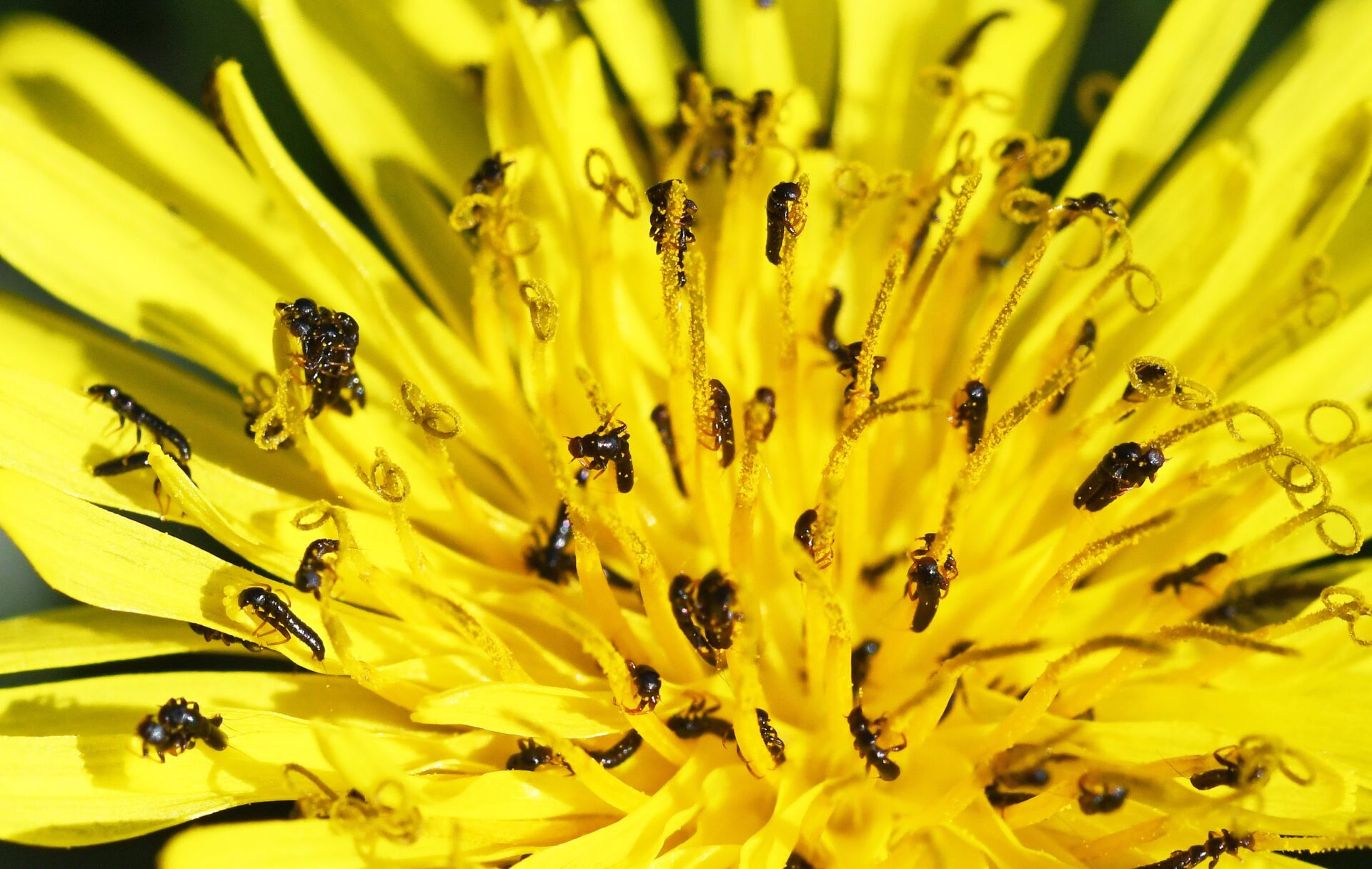
Violet oil beetle triungulins waiting for a lift on a dandelion

Stowaway Triungulins
Oil beetles are large, from 2.5 to 3cm long. With luck, if you’re in the right place at the right time, you’ll spot an adult oil beetle’s glossy blue-black body as it trundles about during the day. In fact, adult females often use compacted human footpaths as a place to excavate their egg burrows, so one might literally cross your path! But don’t pick one up – they extrude an oily substance from their joints when alarmed – hence their name!
Another life stage of the oil beetle you might happen to see is their larvae, or triungulins – so-called for the three hooks on their feet.
Once the eggs hatch, these 1.5 to 2mm larvae make a dash for the nearest flower and then wait for unsuspecting insects to pass so that they can jump on board.
To survive, triungulins need to be transported to the nest of a female solitary bee. Here they will eat the bees’ eggs and pollen supplies before emerging as an adult oil beetle the following spring. It’s an unreliable plan. Thousands of oil beetle larvae don’t make it to their desired destination – and don’t worry, bee populations are never at risk. This is just one of nature’s wonders and has been going on – right under our noses – for millions of years.

How to find and record oil beetles

When to look: Mild days from February to June (they are especially active in April!).
Where to look: Woodland edges, flower-rich meadows, coastal grasslands, dunes, and heathland on mild days from February to June. Look for adult females excavating burrows and triungulins on the petals of dandelions and other wild flowers (see image above).
What to record: Take as many close-up photographs as possible from different angles of any adult oil beetles you find (phone cameras are especially good for this). Photographs of the head and thorax are especially helpful for identification. Also make a note of the location and date.
Where to record findings: Record your findings and submit photos on the Oil Beetle Recording Scheme website. For more info see their twitter account @OilBeetlesUK. And here’s a helpful Buglife ID sheet you can print.

Microplastics on Dorset’s beaches

0

There has been a change in the rubbish on our beaches, says DWT’s marine awareness officer Julie Hatcher – but there’s still more to do

Microplastics on the beach at Kimmeridge Bay

Have you noticed a big change on our Dorset beaches in the last few years? The piles of plastic drink bottles, heaps of fishing litter and tangles of advertising balloons that used to accumulate in coves and corners of beaches have mostly vanished. Following the introduction of innovative and inspiring movements such as 2minutebeachclean plus widespread coverage of the marine litter issue, there has been an avalanche of action.
All along the coast, community beach clean groups have formed and individuals are inspired to pick up the litter they see when they are out and about. Litter is removed from beaches almost as soon as it touches land.
Unfortunately, that’s not the end of the story for marine litter. In the relative absence of large litter items, it is shocking to notice the profusion of microplastics that remain.

A man-made death trap
These tiny pieces of plastic, each measuring no more than 5mm in diameter, wash ashore in their billions during storms. They often blanket the strandline, rockpools and seaweed in their myriad of colours and shapes. Too tiny to pick up by hand, they make their way into the beach habitat, mixing with the organic debris that provides vital food and shelter for the wildlife that lives there. To remove them mechanically is to remove that rare and specialised wildlife ecosystem.
The term microplastics encompasses tiny particles, chunks, threads and beads from a wide range of sources. They include nurdles, the form in which raw plastic is transported around the world; irregular broken pieces from larger objects; bio-beads used in sewage treatment; bits of monofilament and nylon threads from fishing line and nets; polystyrene beads … the list is endless.
But that’s just the stuff you can see. In addition are the microscopic microplastics. These miniscule plastics include fibres from our clothing and the microbeads used in some industrial applications. Even the cosmetics industry continues to use non-banned microplastics. They are ingested by plankton, right at the bottom of the marine food chain.
Nothing can be more depressing than walking on an exposed beach in the aftermath of a storm and seeing an endless swathe of microplastics stretching into the distance, coating all surfaces and smothering pools. But it’s when you look closely by your feet that the true horror hits you; the sheer number of individual items making up this man-made deathtrap.
This stuff can’t just be picked up like bottles and fishing nets. People have tried sweeping it up en masse and filtering out the sand and organic matter but it can’t be done without destroying that extraordinary wildlife habitat.
The answer lies with preventing it entering the environment; with consumer demand and political campaigns; with changing our habits and behaviour. We can all start by reducing our consumption of single use plastic, by re-using and refilling containers for example. Selecting items with minimal plastic packaging, supporting businesses that make the effort to reduce plastic waste and checking cosmetics ingredients to avoid microplastics are all steps we can take to minimise the effect they have on the environment. Change can happen quickly – and we can all have an impact.

Postcards from a Dorset Collection

0

Each month local historian Barry Cuff shares a selection of rarely-before seen images from his unique archive (more on his collection here).
This month Barry has picked Chapman & Son of Dawlish.

Sturminster Newton Market Place – the card was posted to Derby in 1910
Sturminster Newton bridge. The card was posted to Bagber, just 3.5 miles away, in 1918
This postcard of East Street in Wimborne was posted to Redhill, Surrey in 1909
This image of Lyme Regis Lifeboat was sent to Talgarth, Brecknockshire in 1910

‘Chapman & Son of Dawlish in Devon photographed and published cards of just three seemingly-random Dorset towns: Lyme Regis, Wimborne and Sturminster Newton. I have been collecting since 1974 and have never seen cards by them of any other Dorset location.’

A brilliant day out at the Spring Countryside Show

1

What a great day we had at the Spring Countryside Show today – were you there? Are you going tomorrow? There’s so much to see, but here’s our own highlights from the first day:

The Sheep Show. Brilliantly entertaining whilst being oddly educational – seriously do NOT miss this show. Experience more fun and excitment than you’d expect from a man and his sheep.
Find it: Friars Moor Farm Yard, three shows daily

The grown up gun dogs team at the Spring Countryside Show

The Gun Dogs display. SO so interesting and fun. And it’s not just for gun dog owners, it’s for anyone who owns a dog; the tips and tricks on training are incredibly useful, and as a bonus you get to watch the controlled mayhem that is a bundle of adorably excited five-month-old cocker spaniel puppies being the BEST dogs.
Find it: Gritchie Brewing Company Rural Ring, two shows daily

Young vintage steam engine enthusiasts at Spring Countryside Show

The Falconry display. Witness the captivating Mere Down Falconry performance – it’s always an amazing show.
Find it: Gritchie Brewing Company Rural Ring, two shows daily

Jonathan Marshall’s Free Spirits Show. Obviously. Always popular, it’s impossible to ignore the beauty of Jonathan’s Amadeus (yes, he’s one of the Lloyds Bank black horse) and his magnificent falcons. If you haven’t seen it before, prepare for the unexpected (see our interview with Jonathan Marshall here).
Find it: Gritchie Brewing Company Rural Ring, two shows daily

Flyball. Absolute chaotic yelping energy. These dogs are living their BEST life. Not a single member of the audience around us had a clue who was winning, and not a single one cared! Everyone was having a great time just watching the teams of dogs taking turns to fly down the jumps, slam into the ramp to retrieve their ball and then race back again while their humans yelled encouragement from both ends. The task seemed to be to get the dogs as hyped up as possible and then let them RUN. It works.

Flyball at the Spring Countryside Show

Terrier Racing. It’s absolute chaos, but it’s a thing of joyous beauty to watch, and the commentary is hilarious! Think your dog has the speed? Enter them in the terrier racing (it’s not just for terriers, we saw all sorts having a go) – it was just perfectly brilliant. Bonkers.
Find it: Gritchie Brewing Company Rural Ring, two shows daily

The Farrier. Do circle back if Sam Wilkes isn’t working when you see his area – it’s such a great opportunity to see the farrier skills up close, and Sam is great at explaining as he goes (you can see him featured in January’s A Country Living here).
Find it: Garden Village, three demos through the day

Spring countryside show grey face sheep

The Farmyard. Don’t miss out on the chance to get close to the wonderful (and HUGE) rare breed pigs and piglets, the completely wonderful grey face sheep, the Boer goats and the mad chickens. Do stop and chat to the people who breed them, they’re keen to talk!
Find it: Friars Moor Farm Yard

Spring countryside show OSB piglets

ALL THE FOODS! We had a fabulous hog roast roll from local Stalbridge butcher’s Else’s, plus a slice of cake from Victoria O’Brien’s tent. We tried where we could, but we just couldn’t sample all of the cheese, gin, rum, burgers, curry, jams, chills, pancakes, doughnuts, sausage rolls, cakes, fudge, pasties… Go prepared.

All images © Courtenay Hitchcock, BV magazine

Why not head down to the Spring Countryside Show tomorrow (23rd April)? It’s a great day out!
Gate Price is £16 per Adult, kids go free. Dogs on leads are welcome.
Find it at the Turnpike Showground, Motcombe (between Shaftesbury & Gillingham), SP7 9PL

Letters, pigs and the effect of the oil spill

0

The April BV Podcast begins, as it does every month, with this month’s letter from the editor and all the latest reader’s letters. This month we then move on to three interviews. Jenny Devitt chats to Giles Simpson, Chairman of the G&S Show ahead of this weekend’s Spring Countryside Show.

Next Terry spoke to journalist Andrew Livingston as he discusses the current outcomes on the Poole Harbour oil spill. Lastly, we hear from local farmer Lillie Smith as she tells BV listeners about her rare breed pigs

Never miss an episode – if you’re not already subscribed to the BV, you can sign up here and receive a notification of each new podcast (just three a month) straight to your inbox! Or you can catch up on all previous episodes right here.

  • The Spring Countryside Show is BACK! The first show of the year in Dorset’s rural events calendar is this weekend, and Jenny chats to Giles Simpson, the Gilingham & Shaftesbury Show Chairman, about what’s in store at Turnpike Showground.
  • Journalist Andrew Livingston as he discusses the current outcomes on the Poole Harbour oil spill. Although initial fears around the spill were quickly calmed, the long-lasting effects are still unknown. 
  • For Lillie Smith, it all began with Cynthia. A huge Gloucester Old Spot pig, Cynthia lived on a farm where Lillie, a student at the time, had a weekend job mucking out horses. The young farmer takes a break from her farm in Shillingstone where she lives with husband Morgan, their four children ranging from two to eleven and seven of the rarest of pig breeds, Oxford Sandy and Blacks.

Stur Litfest returns in June

0

The Sturminster Newton Literary Festival returns for its fourth year from 5th to 10th June with an expanded programme that now includes non-fiction events and covers the wider Wessex region. The festival offers a diverse range of topics, from Michael Langridge’s sequel to Tess of the D’Urbervilles to Chris Taylor’s experiences as a helicopter test pilot, and Jon Woolcott’s insights into Dorset’s history.
Festival highlights include journalist Felice Hardy’s talk about her grandmother, an Austrian tennis champion who escaped the Nazis and played at Wimbledon, and West Dorset-based author Brian Jackman’s discussion of how the natural surroundings inspired him to write Wild About Dorset.
The festival also features local playwright Sue Ashby’s dramatic monologue From Sturminster Newton to The White House: the Fuller sisters in America, and local singers will be performing songs by the Fuller sisters.
In addition to talks, the festival offers walks and tours of notable locations, such as Robert Young’s Sturminster Newton and the Marnhull setting for Tess of the D’Urbervilles.
Festival committee chairman, Pauline Batstone says ‘I am delighted that we have such a full and wide ranging programme for our fourth year,’

Details of all events can be found on the Stur Litfest booking portal here

Farm and Estate Technician | Kingston Mauward College

0

This role will include the maintenance and repair of small tools and equipment for curriculum and farm use. You will also work closely with academic staff to ensure student practical sessions provide a high-quality teaching experience for all learners.

You will assist with all duties necessary to ensure the smooth day to day running of the mixed farming enterprise on the college estate. A key feature of this post will be to take a pivotal role ensuring resources required for practical sessions for all teaching staff are supplied and planned.

Hours: Will vary seasonally, with other staff will cover the time from 6.30 am to 4.30 pm and be worked over Monday to Sunday with flexibility to meet business needs.

Status: Permanent

Salary: £26,057 – £27.273 per annum pro rata (dependent on experience)

To apply: https://www.kmc.ac.uk/college/quick-links/ work-for-us/vacancies/

For more information please call the Farm Manager (David Cotterell) on 01305 215019.

BULGIN Diane

1

Nee Priddle Nee Smith

March 1946 – 16/04/2023

Formerly from Wincanton

It is with great sadness Diane’s family announce she passed away in Perth Australia on 16th April 2023 after a short illness.

In March, 3,400 primary schools learned about British farming through NFU live lessons

0

The NFU once again used the Science Farm Live project to livestream British farming into primary schools, says county advisor Gemma Harvey

As part of British Science Week in March, the NFU’s education team gave students from more than ten per cent of primary schools across England and Wales the opportunity to step into farmers’ shoes in a series of live lessons..
With a record number of pupils getting involved in the 2023 Science Farm Live project (190,000 from 3,434 schools), the virtual lessons showcased how farming is intertwined with so many key science subjects.
Over three virtual lessons, the programme used British Science Week’s theme of ‘connections’ to look at some of the unusual connections that can be found between farming and other sectors; they took place over three virtual lessons.
The first focused on how tractors are connected to space, with NFU next generation forum chair Eveey Hunter exploring what materials a tractor is built from and how her tractors drive themselves using GPS.
Lesson number two was with Flavian Obiero and his pig dog Rex, with children learning how he keeps his pigs happy and healthy as well as how pigs are connected to jumbo jets.
The final lesson looked at the link between sheep and seaweed, with shepherd Susie Parish and members of the Sussex Seabed Restoration Project following the journey of wool from sheep to the seabed to help restore sea kelp populations.

The premise of the virtual lessons was to highlight how science is ingrained in almost every aspect of agriculture. By taking farming into classrooms across the country it really brought the subjects to life. The fact that the highest ever number of students and schools registered this year shows that teachers are increasingly recognising the value of teaching science through the lens of food and farming.

If you or your school would like to get involved, please take a look at the NFU education website for more information.

Sponsored by Trethowans – Law as it should be