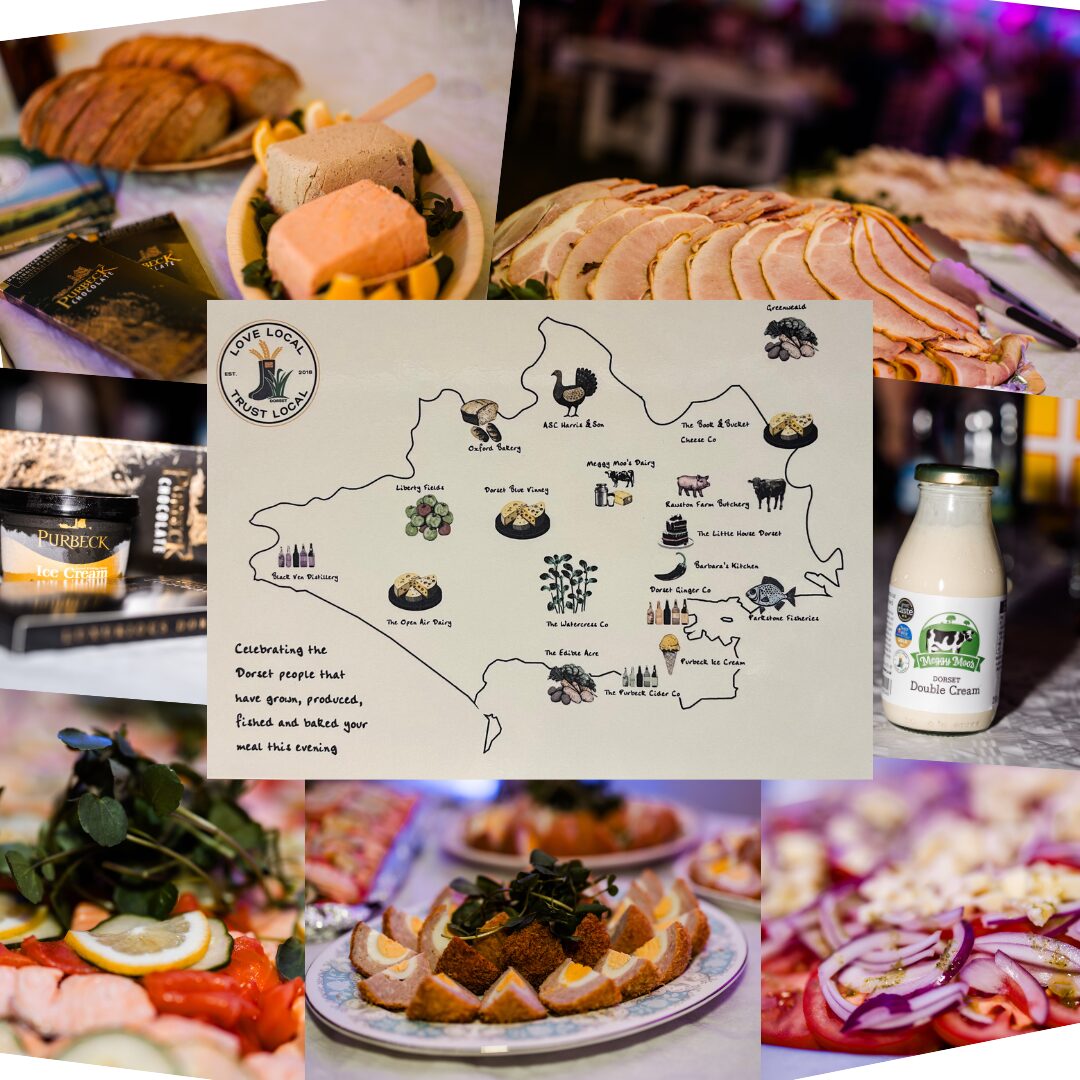
2024 has been a very busy year here at Love Local Trust Local HQ. We started working hard at the beginning of the year, finishing the new website which we had started working on in 2023. Next we had to finalise the classes for the 2024 Awards, before the launch in March. The awards year ended with a dinner and awards ceremony in the members pavilion at the Dorset County Show on 3rd September – more than 150 people attended this wonderful evening. Although it was an extremely cold night, many people left the event saying they were truly inspired by their experience. Local councillors and business people from all over Dorset came and enjoyed the feast of local food before the awards ceremony. We must extend a big thank you once again to all the sponsors and judges who gave their time to go and meet with the amazing Dorset entrepreneurs and make the hard decisions of choosing the winners. I seem to say it every year, but the entries were truly amazing with inspiring stories from excellent Dorset producers. This was our fourth year of awards, and we are always learning from them! The next awards will be in 2026 and there will be new and old categories to be announced at the beginning of 2026 which we are already working on. It might seem a long way away but as we all know time flies and it will be here before we know it!
Looking ahead Even without an awards next year, 2025 will be busy, with three or four workshops planned plus some fun networking evenings for everyone. We have already enjoyed a fun skittle evening to kick off these events. Rawston Farm will also be hosting Open Farm Sunday which is on 8th June 2025. I sincerely hope it will be well supported not just by the general public but by our Love Local family. In previous years we have had 2,000 people through the farm gate, and we’re aiming to see this many and maybe more next summer. At the event, the Love Local Farmers Market allows local businesses to showcase what they produce and let people know where to find them. We have also been working on our directory which we hope will not only help put local business in touch with each other, but also ber an easy way for everyone to find them and see what they do. As a self-funded not-for-profit organisation, we are hoping this directory will help us build our growing movement to continue our important work. Lastly, on a personal note I’d like to say just how lovely it’s been to get to know and work with so many like-minded people. Recently, Jon and Barbara from Help & Kindness gave us the opportunity to join in the Dorset COP conference at Bournemouth University. The Power of Good Food Partnerships across Dorset workshop showcased the importance of having a strong voice, working together and creating robust local food networks.
One last request For those who attended the LLTL awards dinner, you might remember our song My Story. Please do have a listen (you can just play the video below!) and share it on Spotify or YouTube – every play we achieve helps to spread our message! It’s crucial that we continue to stand up for Dorset’s amazing farmers, food producers, and creators of all things grown, produced, caught, reared, brewed, crafted, or cooked locally. Barbara Cossins Founder, Love Local Trust Local
Fairmead Community Special School transforms the lives of pupils aged between
4-19 years with additional learning needs (MLD and ASD). The school works in partnership with parents/carers and other stakeholders to develop our pupils in becoming positive individuals who make a valuable contribution to their community.
FULL-TIME RECEPTIONIST/ADMINISTRATION ASSISTANT
Term Time only (39 weeks)
Grade 14-13 – £21,565 – £23,351 (gross annual salary based on 39 weeks).
Reflective of experience
Monday – Thursday, 8.00am – 4.00pm and Fridays 8.00am-3.30pm
(37 working hours, per week).
We are looking to appoint an enthusiastic member of staff who will carry out receptionist and administration duties in the school office, acting as the first point of reference when visitors arrive/call, presenting a positive image of the school. This role is to provide a high standard of clerical and administrative support to assist in the smooth and efficient running of the school.
Prospective candidates are warmly invited to visit our school; this can be arranged by contacting [email protected]
Closing/Shortlisting Date: Monday 6th January 2025 Interviews: Thursday, 9th January 2025
Fairmead School is committed to safeguarding the school community. All job applications must contain thedisclosure of any spent convictions and cautions. The school will carry out pre-employment vetting procedures, which include an online search for shortlisted candidates and the successful outcome of an enhanced DBS
We can’t quite believe it—the shortlist for the 2025 Regional Press Awards is out, and The BV has made the cut for News Brand of the Year (Small)! This award is widely regarded as the biggest national prize in regional journalism, and to even be shortlisted is an incredible honour.
Honestly, after being named Regional Publication of the Year (NMA’s) and News Website of the Year(Future of Media Awards) earlier this year, we thought we’d hit our limit. But this third recognition is like finding an extra present under the Christmas tree – unexpected, exciting, and a bit surreal! It’s a true testament to the strength of our community and, above all, to the extraordinary team of people who fill The BV with Dorset life every month.
While just the two of us may steer the ship, the real magic comes from our talented contributors and, of course, from you, our readers. We’ll find out in March if we’ve won, but for now, we’re simply thrilled to be recognised among the best in the business. Here’s to celebrating community, storytelling, and the power of regional journalism. What a way to end the year!
From housing battles to Christmas trees, the first BV podcast of December is packed! Hosts Terry Bennett and Jenny Devitt explore the controversial housing development in West Wincanton to the challenges facing the local food and drink sector—and they dive into the fascinating world of Dorset Christmas tree farming.
Housing Crisis – Growth vs Greenbelt
“Dorset doesn’t need sprawling estates—it needs modest, affordable homes for locals who actually want to live and work here.”
Fanny Charles investigates the West Wincanton Development, a proposed 650-home project that’s sparking debates about balancing housing needs, greenbelt preservation, and community infrastructure. While some see it as an opportunity for affordable homes and modern amenities, others fear the loss of farmland and the strain on local resources.
Fanny discusses the importance of brownfield development, ensuring affordable housing provisions, and holding developers accountable for promises like green spaces and biodiversity net gains. The episode highlights the need for local voices in planning decisions to prevent short-sighted urban sprawl.
The anonymous Grumbler column in The BV
Food and Drink Sector – Overlooked and Underfunded?
“Dorset’s food and drink producers are invisible in the council’s plans—yet they’re the backbone of our local economy.”
This month’s anonymous Grumbler column asks Does Dorset Council care about its thriving food and drink sector? Dorset’s producers are celebrated for their quality and innovation, yet critics argue that they’re underfunded, overlooked, and absent from local growth strategies.
With Wiltshire’s food fairs serving as an example of success, the call for better support, events, and funding for Dorset’s producers rings loud and clear. The podcast emphasizes the sector’s potential to boost economic growth and tourism, provided the council invests in the right strategies.
The Secret Life of Christmas Trees
“People don’t realize the sheer work involved—each tree gets 10 touch points a year to create that perfect Christmas shape.”
Pete Hyde reveals the magic (and hard work!) behind Dorset’s finest Christmas trees. From trimming techniques to pest management and needle retention secrets, Pete shares tips on picking and caring for the perfect tree this holiday season.
He also reminds listeners why real trees are a greener option than artificial ones—and how buying local supports Dorset’s economy while reducing environmental impact.
These interviews were based on articles found in December’s BV, which can be read here … grab a coffee and jump in to the Dorset-ness. News, opinion, people, wildlife, art, farming, what’s on, horses … and frankly stunning photography.
Did we mention it’s FREE?
The BV is Dorset’s go-to magazine – named ‘Best Regional Publication in the UK’ (ACE Awards) and ‘Regional News Site of the Year’ (Press Gazette) in 2024. Brimming with Dorset’s people and places, it’s too good to miss!
Poole, Dorset,UK, November 14 2024: Augusta Westland 169 Dorset and Somerset Air Ambulance Helicopter.
Last month my partner and I actually managed to sneak away for a well-earned break. For a whole weekend we managed to have no children and escape far away to an exotic land … OK, we went to Wales for two days and we took the kids with us – but I did pretend that they weren’t there the majority of the time … Driving around the snowy Welsh hills we saw many homemade signs calling, ‘Save our Mid Wales Air Ambulance’. Looking into the story, it seems that the Welsh NHS has voted to merge two of its air ambulance bases in 2026 – Welshpool and Caernarfon – leaving less coverage across North and Mid Wales. I think it’s a shame. The air ambulance does such fantastic work getting out and saving lives in areas that vehicles struggle to reach … which would describe a lot of Wales! I’ve never personally had to call out the Dorset and Somerset Air Ambulance, but my family has had a few run ins! My mum was an avid horse rider, she was devoted to her horse Charlie (made me a bit jealous sometimes!). Sunday mornings would consist of my brother and I playing rugby and my Mum disappearing off into the West Dorset countryside on horseback. I’m actually unsure which hobby was the more dangerous. It wasn’t that rare that we had a chopper landing on the rugby pitch because someone had been injured. But the worst injury I saw was when my Mum came off her horse. Out in the middle of nowhere, she leaned down while on Charlie to open a gate. Unfortunately, at the exact moment she reached for the gate, a donkey spooked the horse, who reared up, throwing mum off. SMACK! She hit the ground hard, doing herself some serious damage. She was fortunate that a walker saw the fall and called 999 (I would have loved to have seen Charlie attempt to dial 999 on my Mum’s old Nokia!). Air Ambulance dispatched and she was swiftly rescued and taken to hospital. She was ultimately fine, but we just don’t know if the outcome would have been the same without the amazing work of the helicopter crew.
Not a proud day Thinking about it, I did have one run in with the Dorset and Somerset Air Ambulance … although it was actually a teacher from Greenford Primary School who saved me. We were so excited to have the crew land on the school field to show us children the helicopter and to teach us a bit about the work they did. They even let us sit in it! We all queued alongside the beautiful yellow machine, eagerly awaiting our turn to pretend to be controlling the chopper. Being an overly inquisitive individual, I inevitably fiddled with all the nooks and crannies as I waited, and suddenly I was stuck. I began to sweat – profusely. My finger was trapped in a bit of metal tubing on the side of helicopter. I stayed quiet, hoping that my sweaty body would just free itself. No such luck. Soon it was my turn to get in and pretend to fly. My teacher looked over and saw me on the edge of tears. I’d been rumbled. Everyone laughed. As I said, it wasn’t actually the air ambulance crew that saved me in the end: a teacher went to the staff room and got a tub of butter out the fridge. Greased up, I managed to wriggle my finger to safety … and lived to tell the tale. Anyway, the moral of the story is that if you ever have any spare change, throw it the way of your local air ambulance crew. You just don’t know when you, or someone you love, may need them. (ALSO – always watch were you put your fingers!)
At the northernmost tip of Dorset, just a few hundred yards from where Dorset, Somerset and Wiltshire meet, there is a Site of Nature Conservation Interest. It is an area of very marshy grassland, nestled under the scarp edge of Cranborne Chase and West Wilts National Landscape. Once upon a time it was not so: a footpath led from the ancient Sandways settlement in Bourton up the hill towards Kite’s Nest and the border with Somerset. Until some five years ago, this footpath was in disrepair and effectively unusable, due to the perils of deep black mud. Supported by Dorset Council’s Rangers, the local Bourton Wildlife and Habitat Group (BWHG) has set about pushing through a series of boardwalk sections to make the path navigable again. The Rangers have supplied designs and material, and Bourton delivered the manpower and oomph to make it happen. Everyone knew, though, that until an old sunken track could be bridged, the project would remain half done: in the wetter months this steep-sided gulch has been a significant obstacle. The answer? A near five metre bridge, partly constructed at the Rangers workshop and then manhandled in and completed in situ. A final single morning’s work resulted in a secure and safe bridge. The Bourton community thanks Rangers Stuart, Yorgos and Luke for their effort, good humour and passionate interest. By undertaking this project in-house and with direct community engagement, the Rangers have cut the cost by four-fifths compared with using an external contractor, and have also delivered learning and experience for their own team while cementing a strong relationship with a capable local group (who have plenty more ideas for future activity!). Treading the boards now on Footpath 11, a visitor can see ponds and the life they attract, marshy slopes, some rough grassland (ideal for Barn Owls – there is a new box in one of the big oaks) and many mature native trees before continuing to the glory of the downland above.
Shaftesbury-based chef and food writer Philippa Davis celebrates the wonderful food and drink of Dorset in a new six-part television series on Prime Video. In the food and travel programmes, A Taste of Dorset, Philippa explores this beautiful county and meets some of the outstanding producers who have made Dorset one of the country’s most exciting food destinations. Viewers can follow Philippa across the county as she meets three very different producers in each 25-minute episode. They range from fifth-generation millers to first-time wine-makers and from oyster farmers to apple vodka distillers. We hear about their stories and their products and find out why they feel so deeply connected to Dorset and its community. Discovering, tasting and gathering ingredients as she goes, with her boundless energy and engaging enthusiasm, Philippa allows viewers to discover the magic, warmth and richness of Dorset’s people, places and producers.
The producers visited in A Taste of Dorset are:
Episode 1 – Famous Hedgehog Bakery (now closed), Ajar Of, Hazelbury Bryan, and Liberty Fields at Halstock
Episode 2 – The Dorset Dairy Co at Stalbridge, Breezy Ridge Vineyard at West Melbury, Baboo Gelato, Weymouth, and Hollis Mead at Beaminster
Episode 3 – Crab House Café, Chesil Beach, Capreolus Fine Foods Ltd, Rampisham, and Weyfish, Weymouth
Episode 4 – Cranborne Chase Cider, Minchington, Brothers Farm, Wimborne and From Salt to Smoke (now closed)
Episode 5 – NR Stoate & Sons Cann Mills, Shaftesbury, Fivepenny Farm, Wootton Fitzpaine, and Gold Hill Organic Farm, Child Okeford
Episode 6 – Lyons Hill Farm, southern edge of the Blackmore Vale, Dorset Sea Salt Co, Chesil beach, and The Story Pig, Sandford Orcas.
A delicious county Each episode culminates in Philippa making a family-friendly feast or delicious cocktail on location with one of the featured star food producers. She says: ‘I’m incredibly excited to support and champion the outstanding food and drink producers we have here in Dorset. It feels vital, now more than ever, to connect our wonderful farmers and makers to consumers in order to share their stories and what they do.’ Tony Hindhaugh, executive director of production company Planet Eat Media, says: ‘I was bowled over by the friendliness and passion of every single producer we visited. Dorset is an utterly delicious county and we are delighted to help showcase the marvellous food and drink scene there.’
Philippa Davis grew up on a Dorset smallholding where her love and interest in great food began. At 19 she moved to London to cook in the restaurants The River Café and Moro before setting up and running The Mudchute Kitchen on London’s largest city farm near Canary Wharf. She now works as an international private chef, and writes for BBC Food, Condé Nast, The Field Magazine, the Deepest Books series and Dorset Magazine. She is also a regular judge for the Great Taste Awards, the World Cheese Awards and The Academy of Chocolate. She has presented two shows for Channel 5 and was a judge on Channel 4’s Beat the Chef. Her food adventures can be followed on Instagram @philippadavis_food
With rain-soaked weeks, compost chaos and sweeping revelations, George Hosford has been navigating a turbulent autumn on the farm
Autumnal dawn sky over Travellers Rest Farm
It’s been quite the soggy autumn – we’ve recorded an eye-watering 208mm of rain in September, (average is 76mm), 155mm in October (average 120mm) and 141mm in November (average 120mm). Everything is utterly soaked. We had so few dry days that autumn sowing progress was very limited. Doug eventually managed to sow the winter barley across three separate days – only to have it pour down again very shortly after. No hope of rolling, and thank goodness we decided not to apply any pre-emergence weedkillers this year, as they can be washed into the rooting zone of the seeds by heavy rain, risking crop damage. Those farmers not afraid of sowing early may be feeling pleased they got a shift on – there was a week-long window of opportunity at the beginning of October. At Traveller’s Rest we try to hold back when the weather is mild like this year, as aphids carrying the barley yellow dwarf virus (BYDV) will still be flying and spreading it. We prefer to collect the £45 per hectare Sustainable Farming Incentive (SFI) payment (bribe?) not to use insecticides to combat BYDV, so we have to take steps like sowing later, once the weather gets cooler (and inevitably wetter …). The SFI for 2024 now offers payments for 102 (count ‘em!) different options designed to protect and benefit the environment, including the no-insecticide option. It’s effectively a pick-and-mix approach so that farmers can tailor their own agreements. For anyone unfamiliar with this, and curious to know what ‘public money for public goods’ looks like – simply click here (warning: it’s quite dry!). Invitations to apply for these options were announced back in July, and thousands of farmers made applications.
Durweston Bridge during the recent Stour flooding caused by Storm Bert
On a knife edge However, only hundreds have been offered agreements to date, due to manual checking while (we are told) the system beds down. DEFRA had made huge steps forward with SFI 23, many offers were made, accepted and put into action very efficiently. Some of the actions on the list we opt for include the growing of cover crops, growing companion crops (such as in our bi-crops of wheat with beans) and not using those insecticides. We are now a long way into the new post-Brexit arrangements era of public money for public goods, although delivery has been painfully slow. The old payments system (BPS) – which was based on area farmed – is now at half the value it used to be, and will be down to zero by 2027. However, the new systems have been running behind at approximately £100 million per year for the last three years.
Growing companion crops (such as this bicrop of wheat with beans) and the wildflower margins (below) are two of the 102 options in the Sustainable Farming Incentive 2024 list
If the government wants to secure the nation’s home-grown food supply, and to ensure that all the environmentally beneficial actions, that the SFI promotes, happen, then it will have to give clear and positive signals to farmers in order to keep their confidence, which is currently on a knife edge. Ignoring the agricultural Inheritance Tax Relief furore, the recent budget allocated £5 billion for farming and the environment over the next two years – touted as the ‘largest amount ever dedicated to supporting sustainable food production and nature recovery’. Most of the SFI list of environmental actions require land that would otherwise be used to produce food to be taken out of production. This can only happen if the rewards are sufficient, and if the recipients believe that the system isn’t going to lurch from one extreme to the other with every change of government. Cycles are very long in farming, and long-term planning is rare in politics.
If it’s not one thing … As well as trying to sow barley and wheat between the numerous rain events, Gary tried to get all our compost spread – we had 4.5km of compost windrows around the farm waiting to be spread onto our growing cover crops. On the day he should have finished, he was prevented from doing so by a large bearing failure on a shaft driving the feed chain in the bottom of the machine. No chance to fix it on the Friday it happened, and then yet more rain across the weekend. Returning to the machine on Monday morning, he had a puncture in the tractor…Sidenote: in my endless search for interesting pictures to accompany this column, I flew my drone last month, hoping to obtain action footage of Gary at work. Sad to report the drone developed a compass error, and with barely any warning flew off on a corkscrew path towards the Bonsley Forest. It came to rest (I am supposing) high in a beech tree – far too high and impossible to see until the leaves drop. Thus far, my pictures remain unreachable and unpublishable!
George’s drone’s corkscrew path towards the Bonsley Forest
Sweeping insights It has taken me many years to properly appreciate the attributes of a broom. During the course of a harvest, many acres of floor are swept, and the better the broom, the more enjoyable and satisfying the job is. The angle of the broom head, by which I mean the angle at which the bristles meet the ground, is crucial if you only want to sweep each part of the floor once: it will help greatly if the bristles are at right angles to the floor.
We had 4.5km of compost windrows around the farm waiting to be spread onto our growing cover crops’
Second to this comes the angle of the handle – it has to be attached to the broom head at the right angle to allow the first requirement to be met, and it needs to be long enough to not have to bend over too much while sweeping. This may all seem blindingly obvious, but it is surprising just how many brooms on the farm do not meet these basic specifications – and consequently do a pretty rubbish job.
To the first two characteristics above I would add two more. The quality of the bristle, and no, plastic just does not cut the mustard. Plastic bristles are invariably too stiff, so do not vibrate in the right way in order to keep the dust/grain/rubbish moving along in front. In general it seems that natural products like bassine are the best – bristles need to be stiff enough, but not too stiff. A general purpose broom will have to cope with a variety of surfaces, from lovely smooth power-floated or polished concrete to rough farmer-laid concrete from the 1970s, tarmac or wooden floors. No sane person wants to have to keep three different types of broom, so they have to be just right, as Goldilocks discovered in the house of the three bears. The last, and potentially most irritating, detail is the small matter of how the handle is fixed to the head. Many heads are pre-drilled for the handle, which means there is a gap in the middle. This in turn then leaves a line of material in every swoosh, and who wants that? Last summer I found the closest broom to perfection I have ever had the pleasure of working with – a 36 inch Bassine broom from the Bearing Boys in Norfolk, one of my favourite online suppliers for so many items, from belts to bearings, … and now brooms, obviously. They are light too, which adds even more pleasure to the job! So I’ve bought three more this year, and I love using them.
The 2024 Berwick St John Country Fayre has achieved a historic milestone, raising £100,000 for the Stars Appeal, Salisbury Hospital’s Charity. Initially announced as £96,983.99 at a special presentation on 1st December at West Barn Lodge in Fovant, additional donations from nearly 300 attendees pushed the total to a record-breaking figure – the largest in the Fayre’s 32-year history. Running every other year since 1992, the Fayre has consistently raised substantial funds for various causes, committing long-term support to the Stars Appeal in 2012. This year’s event, held on 14th and 15th September, attracted thousands of visitors and featured an array of activities from displays of steam engines, vintage tractors, heavy horses and classic cars as well as a dog show, rural crafts, fairground rides and entertainment. Ahead of the main fayre event, visitors enjoyed an evening of live music on Friday, September 13th.
Images: Spencer Mulholland
Fayre Secretary Louise Hall praised the community’s efforts: ‘We are blown away by the generosity and support received. Despite facing many challenges ahead of this year’s event, the entire team pulled together to deliver a brilliant show with a fantastic atmosphere. We are so grateful to everyone who supports us, not just financially, but also by providing services and equipment and by volunteering their time. We sincerely thank everyone who has worked so hard to make this possible.’ At the presentation event, patient ambassadors and families shared powerful testimonies about how Stars Appeal initiatives have transformed their care experiences. Stars Appeal president, the Earl of Pembroke, said: ‘I congratulate everybody involved, and I deeply appreciate the incredible teamwork required to organise an event of this scale. The services provided by the Stars Appeal make a profound difference to the thousands of families who rely on them. They allow patients to be diagnosed faster, and with families at their side, recover quicker and return home sooner.’ Funds raised contribute to the charity’s £1 million annual target, supporting projects such as equipment upgrades and enhanced patient facilities. The next Fayre will be 19th and 20th September 2026, with additional events planned for 2025. berwickstjohncountryfayre.co.uk