What could happen to your estate if you die without a valid Will in place?
If you die without a valid Will then a set of rules called the ‘Intestacy’ rules determine how the estate will be distributed between blood relatives.
In limited circumstances, the rules of intestacy can suit the family of the deceased. However, there are a lot of circumstances whereby the intestacy rules are not suitable.
If you are not in a civil partnership or married then a ‘partner’ does not receive any of your estate. And if your estate is worth £270,000 or less your spouse or civil partner will receive everything – leaving nothing for children from a previous relationship. Your estate may even pass to unknown family members.
The intestacy rules also ignore the distribution of any personal items and charities that the deceased may have supported. Without a Will you haven’t appointed executors to administer your estate which can also cause more work and delay.
What are the risks of using a DIY Wills kit or an unregulated service?
You shouldn’t use an unregulated service to manage one of the most important documents you’ll need. People are often tempted by low fees (but do. always watch out for hidden costs). If Solicitors fees are your concern there are schemes that we can utilise to assist with the cost of a Will.
DIY Will kits do not provide you with the personal guidance that you need to make sure that your Will is clear and deals with all eventualities. Solicitors are experienced in dealing with all circumstances and can therefore tailor your Will specifically to your own needs. They are also trained on the legal intricacies that will determine the best way of distributing your estate regarding inheritance tax planning.
Solicitors also have insurance so that if Will instructions are not interpreted correctly then beneficiaries have some recompense. Unregulated services and DIY kit companies do not have such assurances.
Is it important for everyone, no matter their age, to consider making or updating their Will?
Everyone should have a Will and keep it updated: we do not know what may happen today, tomorrow. Making or updating a Will ensures your wishes are clear and comprehensive, giving you piece of mind.
After kindly mentioning my previous column in the opening lines of his February contribution, Andy Palmer noted that when his family moved the 20 miles from Stalbridge to Weymouth in 1973, he discovered a different dialect.
Down on the sophisticated south coast, familiar phrases like ‘Where be you to?’ bain’t yeard at all.
Strangely, if Andy had instead moved the best part of 3,000 miles to the north coast of Newfoundland, he’d have heard something much closer to the vernacular of his Stalbridge roots.
In remoter parts of Canada’s most easterly province, the Dorset dialect survives in better shape that than it does in its native county.
The only known picture of a swanskin garment dates from 1712 and shows a Newfoundland fishing station. The person far right is wearing a swanskin ‘habit’, as it was described 300 years ago
This was brought home to me in 1997 following the second of my two visits to Newfoundland.
‘Arrh, ’tis very beautiful down drew ’ere, you,’ I heard one person say in Twillingate.
A week later I was back in Blighty having lunch in the Red Rose at Sturminster Newton and overheard a couple of locals at another table.
At that moment I realised the people I’d met in Twillingate spoke not just with a Dorset accent but a Blackmore Vale one. It was that specific.
The reason is simple. Twillingate and several other fishing communities were founded by Sturminster merchants in the early 1800s after the bottom dropped out of the swanskin trade.
The manufacture of swanskin – a coarse, wool-based cloth that has nothing to do with swans except in its colour – was a major Blackmore Vale industry for 250 years or so.
The cloth was hammered out at a water-powered fulling mill adjoining Sturminster’s corn mill and as many as 1,200 people were employed in the trade.
Most of the finished cloth was carted to Poole and shipped to Newfoundland, where it protected fishermen from the harsher North Atlantic climate.
When competition from the industrialising North and Midlands brought about the collapse of the swanskin trade, Sturminster merchants filled the economic void by founding new fishing communities and sending their employees to Newfoundland to man them.
The economic migrants took many things with them including their customs, their surnames – and their accents.
Twillingate’s remoteness ensured that these things were preserved.
Two hundred years later, 92 per cent of the ancestors of present-day Twillingate folk are reckoned to have been from Dorset, about half of those from the Blackmore Vale.
Roger Guttridge gets a Twillingate welcome in 1997
During that same 1997 visit, I whiled away a good hour reading the Twillingate phone book.
It read like the register at Sturminster Primary School in the 1950s. Most of the old North Dorset names were represented.
After I gave a talk about the connections between Wessex and Canada’s most easterly province, an audience member told me: ‘Until I heard your talk, I thought that Newfoundland was the only place in the world that didn’t recognise the word “me”.’
The man explained: ‘Old Newfoundlanders don’t say, “Are you coming with me?” They say, “Are you coming wi’ I?” Now I realise where that comes from.’
The man hailed from a community called Hermitage, which was probably founded by migrants from Hermitage, near Sherborne.
At a Twillingate hamlet called Hart’s Cove, I was introduced to Jack Troake, who asked if I’d like to ‘stand on a little piece of old England’.
I accepted the invitation and he led me to a spot of ground that sported a healthy crop of grass and weeds, in contrast to the rocky, less fertile terrain all around.
Jack picked up a handful of soil from a freshly dug area and ran it through his fingers.
It was best quality dirt – rich, dark soil that reminded me of my own garden at home in Dorset.
‘Slade and Duder had big fishing premises here at Hart’s Cove,’ said Jack, referring to the days when the Poole-Newfoundland cod trade was at its height.
Roger’s picture of Jack Troake sifting Dorset soil, as printed in the Downhomer
‘The sailing schooners left Poole empty and needed ballast.’
That ballast consisted of best Dorset topsoil, which on arrival at Hart’s Cove was tipped on a certain spot to form a fertile garden.
‘They grew vegetables in it – it was good for carrots and spuds,’ he said. (Yes, he really did say ‘spuds’.)
‘People also used to go there to dig for worms for fishing.’
The freshly dug patch indicated that they still did – and I’d wager that these worms, like the human inhabitants, have Dorset ancestors.
When I told this story to my mother following my return, she said: ‘I went to school with Troakes at Blandford.’
Another local surname, then. I fancy I’ve also heard the surname ‘Hart’ in Stur at some point.
Jack Troake’s story was one of dozens relating to the Dorset-Newfoundland connection that I uncovered during the nine years that I wrote a column for the province’s leading monthly magazine, The Downhomer.
The Downhomer’s founder Ron Young came from Twillingate and is probably descended from Dorset namesakes.
• Talks are underway to restore Sturminster Newton’s 200-year-old link with Twillingate by launching some kind of twinning arrangement between the communities.
You only have a few more days to give your views to Dorset Council on Dorset’s Local Plan. It is SO important you do take a look – and if you don’t have the heart to decipher the 2,000 pages of the full plan, then Rupert hardy, chair of the North Dorset CPRE has broken it into manageable chunks for us, with the biggest issues highlighted. Reading his article will only be a few minutes of your time, and if any of the below rings alarm bells (and it probably will) then you only have until the 15th to make your voice heard:
Last month we wrote about the failings of Dorset Council’s (DC) draft Local Plan (LP) and its consultation process, but we could have said more on the Plan itself which is so very important, deciding the future development of Dorset until 2038. We will do now:
The LP appears to be made up of a mishmash of various plans from the previous District Councils, already out-of-date.It offers no strategic options. It consists of c.2,000 pages of unmanageable documents, which most residents will not read. Recent caveats may have been inserted into the Plan, but clearly the impact of Covid, with its profound consequences for retailing and the hospitality, has not been factored in. The Council’s excuse is that they are under pressure from government but other councils are taking a more measured and consultative approach.
The government’s housing requirement for Dorset is 30,000 new homesbut DC officers have conceded that they are actually preparing for more with a housing supply figure of 39,000 homes, to allow for unmet need from Bournemouth, Christchurch and Poole (BCP) and the New Forest, although it has not been requested yet. Last year Dorset CPRE commissioned an independent report that heavily criticised the government’s Standard Housing Method (SHM). The government did state though in December 2020 that the SHM is a starting point for assessing housing need, not a target in plan making. There are plenty of examples of other local authorities, where adopted LP numbers are lower than the government’s SHM. Given the number of constraints facing Dorset, such as the Green Belt and the protected Areas of Outstanding Natural Beauty, why are DC proposing such a major increase over the last adopted Local Plans?
North Dorset’s problems emanate from the allocation of 1,800 houses to the Gillingham Southern Extension in the old North Dorset’s Local Plan, with none having been built yet. As a result of the loss of 5 year land supply, much speculative development has landed elsewhere. Residents here now face thousands more homes being built over their beautiful countryside.
“DC have targeted Stalbridge in particular with a housing allocation of 610 more homes. Yet it offers no useful public transport, no doctor’s surgery, no secondary school, few retail or employment options and narrow constricted roads.“
Rupert Hardy, Chairman, North Dorset CPRE
One other option being offered is to build yet more homes in Gillingham. The Peacemarsh proposal might deliver 600 units too, despite poor infrastructure and serious flooding risk, hence the name.
Rolling downland at Pimperne threatened by Wyatt Homes development and included in Local Plan
It is not easy navigating through the many documents, as the Plan covers much, such as transport, employment, the environment etc and not just housing. Most of the focus on housing is on the towns where more development is proposed. However if you live in a village, you can identify what Tier your village is placed in the Settlement Hierarchy, as this will determine the degree and type of development that might be expected.
“Even if there appear to be no allocations in your parish, watch out as there only 26,000 homes allocated formally in the Plan.”
Rupert Hardy, Chairman, North Dorset CPRE
Neighbourhood Plan Housing Requirements are shown in Appendix 2, but the Plan says clearly these are minimum figures! Small and medium-sized housing sites are shown in App.3, while new or extensions of existing Gypsy and Traveller sites are in App.4. It is curious that two thirds of the these happen to be in North Dorset in Marnhull, King’s Stag, Gillingham, Thornicombe, Enmore Green and Shaftesbury.
One extraordinary feature of Dorset’s Local Plan is its bold reliance on a DC forecast of 21,000 new full-time jobs being created over the twenty years to 2038. Yet there is no chapter on economic strategy to justify this.
Insufficient consideration has been given to whether the Plan is compatible with DC’s declared climate emergency. There is much comment on the “need to enable better public transport services, promote active travel and reduce car dependency”. Besides wishful thinking that residents will walk and cycle more, there appears to be no strategy for improving public transport.
There are serious omissions in the Wind Development Opportunities Report. DC say the potential locations shown could deliver 400 Gwh of renewable energy but there is no consideration of landscape restraints, so the target is risible. Overall we would like to see much greater focus on roof-mounted solar panels as a means to generate more renewable energy.
Why has Blandford, the former administrative seat of North Dorset, been relegated to the South Eastern Functional Area? Is this a ploy for Blandford and surrounding villages to be set up as a dormitory town for BCP, and to support their need for housing? Local parish councils and the town are united in opposing this.
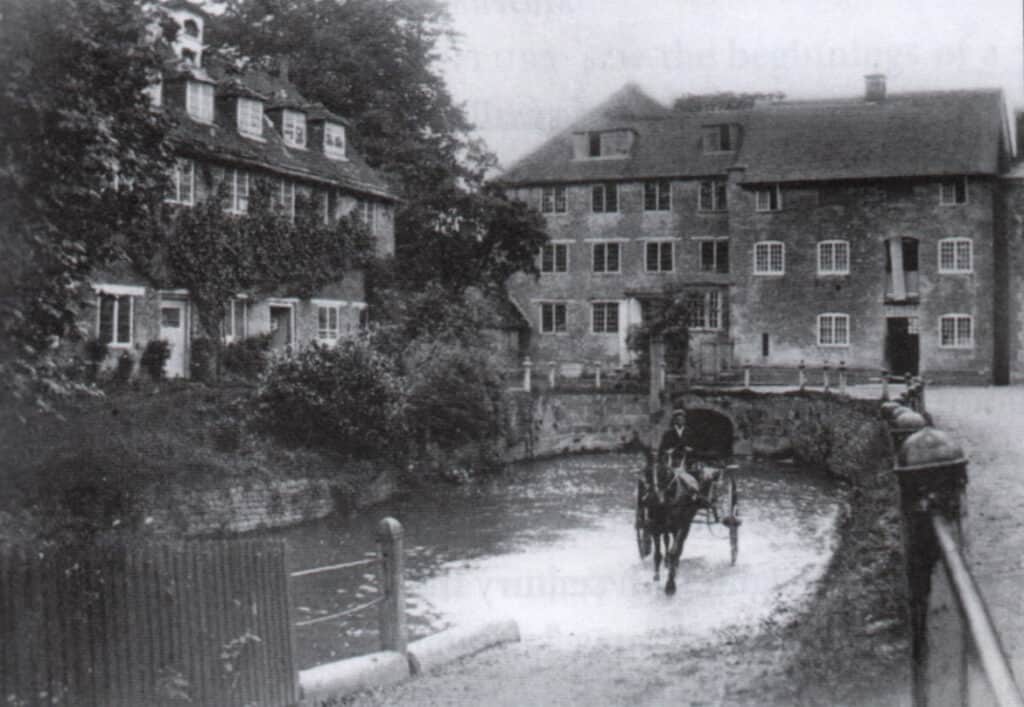
They are sadly long gone, but Gillingham’s old mill buildings once provided the town with a gloriously historic centrepiece.
They were attractive enough to catch the eye of the great John Constable, who painted the mill while staying at Gillingham Vicarage with his friend Archdeacon John Fisher.
Town Mills c1900. The recently closed silk mill is left of centre adjoining the rebuilt corn mill (far right). Far left is the house that included the indentured girls’ dormitory with silk workrooms rooms on the ground floor. Picture from Gillingham: The Making of a Dorset Town, by John Porter
The silk mill, built by Stephen Hannam in 1769 adjoining his corn mill, provides one of Gillingham’s most interesting historical stories.
For many decades, beginning in the 1780s, the Hannams added girl power to water power to aid their silk throwing business.
Surviving apprenticeship documents reveal that girls aged nine to 18 were recruited from London workhouses to ‘learn the art and mystery of a silk throwster’.
A similar view from a slightly different angle
Under the terms of the indentures, the girls were required to serve the mill until marriage or the age of 21.
Most probably did marry locally and will be among the ancestors of some North Dorset people today.
For their part the Hannams were required to provide the girls with ‘double apparel of all sorts, good, and new … one suit for holy days and another for working days’.
The girls were accommodated on the upper floors of an east-facing Georgian house a few yards away, with the ground floor used for washing and drying the silk.
Barnaby Mill retirement flats from a similar angle in 2021 with the surviving mill manager’s house (far right)
This house later became Brickell’s printworks until it was demolished in 1924.
The silk mill, which shared a mill wheel with its grist-grinding neighbour, closed in 1895.
G B Matthews and Co continued as millers until 1965, after which the vacant mill buildings fell into disrepair and were eventually destroyed by fire in 1981.
A decade later the Barnaby Mill retirement flats were built on the site next to the old mill manager’s cottage – the only survivor of the original mill complex.
Many ex-pupils of St Mary’s Primary School will be saddened by the death of ex-head teacher Pam Roxburgh (née Roberts) who died early last month in Blandford Hospital.
As ‘Miss Roberts,’ Pam taught at Stalbridge for in the 1970s before being appointed head of a primary school in Cornwall. She returned to Stalbridge as head of St Mary’s.
She married Edwin Roxburgh, an antiques dealer and land owner, and went to run a successful chinaware shop in Sherborne’s Long Street, before moving with Edwin to the Dordogne in SW France.
On Edwin’s death she returned to Dorset to live in Fitzoak Cottage in Higher St, Okeford Fitzpaine, where she was diagnosed with cancer and Parkinson’s disease.
Pam, 81, was a striking, warm-hearted lady with a keen sense of fun, says Andy Palmer, who was a 10 year-old pupil at the school when she first taught at Stalbridge.
‘When I moved back to Dorset I used to call on her several times a week and take her out and it was always a pleasure. She was full of fun and still behaved as if she was in her twenties, when she became friends with my mother, Audrey Palmer, who also taught at St Mary’s’.
The Princess Royal is the President of the Riding for the Disabled, a National Charity, started in 1969, for riding horses and now carriage driving.
There are National and International Groups, one of the 500 groups in the UK is the Blackmore Vale RDA. The Blackmore Vale RDA often translate RDA as Riding Develops Ability or Riding for Different Abilities. They are situated in North Cheriton & are currently all crossing fingers, toes, & hooves that they are going to be able to start riding again soon. They have been closed for a year now, apart from a short while in the autumn when they were permitted to use a mechanical horse with a remote control & a family member helping the rider. They had one very special day when one rider was able to ride a live pony in the school & then……they were locked down again.
Image: National Hunt Jockey Bryony Frost who is a keen supporter of RD
In the picture their flag bearer is National Hunt jockey Bryony Frost, who is a keen supporter of RDA and is hoping that they can reopen soon and have some fun days & show everyone what they CAN do this year.
They are an eclectic group of many volunteers & ponies who together can provide riding, be it on Bob & Florin, the mechanical horses or the real ponies Pod, Toby, Woody & Duke. They normally (whatever that means now!) ride on Monday, Wednesday, Thursday & Saturday mornings but they can be flexible.
Ooof – sorry, sorry – the Blackmore Vale March magazine turned into a huge great thing. It’ll be a long read, so I suggest you go make a pot of coffee!
There’s also important news on local help for victims of Domestic Violence, the deathly seriousness of littering at Compton Abbas Airfield and the genuine surge towards shopping locally.
EVERYONE should read Rupert’s column this month – he’s written a handy short hand guide breaking down the Local Plan. It has massive, long-lasting impact for every Dorset resident, and needs your attention – complaining in two years time that 30,000 new homes are being built will be too late, this is your chance (also check your local town council’s website – most are holding extra-ordinary meetings to discuss the Local Plan. Do attend, listen, and use your voice).
We’ve also got seven pages of Mother’s Day messages – I love them all. But we’ve tucked them away at the back, because you don’t need them til next week. No peeking.
Don’t forget: every link is clickable, and there’s lots of video too. Do pinch and zoom the pages, and you can flip back and forth as you wish. And please, do share – you can share the whole magazine, or just a single page. Not long now and we can break out and see a face or two for outside chatting. I honestly can’t wait. In the meantime, come have a chat on Twitter, Facebook or Insta. Coffee’s at 11, and we like posh biscuits. Laura & Courtenay x
Sturminster Newton Town Council is seeking a Town Clerk. This is a real opportunity for an experienced leader who is dynamic, innovative, and resilient and who will focus on pragmatic solutions to meet the aspirations of the councillors and the people of Sturminster Newton.
The Town Clerk is responsible for carrying out all the functions of the Proper Officer and also the Responsible Financial Officer, providing effective leadership and management of staff, services and facilities. The role is challenging and you will be required to work evenings regularly and occasionally at weekends. You will be supported by a strong and positive team of eight staff.
The post is 25 hours per week, the core hours are 09.00 to 13.00 Monday to Friday and the remaining hours may be worked flexibly. The salary is NJC scale point 37 to 42 (£40,875 to £45,859) on a pro-rata salary of £27618.92 to £30985.81. The package includes the equivalent of 24 days’ paid leave plus public holidays and a contributory pension scheme.
For more information see the Town Council website or contact Acting Town Clerk, Mal Derricott, at [email protected]
A recruitment pack and application form (required for all applicants) can be downloaded via the link below.
The Government is expected to extend the stamp duty holiday for another three months in order to boost the property market following the announcement of the roadmap to ease lockdown restrictions in Britain.
The news will be welcomed by many who were concerned about missing the 31 March deadline.
We understand that Rishi Sunak, Chancellor of the Exchequer, will make the announcement in the budget on 3 March 2021, although details of the extension are yet to be confirmed.
The SDLT holiday was designed to be a temporary relief to stimulate the market and support jobs following the COVID-19 pandemic and subsequent lockdown.
It is understood that property transactions fell by around 50% during the first national lockdown.
The tax relief increased the starting threshold of residential SDLT from £125,000 to £500,000 from the 8 July 2020 until 31 March 2021. Since the relief was introduced, transactions have significantly increased and seasonally adjusted data showed that in October 2020, transactions were 8% higher than October 2019.
The market has been very busy, and the boom has led to substantial increases in average house prices over the last seven to eight months which show little sign of abating. The SDLT threshold extension undoubtedly contributed to this increase. There has been considerable concern within the property market that the abrupt end of the tax break could bring significant disruption. The cliff edge and bottleneck could have seen thousands of transactions collapse, leaving many out of pocket and a sudden fall in property values.
Thousands of people signed a petition to extend the SDLT holiday, which resulted in the issue being debated in parliament and many estate agents, solicitors, surveyors and regulators have also lobbied the Government to extend the deadline.
A temporary solution?
It has been suggested by many professionals within the industry that the most sensible and balanced approach would be to continue the threshold extension and taper it out over a period of six months to a year to ensure there is no sudden collapse and that we don’t simply move the same issue further down the road, only to face it again in the coming months. In this way, we could ensure some continuity and stability in the property market at a time when many may feel that there is very little certainty in employment, finances, or the wider economy.
It is hoped that the extension takes into consideration the challenges the industry has faced amid greater demand from buyers and the lockdown.
If you need further advice please contact Charlotte Robins, Licensed Conveyancer