Wincanton Racecourse is gearing up for a thrilling few months of top-class National Hunt action, packed with style, charity and festive racing. This year’s iconic Badger Beer Chase promises not just exhilarating racing, but also a celebration of style. Racegoers can compete for our Style Awards, with categories including Best Dressed and Best Dressed Couple. Prizes are truly spectacular, featuring a Boodles necklace worth £3,000, luxury vouchers from Fairfax & Favor, Hobbs and more.
Following the Badger Beer Chase, we’ll host Discover Racing Raceday on Thursday 20th November, a quieter November fixture perfect for learning more about the sport. If you’ve never been before it’s a great way to start – and why not take a look at editor Laura’s tips from her trip to the races. This day will also feature a charity race for the Keagan Kirkby Perpetual Trophy, rescheduled from the unfortunate abandonment of our Horatio’s Garden season opener. Supporters can donate to the riders via their JustGiving page, helping raise funds for this fantastic cause. We then move into the festive season with PricedUp Military Raceday on Thursday 4th December. This special fixture will include a military riders’ race before the main action, bringing a unique and patriotic twist to Wincanton’s December racing calendar. With top-class racing, style, and charitable events, Wincanton Racecourse continues to offer something for everyone this autumn and beyond.
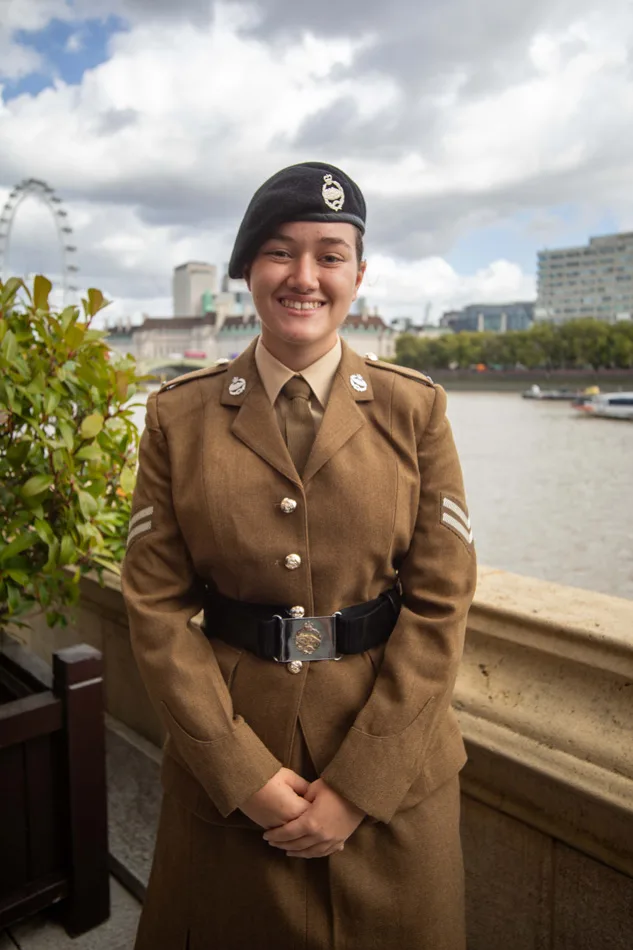
Charlotte Bedford, a 17-year-old from Wimborne, has been named the nation’s top army cadet – recognised in Parliament for her kindness, grit and leadership
The prestigious Cadet Vocational College Westminster Award recognises young people aged 16 to 18 who have shown selflessness, community spirit and a commitment to going the extra mile. This year’s winner was Corporal Charlotte Bedford, a teenager from Wimborne, who received the honour at the House of Lords after a gruelling, months-long selection process.
Getting there Charlotte has been an army cadet for four and a half years. She was nominated for her selfless work with younger cadets, mentoring a student who was bullied, and volunteering with the Royal British Legion’s Poppy Appeal. She also raised more than £4,000 in order to take part in a community project in Cambodia with Camp International. ‘I aged out of girl guiding and my friend asked me to go along to cadets for a bit of fun and a laugh. The Westminster Award is very competitive. The selection process starts with more than 2,000 people and you have to be nominated by your main adult instructor. Then, if you get through, you write a paragraph explaining why you think you’d be good for the role.’ The process becomes steadily tougher. ‘At the third stage, you’re down to the final 45 people and you come together for all sorts of team-building activities. For example, we did a gun run, which was great fun. We had to take the gun apart, put it back together, run with it, take it apart, and get it back together again. Only 12 cadets are left for the final stage. We spent ten days away in Southampton, where we did sailing and velodrome cycling. Then we went to Wales and did caving and some other activities. Along the way we also met local charities such as the RNLI, and we also did a litter sweep in Southampton.’
Just a little further Throughout the selection process, the cadets are continuously observed by the judges – on camera and off – to see how they behave under pressure. Finally, after such a gruelling set of events, all 12 finalists were invited to the House of Lords – which is where Charlotte discovered she was the winner, and was presented with the award by Lord Lingfield. What impressed the judges most was that, in their words, ‘Charlotte remained authentically herself, demonstrating kindness even when the cameras were turned off and the officials weren’t around.’
‘I was so surprised,’ she says. ‘It was really exciting. Everyone was saying well done. I also did a lot of volunteering for this award, and I went to Cambodia this year to help a community build toilets and wells. Next year I’m taking part in a project in Tanzania. One of the reasons elephants get killed is that they come too close to villages, and I’ll be helping to build a metal shield that deters them from getting into danger.’ After such a demanding process, Charlotte says she came away with a new mindset: ‘Just meeting everyone … the whole experience itself was fantastic. I have made friends for life. I had never done caving before, and it was really scary. But it shows that even when you think you have pushed yourself to the limit , you can always go that little bit further.’
Nursing ambition Guy Horridge OBE, Principal and Chief Executive of Cadet Vocational College, praised her achievement: ‘Charlotte is a worthy winner of this year’s Westminster Award and I’m delighted for her, her family and Dorset ACF. The competition was tough, as it always is with so many excellent candidates, but Charlotte just had that extra something that means she is our winner this year. ‘At a time when many young people are viewed less than favourably, Charlotte epitomises what is good about young people, with her selfless commitment to her cadet organisation and other community activities.’ With such a prestigious award behind her, Charlotte is already thinking ahead. ‘I have done a lot of first aid training with the army cadets and it’s made me realise I’d like to be a nurse. I’m hoping to do an adult nursing course and I am interested in mental health. I’ll either apply for university and work in civvy street with the NHS or aim for Sandhurst and do officer training.’
With fewer doctors and shrinking budgets, Dorset GPs are seeing more patients – and behind those busy surgery desks the strain is showing
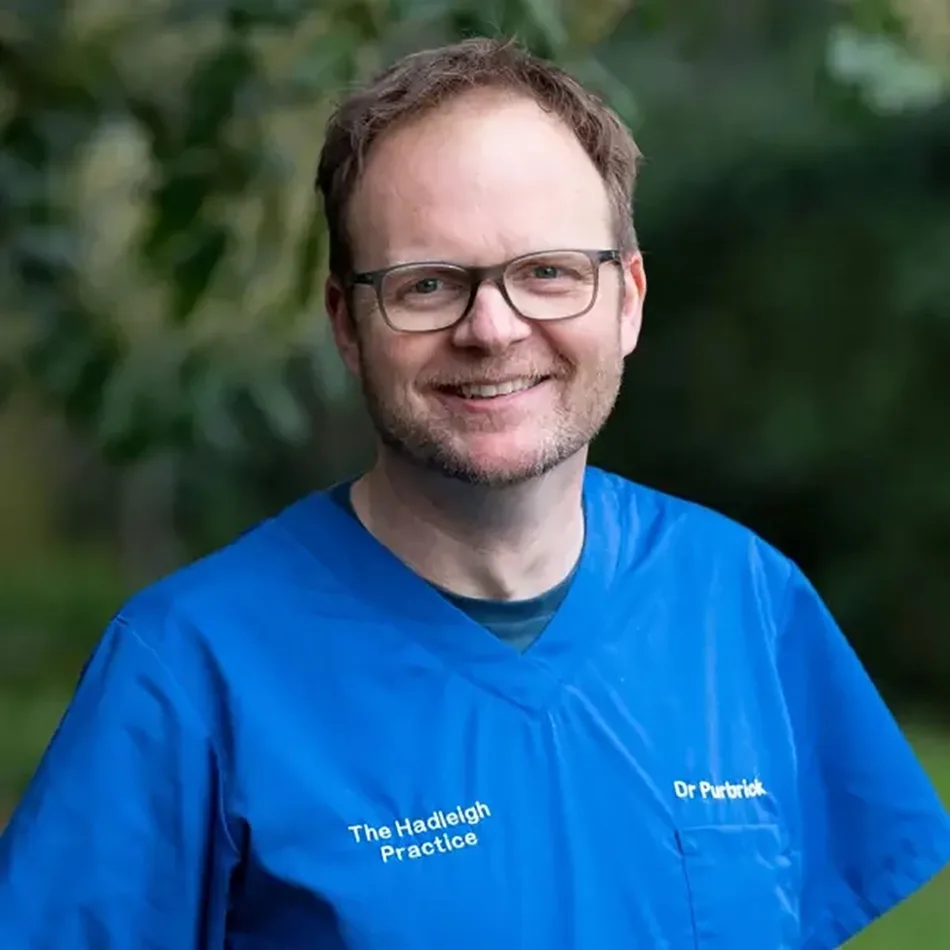
Dr Andy Purbrick is a GP in Broadstone and joint chief executive of the Wessex Local Medical Committee
From the 8am scramble for appointments to receiving life-changing diagnoses, Dorset patients have mixed experiences of their GP surgeries. So what’s really happening behind those busy reception desks – and why does it seem impossible to be seen when you need to be? When most people think of healthcare, they picture hospitals – yet around 90% of consultations with a clinician happen in primary care – your local GP surgery. Does the funding reflect that workload? Not even close. Only 7% of the NHS budget goes to general practice, with the rest largely directed to hospitals. Your GP surgery receives about 31p a day for each registered patient – less than the average price of an egg. Across Dorset, there are between 38,000 and 45,000 appointment slots each month – theoretically enough for half the population to see a clinician if they need to. Despite frequent complaints about waiting times, almost 40% of Dorset patients are seen by a GP on the same day, and 61% within a week. But Dorset also ranks among the worst areas in England for long waits: 8% of patients wait more than 28 days to see a doctor, compared with a national average of 5%. The reasons are complex. Some patients prefer to wait for a specific GP, while others have conditions that require specialist input. With Dorset’s ageing population, many are likely to have a long-term condition or require specialist assessments. Hard to recruit Despite rising need, the number of fully qualified, full-time GPs in Dorset has fallen steadily – there are now 429, 29 fewer than in 2017. Dr Andy Purbrick, a GP in Broadstone and joint chief executive of the Wessex Local Medical Committee, which supports general practices across the region, says the decline is deeply worrying: ‘It really dismays me. I’ve been a GP for 25 years and I’m also a trainer. I always wanted to be a GP – but we’re seeing more colleagues leave the profession early, often due to burnout. The clinical hours don’t reflect the total hours worked. Often it’s the unseen load – results to check, admin to process, constant behind-the-scenes work.’ He says stagnant government funding is compounding the problem. ‘Our core contract hasn’t been uplifted for years, which makes it hard to recruit. A survey by the Royal College of General Practitioners found that 40% of GPs plan to leave the profession within five years. Even trainees now question whether they’ll last in the job. Burnout is real, and we’re constantly trying to maintain a safe workload. ‘We’re the part of the NHS that can’t say no.’ Training and recruitment is also under strain. Dorset has a comparatively strong record on training places – around 65% are currently filled by international medical graduates – but retention of trainers remains a problem. ‘We’re struggling to keep enough trainers,’ Dr Purbrick says. ‘We try to fit everything into an already packed day. There’s also a lack of physical space – most of the capital funding for building goes to hospitals. We even have qualified GPs looking for work, but practices simply can’t afford to employ them.’
Doctor and Patient in a consulting room at a GP surgery
Open a motorway Not everyone is convinced that the new appointment booking system is working. The government has asked practices to make online booking available throughout the working day, rather than only in the mornings. Dr Purbrick says the reality varies across Dorset: ‘It’s a mixed picture. Every practice is different – and many have offered online access for years. At the Blackmore Vale Practice, for example, introducing an online system cut average phone waits from 11 minutes to just one.’ But digital access also brings challenges. ‘Our main concern is the perception that we’re opening a motorway into general practice,’ he says. ‘Some practices worry about how to meet demand safely. Patients don’t always know what’s urgent and what isn’t. Someone might think their problem is minor but actually need urgent care – and others, especially those with complex needs, can struggle with technology.’ Missed appointments remain another frustration. In Dorset alone, there were more than 13,500 missed appointments in June 2025 – equivalent to £627,000 in lost clinical time.
A complex picture Despite a slight fall in Dorset’s population – down 0.03% – the number of requests for GP appointments rose by 11.3% in June this year alone. It’s a sharp reminder of the pressure on primary care. ‘It’s a complex picture,’ says Dr Purbrick. ‘We’re seeing more people with long-term conditions and frailty, and a significant rise in mental health problems. One in six adults in Dorset is on an antidepressant. Covid has had a big impact, particularly on younger people’s mental health. We also see patients multiple times while they wait for hospital treatment.’ He says many patients now come forward earlier or for social rather than medical reasons: ‘Some people just need support – others are anxious about taking risks with their health. We also bring people in proactively to monitor and prevent illness, which we know is the best way to manage long-term health overall.’ West Dorset MP Edward Morello agrees that the strain on general practice cannot be solved in isolation: ‘GPs are under enormous pressure,’ he says. ‘Outdated funding, ageing buildings, recruitment difficulties and an ageing local population all play a part. When residents can’t get appointments, pressure simply shifts to A&E and pharmacies. We need a proper, whole-system plan – not quick fixes that just move the problem around.’ Dr Purbrick believes the focus must return to prevention. ‘It’s mainly about workload and the growing complexity of long-term conditions,’ he says. ‘Most investment still goes into hospitals, but real progress comes from preventing illness in the first place. Most of us became GPs to help people stay well – we just want the space and support to do the job properly. We GPs are here simply to do the best for our patients: we go to work to do a good job.’
New BBC data shows Dorset’s council tax bailiff cases soaring – but the bigger story is rising debt, tighter recovery, and families caught in between
Rear View Of A Male Bailiff Standing With His Hands On Hips At House Entrance
Dorset council recorded the sharpest rise in England for households referred to bailiffs over unpaid council tax – an eye-watering increase of 5,119%, according to new BBC data. Freedom of Information figures released to the BBC, and now shared with The BV, show that in 2021/22 just 37 Dorset households were referred to enforcement agents. By 2024/25 that number had climbed to 1,931.Mathematically, that is indeed a 5,119% rise – but it tells only part of the story. Dorset Council says 2021/22 was an exceptional year: during the pandemic, court sittings were suspended and recovery activity scaled back, while the new unitary council was still in the process of merging its tax systems. ‘Like other councils, we limited our recovery actions during Covid,’ a spokesperson said. ‘Therefore, the 2021/22 starting data the BBC used is not truly representative.’
The real picture When collections resumed, the council began to work through the arrears that had built up. Dorset referred 612 households in 2022/23, 1,473 in 2023/24, and 1,931 so far this year. That’s roughly a threefold rise since recovery restarted – far short of the 5,000% headline, but bailiff referrals have roughly tripled since recovery restarted – in real terms, meaning three times as many Dorset residents are now facing bailiff action as just two years ago. Debt advisers say that the scale of the increase still raises alarm. Even allowing for pandemic backlogs, the figures suggest that more households are struggling to keep up with rising living costs while councils are moving faster to recover unpaid tax. Each referral represents a family at risk of mounting fees and potential loss of possessions – and, in some cases, their homes. The council says its enforcement and reporting processes have remained broadly consistent since 2022, though new national guidance is expected following a government consultation on modernising council tax collection. Dorset has contributed to that consultation, which aims to ‘streamline collection, reduce administrative costs and improve the experience for customers’.
Don’t ignore the bill Debt-advice charities say the national picture remains worrying. The StepChange charity and Money Wellness both told the BBC that councils’ reliance on bailiffs often makes debt problems worse. A £75 letter fee, £235 for a visit and further costs for any sale can quickly inflate a small arrear into a crisis. Citizens Advice, meanwhile, continues to stress that council tax and HMRC debts should be treated as top priority for anyone struggling financially, as both bodies are among the quickest to escalate recovery through court orders or enforcement agents. Dorset Council echoed that message: ‘Anyone struggling to pay their council tax should contact us or Citizens Advice to find a manageable solution,’ it says, pointing to the guidance on its website here: dorsetcouncil.gov.uk/w/problems-paying-council-tax.
The issue is part of a wider national trend: nationwide, councils referred 1.4 million accounts to bailiffs last year – up 46% in four years – even as the average recovery per case has fallen slightly. That suggests enforcement is becoming less effective, but more common. For Dorset, the headline-grabbing percentage hides a simpler truth: after two years of Covid disruption and reporting delays, enforcement has returned to more normal levels. But behind the numbers lies a harder truth: more households are sliding into arrears, and the debate over whether bailiffs remain the right tool for the job is far from over.
From heating bills to hospital trips, costs across Dorset are leaving many isolated and quiet poverty is growing, warns Jon Sloper
Many people are finding it hard to access what they need when they need it
While most of us are awaiting the forthcoming budget with some trepidation, many in Dorset will be actively dreading it: fearing anything that means more money disappearing. It certainly feels as though we’re all paying more and more for less, whether it’s the horrendously high water bill or creeping shrinkflation in shops. Older people tend to be disproportionately affected by the rising cost of living. In 2023, more than 200,000 pensioners in Dorset received a winter fuel payment and the cost of living allowance. With the Government’s new ruling on winter fuel entitlements, that number has fallen to just 20,000 people this winter. The NHS in Dorset has been using its data to identify those people at most risk of illnesses – they estimate 44,000 people could become ‘financially vulnerable’ over the coming winter months.
Challenges in the community Last year, Jon Sloper, chief executive of Help and Kindness, was part of a team reviewing data with colleagues from across health and social care. He says the work exposed major gaps in how services connect and communicate: ‘For many people, it’s hard to find what you need when you need it. There are also gaps within the public sector – individual organisations often don’t know what others are doing. When someone leaves a role, much of the local knowledge goes with them.’ Jon says there are still big gaps in communication between services. ‘The data revealed thousands at risk from the cold, especially those with health conditions and shrinking incomes. With the reduction in winter fuel allowance, we looked at who fell into that group and whether they were already receiving support.’ People with a chronic condition are vulnerable to drops in temperature: the mercury only needs to drop 4º to significantly affect their health and potentially require an emergency admission to hospital. Jon continued: ‘Having found our at-risk group, we involved local authority and health colleagues and asked whether these people were already receiving support – perhaps living in residential care. Or were they living independently, and potentially struggling with additional costs?’ As the GPs had access to the confidential patient data, they reviewed their lists to see whether potentially vulnerable people had received a check-up recently, and if their medications were up to date. Some were contacted individually and in other cases, open health and wellbeing events were held. In addition to a health check, financial advice around preparing for winter was available. Jon says: ‘We wanted them to think about how they would stay warm, and to get in touch with their GP earlier. We knew where there were small pockets of people across Dorset so we worked to reach those people via parish magazines to ask them about winter readiness. We saw a reduction in people attending GP surgeries and an increase in people applying for pension credit, which we encourage: it is the gateway for other benefits.’ Help and Kindness liaised with Age UK and the county’s library services, which helped people with applications, and also with families and carers, advising them on support. Increasingly, Jon is receiving requests for help from family members who want someone to check on a relative – the calls come in from all over the world. Last winter’s work revealed just how fragile life has become for many Dorset residents.
Group of four cheerful senior friends, two men and two women, sitting at table and enjoying talk after playing cards in assisted living home
Jon says the team’s work also exposed wider critical issues. ‘The loneliness is huge. Every week we hear from people who haven’t seen anyone for a week and just want someone to call in. We try to join those up, suggesting places people can go to, like a lunch club. We have access to more than 13,000 events and organisations across Dorset. ‘But the other issue is transport. For many, unless it is literally on their doorstep, they can’t get to it. We try to find local volunteers or community schemes, but transport is one of Dorset’s biggest challenges.’ Poverty, Jon says, is not just a vast issue, it’s a slow burn. ‘There has been a phenomenal rise in the cost of living, and many in Dorset are on fixed incomes. Their overheads are going through the roof, and their money isn’t keeping pace. On top of which, there are the challenges of a boiler that needs fixing or a fridge that breaks … For those reliant on medication, losing a fridge becomes a crisis. And there are no savings left … People don’t have savings any more. They use them for buying food and paying the electric. ‘The poverty issue is everywhere. And it’s not just older people. It’s households with double incomes, people working in care – it’s everywhere.’
Issues in rural Dorset Living in rural areas of Dorset brings extra pressures. In the middle and north of the county, Jon says, gaps in mental health support and transport leave many isolated. ‘There isn’t a single set of resources available everywhere. Wherever you go in Dorset there’s a different set of challenges and a different set of solutions. And different gaps. ‘There have been huge gaps in mental health support in North Dorset, though it’s starting to improve. Transport in North Dorset is a huge issue and it really affects access to health services – people just can’t get to them. We have many conversations about community transport: there won’t be a major change in public transport infrastructure, so we’re looking at alternatives. ‘Much of rural Dorset is a food desert. From north of Dorchester out to Yetminster and up the Piddle Valley there are a limited number of village stores with no supermarkets. And you can’t easily get to a supermarket from any of those places: if you can’t drive to a supermarket the cost of food can be more expensive.’ He believes Dorset could make better use of existing resources. ‘For example, school transport could be used to support carers in the middle of the day. We often don’t make the most of the resources we have. People struggle to get to hospital appointments in Bournemouth and Poole: it’s £50 for a taxi, one way, from Bridport to Dorchester! How are people supposed to afford that, especially when they are sick?’ Each call for help, Jon says, reveals how complex people’s lives have become. ‘One problem often turns into nine once you start listening.’ His message is simple: community awareness matters. ‘There’s so much quiet need,’ he says. Most of the time, help is out there – the challenge is making sure people know it exists.’ As winter approaches, that awareness – a neighbourly check-in, a shared lift, a simple hello – might be the smallest act that makes the biggest difference.
Help and Kindness maintain a vast directory of services and grants – if you belong to an organisation that can lend a hand or fund something, please let the team know so they can continue to join the dots on services in Dorset. helpandkindness.co.uk
Bournemouth Symphony Orchestra ensemble in Sturminster Newton. Don’t miss this rare chance to experience and enjoy some of the South West’s premier classical musicians performing in North Dorset. The Bournemouth Symphony Orchestra visit to The Exchange on Thursday 20th November will now feature a larger group of 19 musicians, in an ensemble presentation for strings.
BSO’s Serenades and Starbursts is a fascinating programme of musical exploration for an audience of all ages. Tchaikovsky’s masterpiece Serenade for Strings lies at the heart of this musical tapestry. A musical tour will start on the Mediterranean coastline with Jenkins’ Palladio, inspired by the 16th century Italian architect from whom the piece gets its name. Travelling east, Bartok’s Romanian Folk Dances will be followed by Skyork’s beguiling Ukrainian Melody, and then Holst pays homage to British folk song with his charming St. Paul’s Suite. Travel further still, across the continent and through time, into a galaxy of rapidly changing musical colours, exploding gestures and fleeting melodies, in the wondrous soundscape of jessie Montgomery’s Starburst. Then Gershwin’s ethereal Lullaby continues the journey further and further away – a musical treat for all.
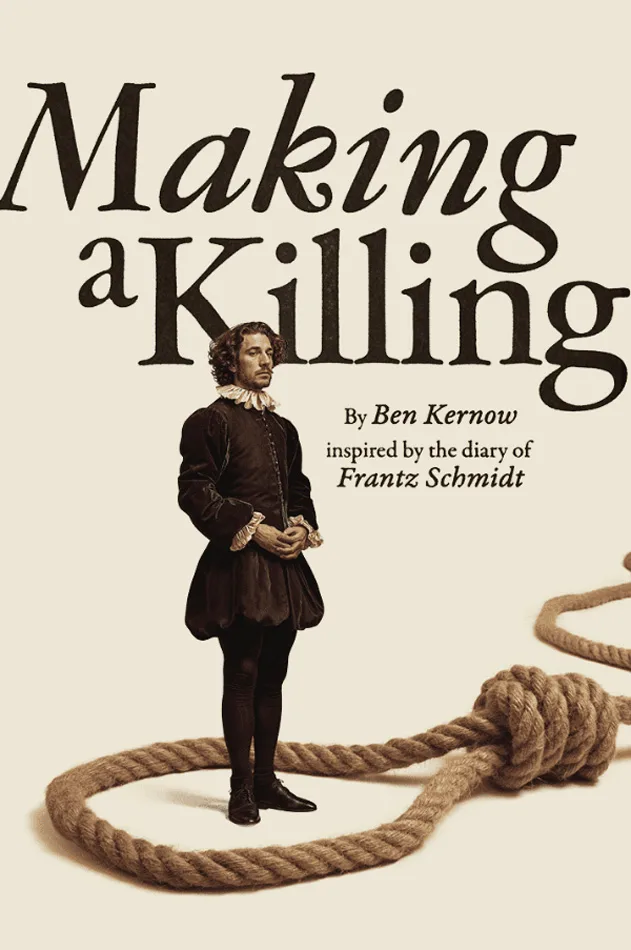
Don’t miss a gripping, razor sharp, dark comedy at The Exchange. Inspired by the notorious diary of Frantz Schmit, Making a Killing is set in 1590, in a world disturbingly like our own. The ropes are ready, the crowd is waiting, and the hangman has a new apprentice. In the shadow of the gallows, seasoned executioner Schmit wrestles with a family curse that haunts his every step.
When his brash new assistant arrives, the two men are thrown together in a world where duty, morality and power collide – and every decision leaves a mark. As the gallows fill and suspicion takes root, their fates become dangerously entwined, until both must decide who they are, and which side of the rope they stand on. Making a Killing by Ha Hum Ah Theatre is at The Exchange on Tuesday 11th November.
Both these shows are presented by The Exchange in partnership with Artsreach. Tickets are only £14, with generous concessions for children and for families. stur-exchange.co.uk/whats-on
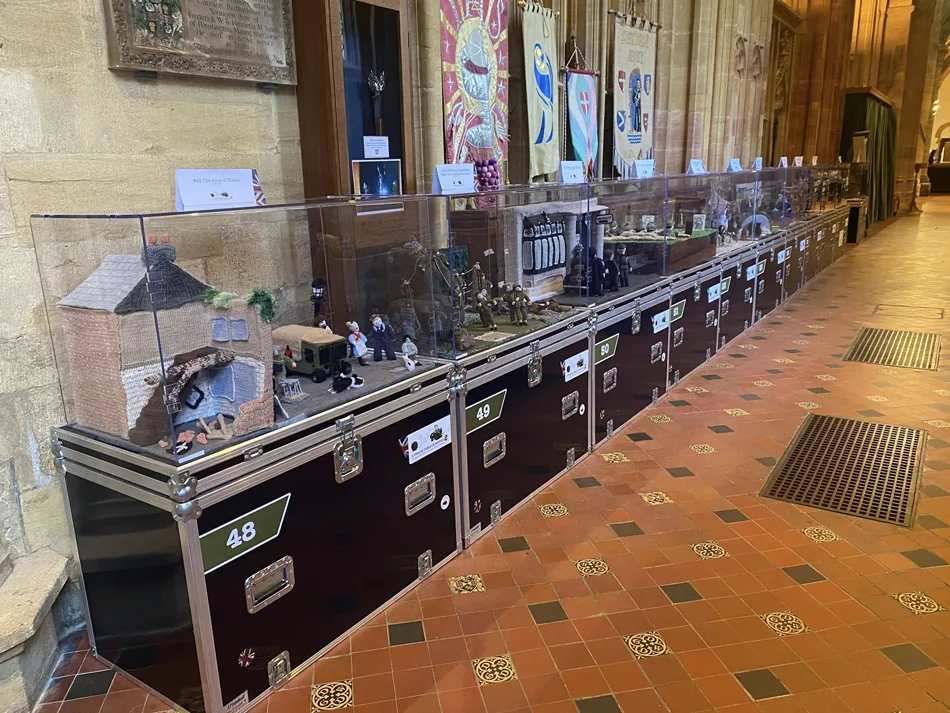
A unique and moving exhibition has arrived at Sherborne Abbey just in time for Remembrance. The Longest Yarn is a touring exhibition which tells the story of Britain during the Second World War – told through 80 meticulously crafted knitted and crocheted scenes.
Rector Martin Lee and Major General John Stokoe with the knitted figure of Piper Bill Millin
he Longest Yarn’s Britain At War installation stretches 80 metres. Images courtesy of Sherborne Abbey
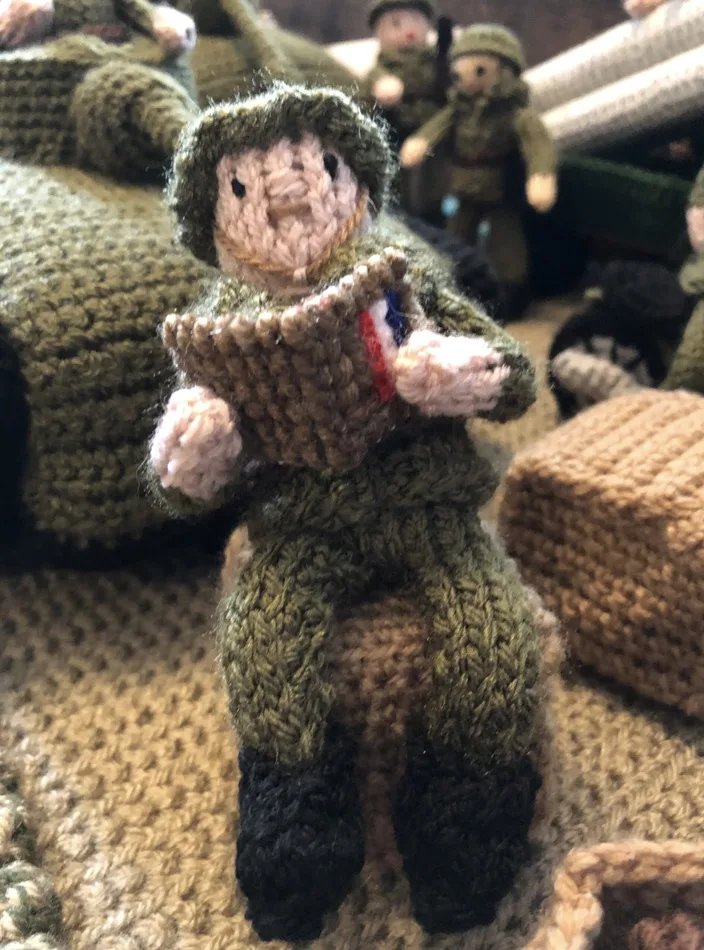
The installation, titled Britain at War, stretches an astonishing 80 metres in length across two 3D displays. It chronicles daily life from 3rd September 1939 to VE Day, 8th May 1945, with panels depicting rationing, evacuees, soldiers, the Blitz, wartime headlines and the eventual jubilation of peace. Alongside the intricately-made panels stands a cast of life-sized, knitted characters – each representing key historical figures and veterans from Normandy on D-Day. All the scenes have been designed with historical accuracy, under the guidance of expert historians, and each tells its own carefully chosen story.
Case 41 is the Balham Bus CrashBuckingham Palace on VE day
The Sherborne Abbey exhibition was officially opened on 4th November by Rector Martin Lee and Major General John Stokoe, who was photographed with the popular figure of Piper Bill Millin – Lord Lovat’s Mad Piper of Sword Beach – who played his bagpipes as Lord Lovat’s commandos fought their way ashore on D-Day.
Land girl Daphne Hedges moved to Devon to catch rats
This powerful, imaginative exhibition offers a heartfelt tribute to those who lived through the war – a visual storytelling project as creative as it is commemorative. The Longest Yarn runs at Sherborne Abbey until 27th November. Entry is free, but donations are warmly welcomed to support both the Abbey and veterans’ charities. Visitors who make a donation are invited to take an exhibition leaflet, available at the main door.
With exceptional attention to detail, every tiny figure has been crafted with a personality
Sherborne Abbey is open to visitors Monday to Saturday, 8am–5pm, and Sundays, 11am–5pm, unless services are taking place. More details can be found at: thelongestyarn.com
As Armistice Day approaches, we pause to remember the sacrifices of those who fought for their country. Yet we know that some veterans, like Dorset’s Henry Maidment, slipped quietly through the cracks of history. Henry’s bravery was recognised only when poverty forced his name back into the public eye.
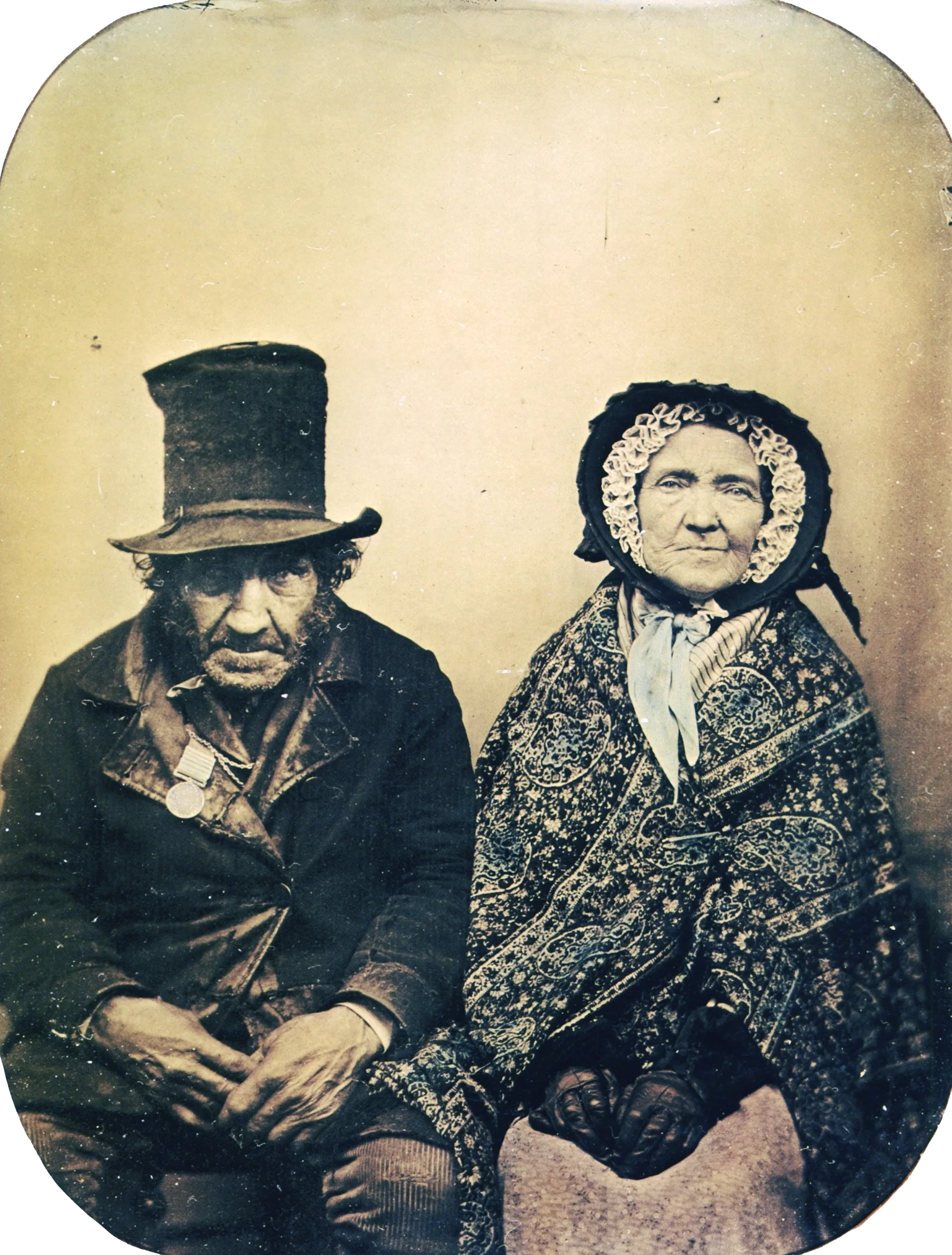
This image is widely circulated online labelled as ‘Henry Maidment, a Napoleonic War veteran, with his wife Rosanna Belben’ – but there is no definitive proof of the couple’s identity.
The photograph above, sometimes seen in colour-tinted form, is widely circulated online labelled as ‘Henry Maidment, a Napoleonic War veteran, with his wife Rosanna Belben’. It appears on genealogy sites such as Find a Grave, though there is no definitive proof of the couple’s identity. When the military charity SSAFA shared the same image, they described it simply as an ‘unknown soldier’. Some have noted that Henry’s medals appear to be worn on the wrong side – perhaps simply a sign the image was flipped, but it could be that the decorations were not his at all. Whatever its origins, it remains a powerful, haunting symbol of an old soldier’s twilight years.
Born in 1783 in the village of Pimperne, near Blandford, Henry Maidment fought in the Peninsular War against Napoleon’s forces, taking part in the brutal battles of Talavera, Salamanca, Vittoria and Toulouse. His medal – the Military General Service Medal with multiple clasps – testified to years of service in Europe’s bloodiest campaigns. Yet by 1866, aged 83, we know the decorated veteran was destitute, surviving on a parish handout of two shillings and sixpence a week and a single loaf of bread.
Public appeal
His situation prompted a very public appeal. In March 1866, George Mansel, a local lieutenant, wrote to The Times describing Maidment as “a fine old soldier now suffering hard times” and inviting donations from readers:
May I endeavour to enlist the sympathy of your numerous readers on behalf of one of the few surviving veterans of that army which gained immortal renown under our great Duke in Spain from 1809 to 1814? The subject of this appeal, Henry Maidment, is now living at Pimperne, near Blandford.
He is in his 84th year, and his sole support is 2s. 6d. a week and one loaf of bread, allowed him by the parish.He served in the 53rd Regiment, and fought in the following battles, for which he received a medal and seven clasps:- Talavera, Salamanca, Vittoria, Pyrenees, Nivelle, and Toulouse.
Having enlisted for ten years,he was discharged without a pension. He is a fine specimen of an old soldier, and has always borne an excellent character. If any one who reads this appeal would like to soothe the remaining years of this veteran with a few necessary comforts, the Rey. William Bury, rector of Pimperne, near Blandford, and myself will be glad to be their almoners.—I remain, yours truly, GEORGE P. MANSEL, Langton-lodge, Blandford.
‘More shame’ for Mansel
But the response to the appeal was mixed. The Times’ letter was also shared in the local Western Gazette, and the editor, in recapping the whole of the correspondence, noted that ‘the following snarling epistle’ appeared a few days later:
Sir,- read in the Times of the 28th a letter signed by a gentleman of property and position, as I am told, in Pimperne – Colonel Mansel – inviting the sympathy and assistance of the public towards maintaining a very old Peninsular veteran, whom he describes as bearing an excellent character, and having no other maintenance than 2s. 6d. a week from the parish of Pimperne.
If this be so, more shame, I think, for the Colonel, Lord Portman, and other rich proprietors in the parish and neighbourhood, who surely might afford, among them, to keep this poor old soldier in comfort without invoking the powerful aid of your columns to assist them.
We have heard much of late of the condition of Dorsetshire labourers, who are starved on wages of 8s. and 9s. a week, so perhaps one ought not to be so greatly surprised at this appeal. I am neither a landed proprietor nor a military man; but, thank God, I live in a part of the kingdom where we pay our labourers from 15s. to 18s, a week, and do not require the sympathy of the benevolent public to help us to keep such deserving objects of charity living among us as this worthy old veteran.–Yours, &c., a MAGISTRATE.-’
Henry Maidment died two years later, his death registered by a neighbour who had cared for him in his final days. He was buried in St Peter’s churchyard, Pimperne. His story – uncertain in image but clear in meaning – serves as a reminder that remembrance is not just for the fallen, but also for those who lived through the hardships of war.
As we mark Armistice Day, Henry’s story continues to resonate: a soldier whose battle extended beyond the battlefield.
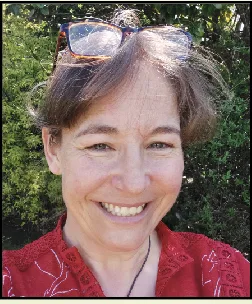
This month, I bought a pair of trousers. They are both comfy and flappy. This may not sound like headline news, but trust me – it’s a revelation. Soft, swishy, deeply satisfying. They make a pleasing noise when I walk. I’ve worn them three days in a row. Life, I’ve decided, is too short for uncomfortable clothes – one of the few perks of reaching an age where you no longer care if your family hates your wardrobe. My son is currently thousands of miles away – I haven’t hugged him in a year, and right now he is sad and unwell. And as I write, the Chancellor is sharpening her pencils and her tax plans. Wars around the world make my heart heavy and my brain rage. And I now have enough grey hair for it to visibly appear in my hairbrush (which feels rude, frankly). So let’s take our wins where we can. The flappy trousers. The good coffee in the right mug. The dog you pass on your walk who simply must be greeted while he wags in circles. The doughnuts my daughter always buys me on publication night – even when I’ve said (pretended) very firmly I don’t want one. It’s not about being in denial. It’s about finding balance. We’re not ignoring the big things this month – inside you’ll find out why you can’t get a GP appointment, how council tax debt is landing more Dorset families a bailiff visit, and how quiet, hidden poverty is growing across the county. Rural communities are struggling to support their most vulnerable. But for balance, there’s also the Wimborne teenager recently named the UK’s top army cadet. The hockey club storming to success. And the fact that I appear to be going into business with MP Simon Hoare. Probably. Plus, of course, the usual dose of glorious Dorset photography, from talented locals who, quite honestly, are just showing off. So for now, I’m raising a coffee (in The Mug) to the little things. The ones that still spark joy, even when the news is dreadful, the mother-worry won’t subside and my hairbrush is rude. Long live the flappy trousers.
Laura x
On Sturminster Town Council I was surprised to read about Pauline Batstone step down as Mayor of Sturminster Newton, then hearing that she had just as quickly returned to the council (though not as mayor). An experienced local politician like Pauline would have surely known this: either the position had become untenable – in which case walking away was the right call – or it wasn’t, and the resignation was a misjudged political flounce. Going back so swiftly weakens your position. It reads as indecision and undermines public trust. If you’re going to quit, quit properly. If not, don’t storm out in the first place. Name and address supplied
Local councils are a magnet for big personalities, and Stur certainly isn’t the only town where heads clash and tempers flare. But some of these dramas could be avoided with a little more turnover. The Dorset Insider is absolutely right (as usual) – there are far too many long-term lingerers on local councils who seem more invested in holding office than doing the job. Perhaps it’s time for fresh blood. An upper age limit might be controversial, but some form of activity review or term refresh wouldn’t go amiss. Public service isn’t a lifetime appointment, and complacency kills councils. J.S., Shaftesbury
I went to the Town Hall event about the proposed Local Plan, and I have to say, I came away feeling rather deflated – and oddly sympathetic. The council officers present did their best, but it was painfully clear they’re stuck in an impossible position: caught between a central government demanding tens of thousands of new houses, and communities asking perfectly reasonable questions about how on earth Dorset is expected to cope. It’s hard not to feel that the officers on the ground are being used as human shields for a top-down, target-driven system that’s entirely disconnected from rural reality. They looked exhausted, underprepared, and in some cases genuinely embarrassed that they couldn’t provide proper answers. But my sympathy for them doesn’t make up for bad planning. And this isn’t just bad planning – it’s barely planning at all. If roads, bridges, water, sewage, GPs, schools and public transport are all “someone else’s responsibility”, then who exactly is coordinating this vision for growth? How can you propose building thousands of homes without knowing how people will get to work, see a doctor, or even flush their loo? It’s not enough to say “that’ll be discussed with the developers later”. That’s not forward planning – it’s kicking the can down the road and hoping someone else will sort it out. Infrastructure should be in place before building begins. End of. Dorset deserves better than glossy posters and vague assurances. If this is truly a consultation, then here’s my input: come back when you have a joined-up plan that actually respects the people who already live here. Caroline B., Motcombe
I attended the recent local plan consultation at Gillingham Town Hall hoping for answers. What I got was glossy display boards (on all of Dorset, with very little at all on Gillingham specifically), vague hand-waving, and a lot of ‘you’ll need to ask the developers/someone else.’ No one could tell me who will buy the affordable homes – or how affordable they will actualy be. They don’t know what types will be built, or how local infrastructure – roads, schools, GPs – will cope. Is this supposed to be planning? It felt more like shrugging. Sally H, Gillingham
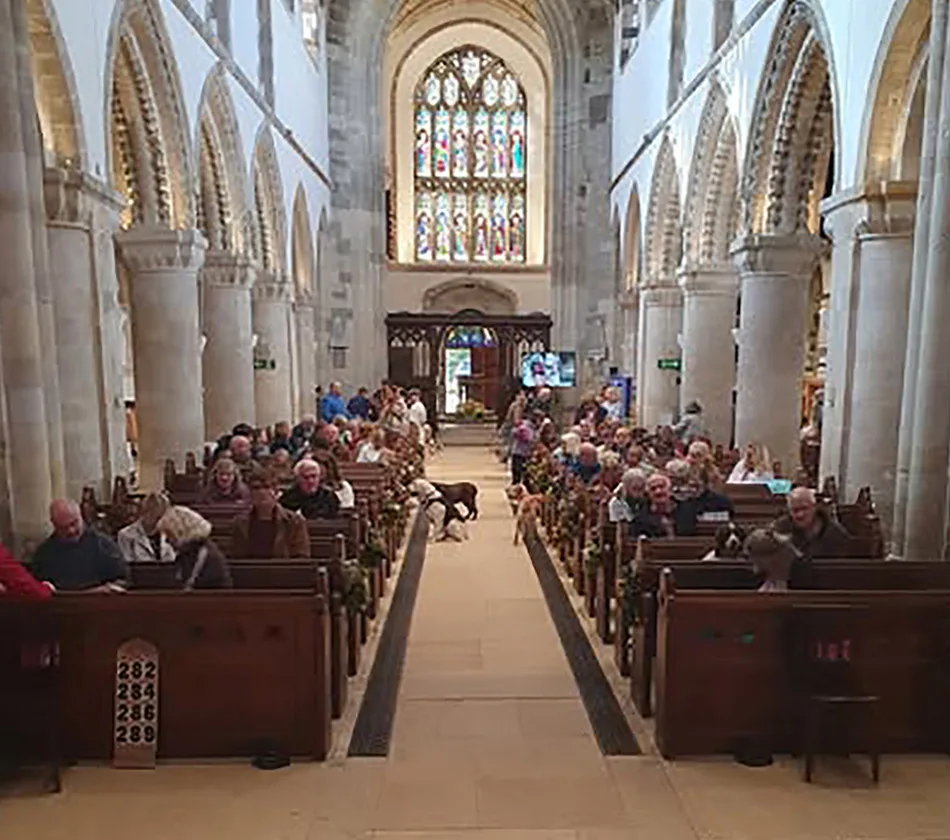
Animal Blessing in Wimborne Minster An Animal Blessing Service was held in the Minster Church of St Cuthburga, Wimborne Minster, on the afternoon of Sunday 12th October. The service was conducted by The Rev’d Canon J.W. Roland, rector of Wimborne Minster. The service was well attended by beautifully behaved animals, including cats and sheep as well as lots of dogs! The animals came into the Minster for prayers and a blessing and Ruth Marshall, the parish secretary, gave a short talk entitled My Church and other Animals. She also brought along two of her North Ronaldsay sheep, a rare breed originating from the Orkney Islands. The sheep are used to graze the graveyard of St Wolfrida’s Parish Church, Horton, and a collection was taken in aid of the sheepfold at this church. Diann March
Call for emergency suicide training I’m writing to you about the amount of times our local emergency services have been called out to suicide and self-harm incidents. The Government currently doesn’t ensure our emergency services provide staff with any national standard of suicide prevention training. Yet, Samaritans found that last year, South Western Ambulance Service were called out to 87,290 mental health-related and 28,667 suicide and self harm-related incidents. These new figures show just how often our local emergency workers are in contact with those in suicidal crises – and why training all emergency response workers in suicide prevention is urgent. Right now, our emergency responders – and anyone who is in crisis from our community – are being failed. These workers are often first on the scene when someone is suicidal: providing them with the skills and confidence they need to identify and support anyone who is suicidal could save lives. I urge readers to email your local MP and back Samaritans’ call for mandatory suicide prevention training for our emergency responders, to help reduce lives lost to suicide in Gillingham. Richard Strookman, Gillingham.
Want to reply? Read something you feel needs commenting on? Our postbag is open! Please send emails to [email protected]. When writing, please include your full name and address; we will not print this, but do require it.