The Tory byelection defeat had everything to do with Mr Johnson, says North Dorset Green Party’s Ken Huggins
Boris Johnson has just claimed that his government’s record is ‘exceptional’. He has never spoken a truer word. He blames the crushing Tory defeats in the Wakefield and Tiverton/Honiton byelections on the media, for focussing more on his personal conduct than on his policies. That he considers his personal conduct to be of no consequence says it all. There has been plenty of media focus on his policies, many of which do not stand up to close scrutiny. And whilst Government spokespeople take every opportunity to remind us of the speed of the vaccine rollout, they deliberately ignore the massive failings elsewhere in dealing with the covid pandemic. For example, the Government claim that a ‘protective ring’ had been thrown around care homes. Not true. My mother caught covid in Yeovil hospital, but was promptly discharged right back into her care home. Tens of thousands of vulnerable care home residents caught covid and died. Then there was the debacle of PPE procurement, with eye watering profits, commissions being paid without proper scrutiny and billions spent on unusable items. Wasted taxpayers’ money that could have been profitably used to increase supplies of renewable energy, and reduce energy consumption by insulating homes. For us to have such a Prime Minister at this time is more than just an embarrassment, it’s a disaster. With the enormity and urgency of the environmental crisis ever more apparent, now more than ever we need strong, compassionate and caring leadership, with recognition that we are all in the same boat. Accepting that everyone has to be taken care of, regardless of which school they went to, or how wealthy they may be. For any conservatives pondering their next steps, as an ex Conservative voter myself I can confirm the warm welcome that awaits in the Green Party.
The kitchen’s open! A beautiful Elizabethan kitchen has been revealed at Athelhampton House, hidden and forgotten despite the room’s continuous use for half a millennia.
The revealed Elizabethan kitchen range at Athelhampton House. Image: Courtenay Hitchcock
Giles Keating, owner of Athelhampton, today invited Chris Loder MP to formally open the ‘new’ kitchen in the famous Tudor house. It is believed to be one of the oldest kitchens in the country in continuous use — for the last 500 years. Over time the Elizabethan origins were hidden behind thick white paint, substantial brickwork and plaster, and a range of rough modern cabinets.
How the Athelhampton kitchen looked until recently, with the top of the filled-in arch apparent. Image: Giles Keating
“The ‘cabinets’ were awful – when we took off the rather nice doors we revealed a really rough DIY 3”x2” framework, clearly homemade, with barely a shelf inside!” said Giles “We knew there was probably something there because we could see the shape of it. But of course, we had no idea what sort of condition it was in, or what was underneath. So we stripped off the modern surfacing, and revealed that beautiful arch. But there was also a vast amount of more modern brickwork which had been used to fill it in, almost entirely, with just a central space left for the Aga, and a gap to one side. We’re not sure why that was left, possibly because the builders were aware of the presence of the bread oven behind, and left access to it. “We were keen to find the fireplace behind all the brickwork, but we were genuinely worried the whole building would fall down! So we had to put structural underpinning in place first, and then knock out the modern brickwork piece by piece.”
“They used the biggest drill bit I had ever seen!” Giles described the work to support the wide Elizabethan arch. “Originally the arch would have been self-supporting, of course, but at that time there weren’t two floors above it. We presume it was filled in and supported at the time those extra floors were created. Removing those supports would have been dangerous without the structural engineering work” Matthew Ellis, head of Ellis & Co, specialists in conserving and repairing historic buildings, explained “The arch had been supported by brick pillars, so we needed to use cintec anchors: a long hole was drilled through the arch itself from the outside walls on each end, filled with a special ‘sock’ (a porous fabric sleeve) into which non-shrink cementitious grout was injected under controlled pressure. The result is invisible from inside the kitchen, but provides the necessary arch support and allowed the more modern ‘filler’ brickwork to be removed”
This bread oven had been entirely covered and hidden by a sink – forgotten and unknown to the Athelhampton team until the restoration works began. Image: Courtenay Hitchcock
The team slowly revealed a stunning Elizabethan fireplace and bread oven, complete with soot-blackened bricks. The removal of the modern kitchen units and sink also revealed an unkown bread oven hidden in the wall – now revealed and restored, too.
The archway is wide enough for perhaps a dozen cooks to work at simultaneously (provided the outside ones ducked their heads!), and on the opposite wall is ‘an Elizabethan hob’ – a stone platform with holes to allow pots to be placed over the fires beneath; effectively allowing Tudor ‘hob cooking’ away from the naked flame in the main fireplace under the arch. With an eye on modern standards, however, there are now electric hotplates hidden inside the stonework – a testament to Athelhampton’s drive towards the removal of all fossil fuels on site, and the estate’s aim to become carbon neutral.
Chris Loder MP and Athelhampton owner Giles Keating celebrate the cutting of the ribbon and the official opening of the kitchen. Image: Courtenay Hitchcock
Athelhampton House and its 29 acres of formal and informal gardens was built by the Martyn family – the ending of the Martyn male line in 1596 is marked by a tombstone in the Athelhampton chapel of St Mary Magdalene at Puddletown, in an inscription of brutal – but amusing – honesty: ‘Nicholas the First and Martyn the Last,/Good night, Nicholas!’
Thomas Hardy, who lived at nearby Bockhampton, loved Athelhampton, and thinly disguised it as Athelhall in his short story The Waiting Supper, and in the poems The Dame of Athelhall and The Children and Sir Nameless.
From L-R Matthew Ellis, head of Ellis & Co in charge of the restoration project, with his foreman, Chris Loder MP, Giles Keating owner of Athelhampton, project surveyor Stefan Pitman of SPASE Design, Owen Davies, head of the commercial team at Athelhampton and Claire Poulter, specialist decorator
The Tudor kitchens have not been open to visitors previously, as they were part of the private living apartments within the house; Giles Keating in fact still uses them to enjoy his breakfast. However he explained that they will now form an essential part of the visitor experience, with regular demonstrations, and a large living history re-enactment already planned for October.
Both Giles Keating and Chris Loder were quick to praise the team of craftsmen who have removed all trace of the modern facings and revealed the beautiful Tudor bones of the building.
The panelling restoration – of the two biggest panels above, the left hand one is original oak, the one on the right is a more modern pine replacement, painted by Claire Poulter. Around the window itself, work is still underway. Image: Laura Hitchcock
Thanks to Ellis & Co, Claire Poulter has also been working to restore the panelling in the adjacent dining room “Honestly, I’ve even been dreaming in squares for months. There are over 1,100 of them in here – and I’ve sanded back every single one!” Claire has worked to repair the original oak panelling, and when the stripping revealed that some of the panels were in fact pine and marine ply, she used her specialist decorator skills to paint it – “It’s a bit like stage dressing – hopefully a casual visitor would be hard-pressed to spot the difference.”
The complete Elizabethan cooking range under the arch, complete with a new spit from a local blacksmith
MP Chris Loder, cutting the ribbon at the official opening ceremony, explained why he was keen to be part of the project: “It’s no secret that the economy of rural Dorset has a huge dependency on tourism. The work Giles has done at Athelhampton brings people into the area and money into the local economy, which is absolutely vital. I’ve been coming to Athelhampton for over eight years. I have actually eaten in this very kitchen – not realising that behind the aga was this wonderful arch, which is so beautiful to see.”
The revealed Elizabethan range, with serving hatch through to the dining room where the panelling has also been restored. Juliet Ferguson is a living historian with a specialism in the Tudor period. Image: Courtenay Hitchcock
He added “We have recently had an issue with Thomas Hardy being removed from University syllabus. I am aware that Nadim Zahawi – former education secretary, now chancellor – perhaps wants to be Prime Minister. I shall be very clear that I’m open to negotiation, and if he wants my support then we’ll have to sort out the Thomas Hardy issue … “I’d like to congratulate the whole team who have achieved this today – it’s terrific to see the work come to fruition. Thank you all.”
Athelhampton House & Gardens has summer opening hours until 8th October: 10am to 5pm, Sunday-Friday (CLOSED on Saturdays). The House opens 11am daily, last admissions at 4pm
The disconnect between comsumers and the food on their plates has arguably never been wider – Andrew Livingston suggests that social media can help
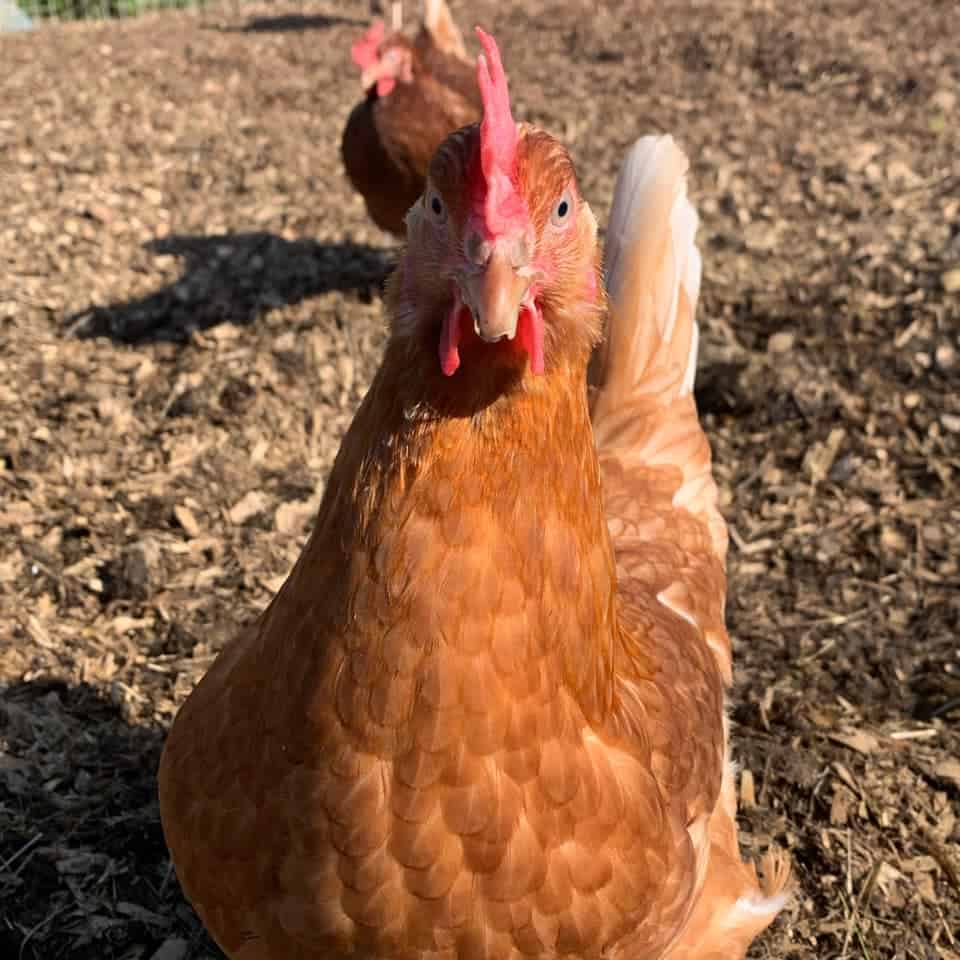
One of the free-range Westleaze hens. Image: Andrew Livingston
Twenty years ago, if someone had had said that social media would be a vital tool for farmers, quite honestly, you would have thought they were mad. Farmer Giles down the road really wasn’t updating his Myspace or Bebo pages. Today, however, Facebook, Twitter, Instagram, Snapchat and TikTok are all useful and engaging platforms for farmers. I’m not saying your average farmer needs to know how to do an Instagram story to be a good stockman, or that a decent TikTok will help them know about their cereals. But it really does help in other ways. When I started at Westleaze Farm, I was quick to set up Facebook and Instagram pages for our farms in both Beaminster and Weymouth. I wouldn’t call myself an influencer, but social media has undoubtedly helped us engage and sell our produce to our local communities.
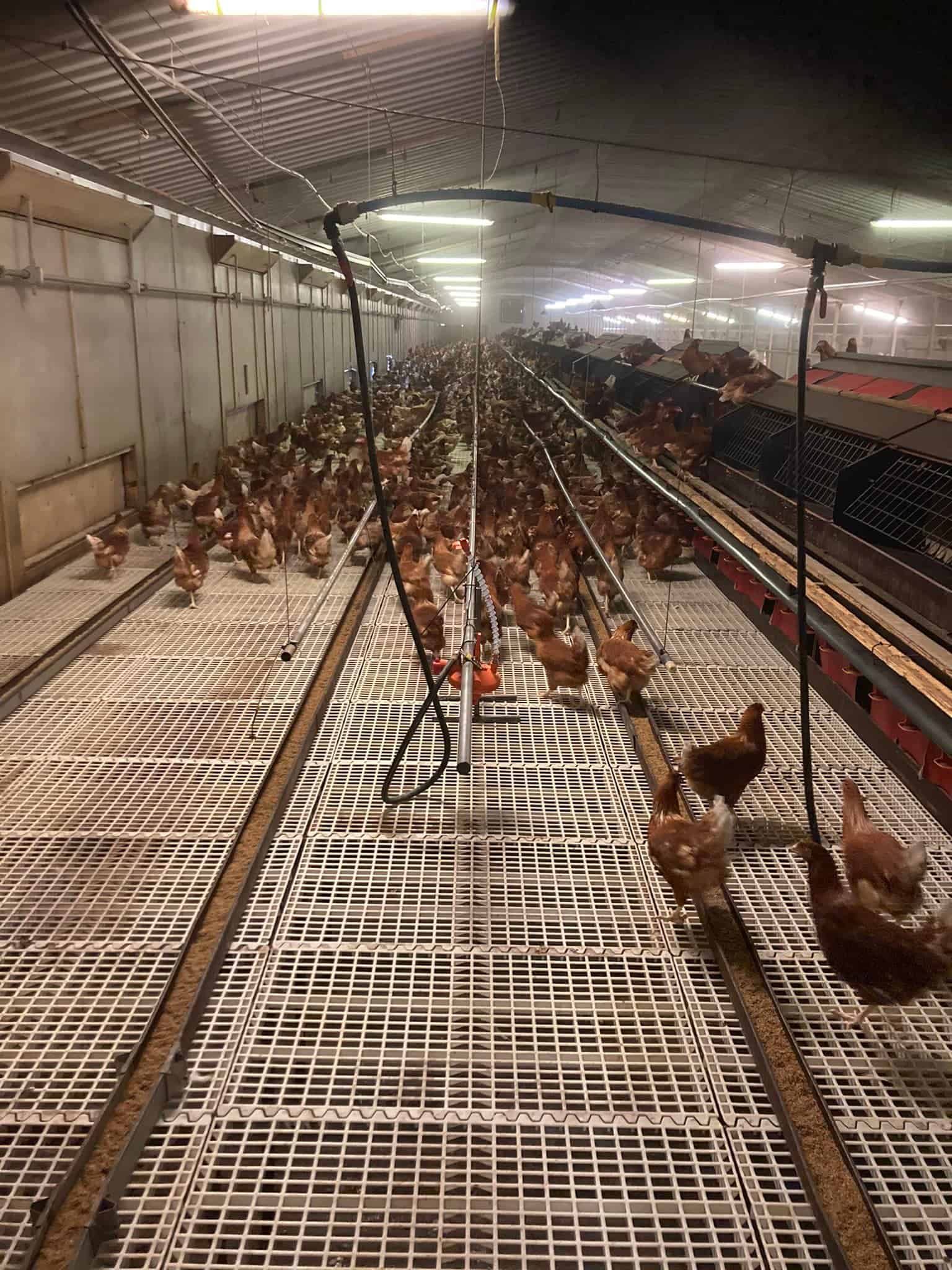
It’s an education But the real reason that farmers need to be on the socials is education – people outside farming need to learn about what’s really happening on-farm. After LEAF (Linking Environment and Farming) Open Farm Sundays, social media is the best way to try to educate the public about the truth about farming – because they currently have no idea. Recently, in Weymouth, we had new birds placed for our next flock of free range layer hens and, as we always do, we put out a post promoting the girls. With the post, we published pictures inside the shed (opposite) – a rare and moderately brave thing for a chicken farm to do, as it always opens you up for scrutiny from those who seem to have no conception of where their food really comes from. The Facebook post was swiftly deluged with comments, mostly untrue and misinformed, as the people of Weymouth decided to tell us that actually our birds weren’t free-range – “These aren’t free-range then,” and “Poor hens locked inside.” One user did respond and put it perfectly: “I swear we’re so out of touch with where our food comes from … You can drive past this particular farm and see the hens out in the field.” You can see the other side of that shed wall in the video above.
Inside the hen shed Image: Andrew Livingston
Eco-aware generations I don’t blame the public for having no idea where their food comes from. Frankly, they have never been taught the truth. I wouldn’t advocate for agriculture and the environment being a compulsory subject in schools, but kids do need to be taught at a young age what has to happen for their turkey dinosaurs to reach their plate. Unfortunately, Countryfile and similar programmes don’t show what true farming is like – lambing season isn’t always in warm, perfectly lit barns. For smaller farms, it’s a case of chasing the lambing ewes in the middle of the night across open fields through sideways rain. Millennials, Gen Y and Gen Z are all growing up with a greater understanding of the environment and of their own carbon footprint. Farmers need to fight to teach these eco-aware generations that farming is more than just a methane statistic. Apparenmtly the mainstream news media isn’t interested in showing farming in a good light, but thankfully for us the new generations don’t watch old news media – they scroll on phones and watch silly dances. And with that comes the opportunity to get seen and teach them something new.
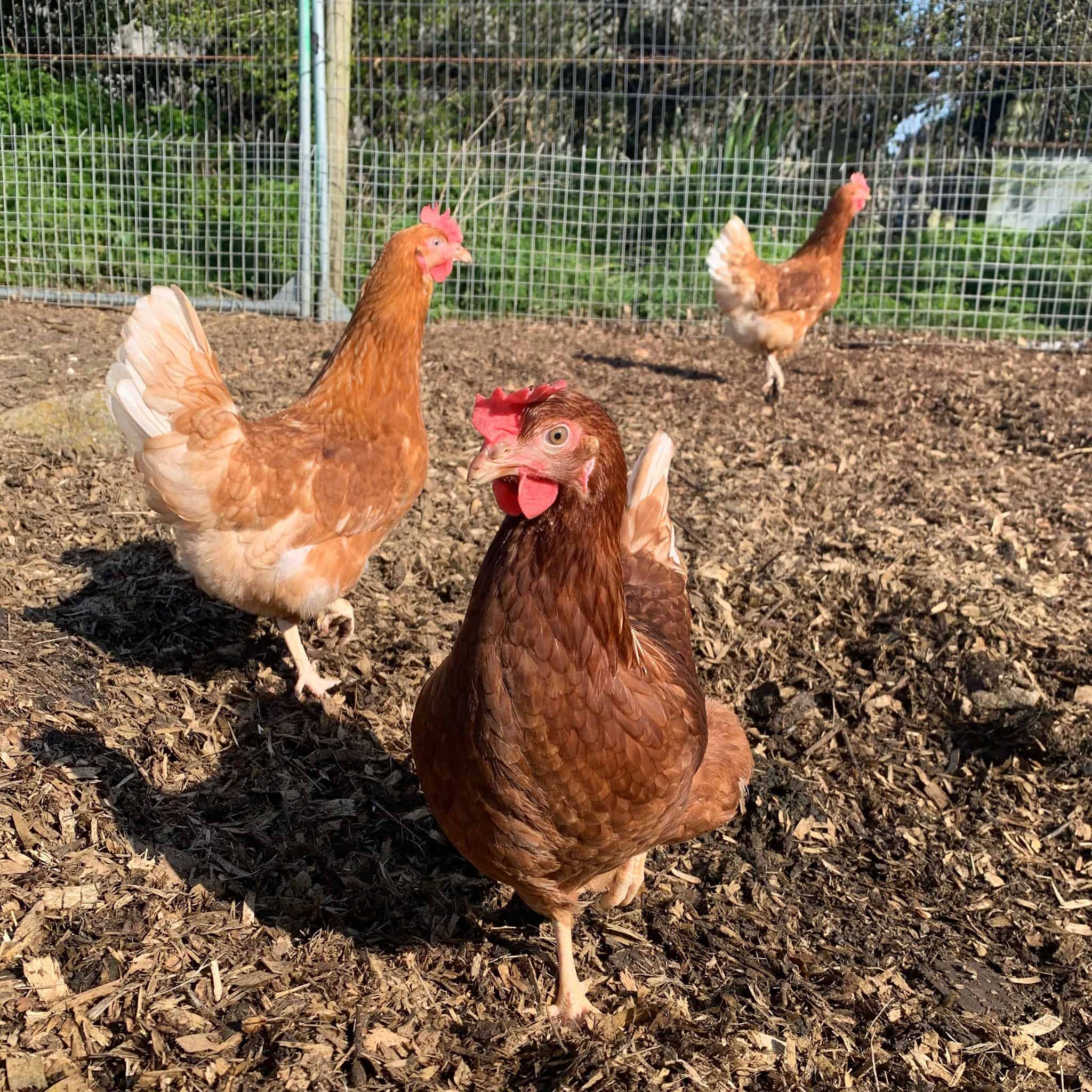
Where the hens spend their days Image: Andrew Livingston
At Wells Cathedral School and Little Wellies Nursery, we think that even with our smallest pupils, we need to remember to focus on the bigger picture. Our school values of Creativity, Aspiration, Responsibility and Endeavour are at the heart of all that we do. These four values – which appropriately also spell the word “CARE” – inspire us as teachers to nurture and develop these qualities in our pupils, with the aim of assisting them in becoming amazing young people that leave school with huge potential for life’s successes.
Why do we put such emphasis on these values? Simply put, it is these qualities – alongside our Learning Powers of resilience, motivation, curiosity, careful thinking and resourcefulness – that are so often the strong predictors of success in life. These are skills that run through every year of our educational journey from Nursery all the way up to eighteen. They grow and develop, and increase in complexity and maturity as the children work their way through school and then into their adult lives. When our children are faced with challenges or things get tough – as has been the case for so many of us in recent years – it is these qualities that will get them through.
Reach for the Stars At our school assemblies, we delve into what these, for a little child, rather big words mean! It is our job in Pre-Prep to turn these large, somewhat generic words into things that really mean something to our children. A recent focus for us has been ‘Aspiration’. We started assembly by playing the song ‘Reach for the Stars’, and explaining to the children that this means to believe in oneself and reach high. Children need to be shown how high they can reach.
Having established this idea, we couldn’t think of any better way to show this than to let our Nursery and Pre-Prep children observe the older children in the School. We chose to focus on the performing arts, and let our children enjoy a whole host of opportunities, devised and delivered by pupils from our Junior School and Senior School. One particularly memorable occasion was when our Senior School musicians put on an inspiring workshop, playing popular Disney songs on a whole host of instruments. This inspired the children in Pre-Prep to come back exclaiming that they want to play every instrument under the sun!
More recently, our Pre-Prep children also had the wonderful experience of watching a dress rehearsal for our Junior School production of Shrek, featuring pupils from Year 3 to Year 6. Our youngest children could not have been more inspired. They could not believe that underneath those costumes and all that make-up were some of the older children that they actually know! These opportunities make our children feel like anything is possible if they work for it. Our children are of course incredibly fortunate to be surrounded by such inspiring role models, and we as teachers feel just as fortunate to work with them. So while we aim to inspire them, they also amaze, delight and inspire us, creating a cycle of aspiration where we’re all helping each other achieve our own personal success. We’re all reaching for the stars together! John Fosbrook Director of Admissions
Crushing costs and a difficult labour market are potentially tempered by the positivity of busy order books, says Dorset Chamber CEO Ian Girling
shutterstock
A really warm welcome to my column and I hope this finds you well. This month I’d like to reflect on the economy and talk about some of the challenges we are facing as consumers and businesses. Considering what we’ve been through with Brexit, Covid and now a war in Ukraine, it’s little wonder the economy has taken a hammering. We are all obviously concerned about rising costs and the resulting decrease in the standard of living. As consumers, we are facing increasing food costs (and indeed many supermarket shelves are often empty), the cost of running our cars is spiralling and heating costs are going through the roof. This all has a real impact on standards of living and unsurprisingly, many employers are facing upwards wage pressure from their staff.
The stress circle With a record number of vacancies, employers are having to do all they can to keep staff – with many consequently seeing wage bills increase as they fight to retain their staff. This is on top of hugely increased transport and distribution costs, increasing costs of raw materials (especially steel, wood and construction supplies) and, of course, escalating energy costs. All of this is hugely eating at margins, yet many businesses are concerned at passing on these costs in the form of price increases when consumers are already so squeezed. This then leads us into what feels like a never-ending downard spiral – reflected in the latest inflation figures and comments from the British Chambers of Commerce and other business groups.
It’s not all doom But interestingly, the high number of vacancies is the complete opposite of the nationwide unemployment situation that was expected after the pandemic. Many employers are currently facing real recruitment challenges and it really is an employee market. Businesses are identifying this as a real barrier to growth at the moment and this in turn is also pushing up wage costs, simply to recruit and retain talent. What may also be surprising is that many businesses are reporting strong demand for products and services and order books are busy – indeed, many businesses I speak to are reporting record growth despite the current economic climate.
The need to plan As I say, given the last five years or so, it’s clearly going to take some time for the economy to settle and it’s fair to say we face a challenging time. However, it’s important for businesses to maintain a clear focus on their plans, look after their teams, invest in technology and, essentially, look after cash flow – the life blood of any business. Should you need any help or support, don’t hesitate to contact us here at Dorset Chamber. Until next time, Ian
Fifth generation farmer James Cossins says it’s time to explore new (old) ways to maintain cattle feed through the summer
Combining at Rawston Farm in the 1960s
Over the last two months we have been busy harvesting our grass crops into silage clamps, silage bales and hay – all to be winter feed for our cattle. In Dorset it has been a dry season, and the showers we have experienced are more of a hindrance – especially when trying to make hay! It seems that every year at this time grass growth stops which means that some cattle have to be supplemented with additional forage. We are currently using last year’s silage bales to keep the milking cows performing. To counter this, we are looking at sowing some herbal leys – following the example of many organic farmers who find these leys productive in dry weather, and perform well without any additional inorganic fertiliser. The majority of modern productive grassland consists of less than five different plant species, and are often composed of just two – perennial ryegrass and white clover. A herbal ley has a combination of 15-40 different grass, legume, and herb species like clover, chicory, plantain, sainfoin and ryegrasses. They are left down for around five years before returning to arable for two or three years. In addition to providing forage, the leys also improve soil structure, add fertility and suppress weeds. This is all part of regenerative farming – something we will hear a lot more about in the future.
Looking towards harvest Our arable crops are beginning to ripen off now. Harvesting is likely to start by the middle of July, with the winter barley crop being the first to harvest followed by our oilseeds. The crops look promising but you can never be sure until they are in the barn! With prices all over they place the marketing of these crops will be a challenge, some can vary by £20 a day. We have marketed some crops already, taking advantage of what seemed like a good price on that day. With fuel prices nearly double last year’s levels, fertiliser still very expensive and general inflation rising, the financial outcome on this years harvest will be interesting.
Tb clear finally Our recent Tb test gave us reason to celebrate; a second clear test after 18 months of testing every 60 days. We can now sell cattle to a wider market at sensible price levels. We will also not have to test for another six months which is a considerable relief. Lets’ hope we can continue to remain clear. Apparently the Tb vaccination programme may be rolled out in 2025, and although according to our vets it will not be 100% effective, at least it is a step in the right direction to eradicating this disease.
Louise Stratton with her leaving gift
In other news It is great to see the Agricultural shows back this year. In Dorset we have three great shows – the Gillingham and Shaftesbury Show, the County Show at Dorchester and the Melplash Show. Great days out for everyone. The picture below shows our retiring NFU County Adviser Louise Stratton with a painting of her current horse donated by Dorset farmers. Louise has been a regular writer for the BV but now moves to pastures new within the agriculture industry, and we welcome Gemma Harvey as her successor. As we move into July lets hope the weather is kind to for harvesting and everyone can stay safe in the fields and on the roads.
Not every village has a close social life – Adrian Fisher describes how one Dorset village is successfully strengthening its sense of community.
St Nick’s Cafe
One of the wonderful things about the recent jubilee was that local activities and celebrations continued for four days. It was a once-in-a-thousand years event, and it was incredibly special. Seeing some of the same local people day after day at various events nudged relationships up a notch or several. It is often said there is more direct social interaction in villages than in cities or their sprawling suburbs. Part of the reason is the open land around each village. It makes every person in every household more relevant, just because they are there. So we look out for them a bit more – if we don’t there is always the risk that no-one outside the village will. What really helps in a village is to gather, regularly and frequently. A pub is one way, but because it’s open all hours, all week, there is not quite the same sense of gathering everyone together at one time, regardless of who they are. Something like a darts night is great, but only if you are keen on darts!
A regular meeting The ratio of village halls to houses in Dorset villages is remarkable. There’s a village hall in most villages, sometimes in a village with as few as 166 houses. Village halls are a great social resource, but they can tend to feel more institutional than a homely pub run by a keen landlord. Nevertheless, when there’s no pub in the village, some village hall committees have started holding a monthly Pub Night, which helps create a must-attend sense of occasion. And of course there’s another building nearly every village has – the church. Churches have character and attitude in spades; and as one of the oldest buildings in the village they are typically very central. A Sunday church service can lead to a social gathering place over coffee afterwards. But with falling attendances and often only monthly services, these occasions may be less regular now that clergy can be stretched to cover anything from a four-parish benefice to as many as eight churches.
St Nicholas’ in Durweston is serving a new community purpose outside regular services
A new way However in Durweston every Thursday from 8.30 till noon, St Nicholas’ church is transformed into ‘St Nick’s Cafe’, with up to 60 people dropping in during the morning. About 150 people went along on the Thursday of the Jubilee weekend. The cafe was a instant hit and has become a sustained success. Parents come in before or after dropping off their children at the school (next to the churchyard); others come in at much the same time each week. Ideas arise, are discussed and the extra people needed are roped in. New events and activities are planned and carried through. The original idea for the Blandford Film Nights, run by the Blandford Welcome Group, was proposed to Duncan Kenworthy and the late Roger Graef in September 2021 at the St Nicholas Church parish fete. More than 200 people had turned out, and again it was a great success. One newcomer, Alan, is seeking to move from the Home Counties to Dorset. He had heard of the community activities in Durweston. On the Thursday morning he visited, he was utterly bowled over by what he found. Smiles were everywhere; longstanding fellow villagers were greeting each other with warmth and joy. Someone began singing in the kitchen. He said he had never come across anything like this before, and is now eagerly seeking to find a house locally.
New communities too Refugee Ukrainian families also gather at St Nick’s, finding a place to speak to others in their own language, and to discuss their shared refugee situation. Vira, a Ukrainian teacher of the English language at high school and college level, told me that the warmth of welcome and desire at a personal level to help had been immensely impressive. But at the government level, less so. The one recurring theme among Ukrainians is the difficulty of finding work. After all they have been through, it is crushing not to be able to do something useful. For Vira, the prospect of having to spend years replicating her qualifications before doing what she is immensely proficient at doing, teaching English to Ukrainians, is soul-destroying. It’s not as if we don’t have lots of Ukrainians all around us, who desperately need to master English before they can get a job (as Irina, a proficient beautician, discovered when seeking work at beautician businesses in Blandford). St Nick’s Cafe is a remarkable success story, which has already transformed the life and spirit of Durweston. Let us hope that other villages can do something similar and build on the strengths that village life can offer.
Redundancy led to a business launched in a week during the pandemic – and now Sarah McCombe has been featured on TOWIE. Rachael Rowe reports
Sarah McCombe of Black Cat Catering Image: Rachael Rowe
When I met Sarah McCombe, she had been in her new catering unit near West Orchard for just one week. Black Cat Catering was created in the early days of lockdown and continues to thrive with its colourful grazing tables and buffets. Sarah outlined how it all began. “I worked for a company in Sturminster Newton, but there was just no work during the lockdown, and after a few months, I was made redundant. I had always done food and cookery when living in Surrey, I had a small redundancy payout, so I thought, why not? We were born within the space of a week in August 2020.” It’s not every day you hear about a business setting up so quickly, but for Sarah, things moved rapidly. “I organised a stand at a one-day event organised by Gillingham and Shaftesbury Show and I had business cards by Friday. My friend Holly creates grazing tables in Surrey and suggested I do something similar in this area.” But where did the black cat idea come from? Sarah smiles. “We have a black cat called Oreo, and my son Toby suggested naming the business after it. I also wanted something that was a little bit different.”
One of Sarah’s grazing platters
Talking of different, one of the distinctive features of Black Cat Catering is the remarkable grazing tables. If you think a grazing table belongs in a barn or have never seen one, you’re in for a treat. Think enticing, creative displays of food, and in this case, piles of local Dorset produce. It’s the kind of display that literally makes you want to dive in and graze. Sarah explained: “It’s a colourful feast of colour and textures, and each one is unique. A grazing table is not a beige buffet! However, in North Dorset, we still do a lot of traditional buffets because grazing tables are less common here. I also like to add homemade food to the display. We include selections from local producers such as The Real Cure, Dorset Blue Vinny, and clotted cream from Crook and Churn. Every table is different and depends on my mood on the day.”
Sarah also sells grazing boxes direct from her website
Successful collaborations One of the striking things about Sarah’s business is the collaborative working with other companies. Sarah loves going to country shows and talks to potential companies. “We’ll send pictures of our work and ask them if they want to be included. We’ll ask for a trial if it’s a new company.” She also works with glamping companies (her Firepit Graze boxes are popular) and events businesses. “I’ll give it a go, and if it works – great. I’m very much into celebration and creation.” Her business focus is very much on grazing tables and afternoon teas. But, incredibly, she had to learn to bake, having not done it before- you’d never believe it looking at some of the displays.
The fruit platters served on the TOWIE beach setAnd Sarah’s grazing platters taking centre screen in the TOWIE beach house
Featured on TV An early opportunity for Sarah was being approached by the TOWIE production company to provide products for their shows – their 2021 season started off in Dorset. She had to swiftly work with other companies to collate the food for grazing tables and small platters, but that opened doors. “I went to Bournemouth to set up; the downside was having to take everything onto the beach! We also had to be with the cast, so there were many photo opportunities. And I met people there that I still work with in business.” With a business set up in such a short time, I’m curious about what she’s most proud of. “Simply having the guts to go ahead and do it – and in one of the toughest environments possible.” www.blackcatcatering.co.uk
Afternoon tea for a recent local wedding
Quick fire questions for Sarah:
What went well? “That first week. When you say go, you have a short time to do things. The first show at Gillingham and Shaftesbury, where we had a display, was brilliant because we connected with many other people.”
What was not so good? “Right now – I’m still finding my feet. It’s a challenging environment at the moment, so it’s just keeping the business going.”
Best advice? “To have a clear vision of where you want to be. You also have to be thick-skinned and prepared to take a knockback. And do take time to know your clients in the first weeks. You also need to have the guts to stand by your instincts- if you have a USP, keep it.
The transition from the EU’s Basic Payment Scheme is likely to result in a big loss to the Dorset economy, says NFU county advisor Gemma Harvey
According to Defra’s Agricultural Price Index, the cost of fertiliser more than doubled between March 2021 and March 2022, with ‘red’ diesel used on farms going up by almost a half in the same period. These rising costs and simultaneously reducing support payments mean the situation is growing increasingly difficult for many farmers. But in order to deliver socially, economically and environmentally, Dorset’s farms need to remain financially resilient, profitable and productive. The rising costs are happening against the backdrop of agricultural transition, as we develop our own policy after years of being part of the EU’s Common Agricultural Policy. A key part of this transition is a move away from direct payments, in the form of the Basic Payment Scheme (BPS), towards a system of payments for ‘public goods’, such as environmental outcomes and benefits.
A loss to the county Research commissioned by the Great South West Local Enterprise Partnerships (LEPs) and the NFU shows that Dorset is due to lose tens of millions of pounds as a result of this. In 2020 Dorset received £38.3m in BPS payments. Payment reductions will be incremental over the course of the transition period (between 2021 and 2027). By the end of 2027 the total BPS amount lost from the rural economy of the county will be £33.5m.
A suitable replacement There is no single replacement for these payments. Farmers will be able to apply for environmental stewardship agreements, the main one being the Sustainable Farming Incentive (SFI), due to open for applications at the end of June 2022. Many farmers and growers may also be eligible for some funding towards productivity schemes. Although still being developed, as things stand the SFI will fall far short of replacing what is lost by the phasing out of the BPS. The report suggests that SFI payments will only deliver 10 to 30 per cent of the lost BPS by 2028.
UK food production The recent publication of the government food strategy, which follows the independent review of the food system carried out by Henry Dimbleby in 2021. The strategy sets out the government’s policy initiatives, taking into consideration the more recent challenges posed by the war in Ukraine and the impact of the Covid-19 pandemic on the global economy. The strategy issues a clear statement of governmental support for domestic food production, maintaining our productive capacity and growing more food in this country in order to address the mounting concerns around food security. The NFU believes that domestic food production and environmental delivery go hand in hand. We are proud that British farmers have an ambition to reach net zero by 2040, while still maintaining current levels of food production.