From clearing beds to sowing seeds and preparing dahlias for the cold months, Pete Harcom has plenty of jobs to get your patch winter-ready
This is the month to prune back any tall and climbing roses to prevent wind rock
November and early December is the ideal time to plant tulips – plan ahead now, and your spring self will thank you for it! They are very easy to grow if you follow a few basics. Ensure the soil (in pots or in the ground) is enriched with compost, and is well drained – try adding some grit when planting. Tulips are fully hardy, and can be planted in pots or borders, in full sun or partial shade. Plant at least three times the depth of the bulb, approximately 15 to 20cm (6 to 8 inches) deep – with the pointed end facing upwards – and around 10cm (4 inches) apart. Keep pots just up off the ground on pot feet to prevent water-logging. If you are worried about mice or squirrels getting to the bulbs, you can put some chicken wire over them. I find prickly bramble or holly twigs work well to deter them too. Water just after planting, but try not to water too much. When shoots appear a high-potassium feed such as tomato fertiliser will help the blooms.
Daffodil bulbs and tulip bulbs ready to be planted in the fall before the first frost hardens the soil
Other jobs this month Spread some gravel around hardy alpine and rockery plants – they like dry ground, and this helps to keep them from getting waterlogged. Even with our modern milder winters, it’s a good idea to bring any pots of fuchsias or pelargoniums into a greenhouse or potting shed to ensure protection from frosts (do ensure they are free of slugs and snails!). Prune your climbing roses and any tall standard roses to help reduce wind rock – prune old flowered rose shoots to a third of their length. Acers can also be pruned in December, and check all your climbers to ensure they are adequately tied in and supported. Leave the Hydrangea spent flowers heads on the plants – they help protect flower buds that form lower down the stems. Avoid disturbing any large piles of leaves now – leaf piles are amazing for wildlife, providing shelter and also a great nesting spot for hibernating animals, like hedgehogs, frogs and countless insects. Hang fat balls and bird feeders around the garden too, and ensure they are clean and regularly filled. Now’s also a good time to clean up those gardening tools! Bring them into the shed, clean them off, sharpen and oil them. And now you are ready for spring!
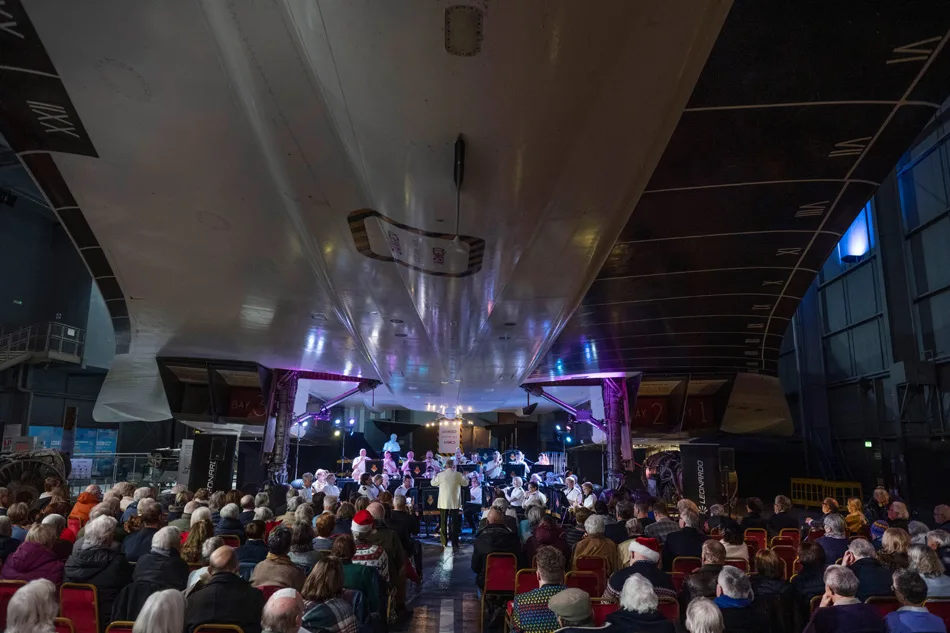
The Fleet Air Arm Museum’s much-loved Christmas Concert returns on 11th and 12th December, set once again beneath the awe-inspiring wings of Concorde. Performed by the HMS Heron Volunteer Band, the evening promises seasonal favourites and festive classics to delight all ages.
Based at RNAS Yeovilton, the Somerset band is made up of serving and former military personnel alongside local civilians – a tight-knit group known for their energy, talent and strong community spirit. Their Christmas concert has consistently sold out for the last decade and remains a firm favourite in the museum’s calendar. Tickets are £20, including mulled wine and a mince pie on arrival, with tea and coffee in the interval. Doors open at 7pm and the concert begins at 7.30pm. Book now https://bit.ly/4oo9PXp
There’s only one thing worse than being talked about, and that’s not being talked about. Rachel Reeves’ budget speech inclusion of a puerile dig at the new leader of the Green Party beautifully highlighted the Labour Party’s increasing desperation, as it haemorrhages members drawn to the Green Party’s positive political vision.
Ken Huggins North Dorset Green Party
Elsewhere, the latest international COP summit in Brazil failed yet again to agree on how to address the unfolding climate and environment crisis. Petro-states, led by Russia and Saudi Arabia, ensured that the Conference’s final statement didn’t even mention fossil fuels. Short-term greed successfully overrode any consideration of the long-term consequences for us all. Malignant Russian influence has been further exposed in the last few weeks by the jailing of Reform’s former leader in Wales, Nathan Gill, for taking bribes to make statements in favour of Russia when he was working closely with Farage as an MEP in Brussels. You wouldn’t know it from the almost total lack of media coverage, but on 27th November there was a crucial National Emergency Briefing in Westminster Central Hall, where ten of the UK’s leading experts gave short sharp presentations on the latest assessments regarding the impacts of the climate and environment crisis on the UK’s food and energy security, national security, economics and health. Along with others I urged our MP Simon Hoare to attend. He didn’t … so I shall send him a recording of the event in the hope that he watches it and heeds its messages. The issues are of profound importance for every single one of us. In November I was pleased to again be part of a group invited to assist with Weymouth College’s annual Environment Week. The 2023 State of Nature Report assessed the UK as one of the most nature-depleted countries in the world, so we facilitated student discussions on the topic. Students, like the many people now joining the Green Party, are increasingly concerned at the uncertain future we face. The environmental clock is ticking ever louder, but there’s no sign of the government taking the urgent actions needed to ensure that we have a positive future to look forward to. Ken Huggins North Dorset Green Party
Under the last Conservative government, the UK’s national debt went from £1.2 trillion in 2010 to £2.7 trillion in 2024. The Tories ran a deficit every single year they were in office, presided over record levels of welfare spending and a 70-year-high taxation burden. They took the national debt, as a percentage of GDP, from 65% to 96%. Just the interest payments alone on the UK’s national debt now make up close to 10% of all public spending, at over £100 billion per annum – almost double the entire defence budget of £62 billion. During their 14-year period in office, the Tories spent £177 billion of taxpayers’ money on foreign aid alone. Labour’s budget last week was quite simply a continuation of the Conservatives’ high-tax, high-welfare and high-spend policies that will further hammer those who are working to pay for those who are not. It will penalise those prudently trying to save, and cumulatively, it will materially exacerbate the country’s already highly precarious debt position. Since taking office, Labour has now levied £70 billion of tax rises on businesses and workers – and by the end of this parliament, the tax burden, as a percentage of GDP, will reach a record high of 38%. Over the next five years, welfare spending will rise by £73.2 billion to £406 billion per annum.
Thomas Gargrave Reform UK Dorset
Pernicious policy Labour’s most pernicious policy in the budget, that of freezing tax thresholds, is actually just a continuation of the Conservatives’ policy introduced in 2021 by Rishi Sunak. The Conservatives planned to freeze tax thresholds until 2028, and Rachael Reeves has extended the Tory policy until 2030-31. The result will be that millions of working people will be “fiscally dragged” into either paying tax for the first time, or into higher tax bands. Labour will use a considerable portion of the £26 billion raised from tax increases to fund a welfare spending splurge: most notably, the ending of the two-child benefit cap. Analysis by the Centre for Social Justice has found that a family with three children, with at least one parent claiming the average rates of Universal Credit and other benefits, will receive £46,000 per year by 2026-27. For a family with five children, this rises to £55,000. One element of this under-discussed policy is the very significant payments that will go to foreign nationals. As of June 2025, the DWP revealed that there were already 1.26 million foreign nationals claiming Universal Credit. Professor Matt Goodwin has estimated that there are 341,700 foreign-born families that will benefit from the decision to lift the two-child cap, with households from Pakistan, Bangladesh, Nigeria, and Somalia being the largest beneficiaries. It is simply unconscionable to levy tax rises on British workers to pay for the benefits of foreign nationals. Additionally, the OBR estimates that net migration will rise to 340,000 per year during the forecast period – the highest outside of the Conservatives’ mass immigration wave – and spending on asylum accommodation will be £15 billion over the next decade, up from the previous estimate of £4.5 billion.
Immediate measures The truth is, none of these tax increases need to happen. They are choices that Labour has made. It has now emerged that the OBR told the Treasury several times in the lead-up to the budget that due to higher than expected inflation and wage growth, the government would in fact be within their fiscal rules and actually have a surplus of over £4 billion. This reality is clearly in sharp contrast to the picture that Rachel Reeves articulated to the country regarding ‘black holes’ to justify her tax raid on working people. Given the seeming disparity between the economic facts and what she has stated to parliament and to the nation, I cannot see her position as tenable. As immediate measures, we need to completely end all welfare payments to foreign nationals, scrap our foreign aid budget, scrap net zero to slash families’ energy bills and start incrementally, as fiscal conditions permit, raising the point at which people pay tax so they can keep more of their own money. As Reform’s leader, Nigel Farage, said in his post-budget address to the nation, Labour and the Conservatives broke Britain; Reform UK stands ready to fix Britain, and with our national debt increasing by £428 million per day, that cannot come soon enough. Thomas Gargrave Reform UK Dorset
Last week saw Rachel Reeves make her Budget announcement. It was a botched opportunity to address some of the fundamentals and raise money through fair taxation to pay for public services. While the changes to energy bills should be welcomed, she failed to embrace the Liberal Democrat proposal that would have saved households more by removing the Renewable Energy Obligation. She also ignored our calls for a cut to VAT for the hospitality sector – vital for West Dorst’s economy.
Edward Morello MP for West Dorset
Despite banks’ profits doubling over the last five years, there was no demand by the Chancellor that they pay more. Instead, the freezing of the tax-bands will mean even more people dragged into higher-rates of tax, with nearly a million extra people now paying 40p on the pound. Meanwhile, per-pupil funding is being cut and interest on tuition fees for university graduates is being frozen at nearly eight per cent (despite interest rates falling elsewhere). And pity too the farmers, who saw no move to roll-back the disastrous family farm tax. For all the Government’s talk about ‘working people’, this was a Budget that will make working families poorer. This week I was proud to host the launch of the newly formed UK Fruit & Vegetable Coalition. Spearheaded by one of our own West Dorset residents, the UKFVC brings together organisations representing organic, agro-ecological growers from across the UK with the aim of ensuring more fruit and vegetables are produced here and reduce our reliance on imports. I look forward to supporting them in their work to improve food security and providing healthy food to the Nation. As I write it is UK Parliament Week – an annual event aimed at spreading the word about what Parliament is, what it does, and how you can get involved. It is especially aimed at young people and improving engagement in politics. I’ve been having Q and A sessions with schools in Sherborne, Dorchester and Bridport, as well as Brownies and Guides groups. Visiting schools and youth groups is something I look forward to: I always get asked insightful questions and come away with loads of ideas for the real-world changes young people want to see. Edward Morello LibDem MP for West Dorset
MP Simon Hoare blasts the Chancellor’s Budget as a rural-punishing exercise in political survival – built on deception, not duty
Simon Hoare MP
Rachel Reeves excelled herself with this year’s Budget. Delivered – without a hint of irony – during the BBC’s scam awareness week, she unleashed her inner Artful Dodger and dipped into all of our pockets. The spirit of Christmas cheer was banished to the wings, and her characters of choice were pantomime baddy mixed with Scrooge at his most curmudgeonly.The Budget was not a good one. First, it was based on three lies: 1) the promise made at the election by Labour not to raise taxes on ‘ordinary people’; 2) that last year’s tax raid was a ‘one-off’ and subsequent years’ spending would be financed by growth and; 3) that there was an extra dimension to the Chancellor’s fictitious black hole (can one have an extra dimension to a fiction?) which required draconian action to create fiscal headroom. All three were lies. I do not use the word lie lightly. Indeed, in Parliamentary terms it is almost as bad as the C-bomb, for no Hon Member can ever lie. But, we were lied to. Rishi Sunak pointed out clearly what a Labour Government would do. He was ignored – and the rest, as they say, is history. Labour’s ‘ordinary people’ – a phrase which I frankly find baffling – are now being taxed more. This is the second year’s tax rises … and there is no growth. There was no extra doom dimension that needed plugging, as the Office of Budget Responsibility had made clear to the Chancellor before she gave her Nightmare Before Christmas press conference. A budget evolved in chaos was based on a bed of deceptions, half truths and sleights of hand. Ms Reeves is the dodgy croupier par excellence.
A punch between the eyes It’s the ‘Why the Hell Should I Bother Budget?’. If you are saving via an ISA to try to do the right thing (and we are all trying to encourage savings) you are hit by a new tax requirement. Paying a bit extra into your pension to do the right thing for your old age? A punch between the eyes again, with changes to pension policy. Trying to create growth through setting up or expanding a business and taking on staff? Hit again with business rates, no changes to VAT for the hospitality sector and just making it harder to be an innovator, investor or entrepreneur. Put simply the Budget flicked a very large V at those trying to work hard and do the right thing. This was not a Budget for the country. It was a Budget to save (temporarily?) the jobs of 10 and 11 Downing Street. Even with Starmer’s eyewatering majority, he still has to pay blackmail cash to appease his backbenchers. Gone is any attempt to reform welfare spending. Instead, a massive series of tax raids to remove the two-child benefit cap. The cap was a popular policy among all voting groups, because it injected fairness and responsibility into the choices of having children. All of that has gone because Labour MPs insisted upon it. Every street, village, hamlet, town across our country will know of someone who milks the system. The person who opts out while the vast majority haul themselves out of bed to go to work, to earn some cash to pay the bills and support their family. This Budget laughs, openly and without embarrassment, in their faces. The Chancellor told us that she needed to increase taxes to pay for existing increases in welfare payments. And, what did she do? She ADDED to those payments. Unless there is growth – and that now seems way out of reach – next year’s budget will see more of the same: increases in taxes to pay for Labour’s increased spending, which it is having to do to keep the unions and their left-wing MPs quiet. Where is Starmer’s spine? Where is Reeves’ resolve?
Direct hit on rural lives Changes to the Family Farm Tax still do not make this horrid tax any more acceptable. There are ways of taxing the Dysons of this world without punishing hardworking family farmers. The tax needs scrapping. End of. Conservatives would do so. The Chancellor’s proposed pay-per-mile is wrong. Why not simply create a new Road Tax band? Paying per mile is a direct hit on rural motorists. It is also bad environmentally – people will retain or replace their unleaded or diesel vehicles as they are likely to be cheaper to run. Reduced purchaser demand will also likely lead to a decline in the UK car industry and subsequently jeopardise foreign inward investment. This was a Budget for Labour self-preservation. A Budget to save Sir Keir’s job, not yours. A Budget for the unions, not the people. A Budget conceived in chaos, delivered in mayhem and swaddled in a blanket of lies. It was not for the good people of North Dorset – and my post bag and inbox tells me so.
Community kindness still changes lives, says Joanne Platt, who offers struggling families a lifeline from her packed garage in Gillingham
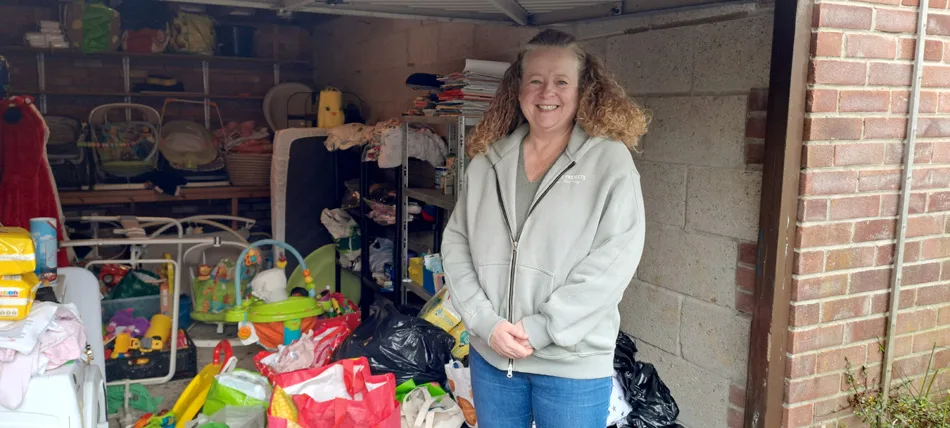
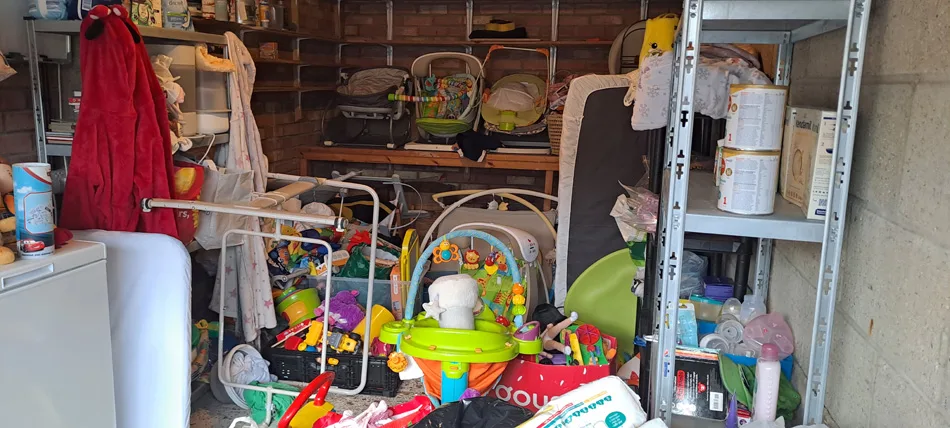
Joanne Platt in her garage, which for the last three years has been home to the BabyBank Gillingham Image: Rachael Rowe
All the bills have come in at once … your hours have been cut at work … the washing machine breaks just as the heating bill lands. Everyone is watching their spending right now, but for some families it takes just one small thing to trigger a financial crisis. Tucked away on a quiet street in Gillingham, one small garage has become a lifeline for parents caught in that moment. BabyBank Gillingham – a community-run service offering clothes, baby food, nappies and other essentials to local families. And behind it all is just one person – Joanne Platt. ‘It started around two and a half years ago. An item on the news about BabyBank Alliance got my attention. People were donating things up and down the country. I contacted them, and they said at that time there was nothing available between Bath and Bournemouth: a huge area. I thought, why can’t I just do something? So I put a simple post on Facebook, saying that I was thinking of collecting items. Within days, the messages began. Clothes, toys, cots, baby food – it all poured in. ‘I’d collected for Ukraine before, but this was different,’ she says. ‘I’ve now helped hundreds of families. And the amount of things that people donate continues to surprise me. Sometimes I message people back and ask if it’s OK, as they have donated so much: they always respond “Yes, we love what you do”. ’I think some people put things in the loft and keep putting things in the loft. Then one day they’ll think – I need to sort that out. Because it’s in the loft you can’t see it – so it ends up as years worth of stuff.’
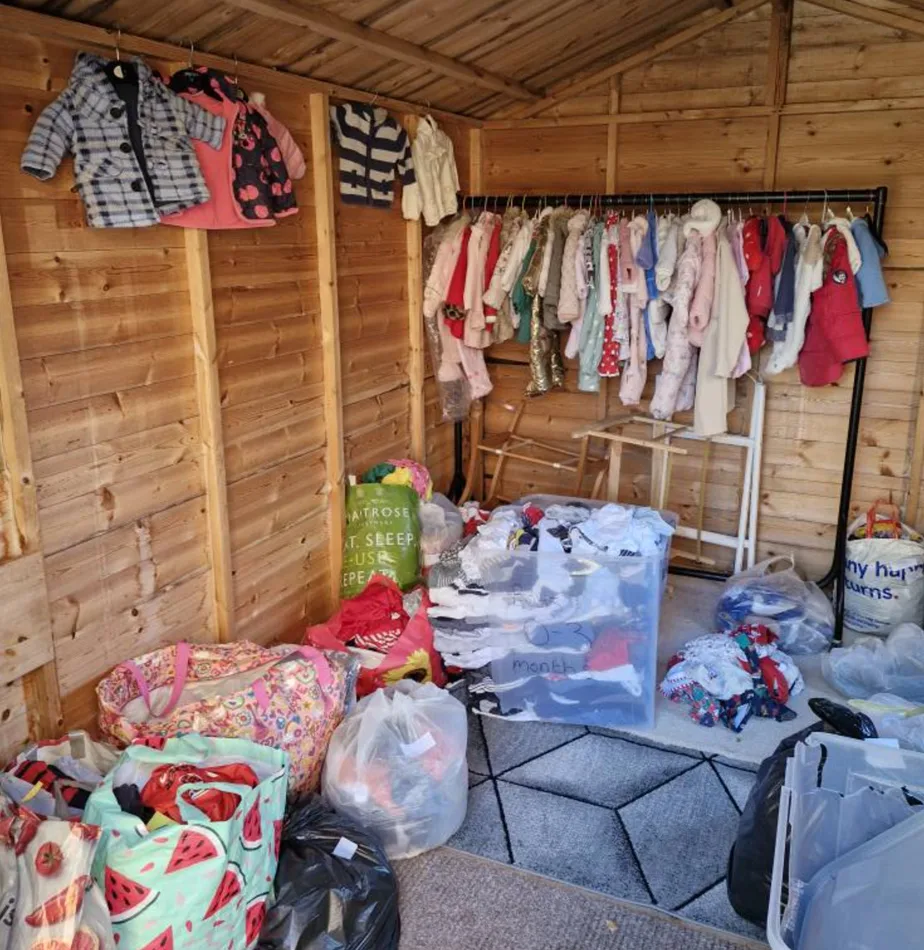
Even the summerhouse gets pressed into serviceDonations are sorted into age groups
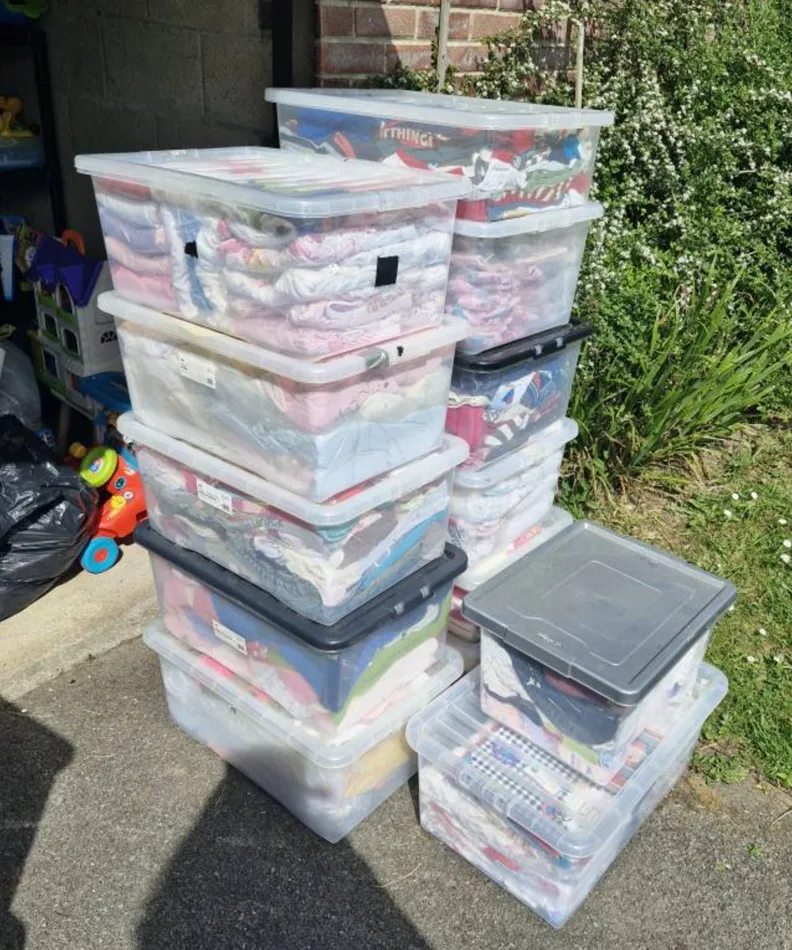
Shelves of kindness Joanne’s garage is neatly stacked with donations for children from newborn to ten years old: piles of clothes, nappy packs, toothbrushes, picture books, and the odd pushchair or baby walker. Everything is impeccably clean. Unsurprisingly, there is also a fast turnover of items. Nothing stays for long. ‘The most popular things are clothes for toddlers – they grow so fast – and wellies,’ she says. ‘You can tell we’re in North Dorset!’ BabyBank works by people simply messaging Joanne through Facebook. A new mum might need items for a six month old, while another mum is looking to replace a winter coat. Joanne then sets items aside and arranges times for collection. Health visitors and midwives also refer families to Joanne, and the food bank shares baby supplies with her. ‘I see grandparents, foster families … families right across the board. I get people from Blandford, Yeovil, all the outlying villages. The furthest someone has travelled is from Corfe Castle. ‘It’s for anyone who needs it. There’s no judgement. Sometimes – I know from my own experience – some months, everything comes in at once and you think “Um … I’m a bit stuck”. I do just offer things to people when they come round. A lot of people have now become friends, and I love seeing the children grow up. ‘I think some people are a little bit nervous asking for help – which is a shame. Especially young people. I don’t judge. ‘I do try not to have people here at the same time, so they can get to know me. Some people don’t want to talk much and I have to ask them what they need. Some just take stuff, say thank you and go. But next time they come they are more relaxed. You’re coming to someone’s house, after all. I just want people to feel welcome.’
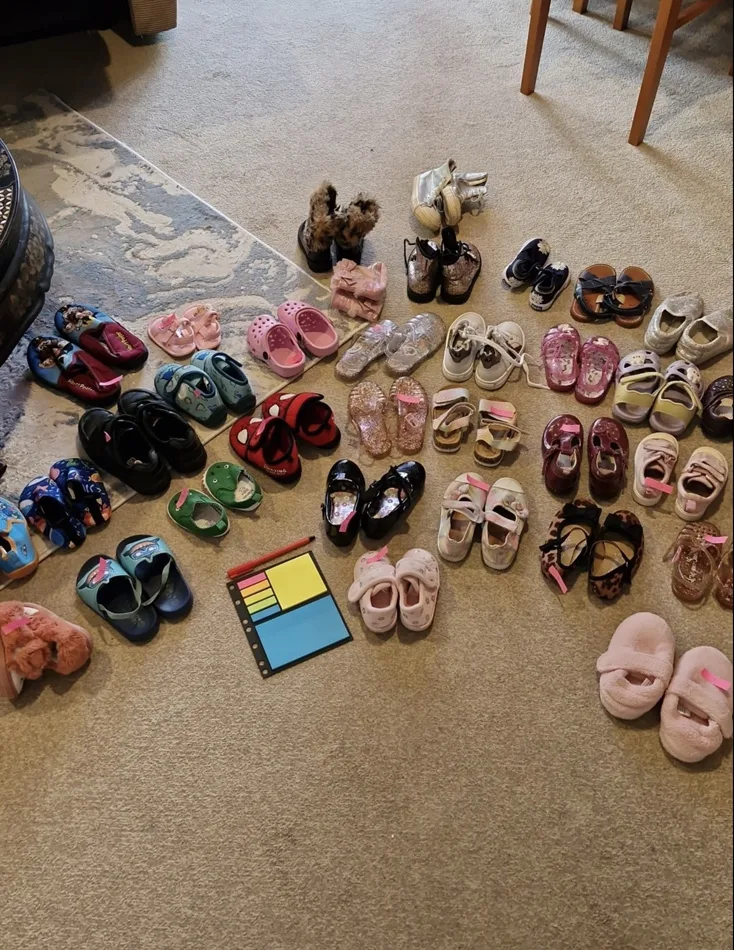
Joanne holds regular ‘shoe days’
It’s not just clothes at the BabyBank
Paying it forward Her 24-year-old son, who has disabilities, often helps her sort donations. ‘It’s a good way of recycling too, which many are conscious of now. So many people get bought so much clothing for babies – they just don’t get through it all. And if you’re in need, even the cheap supermarkets aren’t that cheap any more.’ One story sticks out in Joanne’s memory: ‘Not long after I started, a lady messaged me and said she had some donations. When she pulled up with a car full, she said: “We don’t need anything – but our Mum would have loved you.” The family obviously remembered what it was like when they were growing up, and had decided that wherever they went in life they would always give back. They dropped off some beautiful things, but it was her words that stuck with me. If someone does something nice for you, then you return the favour – pay it forward. ‘The kindness and generosity of people is there. Sometimes it can feel like it is missing these days, but it isn’t.’ In the run-up to Christmas, Joanne’s work only grows. ‘People often ask what they can donate – nappies, wipes and toothbrushes are always needed. If I put a video on Facebook I’ll get 3,000 views, and people can pick what they want from it. I started putting out winter coats in June because I realised people were looking forward and thinking about what they would need in the colder months. ‘This is something I really enjoy doing. And for the foodbank to give me so much … that helps so much, it’s wonderful.’ For now, the garage remains the perfect base. ‘If I had a commercial unit, it’d mean travelling and more expense,’ Joanne says. ‘Here, it’s easy. I can just get on with it.’ One day Joanne would like to make BabyBank Gillingham a registered charity – but she realises there’s a lot of work involved in setting it up. Instead, she’s focused on keeping the garage shelves stocked – and responding to the next message from a family in need.
Lost parcels, wrong porches and a dog bin drop-off have turned winter deliveries into a rural guessing game, as North Dorset villagers turn detective
For years, village Facebook pages debated which postie would be the last to surrender their shorts to winter. This December, the talk’s turned to something new – the thrilling neighbourhood game “Where’s My Parcel?”, We’ve all been there: you receive a text saying your parcel has been delivered to your porch … only to find it balancing precariously on the garden wall. Or the local Facebook page will start getting busy as it’s not actually YOUR porch where your parcel is languishing, and everyone starts trying to match front doors with the one in the photo sent by the courier. There’s even a request on NextDoor to start up a dedicated group for lost parcels as there seem to be so many.
This was The BV team’s unanimous favourite, from a NextDoor post in Henstridge: ‘Does anyone know where this ditch is? My parcel is somewhere in it…’
What is going on? In Okeford Fitzpaine, a dog walker started finding packages in the dog waste bin – apparently a local courier had had enough of unmarked houses. In Buckhorn Weston, the village WhatsApp group recently lit up. Local resident John Grant outlined what happened in what will be a familiar scenario to many: ‘There were 60 or 70 messages on the village group chat. The phones started to buzz – and it was all people looking for parcels. About seven people were affected, all on one day. The parcels were eventually found in a pile in the middle of the village – and still more were delivered to the wrong houses. We put together a list of all the incidents and contacted Evri. ‘Everyone always blows up and says they won’t use them again, but it’s not that straightforward.’ says John. ‘Getting through to someone was difficult, but two days later they came back with an apology. It turned out they had used a third party as holiday cover. Evri acted promptly on the complaint and removed those couriers from their business. They also told me they were implementing stricter oversight to make sure it didn’t happen again. It’s so difficult to get through to them, but when you do they are very helpful.’
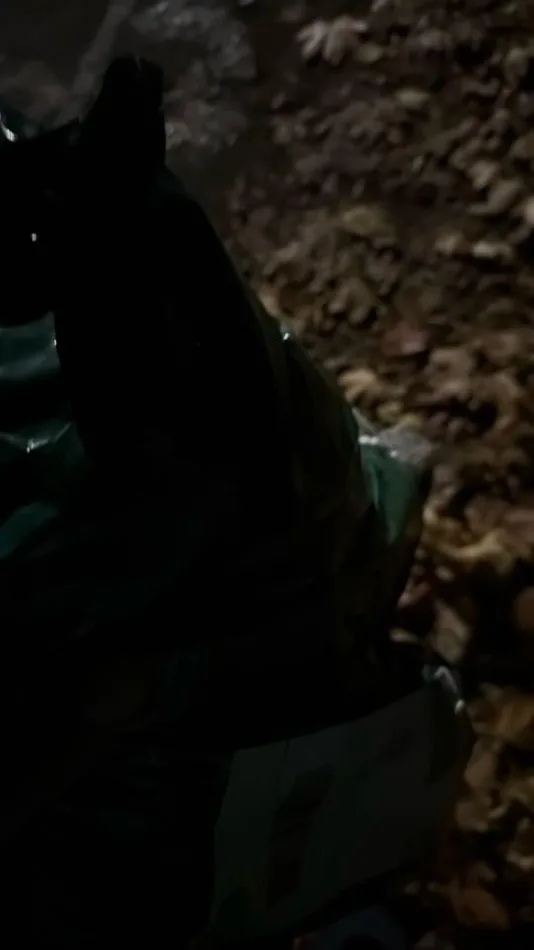
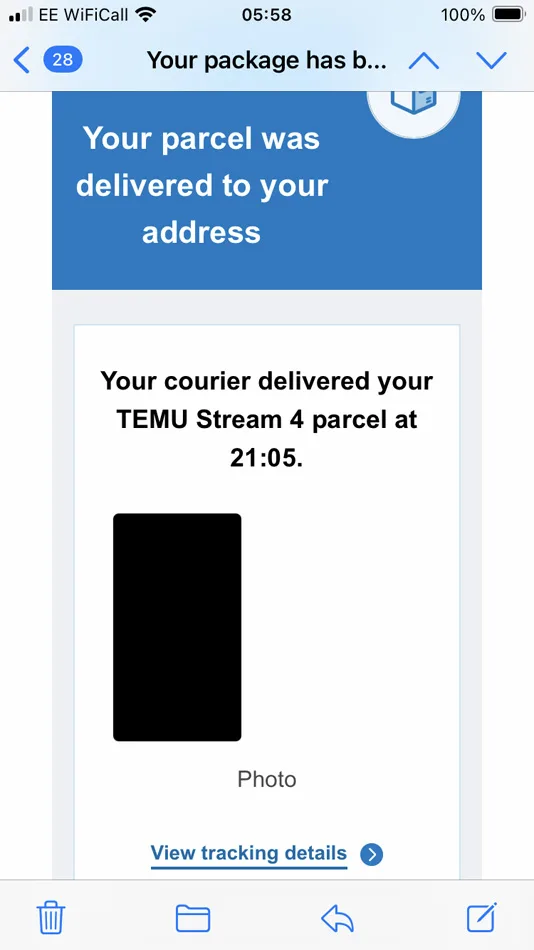
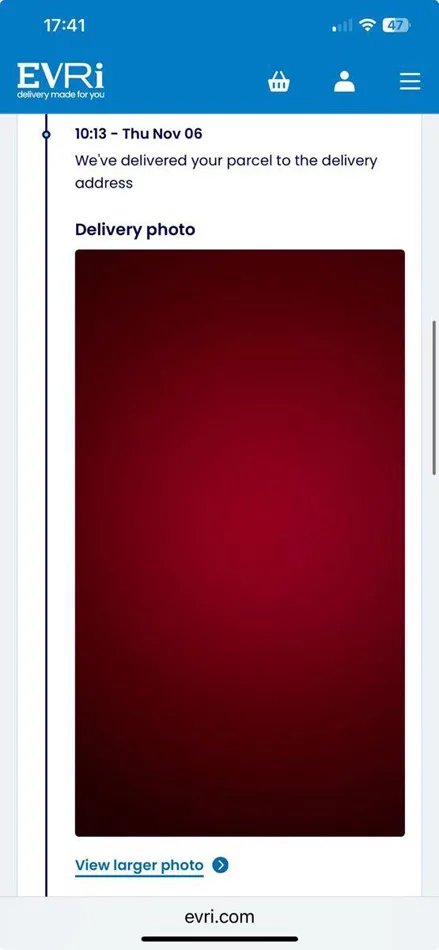
This 9pm delivery in Compton Abbas was tricky to track down from that plain black square … Abbas was tricky to track down from that plain black square …
A rural round Evri is, of course, only one of several delivery companies operating in the area. Delivering parcels in the wilds of North Dorset is not easy for non-locals, given the state of the roads, lack of signage, and no street lighting when it gets dark. In addition there are un-gritted roads in winter and when you finally do get to the right house, no one is in to accept the delivery. An Evri spokesperson gave The BV an insight into the huge volume of parcels they deal with: ‘We’ll deliver over 900 million parcels in 2025 – around four million parcels a day during our busiest weeks.’ We might hear a steady stream of horror delivery stories, but Evri told The BV that their record was actually good. ‘Our “Consistently on-time” performance exceeds airlines and railways! We deliver more than 700,000 parcels each week just across Dorset: typically a courier has a regular patch of around a square mile, though this does vary, depending on geography.’ In the busy days running up to Christmas the volume of parcels will inevitably increase. Evri is just one company, and others will have similar volumes of post to deliver across the county. And it’s not all bad news – though social media threads full of frustration are common, there is also plenty of praise from those taking the time to mention their village’s fantastic delivery driver. There are even one or two kind folk across the Blackmore Vale who keep a flask of hot water and mugs in their porch so delivery drivers and post office workers can make a warm drink while rushing from village to village (and no, we’re not telling you where they are in case they get raided for their free coffees).
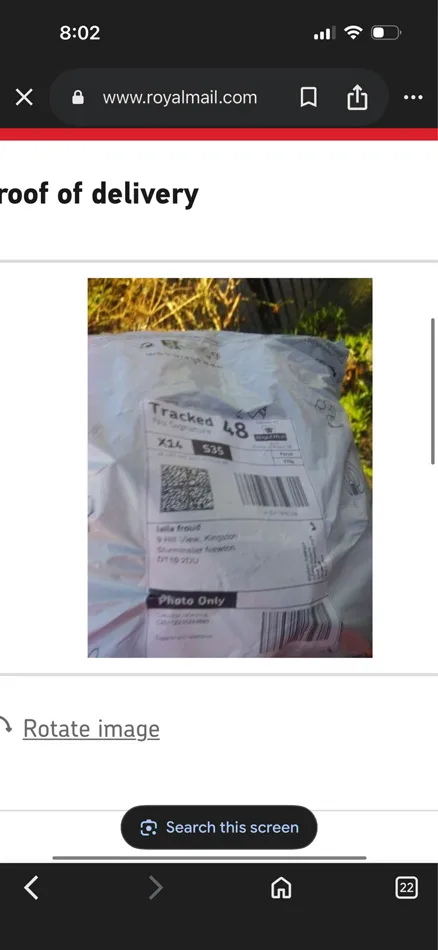
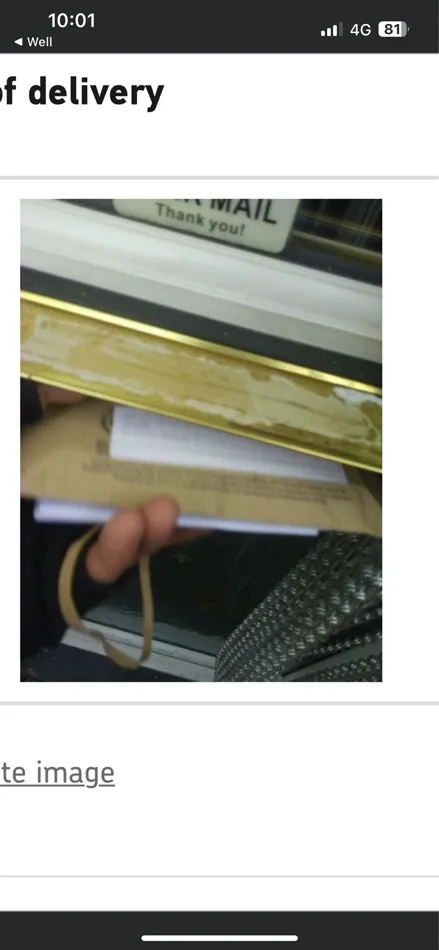
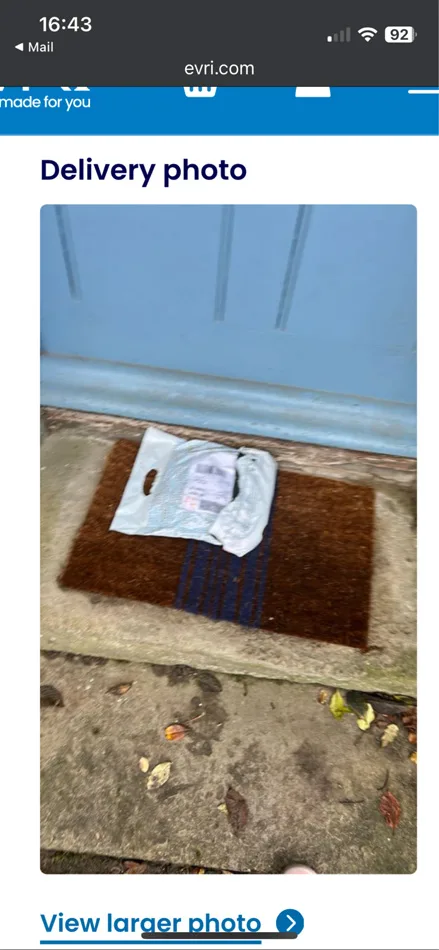
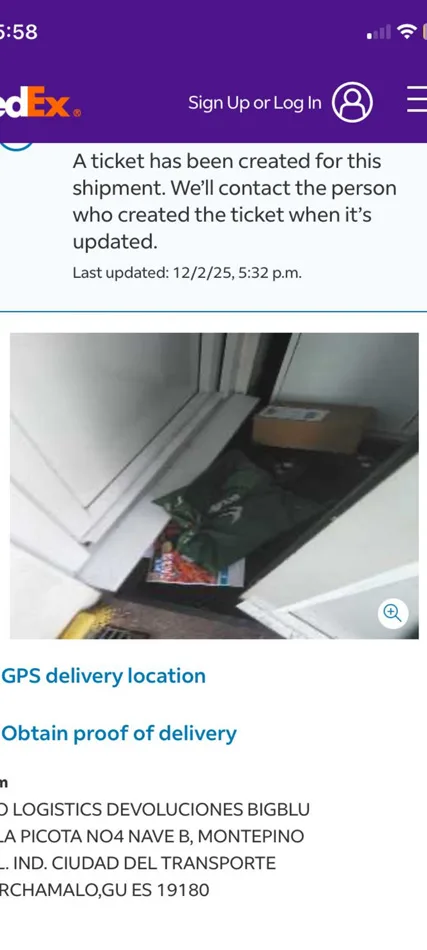
Above –These are all examples of ‘proof of delivery’ images sent: from a random letter box in Donhead St Mary to the blue door which was the ‘proof’ for at least five different parcels. There’s the ‘three white doors’ surprise – and of course, we had to include this Plain Red Square conundrum
More common, however, are those who continue to ask if anyone recognises a particular doorstep in Shaftesbury or a letterbox in Hazelbury Bryan … You can help yourself There are several recurring issues that delivery drivers find challenging. For example, newly-built estates – new residents will order items, but no one on the ground will know the street name when asked for directions, as they have not been set up by the post office for deliveries. Evri told us that the challenges are similar across the country, but there are practical steps customers can take to help ensure their parcel finds the right doorstep: Make sure your house number is visible, and turn outside lights on if it’s dark when you’re expecting a parcel delivery. Keep pets secure: while most couriers love dogs, some four-legged friends can be a bit too excited that your parcel has arrived. Add a map pin via the Evri app – this is particularly helpful for remote locations where postcodes might not take a driver to the right place, or for addresses with multiple entrances. Choose a safe place or divert your parcel if you’re not going to be in. You can nominate a neighbour, pick a safe place, or send it to a ParcelShop or Locker – all in the Evri app. As online shopping increases, the volume of parcels sent by couriers will naturally increase. And while many of us have excellent and courteous delivery drivers, there will inevitably be issues getting some packages to the right place. When you see the messages pile in on the local Facebook page, spare a thought for the courier on a tight schedule trying to find the right door in the dark. They’re working as hard as Santa – but without the sleigh.
Vulnerable young people in Dorset are about to be given an opportunity to rewrite their futures, thanks to an innovative and inspirational partnership between Dorset Council and Salvation Army Homes. The first 24/7 supported living scheme for 18-25-year olds at risk of becoming homeless has officially opened in rural Dorset, in partnership with new provider, Salvation Army Homes.
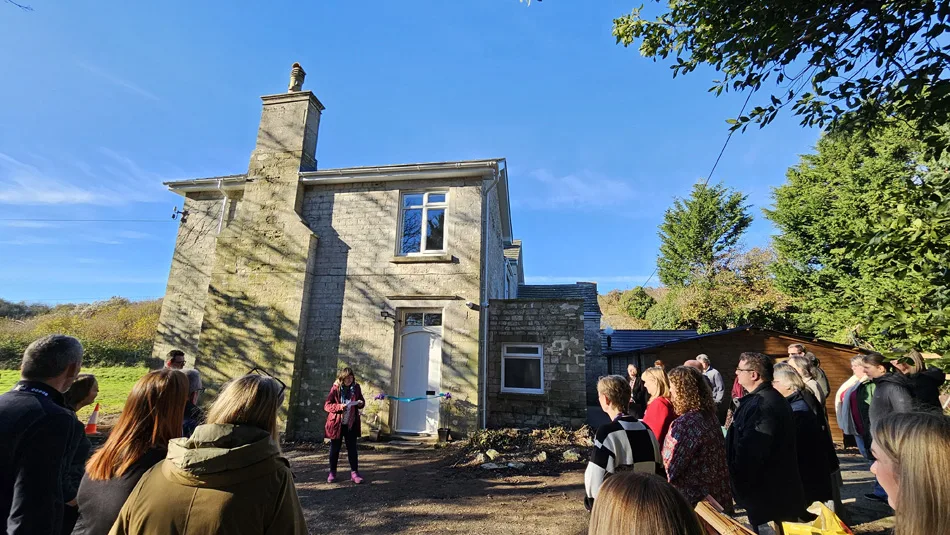
Gill Taylor speaking at the official opening of West Farm
The smile on Gill Cook’s face is radiant. As Head of Supported Housing at Salvation Army Homes, this is the first time the charity has been involved with a project in Dorset. ‘The building is absolutely fantastic, the location is incredible, and we’re so excited about delivering the project. West Farm itself has 24-hour support, and capacity for six young people. There is also land that will be used in therapeutic ways. Then nearby there are two self-contained flats. The whole idea is to create a really safe space where people can learn how to live independently.’ West Farm was built on land owned by Dr John Caius, one of the founders of Gonville and Caius College at Cambridge University – he bought the land in 1570 from the Earl of Dorset. Dorset Council purchased the property from the university, and since then has worked with Homes England, renovating it to provide homes for local young adults. The site has an acre of land and several outbuildings – providing a unique and calm setting for tenants to learn vital life skills and gain self-confidence.
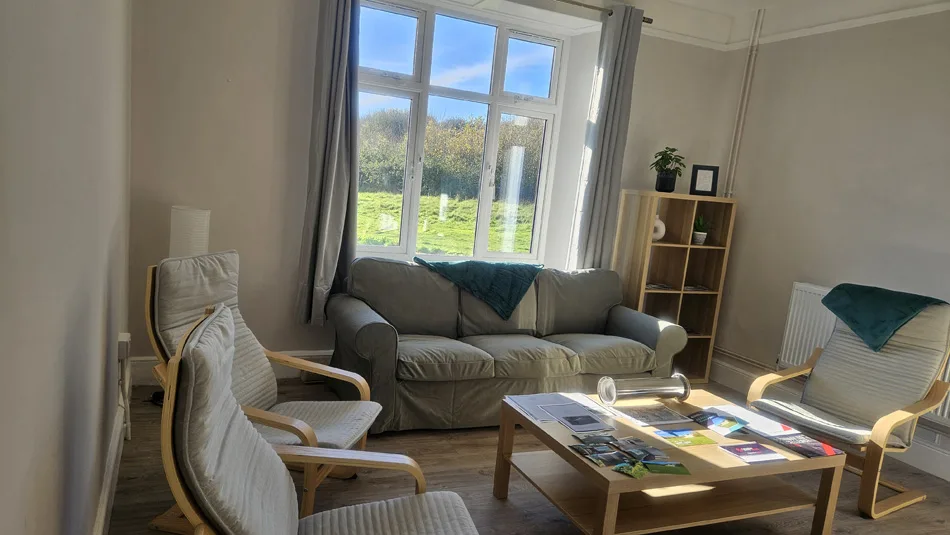
New lounge for the West Farm communityWest Farm has been thoroughly renovated and decorated in a trauma-informed palette
Stopping the cycle Dorset Council formally tendered for a service delivery partner, and Salvation Army Homes won the contract. Gill Cook told The BV: ‘We have several other services like this – although none of the others are on a farm! ‘There are lots of reasons why young people become homeless, from relationship breakdown to offending, substance misuse or domestic abuse. Projects like this are part of our strategic response. It’s really difficult, with the lack of accommodation for young people – particularly in rural areas. It’s a real issue. The people who will move into West Farm may have been in the care system, or will have had other issues that have led to them becoming homeless. ‘The idea of the training flats is that people will initially come into the 24-hour service and learn the skills they need to live independently and become part of a community, engaging in education and training. ‘But when people have been in a 24-hour support environment and are then suddenly put into an independent flat with no support at all, it’s very difficult. That’s when tenancies fail: they go back to the beginning and we end up with this never-ending cycle of homelessness. ‘When people are ready to move on into more independent living, the flats here are fully furnished, and they will still get the support of staff on site so there is continuity of care. They will live there for as long as they need to, learning to pay their bills and other skills. Then, when they are ready to go, we work with other housing providers to get them more permanent accommodation. ‘For young people this is really important. We see so many people entrenched in certain lifestyles and homelessness. ‘If you can break that cycle by providing the right support at the beginning, hopefully you prevent them going in and out of prison and a lifetime of ill health, or disruption to the community.’
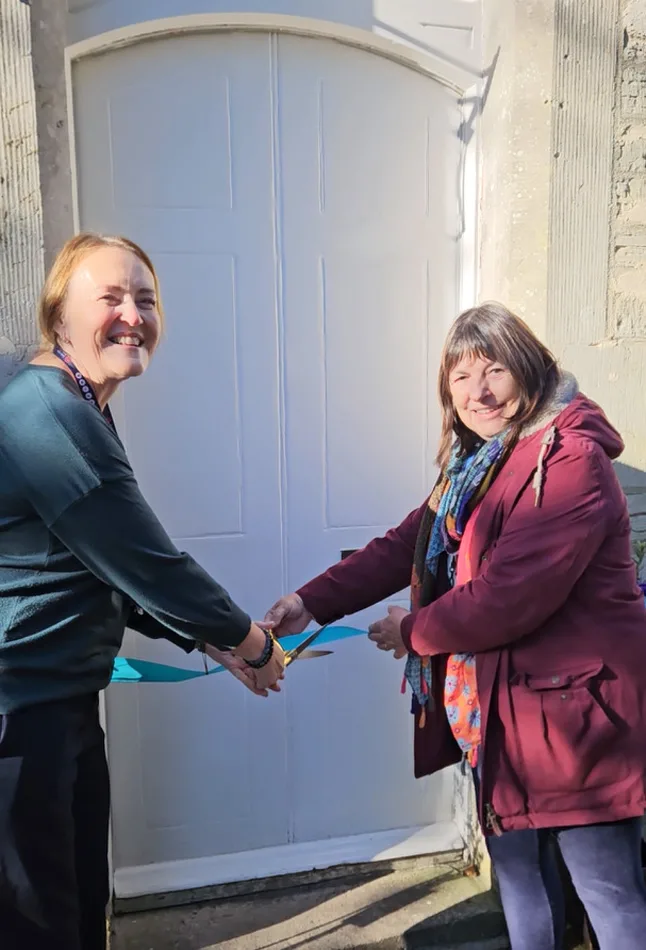
Gill Cook (SAHA), left, and Dorset councillor Gill Taylor cutting the ribbon to West Farm
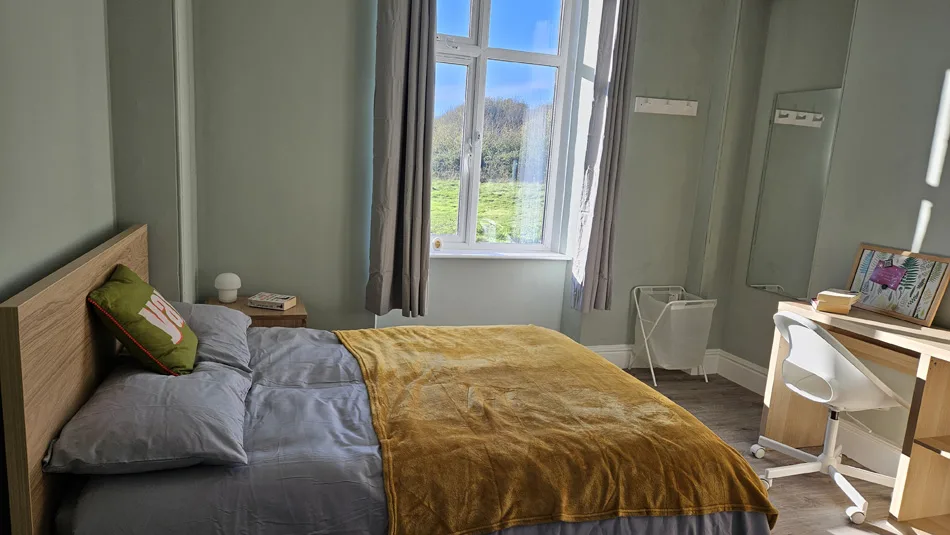
An inspirational future Cllr Gill Taylor, portfolio holder for housing and health at Dorset Council, says: ‘Eight young people are being given the opportunity to rewrite their futures as this scheme comes to fruition. This project has come alive due to financial investment, plus of course the passion and vision from our Housing service to deliver more new accommodation to prevent homelessness. We are very much looking forward to working with Salvation Army Homes, whose staff have lots of great ideas on utilising the beautiful setting to its maximum potential and engaging with our young people.’ Much thought has gone into the design of West Farm. Swedish furniture brand IKEA provided £1,000 worth of furnishings and supported the team with design tools: the colour palette is a ‘trauma-informed scheme’, ensuring it is the calmest possible environment. Each new resident will be given the opportunity to plant a fruit tree, which will become part of a West Farm legacy. There are also plans to have chickens and to offer other outdoor activities. For Gill Cook, the highlight came when the team actually saw the building and the project became a reality. ‘It’s the building, the location … the care and thought that has gone into the refurbishment. The grounds … well this is incredible. ‘Just imagine you are a young person who has been homeless. You have no family contacts, perhaps you have been in care. ‘Then you come to West Farm – and all of a sudden you have a community. You wake up in the morning, open your curtains and look at that amazing view. You go downstairs and collect eggs outside for your breakfast. Imagine eating a breakfast of something you have created, by working in the garden. ‘Suddenly you are part of something, not on the outside. Just think about the difference that makes to the whole of your life – and the confidence you’ll get from that. ‘And from there you’ll develop so many skills, self awareness and other things, so you can go out into the world and do anything you want to do.’