Kate Chidley didn’t want “a proper job” … so she followed in the family tradition and became an artist. By Fanny Charles
Artist Kate Chidley with this year’s Christmas card, featuring the West Front of Bath Abbey Image: Fanny Charles
When you arrive at Kate Chidley’s Old Chapel studio in West Coker, the first thing that you notice is the big colourful “Egg box” by the red door. And the first thing you see inside, once you have taken in the height and scale of the 1839 former Wesleyan Methodist chapel, is the elegant mannequin stretching her legs from one of the high window sills.
There are other mannequins around the big space, which Kate describes as ‘chaos’ but which looks like the busy studio of a prolific artist, with piles of prints and paintings, books, sculptures and general ‘stuff’. She found some of the life-size figures at a car-boot sale and she bought others on Facebook – a few were originally costume models from the V&A in London. She bought The Old Chapel in 2015, and had a mezzanine constructed, which is reached by a metal spiral staircase that she found at an old blacksmiths at Frome.
Home Gallop
Cows jumping over the moon Kate’s art fits comfortably into this eclectic setting – she has an eye for the quirky and the unusual, with hints of folklore and magic, country tales and curious characters, ancient sites and historic buildings, cows in fields or jumping over the moon … In fact her farmer father encouraged her artistic inclinations, suggesting she would be better off painting cows than milking them. Kate is Somerset and Dorset born and bred – literally … Higher Halstock, where the men in her family have farmed for generations, has farmland in Dorset and woods in Somerset. Her mother and grandmother were both artists and her great-grandmother, sculptor Maggie Mitchell Richardson, studied at the Royal Academy of Arts – a rare woman student in the early 20th century. ‘I never wanted to have a proper job,’ Kate says. Her mother supported her plan to do an art foundation course at Yeovil College followed by a degree in illustration at the University of the West of England at Bristol.
Moojitos by Kate Chidley
‘Mum was always supportive but she also insisted that I got a job. She said: “You have to know what work is.” So I worked as a cleaner for a year.’ Over the years, Kate has produced colourful pictures that range from rural scenes to cows jumping over the moon, but increasingly she has focussed on her unique maps, which range in theme from Glastonbury Festival to whole counties. She is currently working on Hampshire. It all started when she made a map to show visitors where she was exhibiting and found she loved the process. She also made a map which was on the back cover of the Scotts of Merriott horticultural catalogue – her grandfather, Michael Wallis, owned the famous and historic nursery, which sadly closed in 2009.
In Kate’s former Wesleyan Methodist chapel, an elegant mannequin stretches her legs from a high window Image: Fanny Charles
She spends weeks researching each county, and asks for suggestions via social media and from anyone who has particular knowledge of her chosen area. Hampshire is full of amazing stories – from the murder of King William Rufus in the New Forest to Henry VIII’s Mary Rose and Nelson’s Victory at Portsmouth, to the glories of Winchester Cathedral or Highclere House (television’s Downton Abbey). The actual painting takes an intense three weeks – an amazingly short time when you look at the detail in the large and colourful maps.
Festival souvenirs One of Kate’s most popular designs is her annual map of Glastonbury Festival, where she has two stands every year. Over the last decade these have developed from what was initially just a colourful guide to the sprawling site of the world’s greatest music festival into a unique festival souvenir. She loves to hear from people who have a particular connection with the festival – where a couple got engaged, for example – and will include a little image to record these special personal stories. She also paints colourful little flags which represent people who have got in touch with her about the festival during the year. She loves the way they search for their own little picture or flag!
Glastonbury 2014
With the county maps, Kate begins with relatively conventional map-making – towns, villages, famous landmarks or historic buildings. But she also includes more unusual items, folklore and little-known stories about places that are perhaps less known or visited. In her map of Wiltshire, for example, there is a small picture of an extraordinary stone building which is a unique sheep shelter. Clients who buy a map can also ask to have their house or farm included, or some other detail to personalise it. ‘It’s often these little things that people love,’ she says. ‘I love to make someone happy. If people laugh or cry because they love my pictures, it makes me so happy. I feel I am illustrating memories for people.’ Kate has a stall at the Bath Christmas Market, which runs daily to 10th December. She is in the Abbey Yard – appropriate as her Christmas card this year depicts the beautiful West Front of Bath Abbey. You can see some of her work and read about her various projects on katechidley.com and you can visit her studio by appointment – contact her via the website.
It’s December, but there’s always something to be done. And now’s the perfect time to finally work out composting, says gardener Pete Harcom
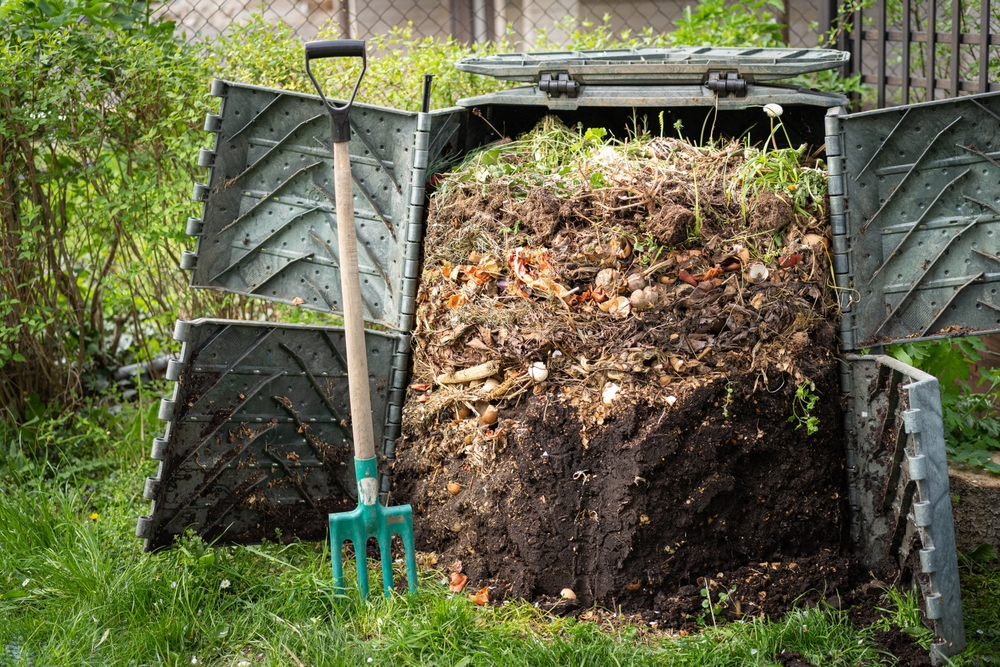
This month we need to continue winter digging as we prepare the borders for next spring. To feed the soil and improve its structure, the best thing to use is garden compost, well rotted manure and leaf mould. Do you make your own compost? Homemade compost saves money and resources, it will improve your soil structure and it can reduce your own impact on the environment. There are lots of types of compost bins available at the garden centre or via your local council, but it’s also easy to make your own, using wooden pallets for example – there are many guides for making wooden compost bins online. Dorset Council currently has a home composting offer – you can buy a 220 litre plastic compost bin for just £6 AND if you order two, the second one is half price! There will be a delivery charge (£7) and you may also need to buy a base for the bin, but it is still at a reasonable cost. I have experience of these black plastic bins and they can work really well, providing good compost in just 12 months!
How to start composting Find the right site – ideally site your bin in a reasonably sunny place on bare soil. Be sure to choose somewhere you can easily add ingredients to the bin – and get the compost out! Gather the right ingredients – save everything from vegetable and fruit peelings to teabags, toilet roll tubes, cereal boxes and eggshells to go in your compost bin. Never put cooked food, meat, fish or dog or cat mess in a compost bin – this will attract vermin. You can put in limited amounts of paper or thin cardboard, but no glossy printed paper. Fill it up! Place all these items, along with all of your garden waste into your compost bin. A 50/50 mix of greens (nitrogen rich) and browns (carbon rich) is the perfect recipe for good compost. You need to ensure the contents are cut into small pieces, and mixed well – a garden shredder will help with this – or try to cut up or break any woody twigs etc down by hand, as this will aid decomposition. And now you wait … It takes between nine and 12 months for your compost to become ready for use. Keep on adding greens and browns to top up your compost. Once your compost has turned into a crumbly, dark material with just an earthy smell, it is ready. Use it to enrich borders and vegetable patches, plant up patio containers or feed the lawn. Anyone with a smaller garden might want to consider setting up a wormery instead – check out theurbanworm.co.uk
She chose the harp over the recorder when she was five – Gwyneth talks about her life with her giant instrument as she chooses the discs she can’t live without
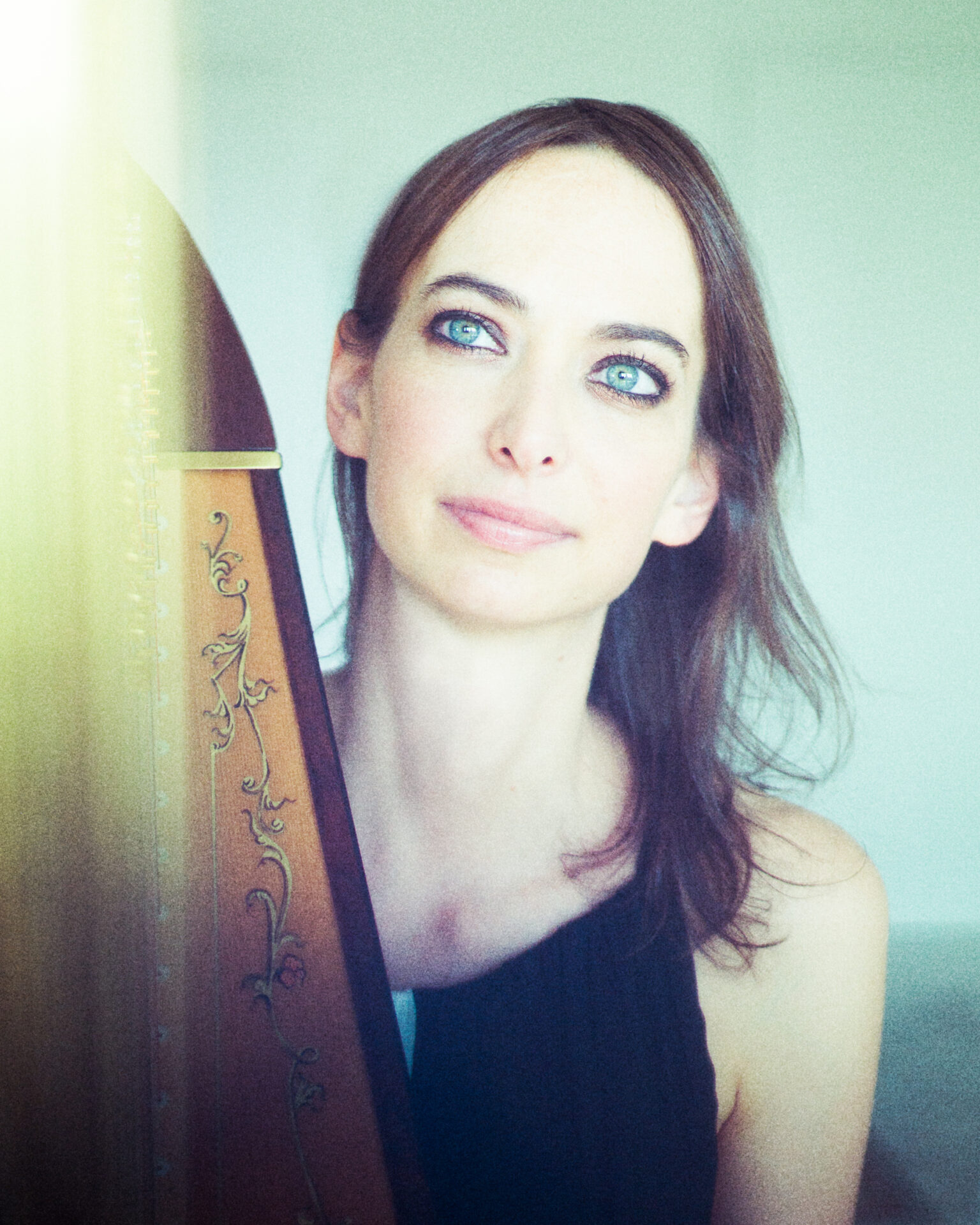
Gwyneth Wentink at home in North Dorset
Gwyneth Wentink is an internationally acclaimed harpist and arts advocate working across many genres and roles. As both a classical and experimental harpist, Gwyneth has performed on the world’s most prestigious stages – Carnegie Hall and Lincoln Center in New York, the Royal Albert Hall and Royal Opera House in London, and the Konzerthaus in Berlin, among others. Many of today’s leading composer, including Theo Loevendie, Marius Flothuis and Terry Riley, have written works for Gwyneth. She is solo harpist of both the Orchestre Révolutionnaire et Romantique and the English Baroque Soloists under Sir John Eliot Gardiner. Now aged 42, Gwyneth decided she would be a harpist when she was four.
Gwyneth Wentink, aged 5, playing a Celtic harp
‘My father is Dutch, and my mother is Hungarian – they met at a music festival in Hungary. The story goes that my mum saw my father when he stepped out of his car. And she thought: “That’s the man I’m going to marry.” Just like that. They had known each other for about six weeks, when he proposed to her! He had to go back to the Netherlands; they didn’t see each other for a while until he came back with his mother, and they promptly married. My mother returned with him to Holland – she was a very talented piano player and my father was a trombone player and a conductor. I have two older brothers – and no, they’re not in music! They are very musical, and love music, but they decided not to go into the profession. ‘Funnily enough, we’re here talking about my favourite music and what I listen to, but relatively I listen to very little music. I would say my brothers listen to much more music than I do!’ Up close, Gwyneth’s beautiful harps are not only far larger than one expects, but also strikingly complex. What had appealed to Gwyneth as a child, to make her want to start playing one? ‘It’s funny, because even now, when I look at them, how they’re standing there, I can remember clearly being four and seeing and hearing them above an orchestra for the very first time. And I just remember falling in love, asking my mum, “I want to play that instrument that you hold between your legs.” And she said: “Oh, great, the cello!” It was her second love, after the piano. But I said, “No, no, no, the BIG instrument.” They realised it was the harp – and they were a little bit disappointed! ‘They waited for a while because they knew it’s not easy to play, and finding a teacher could be hard, and if it’s successful, the traveling involved … But when I was five, they took me to a music school, where the teacher said: “She can start with a recorder for two years. And then, if that’s going well, then she can choose to play the harp.” ‘No no no NO! I did not want to play different instruments! And I really knew – yes, I want to play music, but I really wanted to play the harp. So my parents were really sweet; they got me a private tutor and we rented a little harp, a Celtic one. I loved it and things went really fast. I had my first TV performance when I was six – in a dress that my neighbour made! – and I just knew. This is what I want to do the rest of my life.’ Gwyneth lives on top of a rather wild and windy hill in North Dorset, surrounded by forest; it’s a very rural setting and a far cry from a busy Dutch city. ‘Silence is something I always long for. I really need my own time – before a concert, after a concert, or just in general – I need time to recharge. I used to travel in my teens and in my 20s, and I went a lot to India to go on a mountain to find the silence.
Gwyneth Wentink Image: Loulex
‘I think the nature is quite rough here in Dorset. I wake up always early, I get the dog first, I’ll go to the chickens … this morning there was quite a harsh wind, snow had started flying, and the elements are really in your face here. And I think that’s super creative. ‘It makes me also very grounded, when you really are confronted with the elements, and you really see the seasons change. I remember perhaps ten years ago, I was driving in Germany – it was almost winter, and I realised I had travelled so much I had completely missed autumn. I was so much in cities and so much traveling and not paying a lot of attention. ‘And now I’m in the opposite environment, I’m feeling really grateful for it. ‘I’m new to Dorset, and I absolutely love it. I feel very blessed to be here and proud to tell people when they ask where I live. I’ve been here for perhaps four years? But it feels a lifetime already! Maybe because of the COVID years. ‘I think especially it’s that element of the silence, the power of the nature here and the tradition that is still here. And I would say the balance between how human life collaborates with nature is, I think, in such a beautiful balance here.’
A life in music And so to Gwyneth’s eight music choices, in no particular order, along with how and why they have stuck in her life:
Canto Ostinato Simeon ten Holt My first choice is the piece I mentioned about the repetition that goes on. And it’s a piece by a Dutch composer Simeon ten Holt, called Canto Ostinato. It is basically Holland’s most popular classical music piece. It was written in the late 70s, and he was a surrealist composer at the time. But secretly, he was being inspired by the minimal musicians in the states – Philip Glass, Terry Riley. So he started working on this piece, which is very harmonic and very beautiful. And he felt that he couldn’t come out with it. But eventually he brought it out. Originally it was for one to four pianos, with a certain element of freedom for players. It’s made out of little cells or bars. And as a performer, you can choose how many times you want to repeat that. It can take a couple of hours if you want to – or days if you really stretch it out! And when I heard this piece, I was just mesmerised; I thought “I absolutely have to transcribe this for harp!” So I have made an arrangement for harp and electronics and visuals, and I have toured with that in the past, but I’ve always wanted a version for acoustic harp – and that one is coming out next May. I’m really excited about it! I recorded that in Forde Abbey in Dorset. But this version I’m sharing is a beautiful recording for two pianos and a marimba. It’s a piece that just plays an important role. I’ve played at the most funky occasions, you know – like underground techno festivals in Japan to weird places in Russia, and in India, and then went on a state visit with the king. It’s got a wide audience – young people, people who didn’t really know anything about classical music, and it’s kind of a ritual, this whole music. I’m always mesmerised with how the audience responds to it and how they embrace it.
L’Orfeo Claudio Monteverdi This is something that is important to me, that has an important part in my musical career. It’s the first opera written by Claudio Monteverdi, and I played it on the Baroque harp. It’s such a powerful piece, the human expressions were so poignantly brought out in music, and the way he writes for harp … there is a moment about two thirds down the opera, where the harp has a solo of a couple of minutes where everything is silent, and this small, solo comes in. It’s such powerful music and a moment also in the opera. I’ve played that a couple of times, and it’s definitely one piece that I wanted to put in the list.
Symphony No. 3 in F Major, Op. 90: III. Poco allegretto Johannes Brahms This one means a lot to me. It’s actually a piece when my partner and I got together – Brahms Symphony Number three. It’s a piece that John Eliot was conducting, at the time when we got together. I’ve known the piece for a long time, and I always thought it was such a moving and just utterly beautiful piece, but now it has extra meaning.
Raag Patdeep Hariprasad Chaurasia We’ve got some Indian things coming up! So this is a recording by an Indian bansuri flute player, Hariprasad Chaurasia, and he is an absolute legend on the Indian flute. At one point in my career, I got a scholarship from the Dutch government, and they said I should do anything I wanted, to explore anything I chose. And I said, “Well, I want to do something with Indian music.” So they connected me to Chaurasia. We played a little bit together, and I had no idea what I was doing, this was classical Indian music! He said, “Well, just play something in E!”. And then he invited me to a concert in New York, which was just an incredible experience. And he is such a legend; even being in the presence of him playing was a life-changing experience. I have played with him a couple of times over the years, and he’s a huge musical inspiration and example to me.
To the Light Elements Trio This is linked to my previous recording of Chaurasia. At that first performance with him in New York there was a saxophone player from California, George Brooks. He is a composer and saxophone player of jazz and Indian music – I didn’t know him at the time, but he has become a collaborator and good friend and we perform quite a lot together. We set up a trio with Kala Ramnath on the North Indian violin, George on saxophone and me on harp. We’re kind of creating a new genre, with the influence of classical music, the improvised northern Indian world and then the jazz. It’s complex and challenging but it’s one of the most fruitful and meaningful things that I’ve done.
Image: Loulex
Nusrat Fateh Ali Khan Staying in the Asian realm, it’s a recording of a qawwali singer Nusrat Fateh Ali Khan from Pakistan. I’ve travelled to India quite a lot since I was 19. Either just to travel – I love the country – or to meditate and stay there for a while. I was in Delhi, which was usually my base, and I would always go to qawwali, which is what they sing when the sun sets on a Friday. It’s a form of Sufi Islamic devotional singing. There is a shrine where the poet Kabir is buried and also Hazrat Inayat Khan, the musician who brought Sufism to the west, and who was a teacher of Debussy and Scriabin. At that shrine they have this qawwali and Nusrat Fateh Ali Khan is one of the most known Pakistani qawwali singers. And I’ve always listened to it. I find it super-charges the soul.
Harp Concerto Alberto Ginastera We go to South America now! This is my favourite – I wanted to have a harp piece in here, and this is the harp concerto. It’s a fantastic piece. For me, it’s my favourite harp piece. I’ve done it through my career many times. It really showcases the harp, what it can do. It’s very melodic, it’s very expressive. It has quite wild moments. And the orchestra is really big, with a very big percussion on the back. Super exciting. And just a great piece.
Brothers in Arms Dire Straits This one’s slightly out of the norm of the other ones! I was thinking, what means something to us when I was growing up. We used to go to Hungary a lot, and we had these long car journeys, and we would either listen to Pink Floyd or to Dire Straits. And I think if there is one band that I really grew up with, and listened to a lot with my brother, it’s Dire Straits, so I chose Brothers in Arms.
Book I’m such a reader, it was very difficult to make a choice! I thought that it would be good to have something light and funny on my island, and I love, love, love David Sedaris as a writer. Any of his books would be good, basically I think they’re all great, but maybe Naked. I think that’s a fantastic book. Luxury Well, I thought this was easy – that’s going to be my harp, obviously! And then, okay, if I have to choose which harp, I would probably take my pedal harp. Although … I’m thinking now … the sand and the damp won’t be good for the mechanics … should I choose another? … no, they will last for a while. Yes, it will be my pedal harp. It’s wood, it’ll float, I’ll use it as a boat!
We start the month, as always, with the Letters to the Editor, before listening to a Brecon Cathedral bellringer at Hazelbury Bryan Primary School. Jane Adams chats to Jenny about the fascinating (no, really!) world of lichen, and lastly we hear from International harpist Gwyneth Wentink.
In her letter this month, editor Laura is looking back to a specific shopping list she once saw on Twitter which has stayed in her head ever since. Following the letters to the editor, we move on to this episode’s features:
Hazelbury Bryan Primary School’s call to ‘make a noise’ against bullying was answered by a cathedral bellringer’s visit last month
Jane Adams delves into the peculiar world of lichen, revealing a vibrant, year-round splash of colour in the UK’s landscapes, even on the darkest days. She and Jenny take a fascinating walk through the secret world hiding in plain sight, used for centuries for firelighting, perfumes, clothes dye … and growing on slow-moving sloths.
She chose the harp over the recorder when she was five – and she talks about her life with her giant instrument as she chooses the discs she can’t live without. Gwyneth Wentink, internationally acclaimed harpist, selects her Dorset Island Discs
Mid-life career changes have led Martin and Jenna Lee to sweeping success – he’s a Master sweep and she is Dorset’s first female Guild-qualified sweep
Legend has it that King William the Conqueror declared (not decreed() chimney sweeps to be a symbol of good luck after he was saved by a plucky sweep from a runaway carriage. Another legend says it was George III , and he was saved by a brave sweep after dogs spooked his horses. My personal favourite is the tale of the chimney sweep who lost his footing and was left dangling precariously from a gutter. The woman in the house pulled him to safety and it was love at first sooty sight. Since then, it’s been lucky to have a chimney sweep at weddings or to shake a sweep’s hand – Prince Philip reportedly dashed out of Kensington Palace to do just that before his wedding to the then Princess Elizabeth. That good luck – along with a lot of hard work – seems to have followed Wimborne husband-and-wife Martin and Jenna Lee. They both made career changes, Martin six years ago and Jenna just this year, to start their own chimney sweeping businesses There are only 15 female Guild sweeps in the whole country and Jenna (43) is proud to be the first in Dorset to qualify with HETAS (Heating Equipment Testing and Approvals Scheme).
Martin Lee, master chimney sweep
It’s not all Chim Chim Cher-ee There’s certainly a lot more to this profession than Bert from Mary Poppins would have you believe. An intense mix of classroom training, practical sessions and shadowing master sweeps is demanded for sweeping inglenooks, wood burners, open fireplaces and even pizza ovens. Martin explains a particular challenge: ‘Everyone in the industry knows that Aga Wenlock stoves are incredibly tricky to take part. At the training centre there’s one we strip and put back together against the clock. Some sweeps have even got one in their shed so they can practice. I’ll admit I’m a bit of sweep geek but even I wouldn’t go that far!’ The classic chimney sweep’s bristle brush is still in use – but now it works alongside high-tech kit including CCTV equipment. There are the challenges of removing birds’ nests as well as occasional birds, bats and squirrels – dead and alive! Martin says rain is the bugbear of a professional sweep: ‘Fluffy dry soot is replaced by congealed soggy goo that clogs up equipment.’ Martin and Jenna are meticulous in their approach to work. ‘The secret of being a good sweep is all about the set-up,’ says Martin. ’You need to assess the property and gauge what rods and equipment you’ll need, to minimise trips in and out of the house. It’s not just about dirty boots, you might also be surrounded by valuable ornaments, so taking extreme care is very important.’
Spot the classic chimney sweep bristle brush
His expertise means he is also called on for renovation projects. ‘In one old house, the builders were opening the blocked-up fireplaces. I spent a fortnight clearing 17 chimneys. I cleared huge nests that had been there more than 50 years – in one grate I found a newspaper dated 1954. The old adverts for tobacco were wonderful!’
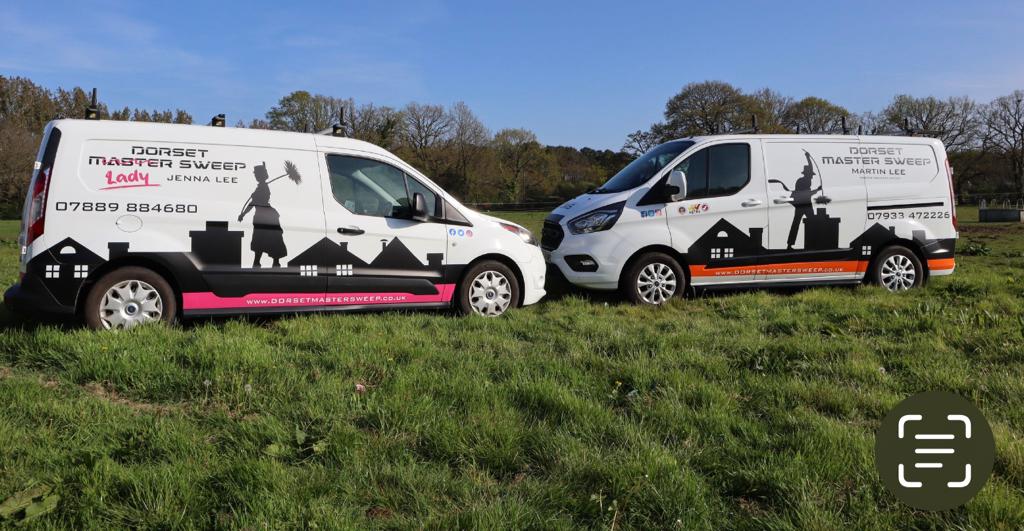
A matching set for the master and lady sweeps
Enter the lady sweep The run-up to Christmas is the busiest time, with the couple each racking up 100-hour working weeks. Their customer base stretches across Dorset and into the New Forest, ranging from celebrity mansions with 14 chimneys to a small bungalow with just one. Jenna says: ‘Martin was getting busier, so I started doing some of his paperwork. When I did the numbers I realised there was enough work for us both. I’d been working for an asphalt company for nineteen years, getting up before dawn, and it was taking its toll. As a couple, we were just passing each other in the evening. Martin would be ready to chill out and I’d be going to bed!’
Jenna Lee is the first female Guild sweep in Dorset – and one of only 15 in the UK
Jenna cut her working hours so that she could help Martin – and then she was made redundant. For six months, Jenna spent two days a week shadowing Martin and in June this year she qualified and launched her own business, Dorset Lady Sweep, complete with a distinctive, pink-flashed van and Mary Poppins-style branding. She says: ‘Some customers are surprised to see a lady sweep but by the time I’m finished, they’re impressed. A lady in Swanage told me she’d never had any issues with male workmen but felt more relaxed with another woman working in the house. ‘It’s certainly not a way to make a living if you’re worried about breaking a nail, but I love it!’ And do the couple have a watershed, when talk of rods and flues is banned? ‘Not really. We’re a good team. The only time we fall out is over radio station choice and air-con temperature in the works van if we’re on a job together!’
It’s a dirty job but someone has got to do it – more than four bags of soot came out of this chimney!
Huge congratulations to Diane Davies from Gillingham who won the BV’s Local Flavours Hamper and is now set for a very Merry Christmas with family and friends
Diane Davies of Gillingham receiving the BV’s Local Flavours Hamper from Courtenay this morning. BV Magazine December 2023 – Image Laura Hitchcock
We would just like to extend our heartfelt thanks to all the wonderful local producers listed below who generously contributed to fill the hamper:
Members of the William Barnes society with Giles Keaton, owner of Athelhampton (front, second left)
On a rainy Sunday at the end of November, a very special Barnes Oak sapling was planted on the gardens of Athelhampton House by members of the William Barnes Society. William Barnes was a 19th century English polymath, writer, philologist, priest, mathematician, engraving artist and inventor. He was perhaps best known, however, as a poet, writing more than 800 poems in the Dorset dialect. He was also the co-founder of Dorset Museum. He was born and spent his childhood in the hamlet of Bagber, just outside Sturminster Newton. Along the route he would have walked into town there still stands a large oak tree, which has been locally named the The Barnes Oak – this was the tree he wrote about in his poem The Girt Woak Tree That’s In the Dell. Mark North, Dorset Museum’s marketing officer, explained how the saplings came about: ‘During covid I visited his birthplace, and also the Barnes Oak. The floor of the path was full of acorns that had fallen from the tree, and I decided to gather as many as I could, take them home and grow trees from them. The idea of the project was to carry on the legacy of the girt woak tree and to plant them in other places that are associated with Barnes.’ The Athelhampton sapling was purchased especially for the gardens at Athelhampton at a fundraising auction earlier this year.
Sir Frederick Treves, who died a century ago this month, was one of Dorset’s most famous men – Rachael Rowe reports
Sir Frederick Treves
On 15 February 1853, Frederick Treves was born at 8 Cornhill in Dorchester, the son of upholsterer William Treves. Young Frederick attended a local school run by Dorset dialect expert and poet William Barnes, who had a significant impact on Frederick’s writing in later years. After his father died in 1867, his mother moved the family to London where Frederick attended Merchant Taylor’s School before enrolling at the London Hospital Medical College. He became a general practitioner in Derbyshire before returning to London to continue his studies. In 1875 at the age of 22, he passed his membership exams for the Royal College of Surgeons (RCS) and five years later became a Fellow of the RCS. In 1877, Treves married Ann Elizabeth, whose father, Alfred Samuel Mason, was a well-known Dorchester brewer. The couple had two daughters.
The Elephant Man Frederick Treves was a lecturer in anatomy as well as a surgeon at the London Hospital. One day in 1884, he heard a commotion in the building opposite the hospital, and went to investigate. There he met Joseph Merrick, commonly known as the Elephant Man, who was being exhibited as entertainment by Tom Norman, a London-based showman. After birth, Merrick developed a very rare medical condition, causing deformities, lumps and thickening of skin on various parts of his body. Medical science has still not been able to identify the exact cause or nature of this condition. The only way he could earn money to survive was to appear in freak shows and fairs. When Treves saw Joseph Merrick, he immediately had the exhibition shut down and offered to examine him at the London Hospital. He described his first encounter in his 1922 book, The Elephant Man and Other Reminiscences: ‘The whole of the front of the shop, with the exception of the door, was hidden by a hanging sheet of canvas on which was the announcement that the Elephant Man was to be seen within and that the price of admission was two pence. Painted on the canvas in primitive colours was a life-size portrait of the Elephant Man. This very crude production depicted a frightful creature that could only have been possible in a nightmare. It was the figure of a man with the characteristics of an elephant. The transfiguration was not far advanced. There was still more of the man than of the beast.’ Treves eventually provided quarters for Joseph Merrick at the London Hospital in order to oversee his long-term health problems. Merrick lived there for four years, even meeting Princess Alexandra when she visited in 1888. He died in 1890, after the weight of his head led to him suffocating overnight.
Saving the King In 1888 Frederick Treves performed the first appendectomy in England. He was appointed surgeon to Queen Victoria in 1900 and on her death in January 1901 continued as surgeon to Edward VII, becoming Honorary Serjeant Surgeon to the King, and knighted the same year. In August 1902, just before his coronation, the King developed appendicitis, but he was deeply unwilling to have an operation because of the very high mortality rates of operations at that time. Treves talked him into having the surgery, bluntly pointing out that if the king did not have the operation there would be a funeral instead of a coronation. The operation was performed on the table in the Music Room at Buckingham Palace, where Treves was assisted by another famous surgeon, Sir Joseph Lister (Baron Lister of Lyme Regis). They made a small incision to drain an abscess around the appendix, preventing the development of lethal peritonitis and sepsis. The next day, King Edward VII was sitting up in bed happily smoking a cigar. As a result of the King’s successful surgery for appendicitis, the technique was seen as being safe and was implemented across the country, saving many more lives. In 1902, Treves was granted the Freedom of the Borough of Dorchester. When Edward VII fell into a rabbit hole in 1905, Treves treated his achilles tendon.
A Dorset Writer Sir Frederick Treves never lost his love of Dorset. In 1904 he became the first President of the Society of Dorset Men. In 1906 he wrote Highways and Byways of Dorset, a delightful description of the towns and villages in the county. Sturminster Newton is described as ‘No greate place,’ while he thought of Milton Abbas that ‘there is nothing like to it in any part of England.’ Treves travelled to all corners of Dorset on foot and bicycle in order to write his book. To read it is like stepping back in time to the days when Thomas Hardy and Treves would have wandered the countryside, observing people, nature, and the characters living in Dorset. On 7th December 1923, Sir Frederick Treves died of peritonitis in Lausanne, Switzerland. His funeral was held at St Peter’s Church, Dorchester, on January 2nd 1924 and the King was represented by Lord Dawson. Thomas Hardy was good friends with Frederick, and though 84 and very frail, he stood in the rain beside the open grave for the entire ceremony. He placed a poem in The Times, titled In the Evening, to mark the occasion: ‘In the evening, when the world knew he was dead, He lay amid the dust and hoar Of ages; and to a spirit attending said. “This chalky bed? — I surely seem to have been here before?”