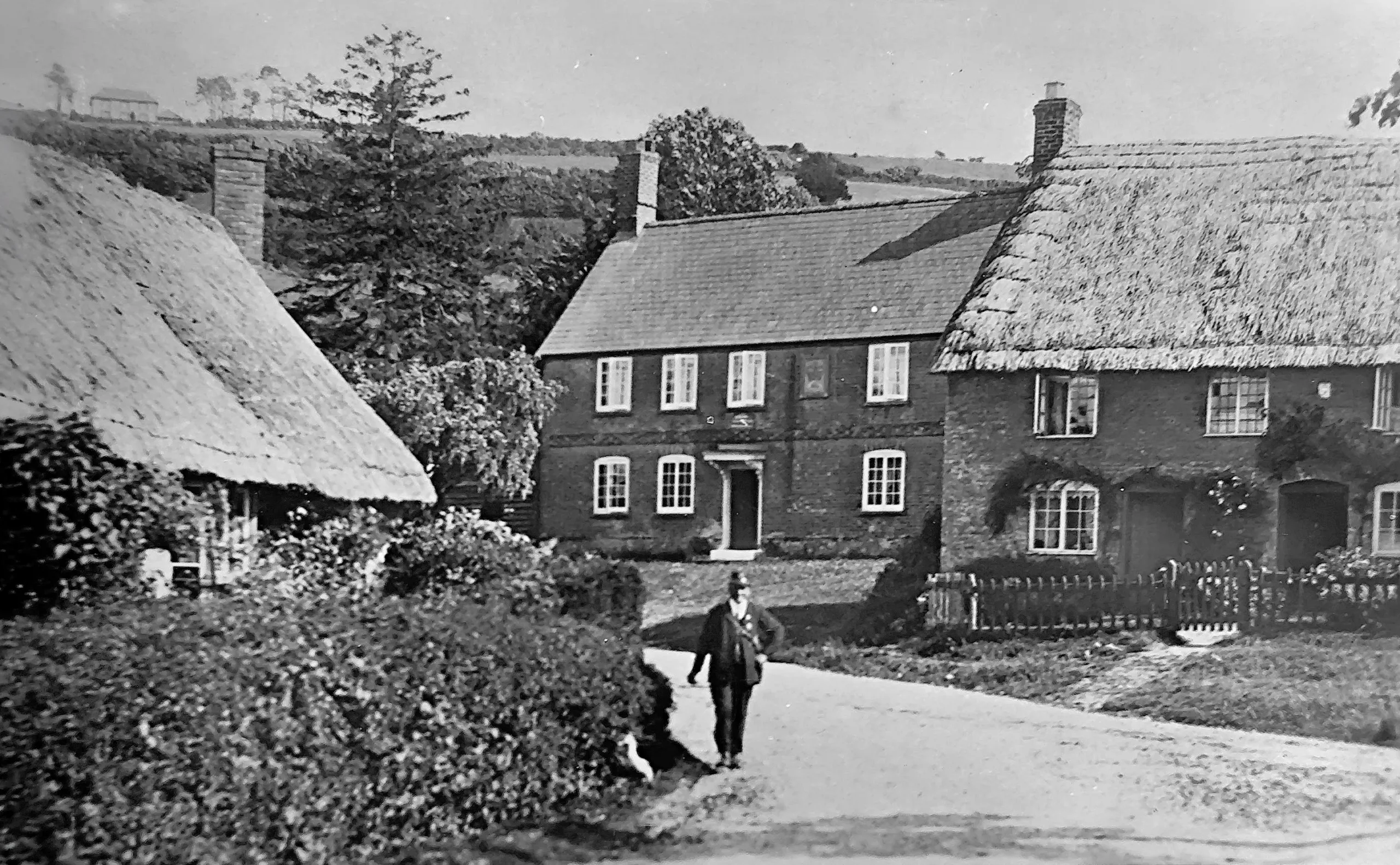
We had fewer correct guesses of last month’s mystery postcard which was of East Stour. We’re thinking his pick this month is the hardest yet (and no, we don’t know either). We’re offering no clues except a date – 1921 (we don’t think that helps!) – and no prizes. You just get the smug satisfaction of solving a postcard mystery. Do you know that cottage? Surely the wall is still standing? If you recognise it, let us know – we’ll reveal the answer in the March issue.
Pussy willow catkins are among late winter’s most generous and quietly important natural wonders, says Jane Adams
Also known as the pussy willow, the male catkins of the goat willow look like a cat’s paws. Once they burst into bright yellow ‘flowers’ they provide early spring support for more than 450 types of insect
When did you last stop to look closely at a catkin? We usually think of the strange blooms as the dangly swaying yellow threads which hang from several species of shrub and tree at this time of year … but pussy willow is by far my favourite catkin. The soft, furry buds grow on goat willow (Salix caprea), and they look and feel just like the paws of a tiny kitten – hence their pussy willow nickname. As a child, I adored the book Pussy Willow, written by the American author Margaret Wise Brown. It told the story of a small, fluffy kitten exploring the changing seasons in search of her namesake. A frog eventually tells her she will find the pussy willow when the small birds sing, the sun shines warm, and the frogs ‘peep’. A wise frog – though, for the record, Dorset frogs definitely ‘croak’ rather than ‘peep’! Sadly, willows are woefully overlooked, despite there being around 20 species in the UK. Perhaps it’s because they aren’t as long-lived as oaks, or as showy as horse chestnuts. Yet goat willow can reach ten metres in height, and the oldest specimens may live for up to 300 years. Straggly, but still beautiful.
Screenshot
The humming tree It’s not as if humans haven’t found willow useful across the millenia. Its branches have been woven into wattle for house building for more than 6,000 years, while its bark’s pain-relieving properties were known long before Felix Hoffmann isolated the active compound in 1897 and it was marketed as Aspirin. But it’s insects that really go wild for this understated tree. Willows have been found to support more than 450 species of insect, from 162 butterflies and moths to 104 bees and wasps. Add over 150 species of lichen, and it’s easy to see just how vital these trees are to the natural world. Goat willow is dioecious, meaning male and female catkins appear on separate trees. By mid-to-late February, male catkins are at their fluffiest, weighed down with pollen and nectar. Female catkins are less kitten-like, but still offer essential nectar. Unlike the dangly yellow hazel catkins, which rely on the wind for pollination, goat willow depends on insects, especially bees. On a sunny, calm day, a flowering willow will literally hum with bumblebees, solitary bees, honeybees and hoverflies. Later, when its rounded, curly-tipped leaves appear, they are food for many moth and butterfly caterpillars, with the purple emperor perhaps its most regal and rare diner. In medieval times, people brought branches of pussy willow indoors to ward off evil spirits – a tradition that feels worth reviving in our troubled times. For now, though, I’ll listen for the frogs and follow in the footsteps of that childhood kitten, stopping every so often to feel the softness of pussy willow’s paws.
A 1938 postcard captures Cerne Abbas in a quiet in-between moment: after decline, before revival – when the Giant didn’t warrant a mention
In his 1906 book Highways and Byways in Dorset, Sir Frederick Treves painted a bleak picture of Cerne Abbas as ‘decaying and strangely silent’: ‘It is a clean, trim, old-world town, which has remained unchanged for Heaven knows how many years … The place, however, is empty and decaying and strangely silent. Grass is growing in the streets; many houses have been long deserted. ‘One feels compelled to walk very quietly through the echoing streets, and to talk in whispers, for fear that the sleep of Cerne should be broken.’ Treves concluded, bluntly, that ‘Cerne Abbas is dying’, its vitality lost, he believed, when the railway reached Dorchester and the coaching traffic that once used the village as a staging post disappeared. Attempts to reinvent the town as a centre of manufacturing failed and, by the end of the First World War, the Pitt-Rivers family – faced with heavy death duties – decided to sell it from their estate. On 24th September 1919, some 4,700 acres of ‘residential, agricultural and shooting’ land were auctioned at Dorchester Town Hall in 75 lots. Present was Frederick Harvey Darton – publisher, Dorset devotee and author of The Marches of Wessex – who toured the properties beforehand and found the same level of decay Treves had noted more than a decade earlier. It was a reality the auctioneers’ catalogue failed to mention, preferring what now read as rather familiar estate-agent phrases such as ‘well-constructed small private residence’ and ‘pretty creeper-clad cottage’. Darton later described the sale itself: ‘It was full, quite full, of farmers, with a sprinkling of gentry… There was a subdued undercurrent of feeling which could not be mistaken: it broke out in cheers when a tenant bid successfully.’
A small number of tenants did manage to buy their homes – the butcher, baker and a shopkeeper among them – but fewer than a quarter of the lots went to sitting tenants, many of whom were already relatively well off. Some cottages sold for under £100; the medieval jetty-fronted houses of Abbey Street went for just £340. The Swanage Times reported that ‘over £95,000 was realised at the sale’. One of the chief properties, the Melcombe Estate, was bought by Mr Clough of Burley, Ringwood, for £29,250. Barton Farm was purchased by its tenant, Mr J Sprake, for £12,300, while The Abbey House, with guest house, gatehouse, Abbey site, outbuildings and 196 acres which included Giant Hill sold for £7,600. The sale may have helped the Pitt-Rivers estate finances, but it did not halt Cerne’s decline. Maintenance proved beyond many of the new owners, pigs were reported living in Abbey Street houses, and within a decade the population had fallen to around 450. Yet from the 1930s onwards, Cerne began to recover. New residents arrived in search of tranquillity, restoration followed and the village slowly found a new footing. Today, with housing developments on the village edge and revived local amenities, the transformation is striking. Once written off as dying, Cerne has long since proved Treves wrong.
The postcard, sent from the village on 22nd July 1938, captures something of that quieter, transitional period. Writing after a long walk in summer heat, the sender noted the ‘good hostel here – a converted workhouse’. Between 1932 and 1955, the former workhouse served as a youth hostel; during the Second World War it housed evacuees from a London school, before later becoming flats. It is now a residential care home. ‘Reached here last night from Iwerne Minster after walking about 18-20 miles & got a lift for 4 miles in a lorry. Weather’s lovely, but very hot – no rain so far. Good hostel here – a converted work-house. Just off to Piddletrenthide & Dorchester. Dick’
‘This is a great way to add some veggies to your macaroni cheese. I also use a creamy garlic cheese with a hard cheese such as Cheddar. Look out for James’s Cheese: for this version I used the garlic cheese and Old Winchester.’ – Lizzi
Sweet potato macaroni cheese
Ingredients (serves two generous portions)
1 sweet potato
150g macaroni
35g butter
35g flour
275g milk
120g garlic cheese
100g hard cheese
Salt and pepper
1 tsp dried thyme
Sweet potato macaroni cheese
Method
Roast the sweet potato in its skin for 45 minutes until softened. Peel.
Boil macaroni for 12 minutes, and drain.
Melt butter and flour in a small pan and gently cook for two minutes. Keep whisking as you slowly add the milk over a low heat – keep stirring. The sauce will begin to thicken.
Add the garlicky cheese in pieces and leave to melt. Stir again.
Put the sweet potato in a bowl and season well with salt, pepper and thyme.
Add the macaroni and the cheese sauce, stirring until the ingredients are combined
Pour the mixture into an oven dish and grate the hard cheese over the top. Bake for approx 30 minutes 190ºC/Gas 5 until browned on top.
Serve with salad or green veggies – delicious!
Lizzie Crow is better known to most as Lizzie Baking Bird. From her tiny bakery in west Dorset, Lizzie creates an impressive range of sweet and savoury bakes, which you’ll find at Poundbury and Wimborne Farmers’ Markets, Bridport Market and the county’s food festivals and agricultural shows. A member of the Guild of Food Writers, Lizzie has won numerous Great Taste Awards. Find her on lizziebakingbird.co.uk
Winter may have soaked us to the skin, but training camps, bold horses and big plans mean the event season suddenly feels tantalisingly close
Blondie and Jess training with former British Team Performance coach Yogi Breisner at the first Howden Way U25 camp
I think the best way I can describe this month is by calling it Jam-packed January. It might have rained a lot, but we have also trained a lot, learned a lot, worked a lot … and fallen off NOT a lot! Phew! Although we’ve been working hard, the winter months make me appreciate being based at the Fox-Pitts’ more than ever. The undercover barn, indoor school and brilliantly draining all-weather gallops mean that winter doesn’t really feel like winter here. And that’s without mentioning the heated laundry room! But before anyone gets too green-eyed, don’t worry – there have still been plenty of days where I’ve been soaked to the skin, physically unable to pry my fingers from the neck strap I’ve been so tightly clinging onto whilst riding some very fluffy, untidy and generally unruly event horses, regretting all my life choices and wishing I’d pursued that career in biochemistry instead …
Henry, back at home, practicing what he learned at camp. Image: Courtenay Hitchcock
Off to camp Winter woes aside, we’ve also been up to some pretty cool stuff this month. At the end of January we were lucky enough to attend the first Howden Way U25 Rider Talent Academy training camp. Blondie, Henry, mum and I headed up to the National Training Centre in Northamptonshire for two days of intensive training – both on and off the horse – with some pretty prestigious coaches. I rarely get butterflies, but I have to say I definitely noticed them as we trucked along the A34 through the early hours of Monday morning. I don’t think it was just the idea of training with some of the Big Guns that gave me that feeling of anticipation – it was also about riding among my peers.
Henry practicing his halts in the February cold, making him appear part dragon! Image: Courtenay Hitchcock
As an U18/Young Rider (in other words, before I got old!), we did lots of training camps, but it’s been a few years now since I’ve had ‘away training’, and I could definitely tell. I had to catch myself before I went down the rabbit hole of ‘what if everybody else is better than me, or has nicer horses than me, or, or, or…’. I reminded myself that I am on my own journey, it’s all about personal progress. Not comparing myself to others is something I’ve always had to work on, and where I’ve been so lucky to have both mum and William to remind me to enjoy each individual moment. As soon as we drove in, all the butterflies went away, and I remembered just how much fun these camps are. The horses were impeccably behaved and we received some invaluable coaching – a highlight for me being Blondie’s arena cross country session with Tina Cook. Blondie’s showjumping background means she’s still relatively new to this scene, but she pricked her ears and gave it her absolute best. She is so bold and genuine, which makes her an absolute joy to work with. We had a really educational two days, and I got to catch up with all the other riders too (now that we’re out of hibernation!). I’ve really enjoyed applying what we learned with the team at home, and I am already looking forward to the next camp.
Jo Rimmer (Jess’ mum) riding Basil in the floods – Temporarily in possession of their very own water treadmill, beneficial in so many ways … not to mention fun!
Over the next month or so we have some exciting things in the pipeline – the horses are getting fitter, and with event plans in the making and our first cross-country school in the diary, the event season is starting to feel less and less like a distant fantasy! Winter is long … but it finally feels like we’re almost there. Don’t worry though, I’m sure it’ll start raining again soon.
Victoria Sturgess from Black Pug Books lets personal grief open a wider reflection on why literature has always returned to an uneasy pairing
I thought I would interweave two seemingly contrasting emotions this month: one brought about by the heartbreaking loss of my beloved cat, Sophie, my dearest companion every day for 14 years. The other is St. Valentine’s day of love. HE Bates – he of the life-affirming Larkin clan in the Darling Buds of May – wrote a quietly understated, bittersweet gem called A Moment in Time. It tells of a young girl falling in love with, and marrying, a fighter pilot in the second world war with the inevitable outcome. It is written in such a way as to be neither maudlin nor heroic. It will stay with you for a long time. Perhaps the most acknowledged and influential title is CS Lewis’s A Grief Observed (written as NW Clerk to allow separation from his public persona). Just three years after their marriage, his wife Joy died from cancer. This is a poignant collection of reflections on very personal grief, the nature of love and the connection between deep love and intense sorrow. Helen MacDonald’s H is for Hawk was acclaimed when published in 2014, and is now being released as a powerful film. It tells of her severe grief following her father’s sudden death, and her obsession with training a notoriously difficult goshawk. The untamed nature of the bird echoes the wildness of grief – but also how it can help with human loss, and bring comfort. It is slightly reminiscent of another outstanding book, Barry Hines’ A Kestrel for a Knave, following the life of a young working-class boy, troubled at home and school, who finds and trains a kestrel. Kes was the award-winning film made from the book, and my final choice is yet another which is now a box office hit film – proving that these powerful emotions resonate far beyond the printed page. Maggie O’Farrell’s 2020 novel Hamnet focuses on the life and tragic death of Shakespeare’s young son, though it concentrates mainly on Hamnet’s mother Agnes. Deep love and raw grief haunt the family, and Shakespeare can only process it by turning to what he does best: write. From the ancient Greeks to now – via Dostoevsky, Dickens, Hardy, Woolf, Ian McEwan, Julian Barnes and many others – authors have recognised the overwhelming connection between two seemingly opposite emotions. What compels authors to explore this, to try and define it … and why do we readers seem to devour it unreservedly? Perhaps because we all understand intuitively that grief is the price we pay for love.
A not-for-profit care home in Castle Cary is celebrating receiving ‘Good’ ratings in all areas from the Care Quality Commission (CQC). Cary Brook provides day care, respite breaks, residential care and specialist dementia support. At its latest inspection, the CQC rated Cary Brook as Good in all five assessment areas: Safe, Effective, Caring, Responsive and Well-led. The CQC’s report concluded that Cary Brook residents were ‘safe and well cared for’, with their privacy and dignity respected. Relatives of those receiving care praised the ‘kindness and attentiveness’ of the Cary Brook team, who delivered person-centred care in a ‘warm and respectful’ manner. The report commended the team for working well with other health professionals to ensure ‘continuity of care’, and noted that ‘end-of-life care was delivered with compassion’. The CQC said that: ‘Compliments dominated the feedback we received, and people said they would recommend Cary Brook as a good place to live’
Outstanding at a difficult time The positive themes noted by the CQC are reflected in independently-verified customer reviews for Cary Brook on carehome.co.uk. Feedback from residents and their loved ones celebrates the care and support provided, the clean and welcoming environment, and the warm and approachable attitude of the Cary Brook team. ‘Always happy staff and residents. My husband is so well looked after, the staff go the extra mile all the time. Home is always clean and well staffed. I cannot fault anything about this lovely home. All staff are very approachable and always happy. I am so glad this home exists.’ – wife of resident ‘The home looked after both of my parents, and the care given was second to none. End of life care for my father was dignified and professional. Acknowledgement and support towards his family were outstanding at a difficult time. I would have no hesitation in recommending Cary Brook Care Home.’ – son of resident Lisa Warne, Cary Brook Registered Manager, explains what this feedback means to the team: ‘We are thrilled with Cary Brook’s latest CQC report. To be rated Good in all areas is a reflection of the happy place which our team have poured so much love and care into, and our wonderful residents who call Cary Brook their home.
‘It means so much more to us that the CQC’s findings reflect the individual experiences shared by our residents and their loved ones in independently-verified reviews. ‘Whether someone is visiting us for the day, staying for a short respite break or receiving longer-term residential care or dementia support at Cary Brook, our passion is to provide the best possible care within an environment where they feel welcomed, comfortable and supported. It is humbling and heartwarming to hear – from our customers and our regulator – that we are achieving this ambition. ‘Thank you to everyone who helps to make Cary Brook such a special place to work and to live.’
To enquire about Cary Brook, please visit somersetcare.co.uk/cary-brook or contact Somerset Care’s friendly and knowledgeable care advisors on 0800 8174 925.

We live in a critical time when the truth has never been more urgently needed: but the media and political discourse is so peppered with lies that it’s all too easy to lose sight of the truth. Some lies are simply falsehoods, easily shown to be untrue but if repeated often enough, they can still be believed by some. Then there are those lies of omission, where important facts are withheld in order to present a false picture of a situation. This is potentially the most damaging form of lying, and where our government and media are so badly letting us down.
Ken Huggins North Dorset Green Party
There was hardly any mention in the media of an event held in Westminster on 27th November last year that was of critical importance to our country, a National Emergency Briefing (NEB) where leading experts issued stark warnings about the imminent danger the UK faces from climate and nature breakdown, and the risks we all face in terms of food security, extreme weather, health, the economy and national security. With ever-increasing weather extremes like last summer’s prolonged drought and the extensive flooding we’ve already experienced in just the first four weeks of this year, surely only the most stubbornly determined climate change deniers can continue to ignore the facts. The aim of the NEB was direct: to present clear, expert-led facts about the climate risks facing the UK, and in so doing reset the national conversation. The resounding message could not have been clearer: the impacts are happening now, they are accelerating, and urgent action at every level of government is essential. The presentations were honest, shocking and revealing – and only offered hope provided we act NOW with the urgency required to avoid tipping points beyond which there would be no return. The climate and nature crisis is already impacting every part of British life and we cannot wait any longer to treat it for what it is – a genuine emergency. Everyone who cares about the future for themselves, their family, friends and communities can discover the true facts at nebriefing.org and join others in taking action. Ken Huggins North Dorset Green Party
A local expert from Citizen’s Advice provides timely tips on consumer issues.
Q: I’m spending a lot of money on energy bills. What can I do to cut down?
A : Let’s take a tour around the typical house:
The bathroom Reduce the water temperature of your shower and keep your shower time to four minutes Keep your bathroom ventilated – close the bathroom door and turn on your extractor fan or open a window during a shower to prevent damp and mould Turn off the tap while brushing your teeth, shaving, or washing your face Use cold water if you don’t need hot
The washing Use your washing machine’s ‘eco’ cycle – this takes longer but uses less energy. Use a heated clothes airer instead of a tumble dryer – they are cheaper to run, but dry clothes more quickly than a standard clothes airer. Hanging your washing outside is the cheapest way to dry clothes – cold and overcast days can still be drying days. Look for breezy weather when the ground is dry. If you are on a smart tariff, schedule appliances to run during lower price times (only run them when you are at home and awake due to potential fire risks)
The kitchen Use the appliance that fits the meal you’re making. Air fryers, microwaves or slow cookers use less energy than an oven, and can be more economical if cooking a single meal. Defrost frozen food in the fridge before you cook it Cook more food at the same time – fridge leftovers to reheat another day Put lids on pans while you’re cooking, and make sure you’re using the right size pan for the amount of food Only add the water you need when you boil the kettle Defrost your fridge/freezer every year and don’t hold the door open for long The heating Check the temperature on the thermostat: 18 to 21ºC is fine for most people Check heating times. If you have a boiler, set the temperature 2º or 3º lower, (or programme it to be off) when you’re out or asleep. If you heat your home with another type of heating, like a heat pump, check with the installer before changing any settings Check for numbers on thermostatic radiator valves. Set each one to the lowest number that still keeps the room comfortable. Consider installing a radiator reflector if you have radiators on external walls Close your curtains and blinds when it gets dark, as this helps keep the heat in. Keeping your curtains or blinds open when it’s light lets the sun warm the room Exploring energy efficiency grants Spend some time checking on help available for paying for energy efficiency home improvements
The BV community news section is sponsored by Wessex Internet