Home Blog Page 417

Experience a different walk

0

What would happen if we stopped watching wildlife and sensed it in other ways? In this month’s nature column, Jane Adams goes on a sensory walk at dusk.

What smells and sounds did you notice the last time you went for a walk? Did you make a point
of touching a leaf or paying attention to the breeze on your face?

It’s amazing how easy it is to let your sense of sight dominate the way you perceive nature.
I often find myself describing an interesting plant or bird I’ve seen to my husband, but can’t for the life of me remember when I last told him about a scent or texture.

So, this month I’m on a mission (you’re welcome to join me). I’m going to take more notice of my other senses, and to help me I’ve started walking in the nearby woods at dusk.

image by Jane Adams

Spangle galls

There’s no getting away from it, walking in the woods after sunset can feel a bit spooky.
It took me a while to calm my nerves, tune in to the scuttling and scrabbling of the unseen wood mice, and not jump out of my skin when a tawny owl screeched overhead. But the more I do it, the more I love it. The other evening I sat under a favourite oak and, having scooped up a handful of fallen leaves, I started to run my fingers over their surface. Some crumbled, but others were covered in circular lumps about the size of a small flat pea. This oakleaf braille was spangle galls; knobbly hard protection for eggs laid earlier in the year by tiny wasps that develop into larva inside the galls, falling to the ground with the leaves in autumn. The larvae continue to develop through the winter, and emerge as adults in the spring. Later, the scent of a fox that must have passed by just minutes before stopped me in my tracks. Breathing in its heady musk, I could imagine the animal’s steady gaze and alert ears, its russet coat and thick bushy brush.

image by Jane Adams

I’m not suggesting an evening walk is right, or even possible, for everyone, but even if it isn’t, give your eyes a rest and think about appreciating nature with your less used, but nonetheless important, senses.

by: Jane Adams – Naturalist. bTB Badger Vaccinator. Nature writer. Photographer. Bee Watcher.

AFC Bournemouth support the opening of Archbishop Wake’s new MUGA.

0

Last year the Friends of Archbishop Wake Primary School launched a campaign to raise funds for an all-weather playing field; a multi-use games area or ‘MUGA’. The school is fortunate to have a large grass playing field, but it is mostly unusable for much of the year when the ground is too wet. A MUGA gives the school an all-weather sports surface which is suitable for multiple activities, so that they can use their outdoor space all year round both for fresh air playtimes and for outdoor PE and sports clubs. 

(In front of the new MUGA, the ‘Wake Zone’ are the Archbishop Wake school council, members of AFC Bournemouth Women’s team, and representatives from the Friends of Archbishop Wake, the Rotary Club, Mrs Doyle and Mr Carter headteacher (far right). Image: Courtenay Hitchcock)

The Friends of Archbishop Wake were aware it was an ambitious project, but launched the appeal and worked to raise as much as they could. In May the digital BV featured eight year old pupil Patrick Doyle’s own fundraising efforts, starting with a sponsored walk on Milldown; Patrick eventually raised over £800 for the MUGA fund.

(The whole school gathered on the playing field for the official opening of the MUGA. Image: Courtenay Hitchcock)

The Friends managed in total to raise over £7000 via a JustGiving page, with the whole school taking part in a sponsored walk event. The Friends also donated an extra £10,000 towards the building of the MUGA – meaning work was able to commence just as the school broke up for the summer.
Work is now completed, and on Friday 5th November the entire school gathered on the school field for the official opening ceremony. After a rousing Good Morning from headteacher Mr Carter, the microphone was passed to the School Council representatives.

(The opening speech was read by School Council Chair Rosie Pitcher (right) and her Vice Chair Annabelle Amey (left). Image: Courtenay Hitchcock)

School Council Chair Rosie Pitcher and her vice-chair Annabel Amey together thanked the long list of both organisations and people who had made the MUGA possible. They then announced that after a long half term debating (and as voted for by the children) the new MUGA would be called (drumroll please)

(The children created a drumroll of thigh claps as they waited to hear the new MUGA name. Image: Courtenay Hitchcock)

THE WAKE ZONE!

The school cheered its approval of the new name as the heads of houses moved to cut the ribbon. These four house captains are all in year 6, and they had to apply for the position and go through an interview process to get the job. They are viewed as amazing role models for the other children to look up to.
Archbishop Wake recently re-named their houses, which have traditonally been named after local beaches. The children voted to re-name them after people who inspired them, and the four houses are now: Attenborough, Thunberg, Rashford and Seacole. 

(The four house captains cutting the ribbon. From left to right, Franklin Butler, Alice Parker, Emily Traynor and Leo White. Image: Courtenay Hitchcock)

Mr Carter, headteacher said “The MUGA has changed our PE lessons and playtimes forever. Physical education has always been necessary but it is even more important for all children since lockdown and really does have a massive impact on both physical and mental health.”

(The AFC Bournemouth women’s team with the Archbishop Wake heads of houses. Image: Courtenay Hitchcock)

The ceremony was watched by members of the AFC Bournemouth Women’s team who had attended to support the installation of the Wake Zone, and were to spend the entire day at the school providing coaching and sports activities for various year groups.

Meteor sighting in Dorset

0

The Blackmore Vale’s dark skies mean we may witness some rare events – one such event happened in the late evening of Sunday 5th September.

At that time, an all-sky camera was taking long- exposure panoramic views of the sky so as to capture images of meteors and other lights as they passed by above Bagber Common. My colleague, John Savage, set up the camera at his home there so that he could record the comings and goings in the sky throughout the night, every clear night. At 10.47pm he happened to be outside when an incredibly bright meteor, known to astronomers as a ‘Fireball’, momentarily lit up the sky, almost turning night into day.

In John’s words his camera didn’t do justice to what he experienced personally – “the fireball streaked, fairly sedately for a meteor, across the sky just above the south- southwest horizon. It was very bright, lighting up the sky, and seemed, mid- trajectory, to explode in silence.” In the image you can see an enlarged portion of the all-sky photo he captured, depicting the bright streak just below the Milky Way.

Small piece of asteroid travelling at 48,000 mph.


The spectacle was actually caused by a small piece of an asteroid or comet travelling at high speed as it entered the atmosphere about 240 miles away over Brittany in France, heading in the direction of Cornwall. Probably the size of a large stone weighing around 40 kilograms, the explosion was provoked by the heat and pressure that was generated inside the object when it hit the atmosphere at a speed of 48,000 mph.

The fireball was filmed by several webcams as it lit up the sky including one at the brightly illuminated Southampton Docks – see the video bottom left. More videos can be found on the International Meteor Organisation’s website.

So next time when you are out and about after dark, be watchful of what’s happening overhead. You never know what you might see – possibly an Unidentified Flying Object – but most likely a fast moving meteor or fireball!

Dr Richard Miles Dark Skies Adviser Dorset CPRE

The tensions behind the ‘pretty’ façade of Dorset’s villages

0

Yetminster is in the Sunday Times’ Top 50 Villages, but not everyone is happy about newcomers pushing-up house prices, says Paul Birbeck

The Sunday Times recently ranked Yetminster 26th in its list of ‘The UK’s Top 50 villages.
The citation reads ‘This is a village that offers more than olde worlde charm, fresh eggs sold
by the gate and a plum position on the River Wriggle surrounded by the fertile farmland of west Dorset.
It has a well-regarded primary school, a shop, a pub and the delightful Old School Gallery café. There’s even a railway connection on the Bristol to Weymouth line.’

And the adulation for the village is not new. Its ‘unique features’ were concisely described by Frederick Treves in his 1906 Highways and Byways of Dorset, in which he described Yetminster as ‘…a picturesque townlet, full of quaint old houses and venerable thatched cottages. The dates on the buildings belong mostly to early part of seventeenth century. In the main street is an old thatched inn, as well as many houses in ancient stone with stone mullioned windows and fine gables. Many of the houses are covered by creepers, and none seems to lack a garden or orchard. Yetminster is probably the most consistent old-world village or townlet in the county, for modern buildings it has few examples.’

Sounds idyllic? Not everyone thinks so. As with any community, evolution benefits some but not everyone.
The 20th century saw the village undergo significant social and economic transformation. The traditional self-sufficient agricultural community that remained largely unchanged for centuries was to be transformed by modernity. Between the 1870s and early 1900s the combination of cheap, imported food products, poor harvests and cattle disease in the vital dairy herds caused 20% of Dorset farmers to give up their farms. The traditional activities of cider making, leather production and the making of Dorset cheeses like Blue Vinney, were abandoned as farmers concentrated on sending milk to large urban markets.

Only the wealthy benefited

The introduction of piped water and electricity supply meant the old wells and water mills were abandoned and the introduction of new farm machinery encouraged large-scale farming, benefitting only the wealthy landowners. By the 1960s changes in farming practice and government subsidies meant that chalk areas became productive for arable farming and intensive sheep production. The historical advantage of clay vales across the Blackmore Vale was reversed. Today, farming in the village of Yetminster is by just three or four farmers.

The pattern of village life has changed. Fine old farm houses remain, but not as working farms. However, not everything

was lost. The village hall acts as the hub for a lot of clubs and activity, and the Community Sports Club hosts football, tennis, croquet and informal recreation. Booming property prices have benefitted many in the village – but not everyone.

The local White Hart pub has been a victim of the pandemic as the leaseholders moved out when trade declined. In the 1990s ex-landlady Carol Bayfield remembers, ‘We used to open the doors and everyone would pile in, there were a lot of thirsty farmers in those days.’ As for today, she adds, ‘there is a real community feel but there have been changes.’

Second home tension

A number of new housing developments have been added around the village. Second home ownership has increased and the recent influx of people from beyond the area can create a feeling of ‘us and them’ between locals and newcomers. Carol continued ‘There’s a large population of older people in bungalows in the side streets. There’s also a new estate by the school, which not everyone is happy about, but it’s brought in a lot of new life. It’s been a really positive move for the village.’

Like all Dorset villages, without new residents – communities can struggle. The most hotly-debated political issues today include the lack of a bus service which makes it difficult for some residents to get into towns. And there
is the inevitable problem for young, first time house hunters and lower income families who struggle to find appropriate affordable accommodation.

by Paul Birbeck

Child Okeford Co-op – 100 years on | Then and now

0

One of the commercial stories of the 20th century centres on the gradual decline of the village and corner shop as supermarkets took over in the post-war decades and grew ever larger.

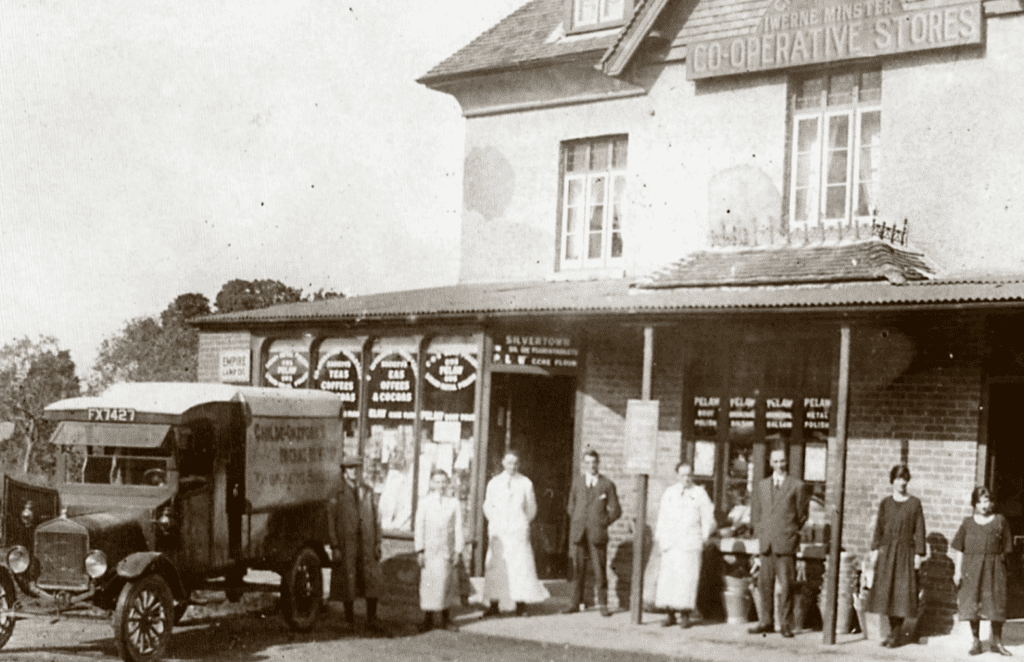
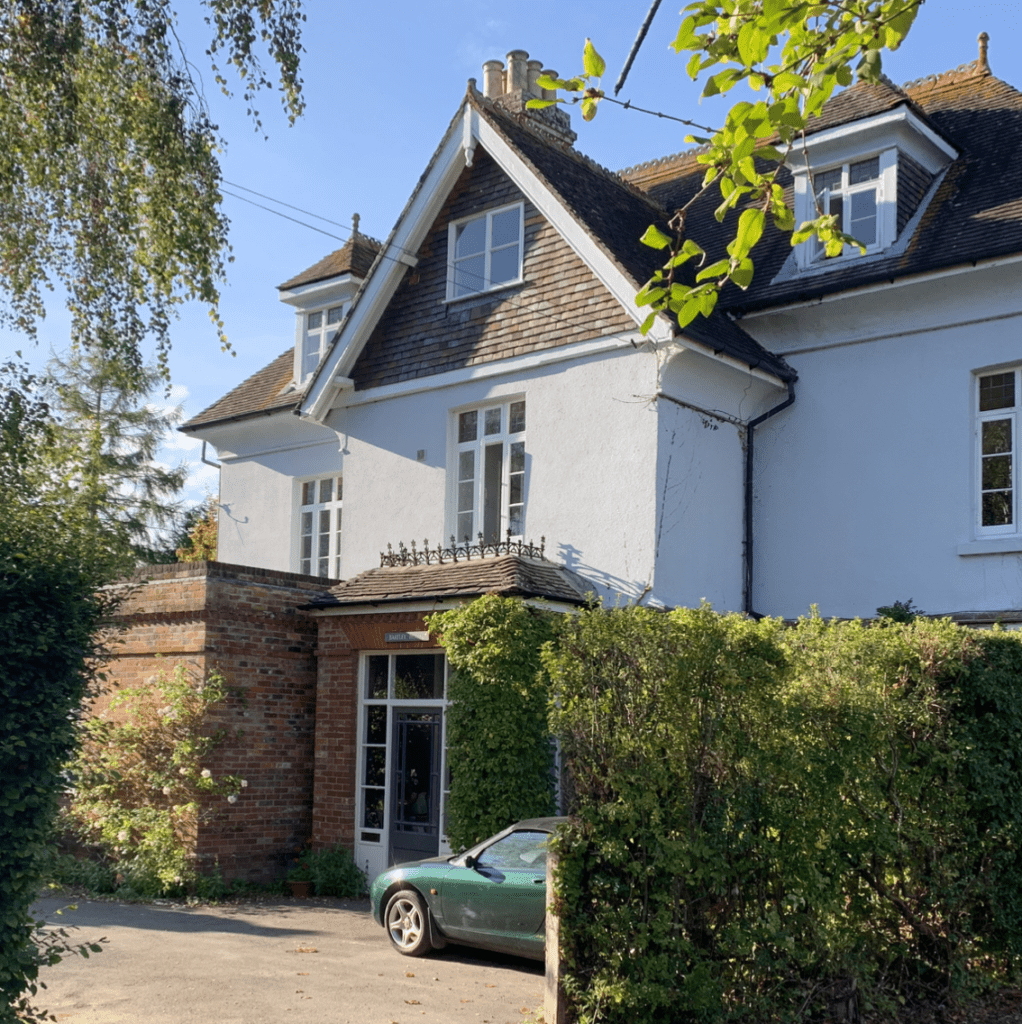
Today’s Bartley House near the corner of Upper Street and The Hollow at Child Okeford was once a thriving village shop, known as the Child Okeford and Iwerne Minster Co-operative Stores.

It opened as a store in 1883 following an earlier spell as a coffee tavern. The 1911 census names 29-year- old Ernest William Ainsworth as secretary and manager of the Co-operative Society. His wife, Violet, 24, and shop assistant John Ryall, 20, also lived at the address.

Calling number eight

By 1931, Kelly’s Directory of Dorset was listing Arthur Moore as the Co-op Stores manager. The shop was now prosperous enough to have its own telephone number: ‘Child Okeford 8’. ‘Child Okeford 1’ belonged to Bertie Diffey, whose grocer’s shop doubled as the post office. As post offices and telephones were run by the same organisation, the GPO, village post offices usually had the first phone in their communities and shared both line and number with the call-box outside.
This was the case for my maternal grandparents, Jim and Jane Ridout, at nearby Fiddleford Post Office, whose number in my childhood was ‘Sturminster Newton 65’.


Other traders in Child Okeford in 1931 included
• grocer James Woolfrey
• butcher Robert Turner
• baker Arthur Fox
• Miss Bessie Adams, who kept refreshment rooms
• saddler and harness maker

Ernest Cuttle
• boot maker Arthur Hart
• beer retailer Robert Hart
• publican Mrs B M Pride at the

Baker’s Arms
• the Woolfrey Brothers, blacksmiths.


The older picture, from the Barry Cuff Collection and David Burnett’s book Lost Dorset: The Villages and Countryside, shows the Co-operative Stores in about 1920.


The Co-op delivery truck’s registration number is FX 7427. FX was allocated to the county in the early 1900s to replace BF which, as I explained in this column two issues ago, caused offence to some, who thought
it implied that Dorset motorists were ‘bloody fools’.


Barry Cuff tells me FX was chosen because those in authority considered it impossible to misinterpret.
The picture features an impressive line-up of eight Co- op staff. Products advertised on the windows include Empire Lamp Oil; biscuits, teas, coffee and cocoas; and several forms of Pelaw Polish, Pelaw being the brand name for the Co-op’s own range of polishes. The prominent former store is now a private house tucked away behind hedges. The verandah is long gone as are the shop windows to the left, replaced by a brick extension. But the house is eminently recognisable and the original porch roof survives together with its ironwork.

by Roger Guttridge

The judging has begun

0

Whilst some of the judging teams for the Love Local, Trust Local Awards have been out aorund the county visiting the finalist food and drink producers, others let the food come to them…

Love Local Trust Local

Last year’s winners Meggy Moos Dairy have returned this year as judges, ansd have been visiting entrants for the Dairy category: “We have spent the last week visiting the entrants for this years Dairy category.

It has been such an interesting week – we had six very different businesses to visit, some were producing the same product but all with a different approach. What was strikingly consistent across them all not only the love and care for their livestock, but also for their customers and for the communities in which they operate.

Love Local Trust Local

We were impressed by their passion and enthusiasm for what they do, their drive to produce the very best product they can and the time they are prepared to invest in talking to customers and helping to educate them on why buying local, seasonal or British is so important.
A huge thank you, well done and good luck from us to all this years entrants. You really are demonstrating why loving local is best.”

As well as the judge’s location visits, all judges and sponsors met during October for an evening of tasting of the finalist products for the 2021 Love Local Trust Local Food and Drink Awards. Upon arrival the entries were arrayed by category (cheese, meat, dairy, bakery, preserves, etc.), and each tasting judge sampled every product.

Forms were available to complete for each category, and judges were expected to note down their favourite, their second choice, and the reasons for those choices, before handing their completed forms to the head category judge and moving to the next category.

Once most of the judging was completed, everyone enjoyed a sociable meal together which was finished by the all important ice cream tasting.

Tickets are now on sale for the awards ceremony on the 30th November – find out more at www.lovelocaltrustlocalawards. co.uk

Sponsored by Blanchards Bailey – Law for Life

The role model in the garden

0

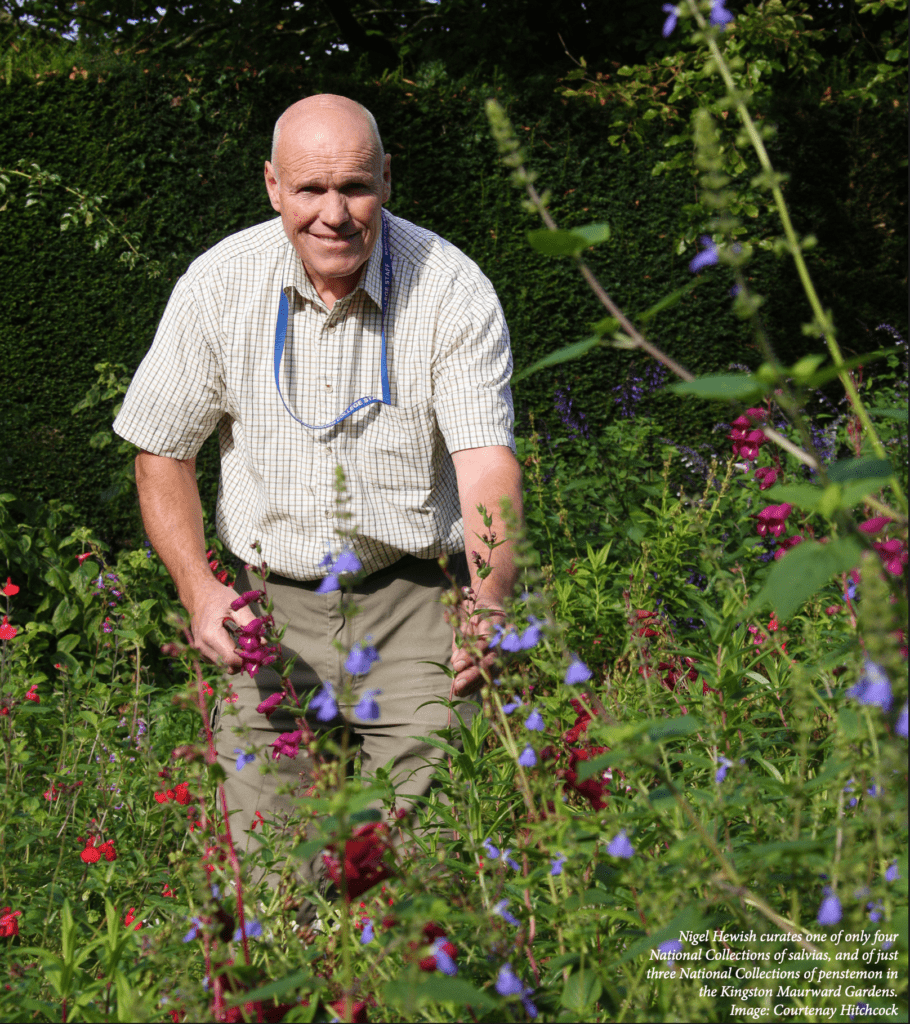
Nigel Hewish, Head Gardener at Kingston Maurward, is responsible for over 2,000 trees, acres of lawn running to a five acre Georgian lake, three large ornamental gardens including an Elizabethan walled garden, a kilometre of formal hedging, huge herbaceous borders and two National Plant Collections.

Nigel Hewish has done five hours of his working day – and it’s only 10am. Responsible for over 2000 trees, acres of lawn, three large ornamental gardens, a kilometre of formal hedging, huge herbaceous borders and two National Plant Collections, it’s no surprise this man is up with the lark!
Added to his challenge is managing all this around numerous events; no-one wants a noisy mower disrupting their marriage ceremony!
Nigel is Head Gardener at Dorchester’s renowned Kingston Maurward, a land-based college and events venue; he’s been tending this stunning landscape for 30 years.

Early beginninngs

His love of gardening was inspired by his father, a trained forester and groundsman gardener. Nigel recalls: “We’d go for a picnic and as soon as the Thermos was empty, Dad would fill it with seeds and saplings, keeping them fresh to grow on at home.”
Starting as an apprentice gardener at Millfield School in Street, where he hails from, Nigel studied horticulture
at Cannington (now part of Bridgewater College), returning to Millfield to take charge of its glasshouses. Before moving to Dorset, he was Head Gardener at the 12th century Berkeley Castle in Gloucestershire.

A living classroom

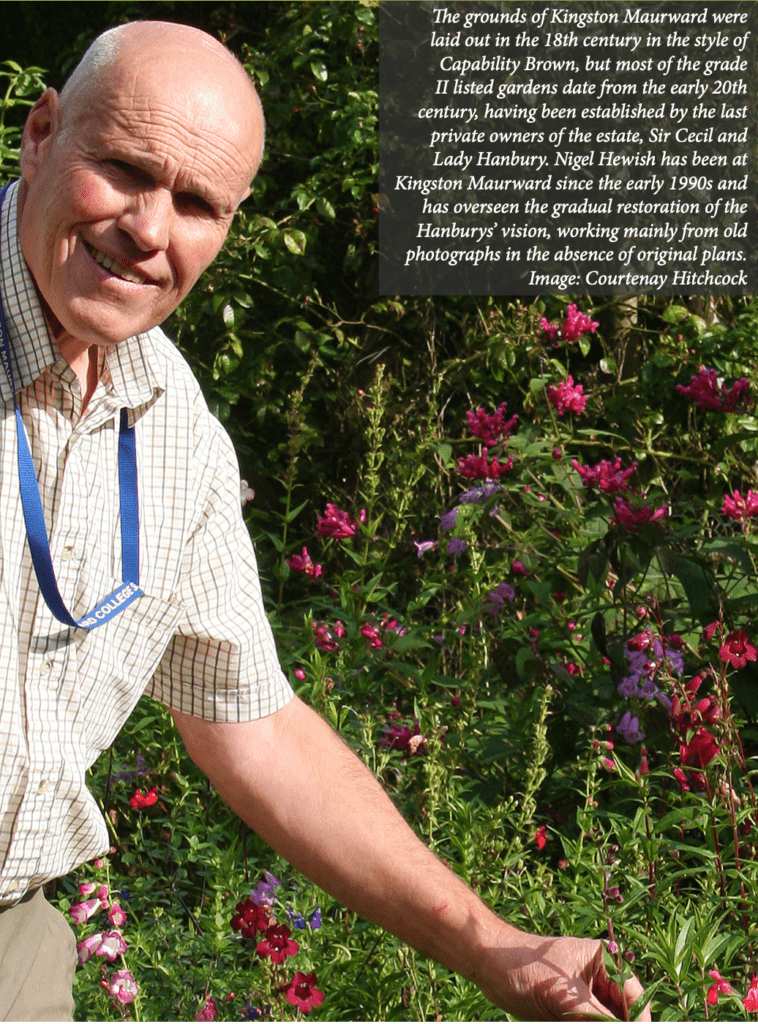
As he shows me round Kingston Maurward, it’s an historical trip through garden fashions. Kingston Maurward Gardens are laid out in the Jardin Anglais style popularised by Capability Brown in the 18th Century, with a matrix of themed small gardens, lakeside walks and a walled garden. The front of the 18th century manor house has a sweeping Georgian-inspired landscape spotted with elegant trees. Back lawns tumble down to a 5-acre Georgian lake. To the side is a stunning Elizabethan walled garden which sits happily alongside twentieth century “garden rooms.”
With a nod to royalty, the Crown Garden has hedges cleverly shaped like crown points, with diamond gaps revealing beautiful vistas. In another garden room a temple stands proud, the pillars and floor a four-year collaboration by stonemason students from Weymouth college and the striking cupola created by Kingston Maurward’s blacksmiths. “The gardens are a living classroom,” explains Nigel. “It’s a brilliant resource for students to learn practical skills. We involve them in projects and offer work experience. Visit any garden in Dorset and you’re likely to find someone who studied at Kingston Maurward. Two of my team of five gardeners were apprentices. They’ve both got degrees in other subjects but say that horticultural training is much harder.”
Long Latin names roll off his tongue and his skill in identifying hundreds of plants is evident. This disarming man is a walking plant encyclopaedia and a role model for trainee gardeners. He’s living proof that life in horticulture can mean a successful and rewarding career. In Nigel’s case – a house on the estate is part of the package too. When asked what he least likes about his job, he struggles for an answer. After a long pause, he settles for paperwork.
“I’m not a great one for being sat in the office doing admin. It’s ok if it’s plant records but I’m not so keen on doing finances.”

Penstemons and Salvias

Nigel’s proudest achievement is curating the stunning National Collections of Salvias and Penstemons – two of his favourite flowers.

These elegant herbaceous plants not only look beautiful and flower through the summer,
but also attract pollinators and wildlife. The National Collections are preserving endangered heritage species – at Kingston Maurward there are

Even with a huge workload, Nigel found time to support
the college’s show garden at
the prestigious Chelsea Flower Show 2019 which gained a coveted silver gilt medal. He was responsible for growing and presenting some of the plants, which needed to be perfect for the eagle-eyed RHS judges. The college is planning to enter again in 2022.

And Nigel carries on learning. “Nature still astounds me. Every day there’s a plant that surprises me – even after 30 years.’’

Kingston Maurward Gardens open 10-4pm daily. Group garden tours can be arranged. Tel: 01305 215000.

Kingston Maurward College offers horticultural, agricultural, arboriculture, conservation and farming courses plus many more. New for 2022 are Business Studies and Travel and Tourism in response to industry demand.

Nigel’s Quick Fire Round:

  1. Tool you can’t live without? In my pocket is a folding Silky pruning saw. Its blade is only six inches but it can cut branches six inches thick. Expensive but invaluable! We trial equipment for Which? Gardening magazine and the cheaper models are rarely as good.
  2. Best gardens to visit in Dorset? Abbotsbury with its tropical feel. The spring display at Minterne Gardens is magnificent too.
  3. What book is on your beside table? None – I fall asleep as soon as I hit the pillow. When I get a chance, I’m reading ‘A Trillion Trees – a way to reforest the world.’ My books are always about nature, conservation or trees.
  4. Top tip? Be patient. Not everything comes up as quickly or as easily at it seems on gardening programmes.

by Tracie Beardsley

Coffee and punctures Tales from the Vale

0

Coffee and punctures

Great new coffee house in King’s Stag attached to the Green Man pub with an attractive almost Scandi-minimally-decorated interior.

I was going to say that the outstanding feature is the enormous map of Dorset, dating from 1890 which covers an entire wall. It must be 20 x 8 feet – couldn’t keep my eyes off it as I sipped my Flat White (not entirely sure what a Flat White is).

But it’s not the café’s finest feature: the outstanding attraction is Catherine, the charmingly bespectacled manager who is warm, welcoming and efficient, as are her staff, Jade and Kim.

The coffee is excellent and the baguettes and pastries, made in the pub’s kitchen, look enticing. But among the goodies on sale is something I’ve never seen

in any other coffee house, and it’s probably not made in the kitchen; puncture repair kits for cyclists.

‘We’re in the middle of a hugely popular cycling area,’ Catherine explains. It makes perfect sense. There’s been real thought behind this new business – well worth a visit.

The wiser sex

My mate James near Okeford Fitzpaine has got a new girlfriend, Sophie.
This, in itself, does not come as

a surprise as he’s mailed with similar news many times. ‘Come over for a coffee and meet her,’ he suggested. This is Man Speak for: could you check whether

A – She is the most gorgeous, charming, elegant, witty woman in the world
B – I’ve made a disastrous

mistake
And he generally wants an opinion within 10 minutes of me meeting the new girlfriend.
Now, this could be a little tricky, me blurting out a decision about the lady while she is actually with us so, we’ve developed a totally foolproof and brilliant formula for me stating whether it’s answer A or B.
If it’s answer A, after 10 minutes I’ll take a big swig of coffee and say, ‘A bloody good brew that’ or similar, but the first letter of the sentence is an ‘A.’

And if it’s answer B I’ll say, ‘By ‘eck, James, that’s good coffee.’ Clever stuff, you’ll agree: and as hard to fathom as Germany’s ‘impenetrable’ code during WWII. So, I went over and after 10 minutes I put my empty coffee mug down and said, with particular emphasis, ‘A bloody good coffee that.’

Sophie immediately laughed and said, ‘I’ve passed the mate test, then.’
James and I were astonished. ‘Oh God,’ Sophie said, highly amused at our embarrassment, and not in the slightest put out, ‘women do it all the time. The only difference is that we’re just that bit more subtle about it.’ James, suddenly remembering

‘a coffee’ a week earlier with Sophie’s mate, said, ‘did you do that with me when Anne came over?’

‘Didn’t you know?’ Sophie asked with incredulity.
James and I were too discombobulated to ask how women organise their mate tests (full report next issue, as they’re coming over for supper).

We should have learnt from history: the German code was broken early in the war and they had no idea. Germany was astonished when the fact was announced in 1974. The Germans should have got an all-women team to devise their code – we’d still be working on it.

A bridge too far

Big mistake in the original version of the previous mag about Lt Salkeld who won a Victoria Cross during the Indian Mutiny (as it’s called if you’re a Brit) or (if you’re Indian) the First War of Independence. One man’s rebel is another man’s freedom fighter.

I told the Editor, Laura, that there was a mistake. She reminded me that I wrote the article, so that’s enough on that subject!

But it leads me to…

The proud ‘Coward’

…a great obituary many years back in The Times. A big cheese in the City had an excellent
war record as he received two (bloody two!) Victoria Crosses. We know how grudgingly these prized medals for the highest, almost insane, levels of bravery in the face of an enemy, are awarded.

His elder brother also fought in the war. And he did very well. Yet, his nickname in the City was ‘The Coward.’
It says a lot about English humour that he didn’t mind this epithet.
He was given his nickname because during the war he only got one Victoria Cross!

Chutzpah

There’s a definition of chutzpah: it’s when having been convicted of murdering your mother and father, you apply to the court for clemency because you’ve recently been orphaned. Sometimes chutzpah is funny, sometimes it ain’t.

‘Mike,’ a DFL (Down From London) booked a pub restaurant

table for four on a Saturday evening – prime 8pm slot at the pub’s busiest evening.
In the meantime he read a review of another place and booked a table there, without cancelling his first choice.

It is courteous, and in diners’ own interests, to arrive at the booked time. But times are hard, and the first restaurant kept the table until 8.30 before releasing it – too late, and they lost four covers.

You don’t need to be a genius to understand that hospitality operates not just on a knife- edge, but on fork and spoon- edges, too. ‘Mike’ didn’t like the second restaurant, so next time the selfish DFL booked his first option again. And the idiot did it in his own name. The proprietor told ‘Mike’ exactly what he thought of him. Good for the boss. The customer is not always right.

Lockdown inanity

We’re fortunate in that our garden (I prefer to think of it not so much as ‘woefully neglected’, but ‘natural and organic’) we enjoy a lot of bird life.
At one time during what many refer to as the ‘summer’ (playing fast and wild with the English language) we had three young wrens who would caper excitedly just outside the French windows. You’ve got to give names to regularly-visiting birds. We called them René and Renata, but struggled for a third wren-based moniker, until a lightning strike of pure brilliance came to me – Renoir.
So that’s what we called them, until another appeared for a few days, the three Rs seemed to accept her (or him) and then he (or her) vanished. So we refer to it as Renegade (Kae’s idea).
For a week or two we had a tiny robin – Robbie was too dull. I suggested that our new friend was too small really to be called a robin, he was more a robinette.

Kae immediately said, ‘we’ll call her (or him) Tap.’
Well, that threw me so she explained the French for a water tap is ‘robinet.’

Continuing our inanity, we needed names for the pigeons: again, always seeking originality, ‘Pidgie’ simply wouldn’t do.
Our first pigeon we named him Walter (after an old actor, think he was in the Archers c.1873). For our second, we went for Lieutenant Pigeon (there was an amusing band in the 70s called this which issued a bizarre song called ‘Mouldy Old Dough’ that inexplicably went quite high in the charts. If you want a real laugh YouTube Stevie Riks impersonating Freddie Mercury singing this song (no need to Google, I did it for you. There’s three minutes I’ll never get back – Ed.).
And we needed a name for our other pigeon. Obviously he was soon Second Lieutenant Pigeon. Then in late summer came the crows: the first was, of course, named Russell. The second was Sheryl (we sort of think Sheryl Crow is an American singer but can’t be bothered to Google her in case she isn’t).
Then we just gave up.

by Andy Palmer

Dorset’s first woman driver | Looking Back

0

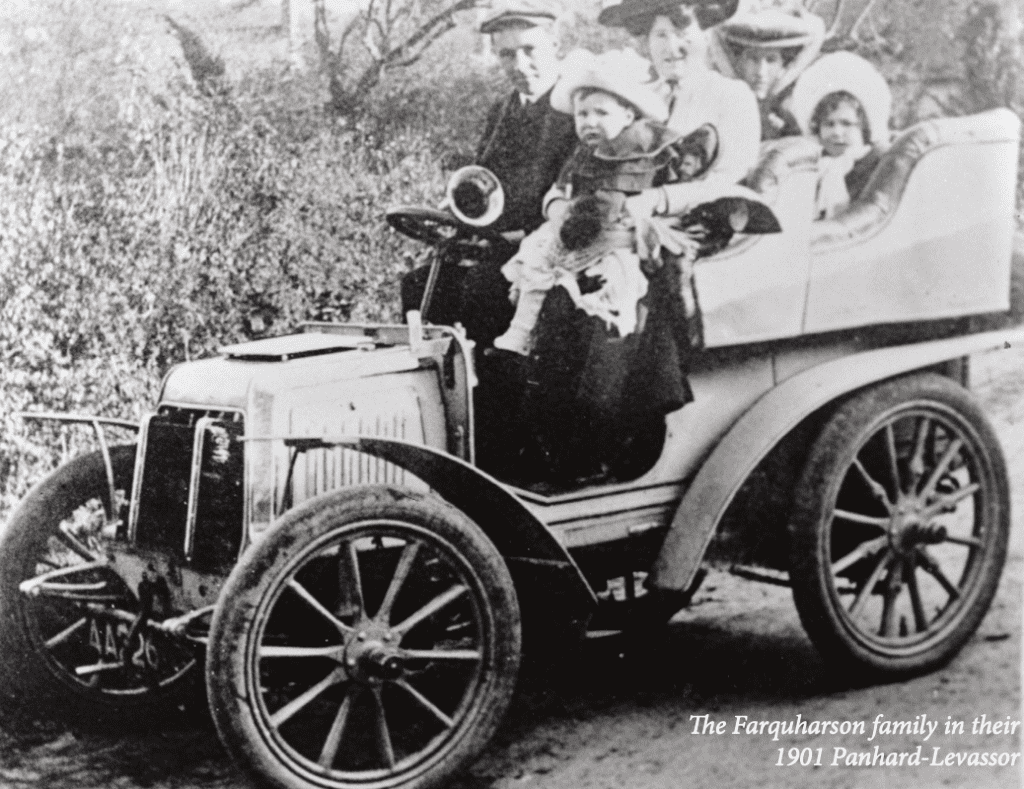
She was Dorset’s first woman driver, and she documented her motoring adventures in a diary written almost 120 years ago. Roger Guttridge shares the story of Mary Farquharson.

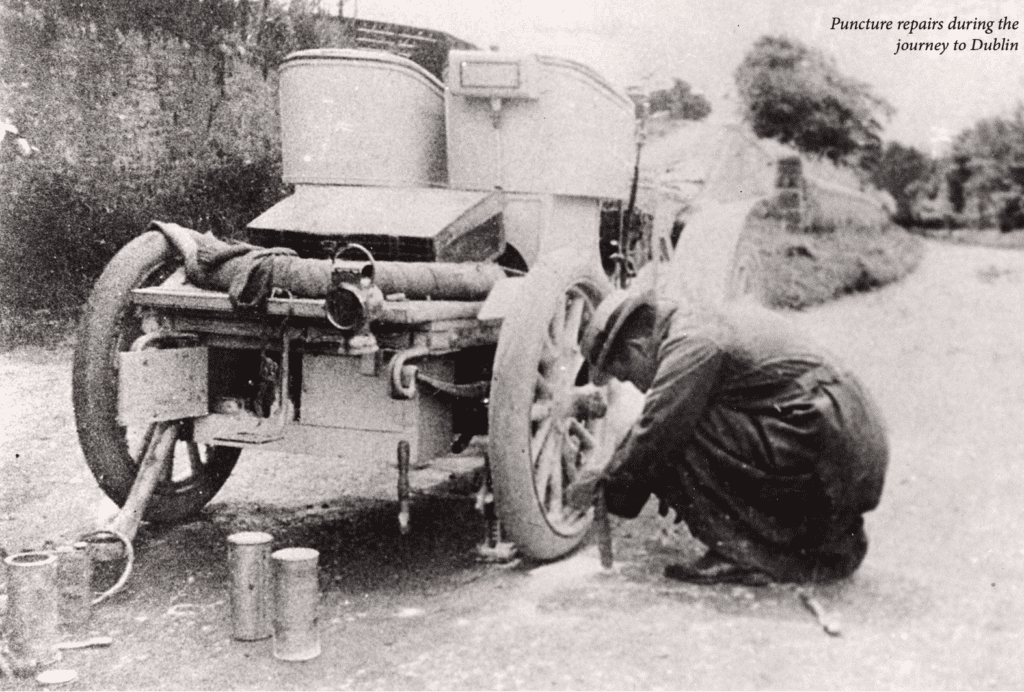
The diary – hand-written and unpublished – describes the eventful travels of Mary Farquharson, wife of village squire Henry, of Eastbury House, Tarrant Gunville. During her first year on the road in 1902-03, her 10-horsepower Panhard-Levassor took the ambitious motorist as far afield as Oxford, London, Lincoln and Dublin. But it was never
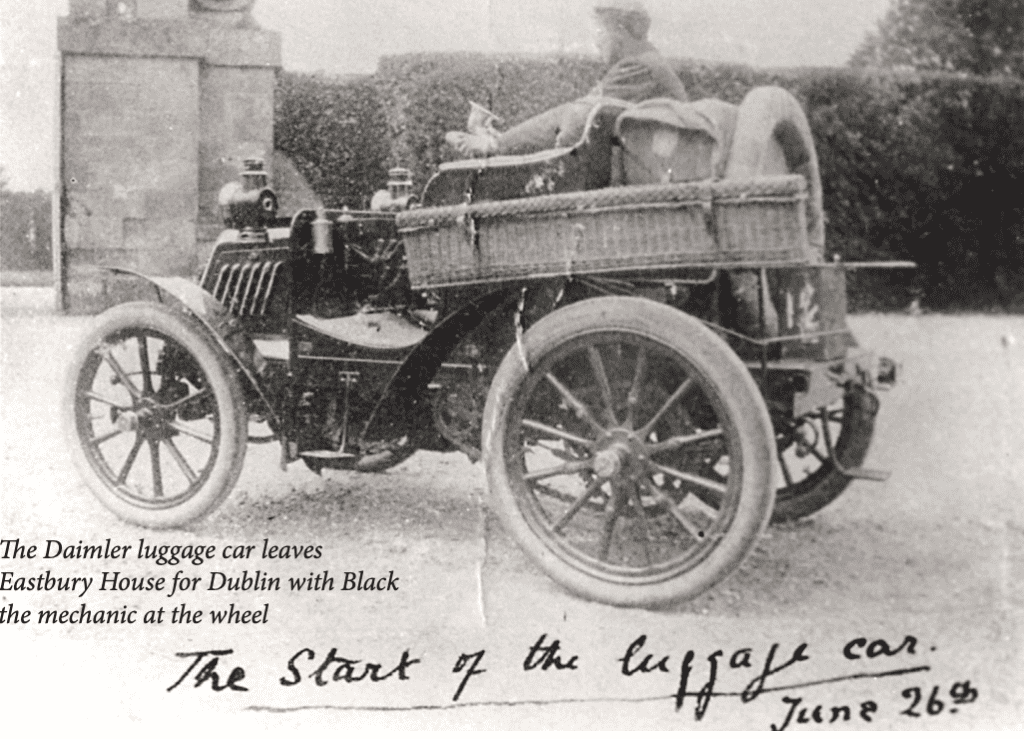
plain-sailing. Punctures and breakdowns punctuated every trip and Mary’s mechanic, whom she refers to only as
‘Black’, was required to follow on his motorbike to deal with any problems. ‘I believe she was not only the first woman driver in Dorset but in the south of England and possibly the whole country,’ her son, Peter, told me in 1991, when he was 80.

A wedding in Oxford

Mary’s first diary entry on July 1, 1902, describes a trip to Oxford for a wedding the following day. ‘Marcia and I were ready to start at 10 o’clock,’ she writes. ‘We waited an hour and then found out the pump would not work, so Black was wired for. ‘We eventually started at 2 o’clock and met Black on his bicycle. We then stopped for the pump to be done.’
The travellers resumed their journey only to hit trouble again as they approached Melbury Abbas: their brakes weren’t working. Wisely, they decided not to proceed down the steep hill into the village and sent to Shaftesbury for help. Two hours later, five men arrived and lowered the car down the hill on a rope. Mary writes: ‘We went on to Shaftesbury and stopped one hour there while the brakes were seen to. It was 7 o’clock when we left there, we having been five hours doing 10 miles.’ At Salisbury the 1901 Panhard had a puncture and the novelty of a car undergoing roadside repairs attracted a crowd of curious onlookers.


When the roofless vehicle finally left the cathedral city at 9pm, it was ‘quite dark and pouring with rain’.
Mary and Marcia reached Andover at 10.45 and stopped for some supper and a change of clothes, but at 11pm were ‘turned out (closing time) having only had a few mouthfuls’.
The diary goes on: ‘Andover to Newbury in pitch darkness, and we did not know the way, was not a very enjoyable ride.
‘The brakes are again not acting, and we came to some steep hills, and once the car got out of control.
‘We occasionally woke up a cottage to inquire the way. We reached Newbury at 2.30 and were stopped by a policeman, who wished to take our names, as we had only one lamp burning, the other having just given out.’
They managed to give the officer the slip by driving off when he popped into a hotel to write down their names.
What was left of the night was spent at another hotel but by 6am they were off again.
Two miles from Oxford the countershaft bracket broke, forcing the travellers to abandon the Panhard in a barn and complete the journey in a hansom cab.
They reached the wedding venue with barely an hour to spare.

Horse not required

A week later, during a trip to Maidenhead, the brakes failed again – this time on a hill marked ‘Dangerous’.

‘The car was fast getting out of control,’ says Mary, who was with husband Henry and Black.
To avert disaster, they ran the car into a bank, where it became firmly stuck.

‘We enlisted some haymakers, who lent us a horse to endeavour to extricate the car,’ writes Mary.

‘The horse proved utterly useless and did more harm than good, as it only proceeded to kick.
‘The men then managed to pull it out themselves and with great difficulty we got down the hill and pushed the car into Romsey, with both tyres badly punctured.’ Returning from a trip to Lincoln, the car collided with a horse and dogcart driven by a small boy. The Panhard’s hubcap was bent but Mary fails to tell us what happened to the boy and his horse and cart.

Thrill seeker

Mary’s most ambitious journey during her first year as a motorist took her to the famous Gordon Bennett motor race near Dublin in 1903.

On this occasion Black was required to leave early in the slower 1898 Daimler luggage car. They crossed the Irish Sea from Anglesey with more than 50 other cars on what must have been one of the world’s first car ferries.

Mary, whose husband held the dubious honour of being the first driving to crash a racing car at Brooklands, noted of the Dublin event: ‘To see the cars thunder by was most thrilling, the speed being terrific.’

by Roger Guttridge