Home Blog Page 13

Dorset Council budget relies on Council Tax to fund rising care costs

0

Dorset Council has published its draft budget proposals for 2026/27, revealing that the majority of new spending on social care and services will be funded through Council Tax rises rather than additional government support. The council plans to spend £482.6m running services next year – an increase of £18.9m on 2025/26. Around 60% of that total will be spent on care for elderly residents, vulnerable adults and children.

Council Tax is set to rise by 4.99%, made up of a 3% general increase and a 1.99% adult social care precept. For a Band D household, this equates to an extra £2.02 per week (£105 a year). Dorset already has one of the highest Council Tax levels in the country, with the average Band D bill for 2024/25 standing at £2,454, placing it among the top three local authorities nationally.
The draft budget papers show that Dorset Council’s Core Spending Power will increase by £25.9m in 2026/27. However, £24.1m of that – around 93% – is expected to come from Council Tax rather than new government funding, underlining the council’s growing reliance on taxing local residents to balance its books.

The council says this reflects longstanding unfairness in the way local government funding is distributed. Dorset serves a large rural and coastal area, with dispersed communities that are more costly to serve than urban populations, and an older demographic that places sustained pressure on adult social care budgets.

Cabinet Member for Finance Cllr Simon Clifford said Dorset’s rural nature, ageing population and transport challenges were not properly recognised by national funding formulas.


93% is expected to come from Council Tax, underlining The council’s growing reliance on taxing local residents to balance its books

‘Even though Dorset is a rural county, with the oldest population in the country and poor transport links, this is not recognised by government,’ he said. ‘Dorset deserves fair funding – but it is not getting it.’

Similar concerns have also been raised at a national level. Writing in his column for The BV this month, North Dorset MP Simon Hoare said: ‘There must be a clear rural dimension for funding formulas for schools, police, local government and the Environment Agency. Without it, we are in the fight with one hand tied behind our backs.’

Risk level ‘high’

The draft budget includes an additional £12m for adults and housing services and £5m for children’s services, alongside £1.7m to support children and young people with complex needs. Rising demand and inflationary pressures are cited as the main drivers of the increased spend.

Major capital spending is also proposed, including £8m to complete the new recycling centre in Blandford, £6m to complete major safety works at Dinah’s Hollow on the C13 in North Dorset and £7.7m for a new reablement centre in Bridport. Car parking charges are to be frozen for a further year.

However, the council’s own Medium-Term Financial Plan warns that the financial risks facing Dorset remain high. The report describes both the current and residual financial risk level as ‘high’, and confirms that future budgets are increasingly dependent on Council Tax rises, service efficiencies and outlined savings being delivered.

It also highlights growing pressure from special educational needs and disabilities (SEND) costs. Dorset’s Dedicated Schools Grant deficit is forecast to exceed £150m by March 2026, with servicing costs of around £5m a year. 

While government accounting rules currently prevent the deficit from triggering insolvency, those protections are due to end in 2028. The proposed budget relies on a programme of savings through automation, service redesign, vacancy management and reduced back-office costs. The council acknowledges that failure to deliver these savings, or any further increases in demand-led services, would place additional strain on future budgets.

  • The draft proposals will be scrutinised by councillors at the People and Health Scrutiny Committee on 21 January and the Place and Resources Scrutiny Committee on 22 January. Final recommendations will go to Cabinet on 29 January before being considered by full council in February.
  • All budget papers are published on the Dorset Council website, and the full Budget and Medium-Term Financial Plan Strategy Report can be read here
The BV puzzles – January 2026

0

Welcome to January’s BV Puzzles page – your free spot for a quick brain workout. Complete the crossword, test your logic with a classic sudoku, or relax with our massively popular seasonal Dorset-themed jigsaw: this month we have a December sunset, with a skeletal tree filled with noisy rooks. We were on our way home for an afternoon walk when Courtenay stopped his car right in the middle of the lane (between Hazelbury Bryan and Stoke Wake) to take it!
No logins, no printouts – just free puzzles updated every month right here on The BV.
Perfect for puzzle fans across Dorset and beyond, our digital puzzles work on mobile, tablet or desktop. Enjoy a quiet moment of challenge with new puzzles published every issue of The BV magazine.


Made by The BV with the online crossword maker from Amuse Labs

Play Sudoku online!

Celebrating Dorset, rebuilding trust

0

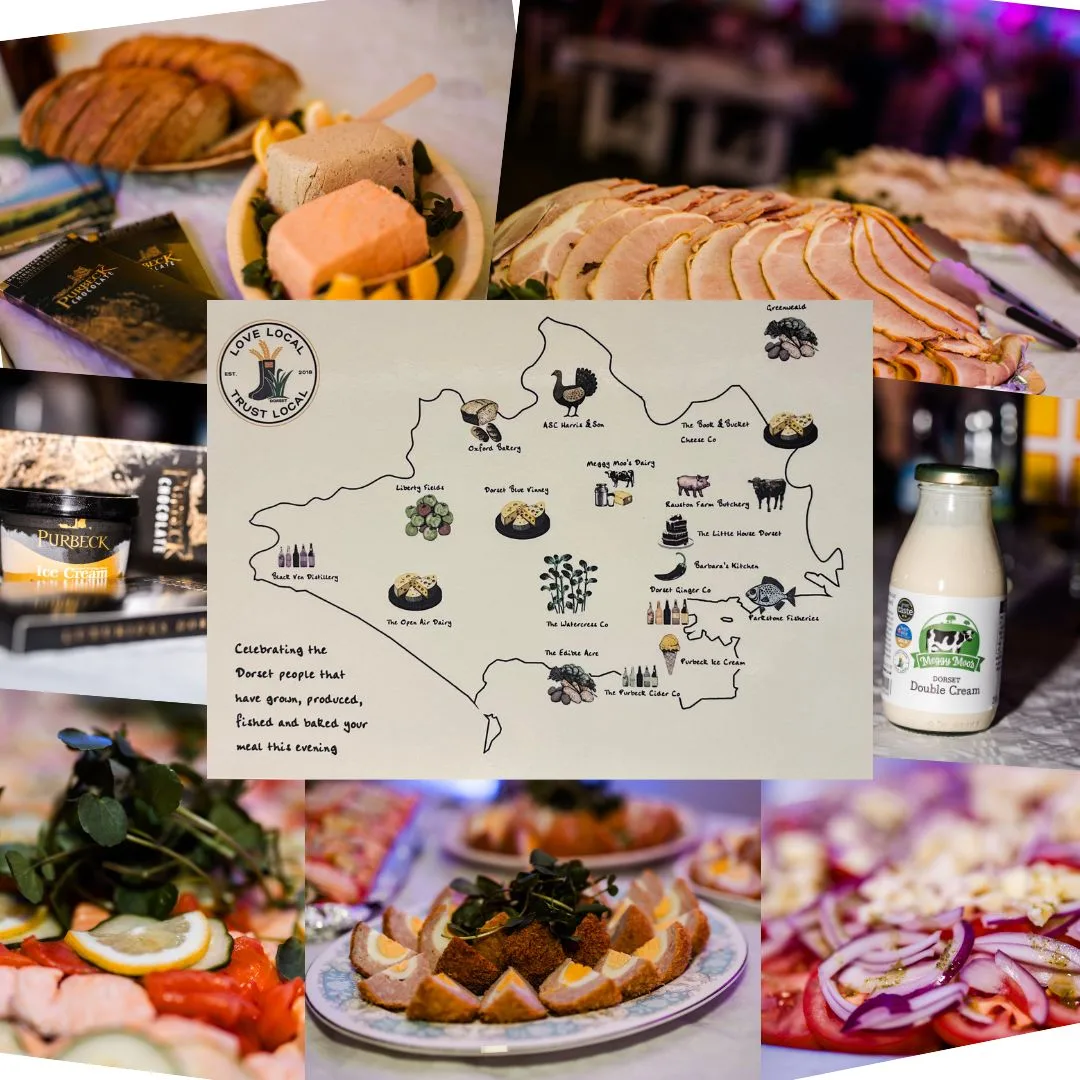
In 2018, Love Local Trust Local was created to bring something back into our local community that many felt had gone missing: trust.


As producers, business owners and customers, we’ve all seen growing confusion around food labelling, sourcing and provenance. We see products marketed as local or British, decorated with flags, logos and claims that suggest one thing – yet when you look closer, the reality often tells a different story. It’s misleading, and it’s unfair to the people working hard every day to create, grow, raise and produce goods with care and integrity.
Most well-known schemes and labels started with good intentions, but over time some have lost their way. Too often they’ve become more about paperwork, scale and pleasing big retailers than protecting the interests of independent producers or consumers. They’re no longer truly producer-led, and they don’t always reflect the real value of local skill, craftsmanship, time and investment.
That’s why Love Local Trust Local exists.
We believe in honest labelling, clear provenance and supporting local producers, local businesses and local pride.
When people see our label, they know exactly where something has come from – right down to the county it was produced in. It’s about rebuilding the connection between products and the people behind them. And it’s about giving customers a real choice and a real reason to support local.
Because when you know who made something, where it came from, and why it matters, trust follows – and communities thrive.


So please get behind the Love Local Trust Local Awards in 2026. Nominate. Enter. Become a sponsor. Get involved.
Help us celebrate and support the incredible producers, makers and businesses here in Dorset
Barbara Cossins

LLTL 2026 awards are now open for entries – find the entry form here – https://www.lovelocaltrustlocal.co.uk/awards-entry-form/

sponsored by Wessex Internet

Angela Rebecca Teasdale

0

5th October 1976 – 14th December 2025

Angie passed away suddenly at home on Sunday 14th December, aged 49 years. Devoted wife to Roger, proud mother to Leighton, much loved by family and friend to so many.

Funeral Service is at Poole Crematorium at 1100 on Friday 16th January, refreshments following at the Exchange, Sturminster Newton 1300-1600.

Family flowers only please but donations in lieu of flowers can be made to Fire Fighters Charity or Teddy20 if desired. The easiest way to do this is via the Much Loved page https://angelateasdale.muchloved.com but if you would prefer you could send donations to Grassby & Close Funeral Service, Sturminster Newton.

For those unable to attend, who may wish to watch the service, streaming is available live and on demand. Please request access to this from Roger in plenty of time.

How the seasons in Blackmore Vale change your daily commute

0

Most drivers treat country lanes the same year-round, but Blackmore Vale’s seasonal shifts demand different approaches to stay safe. From summer’s dust clouds to winter’s frozen ruts, these narrow roads change character completely every few months.

The Blackmore Vale presents unique challenges for motorists throughout the year. Narrow lanes with high hedgerows, limited passing points, and surfaces that deteriorate with weather create conditions rarely found in urban areas. Rural road fatalities account for 60 per cent of all fatalities despite carrying only 44 per cent of road traffic, with one in every 31 accidents resulting in death compared to one in every 120 on urban roads.

Spring brings mud and agricultural activity

Spring brings intensive farming work across the region. Tractors moving between fields deposit thick mud on road surfaces, particularly after rain. Local councils regularly warn drivers about these contaminated surfaces and reduced grip levels. These muddy patches reduce traction significantly and can hide potholes that developed over winter.

Fluctuating temperatures lead to changes in tyre pressure, which can affect handling on already unpredictable surfaces. Spring showers make conditions particularly slippery where mud mixes with rain. Drivers should anticipate sudden stops where farm machinery blocks the road and carry basic supplies, as many lanes lack mobile signal.

Summer creates dust and visibility issues

Dry summer months create their own problems. Dust from harvesting settles on windscreens, reducing visibility when sunlight hits at low angles during morning and evening commutes. Overgrown vegetation narrows already tight lanes, with branches scratching paintwork and obscuring road signs.

High temperatures affect vehicle cooling systems on steep climbs, whilst extended heat exposure impacts tyre pressure and condition. Experts at Precision I.A. Detailing note that overheating becomes a major concern during hot months, especially when cooling systems aren’t in peak condition. Tourist traffic increases substantially, with drivers unfamiliar with single-track etiquette causing delays. Popular walking routes mean more pedestrians on roads without pavements, requiring extra caution around blind corners.

Autumn and winter present the most challenging months

Autumn transforms road conditions dramatically. Fallen leaves create a slippery layer, especially dangerous on corners and hills when wet. They block drainage gullies, causing water to pool across surfaces. Morning frost catches many drivers unprepared, particularly on shaded sections that remain icy while surrounding areas have thawed.

This is when vehicle preparation matters most. Tyre condition becomes critical—worn tread struggles with wet leaves and mud tracked onto tarmac from field entrances. As reported by the AUTODOC expert: “It’s not a good idea to mix different types of tyres on your car, such as winter and summer tyres or different treads, as this can seriously impair handling, braking and stability.” This warning proves particularly relevant on Blackmore Vale’s challenging terrain, where consistent grip across all wheels prevents dangerous skids.

Winter brings the hardest conditions. Stopping distances can be up to ten times greater on icy roads than dry roads, whilst braking distances double in wet weather. Cold temperatures affect battery capacity and thicken engine fluids, making starting difficult on frosty mornings. Ice forms in ruts created by tractors, making steering unpredictable. Many minor lanes receive no gritting treatment, leaving drivers to navigate treacherous surfaces independently.

Understanding stopping distances on rural roads

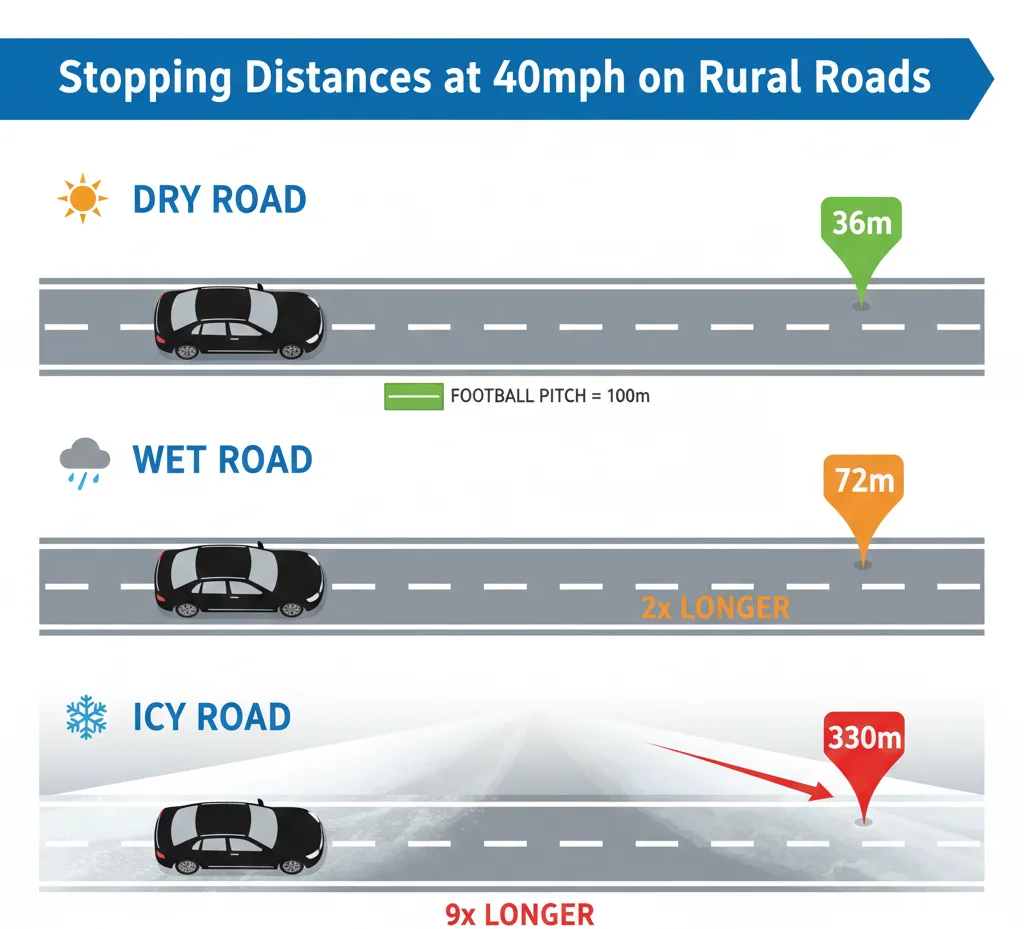
The difference between safe stopping and a collision often comes down to understanding how weather affects your ability to stop. At 40mph—a typical speed on Blackmore Vale’s narrow lanes—the contrast between conditions is dramatic. On a dry road, you’ll stop within 36 metres, roughly a third of a football pitch. This feels manageable and gives most drivers confidence in their reactions.

Wet conditions tell a different story. That same 40mph now requires 72 metres to stop—double the distance. Suddenly, what seemed like adequate space becomes insufficient, especially on lanes where visibility around bends rarely exceeds 100 metres. Rain doesn’t just make surfaces slippery; it fundamentally changes your vehicle’s relationship with the road.

Winter ice creates genuinely dangerous situations. At 40mph on icy surfaces, your stopping distance extends to 330 metres—nine times longer than on dry roads. That’s longer than three football pitches. On most Blackmore Vale lanes, you simply don’t have that much visible road ahead, meaning if you spot a hazard at normal driving speeds, you’ve already lost the ability to stop in time. This stark reality explains why speed reduction becomes non-negotiable during winter months.

These figures, based on Highway Code and nidirect guidance, demonstrate why experienced rural drivers instinctively slow down when conditions deteriorate. The physics doesn’t care about schedules or familiarity with the route—ice eliminates the margin for error that exists in better weather.

Adapting your approach

Successful navigation requires seasonal awareness. In spring and autumn, assume every corner might have mud or debris. Reduce speed before you see the hazard, not after. Claims data shows a 25 per cent increase in accident claims during November compared with April, highlighting how dramatically conditions change.

Vehicle maintenance shouldn’t follow a standard urban schedule here. Check tyre tread and pressure more frequently, particularly before autumn arrives. Ensure windscreen washers contain proper cleaning fluid capable of removing agricultural residue. Battery checks become especially important before winter. Keep fuel tanks fuller than usual—running low on an empty country road in winter creates unnecessary risk.

Regular users develop instincts about which sections flood, where ice forms first, and which corners collect leaves. This knowledge builds over years, but newcomers can accelerate their learning by driving cautiously and observing how conditions change week to week.

The Blackmore Vale’s beauty comes with responsibility. These roads demand respect and adaptation. Drivers who adjust their habits to match seasonal conditions find rural motoring safer and less stressful throughout the year.

Sources of information: based on UK government data on road traffic accidents (2023), recommendations on traffic rules, the NFU Mutual Rural Road Safety Report (2023), nidirect rules, AUTODOC ( More information about car tyres can be found on autodoc.co.uk ) and Precision I.A. Detailing.

Quick Tips:

Q: When should I switch to winter tyres on Blackmore Vale roads? Consider winter tyres when temperatures consistently drop below 7°C, typically from late October through March, as they significantly improve grip on wet leaves, frost, and icy surfaces common on ungritted lanes.

Q: What’s the most dangerous time of year for driving rural roads in the Vale? November through February present the highest risk, with claims data showing a 25% increase in accidents during November alone due to fallen leaves, ice formation, and limited visibility combined with untreated road surfaces.

Lessons from a yearling (pt2)

0

In the second part of her series, Tamsin Doar is heading out for a mooch, cautiously trying out loading, and surpassing all expectations at a show

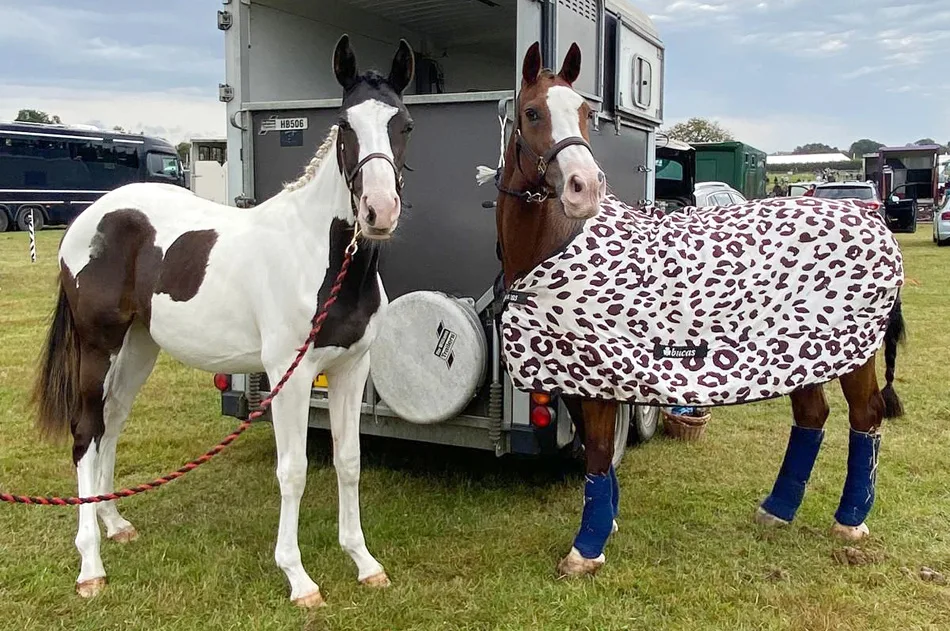
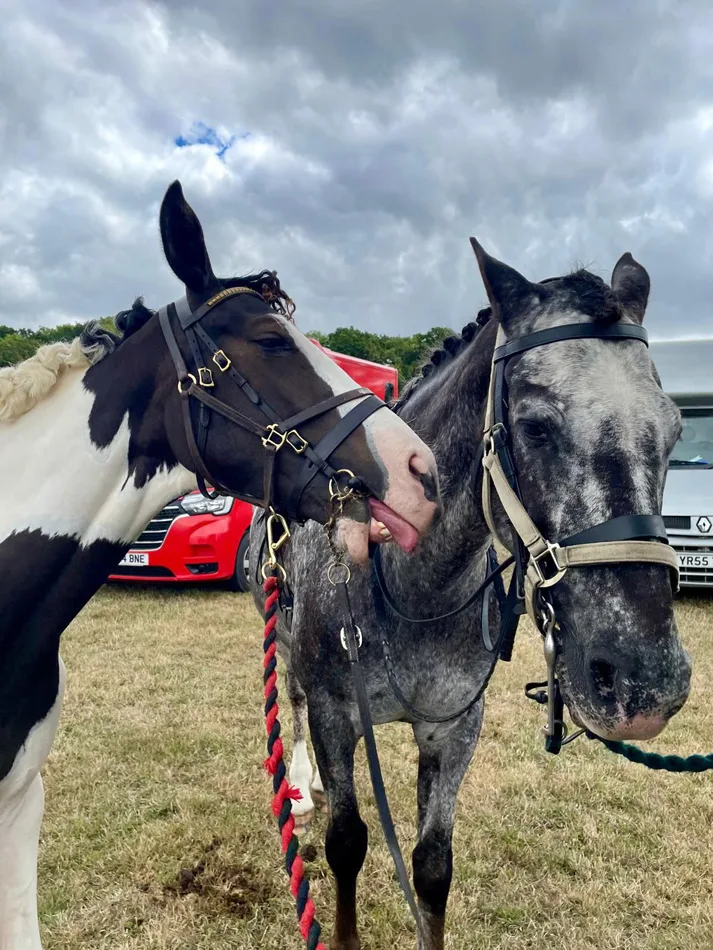
The Sass Queen (right) is proud to pass on all she knows to Squish
All images: Tamsin Doar

One thing I noticed with The Sass Queen is that she learned and processed by watching. I decided the same was probably true of Squish, so anytime the farrier came to shoe the others, Squish would be brought in and tied up next to them to watch. The noise, the smell … the whole experience initially seemed totally confusing to her, but after a couple of visits she’d happily stand and munch at her haynet and let the farrier give her a trim when needed. Although she won’t need clipping for a few years yet (her current woolly-mammoth state is testament to this), if I’m clipping, she’ll stand next to whoever I’m working on so she can see what’s going on, hear the clippers and see there’s really nothing to worry about. My plan for this winter is to slowly progress to just holding the clippers next to her with my hand in between so she can feel the vibrations.
To some this might seem excessive – she’s still so young – but I’ve found that making them confident while they’re young is far easier than trying to persuade a fully-grown equine teenager: they’re much larger, stronger and far more opinionated.

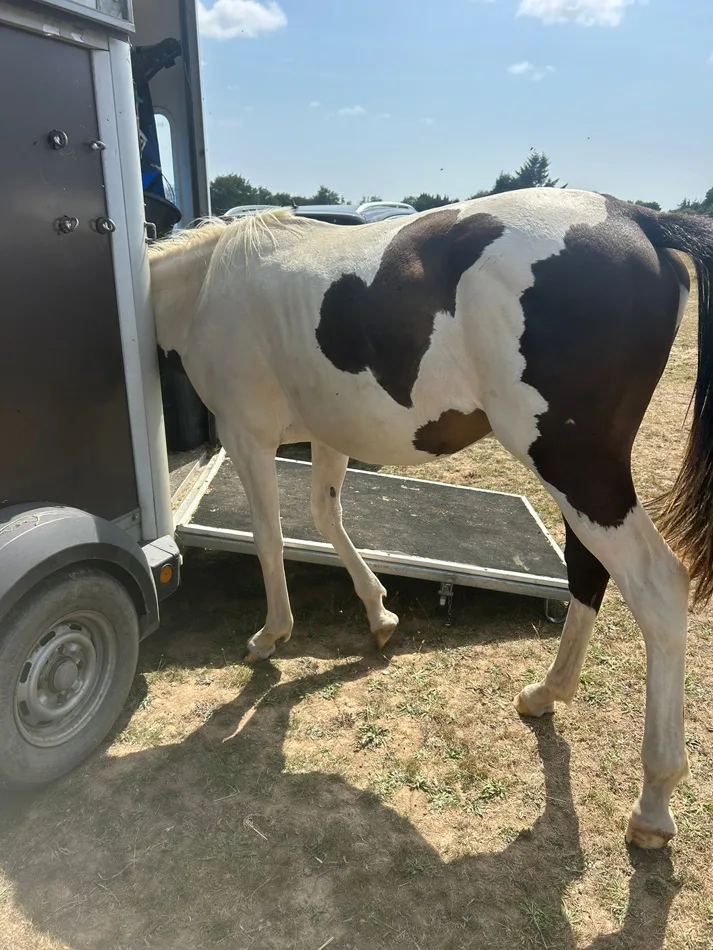
Squish investigating the trailer, not really sure what all the fuss is about


The Sass Queen is also one of the most bombproof horses I know: trains, tractors, low-flying aircraft, cows … she’s seen it all, and never drops her “I can take on the world” attitude. I’m sure this is largely due to her coming out on hacks as a youngster: my dad would lead her while I rode her mum. Although she made an awful mother herself (that’s a story for another time!) she’s been surprisingly maternal towards Squish, and is quite happy nannying her: even toning down her jogging to just three quarters of the ride instead of the entire time.
Squish has been quite happy mooching along next to her while I ride. If she needs time to stop and look at something, we’ll happily oblige (well, I will … The Sass Queen impatiently stomps, letting Squish and me know that she just wants to get on with it). So far, Squish has seen tractors, cars, dog walkers and motorbikes and hasn’t batted an eyelid at any of them – although she regularly stops at the small windmill that we pass on our ‘round the block’ route (why is it so tall and spinny?!). We’re lucky to have varying terrain and woodland around us, so the outings also give her the chance to learn where her feet are, and to pick her way through different ground without having someone on her back interfering.

Squish wins ‘a frilly’ at the G&S Show!

The magic travel box
One thing that Squish seemed particularly curious about was the big magic box that The Sass Queen would sometimes disappear into, and then re-appear from at the end of the day, sporting a frilly or two and proclaiming (in her loud and opinionated way) what a wonderful time she had had at a pony party. Surprisingly for some (considering how she now loads herself, marching up the ramp like she means business), The Sass Queen used to be an awful loader. I vowed that my next horse must be a good traveller, even if it only had three legs. I wasn’t sure if Squish was quite ready to start loading, but considering she had arrived sweaty and stressed, I wanted to assure her there was nothing to worry about.

Squish and the Grumpy Uncle


On our first lesson I intended to just feed her on the ramp: no actual loading, just a look inside (with all partitions taken out) to see there was nothing much to be concerned about. She munched on a mouthful of food and merrily walked herself inside with a look of “so where are we going?”. We practised this once a day for a few weeks, and only for a few minutes at a time so as not to overload her. Once she was happy, we introduced the partitions and brought the Grumpy Uncle in to babysit – showing her that sometimes other horses share the space (and the food!). For the first couple of ‘journeys’ my friend drove us around the field with me standing inside reassuring her – allowing her time to adjust her balance and understand the noises were nothing to worry about. I’m sure I saw the Grumpy Uncle (a very seasoned traveller) eye-roll at one point at the amount of praise Squish got for a two-minute journey that didn’t even leave the field! Unfortunately, we’ve now created a monster: Squish has twice broken out from the field when she’s seen the ramp is down, and neatly loaded herself into the trailer…
As with all our training, I made sure we went at Squish’s pace, and only moved on when she seemed completely happy.
She’d taken everything in so well that I decided to enter her in some in-hand classes at a couple of local shows this year, purely for experience (geographically local doesn’t necessarily equal small – one was the G&S and another was Dorset County so there was lots going on for her to take in!).
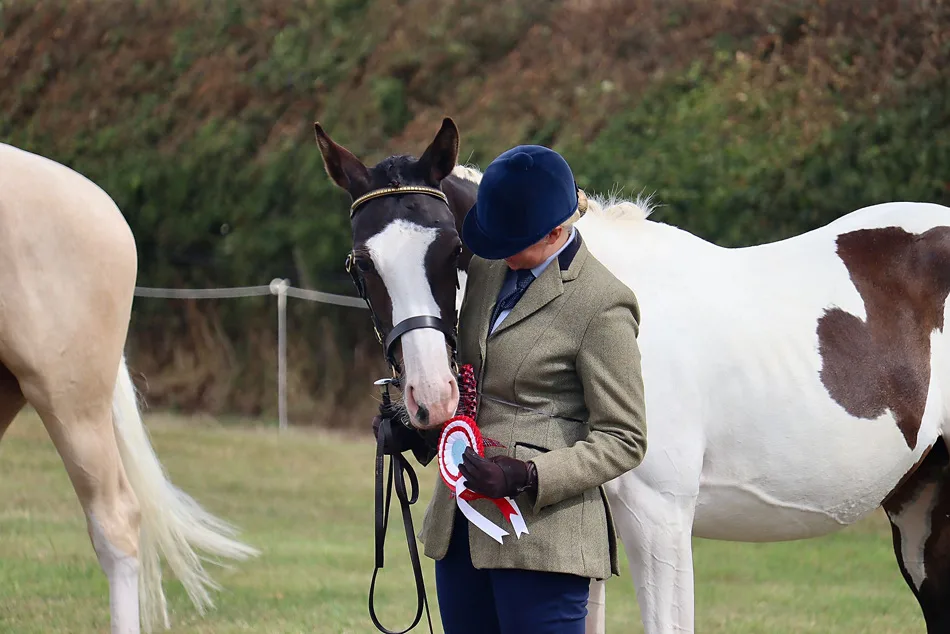
She exceeded all my expectations: she calmly stood when tied to the trailer, behaved better than I’d expected in the ring and received some lovely compliments from the judges – and she came home with a couple of frillies!
She even saw the motorbikes from the main ring and the carriages as they went past, and gave both a cursory glance before tucking back in to her haynet. A far cry from the shy yearling who came off the trailer just six months before.

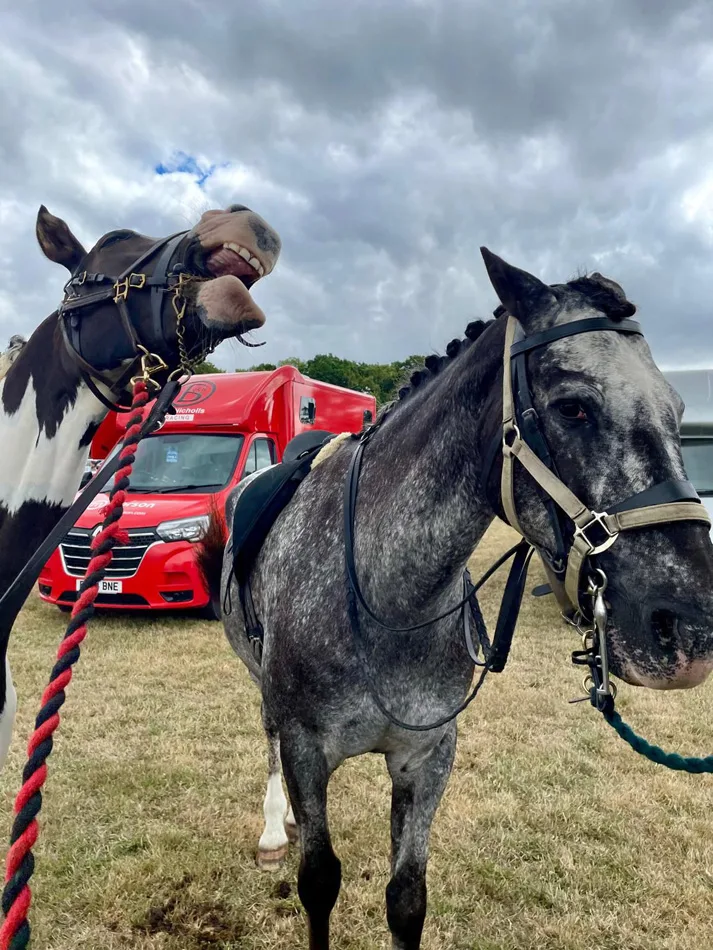
Hilarious Squish. Grumpy Uncle not amused


Apart from the odd mooch around the countryside, farrier visit and grooming, this winter Squish will be turned out with the others to continue being a baby, giving her more time to process what’s happened this summer as she gently matures. Hopefully next year she’ll go out to a few more shows to gain experience and continue her basic education – and I’m sure there’ll be plenty more times to come where I question my sanity! If there’s one thing she’s taught me it’s that anyone who takes on a youngster needs perseverance, patience, determination … and good friends who turn up with tea, cake and prosecco!

Our Darkest Hour?

0

As Westminster turns a blind eye to rural Britain, NFU chairman Tim Gelfs argues that farmers must take their case to the people

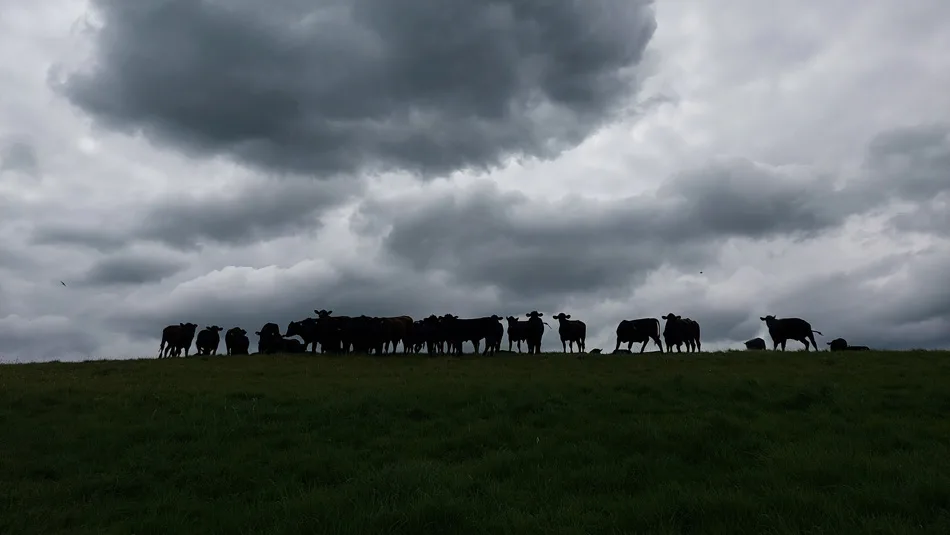
Herd of Dorset cows under a stormy sky
Image: Laura Hitchcock

One of my favourite lines from Darkest Hour is: “You can’t negotiate with a tiger when your head is in his mouth.” It often comes to mind when thinking about this Government’s approach to rural policy. How do you even begin to lobby or negotiate with a Government like this? Short answer – you can’t!
We are dealing with an ideology: a tunnelled view that appears to be unwilling to listen. We are in uncharted waters.
It has been a disaster for rural businesses since the beginning: the attack on IHT, the collapse of the SFI through mismanagement and interference from the Treasury, no leadership for the control of TB … the list goes on! As I write, we have just listened to a disaster of a Budget for business – yet again no ambition for growth, and no mention of the rural economy, apart from in the small print.
It’s not from a lack of effort from rural businesses that our voices are not being heard – there have been MP meetings, lobbying at the highest level by industry representatives, protests, TV and radio interviews and headlines in the papers, all highlighting the issues of our rural economy. Sure, we have been thrown a few crumbs from the high table, but it’s all on their terms.

Carnival protest
We saw another attack on our rural way of life with a complete U-turn from the Met on the tractor protest on Budget day, with unfounded excuses of ‘disruption’. They would have a case if the last rallies had seen unrest – or even arrest! But there was none. In fact, we have had a great relationship with the Met over the past year: they are quite complimentary of how we have conducted ourselves. The protests have had a carnival atmosphere, with good humour and great public support while still getting our message across. Are we disrupting businesses? Go and ask the pubs, cafes and restaurants if we were a disruption … except maybe to their card machines and tills!
So how do we change direction? How do we get Government to engage with conviction rather than mere lip service?
We have just witnessed the answer in this Budget: the Government is on the ropes, weak from the top … and MPs have smelled blood!
The Budget was not for the country, it was to appease the backbenchers, it was a job survival Budget. A year ago, most of the backbenchers were newbies, overwhelmed by their new place of work.
But as they gain confidence, their voice gets louder and stronger. And the way to the backbenchers is through the people who put them there, their constituents. We have a golden opportunity every month when the latest inflation figures are released.
Food inflation is always highlighted, and it is impacting on everybody’s life: we should capitalise on the connection between this and the attack on rural businesses. We need to get the message to the towns and cities of our green and pleasant land … and we need to drive this from the bottom because the top isn’t listening!

A splash of yellow in December

0

Jane Adams enjoys her chance meetings with a grey wagtail, Wimborne’s winter dancer

There’s a bird I always associate with the colder months. I shouldn’t, really – I see it in the summer too, dashing about after flies and small aquatic insects, paddling in what’s left of our streams after months of hot weather.
But in winter it seems to stand out more.
I often see it in Wimborne – as I walk between picking up walnuts in Grape Tree and nipping into the Co-op for a pizza, I often see one on the River Allen, bouncing around at the water’s edge.
I pause on the old bridge on East Street (yes, right next to the metal sign that reads: “Safety first. Do not stand on bridge”). A neatly dressed man, newspaper tucked under his arm, mid-70s, I’d guess, sidles up to me as I’m looking down at the water.

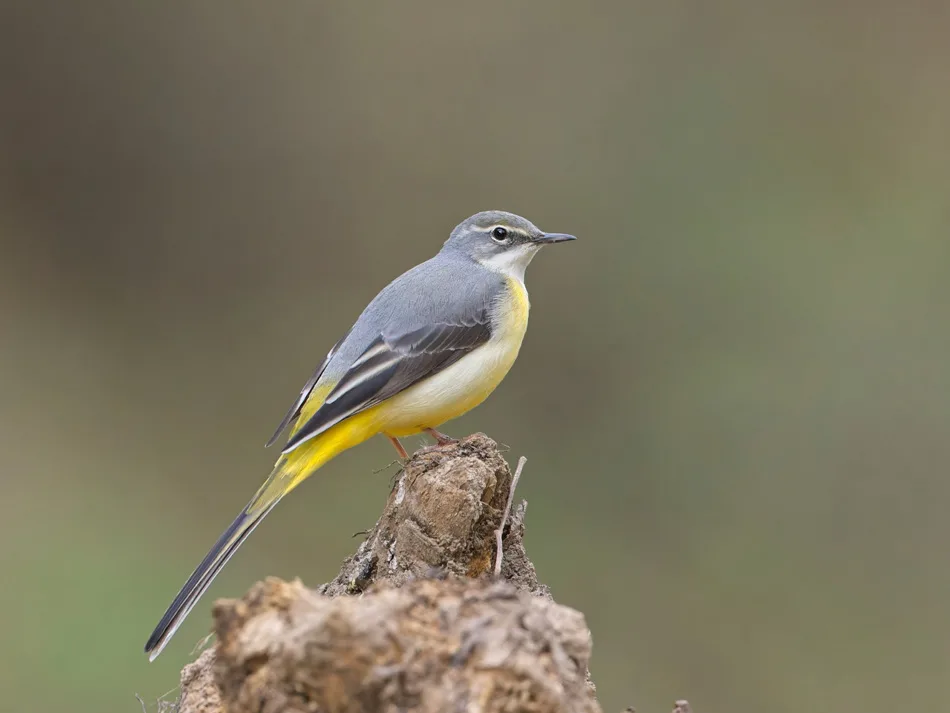
Grey wagtail, Motacilla cinerea, perched on a stump – not to be confused with its yellow cousin, it has that soft grey back and a much longer tail


‘Yellow wagtail,’ he says. ‘Always in Wimborne. Beautiful bird. Beautiful.’
He’s smiling down at it, and I’m just about to tell him it’s not a yellow wagtail when he turns away, and I hear him telling the same information to a young couple who have stopped next to him.
It’s an easy mistake to make … but yellow wagtails are mostly a summer visitor to the UK, like swifts and swallows. There’s a chance you might see one in Wimborne en route to its nesting grounds in spring, but they’re by no means common and usually gone by mid-October. The bird we’re staring at might have a rich flash of yellow under its tail, but the yellow wagtail has far more yellow, along with a shorter tail and soft olive-green feathers on its back.
The bird below us is a grey wagtail: just as thrilling in my book, but much more common. To me it’s the ballet dancer of the bird world, twirling and jumping across the weeds and debris of the river like a miniature Dame Margot, pumping its sleek, long tail feathers as if its life depends on it, bobbing its body up and down in time to music we can’t hear.

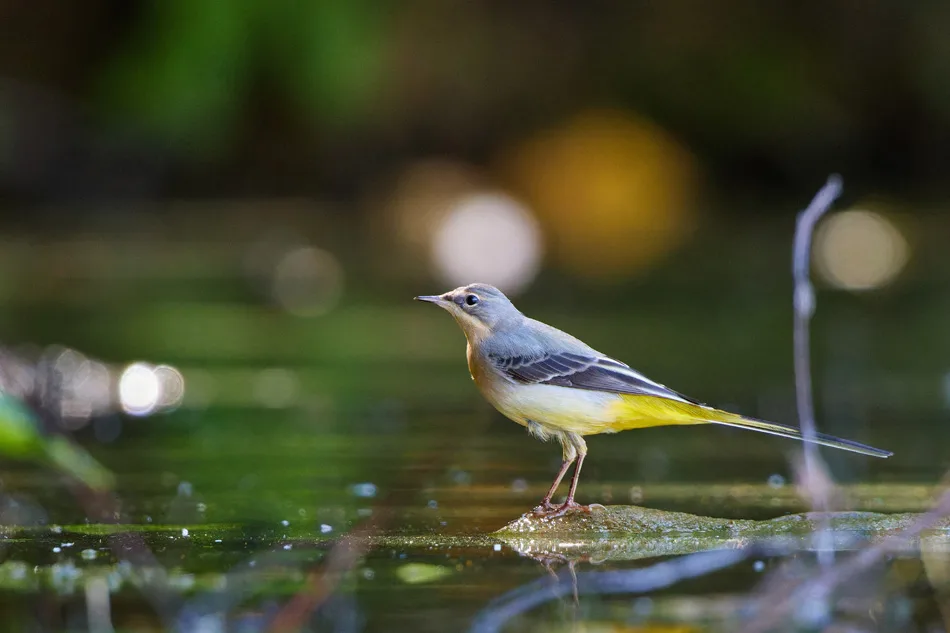
The grey wagtail lives year-round in Dorset, and can be found foraging on the banks of fast-moving streams


Grey wagtails live in Dorset year-round, foraging along the edges of fast-flowing streams. They fill the air with a cheerful tsreep, bringing life to an otherwise quiet and overcast day.
And though their colouring above is grey, the feathers below their tails glow almost tropical yellow, so vivid against the monotone hues of a winter riverbank.
The gent on the bridge walks away, and it’s just me and the young couple still peering happily into the water.
‘Beautiful, isn’t it?’ the woman says. ‘We’ve just found out it’s a yellow wagtail.’
I think about telling her, but decide against it.
Who cares what its name is, as long as someone is noticing it.

Dorset digs in for the year ahead

0

Despite inflation, skills shortages and mounting pressures, Ian Girling says Dorset businesses continue to show resilience, innovation and commitment

Ian Girling, CEO of Dorset Chamber

It’s hard to believe where the last 12 months have gone and Christmas is now literally just around the corner. As we reflect on the last year, it’s clear it’s been another tough one for businesses across the UK. Yet our business community continues to show remarkable resilience.
The last 12 months have seen many challenges for businesses. Inflation and rising costs continue to be an issue. The Bank of England have set a 2% target for inflation, yet the rate has hovered around 3.8% over the last year, meaning that prices have continued to increase. These continually increasing prices remain a challenge for both consumers and businesses.
Alongside the rising national minimum wage, the increases in national insurance in April are placing severe financial pressure on many businesses. Skills and recruitment also continue to be a challenge for many businesses, compounded by high housing costs that make it difficult for people to move in to or stay in the area.

Dorset finds a way
Yet while the national headlines focus on uncertainty, the story across our own county is one of determination, innovation and quiet strength. The challenges cannot be denied. But Dorset is home to many incredible businesses – some well-known and others not. Through our work at the Chamber we see businesses investing in technology, developing their teams, embedding innovation and carefully planning ahead. Given the economic headwinds, Dorset companies are realistic about the challenges – but unwavering in their commitment to keep the county’s economy moving.
We should also be proud of Dorset’s sense of community. Chambers, networks and sector groups across Dorset connect leaders, share insights and provide practical support. This collaborative mindset has helped many firms navigate complex changes while protecting jobs and contributing positively to local communities.
As we look forward, we’ll continue to do our absolute best to support businesses across Dorset in the year ahead and I’d like to take this opportunity to wish you a happy and peaceful Christmas, and successful 2026.