
Home Blog Page 173

In the studio with Toby Wiggins

0

The award-winning artist is continuing a century-old tradition at Dunshay Manor, the Purbeck home of the sculptor Mary Spencer-Watson

Toby Wiggins’ portrait of the late Mary Spencer Watson

Dorset painter Toby Wiggins was born just a few miles from the home and studio of the late sculptor, Mary Spencer Watson. The ancient landscape, with its quarries and Saxon farmsteads, eventually drew him back to Purbeck where he now has his studio in one of Spencer Watson’s old buildings.
His earliest memories were formed by traditional farmwork, the sounds of the stonemasons, the wildlife, the cries of seabirds and an unusual relationship between the local landowner and the tenants.
Toby won the prestigious 2023 Ondaatje Prize for Portraiture for a powerful and deeply moving study of a local master hedge-layer, Russell Woodham. When you visit Toby’s studio on Purbeck, the portrait dominates the large space. It draws you in. You are instantly attracted to the warmth, intelligence and wry humour on Russell’s face, to his obvious love for his cocker spaniel, Conker, who stands close to him, to the timeless beauty of a traditionally laid Dorset hedge.
Elsewhere in the studio there are sketches and studies, a full-length portrait of Mary Spencer Watson (right), whose studio was once here, and a rather sombre study of a man in a suit, with a mountain behind him. This is a commissioned portrait for a board-room, and it is as different from the paintings of Russell and Mary as it is possible to imagine from the same artist’s brushes.
These three paintings, set in the studio in old farm buildings at Dunshay Manor, between Harman’s Cross and Langton Matravers, give even the most casual visitor an insight into both the portrait painter’s skill and the nature or character of the sitter.
The businessman gives nothing away, but his upright posture, with a snow-covered mountain in the background, suggests power and perhaps a rather uncompromising attitude. There are no objects or clues to hint at his interior life.
Mary Spencer Watson (1913-2006) is also uncompromising – this was a woman whose sculpture was inspired by the geology around her family home at Dunshay, and by watching the masons cutting Purbeck stone in quarries where she would select stone for her carvings.
Mary’s sculptures include the Four Evangelists, who stand outside the Chapter House at Wells Cathedral.
Mary was born in London but in 1923 her family – her father was the artist George Spencer Watson and her mother, Hilda, was a dancer and mime artist – moved to the late 16th century Dunshay Manor. This was her home for the rest of her life. The family decorated the Manor in the Arts and Crafts style and used its outbuildings as studios and for dance and theatre productions.
In Toby’s portrait, Mary looks strong and deeply intelligent. You can imagine from the physical solidity of her pose, the uncluttered background and her monochrome clothes that she was as “hefted” to Purbeck as the Herdwick sheep are to their native Lake District.
Russell Woodham is similarly at one with the setting, resting for a few minutes beside the hazel hedge he is laying in the Dorset style, on an unidentified hillside in West Dorset. It is winter, because that is when you lay hedges. It is hard, physical work, and Russell has been doing it for decades (see the profile on Russell in The BV, Oct 21 here).
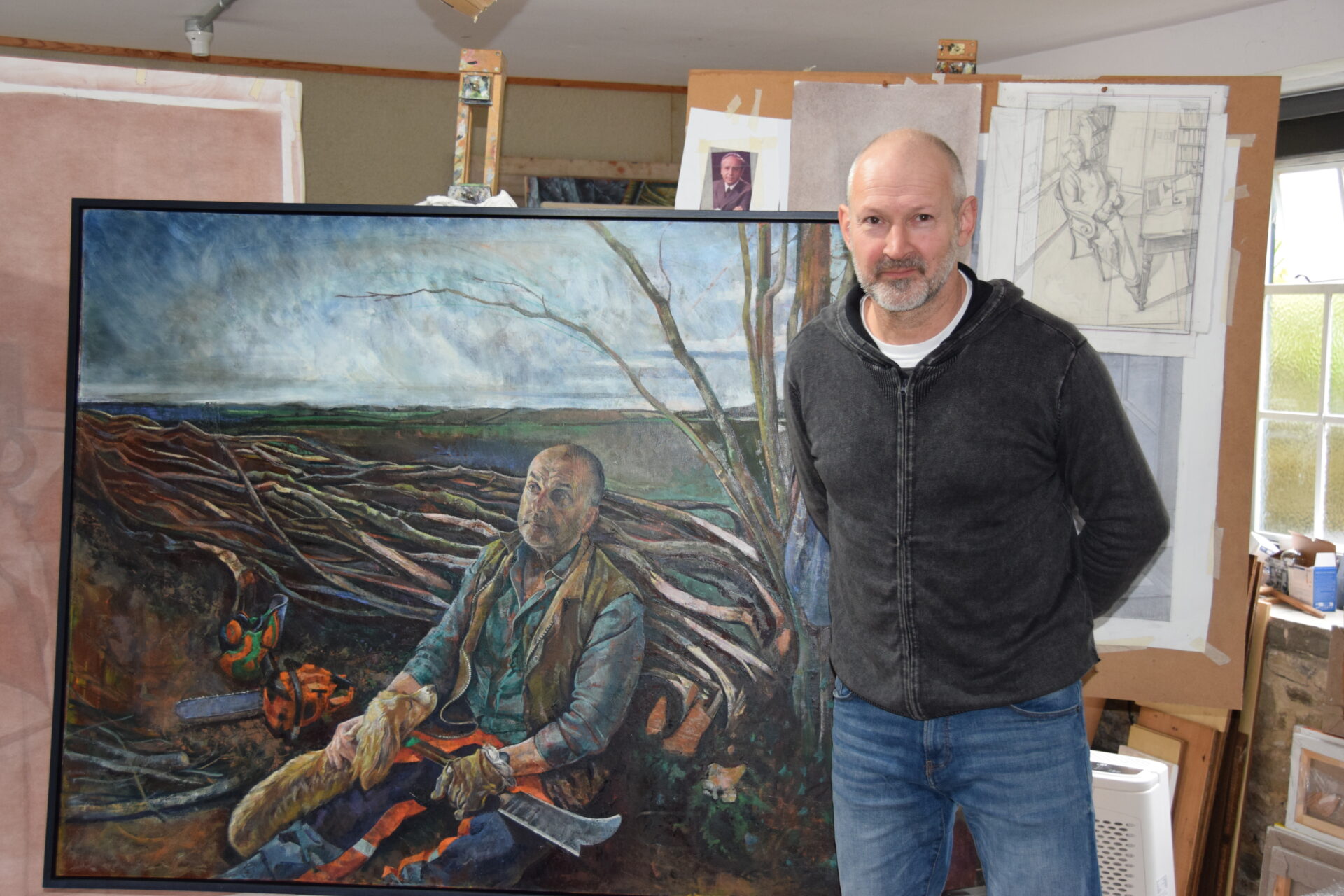
In the studio: Toby Wiggins in front of his award-winning portrait of the Dorset Hedgelayer, Russell Woodham

Finding his art
Toby grew up in a tiny tenanted cottage on Afflington Farm, one of several ancient farmsteads around Dunshay. As a child, he saw hedge-laying and quarrying, and observed the unusual way that Mary Spencer-Watson managed her tenants – they were not charged rent, but instead did whatever jobs were needed around the property. He showed an early aptitude for painting and drawing, which was encouraged by teachers at school and at Bournemouth College of Art. Toby went on to study at Falmouth College, followed by three years postgraduate study at the Royal Academy Schools. He worked in London for some years, but was pulled back to Dorset in the early 2000s.
He has always kept in mind advice that Mary was given by her father: ‘It’s a privilege to do this [make art]. Take it seriously. Work hard.’
Toby is self-deprecating – he says there are many people who have more natural talent than him, but are perhaps not prepared to put in the long hours of work, false starts and failed attempts that go with completing a satisfactory portrait. He worked hard at art college and received a rigorous training at the Royal Academy Schools, where the skills of drawing, sculpture and the various disciplines of painting were all taught.
From the promise of Toby’s early artistic endeavours, Mary Spencer Watson had taken an interest in the talented youngster. Back in Dorset as a professional artist, Toby asked if he could paint her portrait, and in 2004, after the work was finished, she allowed him to use her studio: ‘She wanted someone to continue artistic practice at Dunshay. And of course I did some jobs for her!’
Following her death in 2006, there was a lengthy legal battle over the future of Dunshay, but eventually the Landmark Trust (to which Mary had bequeathed the house) gained ownership and began the lengthy project of repairing and restoring the ancient manor ready for Landmark guests. At this point, Toby moved into a second studio, where he continues to work. The Trust opened Dunshay Manor for groups to stay in 2019.
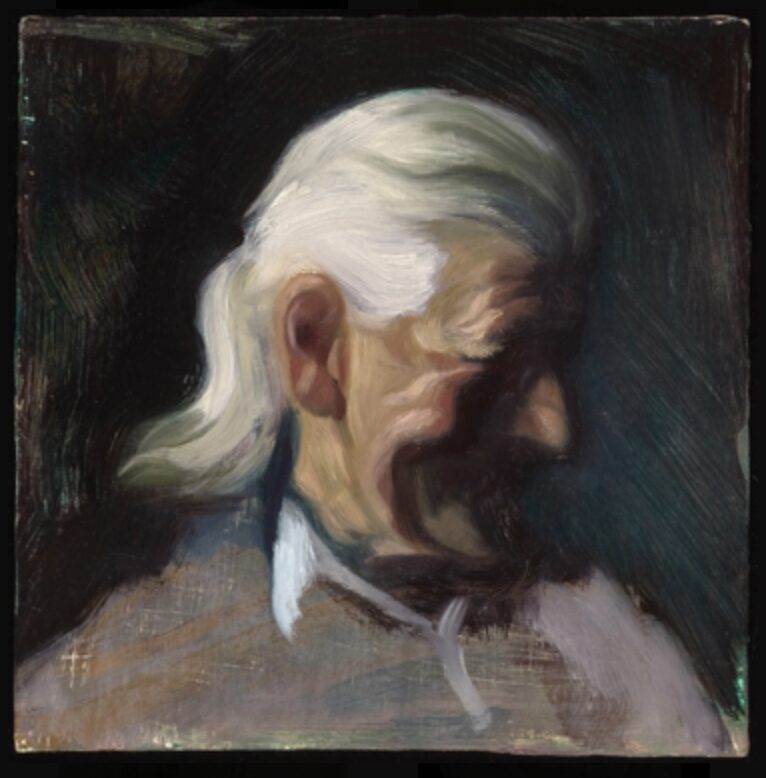
Dionis McNair – New Forest Verderer oil on gesso

Seeing things differently
In 2006, Toby won the BP Travel Award, a competition run in conjunction with the National Portrait Gallery, which is aimed at encouraging artists to focus on and develop the theme of portraiture in their work. As someone who had done occasional farm work ‘to pay the rent,’ Toby’s proposal was to travel around Wessex and paint people working on farms and in the landscape.
‘I was interested in the farmed landscape,’ he says. ‘When you have worked on a farm you see things differently. I wanted to include people who made their living from traditional crafts such as blacksmithing, thatching, hedge-laying, coppicing, hurdle making, charcoal burning and hunting. I wanted to discover what was left of a working countryside that Thomas Hardy might recognise. I found it – a trace of it.’
The range of people he painted for the project is wide and fascinating – from the near-legendary Dionis McNair, one of the few women Verderers of the New Forest, to hurdle-maker Alan Brown of Wool and shepherd Larry Skeats, who effectively saved the ancient shepherds’ huts (now a mainstay of rural glamping), and for years was the much-loved landlord of The Trooper Inn at Stourton Candle.
The BP Travel Award series was shown at the National Portrait Gallery in London and, with some additional studies, including a Purbeck quarryman, at Dorset County Museum in 2008.
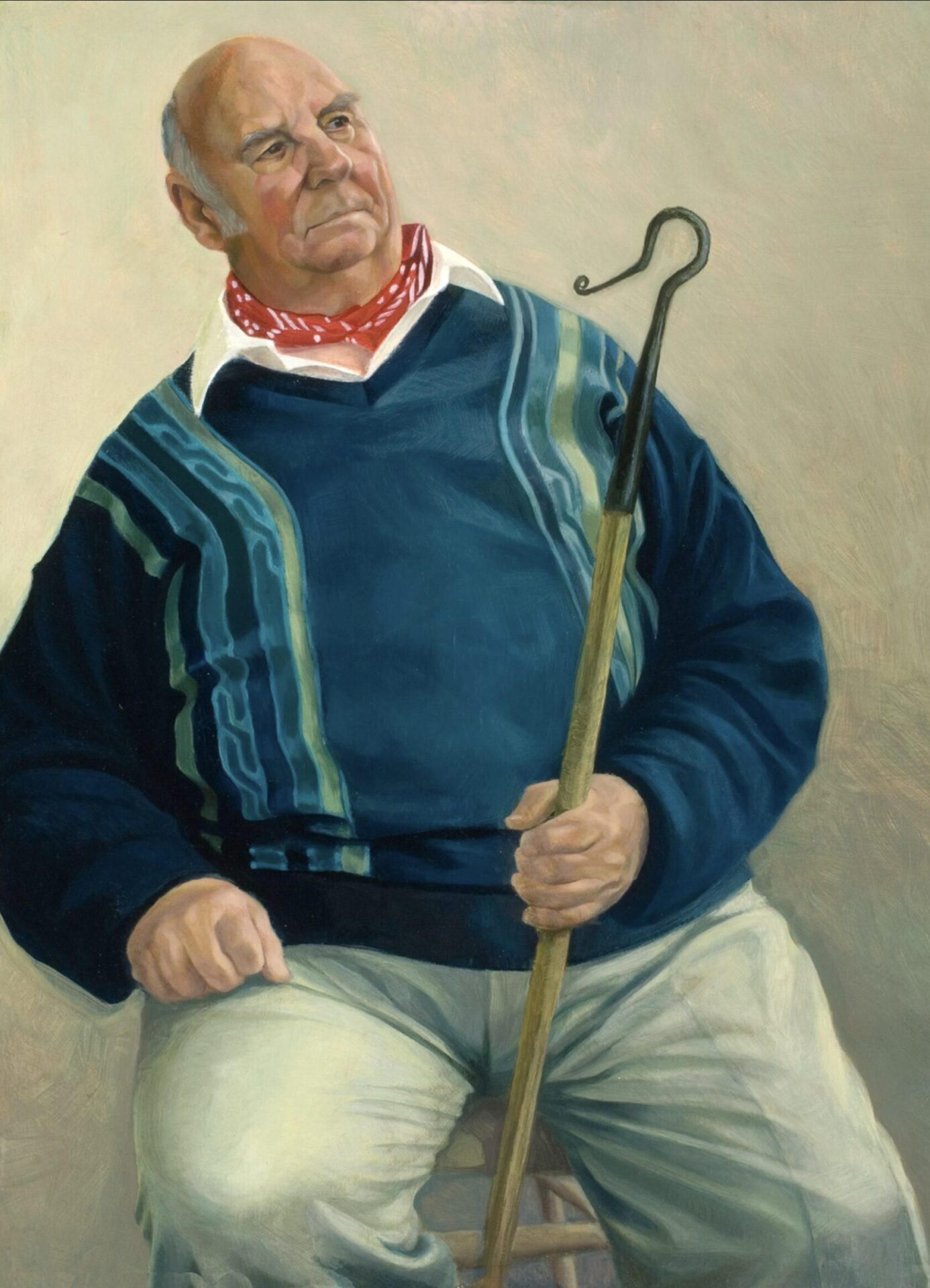
Toby’s portrait of renowned Dorset shepherd Larry Skeats, who for years was the much-loved landlord of The Trooper Inn at Stourton Candle

In the Dorset style
‘But I didn’t get a hedgelayer,’ says Toby. Later, he noticed a sign saying “Dorset Hedgelayer” in a newly-laid hedge near Dunshay.
‘I messaged him on Instagram, and Russell said to come on over and meet him.’
They met on a sunken track leading to a derelict farmstead near Rampisham. The hazel hedge was ‘quite overstood’ – tall, leggy and losing the density of scrub at the base, affecting its value for wildlife as well as its ability to provide a good stock- proof barrier. Russell was laying it in the Dorset style.
The process of painting his portrait was a lengthy one, spread over more than a year, says Toby. He made drawings and sketches, and in the summer Russell came to the studio to sit for him.
It was important that the painting should include Conker, Russell’s constant companion.
There are so many details to discover in the finished portrait – the more you look into it, the more you find. There is the age-old skill of the hedgelayer in the way the hazel is cut and bent to reshape the old hedge, there is the jacket hanging from a hazel spar like a coat-hook – ‘It’s quite a nice office,’ says Russell – and the tools, from the traditional billhook to the necessary 21st century chainsaw. The eye is drawn in different directions by the arcs of hazel branches, the shape of the hazel woven into the hedge, the swing of the axe, the rounded lines of the helmet and visor, and the relaxed position of the hedgelayer, leaning back against a half-finished section.
Most of all, you come back to Russell’s face – weather-beaten, serious, intelligent, with a quizzical lift of the eyebrow and just the faintest hint of a smile. It is a man enjoying a brief rest from hard physical work that is utterly timeless.

Winter’s Work; Russell Woodham at rest while laying a hazel hedge in the Dorset Style


The portrait, which is called Winter’s Work; Russell Woodham at rest while laying a hazel hedge in the Dorset Style. The painting has gone to the National Portrait Gallery for the second round of judging for the Herbert Smith Freehills Portrait Award.
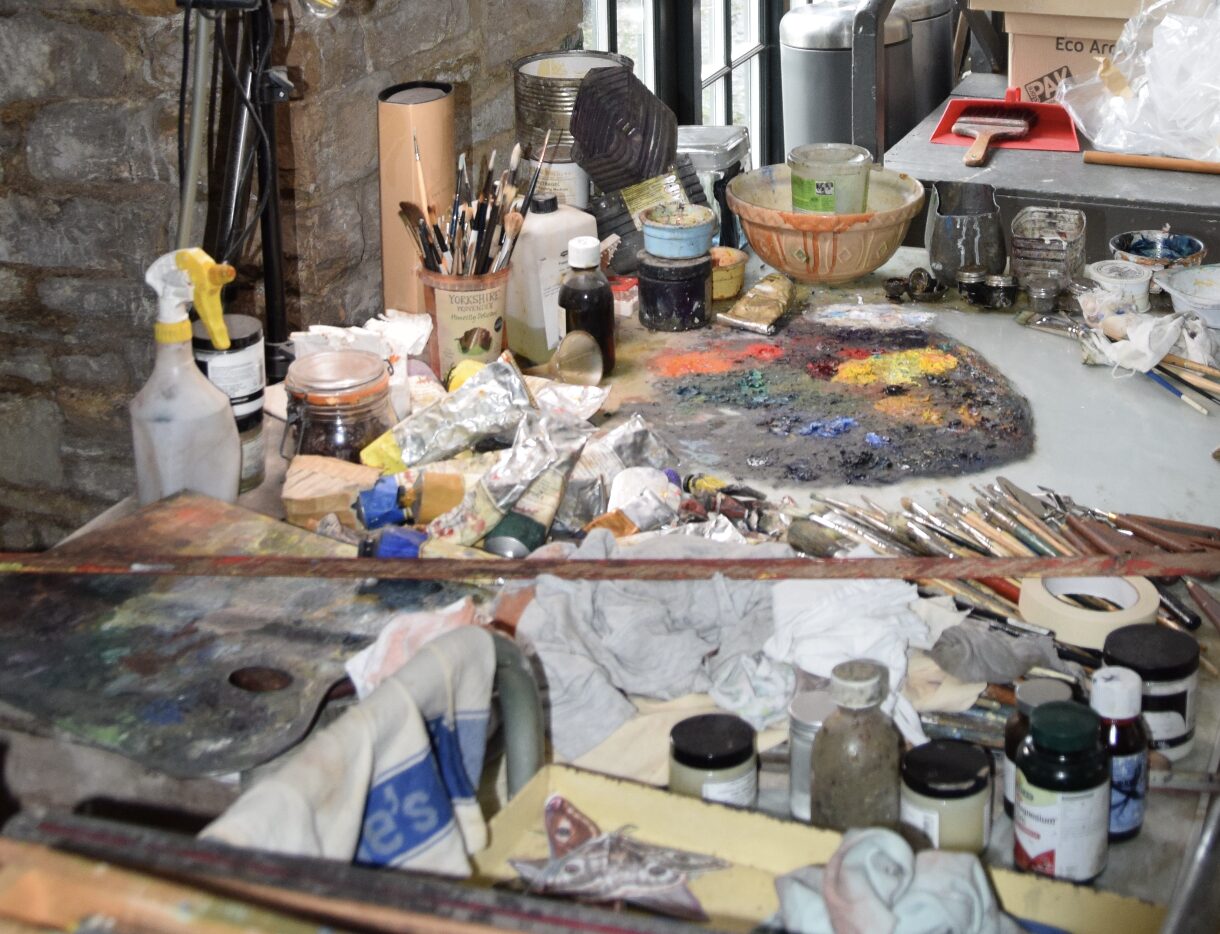
Where the work happens’ – inside Toby Wiggins studio at Dunshay

Artistic conversations
Toby was elected a member of the Royal Society of Portrait Painters in 2006. He won the Prince of Wales Drawing Award in 2005 and 2013, the Changing Faces Prize in 2006 and the Lynn Painter-Stainers Prize for figurative painting in 2009.
He has exhibited widely, including at the Royal Academy of Arts, Royal West of England Academy in Bristol, the National Portrait Gallery, the Holburne Museum in Bath and the Jerwood Space. For more than ten years he taught at Arts University Bournemouth, but now fully focuses on his work as a painter – though he still teaches occasional local classes. Primarily a portraitist, he also draws and paints landscapes and still lifes.
His next exhibition is with fellow portrait painters Anthony Connolly, who has his studio at Semley, and Kent-based Andrew James. Their work will be shown at the Highgate Gallery in London from 12th to 25th April. The Heart Has Its Reasons: Three painters in Conversation brings the artists together ‘in the spirit of artistic conversations which lead to the works and connections that emerge via three distinctive visual languages,’ says Toby.
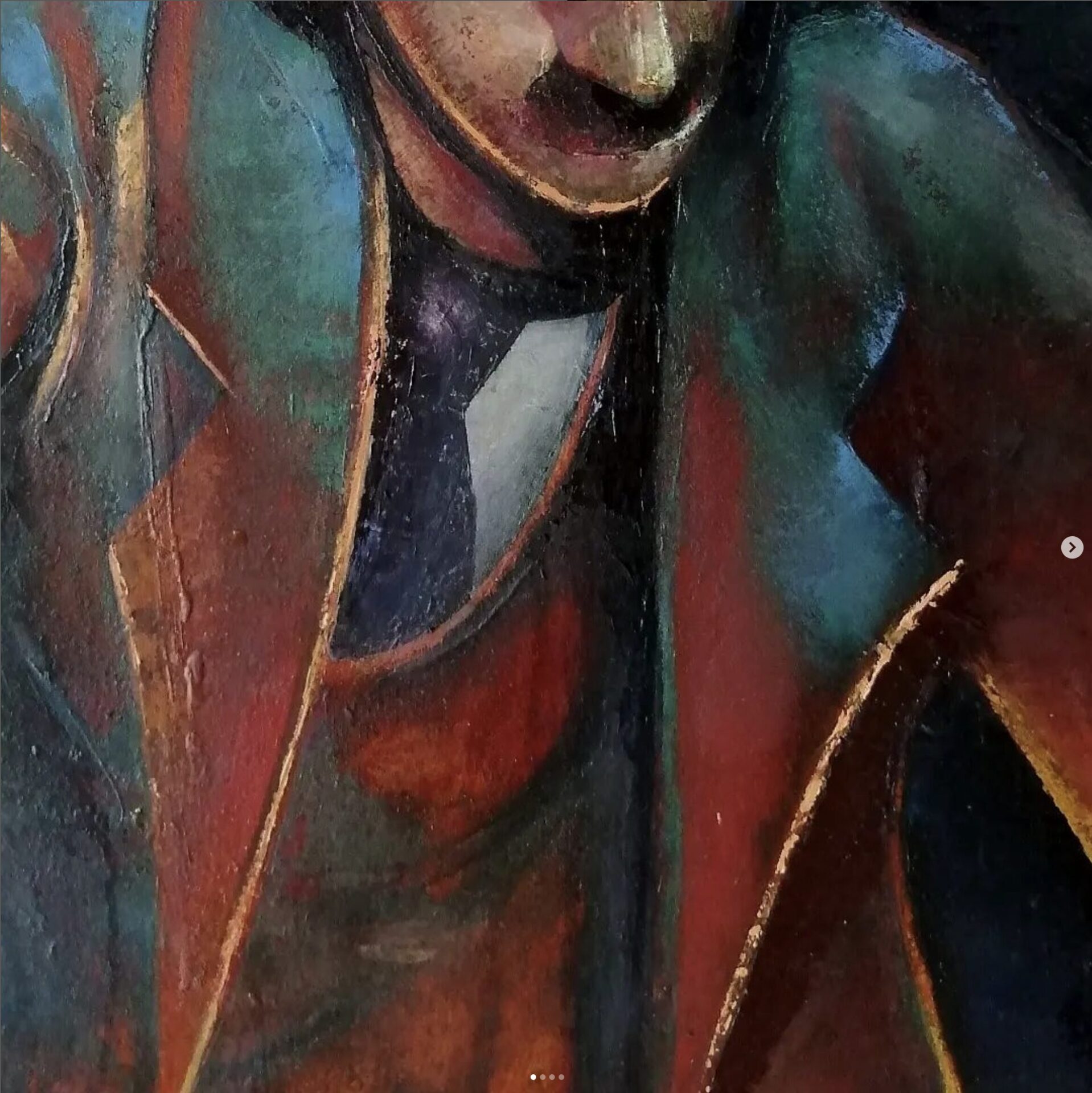
Details of a work in the forthcoming show at Highgate Gallery
‘Gilded Sleep’ oil on gesso panel. Part of The Heart Has Its Reasons
Three Painters In Conversation from 12th to 25th April at Highgate Literary and Scientific Institute


While his portrait of Russell may finally live in London, the painting of Mary Spencer Watson will move just a few yards to its new permanent home. Originally bought by the revered Dorset Museum curator Roger Peers, who died in 2023, it was bought at the posthumous auction of Peers’ art works by the Landmark Trust and will soon be on display in Dunshay Manor.
‘We ought to have it here, for Mary’s sake,’ says Anna Keay, the architectural historian and director of the Landmark Trust.


tobywiggins.co.uk
dorset-hedgelayer.co.uk

Blowing hot and cold

0

There is now scientific evidence that what doesn’t kill you may really make you stronger, says expert Karen Geary

In my student days, I studied both lifestyle medicine and nutrition, initially seeing the former as less significant. However, with better research and increased attention from experts like Dr Rangan Chatterjee, lifestyle medicine (essentially about taking preventative steps to enhance our own well-being) is gaining recognition. Sleep and exercise, as well as nutrition, are fundamental pillars of health. Do these three well and you are winning. Mastering them prioritises well-being over fashionable therapies like breath work, forest bathing and sunlight exposure, which, while beneficial, take more of a back seat.
One intriguing facet of lifestyle medicine is hormesis, or the principle of stressing the body to enhance resilience — literally the notion of “what doesn’t kill you makes you stronger.”
Just like exercise, hormesis – when practised judiciously – can fortify the body. Saunas and cold water therapies, championed by motivators like Wim Hof and his ice plunging, are currently in the spotlight. The basic science is that both hot and cold therapies stress the body, inducing the production of heat and cold shock proteins. These proteins act as cellular guardians, shielding cells from harm and instigating repair processes. Regular exposure to extreme temperatures may give us a stronger immune system and promote long-term health.

Good to be chilly
Cold therapy, with roots tracing back to ancient Egyptian traditions, uses cold exposure to mitigate inflammation and pain. Methods such as cold-water immersion and cryotherapy are used to cool the body, modulate blood flow and reduce pain perception. Whole-body cryotherapy – brief exposure to extreme cold – is popular among athletes and individuals seeking pain relief.
Winter swimming, itself a form of cryotherapy, has been practised for centuries in the Nordic countries for its health and recreational benefits. Data suggests that repeated but brief cold exposure strengthens the immune system.
Cold therapy’s pain-relieving and anti-inflammatory effects involve hormonal mechanisms. Cold water immersion elevates noradrenaline levels, providing the body an inbuilt natural remedy for discomfort while at the same time aiding in muscle repair. It proves effective in managing acute injuries, chronic pain conditions, post-surgical pain, headaches and migraines. Recent research also suggests that cold water exposure may help manage stress and anxiety, offering a holistic approach to well-being.
For stress reduction and immune support, even simple practices like immersing one’s face in ice water, or ending a shower with a minute of cold water (my personal daily habit) can yield benefits.
Whatever you choose, gradually increasing exposure duration is key to adaptation and safety.

Karen Geary in a cryochamber at -135ºC!

Running hot
Sauna therapy, another ancient practice, offers benefits for sleep, stress reduction and exercise recovery. Research suggests that frequent sauna use may also improve cardiovascular health, enhancing arterial dilation and reducing arterial stiffness. There are various types of saunas — infrared, steam, dry and even garden hot tubs — each with similar benefits, though the quality of research varies.
For optimal results, timing is crucial. Sauna sessions a couple of hours before bedtime can improve sleep quality by facilitating a steeper temperature decline. Post-exercise sauna use helps in recovery, reduces muscle soreness and preserves muscle integrity. Cardiovascular benefits are maximised with consistent sauna use, ideally 15 to 30 minutes, three to four times a week, especially when combined with exercise. If choosing, though, I’d pick the exercise over sitting in a sauna for two hours a week!
Safety is paramount when engaging in hot and cold therapies. Gradual progression is advised, and individuals with heart conditions should seek medical advice before starting any regimen. Avoiding participation while intoxicated is essential for safety.
In conclusion, both hot and cold therapies offer intriguing potential for improving health and well-being. By understanding their mechanisms and integrating them sensibly into your lifestyle, you can harness their potential benefits while prioritising safety and holistic wellness.

Hold onto your glow sticks … Salisbury Hospice Charity’s Midnight Walk is back!

0
Samba warm-up

Prepare to light up the city with NEON at this year’s Midnight Walk! The organisers invite you to hop, skip and groove through the streets of Salisbury dressed in neon socks, funky glasses, and head boppers!
The sponsored walk is open to everyone over the age of 12 – and dogs are very welcome!
The walk starts and ends at the Five Rivers Leisure Centre, and there is a choice between the six or 10-mile routes.
Things get started with the dusk party warm-up disco before participants head out to take a walk under the stars to commemorate loved ones lost in this fun and incredibly moving sponsored walk that supports Salisbury Hospice.
The special memories board will return this year, offering the opportunity to dedicate a star to a loved one. In addition, the completer’s medals are ‘living’ medals, in the form of Forget Me Not seeds, a gentle reminder of those loved ones.
The walk is on Saturday 27th April, and registration is open now –
https://www.salisburyhospicecharity.org.uk/event/midnight-walk . Maybe ask, cajole and bribe your friends, family and colleagues to do it with you, and make a neon party night of it!

Sponsored by Wessex Internet

West Dorset’s MP Ensures Banking Services Remain in Sherborne After Lloyds Closure

0

In a significant move for Sherborne, Chris Loder, West Dorset’s MP, has successfully negotiated the establishment of a banking hub in the town. This comes in the wake of Lloyds Bank’s decision to close its Sherborne branch, which prompted Chris Loder to engage in extensive discussions with financial regulators and banking bodies to ensure continued access to banking services for the local community. The hub, expected to launch in 2025, will cater to customers of all high street banks, including those like Natwest and Barclays that had previously withdrawn from Sherborne.

Chris Loder says: “After months of high-level discussions with LINK and Cash Access UK, I’m glad to announce that a Banking Hub will open in Sherborne next year. I’ve been campaigning for the protection of and better access to banking facilities and cash in West Dorset. The Banking Hub in Sherborne will be available to all residents, with different banks – including Lloyds – working on a rotating basis on different days with community bankers available to speak with.”

He further clarified the transition timeline for Lloyds Bank, noting, “Lloyds has informed me that it will cease operating on the 16th January 2025, but are willing to extend this, should it be needed. I am working closely with Cash Access UK, which will develop the Banking Hub in Sherborne, to ensure that it is operational, or a temporary alternative is accessible before the closing date.” This initiative underscores a significant effort to maintain essential banking services in Sherborne, directly addressing the concerns of the local community in the wake of bank closures.

Sherborne Town Council

Sherborne Chamber of Trade and Commerce

Chris Loder MP

Roy Stuart Knapman

3

16/05/192917/03/2024

We are sad to announce the death of Roy Knapman, peacefully in Castle Cary, on the 17th March 2024, aged 94 years. 

A loving husband of 66 years to Shirley, wonderful dad to Lesley, Christopher and Clare; amazing grandpa (grumps) to Ali, Ed, Will and Sophie; and special great-grandpa to Max.

Service of thanksgiving at All Saints’ Church, Castle Cary on Wednesday, 3rd April, at 2:30pm.  Family flowers only please, but donations in memory of Roy to the Alzheimer’s Society or the Ron Pickering Memorial Fund, supporting young British athletes. c/o Harold F.Miles, Funeral Director, South Cadbury, BA22 7ES

Arthur John Simmonds

0

23/04/194212/03/2024

Peacefully at home.

The family extend heartfelt thanks to the Weldmar nurses, district nurses and community care team for invaluable support and kindness during Arthur’s last weeks and wish to thank everyone who has sent lovely messages of condolence. 

Arthur will be buried at the woodland burial ground, Shillingstone at a private service. All are warmly invited to a memorial meeting and celebration of Arthur’s life at the Quaker Meeting House, Abbey Walk: 23/04/2024 at 10.30am, and afterwards for refreshments at home. Donations in memory of Arthur can be made to Weldmar Hospicecare.

Get your seeds on

0

Begin 2024’s gardening journey in March sowing seeds – a magical job that lays the foundation for a season of colour, says Charlotte Tombs

In March, as winter loosens its grip on the South of England and signs of spring really get going, the anticipation of seed sowing fills me with excitement. There’s an undeniable thrill that comes from witnessing the first seed germinate, a promise of new life and vibrant growth. With approximately eight weeks until the last frost, now’s the perfect time to kickstart the gardening season.
If you haven’t grown from seed before, you really should give it a go; it’s so rewarding and so much cheaper than buying your plants ready-grown!
One of the techniques I use for seed starting is a soil blocker. This ingenious tool creates tiny soil blocks, providing the perfect environment for seedlings to establish themselves. I love how efficient it is; 40 soil blocks neatly fit into a takeaway tub, and when covered with the tub lid, it transforms into a mini greenhouse, creating a warm and moist environment ideal for germination. Plus, you don’t waste seed or compost, or waste time pricking out.

What to pick?
As I prepare to sow my seeds, I carefully select from an array of varieties suited for early spring planting. Calendula, with its cheerful orange and yellow blooms, is a must-have for adding a pop of colour to the garden. Cornflowers, in shades of blue, evoke a nostalgic charm reminiscent of English cottage gardens. Malope, with its delicate petals in a deep Vulcan red and white, adds a touch of whimsy to any flower bed. These all make great cut flowers – in all honesty I don’t grow anything that doesn’t make a good cut flower or smell amazing… preferably both! Sweet peas are another favourite of mine, with their intoxicating fragrance and delicate tendrils that climb effortlessly up trellises and fences. Annual phlox, with its clusters of vibrant blooms to attract pollinators, adds a burst of colour to the garden. Quaking grass, with its graceful seed heads that sway in the breeze, adds movement and texture to floral arrangements, and statice, with its papery blooms in shades of purple, blue and white, is perfect for drying and preserving.

A little bit of magic
As I sow each seed into its designated soil block, I can’t help that buzz of excitement, knowing that in just a few weeks, these tiny seeds will burst forth with life, transforming into robust seedlings ready to be transplanted into the garden. I water each takeaway tub, ensuring that the seeds are evenly moistened, and then cover the tub with its lid, creating a cosy haven for germination to take place. Some seeds require dark for germination, some light, so do read the seed packet.
Seed sowing in March is more than just a job on your list; it’s a celebration of nature’s resilience and the promise of new beginnings.
As I look forward to the blooms and abundance that lies ahead, I’m reminded of the joy that comes from working with Mother Nature through the seasons of the year. And as I witness the first seed germinate, I’m always filled with a sense of wonder and gratitude.

Heather’s amazing pulled pork

0

This meal is the one my eldest son requests when he comes home from Uni – thankfully it is ridiculously easy to make!
It’s a slow cooker fave (if you don’t have one, a normal oven works too) and it is so full of flavour.
I’ve also included my own homemade coleslaw recipe – and if you really want to play in the kitchen, then make your own brioche rolls too, using my foolproof recipe that featured in September 21’s BV here.

Ingredients
serves 6 to 10

Pork:

  • 1.8kg to 2.5kg pork shoulder joint
  • ½ cup dark soy sauce
  • ½ cup honey
  • ½ cup sesame oil

Coleslaw:

  • ½ green cabbage
  • 3 large carrots
  • ½ cup mayonnaise
  • ½ Greek style yoghurt
  • 1tsp soy sauce
  • 1tsp honey

Method

  1. Into a slow cooker add the wet ingredients and mix together.
  2. Remove the pork shoulder from any wrapping or string. Pop into the slow cooker and turn it around in the sauce until covered.*
  3. Cook on low for eight hours. I usually start ‘skin side up’ and then turn the joint every couple of hours so that it all gets soaked in the tasty liquid.
  4. The meat is done when its falls apart with a fork.
  5. To make the coleslaw, finely shred the cabbage into a large bowl. Peel and grate the carrot into the cabbage and mix together.
  6. Stir in all the wet ingredients until everything is coated well. You can also season with black pepper if you wish.
  7. Serve the pulled pork in brioche rolls with some shredded iceberg lettuce for some extra crunch. We have also served this with Bao Buns or toasted bagels (see last month’s recipe to make your own here!), the latter liberally laden with butter of course.
Heather Brown is a special officer for the Guild of Food Writers, and has worked in the food industry for 20 years. She is a food writer and photographer, offering one-to-one help to local businesses for content and websites.

If you don’t have a slow cooker, then you can make this in the oven. Just place the meat and the sauces into a large oven proof dish and cook in a low oven (gas 2 – 140º fan) for 6-8 hours, still checking and turning the joint periodically.

Skylarks of Fontmell Down

0

Boasting vibrant displays of chalk downland flowers and butterflies, an abundance of birds and mammals and stunning views over the Blackmore Vale, it is easy to see why Fontmell Down attracts nature lovers all year round.

One of the most celebrated birds in literature, poetry and music, the rather nondescript skylark (Alauda arvensis)
Image: Vaughn Matthews

And quite often, these visitors are joined by their beloved four-legged friends. Walking your dog is a great form of exercise and can help achieve that important dose of nature therapy that we so often neglect.
However, a dog’s naturally inquisitive nature can be extremely harmful to wildlife, particularly our ground-nesting birds.

Skylarks build their small, grassy, cup-shaped nests on the ground Image: Seb Haggett


Many ground-nesting birds, such as nightjar and woodlark, are associated with heathland habitat. However, one particular species takes advantage of the patchwork of grassland and scrub at Fontmell Down: the skylark.
One of the most celebrated birds in literature, poetry and music, the skylark (Alauda arvensis) is a small, streaky brown bird with a crest and long tail. Although its appearance can be described as rather nondescript, the same cannot be said for its unmistakable song-flight. Male skylarks will rise almost vertically from the ground, effortlessly hovering at a great height while singing. These long and complicated song-flights can last for up to an hour, and the birds can reach 300 metres before descending.
In contrast with their impressive aerial displays, skylarks build their small, grassy, cup-shaped nests on the ground. Around three to four eggs are laid, and parents can have up to four broods in a breeding season (between April and August).

Fontmell Down in summer
Image: Jack Clarke

Building their nests on the ground means that they are at risk of disturbance from trampling feet and excited dogs. When the parents are scared off their nests, the precious eggs and chicks become vulnerable to predators.
And it’s not just skylark nests that can become compromised by walkers and their dogs on Fontmell Down. Meadow pipits, stonechats, corn bunting and yellowhammers all nest on, or close to, the ground. The law states you must keep your dog on a lead no longer than two metres between 1st March and 31st July when on any open access land, in order to protect ground-nesting birds. But Dorset Wildlife Trust urges all visitors to keep their dogs on a short lead and stick to the pathways on the nature reserves all year round to protect wildlife and livestock.