

It was a cardboard archive box in a London library that stopped Rachael Rowe in her tracks.
‘I pulled out this packet of papers labelled “Rowe”,’ she says. ‘And what I found next just stopped me. It was a letter addressed to Mr Richard Rowe, schoolmaster, dated 1838. I knew exactly who that was. It was my great-great-great grandfather.’
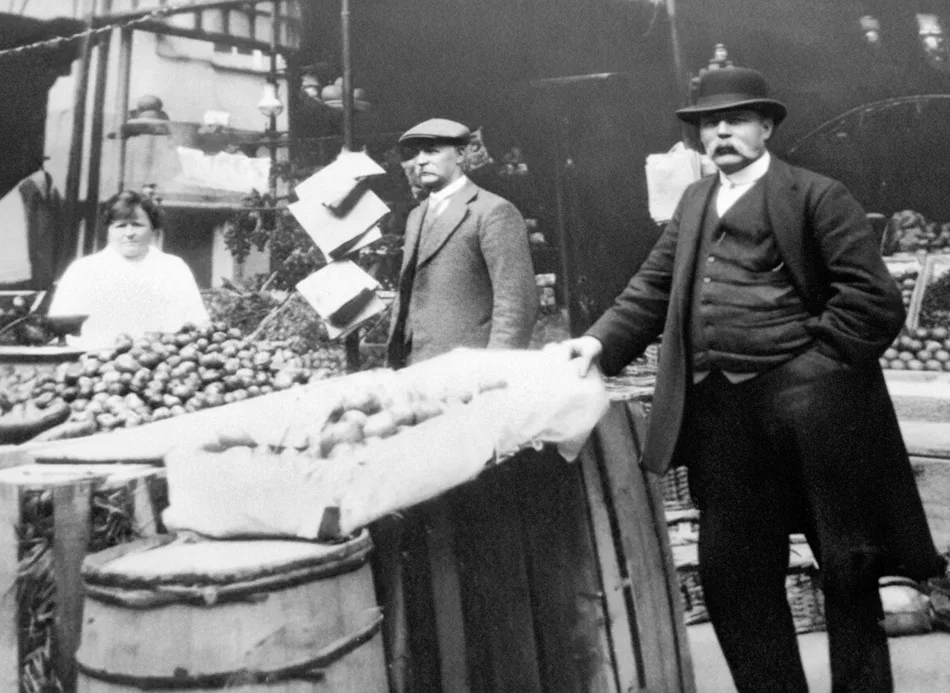
Rachael is now a long time Dorset resident and writer, but at this time was working as a nurse in London. She had gone home for the weekend, and her grandfather joined them for Sunday dinner. ‘He was what we’d now call decluttering,’ she says. ‘He brought a pile of certificates and photos relating to my great grandmother – birth and marriage certificates, a photograph of them working in a fruit and veg shop (above) – and asked what we wanted to do with them. I just thought, “Who are these people?” I wanted to see how far back I could take our family tree.’
So Rachael began tracing her Cornish family history the hard way: it was the 1980s, before Google, before Ancestry.com, before digitised records. Back then, you had to plod through parish registers. Learn to use microfiche. Trawl census books and spend hours at St Catherine’s House.
Then came the revelation.
One afternoon, bored by card indexes at the Society of Genealogists’, she glanced around the room and noticed the stacks of box files – folders of donated material, arranged alphabetically.
‘I thought, I’ll pull down the ‘R’ box for Rowe and see what happens,’ she says. ‘It is such a common Cornish name, it could have been anybody.’
Inside was a packet of papers labelled simply ‘Rowe’. ‘I opened it, and the first thing I saw was the letter to my four-times-great grandfather,’ she says. ‘I just thought “I know who this person is!”. The hairs on the back of my neck stood up. It was like touching time – you’re there, holding something an ancestor has handled.
‘Among the papers in the packet there was a newspaper cutting about an execution,’ she says. ‘My Richard Rowe’s father, also called Richard Rowe, had been hanged.’
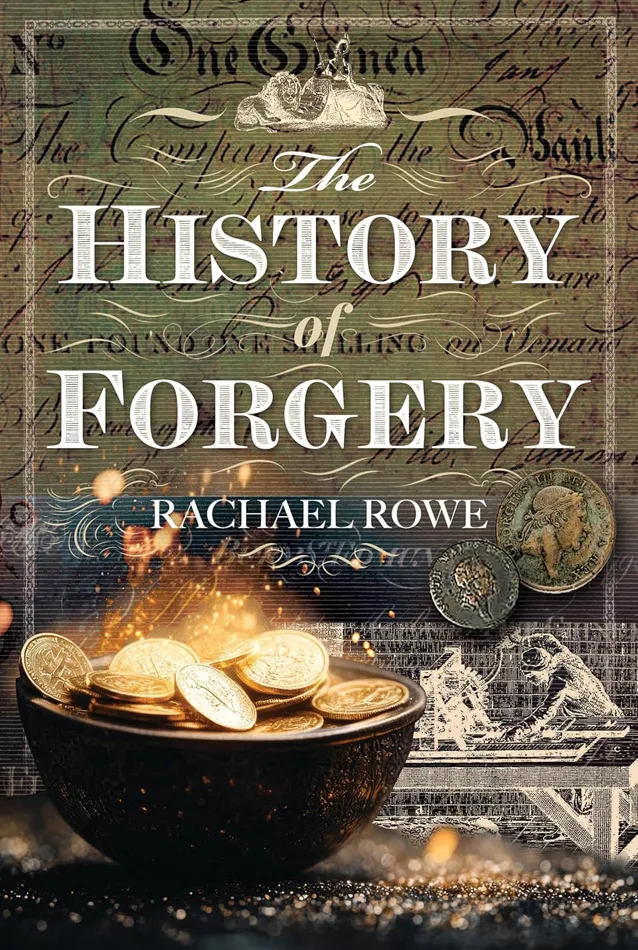
Or had he? The archive box held more than one story. What began as family curiosity would become years of research and, 30 years later, Rachael’s new book The History of Forgery, published by Pen & Sword.
Schoolmaster to condemned man
The packet of documents had been collated by Arthur Francis Rowe, another ancestor who, in the late 1890s, had himself discovered the story of the doomed Richard Rowe. He had donated his research to the archive in the hopes someone else might continue the story – it was sheer chance that Rachael discovered the papers he had left almost 100 years before.
She discovered that Richard Rowe senior had worked as a schoolteacher in Cornwall. He had set up a school for poor boys, he signed off apprentice indentures and he had been press-ganged into the Royal Navy in the 1790s – seized and forced into service at a time when Britain was at war with France. As a schoolteacher, he was used on board to teach the youngest sailors to read and write. But when he fell ill, he was simply left behind in Plymouth as the fleet sailed on.
‘There was no safety net,’ she says. ‘If you couldn’t work, there was no pay, no benefits, nothing.’
Out of work and desperate, he forged a bill of exchange for £26 6s 9d – but he got the name of the Cornish bank wrong. Instead of writing Williams Gould of Truro, Richard wrote ‘Gould William’. And that small mistake led to his arrest.
When Rachael finally accessed the restored court records at The National Archives – documents so fragile they had to be specially recovered for her – she uncovered the full tale.
‘At that time, only the male landed gentry could sit on juries. It transpired that his employer sat on the jury at his trial, and a relative of the bank owner he had tried to defraud chaired it. Would you honestly believe that today?’ she says.
She also discovered a second charge: bigamy. While stranded in Plymouth, Richard had married – despite having a wife and six children still living in Cornwall. With the second charge, any hope of reprieve vanished. He was hanged at Bodmin.
The Bloody Code
Forgery at that time was not treated as a minor financial offence. It was treason. Between the late 18th and early 19th centuries, more than 200 crimes carried the death penalty – it was a period known as the Bloody Code.
‘Until 1779, women were burned at the stake for coining [making counterfeit coins],’ Rachael says. ‘It was considered treason. It was horrific.’
In 1797, the British government began issuing low-value paper banknotes to fund the war effort. A population unfamiliar with paper currency suddenly had to trust scraps of printed paper instead of metal coins.
‘They hadn’t even thought about the consequences,’ she says. ‘People couldn’t read. They didn’t understand the notes, and the change opened the door to forgery.
Between 1797 and 1812, more than 300 people were sent to the gallows. Some were skilled engravers bribed by gangs. Some were architects or artisans whose talents were redirected into criminal enterprise. Some were simply desperate.
‘There were greedy people,’ she says. ‘But there were also people living right on the edge of a society which didn’t look after them.’
The person behind the crime
Initially, Rachael admits, she viewed her ancestor as ‘a bit of a rogue’. It took a writing workshop to shift her perspective. ‘Someone said to me, “This isn’t just a crime story. It’s about social inequality.” And that changed everything.’
When it suited society, Richard had been useful – he was a founder of a poor school for disadvantaged children, he was a press-ganged sailor and a schoolmaster aboard ship. But when he needed support, there was none.
‘The newspaper report of the forgery case said nothing about his teaching career,’ she says. ‘Nothing about the school he’d set up. Nothing about the apprenticeships he’d signed off.’
As she delved further into forgery cases, her curiosity and research widened. She discovered the committed excise officer in Scotland who had spent years tracking down smugglers – who then lost his job when whisky production was regulated and turned to forging notes to pay his debts. There was an architect transported to Australia for forgery whose face would later appear – legally – on a banknote. There were stories of engravers who both designed legitimate currency and copied it. ‘It really made me look at the person behind the crime,’ she says.
Today, fraud is largely digital, often invisible and is usually measured in statistics and headlines. In the late 18th century. It was public, brutal … and deeply tied to class.
The History of Forgery is available via Pen & Sword and major retailers. Locally, there are copies in 1855 in Sturminster Newton.