

As home technology grows more complex, Matt Renaut argues that experience, control and local accountability are what keep Dacombes of Wimborne relevant
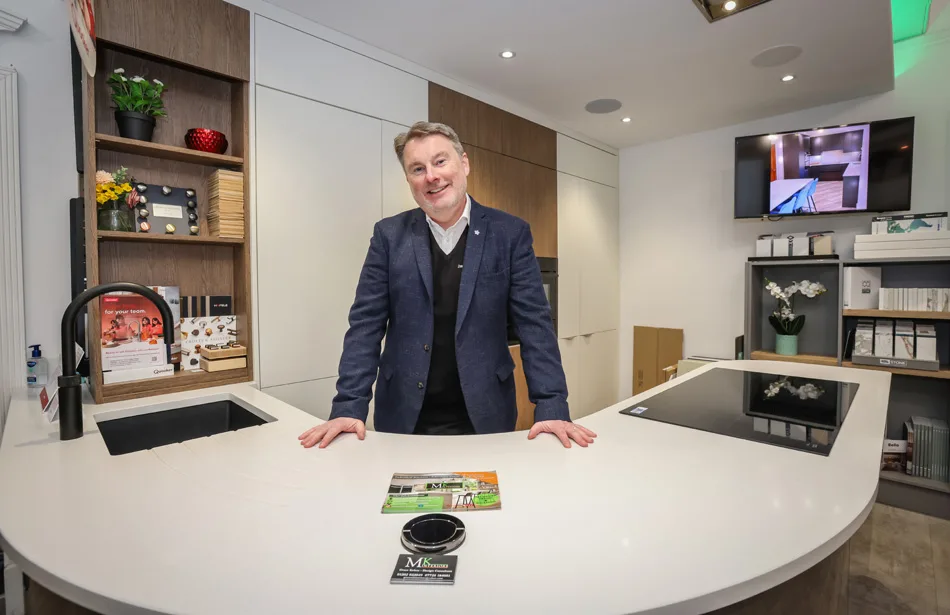
When Matt Renaut talks about what sets Dacombes of Wimborne apart, he doesn’t reach for nostalgia, despite the business being part of the town for more than a century. There’s no talk of ‘the good old days’ or doing things the way they’ve always been done. Instead, he talks about experience and what happens after the sale.
‘We like to deliver all of our products in our own vans and install them properly,’ he says. ‘That way we’ve got control. If something goes wrong, we know exactly what’s happened and we can sort it.’
It’s a practical mindset that runs through the family business Matt now manages – and the store today has evolved far beyond simply selling televisions or washing machines. The focus is now just as much on audio-visual systems, media walls, home cinema rooms and integrated home technology as it is on domestic appliances.

Image: Museum of East Dorset
Maintaining trust
The company itself has deep roots. In 1923 Mr E.T. Dacombe opened a business in Wimborne, selling prams, household goods, and later offering accumulator battery charging for early radios, as not every house had electricity. Televisions followed, and when Ralph Dacombe joined his father’s business after the war, the business became the first in the area to rent TVs – a necessary addition built on reliable, fast service at a time when sets were temperamental and technical support mattered.
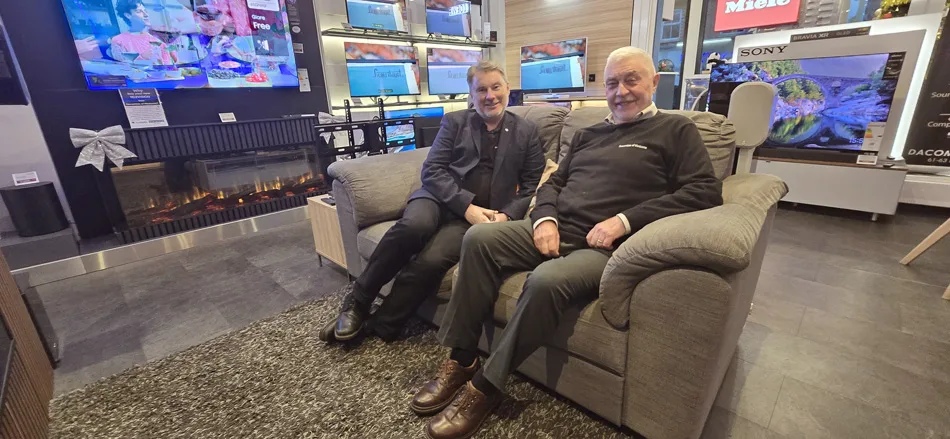
When Ralph retired in the 1980s, the business was taken over by the chief service engineer John Lodge. Looking to retire in the late 1990s John offered the business to John Renaut, Matt’s father. John and his wife Carole, with help from their family, set about bringing the business up to date. John saw technologies arrive, peak and disappear again, and learned early that survival depended on adapting without losing trust. ‘You either move with it or you don’t last,’ he says. ‘People don’t forgive technology that doesn’t work – or businesses that disappear once they’ve taken your money.’
That emphasis on service has been steady through every chapter of the business. Matt joined the family firm in 2000, having already had a career with national retailers and a background as a trained engineer. ‘I’ve always been on the technical side,’ he says. ‘Understanding how things work, how they should be installed, how to fix them – that’s still at the heart of what we do.’
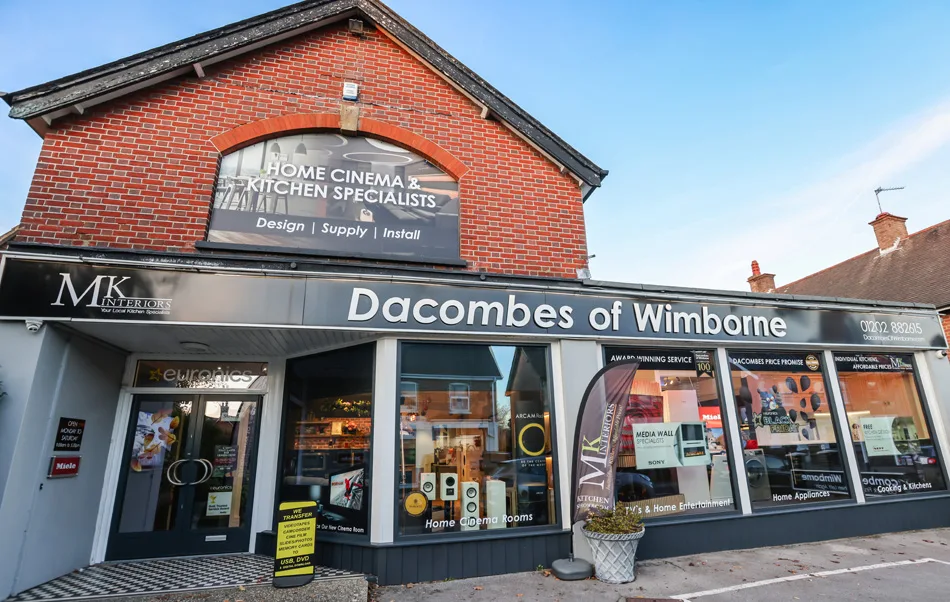
A significant turning point came with the move away from the traditional high-street shop into a larger, purpose-built showroom just outside the town centre. It was a considered decision – and a calculated risk – to give the business something it simply couldn’t achieve before: space.
‘We wanted to be a destination store,’ Matt says. ‘Somewhere people could come, park easily, sit down, take their time and actually experience the technology we’re selling.’
Changing homes
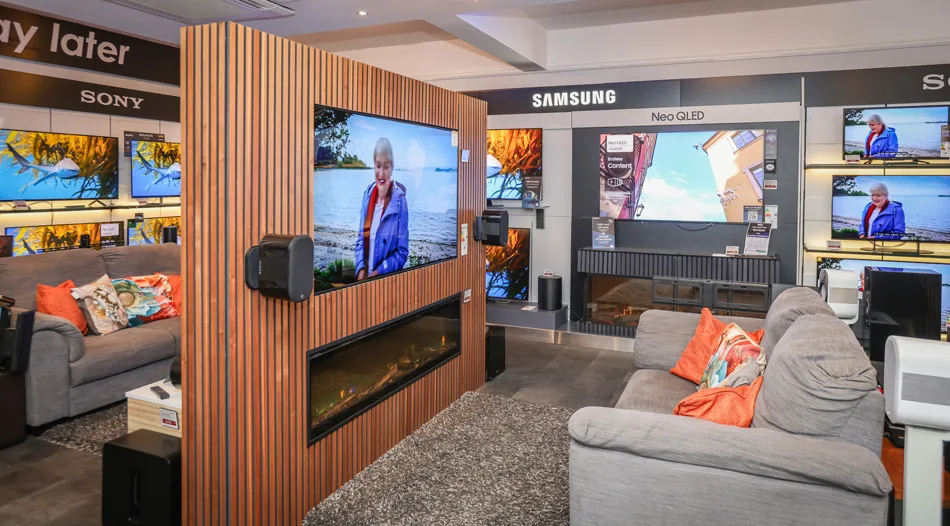
Instead of rows of boxed products, the showroom is laid out like a series of living spaces. Screens, sound systems, lighting and furniture are set up as they would be in a home. Customers are encouraged to sit, watch, listen and compare.
‘We don’t tell customers what things can do – we show them,’ Matt says. ‘That’s when it clicks.’
That approach has proved particularly effective as home entertainment has become central to how people live. Media walls, integrated sound systems and dedicated cinema rooms now make up a growing part of the business, often designed collaboratively with a customer around how they actually use their home.
‘People are staying in more,’ Matt says. ‘If you’re not going out every weekend, you want your home to work harder for you. That might be a media wall in the lounge, or a spare room turned into a cinema space. It doesn’t have to be extravagant – it just needs to be done properly.’
That word – properly – comes up often. For Matt, it applies equally to high-end installations and everyday appliances. ‘If someone wants a washing machine, that’s fine,’ he says. ‘We do those too! The point is, whatever someone buys, they get the same level of service, delivery and backup.’
Price, he says, is often misunderstood. As part of Euronics, one of Europe’s largest buying groups, Dacombes can compete directly with national chains and online retailers. ‘We wouldn’t still be here if we weren’t competitive,’ he says. ‘Sometimes we’re even cheaper overall, especially once you factor in the delivery, installation and support we offer.’
Make sure you get it right
Support is where the difference becomes most obvious. Warranties are registered in-house. Serial numbers are recorded. Even years later, if a customer calls with a problem, the details are already there. ‘You’re not dealing with a call centre,’ Matt says. ‘You can probably talk to the person who sold or installed the product.’
That approach has not gone unnoticed within the industry. National recognition first came in 2016, when Dacombes won its first major industry award at an event in London.
More recently, the business has picked up multiple honours at the ERT Awards – widely regarded as the UK electrical retail industry’s ‘Oscars’ – including being named Best Sustainable Independent Electrical Retailer and also Best Independent Consumer Electronics Retailer (Small Business).
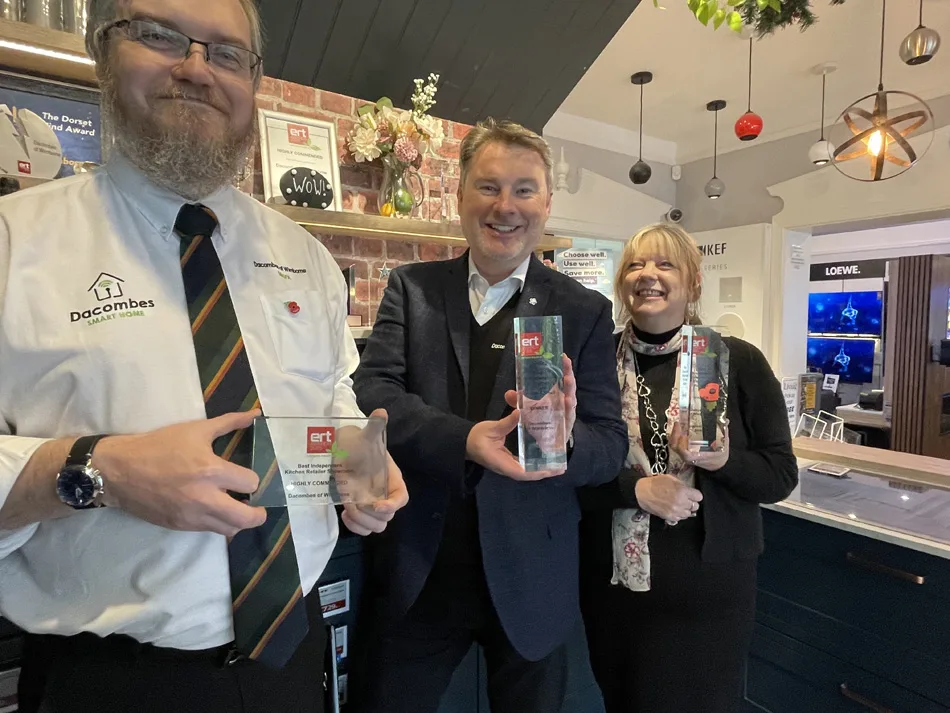
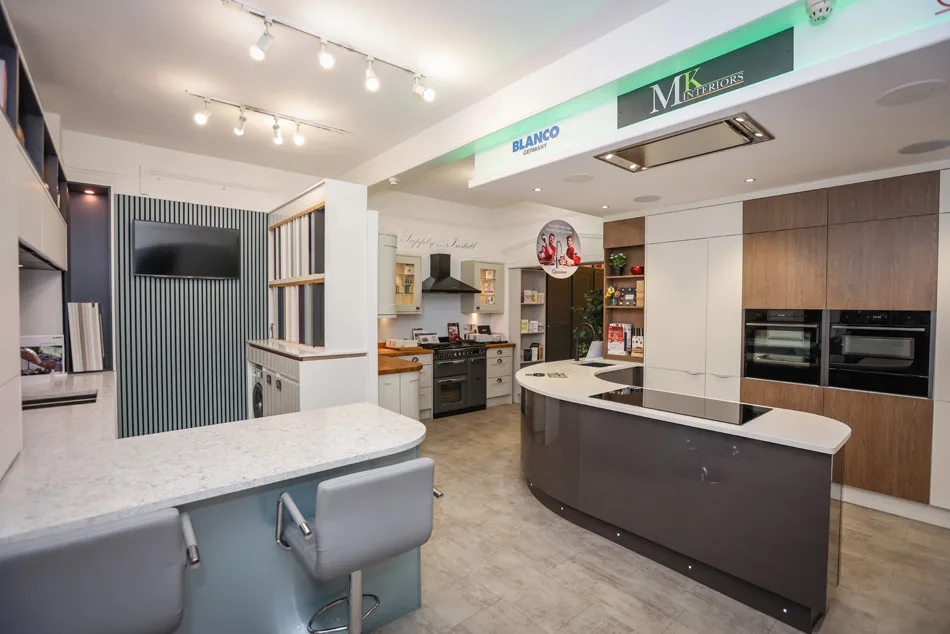
Judges cited the company’s environmental strategy, technical expertise and consistency of service in a sector increasingly dominated by national chains. They were also particularly impressed by the fully working in-store kitchens. These were designed to showcase modern kitchen technology, but Matt offers them free of charge to local community groups for cookery classes and events, reinforcing the idea that the building is a shared asset, not just a showroom. Once a month, Five Loaves Bakery, a local charity supporting people experiencing loneliness and isolation, uses the space to bake together using locally sourced ingredients, with the baked goods sold to raise funds for the charity.
‘We’re part of the community,’ Matt says. ‘So we try to do things that make sense, long term.’
That includes supporting local events. Dacombes sponsors Wimborne Folk Festival and Wimborne Green Festival, and is a main organiser and sponsor of Wimborne Food Festival, alongside backing the town’s flower festival and many other local charities.
The business’s sense of local responsibility was reinforced in 2025, when Dacombes welcomed the Holmans business into the fold. The merger brought another long-established independent Wimborne retailer and its team under one roof, ensuring continuity of service for long-standing customers. And that continuity matters to the Renauts. John is clear about the responsibility that comes with trading in the same town for more than a century: ‘You see people in the street and in the supermarket,’ he says. ‘If something’s gone wrong, you soon hear about it. So you make sure you get it right.’
Electric future
Looking ahead, the direction is clear, and the building itself reflects similar thinking. The roof is fitted with 100 solar panels, backed by battery storage. From May to September, the business runs entirely on its own generated power. Two EV charging points are already installed on site, and infrastructure is in place for electric delivery vehicles in the Dacombes fleet.
Appliances remain important, but the future lies in integrated home technology – kitchens designed around appliances, living rooms designed around sound and vision, and homes where systems work together seamlessly.
‘It’s been 25 years, and I’m still enthusiastic,’ Matt says. ‘There’s a lot more we can do, and a lot of people don’t yet realise what’s possible in their own homes.’
Dacombes is a business shaped by a century of change, but it is firmly focused on what comes next – modern, technically confident and deeply rooted in the place it serves.


