

George Hosford muses on profit-driven big agribusiness, vicious mink and the rediscovered therapy of a day behind the plough
A letter landed in my lap recently from a well-known corporate farming agency – the kind that manages thousands of acres for landowners, running slick operations with bulk buying power for fertiliser, chemicals, tractors and fuel. They run crop trials and manager trainee schemes and employ highly skilled managers who might oversee 3,000 acres each. They appear to be bailing out of many of their farming contracts because they have found that – surprise, surprise – agriculture is no longer giving them enough profit.
For years, these agencies promised landowners better returns than a traditional tenant could offer. But the Basic Payment Scheme is gone (axed two years early). The new SFI is closed to fresh applications, and a vague promise that it will appear ‘next year’ is simply not good enough for an industry that functions on decade-long decision cycles.
All images: George Hosford
Input costs have soared. Crop prices have tanked. For those with finely balanced contractual arrangements, it’s a perfect storm.
Corporate farming brings scale and efficiency – but I wonder whether it fits the sustainability, climate-friendly, clean water and soil health agenda that so many preach these days? How much love is lavished on the land that is farmed in this way, when one ‘farm’ is really six stitched-together blocks, spread across 20 miles? One might say it is inevitable, as food production becomes ever tighter financially, but the heart is being ripped out of rural life.
There is a link to the debate on Inheritance tax buried somewhere here. Land holdings become ever larger, farms have for many years been bought up by wealthy individuals who have earned their wealth elsewhere, or sometimes by real farmers selling farmland for development, who are allowed to roll over the often astronomical proceeds into more land, tax free (thanks to capital gains tax rollover relief, which to my mind needs reform before IHT).
But more often than not land is bought up by people or institutions looking for a safe investment, who are not farmers. In the past they would have rented it out to a tenant to do the actual farming, but sadly this happens a lot less these days because of the corporate farming agencies who convince the owners that they can earn more for them than a tenant could afford in rent as a one-person business. Perhaps we all need to take a good hard look at what is best for the land and the environment. If landowners are not going to farm the land themselves, should they be allowed to own it at all? Discuss.
Destroy the squirrels
An evening spent on the bank of the Stour at Cowgrove farm near Wimborne, as a guest of the Badbury Rings farmer cluster group, was a real treat last month. Neve Bray from Dorset FWAG (Farming and Wildlife Advisory Group) brought us up to date on local beaver releases and progress. There are known to be beavers on parts of the Stour now – their presence is hard to confuse with any other species, their toothmarks and the obvious strength of their jaws are unmistakeable. Some farmers worry they will cause flooding of farmland and devastation of trees, while others are prepared to take the long term view: slowing down water movement in heavy rainfall periods, which should actually reduce flood risk downstream, and the creation of more watery habitat.
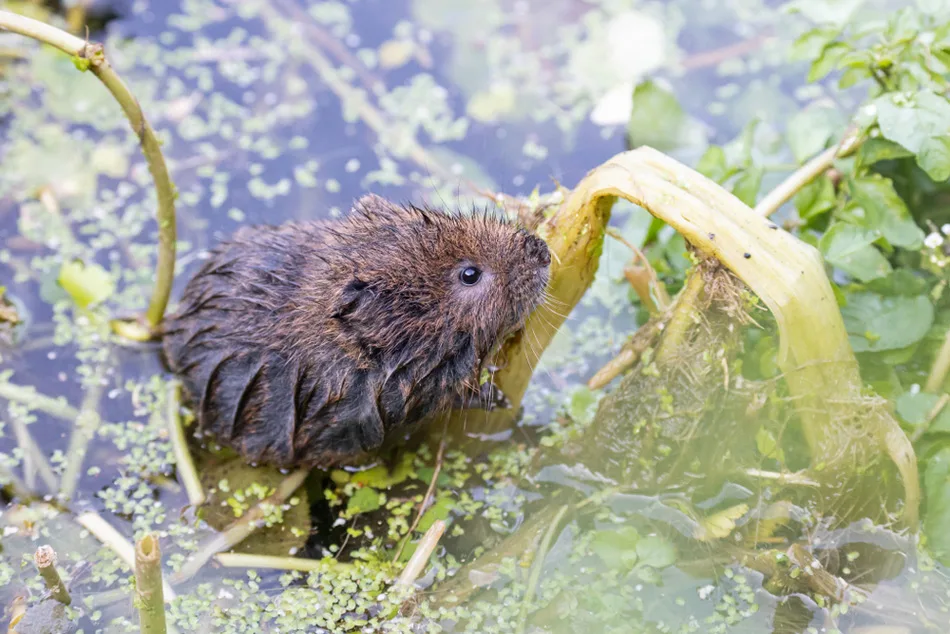
Dr Merryl Gelling from the Mammal Society then provided a fascinating talk about water voles, whose population has been devastated by predators – largely mink, an alien species which now exist widely in the wild. They have either escaped from fur farms (until the 2002 ban) or were released on purpose by misguided anti-fur farming protestors, who have inadvertently caused the near-destruction of the water vole in the UK.
Mink are just the right size to fit into water vole burrows, the entrances to which are usually located just below the water line on rivers, to protect them from non-swimming predators, and they have no defence against the vicious and deadly mink, which also causes much damage to salmon and ground nesting bird populations.
There are now a number of mink destruction schemes operating around the country, using traps baited with smelly mixtures involving meat, fish or, best of all, the scent from another mink. With luck, a scheme might begin soon on stretches of the Stour. Training is available to groups who wish to undertake such activity. The squeamish should not blink: the mink is a deadly predator which causes huge environmental destruction (once caught it is illegal to release).
The same is the case with rats and grey squirrels. In the 1880s, the 11th Duke of Bedford, recklessly released imported American grey squirrels, which he considered to be ‘interesting exotics’, from his Woburn estate. He also presented breeding pairs to landowning friends around the country. His catastrophic actions have resulted in the near-destruction of our native red squirrel, all but wiped out in most of the country by habitat poaching, and by the disease squirrelpox that was brought into the country by greys. There are now an estimated 2.7 million greys in the UK, and less than 200,000 reds, which only remain in isolated places like Brownsea Island in Poole harbour, the Isle of Wight, and more widely in Scotland.
To optimise success rates from all the tree planting that well-meaning environmentalists wish landowners to carry out, they also need to find people who are prepared to trap and destroy grey squirrels, on a very large scale. The grey is responsible for staggering amounts of damage to trees across the country, by eating out growing points, and damaging bark.
I could start on deer here, which also challenge our chances of reforesting areas of the country, but that could be too much for one sitting…
Digging out the plough
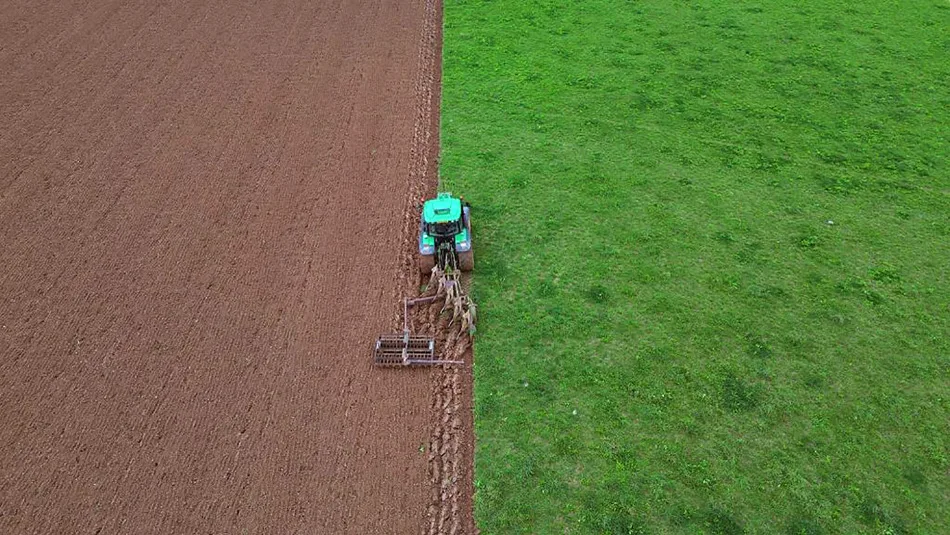
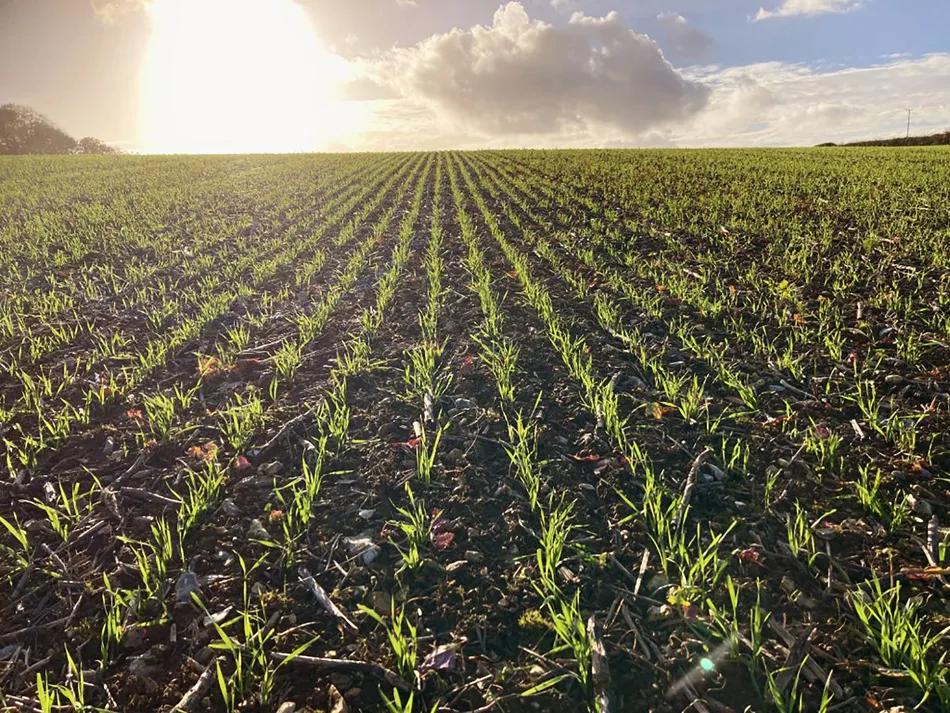
Finally, we returned to an old fashioned and often highly damaging machine last month. On most of our autumn acreage we have stuck to drilling direct, as we have done for the last four seasons. But this method did not work well when we tried it the last time we terminated a grass ley, so after much debate we opted for the return of the plough … just as soon as we could find it.
It eventually turned up in the bushes, and Will spent two days with wire brushes and numerous buffing discs removing 23 years of rust. He then set forth into the first of two herbal ley fields due to return to wheat cropping.
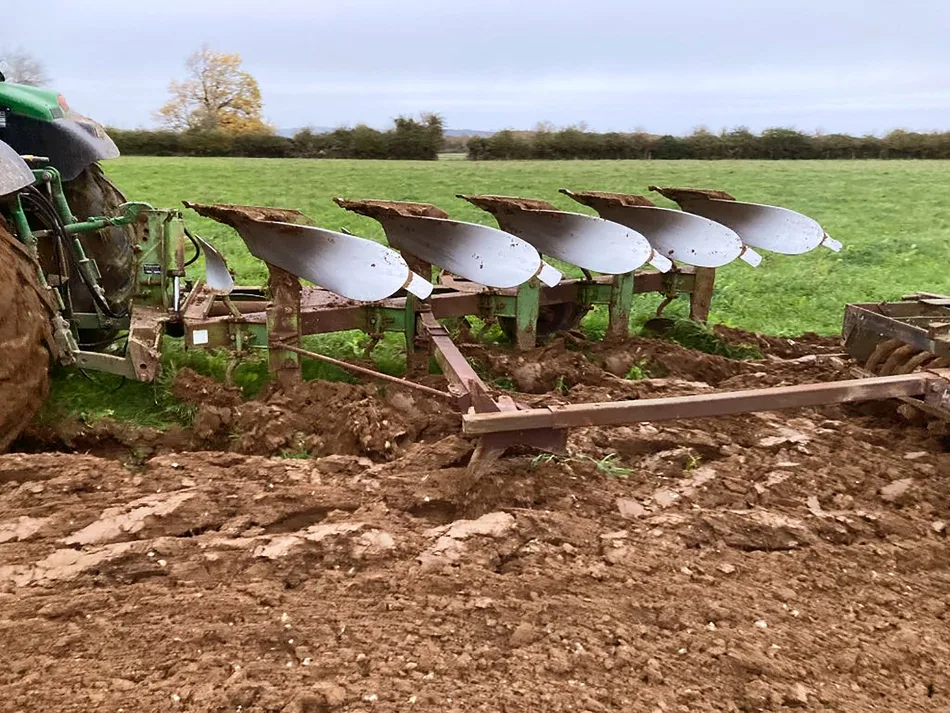
His elbow grease worked wonders: within a couple of turns of the field the plough furrows were properly shiny, and turning over the soil beautifully. The furrow press trolling along behind the plough, kindly loaned by Nigel from Gussage, did a good job of firming the soil to help prevent the next tractor into the field from sinking too deep and making a mess. The plough was followed by the Vaderstad Rapid drill, which consists of a set of discs in front of the drill coulters: these should shake down the soil a little, and disturb any lurking leatherjackets (the larva of the crane fly, or Daddy long legs – a voracious devourer of young cereal plants and the reason we’d had to rummage for the plough in the first place).
We needed to push on promptly with the drill before we got some wet weather, because freshly ploughed soil turns to a pudding very quickly when it starts raining, and takes far longer than undisturbed soil to dry out again.
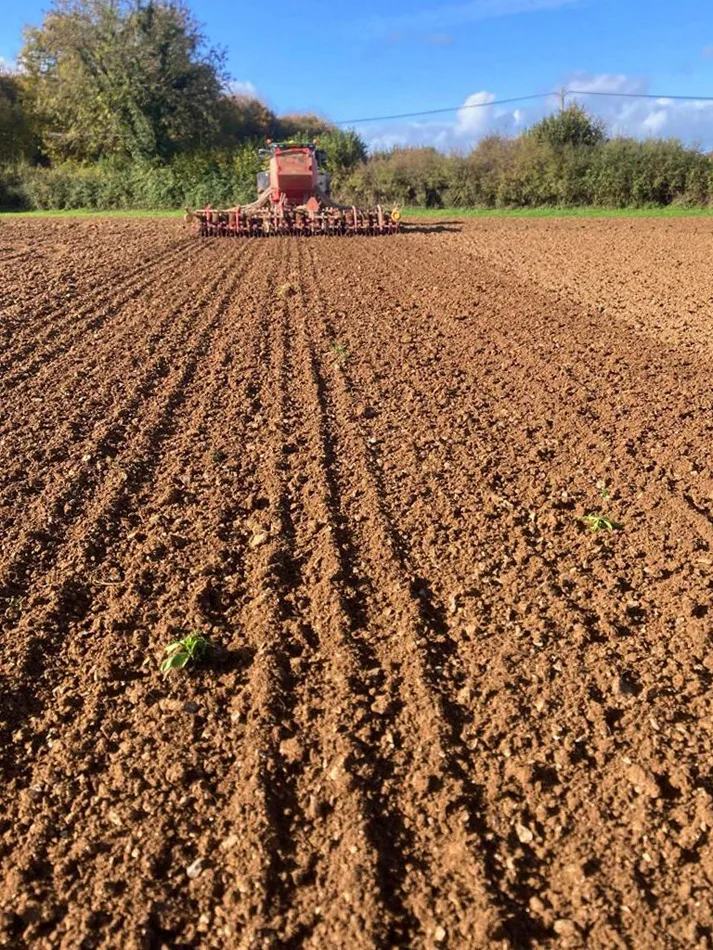
One soon remembers why we gave up ploughing all those years ago. It is slow, labour and fuel intensive, leaves the soil loose and vulnerable to rain, destroys organic matter and wears out metal and rubber on machine and tractor. Sowing into grassland presents its own special issues, but we only had 35 acres to do, and with luck will get a better wheat crop than we might have done any other way.
Never say never.
Before we leave ploughing, here are some thoughts from nature writer John Lewis-Stempel’s latest book England, A Natural History:
“I am always happy ploughing. A mental state, according to scientists at the University of Bristol, enhanced by the very soil itself. A specific soil bacterium, Mycobacterium vaccae, activates a set of seratonin-releasing neurons in the dorsal raphe nucleus of the brain – the same ones targeted by Prozac. You can get a very effective dose of Mycobacterium vaccae ploughing. Or gardening.” Presumably you’d get an even bigger hit if ploughing behind a horse.
You can follow George’s unabridged farm diary on his blog viewfromthehill.org.uk