With cuckoos gone and insects vanishing, Neil Walker believes towns like Sherborne are unexpected sanctuaries for wildlife pushed out of farmland
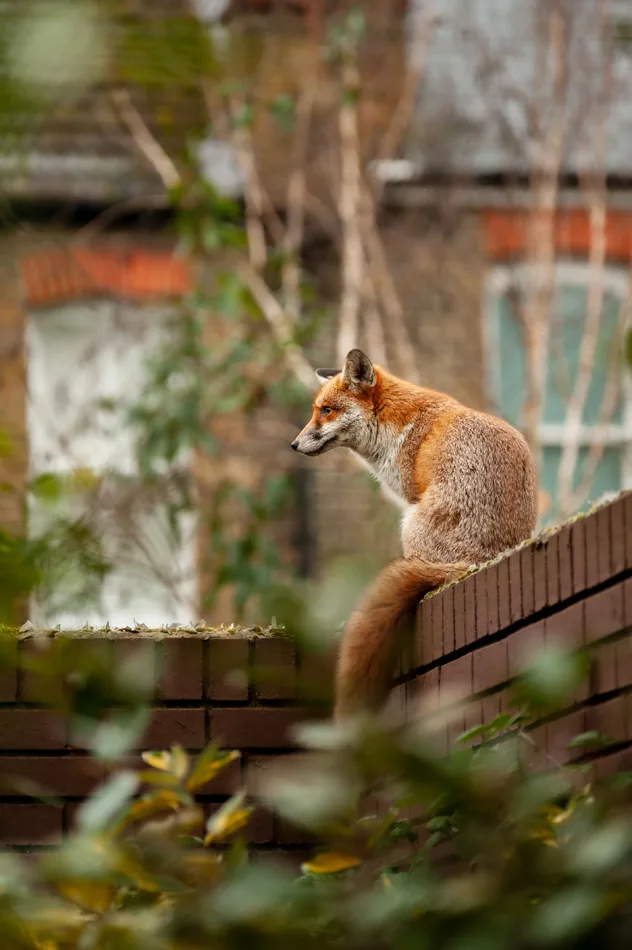
Urban red fox (Vulpes vulpes) wandering on top of brick wall spiked with broken glass on very early morning in residential gardens.
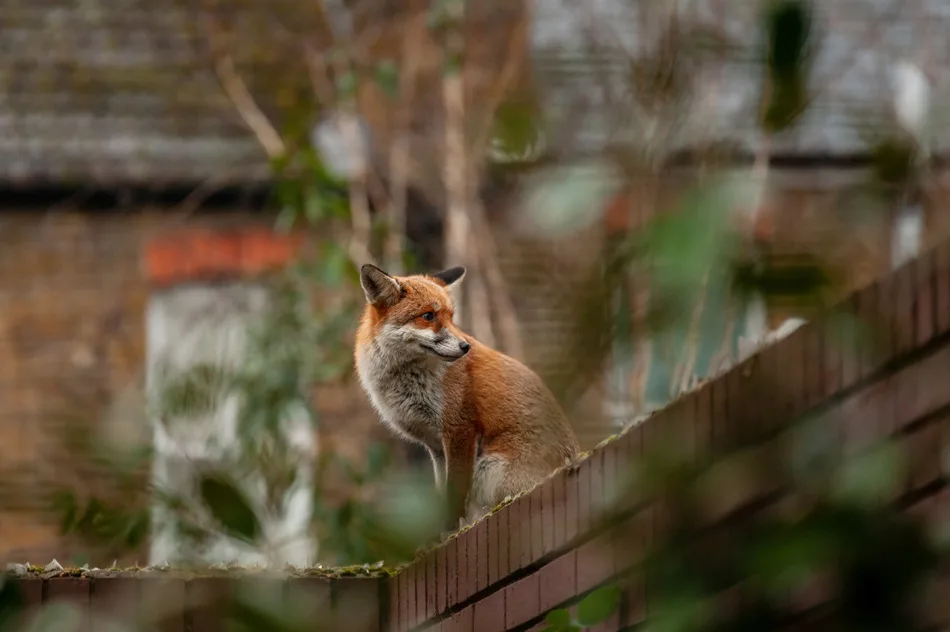
For most of us, the decline in wildlife has been gradual enough to feel almost invisible – until one day it isn’t. Fewer insects spattered on windscreens. Empty verges where rabbits once darted. Realising it’s July and you still haven’t heard a cuckoo this year. Neil Walker has noticed all of these during his six years living on the edge of Sherborne, and they form the backdrop to a growing conversation about how towns may now be playing an unexpected role in supporting nature. ‘When I moved here, I used to hear cuckoos, see hares, foxes and deer regularly,’ he says. ‘Now the cuckoos have gone, the hares have gone, and I hardly ever see a fox. You start asking yourself where everything has gone.’ The answer, he suggests, is not simply that wildlife is disappearing, but that it is being pushed out of the wider countryside. Intensive land use, habitat loss and chemical inputs have made survival increasingly difficult, leaving towns and gardens as some of the last remaining refuges. ‘People often talk about “bringing the countryside into towns”,’ Neil says. ‘But the truth is, it’s already there. Butterflies, birds, bats, hedgehogs – they’re constantly moving through our towns, looking for somewhere safe to feed, breed and rest. The issue is whether we let them stay.’ The 2023 State of Nature Report showed that wildlife decline in Dorset’s farmed landscape is among the most severe in the country. More than 3,000 species of plants and animals in the county are now at risk.
Urban red fox (Vulpes vulpes) wandering on top of brick wall spiked with broken glass on very early morning in residential gardens.
Many small actions Gardening, Neil believes, has become one of the most important connections between people and wildlife. Attitudes have shifted markedly in recent decades, with fewer chemical pesticides on sale and a growing recognition that creatures once labelled as ‘pests’ are essential parts of a functioning ecosystem. ‘We’ve changed our minds before,’ he says. ‘Gardeners used to kill earthworms because they thought they were harmful. Now we know better. The same applies to so many insects – if you remove them, what do you think hedgehogs and birds are supposed to eat?’ Neil points to a paradox emerging across Dorset: while wildlife is declining sharply in surrounding farmland, it is increasingly being recorded in towns. ‘Wild creatures are discovering the town is one place they can still go,’ he says. ‘That really should give us pause.’ The solution, he argues, does not lie in grand gestures, but rather in small, cumulative, everyday decisions – gardens that offer nectar, shelter and connectivity. Fences with gaps for hedgehogs. Trees and orchards planted with long-term benefit in mind. Even people without gardens can often add a bird box to a wall or a window box planted with a few flowers. ‘If each of the 10,000 people in Sherborne did just a little bit more, it would make an extraordinary difference,’ he says. ‘It doesn’t mean gardens have to look messy. Wildflowers are beautiful – most of our cultivated plants started out as wild ones.’ At its heart, the conversation is less about rewilding in the abstract and more about rethinking how towns coexist with the natural world around them. As Neil puts it: ‘We don’t need to do everything. We just need to stop killing what’s already trying to live alongside us.’
Neil Walker has launched the Wild Sherborne initiative. The first meeting is on 12th February, Digby Hall in Sherborne at 7pm. There’ll be tea and cake! wildsherborne.co.uk
Dorset sculptor Jane Shaw has been selected not once but twice for the 2026 Royal Society of British Artists Annual Exhibition – a rare distinction that places her firmly among the top names in contemporary British sculpture.
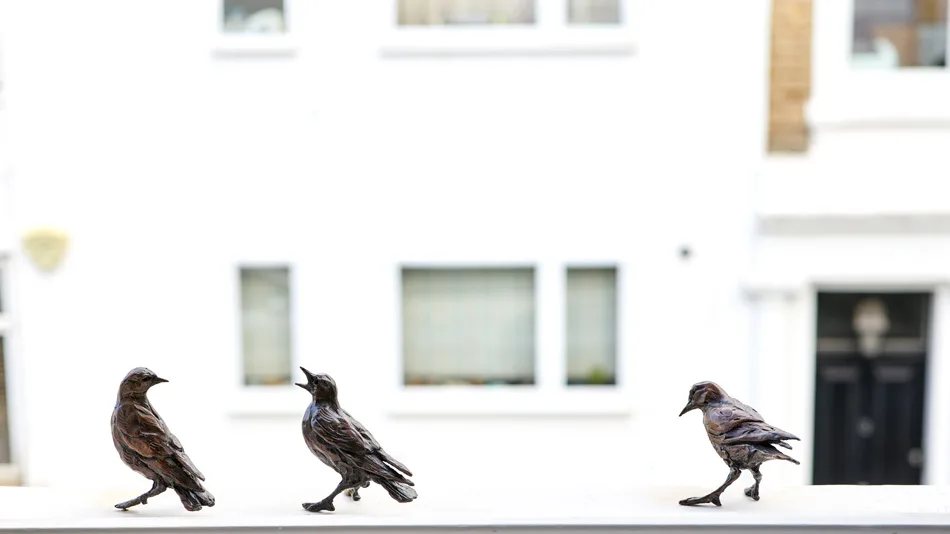
Chosen from almost 4,000 anonymous submissions, Jane is one of very few artists to have two separate works accepted in the same year. Her bronze sculptures Community Spirit (Group of Starlings) and Kissing Mice will both be exhibited at London’s prestigious Mall Galleries this February. Each year, only around 280 works by non-RBA members make the final selection, with most chosen on a one-per-artist basis. To receive a double acceptance, through blind judging, is highly unusual and widely regarded as a mark of exceptional artistic merit. Jane, who lives and works just outside Blandford Forum, says: ‘My work is always about the moment just before something happens – the balance between stillness and movement. To have two such different pieces recognised in this way is deeply affirming.’ Community Spirit captures the compressed energy of a murmuration of starlings, cast in bronze and set on slate. It’s not a literal depiction of flight, but a sculptural interpretation of shared movement and collective instinct.
By contrast, Kissing Mice is a more intimate study in vulnerability and balance. Perched delicately on stacked pebbles, the two mice lean towards one another in a quiet moment of affection. One is older, more watchful; the other curious, reaching. Cast in white bronze, it’s a piece that invites viewers to pause and reflect. Both works will be on display at Mall Galleries, The Mall, London SW1, from 26th February to 7th March 2026, alongside some of the UK’s most celebrated contemporary artists. Admission: £7 (free for under 25s) – mallgalleries.org.uk
The BV community news section is sponsored by Wessex Internet
At Dorset Chamber, we are big fans of apprenticeships, and on 12th February, during National Apprenticeship Week, we will open entries for the 2026 Dorset Apprenticeship Awards – delivered by Dorset Chamber, sponsored by Superior and supported by the Dorset and Somerset Training Provider Network. The awards are completely free to enter and celebrate the achievements of apprentices of all levels across all industries in Dorset. Entries can be submitted by apprentices themselves, employers or training provider and we have worked hard to make the process as straightforward and accessible as possible.
Ian Girling, CEO of Dorset Chamber
Practical solutions Apprenticeships play a vital role in building a skilled, confident and adaptable workforce. By combining hands-on experience with structured learning, apprenticeships allow individuals to gain real-world skills while earning a wage. This ‘learn while you earn’ model makes education more accessible, particularly for those who may not wish to follow a traditionally academic or university path. Two of my own children chose the apprenticeship route straight from school at 16, and it has given them both an excellent start to their working lives through valuable experience, recognised qualifications and a salary. For employers, apprenticeships offer a fantastic way to recruit, retain, and develop talented people to support business growth. With apprenticeships available across a wide range of sectors, they also provide a practical solution at a time when many businesses report difficulties in finding skilled workers. We’ve also seen first-hand how life-changing apprenticeships can be. Many individuals have shared how their apprenticeship opened doors to new opportunities, increased their confidence, and helped them achieve more than they ever thought possible. Apprenticeships are inclusive and accessible, offering qualification routes for people from all backgrounds and at all levels, from supported internships through to graduate-level qualifications. Finalists will be invited to attend an awards ceremony with friends and family, where they will be presented with their award by His Majesty’s representative in Dorset, the Lord Lieutenant. Finalists and winners will also be featured in our magazine. If you are an apprentice, employer, training provider or proud parent, I encourage you to explore the awards. More information will be available from 12th February at dorsetchamber.co.uk.
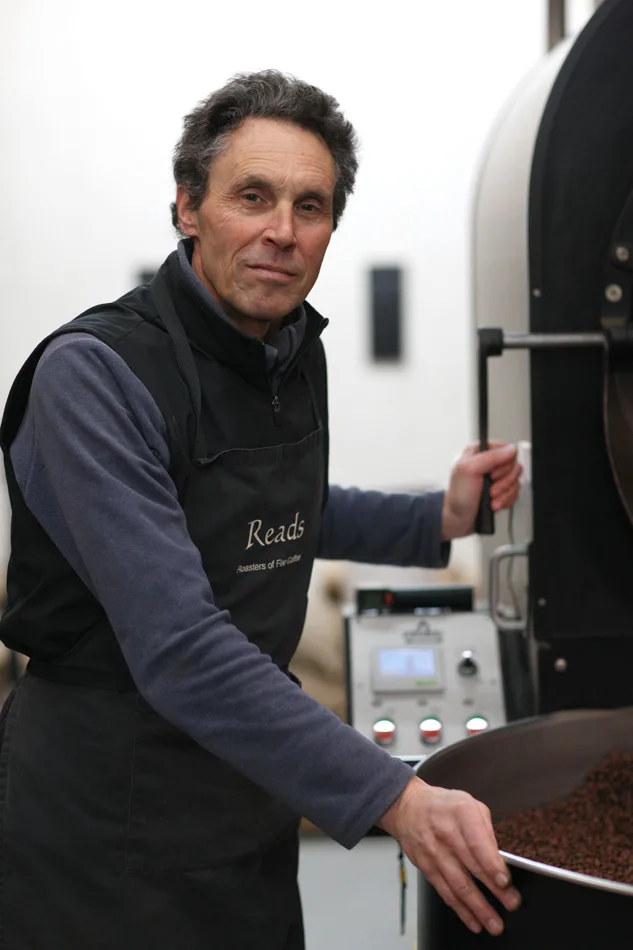
Giles Dick-Read spotted the coffee revolution before Britain knew it wanted one, quitting the corporate world for a converted Sherborne dairy
All images by Courtenay Hitchcock
It’s 1993: a world before flat whites and baristas occupying every street corner. Giles Dick-Read is sitting in Starbucks – a new concept – looking out over Kitsilano Bay in Vancouver. But it’s not the stunning view that’s distracting him, it’s the buzz of the place, the easy banter of the dexterous baristas working vast, hissing machines. ‘I remember sitting there, feeling the energy this coffee business was generating,’ he says. ‘I thought, this must be the next big thing. That’s what I’m going to do.’ Giles had just jettisoned a well-paid job in the corporate world of automotives and car audio. He’d hopped on a plane to Vancouver with no set plans, just the question of ‘why have you given up a great job?’ ringing in his ears.
Giles Dick-Read
For six months he travelled across Canada and the US, researching the fast-growing world of speciality coffee. ‘I was in the right place at the right time and could see what was coming,’ he says. ‘A coffee explosion!’ He was right. According to the British Coffee Association, we now consume a staggering 98 million cups of coffee every day! That caffeine-kicked journey eventually led Giles back to London, where he met his wife Charlotte, then working at Café Rouge. She, too, was discovering Britain’s limited understanding of good coffee. ‘Coffee was awful in the UK,’ Giles says. ‘On the road in my corporate job, I’d discovered you just couldn’t get a decent cup. I was also having some health issues thought to be related to caffeine, so if I was going to be able to continue drinking coffee, it had to be good!’
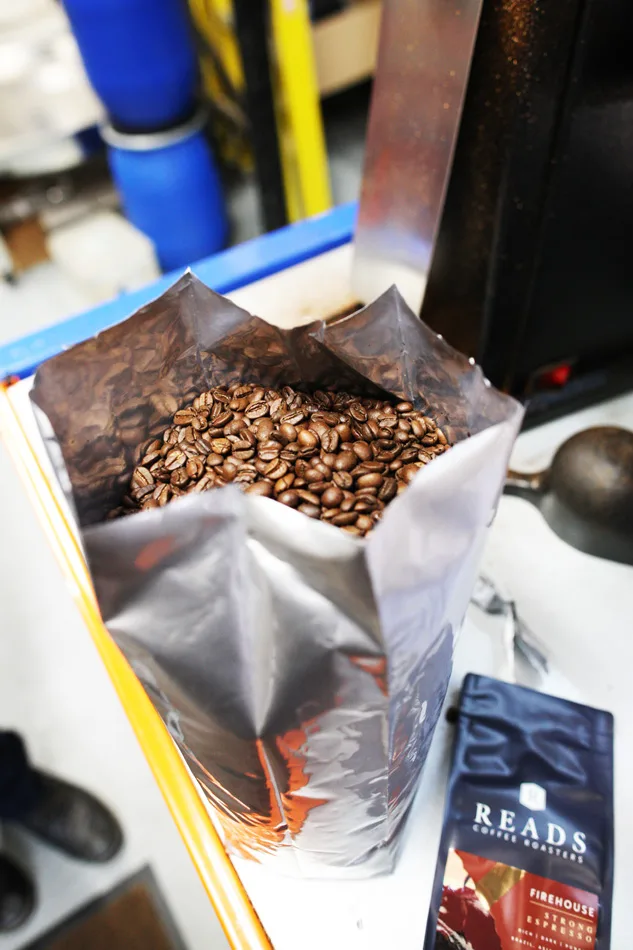
Reads coffee beans roasted, packaged and ready to brew
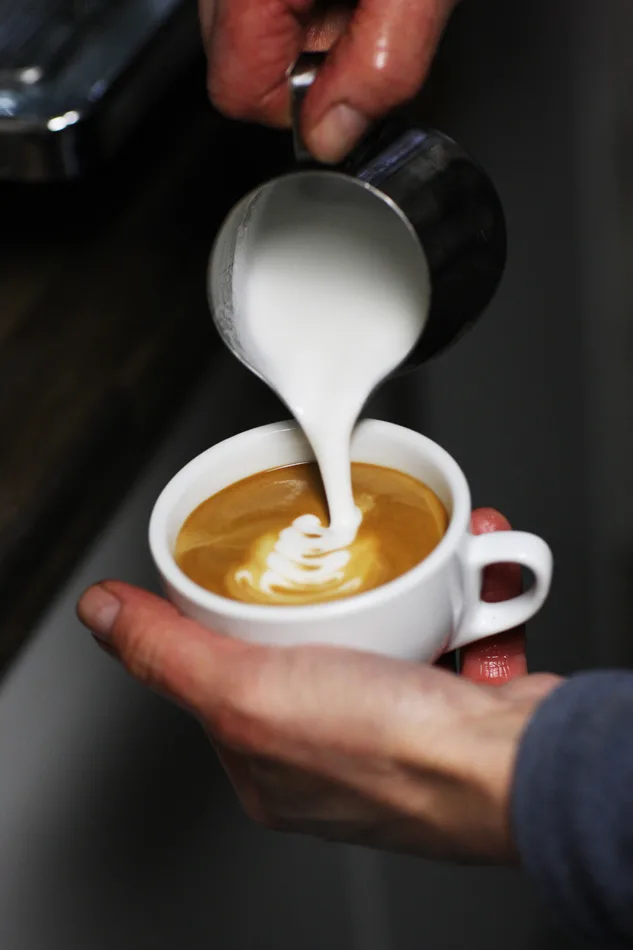
Becoming Mr Bean A job with a small café chain followed – ‘the only one I’ve ever done where my wages didn’t cover the cost of living’, says Giles, – but it proved pivotal. Having trained as a barista, Giles briefly worked at Whittards while researching speciality beans in his spare time. The real turning point came from a meeting with the owners of sandwich chain Pret A Manger. Giles confidently told them: ‘Coffee is the next big thing and you need to take it seriously.’ They did, appointing him their first coffee man, soon nicknamed ‘Mr Bean’. Consultancy work with major brands followed, advising on beans and machines and writing barista manuals. ‘I’ve lost count of how many baristas I’ve trained,’ he says. ‘My top tip? Give them a tennis racquet and ball and get them hitting it against a wall. Hand-eye coordination is everything in a busy coffee house. Surprisingly, a love of coffee isn’t essential. I’ve trained plenty who don’t even drink it.’ Despite his success as the coffee man, Giles again stepped away from a comfortable salary to begin experimenting.
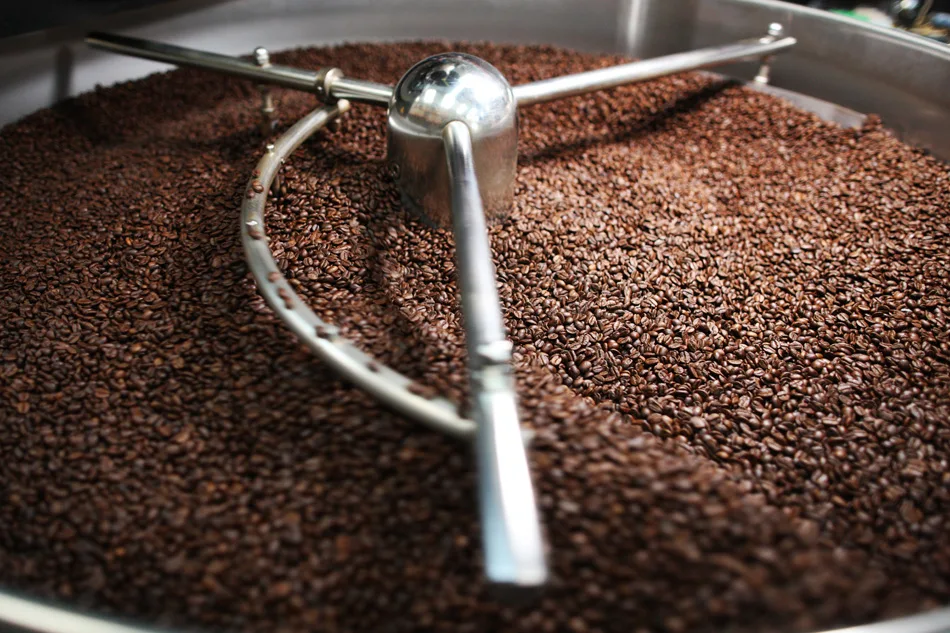
A decaf roast
‘I bought a second-hand roasting machine and started to roast my own beans to sell to friends and family. I love all machines, so I was inevitably fascinated by the magic of the roasting process.’ In 2005, Giles and Charlotte moved to Sherborne along with their fledgling speciality coffee business. A farmhouse with outbuildings provided an ideal new home – a way to run a business alongside family life, with their three young children.
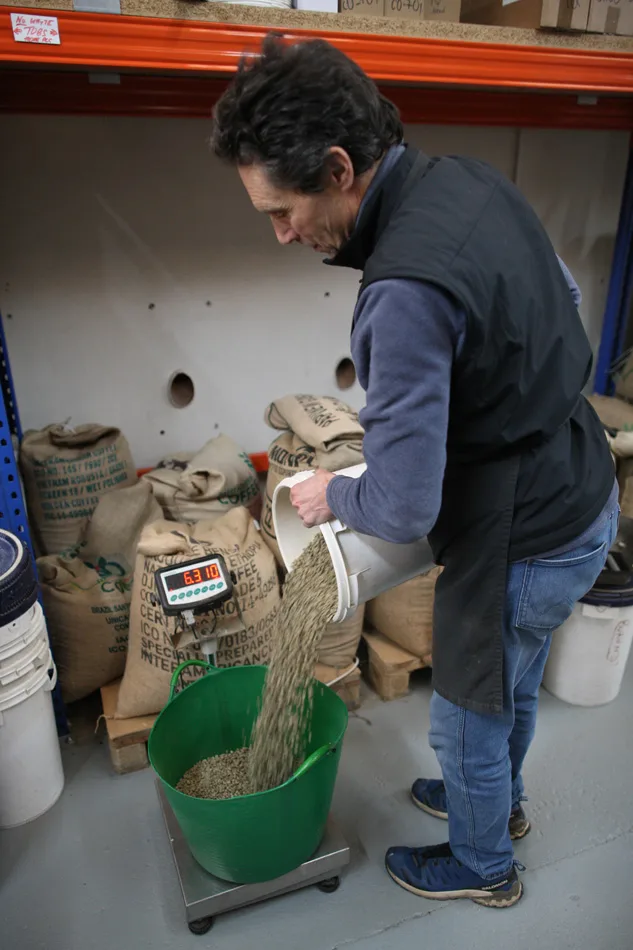
Giles weighing raw coffee: unroasted coffee beans are green ranging from pale, yellowish-green to deep grey-green. They have a grassy herbal scent, very unlike the familiar rich aroma of roasted coffee
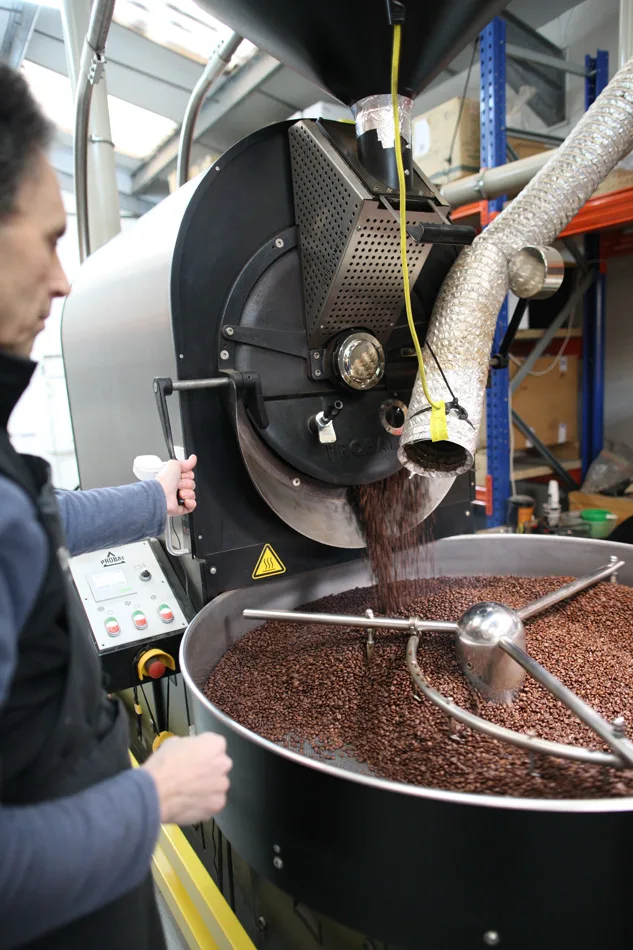
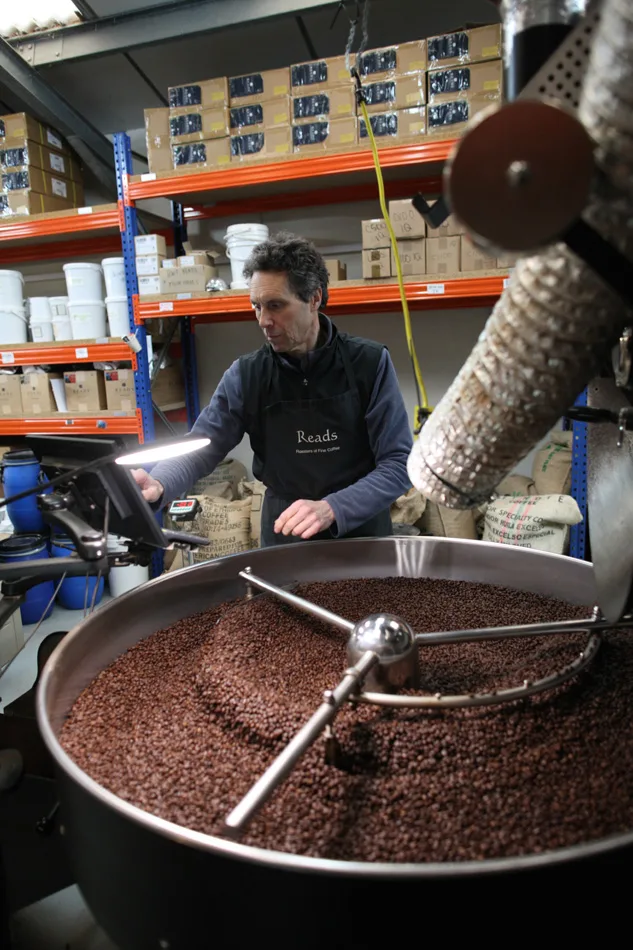
Old roots Today, Giles’ ‘happy place’ is a converted dairy – the Roastery. His original small roaster now sits beside a towering Probat machine. Sacks of green beans from a host of countries – Kenya, Sumatra, Peru, Brazil, India and Rwanda – are piled high. The delicious aroma of coffee permeates. ‘Our neighbours are Sherborne Tennis Club,’ he says. ‘They know when I’m roasting – they get a good waft!’ The Roastery is where everything happens, from cleaning and roasting to packaging. Roasting days are Mondays and Thursdays, and every batch is meticulously logged. ‘It’s the only part of my life that’s completely organised,’ Giles ays, explaining that he still does most of the roasting himself. There’s history in the brand name, too. ‘I hail from Norfolk flour-millers, and my godfather, Brian Read, gave us his blessing to use the Reads name. It’s serendipity, really. Like flour, coffee starts as an agricultural crop. You process it and end up with an ingredient.’ Aside from the roasting, his other favourite part of coffee production is the occasional visit to Tilbury Docks to collect the sacks of green coffee arriving from across the world: ‘It’s such a fantastic experience pulling it off the dockside,‘ he says. ‘Really it’s just the kid in me who loves going to the port to see all the big machines!‘
All images by Courtenay Hitchcock
All images by Courtenay Hitchcock
Coffee culture From bean to cup, Giles knows every stage of his business, and 20 years on, his core ethos hasn’t changed: ‘We’re still all about roasting special coffee in small batches and helping people make fabulous drinks. ‘As I said, coffee is an ingredient, not a final product. The magic is all in the preparation. The ultimate proof of this is Italy. ‘By and large, Italian coffee is quite ordinary: what’s special is the way it’s so skilfully made. ‘All roasters have their own style – give the same beans to several different roasters, and you’ll get a different coffee from each. We choose to roast traditionally, to produce coffees that are fully developed, without being too dark or too light: we aim for a rich, smooth flavour. In short: coffee that tastes of coffee!’
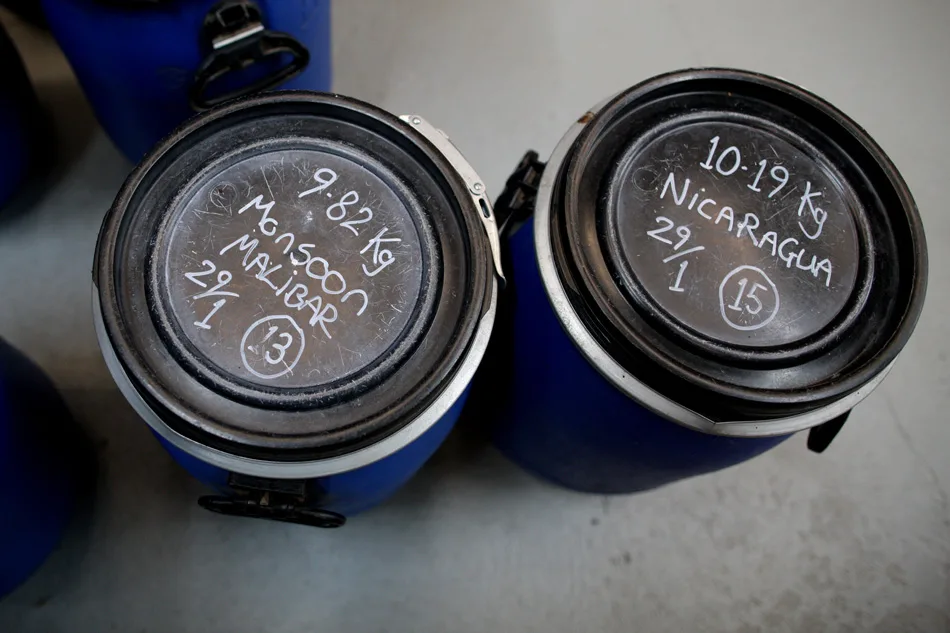
Roasted beans are stored in carefully labelled and dated buckets in the Roastery
Over our own brew (he runs on three espressos a day), Giles gives me a quick lesson on how to use my moka pot: leave the lid open, and watch for the moment the syrupy liquid becomes thinner and paler, that’s the key. A good grinder, he insists, is also essential. Different brew methods need different grinds – cafetières coarse, moka pots fine. The brew ratios of water-to-beans matter too. (Reads supply handy recipe cards to advise customers!) But Giles is no coffee snob. ‘If people want milk and ten sugars, that’s fine. Coffee should just be enjoyed your way.’ It’s that hands-on passion that Giles brings to Reads’ business relationships, from London eateries like Boxcar to Dorset farm shops. ‘I still love checking the machines, supporting baristas,’ he says. His local customer base grew during Covid, when people came out to visit the converted horsebox coffee bar on the farm for their caffeine fix during the pandemic. Although there is an online shop, Giles still makes time to serve and sell beans himself. ‘We run a pop up stall at Martock Market once a month – the queues are amazing, I couldn’t be more grateful to our loyal customers.’
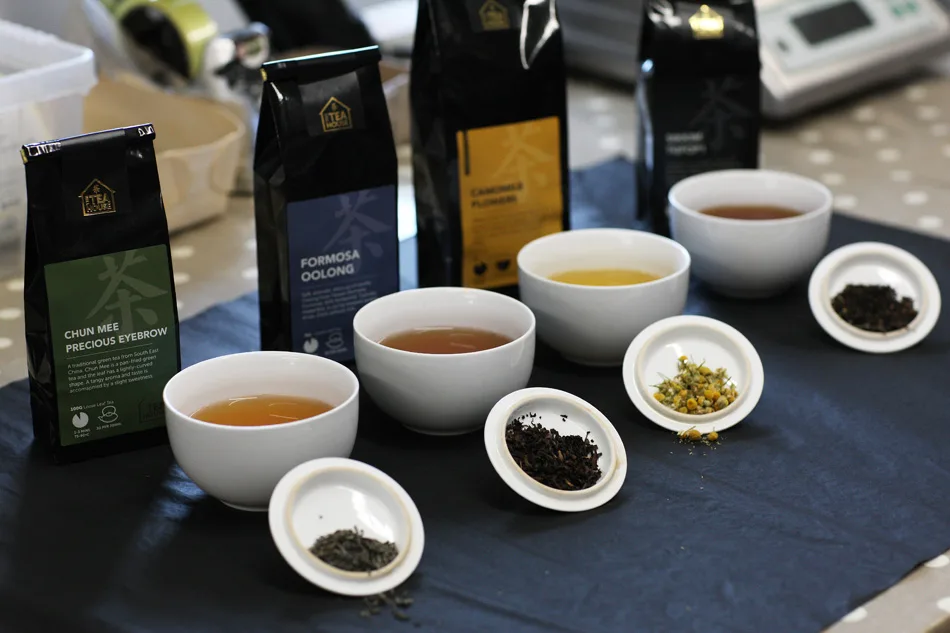
As we leave, he shows me a converted shipping container – ‘the Tea House’. It’s packed floor-to-ceiling with speciality teas bearing evocative names like Chun Mae Precious Eyebrows: a green tea whose leaves have a lightly-curved shape said to resemble a woman’s eyebrow. ‘At heart, we’re still a nation of tea drinkers,’ Giles says, ‘So … watch this space!’ Is tea Mr Bean’s next big thing?
The next Reads adventure looks tea-shaped
Quickfire questions for Giles:
Who would you have a coffee with? My grandfathers – I sadly never met them. Grantly Dick-Read was an obstetrician who made his name as a leading advocate of natural childbirth. My maternal grandfather, Colonel William Kingsberry, was a career soldier killed in Ghent by a V-2 rocket. For my mechanical fix, racing drivers Stirling Moss, both Graham and Damon Hill, and also Guy Gibson VC, commanding officer of 617 Squadron – he led the Dambusters Raid.
Book by your bedside? Rivets, Trivets and Galvanised Buckets: Life in the village hardware shop by Tom Fort. He’s a brilliant researcher, a shared passion.
Favourite place to drink coffee? Ironically, I rarely go out for coffee. If I do, I prefer somewhere we don’t supply as I’m always researching the competition! That said, little beats a fresh brew in my thermos and heading out on my motorcycle to enjoy it on Salisbury Plain or Portland Bill – anywhere wild with fantastic views.
MP Simon Hoare thanks flood responders, reflects on national strengths and says social media needs limits to protect young people
Simon Hoare MP
Let me begin this month’s offering by extending my heartfelt thanks, on behalf of all residents of North Dorset, to Dorset Council officers and councillors, Dorset & Wiltshire Fire and Rescue and Dorset Constabulary, who have all done so much to look after, help and protect communities during the recent heavy rain and subsequent flooding. I also want to thank our parish and town councils, and the scores of nameless individuals who have helped out their neighbours in time of need. I have been compiling a detailed register of where flooding has been at its worst or most disruptive and would welcome residents and others to email me ([email protected] or write to: Simon Hoare MP, House of Commons, London, SW1A 0AA) with their experiences so that I have the fullest picture possible. This will assist me in making the case for remedial works and investments across the constituency. Our changing climate points to these previously rare episodes becoming endemic during the winter months, and we need to do more to attenuate against them.
Battered, not broken I posted on Facebook recently in rebuttal of the assertion that ‘Britain is Broken’ – and I was really encouraged that the majority of those who commented and those who have emailed or written to me agree that our country is NOT broken. Do we need to see investment in certain areas? Yes of course. Do we need to see modernisation? Undoubtedly. Is everything in the garden rosy? Of course not! Our national story is one of evolution and adaptation. Nothing can stick with the status quo. Do those accessing SEND provision or Adult Social Care too often find it a trial? Yes they do. But – and here’s the rub – let’s compare ourselves with other countries across the globe. We have the rule of law and democratic freedoms. We have accountable armed forces and police. We enjoy an independent judiciary. We can say what we like in a free press. We cannot be detained indefinitely without charge. We can criticise the government or the King without the internet being turned off. If we are ill, the NHS will do it’s best for us and never send us a bill. If we are out of work or disabled the State will provide a network of supports, creating a safety net of protection. Our local councils deliver services, day in and day out. We can love whomsoever we like. Our foodstore shelves are plentiful. Our children are not sent out to beg. We can flick a switch, and our electricity supply is reliable. We have schools, colleges and universities doing their best to provide education and skills for the next generation. All of these are important. All of this demonstrates the intent to provide reliable services for all of us to use and access. So, no. Britain is not broken.
The FOMO landscape The Government is to consult shortly on banning the use of social media for those under 16. As the father of three teenage daughters, I see first hand the up and down sides of social media. The answer to the question has to be one of balance. The growing canon of evidence of the harms social media is causing – for ALL age groups – is alarming. Sometimes, I sit back and wonder why we allow it to dominate our lives as much as it does. For too many, social media has become master rather than servant. I will be holding some public consultation events over the coming weeks to explore this issue with parents, teachers, health professionals and, crucially, young people themselves. FOMO (fear of missing out) does seem to dominate the landscape. I have heard from lots of young people in North Dorset that they don’t particularly like social media, don’t even particularly want to use it … but believe that they have to, in order to fit in with their peers. That is no way to run a society. And, when you overlay the algorithms that the providers use to target young users, my conclusion is that something has to be done because doing nothing is not an option. I would love to hear your views on this issue if you are under 16, a parent/guardian, teacher, health professional or relative. What worries to you have? Do you have concerns about the impact of social media? Do let me know ([email protected]).
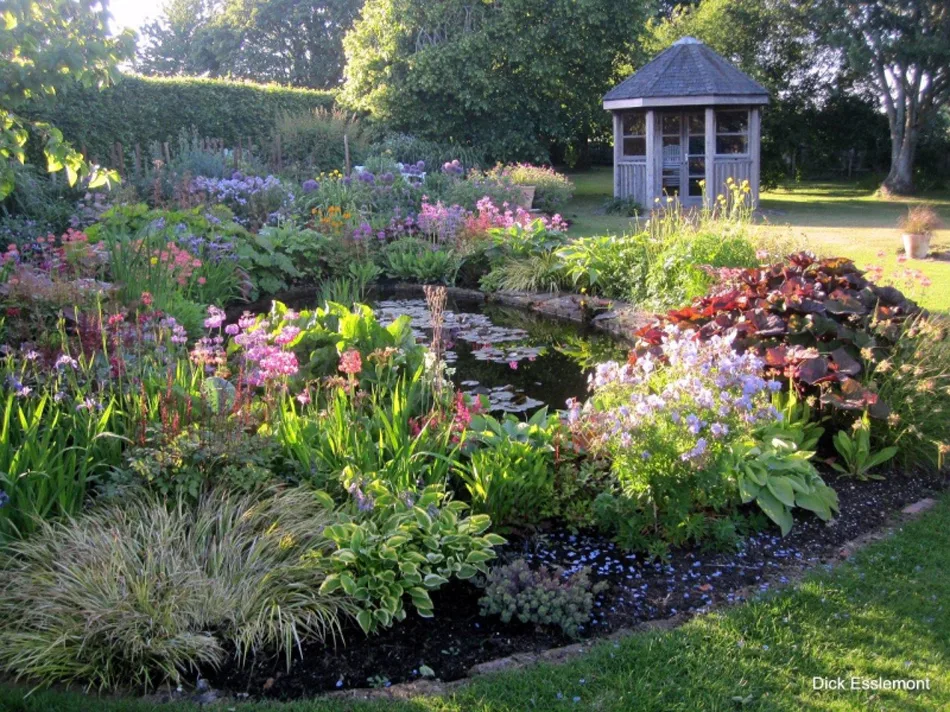
Two beautiful Dorset gardens will open their gates this March as part of the National Garden Scheme. Manor Farm, Hampreston (BH21 7LX) has been nurtured by three generations of the Trehane family for over a century.
The gardens at Manor Farm, Hampreston near Wimborne
With classic herbaceous borders, rose beds and a bog garden, it’s a spring highlight – and due to feature in The English Garden magazine this June. Open Sat 28th Feb (10am–1pm) and Sun 1st Mar (1–4pm). £7 entry, children free. Excellent plants for sale, including hellebores. The Old Vicarage, East Orchard (SP7 0BA) offers a 1.7-acre winter garden full of snowdrops, crocus and bulbs, plus a wildlife garden, grotto and Dorset’s first swimming pond. Open Fri 13th and Sun 15th Mar (from 2pm). £5 entry, children free. Home-made teas available, including gluten-free and vegan options. More info: ngs.org.uk
The BV community news section is sponsored by Wessex Internet
If you’ve ever looked at The Exchange listings and thought ‘nothing there for me’, how about looking again? Yes, there are music shows, but a wide variety – see below – and there is much more on offer. Between now and Easter, in no particular order, you will find brilliantly irreverent cabaret, a British screen legend in conversation, a 60s rock tribute band, the best of Dorset culture in word and song, and a great blend of folk and gypsy music from Eastern Europe. Plus a cake concert by musicians from the Bournemouth Symphony Orchestra.
Cabaret with Balls was scheduled for performance on 29th January – Storm Chandra gave all those who didn’t get a ticket in time a second chance. Charlie Bicknell, a cabaret and circus performer who starred in Ben Elton’s West End hit ‘Popcorn’ is performing with Louise Innes, a versatile mezzo soprano who made her Royal Opera debut in 2010. From Flashdance to Simon and Garfunkel via AC/DC and a throw-back to Not the Nine O’Clock News. The show is a brilliantly irreverent escape from reality, full of surprises, humour, and outrageous fun (age 16+). Edward Fox is one of Britain’s most distinguished screen and stage actors, who has acted with many of the great names of the last five decades. In discussion with the celebrated theatre director and raconteur Richard Digby Day, Edward will share anecdotes from his glittering career, including The Day of the Jackal, Edward and Mrs Simpson and A Bridge Too Far. Ask questions and hear first-hand stories from a national treasure. The annual celebration of Dorset culture centred on William Barnes, born and brought up near Sturminster Newton, mixes his iconic dialect poetry with authentic local music delivered by the Ridgeway Singers and Band, and a delicious cream tea. If you want to know what Dorset means to Dorset folk, this joyous event is for you – but book quickly, there are very few tickets left. You don’t need a ticket for the producers’ market in The Exchange from 11am on the same day.
Alice – The Sounds of Smokie sees five talented musicians and vocalists performing all of Smokie’s hits (if you’re of a certain age, Living Next Door to Alice will just have immediately come to mind). There will be more 60s classics in the show, and audience participation is guaranteed. The Budapest Café Orchestra are no strangers to Dorset. Led by the award winning and outrageously talented Chris Garrick, an orchestra of four brings an evening of folk-based music from eastern Europe – a description which doesn’t start to cover the range of musical delights they will set out. These musicians have worked with Cleo Laine, Nigel Kennedy, Luciano Pavarotti, Dolly Parton … and they are very funny. Don’t miss a treat. Another date for the diary is April 11th, when an open day will tell and show you even more of what The Exchange in Sturminster offers to the whole of North Dorset in 2026. Pick up a brochure or visit The Exchange website for dates and to see what else is on. stur-exchange.co.uk
The BV community news section is sponsored by Wessex Internet
Love Stur A new community initiative, Love Stur, is launching to shine a spotlight on the people, passion and connections that make Sturminster Newton’s local economy thrive. The initiative is designed to celebrate not just individual businesses, but the strong network of relationships that keeps the town vibrant and resilient. ‘Love Stur is about people supporting people,’ said a spokesperson for the initiative. ‘By giving local businesses a platform to not only share their own stories but also to highlight other businesses they value, we’re encouraging residents to shop local and strengthening the sense of community that makes Sturminster Newton special.’
Features will be shared weekly through local social media channels, creating an ongoing series that introduces residents to familiar faces and hidden gems across the town. From independent retailers and service providers to charities and community organisations, Love Stur aims to be inclusive and representative of the full range of local enterprise. The initiative hopes to inspire residents to discover new places, revisit old favourites, and continue supporting local businesses whenever possible. For more information or to express interest in taking part, please contact Lee Cooper on [email protected]
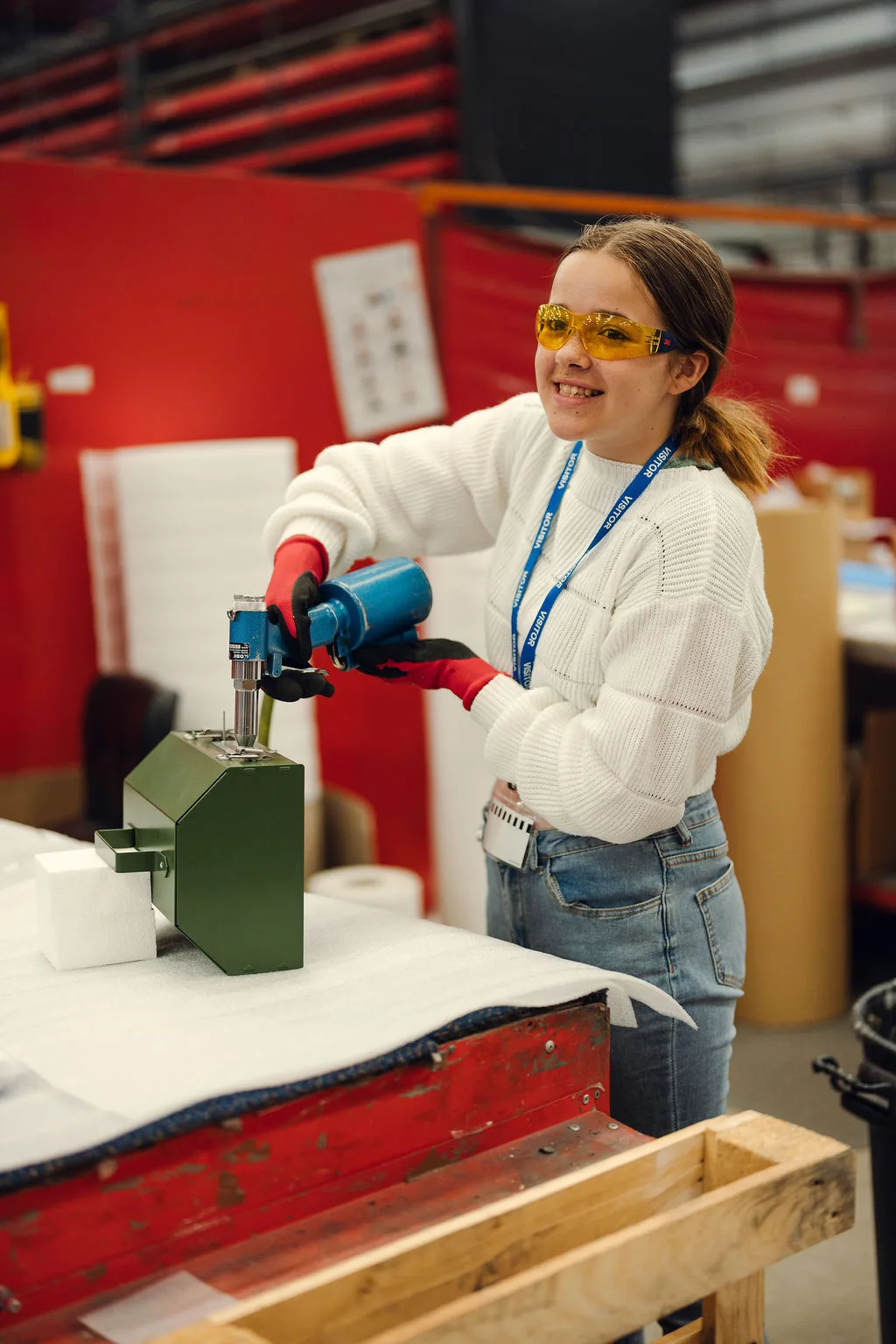
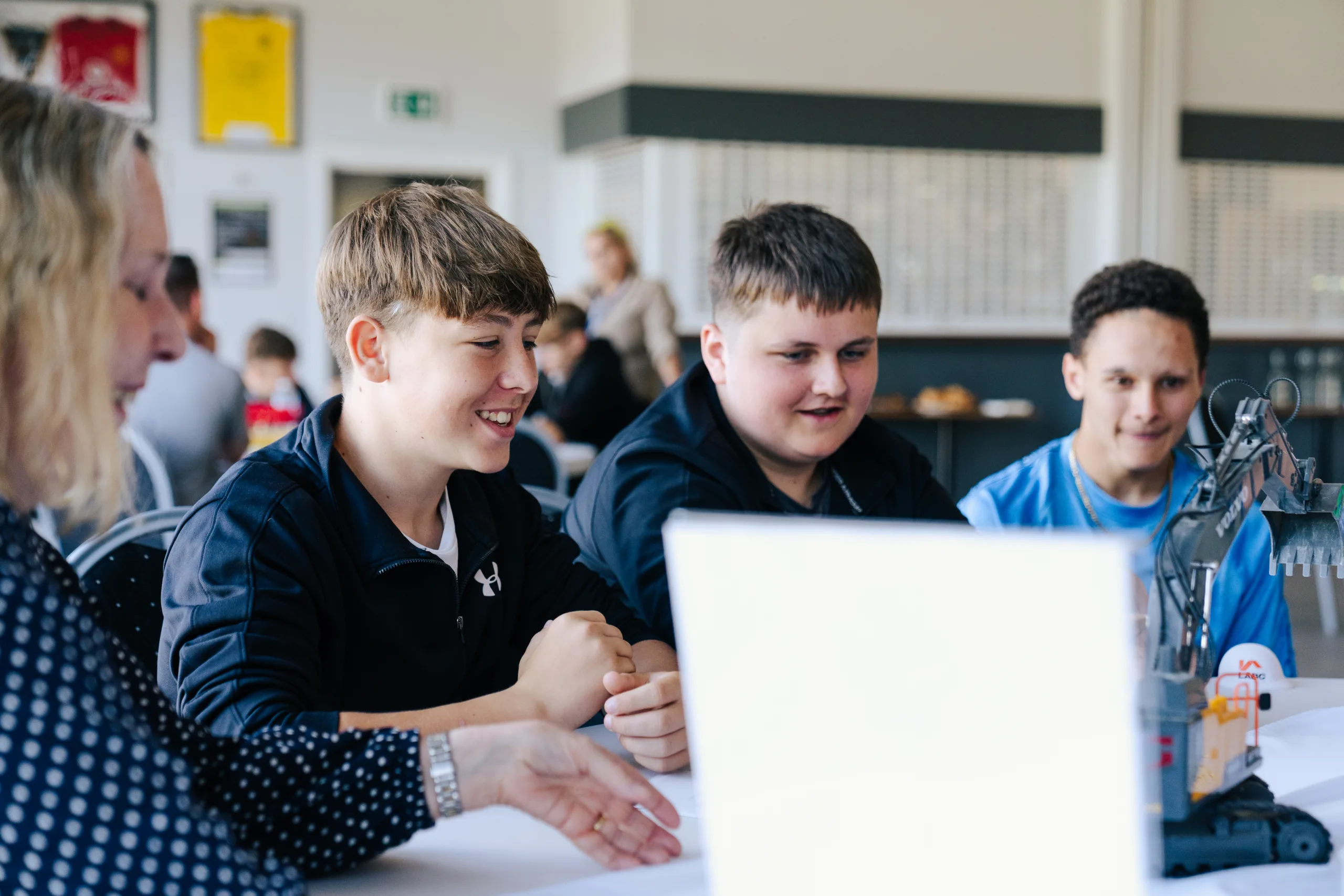
North Dorset Skills Fair Dorset Careers Hub is bringing careers to life with the launch of the North Dorset Skills Fair on Wednesday 4 March 2026 at The Exchange. The interactive event will connect Key Stage 3 students with local employers through hands-on workshops, showcasing real-world skills, careers, and progression routes including apprenticeships and technical pathways – helping inspire the workforce of the future.
There will be hands-on workshops for Key Stage 3 students at the North Dorset Skills Fair
Tea with William Barnes at The Exchange has become an annual highlight in Dorset’s cultural calendar – a much-loved celebration marking the birthday of one of the county’s greatest literary voices. Born on 22 February 1801 at Rushay Farm, William Barnes went on to become the defining poet of Dorset, his work rooted in the language, landscape and lives of the people of North Dorset. His strong association with Sturminster Newton makes the town the perfect place to gather each year in his honour. On Sunday 22 February at 3pm, Artsreach brings together a truly Dorset celebration of song, music and verse, inspired by Barnes’ life and work. The afternoon is served, quite fittingly, with tea and cake made from locally sourced ingredients, adding a distinctly local flavour to the occasion. Before the performance, visitors can enjoy the return of the pop-up market, running from 11am to 3pm, showcasing a range of Dorset artisan-made produce – ideal for browsing, gifting or simply treating yourself. The event also links perfectly with Sturminster Newton Walkabout Leaflet No. 9 – the Literary Trail, encouraging visitors to explore the town’s rich literary connections. For those keen to stretch their legs, the nearby North Dorset Trailway offers accessible walks on firmer ground, away from the winter-wet fields, making it a great option for a seasonal stroll before or after the festivities. With poetry, music, local food and a strong sense of place, Tea with William Barnes continues to be a fitting tribute to Dorset’s most cherished poet – and a date to look forward to each February.
Stur LitFest Looking ahead, Tea with William Barnes also offers a first glimpse of Sturminster Newton literary connections for 2026, especially the Sturminster Newton Literary Festival, running from Friday 12th June to Sunday 21st June 2026. The festival will celebrate literature, place and creativity, building on the town’s deep connections to writers, poets and storytellers past and present. Programme details will be available soon on their website sturlitfest.com. The SNADS Panto SNADS are flapping back into action with the pantomime favourite Mother Goose, landing Wednesday to Saturday, 11th to 14th February! Follow Mother Goose as she chases riches, beauty and happiness (behind you!!) and learns a few life lessons along the way. Expect booing, cheering, singing, dancing, daft jokes and plenty of audience fun! It’s fast, funny and family-friendly, with laughs for little goslings and grown-up geese alike. Don’t miss it – book your tickets now and join us for a feather-ruffling, giggle-filled panto spectacular!
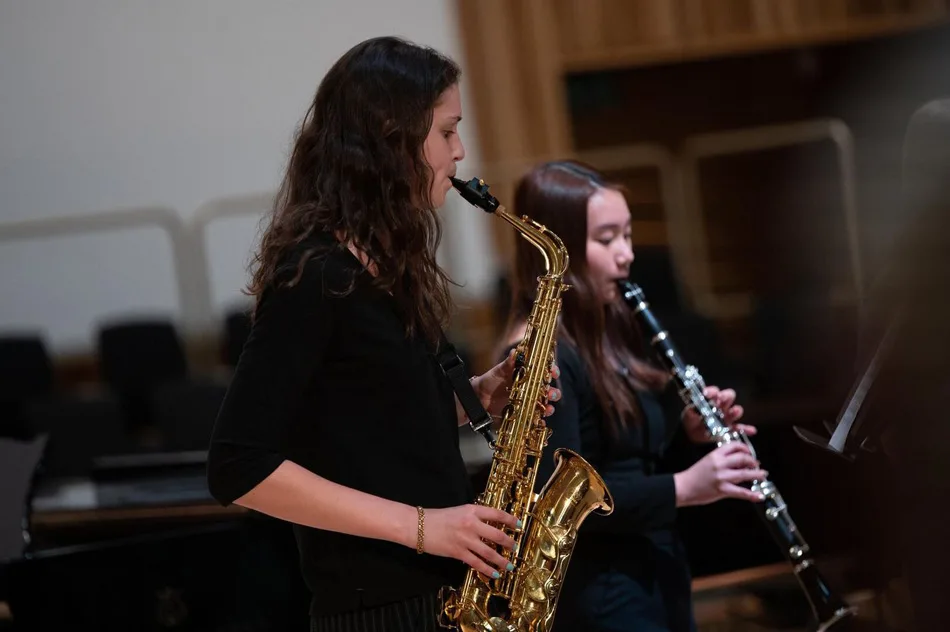
After a pandemic-enforced pause, Sherborne Douzelage is delighted to announce the return of its Young Musicians Competition on Friday 14th February 2026.
The event will take place at the Gransden Hall, The Merritt Centre, Sherborne Girls School, and is held in collaboration with all schools across the Sherborne area. Alongside local entrants, this year’s competition will also welcome a small number of young musicians from Sherborne’s Douzelage twin towns across Europe, promising an engaging and inspiring musical gathering. Finalists will perform in an evening concert, with the overall winner invited to appear at the Sherborne Abbey Music Festival in May. All young musicians in the Sherborne area are encouraged to apply. To register your interest, please contact Dr Rachel Milestone at: [email protected]
The BV community news section is sponsored by Wessex Internet